INTRODUCTION
Although usually neglected, parasites represent 30–50% of known biodiversity (De Meus and Renaud, Reference De Meeus and Renaud2002), thus being crucial to ecosystem health and food web stability (Hudson et al. Reference Hudson, Dobson and Lafferty2006). Moreover, they may mould community and population structure of hosts (Poulin, Reference Poulin1999; Albon et al. Reference Albon, Stien, Irvine, Langvatn, Ropstad and Halvorson2002). One of the main properties of host–parasite relationships is the aggregated distribution of parasites within host populations, which was theoretically pointed out by Crofton (Reference Crofton1971) and first evidenced by Anderson and May (Reference Anderson and May1979), with few hosts carrying large loads of parasites and being responsible for the majority of transmissions and the persistence of parasite populations (Lloyd-Smith et al. Reference Lloyd-Smith, Schreiber, Kopp and Getz2005; Sanchez et al. Reference Sanchez, Devevey and Bize2011). Such pattern is caused by differential host's exposure and susceptibility to parasites (Combes, Reference Combes2001) as well as parasite population dynamics and environmental factors (Thomas et al. Reference Thomas, Guégan and Renaud2009). Host attributes related to exposure to parasites are home range size (Morand et al. Reference Morand, Bellocq, Stanko and Miklisova2004), population density (Arneberg et al. Reference Arneberg, Skorping, Grenfell and Read1998) and body size (Harrison et al. Reference Harrison, Scantlebury and Montgomery2010). On the other hand, host behaviour, sex (Krasnov et al. Reference Krasnov, Morand, Hawlena, Khokhlova and Shenbrot2005) and genetics (Meyer-Lucht et al. Reference Meyer-Lucht, Otten, Püttker, Pardini, Metzger and Sommer2010) may influence host susceptibility, thus affecting parasite infestation among individuals. Hence, one of the most discussed issues in epizootiological studies is the identification of host attributes driving infection dynamics and the implications of heterogeneities in parasite infestation for host population structure and regulation.
Due to physiological, behavioural and ecological differences between males and females, parasitism is usually gender-biased in several vertebrate taxa, with males generally carrying larger loads of parasites than females (Moore and Wilson, Reference Moore and Wilson2002), although few studies demonstrated contrary patterns (Dare and Forbes, Reference Dare and Forbes2009). Several hypotheses, which are not mutually exclusive, have been proposed to explain this pattern. The first one is based on sexual size dimorphism in vertebrates, mostly mammals. Usually, individuals with larger body size are easier targets for parasites (Shine, Reference Shine1989) and may sustain higher parasite loads, due to the amount of habitat and resources when compared with small-bodied individuals (Krasnov et al. Reference Krasnov, Morand, Hawlena, Khokhlova and Shenbrot2005). Secondly, males’ larger home ranges may increase their probability of encountering and being infected by parasites (Morand et al. Reference Morand, Bellocq, Stanko and Miklisova2004). The last hypothesis deals with differential susceptibility between sexes and states that males present higher parasite loads due to the immunosuppressive effects of androgens, especially testosterone, which makes males more prone to infections (Folstad and Karter, Reference Folstad and Karter1992; Klein, Reference Klein2004).
Parasite burdens may also vary seasonally, due to climate influencing parasite populations and infection dynamics (Altizer et al. Reference Altizer, Dobson, Hosseini, Hudson, Pascual and Rohani2006) or due to seasonal events linked to reproduction (Sanchez et al. Reference Sanchez, Devevey and Bize2011). Several studies demonstrated an increase in parasite loads during breeding periods (Christe et al. Reference Christe, Arlettaz and Vogel2000), through the occurrence of an energetic trade-off between reproductive effort and the activation of the immune system (Sheldon and Verhulst, Reference Sheldon and Verhulst1996; Dare and Forbes, Reference Dare and Forbes2009). Not only allocation of energy to reproduction may reduce energy available for defences, but there is also evidence of a detrimental impact of high parasite loads on reproductive success (Hillegass et al. Reference Hillegass, Waterman and Roth2010). Since gestation and lactation are extremely costly among small mammals (Speakman, Reference Speakman2008), usually females present a peak in parasite burdens during these periods (Sanchez et al. Reference Sanchez, Devevey and Bize2011).
Eimeria spp. is an intestinal protozoan that infects several vertebrate hosts, including fish, reptiles, birds and mammals. It is directly transmitted, through ingestion of contaminated food or by oral/fecal contact. One of their hosts are didelphid marsupials, which comprise approximately 90 species (Voss and Jansa, Reference Voss and Jansa2009), ranging from 10 to 2000 g and occupying a variety of ecological niches. Gracilinanus agilis is a small (8–36 g), nocturnal marsupial, which consumes mainly insects and occasionally fruits (Lessa and Costa, Reference Lessa and Costa2010). In the study site, the number of captured individuals was higher between June and October (Lopes and Leiner, Reference Lopes and Leiner2015). Breeding season started in July, and females raise and wean one to two litters between October and February, while adult males disappear between October and December, characterizing post-mating male die-off (Lopes and Leiner, Reference Lopes and Leiner2015). These males presented several signs of reduced body condition prior to disappearance, such as fur loss and wounds. On the other hand, adult females disappear from the population between January and February, thus resulting in discrete generations and characterizing the adoption of a semelparous breeding strategy (Lopes and Leiner, Reference Lopes and Leiner2015). Hence, our main objective was to evaluate the effect of host attributes (sex, breeding status and body mass) and seasonality on Eimeria spp. infestation within G. agilis individuals. We hypothesized that (1) abundance of Eimeria spp. is gender-biased, with males presenting higher degree of parasitism than females, (2) breeding individuals present higher Eimeria spp. loads and increased Eimeria spp. prevalence than non-breeding individuals, especially breeding males and lactating females, (3) individuals with higher body mass present higher Eimeria spp. abundance and (4) Eimeria spp. abundance and prevalence vary seasonally, with higher values during the wet season.
MATERIALS AND METHODS
Gracilinanus agilis individuals were captured at Estação Ecologica do Panga (19°09′20″–19°11′10″S e 48°23′20″–48°24′35″W, MG), a 409·5 ha cerrado fragment in the south region of Uberlândia municipality, Minas Gerais state. Climate in the area is characterized by a dry winter from April to September and a wet summer from October to March. Every month, from May 2011 to June 2012, 70 Sherman traps, baited with a mixture of banana, peanut butter, bacon and oatmeal, were set during four consecutive nights, in a capture grid of 0·96 ha, which had five parallel transects separated by 20 m. In each 120 m transect, there were seven trapping stations separated by 20 m, with one trap on the ground and one trap placed in a tree branch (approximately 2·0 m) in each station. In July 2012, we added another 120 m transect and an additional capture station at each transect; totalling 96 Sherman traps set in six parallel transects separated by 20 m. Captures were done in this new capture grid until May 2013. The grid is part of a long-term capture–mark–recapture study and is located in a cerrado stricto sensu area, containing a sparse arboreal stratum and herbaceous cover dominated by Miconia albicans (Cardoso et al. Reference Cardoso, Moreno, Bruna and Vasconcelos2009).
Captured individuals were marked with numbered ear-tags and had their sex, age class, breeding status and body mass recorded. From each captured individual, feces were collected, stored in small plastic recipients and frozen prior to analysis. Age class was estimated following Macedo et al. (Reference Macedo, Loretto, Vieira and Cerqueira2006), who proposed a method based only on the eruption of the last superior molars. In this way, those individuals presenting only the first and second fully functional superior molars (P3/M1 or M2) were considered juveniles, those with the third superior molar fully functional were considered sub-adults (P3/M3) and individuals with complete dentition (P3/M4) were considered adults. Breeding status was divided into three categories: non-breeding, early breeding (mating males and females, and pregnant females) and late breeding (males preceding die-off and lactating/weaning females). Non-breeding individuals were mostly juveniles and subadults, with males presenting abdominal testis (smaller than 10 × 13 mm2), and females presenting unperforated vagina. Early breeding subadult and adult males presented scrotal testis (larger than 10 × 13 mm2) and females presented perforated vagina and signs of gestation (indicated by palpation). Individuals belonging to late breeding periods were adults captured from October to February. In this period, males presented signs of debilitation (fur loss and wounds) and most females were lactating or weaning their young, although a few non-breeding juveniles of both sexes were also captured. Moreover, this period preceded adult disappearance from the population (Lopes and Leiner, Reference Lopes and Leiner2015).
Ethics statement
Fieldwork carried out at Estação Ecológica do Panga, a research station administered by Universidade Federal de Uberlândia, was conducted after approval of Universidade Federal de Uberlândia. Permission to trap and handle Didelphidae was issued by SISBIO/ICMBio (Brazil) to Natalia Leiner (Permit Number: 22629-1) and all trapping and handling of didelphids agreed with the ethical principles on animal research as regulations of National Advice of Control and Animal Experimentation (CONCEA/Brazil). The protocol was approved by the Ethics Committee on Use of animals of the Federal University of Uberlândia (Permit Number: 152/13). Neither endangered nor protected species were sampled during this research.
Parasitological examinations
Gastrointestinal parasites were assessed through analysis of G. agilis fecal samples. The number of Eimeria spp. oocysts per gram of feces (EPG) was evaluated using the McMaster technique (Gordon and Whitlock, Reference Gordon and Whitlock1939), which dilutes the fecal samples into a very dense sodium chloride solution in order to allow flotation of eggs/oocysts. Only samples weighing more than 0·3 g were analysed. Then, oocysts were counted under a light microscope (Leica DM500, magnification 100x). Fecal egg count is a non-invasive method, allowing proper evaluation of prevalence and intensity of infection, being widely used in wildlife populations and field studies (Meyer-Lucht et al. Reference Meyer-Lucht, Otten, Püttker, Pardini, Metzger and Sommer2010; Viljoen et al. Reference Viljoen, Bennet, Ueckermann and Lutermann2011).
In order to avoid underestimation of prevalence, due to the decreased effectiveness of fecal egg counts according to reduced parasite burden, along with EPG analysis, several drops of each diluted sample were coloured with lugol and reanalysed under a light microscope (Leica DM500, magnification 400) to allow a qualitative evaluation of parasite presence. In this way, individuals were considered infected or not based on the combination of the qualitative and quantitative analysis. Moreover, fecal samples weighing less than 0·3 g were also qualitatively evaluated, since it was not possible to apply the McMaster technique.
Fresh feces belonging to individuals positive for Eimeria spp. oocysts according to the McMaster technique were collected and directly placed into 2·5% aqueous potassium dichromate solution (K2Cr2O2), in order to allow proper identification of oocysts to genus level. Upon return to the laboratory, the fecal-dichromate solution was placed in a Petri dish and maintained in a thermostatically controlled incubator at 27 °C for approximately 5 days (Duszynski and Wilber, Reference Duszynski and Wilber1997), allowing oocysts to sporulate. Sporulated oocysts were observed under a light microscope (Leica DM500, magnification 400) and identified as Eimeria spp. (Fig. 1) according to the presence of four sporocysts, each containing two sporozoites (Duszynski and Wilber, Reference Duszynski and Wilber1997).
Sporulated (A) and unsporulated (B) oocysts of Eimeria spp. (Apicomplexa: Eimeriidae) infesting G. agilis (Didelphimorphia: Didelphidae) in the Estação Ecologica do Panga. Scale bar 10 μm.

Data analysis
The discrepancy index (D) was used to evaluate the distribution of Eimeria spp. parasites among hosts. This index quantifies the aggregation as a departure from a uniform distribution, in which all hosts are equally infested (Poulin, Reference Poulin1993). In this way, D varies between 0 and 1, the latter corresponding to maximum overdispersion, with only one host harbouring all parasites. In order to estimate prevalence of Eimeria spp. for each sex, we pooled fecal samples into three groups, for males and females separately: non-breeding, early breeding (mating and female gestation)/dry season and late breeding (lactating females and males preceding die-off)/wet season. Each individual was assigned as positive for Eimeria spp. if a single fecal sample inside the evaluated group was positive and as negative if none of the fecal samples were positive.
Data analysis was performed using generalized linear mixed models (GLMM), which is an increasingly widespread method in epidemiological studies dealing with longitudinal or correlated data, particularly when they are binary or in the form of counts. GLMM were used to examine the separate effects of sex, breeding status, climatic season and body mass on G. agilis parasite loads. The advantages of using this statistical procedure include the incorporation random effects and handling of non-normal distributions, such as exponential family distributions by using log-link functions. A set of different models were fitted using a negative binomial distribution and a log-linear link function for abundance of Eimeria spp. Random effects were incorporated, due to repeated measures from the same individuals. Hence, specific effects of covariates and factors (fixed effects) were tested while accounting for the variance explained by potentially confounding variables, which are included as ‘random variables’. Sex, breeding status and climatic season (wet × dry season) were included in both models as categorical, fixed predictors, while body mass was added as a continuous predictor. Breeding status was assigned into three categories: non-breeding, early breeding (mating males and females, and pregnant females) and late breeding (males preceding die-off and lactating/weaning females). Although late breeding periods and the wet season extensively overlapped, GLMM allows investigation of the separate effects of each variable. Moreover, during the dry season, breeding status varied from non-breeding to early breeding, and throughout the wet season we were able to capture not only late breeding individuals, but also newborn and juveniles from both sexes, which were considered as non-breeding individuals in the wet season.
Analyses were carried out in R 3·1 (R Development Core Team, 2008), using the statistical package glmmADMB. This package estimates GLMM parameters (fixed-effects and random-effects parameters, such as effects of each variable, differences among treatments, standard deviation of random effects and all interactions) by Laplace approximation, which reduces bias in estimation and is considered more accurate (Bolker et al. Reference Bolker, Brooks, Clark, Geange, Poulsen, Stevens and White2008). After running and checking parameter estimates for each model, models were ranked according to Akaike's information criterion corrected for small samples (AICc, Burnham and Anderson, Reference Burnham and Anderson2002). AICc is essentially AIC with a greater penalty for extra parameters, thus reducing the probability of selecting models with too many variables when the number of samples (n) is small or the number of parameters (k) is too large. The formula used for estimating AICc was as proposed by Burnham and Anderson (Reference Burnham and Anderson2002): AICc = AIC + (2k(k + 1)/n – k − 1). Models with lowest AICc values (difference lower than 2 from other models) were selected as the most parsimonious, and their significance was assessed by comparing it to a null model (containing only the response variable and the random-effect) through analysis of variance.
RESULTS
From May 2011 to May 2013, 98 individuals of G. agilis (66 males and 32 females) were captured at the study site with a total of 381 recaptures, through a sampling effort of 7600 trap-nights (3640 from May 2011 to June 2012 and 3960 from July 2012 to May 2013). Twenty-nine individuals were captured only once, whereas 69 individuals were recaptured from 2 to 17 different times. A total of 441 fecal samples were assessed for Eimeria spp. prevalence, which were pooled into 107 samples in order to count each individual only once at each different breeding status/climatic season. On the other hand, 410 fecal samples allowed an estimation of Eimeria spp. abundance, with each individual being analysed between one and seventeen times, due to the possibility of recaptures during the same trapping session and between sessions.
Eimeria spp. presented an overdispersed distribution among hosts (D values = 0·97), with most hosts presenting few or no endoparasites, while a few individuals were highly infested. Such a pattern, which is extremely common in host–parasite relationships, supports our view that endoparasite abundance varies within the G. agilis population and that individual attributes and/or environmental characteristics should influence infection dynamics in the study site. Based on 107 fecal samples, both sexes presented similar prevalence (83·3% of males infected with Eimeria spp. oocysts, and 84·4% of females, N = 55 males and 27 females). Prevalence peaked during late breeding, which partially corresponded to the wet season, with approximately 82% (N = 14) of males and 79% (N = 11) of females infected by Eimeria spp. During the dry season, prevalence of non-breeding males (48·2%, N = 6) and females (39·1%, N = 9), and early breeding males (47·8%, N = 11) and females (50%, N = 6) were considerably lower. Considering only pooled recaptures of the same individuals at different breeding status (N = 39), it was possible to observe that 36% (N = 14) of the individuals were uninfected during the dry, non-breeding season, and then became infected during the early breeding/dry season and especially during late breeding/wet season, while only 5% of the individuals (N = 2) followed a different, contrary pattern. However, it is important to notice that those two individuals were captured only once at each breeding status. Finally, most individuals (59%, N = 23) remained positive or negative for the presence of Eimeria spp., irrespective of their breeding status.
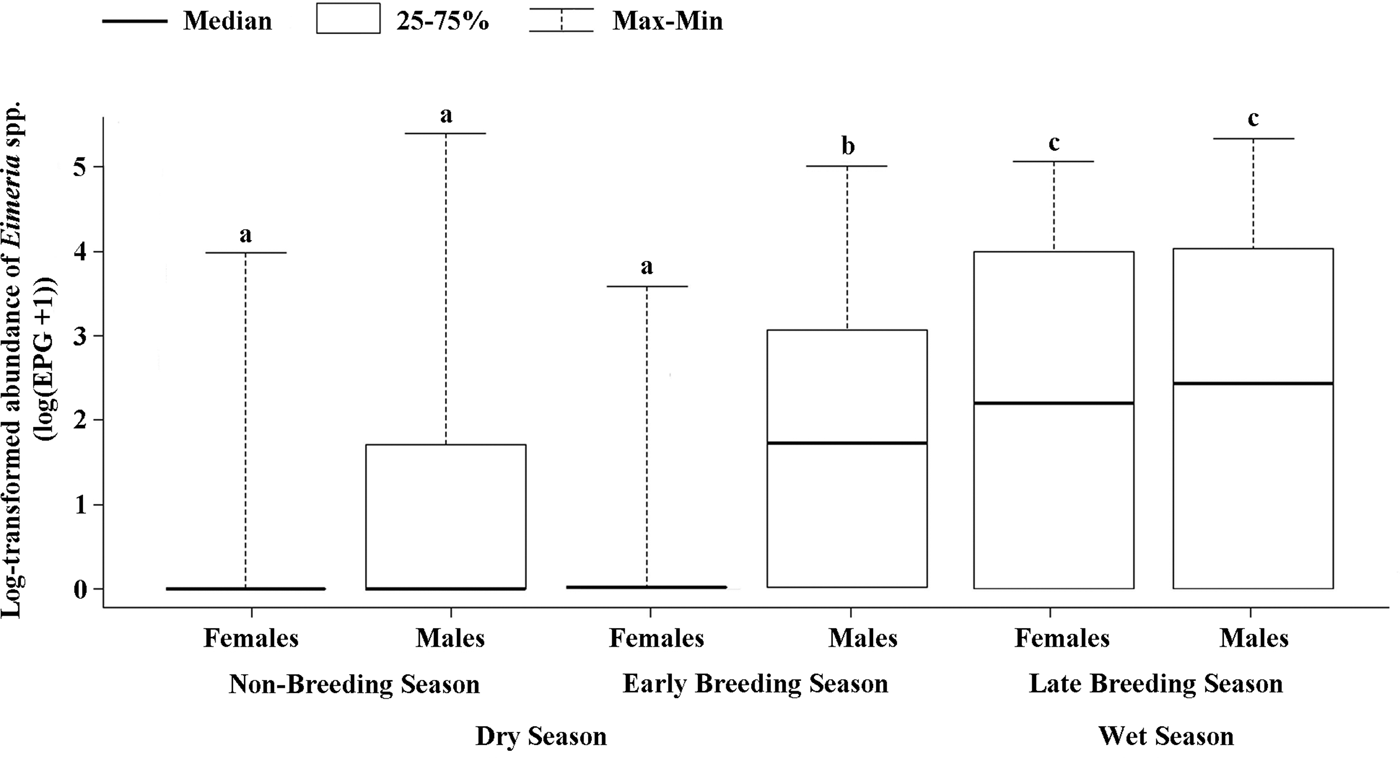
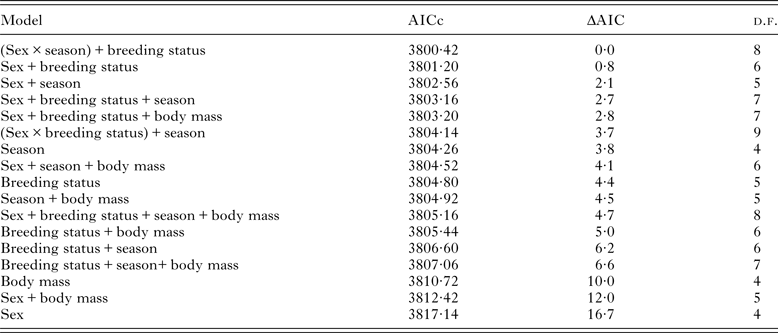
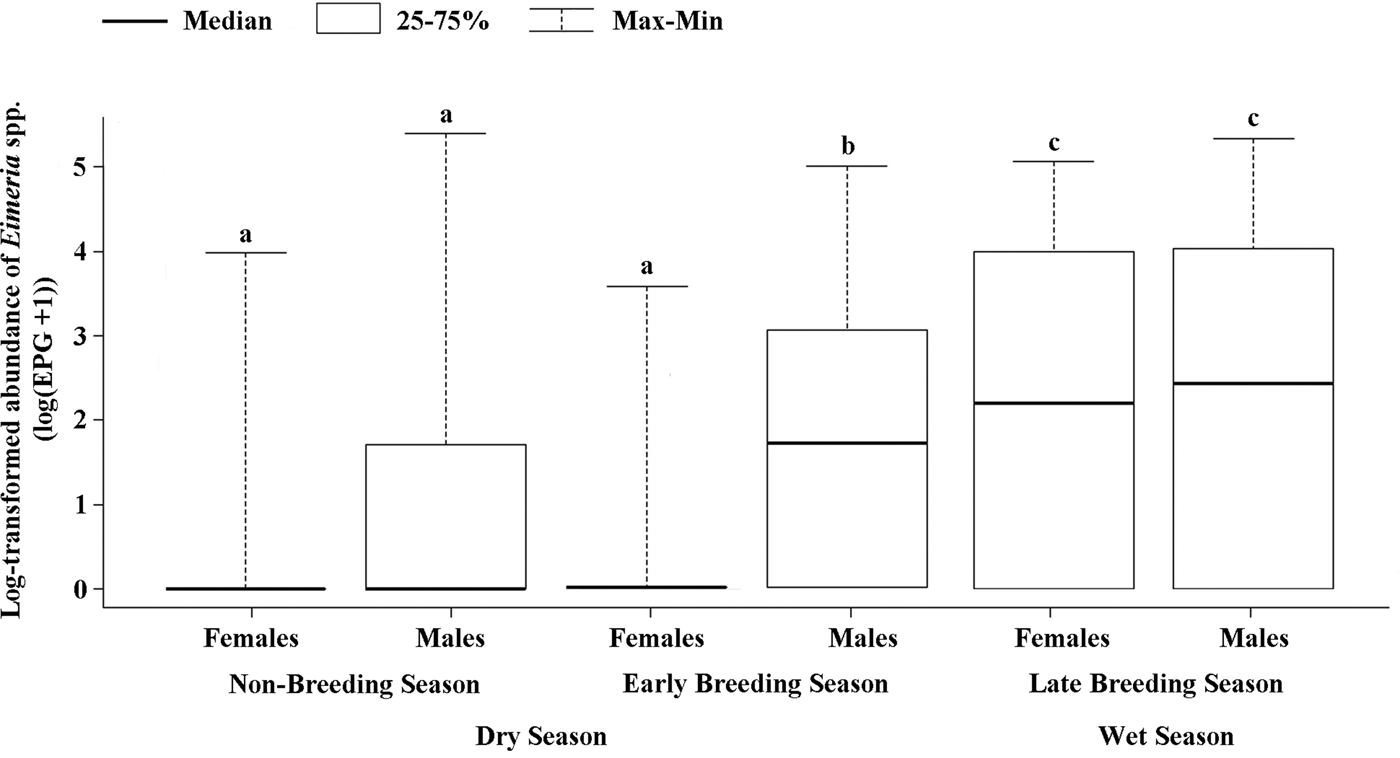
Model selection showed that abundance of Eimeria spp. was influenced by the sex, season and breeding status of G. agilis individuals (Table 1). In the best model, males presented higher Eimeria spp. loads than females during the dry season, whereas individuals of both sexes presented similar abundance of Eimeria spp. during the wet season, which corresponded to the late breeding period (X 2 = 25·88, P < 0·00009). Actually, during the wet/late breeding season, both males and females presented greater infestation by Eimeria spp. when compared to non-breeding males/females and early breeding individuals (Fig. 2). On the other hand, during the dry season, mating males presented higher Eimeria spp. loads than mating females, while non-breeding individuals presented similar, low Eimeria spp. loads (see Fig. 2). Since differences in AICc values greater than two were considered as the limit to distinguish models (Burnham and Anderson, Reference Burnham and Anderson2002), then the model including sex and breeding status should also be included as a parsimonious candidate. In this model, males presented greater Eimeria spp. loads than females, and both sexes increased their infestation during late breeding when compared to the other two periods (X 2 = 21·1, P = 0·0001).
Eimeria spp. (Apicomplexa: Eimeriidae) abundance (log(EPG+1)) according to G. agilis (Didelphimorphia: Didelphidae) sex, breeding status and season in the Estação Ecologica do Panga, from May 2011 to May 2013. Different letters indicate significant differences between evaluated categories.
Summary of GLMM results, evaluating the negative binomial models responsible for explaining Eimeria spp.(Eimeriidae) abundance in G. agilis individuals at Estação Ecológica do Panga, from May 2011 to May 2013
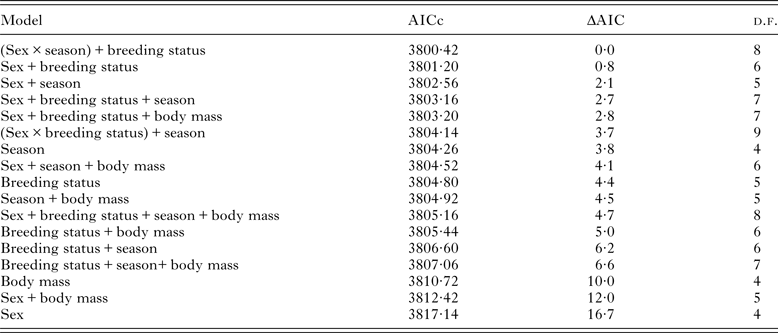
AICc, Akaike's Information Criterion value corrected for small sample size; Δi, value difference between the most parsimonious model i. Models are ranked according to their AICc value.
DISCUSSION
Male-biased parasitism is a widespread phenomenon in small mammals (Krasnov et al. Reference Krasnov, Bordes, Khokhlova and Morand2012). As expected, we found higher Eimeria spp. loads in G. agilis males than females; however, this trend disappeared during the wet season, which overlapped with the late breeding period in both sexes. In this way, the first hypothesis was not supported by our data, since the influence of sex on parasite burden varied seasonally, according to climate and breeding status. Usually, males present higher parasite loads than females, due to increased exposure to parasites via larger home ranges (Krasnov et al. Reference Krasnov, Morand, Hawlena, Khokhlova and Shenbrot2005) and body mass, which could help to support a higher amount of parasites (Harrison et al. Reference Harrison, Scantlebury and Montgomery2010), and increased susceptibility due to the immunosuppressive effects of androgen hormones (Klein, Reference Klein2004).
Contrary to one of the predicted hypothesis, our study population failed to demonstrate a relationship between body mass and heterogeneities of Eimeria spp. loads among G. agilis. However, a previous study reported heavier males than females throughout their lifetimes (Lopes and Leiner, Reference Lopes and Leiner2015). According to Harrison et al. (Reference Harrison, Scantlebury and Montgomery2010), the effects of body mass and sex are often confounded in analyses of mammalian mating systems when males are larger than females. In their study, by controlling the difference in body mass between sexes, they found no effect of sex, suggesting that sexual size dimorphism was responsible for the gender-biased parasitism. However, this seems not to be the case in the studied G. agilis population, once models including body mass presented very weak support in the analyses. Moreover, while the degree of sexual size dimorphism, estimated by male:female body mass ratios, was maintained during G. agilis lifecycle (see Lopes and Leiner, Reference Lopes and Leiner2015), our results demonstrated that differences in parasitism between sexes varies according to their breeding status and the climatic season.
The heterogeneities in Eimeria spp. abundance among G. agilis individuals may be associated with the spatial behaviour of males and females. Slightly higher parasite burden in non-breeding males when compared to females could be due to larger male mobility and female territorial behaviour in G. agilis (Lopes, Reference Lopes2014). We suggest that such space use patterns could increase male exposure to parasites and the probability of encountering new foci of infection through overlapping male ranges, while female territoriality could protect them from parasites. In the breeding season, due to the polygynous/promiscuous mating system of didelphids, usually males increase their home range, in order to maximize mating opportunities (Ryser, Reference Ryser1992). Gracilinanus agilis males follow the same pattern, with an increased overlap between male ranges during the breeding period, while females maintain exclusive areas, overlapping only with males (Lopes, Reference Lopes2014). By travelling greater distances, G. agilis males in Neotropical savannahs consume more insects than females (Martins et al. Reference Martins, Bonato, Pinheiro and Reis2006, Camargo et al. Reference Camargo, Ribeiro, Camargo and Vieira2014), which might expose them to Eimeria spp. infestation. Such spatial organization of individuals could be responsible for larger parasite loads within males, which has already been demonstrated in rodents infested by fleas (Krasnov et al. Reference Krasnov, Morand, Hawlena, Khokhlova and Shenbrot2005). In fact, it is possible that males are responsible for infesting females in this period, once several females were uninfected during the non-breeding period and became infected during the breeding period (approximately 54% of the females, while 45% remained positive or negative for infection, irrespective of the period). Moreover, females’ smaller ranges combined with exclusive areas could create foci of infection, which could be picked up by several males. Hence, based on our findings it is possible that males encounter a high number of parasites and may act as important links, as spreaders of infection between infected and susceptible hosts, as already pointed out by Ferrari et al. (Reference Ferrari, Cattadori, Nespereira, Rizzola and Hudson2004). In fact, immune responses, social behaviour and host susceptibility determine not only parasite loads, but also transmission heterogeneities (Wilson et al. Reference Wilson, Bjornstad, Dobson, Merler, Poglayen, Randolph, Read, Skorping, Hudson, Rizzoli, Grenfell, Heesterbeek and Dobson2001; Altizer et al. Reference Altizer, Nunn, Thrall, Gittleman, Antonovics, Cunningham, Dobson, Ezenwa, Jones, Pedersen, Poss and Pulliam2003), with usually males being pointed out as drivers of population-level infection rates in small mammals (Ferrari et al. Reference Ferrari, Cattadori, Nespereira, Rizzola and Hudson2004; Luong et al. Reference Luong, Grear and Hudson2009).
An alternative explanation for the male-biased parasitism during the dry season is the reduced immunocompetence of males due to androgen and stress hormones that suppress the immune function (Klein, Reference Klein2004). Although the role of both hormones in increased parasite burden, due to their immune suppressive effect, has been extensively debated in several taxonomic groups (Owen-Ashley et al. Reference Owen-Ashley, Hasselquist and Wingfield2004; Roberts et al. Reference Roberts, Buchanan and Evans2004, Reference Roberts, Buchanan, Hasselquist and Evans2007), most studies have found conflicting results (Evans et al. Reference Evans, Goldsmith and Norris2000; Fuxjager et al. Reference Fuxjager, Foufopoulos, Diaz-Uriarte and Marler2011; Ezenwa et al. Reference Ezenwa, Ekernas and Creel2012). Within the G. agilis population, both hormones might play a role in the observed male-biased parasitism during early breeding season. Hence, we suggest that male-biased parasitism is linked to male spatial patterns and greater insect intake that increase their exposure, and both hormones that add-up to the other factors, contributing to the higher Eimeria spp. loads of males when compared with females during the early breeding season. Nevertheless, in order to understand the role of stress hormones (corticosterone) and testosterone on immune response and parasite infestation in G. agilis, future studies should experimentally evaluate the role of these key interacting hormones and track physiological changes and their associated alterations in parasitism among didelphids.
Finally, while parasitism was male-biased during the dry season, our results demonstrated that both sexes experienced an increase in parasite infection during late breeding/wet season, although female suffered an abrupt peak in Eimeria spp. abundance, catching up to male loads in this period. Energetic costs associated with growth and breeding may contribute with increased parasite burden (Sheldon and Verhulst, Reference Sheldon and Verhulst1996), due to the limited amount of energy available to invest in these activities and in the activation of the immune system. The rapid increase in female infestation indicates a greater cost of reproduction during late breeding for females when compared to males. A similar finding was found for northern leopard frogs infested by Rhabdias ranae (Dare and Forbes, Reference Dare and Forbes2009). Among marsupials, lactation may lead to negative energy balance, compromising the amount of energy allocated to other life-history components (Fisher and Blomberg, Reference Fisher and Blomberg2011). Hence, we suggest the occurrence of a trade-off between female reproductive effort and parasite defences accounting as one of the mechanisms associated with female elevated parasite loads, a trend already demonstrated in several previous studies (Christe et al. Reference Christe, Arlettaz and Vogel2000; Sanchez et al. Reference Sanchez, Devevey and Bize2011). The adoption of a semelparous reproductive strategy among G. agilis (Lopes and Leiner, Reference Lopes and Leiner2015) highlights the greater energetic costs within late breeding females. Moreover, greater overlap between male/female ranges during breeding periods probably contributed to increased female infestation, peaking in late breeding when most females have already picked up Eimeria spp. from males. Finally, lactating females may be more exposed to Eimeria spp. infections, via increased food consumption which increases the risk of ingesting contaminated food. In fact, Camargo et al. (Reference Camargo, Ribeiro, Camargo and Vieira2014) previously demonstrated that G. agilis females increase arthropod and fruit consumption during lactation/weaning periods, due to high energetic requirements. Males also increased their parasite loads during late breeding/wet season, but only slightly when compared with females. Post-mating die-off occurring in this period among G. agilis males (Lopes and Leiner, Reference Lopes and Leiner2015) might contribute to greater parasite loads, as evidenced by several semelparous dasyurids and didelphids (Bradley, Reference Bradley, Jones, Archer and Dickman2003; Leiner et al. Reference Leiner, Setz and Silva2008). In dasyurids presenting male die-off, mortality is stress-related and is characterized by an increase in plasma glucocorticoid levels, leading to immune suppression, and diseases associated with higher parasite burdens (Bradley, Reference Bradley, Jones, Archer and Dickman2003; Naylor et al. Reference Naylor, Richardson and McAllan2008). The same trend may apply to G. agilis, although it still needs further study.
Apart from breeding costs, during the wet season, high temperatures and humidity may contribute to oocyst survival and sporulation rate (Fayer, Reference Fayer1980; Fuller, Reference Fuller1996), thus increasing the number of infective propagules in the environment. In fact, in the laboratory, oocysts were unable to sporulate in temperatures lower than 27 °C and low humidity. Unfortunately, we could not measure the number of foci of infection and of infective stages of Eimeria spp. during each climatic season. Although the effects of climatic season and breeding status were difficult to separate, especially during the late breeding/wet season, we observed that non-breeding individuals (N = 11 juveniles, totalling 20 fecal samples) captured during the wet season presented lower Eimeria spp. abundance (mean log(EPG + 1)) = 1·11, s.d. = 1·65, median = 0) than late breeding adults (mean log(EPG + 1)) = 2·24, s.d. = 1·95, median = 2·478). This finding indicates that breeding costs and the associated increase in food consumption within both sexes may play a larger part than climate on Eimeria spp. infestation among G. agilis individuals, although prevalence results suggests that vertical transmission may occur, once juveniles and late breeding adults had similar prevalence (juveniles = 55% and late breeding adults = 72%, N = 36 individuals). Finally, model selection results reinforces the importance of breeding status, rather than seasonality, affecting Eimeria spp. abundance among G. agilis individuals, once all selected models included breeding status and neither included seasonality alone. Nevertheless, as an observational study, in order to clearly extricate the combined effects of breeding costs and season, experiments in captive conditions manipulating breeding costs and climatic conditions should be applied.
In conclusion, our results demonstrate that sex-biased parasitism is not universal within a single species and that instead bias may change or disappear according to host behaviour and susceptibility. In our study, male-biased parasitism by Eimeria spp. in G. agilis was restricted to the dry season, probably due to their space use patterns and increased insect consumption, although immune suppression through sex and stress hormones elevation during the early breeding period may also play a role that needs further investigation. On the other hand, during the wet season, females presented a rapid increase in parasite loads, reaching up to male parasite burdens. We suggest that breeding costs of females and their increased exposure to a high number of infective propagules, due to their greater insect consumption and high environmental temperatures and humidity in the wet season might contribute to the observed patterns. Hence, our findings indicate that several mechanisms may account for sex-biased parasitism, which is a complex issue that seems to be inextricably linked to breeding effort within G. agilis individuals parasitized by Eimeria spp., probably due to the associated costs of reproduction for both sexes in a semelparous species, and to a lesser extent seasonality.
ACKNOWLEDGEMENTS
The authors are especially grateful to Dra. Márcia Cury (ICBIM – UFU) for help with the EPG technique and parasitological examinations and Paulo E.C. Peixoto for help with the GLMM procedures. Four anonymous reviewers provided suggestions that improved the final version of the manuscript. Members of Laboratório de Ecologia de Mamíferos, especially G.P. Lopes and S.T. Cardoso, helped in data collection and discussion of results. The authors are also indebted to Programa de Pós-Graduação em Ecologia e Conservação de Recursos Naturais/UFU for logistical support.
FINANCIAL SUPPORT
Coordenação de Aperfeiçoamento de Pessoal do Nível Superior (CAPES) sponsored A.L.S. Strona, and FAPEMIG PACCSS/CRA-30058/12, FAPEMIG CRA-04023/10, FAPEMIG CRA-00281/13 and CNPq (PELD 403733/2012-0) provided financial support.