INTRODUCTION
The subantarctic fur seal (Arctocephalus tropicalis) is widely distributed north of the Antarctic convergence, between 20°W and 90°E, including Tristan da Cunha, Gough, Crozet, Marion, Prince Edward, Amsterdam, and St Paul Islands (Bonner, Reference Bonner1979; King, Reference King1983; Riedman, Reference Riedman1990).
Vagrant individuals of A. tropicalis have been recorded from South Africa (Gales et al., Reference Gales, Coughran and Queale1992), Madagascar, the Rodrigues and Mauritius Islands (David & Salmon, Reference David and Salmon2003), as well as Chile, Argentina, Uruguay and Brazil.
Castello & Pinedo (Reference Castello and Pinedo1977) reported the first subantarctic fur seal sighting in Brazil, and Ximenez (Reference Ximenez1980) reported individuals being captured in Alagoas State, in north-eastern Brazil. More recently, Oliveira et al. (Reference Oliveira, Danilewicz, Martins, Ott, Moreno and Caon2001) detected an increase in the number of occurrences of A. tropicalis along the Brazilian coast, and suggested that this increase could be related to increases in their populations at their breeding sites, or to increased monitoring activities along the Brazilian coast. Additional evidence points to the importance of ocean current dynamics or to major oceanographic events. Moura & Siciliano (Reference Moura and Siciliano2007) reported that eighteen specimens of subantarctic fur seals were recorded along the coast of Rio de Janeiro State during the period between 1994 and 2006.
In this present paper we analyse the reports of A. tropicalis encountered along the coast of Bahia and Sergipe States, north-eastern Brazil, using the database of the Instituto Mamíferos Aquáticos (IMA). The IMA operates in the area between the mouths of the Rio Pardo (BA) and São Francisco (SE) rivers, and is responsible for the rescue and rehabilitation of pinnipeds found along the shoreline in this area.
MATERIALS AND METHODS
The data presented here were derived from records in the database of the IMA for the period between 20 July 1990 and 18 August 2005. The proceedings for mechanical countenance, medicament supply and necropsy were based on the criteria of Geraci & Lounsburry (Reference Geraci and Lounsbury1993) and Dierauf & Gulland (Reference Dierauf and Gulland2001). The information collected for each individual seal included: date, occurrence locality, condition of the individual (alive/dead), sex and total length. Species identification was based on fur colour as well as external and dental morphology (Repenning et al., Reference Repenning, Peterson, Hubbs and Burt1971; Torres & Aguayo, Reference Torres and Aguayo1984).
The distribution of the records was performed adding the geographical coordinates of the place where the animal was found into a map using the program Arcview v. 3.2.
Age groups were defined following Jefferson et al. (Reference Jefferson, Leatherwood and Webber1993), with adult males having lengths up to 180 cm and females up to 140 cm. Males with lengths up to 99 cm were considered juveniles, those between 100 and 161 cm were considered sub-adults, with adults measuring more than 161 cm. For the females the same age-classes were considered, using proportional length-classes.
Seasonality was defined following Domingues & Bittencourt (Reference Domingues and Bittencourt1994), with the months of December–May corresponding to the season with winds predominantly from the north-east, while in June and November winds predominate from the south-east.
RESULTS
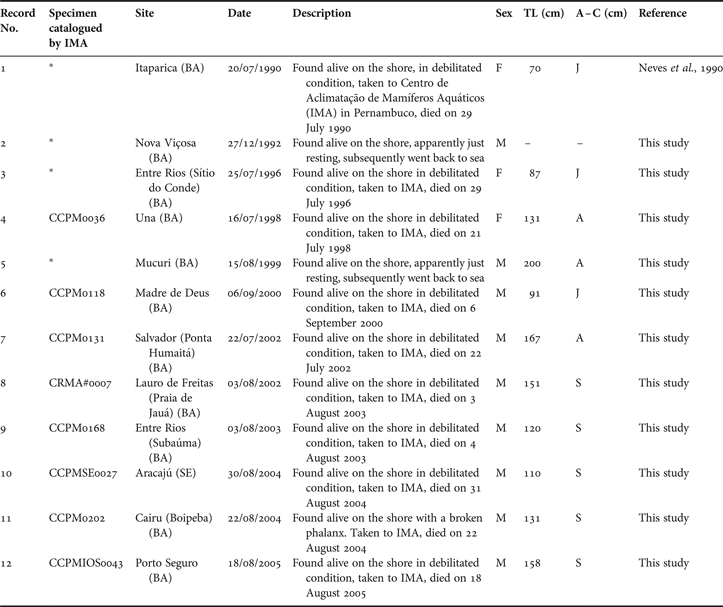
Twelve occurrences of Arctocephalus tropicalis were reported in the study area between 20 July 1990 and 18 August 2005. Only one animal was recorded from the State of Sergipe (CCPMSE0027).
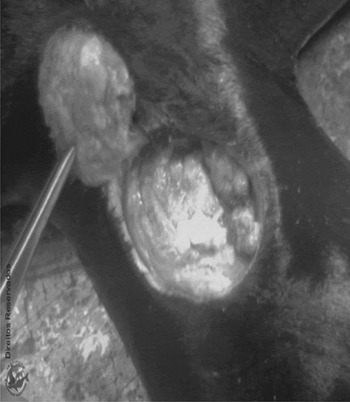
All individuals were found alive, but only two were in good health (numbers four and five; see Table 1); the other animals had clinical conditions that included dehydration, undernourishment, and some of them had wounds caused by cookie-cutter sharks (Isistius brasiliensis) (Figure 1).
Wound on the left anterior fin of the individual CCPM0202, inflicted by the bite of the shark species Isistius brasiliensis.

Summary of reports of Arctocephalus tropicalis in the states of Bahia and Sergipe, north-eastern Brazil, from 21 July 1998 to 8 August 2005.

*, individuals not catalogued by IMA due to the fact that no biological material was collected; –, unregistered data; S, sex (M, male; F, female); TL, total length; A–C, age-class (J, juvenile; S, sub-adult; A, adult).
Individual CCPM0036 demonstrated a severe respiratory infection and was treated during five days but died. A necropsy revealed a hydrothorax condition and the presence of calcified nodules 2 cm in diameter in the lungs; these were removed for analysis. A microbiological examination identified Mycobacterium avium as the causal agent of the infection, confirming the diagnosis of tuberculosis. This is the first report for tuberculosis in pinnipeds in north-eastern Brazil.
Specimen CCPM0131 was found with a wound on its neck, apparently caused by a sharp object. Balloons and food packing were found in its stomach. Specimen CCPMIOS0043 revealed a high number of Anisakis simplex parasites in its pyloric antrum (Figure 2).
(A) Specimen CCPMIOS0043 on the necroscopy table; (B) parasites of the species Anisakis simplex.

Of the seals that were maintained in captivity, only CRMA#0007 remained alive for a reasonably long period of time (dying one year later from a septicaemia with no apparent cause). Before dying, the specimen demonstrated protruding eyes and an extremely infected conjunctiva.
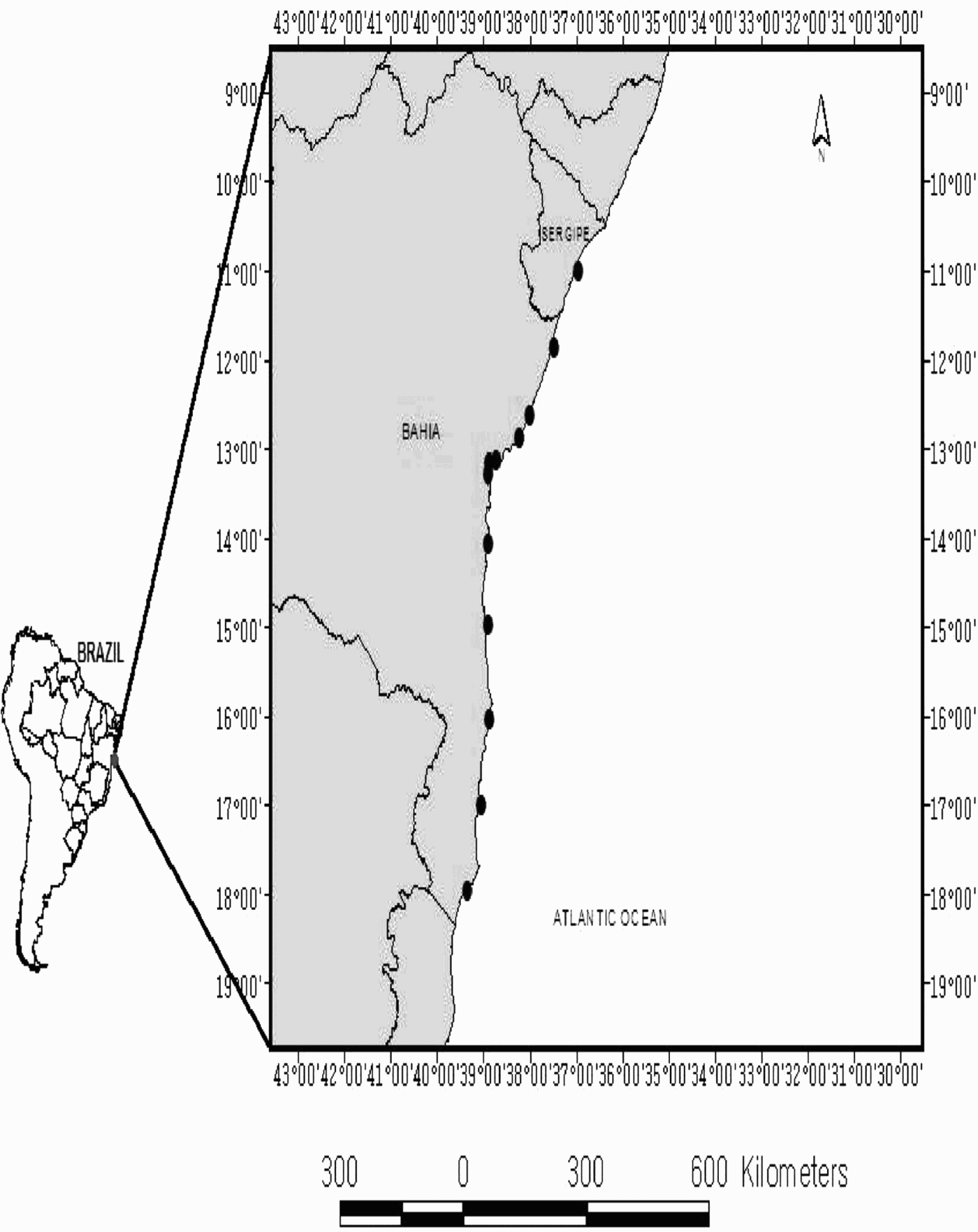
Of the total of 12 occurrences, 42% corresponded to sub-adult specimens. In terms of seasonality, it was observed that most of the sightings were reported during the months of July, August, and September, a time when south-eastern winds predominate. The distribution of recorded sightings (Figure 3) did not reveal any pattern or concentration within the territory monitored by the IMA.
Map indicating the reported sightings of Arctocephalus tropicalis in the IMA region during the period from 20 July 1990 to 18 August 2005 (N = 12) (• Arctocephalus tropicalis).

DISCUSSION
Subantarctic fur seals found on the shores of Bahia and Sergipe are commonly in poor health. Zanelatto et al. (Reference Zanelatto, Correa, Bittencourt and Domit1990) reported that pinnipeds arriving on Brazilian beaches are invariably exhausted and sick. Gales et al. (Reference Gales, Coughran and Queale1992) referred to a larger number of debilitated subantarctic fur seals arriving on Australian beaches.
These feeble animals tend to develop diseases such as tuberculosis due to their diminished immunological capacity. Tuberculosis has been reported in various pinniped species, and among both captive and wild individuals (Dunn et al., Reference Dunn, Buck, Robeck, Dierauf and Gulland2001). Bastida et al. (Reference Bastida, Loureiro, Quse, Bernadelli, Rodriguez and Costa1999) reported the first case of tuberculosis in a subantarctic fur seal encountered on the Argentinean shoreline, and noted the importance of the diagnosis of this illness. This species has wide distribution in temperate and subantarctic waters and can be found associated with reproductive colonies of five different species of fur seals (Arctocephalus philippi, Arctocephalus australis, Arctocephalus pusillus, Arctocephalus gazelle and Arctocephalus forsteri), three species of sea lions (Otaria flavescens, Neophoca cinerea and Phocarctos hookeri), and one elephant seal (Mirounga leonina)—thus increasing the potential for the dissemination of this disease among numerous species of aquatic mammals.
The degree of dehydration and low weight of the vagrant individuals indicates that they may have strayed off routes between islands used for reproduction and, for unknown reasons they do not appear to feed at low latitudes. According to a study of the genetic variability in subantarctic fur seals encountered on southern Brazilian beaches, the vagrant specimens were derived from three reproductive colonies: Gough Island; Amsterdam Island; and the islands of Marion, Crozet and Macquarie (Ferreira et al., Reference Ferreira, Oliveira, Wynen, Bester, Guinet, Moraes-Barros, Martins, Muelbert, Moreno, Siciliano, Ott and Morgante2008). These vagrant individuals thus strayed widely off course before arriving on the Brazilian coast. We have very little understanding yet of why they became lost, although the dynamics of ocean currents in the southern Atlantic Ocean may have an important role.
The stranding of subantarctic fur seals on the north-eastern Brazilian coastline may be due to their passive transport by the Benguela Current. The Benguela Current forms in the cold subantarctic waters and flows north along to the western coast of Africa, then crossing the Atlantic Ocean in direction of the Brazilian shoreline near the Atol das Rocas, where it receives the name ‘Brazilian Current’ (Stramma & Peterson, Reference Stramma and Peterson1989).
In terms of seasonality, beaching occurrences are concentrated during the austral winter months, corresponding to the season of south-eastern winds, and corroborating information provided by IBAMA (2001) and Oliveira et al. (Reference Oliveira, Danilewicz, Martins, Ott, Moreno and Caon2001). Bester (Reference Bester1981) observed that the occurrence of subantarctic fur seals during this period on the Brazilian coastline is related to the absence of these animals from reproductive colonies, which increases the number of vagrant animals in the ocean.
CONCLUSIONS
Subantarctic fur seals disperse throughout the sea during their non-reproductive period, increasing the possibility of their appearance on different continents in the southern hemisphere. We do not yet know how they get to north-eastern Brazil but, considering their health status, we suspect that this is not part of their usual route. In addition to the importance of studies on the population dynamics, biology, behaviour, genetics and epidemiology of A. tropicalis, there is a need to develop educational campaigns to alert the public about notifying institutions accredited and licensed by the federal environmental department to the presence of subantarctic fur seals on the shores of north-eastern Brazil. This will help guarantee the correct treatment of these animals and the collection of fundamental data about these specimens.
ACKNOWLEDGEMENTS
The authors would like to thank Jaqueline M.S. Pinto of the Laboratório de Parasitologia Veterinária at UESC and the Instituto Mamíferos Aquáticos for providing valuable support for our studies; and Mirco Solé (UESC) and Salvatore Siciliano (FIOCRUZ) for their critical reviews of the manuscript.