To drive value-based decision-making in healthcare and improve patient outcomes in Singapore, the Ministry of Health (MOH) established the Agency for Care Effectiveness (ACE) in August 2015, as the national health technology assessment (HTA) agency (Reference Pearce, Lin, Teo, Ng and Khoo1). Since its inception, ACE has been building core capacity in HTA and has conducted over a hundred evaluations on the clinical and cost-effectiveness of health technologies to inform appropriate care and public funding decisions. Through such work, it has become apparent that some health technologies with low value are already widely diffused in the public healthcare system. Given the challenges to change deeply entrenched healthcare practices, ACE aims to keep abreast of new and emerging health technologies at an early stage of their development, and close the gap between their evaluation and introduction into the healthcare system, as we work towards a sustainable healthcare system.
To this end, horizon scanning systems (HSSs) systematically identify, filter and prioritize new and emerging technologies to assess or predict their impact on patient health, costs to society and the healthcare system (2). HSSs have been established in many countries such as Australia, Canada, South Korea and the United Kingdom (UK) to better inform healthcare decisions (Reference Oortwijn3). International collaborative networks like EuroScan (International Information Network on New and Emerging Health Technologies) have also been formed to share methodologies and information on new and emerging health technologies from horizon scanning efforts across countries (Reference Packer, Simpson and de Almeida4). In October 2019, the International Horizon Scanning Initiative, involving nine European countries, was launched under the wider-ranging Beneluxa Initiative on Pharmaceutical Policy to identify innovative medicines to inform decision making on treatments and budgets, as part of governmental responses to rising costs of medicines (Reference Lepage-Nefkens, Douw, Mantjes, de Graaf, Leroy and Cleemput5;6).
In Asia, the Horizon Scanning Service of Innovative Global Health Technology of South Korea, the Malaysia Health Technology Assessment Section and Taiwan's Center for Drug Evaluation have been actively conducting horizon scanning for various types of health technologies. To our knowledge, ACE is the fourth agency in the region to embark on horizon scanning. Taking reference from existing HSSs and international frameworks, ACE has established a HSS in 2019 to identify emerging, especially high cost and disruptive technologies for early assessment, complementing the HTA activities that are typically performed at the time of or following the introduction of the technology to the healthcare system. ACE's horizon scanning activities aim to assess and predict the magnitude of their potential impact including safety or efficacy concerns, potential budget impact to the healthcare system and likely financing framework and any changes that may be needed at a system level such as IT or infrastructure changes if the technology is recommended for use. This paper describes the development of the ACE HSS and showcases its application with cell and gene therapy products as the first example.
The ACE Horizon Scanning System
To develop the framework, we referenced the methods and processes of EuroScan and other overseas horizon scanning agencies, and performed a literature review of existing HSS methods. The findings show that all identified HSSs are aligned to the core principles and methods of horizon scanning as described in the EuroScan International Network toolkit (2), with typical stages such as identification and filtration to select relevant technologies, and prioritization of the technologies for further assessment. The focus of different HSSs may vary with the objectives of the HSS in serving the broader needs of the healthcare decision makers or ecosystem, and each stage of the HSS can be tailored accordingly. Apart from literature searches, international horizon scanning experts from Canada and Australia were also consulted to ensure that our processes and methods are in line with international standards, and to gain expert perspectives on the global trends and developments in horizon scanning.
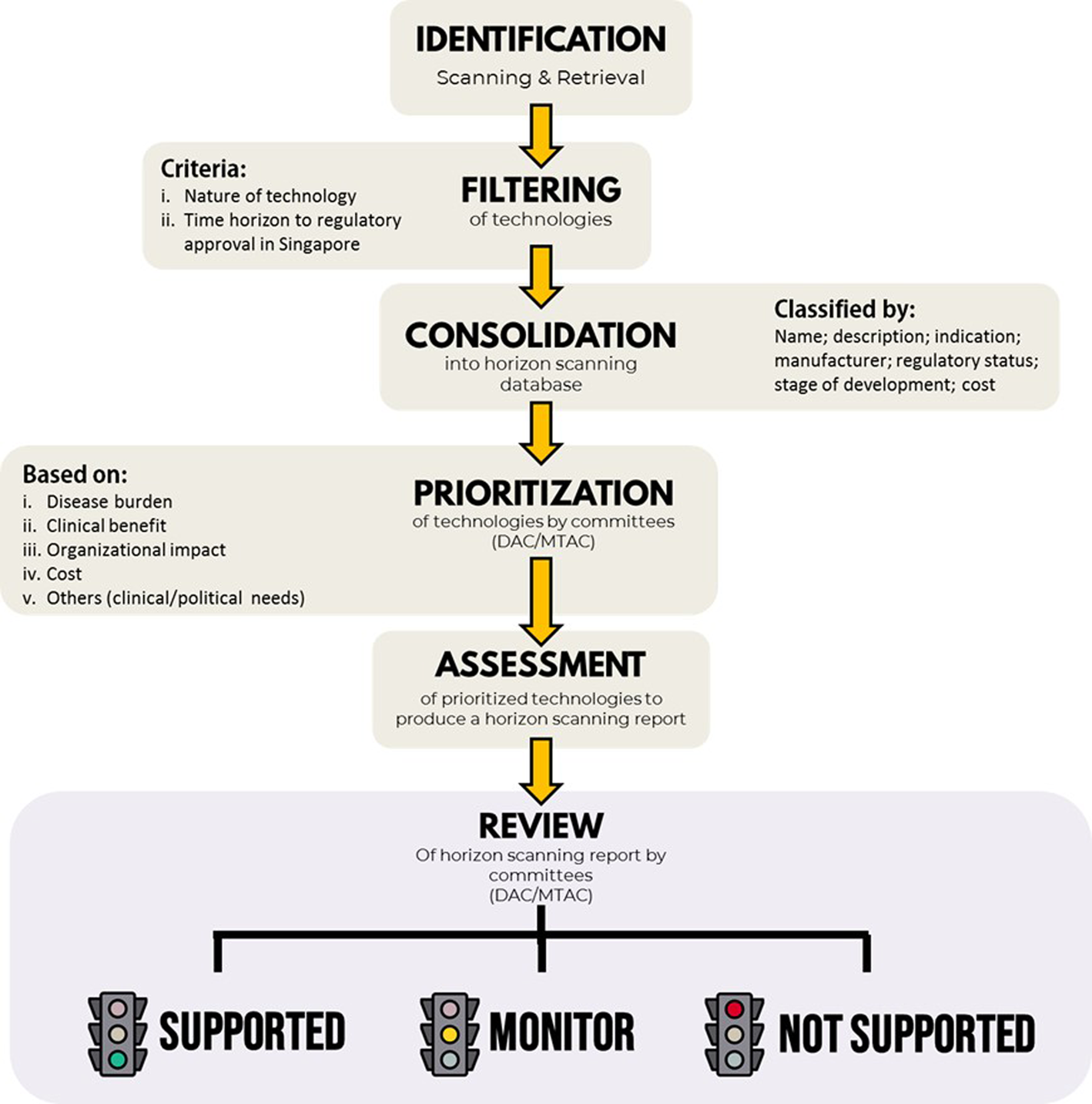
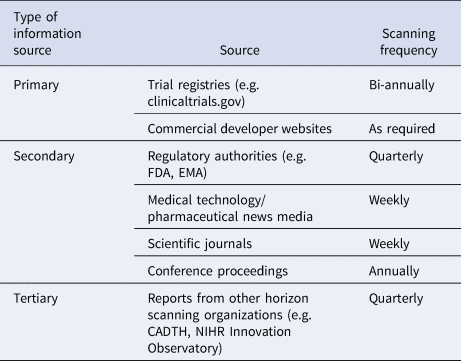
The ACE HSS (Figure 1) begins with the identification of health technologies of interest. As health technologies generally enter the Singapore market at a later date compared with major markets such as the U.S. or UK, new regulatory approvals from the U.S. Food and Drug Administration (FDA) and the European Medicines Agency (EMA) are used as indicators of technologies potentially entering the Singapore market in the near future. We also rely on other sources commonly referenced by overseas HSSs, like trial registries, scientific journals and commercial developer websites (Table 1) (Reference Oortwijn3;Reference Eriksson, Wettermark, Persson, Edström, Godman and Lindhé7). In addition, reports from overseas horizon scanning agencies, information from informal sources like research institutions, technology transfer offices, and print, electronic or social media channels may provide useful information (Reference Hines, Li, Guy, Brand and Papaluca-Amati8). Eventually, ACE may emulate the approach adopted by some EuroScan member agencies and tap on clinical experts for their domain expertise to identify new and emerging technologies, especially those with a shorter innovation cycle or higher rate of diffusion (Reference Gutierrez-Ibarluzea, Simpson and Benguria-Arrate9).
Overview of the ACE HSS.

Identification Sources Employed in the ACE HSS and their Corresponding Scanning Frequency

CADTH, Canadian Agency for Drugs and Technologies in Health; EMA, European Medicines Agency; FDA, U.S. Food and Drug Administration; NIHR, National Institute for Health Research.
The next step is the filtration of identified technologies to select relevant technologies. Identification results are filtered in-house according to the scope of technology and time horizon to regulatory approval in Singapore. The scope of interest is aligned with evolving national healthcare priorities and determined with input from policy makers and local healthcare experts. For example, the National Institute for Health Research (NIHR) Innovation Observatory in the UK is interested in identifying mainly pharmaceuticals and cell therapies, followed by diagnostics and imaging, and devices and biotechnology. Australia, on the other hand, focuses on medical and surgical devices, and diagnostic tests and procedures. Currently, Singapore is particularly interested in identifying high cost or disruptive health technologies that could impact our healthcare system significantly. As such, cell and gene therapy has emerged as one of many key areas to monitor (Reference Elverum and Whitman10) and was used as an example in the first horizon scanning exercise. ACE adopts a time horizon of up to 3 years before regulatory approval in Singapore to focus on therapies in late-stage clinical trials that are most likely to reach the local market. This time-frame may be adjusted for medical devices or procedures, which typically have a shorter product life cycle than pharmaceuticals (Reference Gelijns11–Reference Van Norman13).
In prioritizing filtered technologies for further assessments, a set of explicit prioritization criteria, determined in accordance with stakeholder requirements, is usually used to ensure consistency in the process (Reference Sun and Schoelles14). Accordingly, the ACE HSS adopts key prioritization criteria used by overseas HSSs, such as disease burden, clinical benefit, organizational impact and related costs of the technologies (Reference Douw and Vondeling15). Additional considerations for technology prioritization, such as clinical or political needs, may be used. ACE taps on decision-making committees within the Ministry to assist in prioritization, particularly the MOH Drug Advisory Committee (DAC) and Medical Technology Advisory Committee (MTAC), which are responsible for making public funding recommendations for drugs, medical technologies, and medical services.
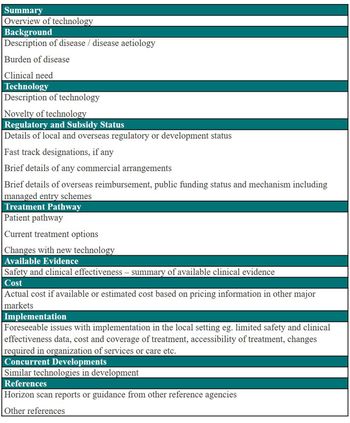
Horizon scanning reports are developed for prioritized technologies. Generally aligned to the practice of overseas horizon scanning agencies, the reports describe the patient population, the burden of disease and clinical need in the local context, the technology and its current development stage, the proposed position in the care pathway, the potential benefits of the technology over current alternatives, and the potential financial and organizational impact. The reports will summarize clinical and, if available, cost-effectiveness evidence and are expected to be around ten pages long (Figure 2). The DAC or MTAC will advise on the potential for the prioritized technologies to be introduced into the system based on the reports, guided by a traffic light system—(a) sufficient evidence to support technology uptake (green); (b) monitoring required due to insufficient evidence but additional evidence may provide useful information (yellow); or (c) technology uptake not supported due to concerns regarding its benefits (red). The reports only serve to inform the healthcare system early on the necessary changes to prepare for the potential introduction of the technologies. It has no implication for any downstream reimbursement decisions, which will generally be informed by more thorough health technology assessments. Dissemination of horizon scanning reports is currently restricted to relevant internal and external stakeholders, with sensitive information redacted, depending on the audience. This could change in the future as the framework evolves, considering that some horizon scanning agencies publish their reports.
General outline of ACE's horizon scanning reports. The reports are intended to inform decision making within the Government.

First Application of ACE's HSS: Cell and Gene Therapy
Cell and gene therapy has recently emerged as an innovative and potentially disruptive class of treatments for a myriad of pathologies. The approval of tisagenlecleucel, the first chimeric antigen receptor T-cell (CAR-T) therapy, by the FDA in 2017 represented a significant milestone in cell therapy development, with tisagenlecleucel showing early promise for treating pediatric and young adult acute lymphoblastic leukemia (ALL) (Reference Maude, Laetsch, Buechner, Rives, Boyer and Bittencourt16;Reference Bach, Giralt and Saltz17). Since then, a litany of cell and gene therapy products, including voretigene neparvovec and onasemnogene abeparvovec—viral vector-based gene therapies for retinal dystrophy and spinal muscular atrophy, respectively—have also obtained approvals from regulatory bodies like the FDA or EMA (Reference Cuende, Rasko, Koh, Dominici and Ikonomou18;19). More notably, the FDA predicts that it will approve ten to twenty cell and gene therapies annually by 2025 (20).
Although these high-cost cell or gene therapy products have yet to receive regulatory approval in Singapore (as of March 2020), the high budget impact, potentially curative nature and uncertain long-term outcomes make this an important space to monitor. Several national initiatives have also been set aside for advancing cell or gene therapy manufacturing and research capabilities in Singapore. Within this context, ACE selected cell and gene therapies to test its new HSS, and to provide early awareness to prepare the healthcare system for any necessary changes in national policies and frameworks for their successful adoption into the local healthcare system.
To identify relevant products, we tracked cell and gene therapy candidates assigned the “Regenerative Medicine Advanced Therapy (RMAT)” and “Advanced Therapy Medicinal Products (ATMP)” designations respectively, by the FDA and EMA, as it has been reported that conducting searches using strategies specific to technology sectors, such as pharmaceuticals, surgical procedures etc., was most effective (Reference Wild and Langer21). While this concomitantly limited our search to technologies that are closer to regulatory approval and market entry due to the expedited review processes associated with these regulatory designations (Reference Iglesias-López, Agustí, Obach and Vallano22), it was in line with our priorities and focus. We also found that targeted web searches using conventional search engines such as “Google” seemed particularly useful, likely due to widespread media interest and reporting in gene therapy developments. In this instance, other identification sources such as scientific journals, conference proceedings, and clinical trial registries in Table 1 were used as supplementary information sources.
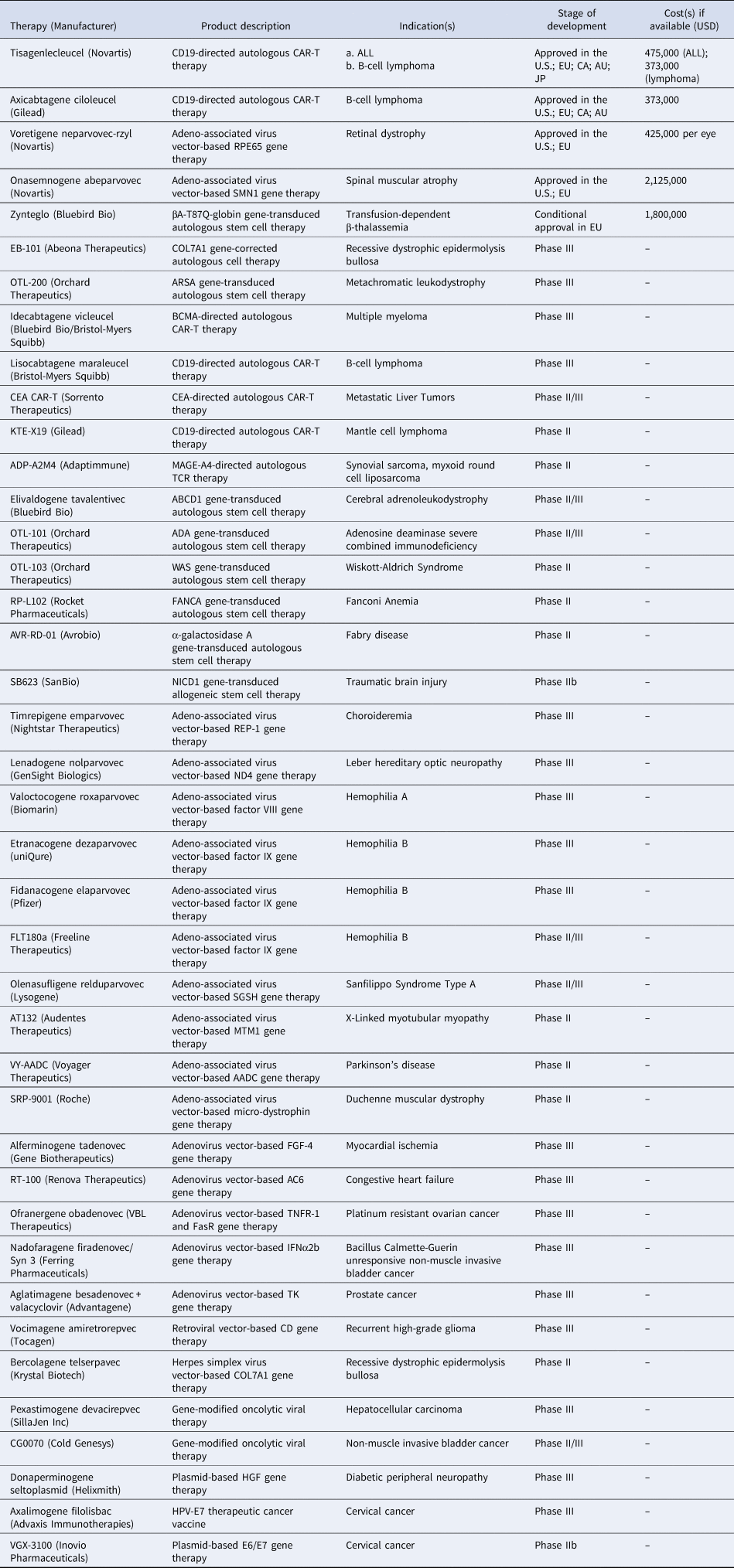
The identified cell and gene therapy candidates were filtered based on two key criteria, the scope of technology and time horizon to regulatory approval, mirroring the NIHR Innovation Observatory's in-house filtration approach in the UK (Reference Oortwijn3). In terms of scope, we mainly focused on disruptive, high-cost, mostly one-time cell and gene therapies that involved gene modification. As per the ACE framework, a time horizon of three years to regulatory approval was adopted; accordingly, therapies in later stages of clinical development (Phase IIb or III clinical trials) were identified. Filtered technologies were tracked by indication, stage of development, cost, and local and overseas regulatory and funding status to provide us with a database of cell and gene therapies which will be further prioritized for assessment. A list of the forty filtered technologies is detailed in Table 2. Nonetheless, we are cognizant that the filtration criteria may need to be tailored for other technologies, such as when filtering medical devices, which are far greater in number relative to cell and gene therapies, and take a shorter time to enter the market and diffuse in healthcare systems (Reference Gelijns11–Reference Van Norman13).
A Shortlist of Filtered Technologies

ALL, acute lymphoblastic leukemia; AU, Australia; CA, Canada; CAR-T, chimeric antigen receptor T-cell; EU, Europe; TCR, T-cell receptor; U.S., United States.
Thereafter, prioritization was conducted among the forty filtered technologies considering predetermined criteria including disease burden, clinical benefit, organizational impact, and costs associated with the technology. Our prioritization method was guided by a qualitative approach where filtered technologies were ranked “high,” “moderate,” or “low” for the key criteria of disease burden and/or clinical need, clinical benefit and organizational impact. Technologies with higher ranks were prioritized, and consideration was given to a technology's proximity to market entry, owing to the increased urgency for early assessment to identify their potential impact on the country's healthcare system. As most of the filtered technologies have not been approved in any markets, their costs were unavailable but expected to be high. Therefore, the cost was not used as the main criterion in the prioritization exercise. Clinical experts in different fields were consulted for inputs during the prioritization exercise.
Notably, we did not apply an explicit scoring system for prioritization since a 2006 EuroScan survey of its member agencies reported that only two systems attempted to formalize the prioritization process by scoring against weighted criteria but eventually abandoned it, in part due to lengthy procedures and the lack of formal training of clinical experts in scoring, contributing to the ambiguity in the prioritization outcomes (Reference Douw and Vondeling15). Furthermore, details on explicit methods used by overseas HSSs to implement their respective prioritization criteria are scarce, with only South Korea and Spain describing a vague scoring process (Reference Oortwijn3;Reference Varela-Lema, De La Fuente-Cid and Lopez-Garcia23).
During the prioritization process, MOH stakeholders' internal requests to assess selected cell and gene therapies were also taken into consideration to ensure its relevance and usefulness in the local context. So far, of the eight prioritized technologies, ACE has produced three initial horizon scanning reports for tisagenlecleucel for ALL, tisagenlecleucel for lymphoma and onasemnogene abeparvovec for spinal muscular atrophy, for MOH's stakeholders to support strategic efforts within the Ministry. A number of additional reports for other prioritized cell and gene therapies are currently in the pipeline.
Impact and Lessons Learnt
One important measure of the impact of a HSS is how the outputs have been used by stakeholders (Reference Maude, Laetsch, Buechner, Rives, Boyer and Bittencourt16). To date, the three horizon scanning reports produced were used to inform timely development of health and funding policies for cell and gene therapies. In the case of tisagenlecleucel, the need for accredited treatment centers and trained medical professionals in administering CAR-T therapies was highlighted in the report. This allows for advanced planning and allocation of resources. Further, the high cost of cell and gene therapies and uncertainties in their long-term clinical effectiveness has led to many countries exploring innovative financial arrangements with manufacturers as part of a risk-sharing approach. The reports highlighted the approach, which may be of interest to local healthcare decision makers. As for onasemnogene abeparvovec, the report highlighted to relevant stakeholders within the Ministry the financing considerations that the local multi-payer healthcare system would need to take into account in order to ensure access to affordable treatments. Other than the impact on stakeholders, active horizon scanning of the upcoming cell and gene therapies also helped ACE keep abreast of the potential new entrants to the market and facilitated resource planning within the agency. ACE will continue to fine-tune the HSS and outputs, in line with stakeholders' feedback, to better serve them.
While ACE's HSS initially focused on cell and gene therapies to allow efficient use of limited resources, several other topics including artificial intelligence, 3D-printing and telemedicine have been nominated by relevant stakeholders and would form part of the ongoing work plan for the horizon scanning unit moving forward. It will also expand in scope to cover topics of national health priorities; for example, during the current COVID-19 outbreak, daily horizon scans are also conducted to identify new or existing technologies or services which have been suggested or used to combat the outbreak. The relevant information is disseminated to relevant ACE evaluation teams for further assessment or used to produce clinical evidence summaries to inform clinical practice and decision-making (24). In all, the ACE HSS will continue to evolve in light of the rapidly evolving healthcare landscape and cater to the needs of stakeholders.
Conclusion
Complementing its HTA activities, ACE has established a HSS to actively track new and emerging technologies with potentially significant impact for early assessment, which informs relevant stakeholders of their associated safety and potential disruption to the healthcare system. The framework was largely developed in line with international best practice. Its first application for cell and gene therapy products has helped to calibrate our processes and methods, and demonstrated its role to ensure the system will be sufficiently prepared for these technologies. Although the long-term impact of our HSS remains to be seen, we expect the HSS to continue evolving to stay relevant and fit-for-purpose in serving the needs of our stakeholders and healthcare system.
Acknowledgment
We thank Linda Mundy (Royal College of Pathologists of Australia), Dr Lesley Dunfield and Leigh-Ann Topfer (Canadian Agency for Drugs and Technologies in Health) for providing invaluable feedback to inform the development of the ACE HSS. We are also grateful to our colleague, Dr Ho Yan Teck, for his assistance in editing the manuscript.