Introduction
In 2012, the American College of Surgeons’ Commission on Cancer (CoC) mandated that, for cancer centers to be accredited, a distress screening program standard of care be achieved by 2015 (Commission on Cancer, 2012). This mandate followed a 1997 National Comprehensive Cancer Network recommendation for universal distress screening at all cancer care centers (Holland et al., Reference Holland2013). These guidelines were intended to improve uptake of distress screening, yet the CoC deadline has passed and many institutions continue to struggle to meet these requirements. In 2007, only 15% of oncologists reported adhering to standardized distress screening (Pirl et al., Reference Pirl2007), and in a 2015 survey, only 54.6% of 467 oncology social workers screened for distress using a standardized instrument (BrintzenhofeSzoc et al., Reference BrintzenhofeSzoc2015). Given that up to 43% of patients report clinically significant distress over the course of cancer diagnosis and treatment (Zabora et al., Reference Zabora2001), widespread adoption of comprehensive distress screening has the potential to connect a large proportion of cancer patients with psychosocial intervention and other needed services that reduce distress (Jacobsen & Jim, Reference Jacobsen and Jim2008). Insight is needed into why some cancer centers can implement standardized distress screening, whereas others cannot, and whether training programs can facilitate adoption of the program standard.
Comprehensive distress screening is a multistep process designed to provide initial detection of distress then documented referral and follow-up. It is recommended that distress screening not only detect distress, but also further evaluate distressed patients and provide referrals for appropriate services (Pirl et al., Reference Pirl2014). The five steps of comprehensive psychosocial distress screening include: (1) screening patients for distress using a validated screening tool, (2) evaluating the screen for clinically significant distress, (3) referring distressed patients to psychosocial healthcare services, (4) following up to reevaluate distress, and (5) documenting distress screening steps in the health record and conducting Quality Improvement by auditing health records (Lazenby et al., Reference Lazenby2015a). Such procedures enhance patient communication with clinicians and increase referrals for psychosocial services (Carlson et al., Reference Carlson, Walker and Mitchell2012).
However, at each step of distress screening, barriers and facilitators may determine whether a comprehensive screening program is successfully implemented. Protected time, engaged leadership, and a culture that values distress screening have all been identified as facilitators of distress screening implementation (Riblet et al., Reference Riblet2014). In contrast, several reports of attempts to implement distress screening at teaching hospitals (Lo et al., Reference Lo2016; O'Connor et al., Reference O'Connor2017) and across outpatient settings nationwide (Tavernier et al., Reference Tavernier, Beck and Dudley2013) show that lack of time on the part of clinicians is an implementation barrier. Review papers have indicated that lack of staff buy-in and lack of staff knowledge about the need for screening interfere with implementation of evidence-based psychosocial care in oncology (Schofield et al., Reference Schofield2006) and with implementation of distress screening (Pearman et al., Reference Pearman2015). A significant body of literature outlines common barriers to and facilitators of implementing distress screening. However, to support institutions in developing screening programs, more research is needed that clarifies how barriers and facilitators correspond to specific steps of distress screening.
For this reason, we designed a 2-year Screening for Psychosocial Distress Program (SPDP) to teach and facilitate routine comprehensive psychosocial distress screening to US cancer care professionals. In this paper, we report data available for clinicians from 18 cancer care institutions participating in the SPDP. To our knowledge, this is the first program to delineate barriers and facilitators to achieving distress screening goals in a cohort of participants enrolled in a training program to implement distress screening over time. Specifically, this article describes (1) participants’ achievement of distress screening related goals at 6, 12, and 24 months postenrollment; (2) barriers and facilitators to goal achievement experienced by participants in their institutions; and (3) the helpfulness of the SPDP for goal achievement.
Methods
Design
The SPDP used a longitudinal pre- and posttest design. Mixed methods research data including both data on process (barriers and facilitators) and outcomes (goal achievement) were collected at 6, 12, and 24 months. A cohort of two cancer-care clinicians (dyads) from 18 institutions (36 clinicians total) completed the 2-year SPDP (2013–2015). The program consisted of an introductory workshop in early 2014; bimonthly teleconferences in the first year and quarterly in the second year for information, problem-solving, and support; and an advanced workshop at 12 months of participation. The workshops, described previously (Lazenby et al., Reference Lazenby2018), included faculty presentations on content relevant to distress screening and participants’ group work and presentations on their distress screening activities.
Participants
Participants were recruited through advertisements online (http://apos-society.org/screening/) and in trade periodicals as described previously (Lazenby et al., Reference Lazenby2015b). Applications were screened for inclusion and exclusion criteria. Inclusion criteria included (1) two people from one institution applying as a dyad, who (2) had direct access to patients to screen, and (3) had strong letters of support from the institution's administrators. Excluded were applicants who applied individually and who had noncommittal letters of support. From the pool of applicants, we selected those institutions that provided the strongest evidence for (1) a well-grounded expectation that the dyads would work well together, and (2) continuous strong administration buy-in and support for distress screening efforts of the dyad over the full 2 years of training (purposive sampling).
Formation of goals relevant to distress screening
Participants were required to state three distress screening goals on their applications. During the introductory workshop, participants were supported by faculty in refining these goals into the Specific, Measurable, Achievable, Realistic, Time-bound (SMART) goal format (Doran, Reference Doran1981). Exercises were driven by the Reach, Effectiveness, Adoption, Implementation, Maintenance framework as previously described (Lazenby et al., Reference Lazenby2015b) to help them develop goals that they would be able to work on over the 2 years of their participation in the SPDP.
Data collection
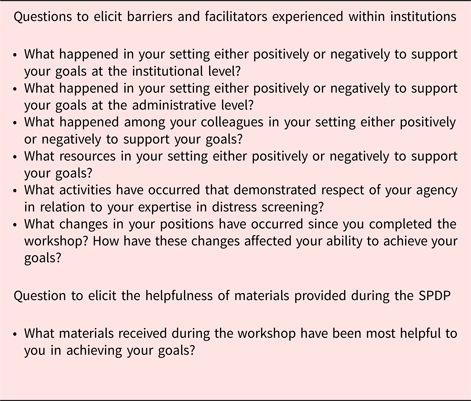
At 6, 12, and 24 months after baseline, we collected data on dyads’ progress on implementing distress screening in their institutions using an investigator-developed Goal Evaluation Form (Grant et al., Reference Grant1999, Reference Grant2007) sent by e-mail to be completed online. The Goal Evaluation Form collected both quantitative and qualitative data: For quantitative data, dyads rated the level of achievement of their SMART goals refined during the introductory workshop at baseline (1 = never started; 2 = stopped/cancelled; 3 = stalled; 4 = in process; 5 = completed). Open-ended questions prompted the provision of qualitative data on institutional barriers and facilitators to goal achievement and the helpfulness of materials provided during the SPDP (Table 1). One institution (18) did not provide 24-month data. Raw data were imported into Dedoose, a web application for managing, analyzing, and presenting qualitative and mixed method research data (SocioCultural Research Consultants, LLC, 2016).
Open-ended questions used in the Goal Evaluation Form to elicit institutional barriers and facilitators to goal achievement and the helpfulness of materials provided during the SPDP

SPDP, Screening for Psychosocial Distress Program.
Data analysis
Goals specified by dyads were categorized according to the five steps of distress screening: (1) screening, (2) evaluating, (3) referring if needed, (4) following up, and (5) documenting (Lazenby et al., Reference Lazenby2015a). Of the original 54 goals, three goals were recategorized into two different distress screening steps and one goal was divided into two separate goals, which resulted in a total of 58 individual coded goals. Goals were defined as unfinished when a level of achievement was reported as “never started,” “stopped/cancelled,” or “stalled” at 6 and 12 months, or reported as “never started,” “stopped/cancelled,” “stalled,” or “in process” at 24 months.
Qualitative data on institutional barriers and facilitators were analyzed with conventional content analysis (Hsieh & Shannon, Reference Hsieh and Shannon2005) by identifying categories directly from the text. Categories were organized into a coding system consisting of main categories (e.g., “lack of buy-in”) and, if applicable, ancillary subcategories specifying more nuanced aspects of the main category (e.g., “lack of administrator buy-in”). Three investigators (RM, ML, EE), who are experts in psychosocial distress screening, independently applied the codes to subjects' self-reported barriers and facilitators. Overall, there were minimal discrepancies noted; these investigators discussed each coding discrepancy and reached consensus on the classification. Data saturation was reached; therefore, no additional coding was needed. In Dedoose, goals’ categories and levels of achievement at 6, 12, and 24 months were specified, and codes yielded during content analysis were applied to qualitative data collected for the open-ended questions. As 24 months, data were missing for institution 18, their goal achievement levels provided for 12 months (“completed,” n = 3) were used for 24 months evaluation. However, the identification of institutional barriers, facilitators, and SPDP materials for institution 18 at 24 months had to be omitted. Data for all evaluation time points were downloaded in an Excel spreadsheet and frequencies of (1a) goal type (as pertaining to the five steps of psychosocial distress screening), (1b) goal achievement levels, (2a) types of institutional barriers, (2b) types of institutional facilitators, and (3) facilitative components of the SPDP were descriptively analyzed.
Ethical approval
The program was exempt from review by Yale University's Human Investigation Committee.
Results
Participants’ characteristics
Of 18 dyads (36 participants total), 11 identified their institutions as National Cancer Institute Designated/Comprehensive Cancer Centers; the remaining seven institutions identified as community/general hospitals. Size of institutions (measured by number of cancer patients treated annually) ranged from 263 to 13,683 patients/year, with a median size of 3,300 patients/year (M = 4,716.66, SD = 4,343.37). Participants’ disciplines were social work (58%), nursing (25%), psychiatry/psychology (14%), and other (3%).
Goal achievement
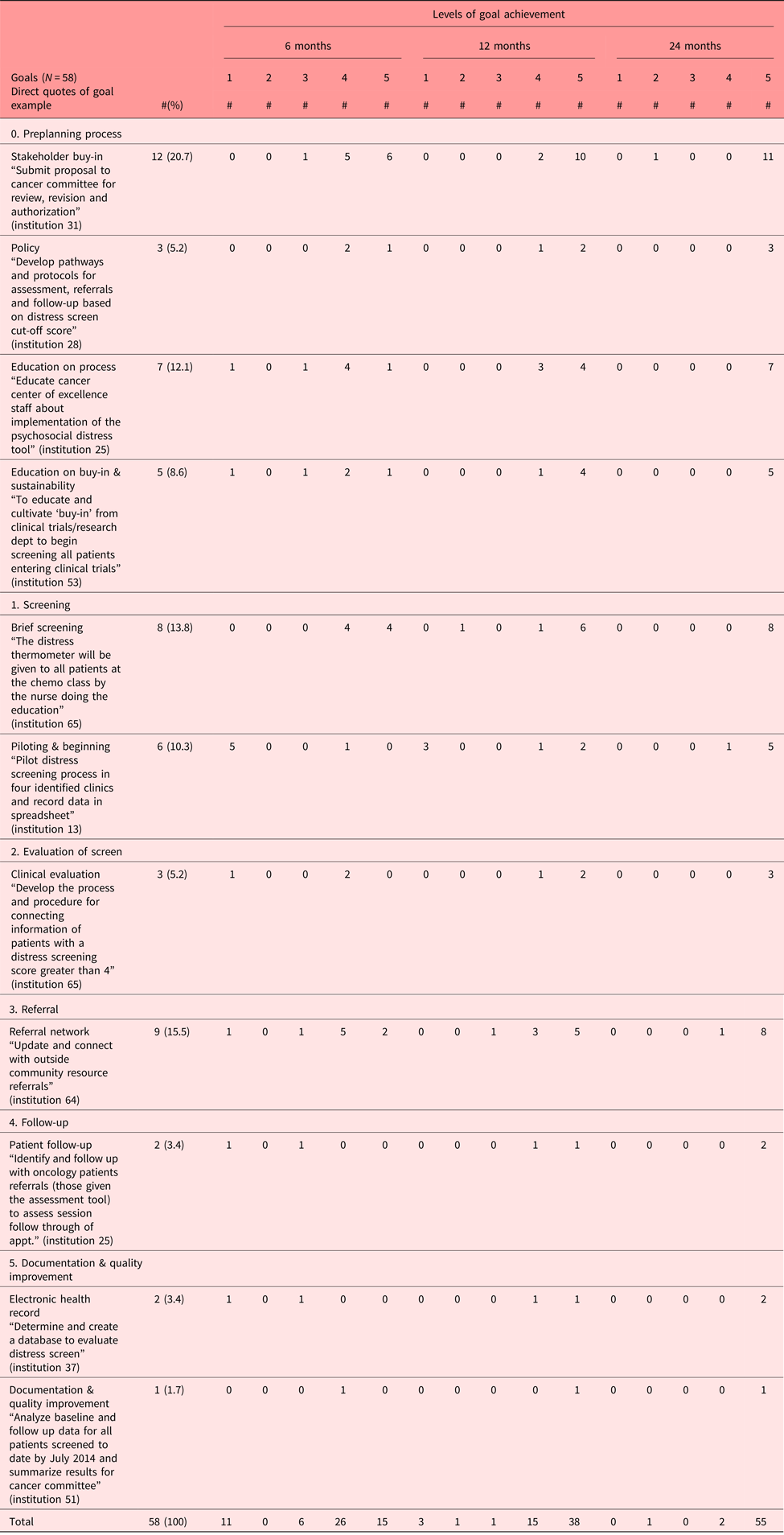
Table 2 displays the 58 SMART goals pertaining to the five steps of psychosocial distress screening along with their level of goal achievement at 6, 12, and 24 months, and direct quotes of goal examples. The most common goals were creating “stakeholder buy-in” (n = 12), establishing a “referral network” (n = 9), and starting “brief screening” (n = 8).
Level of achievement of goals by category at 6, 12, and 24 months (N = 58 goals) and goal example quotations

Levels of achievement: 1 = never started; 2 = stopped/cancelled; 3 = stalled; 4 = in process; 5 = completed .
Over the course of the 2-year training program, participants reported 15 (25.9%), 38 (65.5%), and 55 (94.8%) of the 58 goals as completed at 6, 12, and 24 months, respectively. Of the remaining three incomplete goals at 24 months, two goals, categorized as “referral network” (“create a list of current psychosocial programs, including svcs provided by our behavioral health dept”) (institution 25) and “piloting & beginning” (“pilot distress screening process in 4 identified clinics and record data in spreadsheet”) (institution 13) were in process. Another goal, categorized as “stakeholder buy-in” (“engage key stakeholders at each hospital cancer institute to complete current state assessment across the system”) (institution 51) was stopped/cancelled.
At 6 or 12 months, 18 goals (31.0%) were unfinished, but completed at 12 or 24 months. Specifically, at 6 months, 16 goals (27.6%) were unfinished, but completed at 12 months (“referral network” [n = 2], “education on buy-in & sustainability” [n = 2], “piloting & beginning” [n = 1], “follow-up” [n = 1], “electronic health record” [n = 1], “stakeholder buy-in” [n = 1], and “clinical evaluation” [n = 1]), or 24 months (“piloting & beginning” [n = 3], “education on process” [n = 2], “follow-up” [n = 1], and “electronic health record” [n = 1]). At 12 months, two goals (3.4%) were unfinished (after being “in process” at 6 months), but completed at 24 months (“brief screening” and “referral network” [each n = 1]).
Institutional barriers
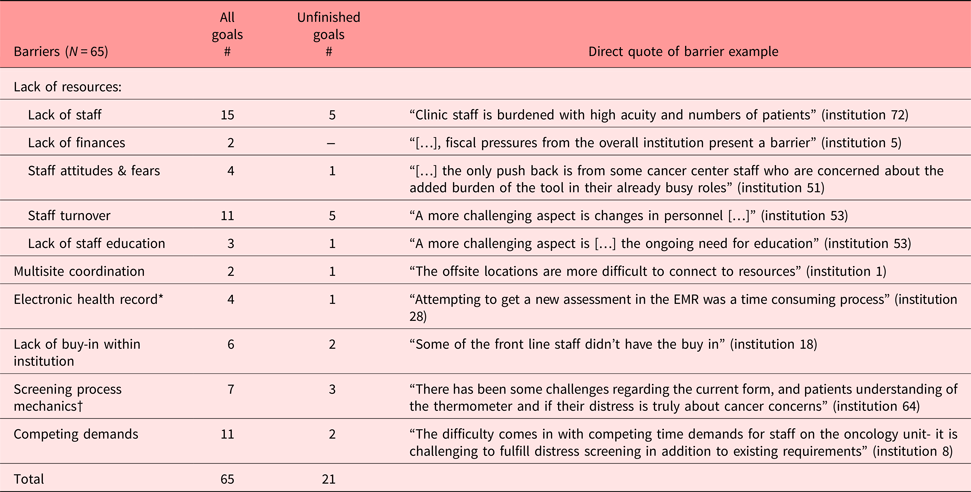
Over the course of the 2-year program, dyads reported a total of 65 barriers occurring during their distress screening implementation efforts in their institutions. The top three barriers were “lack of staff” (n = 15), “staff turnover” and “competing demands” (each n = 11), and “screening process mechanics” (n = 7). Screening process mechanics related barriers refer to the selection, utility/validity of the screening tool, and the documentation of screening activities. Examples of participants’ direct quotes of barriers are shown in Table 3.
Frequencies and quotes of barrier categories reported by dyads at 6, 12, and 24 months (N = 65)

* Barriers related to electronic health record were “lack of IT support” and “limited usefulness.”
† Barriers related to screening process mechanics were “selection of tool,” “utility and validity of tool,” and “incomplete documentation process.”
EMR, electronic medical record; IT, information technology.
Twenty-one barriers (32.3%) were reported for goals, which at any one evaluation time point (6, 12, or 24 months) were reported as unfinished (n = 25, including goals that were repeatedly reported as unfinished at various time points). Analogously to the frequencies found for barriers reported for all goals, among these 21 barriers, the top three were: “staff turnover” and “lack of staff” (each n = 5), “screening process mechanics” (n = 3), and “competing demands” and “lack of buy-in in institution” (each n = 2) (Table 3.). Among barriers reported for the 25 unfinished goals, percentages for staff and screening process mechanics-related barriers were higher (47.6% vs 40%, respectively) than among barriers reported for all goals, including completed goals (14.3% vs. 10.8%, respectively). Percentages for barriers related to competing demands, however, were lower among barriers reported with unfinished goals (9.5%) than among barriers for all goals (16.9%). Barriers related to a lack of buy-in within institutions were reported equally frequently for unfinished versus all goals (9.5% vs. 9.2%, respectively).
Institutional facilitators
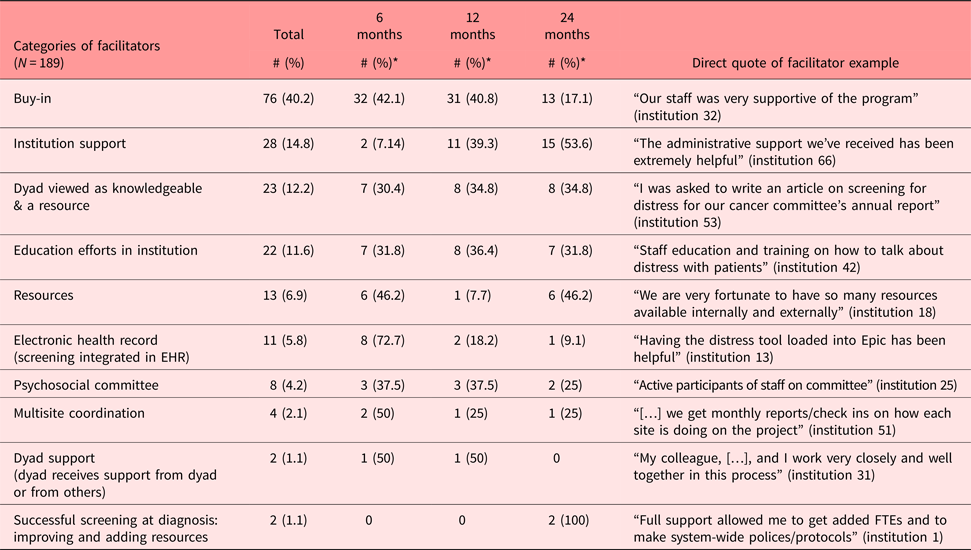
Dyads reported a total of 189 facilitators that they experienced during their distress screening implementation efforts within their institutions. Table 4 shows the frequencies of all facilitator categories at 6, 12, and 24 months along with examples of participants’ direct quotes. By far the most frequent facilitator reported was “buy-in” (n = 76, 40.2%), followed by “institution support” (n = 28, 14.8%), and “dyad viewed as knowledgeable & a resource” (n = 23, 12.2%).
Frequencies and quotes of facilitator categories reported by dyads at 6, 12, and 24 months (N = 189)

* The relative frequencies at 6, 12, and 24 months refer to the absolute frequencies of each barrier, not to the absolute frequency of all barriers (N = 189).
FTE, full-time equivalent; EHR, electronic health record.
With regard to the 18 goals that were unfinished at 6 or 12 months, 35 (17.7%) facilitators were reported concurrently with completion of these goals at 12 or 24 months. Among those 35 facilitators, “buy-in” (n = 12), “education efforts in institution,” and “institution support” (each: n = 6) were most frequent. Whereas the frequency for “buy-in” facilitators slightly decreased from 12 (n = 7) to 24 months (n = 5), the frequencies for facilitators related to “education efforts in institution” and “institution support” both increased from 12 months (n = 1) to 24 months (n = 5) (data not shown).
Helpfulness of the screening for psychosocial distress training program
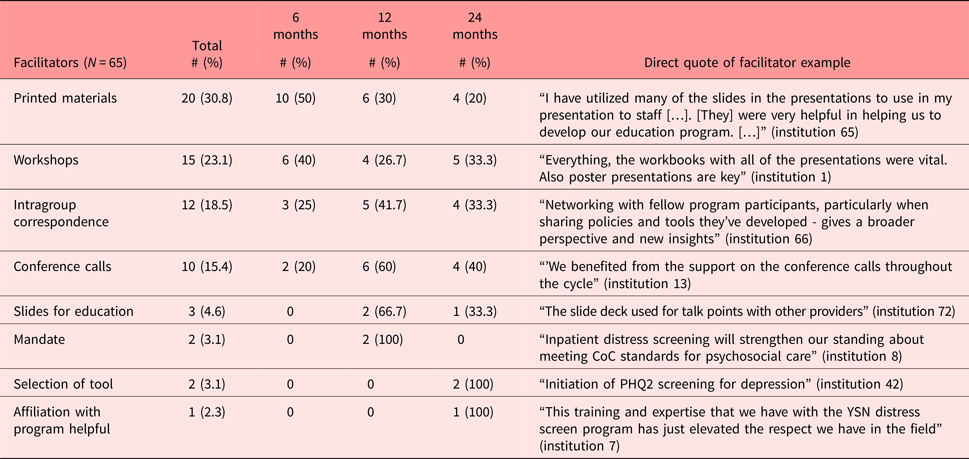
Overall, across all evaluation time points, 65 SPDP-related facilitators were reported. Beyond the materials provided by the SPDP, dyads reported conference calls and interactions among peers from other institutions as instrumental in helping them achieve their goals.
Table 5 shows frequencies reported for components of the training program that were useful at 6, 12, and 24 months along with examples of direct quotes reflective of the component reported by dyads.
Frequencies of facilitators associated with the SPDP to meet the mandate at 6, 12, and 24 months with examples of quotes (N = 65)

CoC, Commission on Cancer; SPDP, Screening for Psychosocial Distress Program; PHQ2, Patient Health Questionnaire - 2; YSN, Yale School of Nursing.
Concurrently with the 18 goals that were unfinished at 6 or 12 months, but finished at 12 or 24 months, SPDP facilitators were reported 13 times (i.e., more often than the top facilitator “buy-in” that dyads experienced within their institutions). Whereas the frequency for “buy-in” facilitators decreased from 12 months (n = 7) to 24 months (n = 5), facilitators reported as related to the SPDP increased from 12 months (n = 4) to 24 months (n = 9).
Discussion
The 18 dyads who participated in the 2-year SPDP were successful in achieving their goals related to implementing the CoC's distress screening standard, with nearly all goals attained by the end of the 2-year training program.
During the implementation of distress screening programs in their institutions, our participants primarily faced staff-related barriers (lack of staff, staff turnover), as well as barriers related to competing demands and screening process mechanics. Barriers related to screening process mechanics and, particularly, staff-related barriers were not only most frequently reported for all goals, but also most frequently reported together with unfinished goals. Therefore, staff-related barriers and barriers related to screening process mechanics are not only most prevalent, but may impede goal achievement. In contrast, although barriers related to competing demands were relatively frequently reported overall, they were less frequently reported with unfinished goals and therefore do not appear to impede goal completion. Rather, competing demands may be an inherent barrier when already busy clinicians take on the responsibility of implementing distress screening. Although it has previously been documented that lack of time is an implementation barrier (Mitchell et al., Reference Mitchell2012) and that conveying lack of time to patients may discourage them from reporting their distress (Biddle et al., Reference Biddle2016), our study suggests that competing demands may not ultimately hinder goal achievement. Although each of these barriers should be anticipated, these results suggest that a sufficient and steady staff base, as well as the piloting and fine-tuning of screening process mechanics tailored to the individual institution are the facilitators that are crucial for the success of a distress screening program.
Most frequent facilitators reported by our participants were buy-in, institutional support, and dyad viewed as knowledgeable and a resource. Whereas buy-in was a frequent facilitator for dyads’ distress screening efforts during the first year of our program, institution support increased over time and particularly during the second year of training. It is possible that it takes the buy-in of key stakeholders within institutions to subsequently unlock institutional support. Both buy-in and institutional support were also the most frequent facilitators to be reported concurrently with unfinished, but eventually completed, goals. These findings support prior literature that emphasizes the importance of enhancing buy-in of stakeholders for successful implementation of distress screening (Butz et al., Reference Butz2011; Groff et al., Reference Groff2018; Lozcalzo et al., Reference Lozcalzo, Clark and Holland2011). Education efforts in institutions were also one of the most prevalent facilitators reported with previously unfinished and eventually completed goals. It is possible that dyads recognized the need for education as crucial for achieving their goals and enhanced their education efforts accordingly. This interpretation may be supported by the trend that the frequency of Education Efforts facilitators reported concurrently with previously unfinished, but eventually completed goals increased from 12 to 24 months, which is a not a pattern seen for Education Efforts facilitators reported for all goals (Table 4).
The distress screening program appeared to be particularly valuable for the completion of unfinished goals: the SPDP was reported concurrently with previously unfinished, but eventually completed goals more often than any of these other facilitators, with increasing frequencies from 12 to 24 months. Therefore, the SPDP may have been critical for the ultimate achievement of these more challenging goals that seemed to require facilitators beyond those that dyads were able to activate within their institutions. Elements of the SPDP that were reported as particularly helpful were attendance at both workshops and printed materials provided by the faculty. Printed materials such as the slide deck were reported as helpful in implementing education efforts that seemed crucial for success. Participants also reported the training program served as an opportunity to exchange information and resources about distress screening with dyads at other sites. Access to distress screening experts through scheduled conference calls tailored to the needs of the dyads was also considered an effective strategy in promoting goal achievement. Although previous research has demonstrated that conducting a distress screening educational program for oncology staff members is feasible and may enhance distress screening implementation (Grassi et al., Reference Grassi2001), our findings indicate specific components that might be particularly helpful to include in future distress screening training programs, particularly in-person workshops, printed educational materials, and regular opportunities to exchange information with experts and staff members implementing distress screening at other institutions.
Strengths
The program contributes to the literature by identifying barriers and facilitators that seem crucial to the successful implementation of a routine comprehensive distress screening program in community healthcare settings. As such, the method of analysis using a type of software that allowed for analyzing the frequencies of barriers and facilitators alongside goal key phrases was a strength. Literature on distress screening attempts in community settings is scarce, because community settings are less likely to implement and document distress screening attempts than academic medical centers (Pearman et al., Reference Pearman2015). Furthermore, given the diversity of the types of medical centers included in the sample, the results may be generalizable to a variety of types of similar medical institutions.
Limitations
Some limitations of the program should be considered when interpreting the results. The program consisted of one intervention group and did not include a comparison group. It is possible that participating dyads would have achieved distress screening implementation success without participating in the program. Size of institutions varied and three dyad members were reassigned to different locations; therefore, working together was not always possible. Given that participants self-selected to apply to the program and were admitted only if two staff members were committed to participating and demonstrated strong administrative support, results may not generalize to less motivated and less resourced institutions. However, barriers such as lack of staff may be more wide spread at institutions that would not meet criteria to participate in this program.
The data reported are limited to self-report and no objective patient data were audited or recorded; therefore, outcomes are limited to the participants’ perceptions. Furthermore, phrasing of the open-ended questions on the goal form did not allow identifying relationships for barriers and facilitators with specific goals. However, the temporal overlap of goal achievement and the concurrent reporting of barriers and facilitators may suggest connections.
Future research
Given that our program consisted of a small sample size of 18 dyads, future evaluation should include a greater number of participants to either replicate or challenge the present findings. Evaluation should be conducted that directly links specific barriers and facilitators to distress screening goals. Furthermore, assessing patient perspectives on barriers and facilitators to patient participation in distress screening and provider-reported barriers and facilitators to distress screening may shed light on other factors related to distress screening goal achievement (Lambert et al., Reference Lambert2014). Future research should also examine whether and how the CoC mandate itself acts as a facilitator for distress screening implementation.
Given that lack of staff and competing demands were reported as barriers, more efforts are needed to understand how to conduct distress screening in a time-efficient way, and how distress screening can be used to maximize time during diagnostic and treatment visits (O’Connor et al., Reference O'Connor2017). Future research should examine strategies for convincing administrators of cancer care institutions to provide adequate resources to establish and maintain distress screening programs. Our results suggest that gaining institutional support and leveraging its benefits for implementing distress screening takes time. To support staff efforts to secure resources for distress screening, studies are needed that establish cost-effective distress screening policies and identify mechanisms through which distress screening may contribute to reduced health care spending (Pearman et al., Reference Pearman2015). These efforts will be dependent on dyads’ abilities to analyze patient data on distress screening from electronic medical records and demonstrate linkages to patient outcomes such as treatment adherence and completion, and cost savings.
Conclusion
Since 2015, cancer centers are mandated by the American College of Surgeons’ CoC to have a routine comprehensive distress screening program in place to be accredited. Our 2-year SPDP was designed to support cancer care clinicians with distress screening implementation. Results gained from the evaluation of the first cohort of participants indicate that successful implementation of a distress screening program requires time, buy-in and support from key stakeholders, a solid and steady staff base, and education efforts within institutions. Participation in distress screening training programs may help cancer care clinicians achieve distress screening implementation goals that are particularly challenging and require support of external experts, or otherwise may be left unfinished. Future research is needed to develop training programs that assist clinicians in overcoming barriers and activating facilitators that are crucial to meeting the distress screening mandate.
Acknowledgments
This research was supported by the National Cancer Institute grant R25 CA177553. D.R.J. was supported by T32 CA009461. The authors declare that there is no conflict of interest.
A.K.K. and D.R.J. assumed equal lead responsibility for this paper.