Introduction
From 1949–1979 China received three inflows of Chinese diasporic descendantsFootnote 1 who had left Southeast Asia through forced migration. Under the 1951 Refugee Convention they could have been considered ‘refugees’ (nanqiao), as were their counterparts who became accepted by asylum countries like Australia, the United States, and some in Europe. However, China labelled those who arrived on its shores during this period as ethnic Chinese ‘returnees’ (henceforth ‘refugee-returnees’) for political and policy reasons that will be explained in this article. China resettled them in farm clusters known as the huaqiao nongchang, translated literally as ‘overseas Chinese farms’ or known officially as the Farms for Returned Overseas Chinese. While it is difficult to ascertain the degree to which these forced migrants returned involuntary or voluntarily, the decision by the Chinese state to categorise them as ‘returnees’, even though they had not lived in China before, signals the privilege of co-ethnicity. Also resettled alongside the refugee-returnees were other overseas Chinese who had returned voluntarily from the early 1950s onwards because of their feelings of patriotism towards China. They were sent to the overseas Chinese farms by the Chinese state as a result of resettlement policies enforced during that time. These groups of involuntary and involuntary migrants came to be categorised as guiqiao (that is, an abbreviation of guiguo huaqiao, which refers to overseas Chinese returnees). Many had been born and bred abroad rather than in China. They identified as Chinese diasporic descendants from Southeast Asia and maintained transnational cultural identities even as they rebuilt their lives in post-1949 China, at which time the Communist government sought to instil a strong national identity premised upon Han Chinese norms in xinzhongguo (‘new China’).Footnote 2
Debates on managing ethnic diversity in China have focused predominantly on cultural and language rights for the identifiable minority ‘nationalities’. Officially it is recognized that China is a multi-ethnic country populated by the majority Han Chinese as well as 56 ethnic minority groups (known in China as ‘nationalities’ or shaoshu minzu).Footnote 3 However, numerous scholars have identified the tense relationship between inculcating a national identity that privileges Han Chinese norms and attempts to provide recognition for ethnic diversity in China.Footnote 4 They argue that claims of cultural plurality gloss over assimilation processes that are at work in China. For example, Han migration to minority regions has been taking place in the name of modernization and development.Footnote 5 This has led to the widespread use of Mandarin rather than minority languages in these regions and increased competition for jobs and other resources, thus straining relations between the Han migrants and the minority groups.
As in other countries, transnational migration further complicates China's attempts to manage diversity. The return of diasporic descendants and the difficulty they had gaining cultural acceptance by the Han Chinese majority who had never left China signals the limitations of using ethnicity as the primary lens for understanding the way in which ‘difference’ is negotiated and managed in China. The diasporic descendants from Southeast Asia described in this article are ethnic Chinese born and bred abroad who have thus incorporated cultural habits, languages, and attitudes that are distinct from the Chinese who never left China.
While countries like Australia, Canada, and Singapore have turned to multiculturalism as a political and policy tool to manage cultural diversity, China has been reticent about adopting this approach, despite its internal ethnic diversity and the complex transnational migration inflows and outflows populating its society in the past and present. Yet, as this article shows, claims to multiculturalism have been invoked for economic gain from the 1980s onwards, ever since political and economic reforms began to take place on the overseas Chinese farms. Such framings of Chinese identity and multiculturalism encourage selective historical connections with Chinese co-ethnics abroad, while simultaneously creating a new national narrative about contemporary China that is set apart from the overseas Chinese. These insights into the historical return of co-ethnics from abroad, subsequent multiculturalism framings, and contemporary Chinese identity are useful for understanding China in transition today as other types of diasporic descendants converge on the country to live, study or work in ‘immigrant China’.Footnote 6
The next section sets out the research methodology informing this article. Following that, the article considers the wider literature on cultural identities and generational transitions. Then the article presents the case of the overseas Chinese farms, arguing that the transnational identities of the refugee-returnees co-exist uneasily with claims of multiculturalism promoted by leaders of the overseas Chinese farms who are keen to reinvent the farms as tourist destinations. The penultimate section further problematizes such claims of multiculturalism by suggesting that the second and third generations are experiencing assimilation processes that subsume the transnational identities of their parents and grandparents. The conclusion reiterates the key arguments of the article and suggests future directions for research on integration and assimilation as well as overseas Chinese studies.
Methodology
This article is based on research conducted between 2010 and 2013. While the arguments are not meant to be representative of all the overseas Chinese farms in China, they provide insights into forced migration histories, resettlement processes, and intergenerational change that help us to develop a clearer understanding not only of a phenomenon that is little known outside of mainland China but also of integration and assimilation debates in contemporary China. The research design draws on, first, analyses of Chinese language newspaper articles, federal and local government circulars, and academic articles (1994–2010) that focus on the overseas Chinese farms. Second, semi-structured interviews were carried out with the inhabitants of two overseas Chinese farms in southern China. The interviews lasted for 45 to 60 minutes and the questions revolved around the interviewees’ motivations for relocating to China, resettlement experiences, family relations, and the impact of farm reforms. While earlier fieldwork visits mainly sought out the original cohorts of refugee-returnees to uncover their oral histories of return and resettlement in China, subsequent visits began to examine the experiences of the second and third generations to understand processes of intergenerational change.
Third, follow-up interviews were conducted with former inhabitants of the farms who have left to settle in Chinese cities. While some of these respondents were contacted through personal networks, others are members of ‘friendship associations’ (lianyihui) set up by out-migrants from those farms. These associations function as a means for the out-migrants to stay in touch with one another and with those who remain behind on the farms. The associations organize social events and cultural performances to showcase the distinctive guiqiao identities represented by the overseas Chinese farms; most of the events are held in China but some groups have performed in overseas destinations as part of cultural exchanges.
Forty-two interviews were carried out in total. Numerous further unstructured interviews took place during ethnographic observation opportunities, which included home visits, dinners, and participating in social events to which the author was invited. The interviews were not recorded in audio form at the request of the participants. Detailed field notes were taken of the ethnographic observations as well as the interviews. Ethnographic observation and interviews were chosen over surveys because this study is interested in uncovering the oral histories and nuances of life on the overseas Chinese farms that qualitative methods are best suited to draw out.
One of the farms studied was established in 1963 and accommodates 3,500 refugee-returnees. The other farm was built in 1951 and has 13,500 refugee-returnees. The majority of the inhabitants on both farms originate from Indonesia, Malaya, and Vietnam. The main crop on the smaller farm is sugar cane while the other farm has a more diversified agricultural base that includes coffee and cocoa. However, declining demand and falling commodity prices mean that tourism is being developed as an alternative revenue source for both of these farms. The children and grandchildren of the refugee-returnees who remain on the farm find employment mainly in the tourism industry. The farms and the cities in which research was carried out will not be named so as to ensure the anonymity of the research participants.
The original cohorts of refugee-returnees are now in their sixties or older. The earliest arrivals from Malaya and Indonesia came to China as children or adolescents and are more accurately described as the ‘1.5 generation’. Their parents—the pioneer refugee-returnees—are now deceased, but the Malayans and Indonesians we met on the farms still have vivid memories of their families’ forced migration histories and resettlement experiences. The Vietnamese-Chinese pioneers are now in their old age. The children and grandchildren of the three groups mentioned here, namely the second and third generations born in China or who arrived without personal memories of life abroad, span the twenties to thirties age group.
Forced migration, cultural diversity, and generational transitions
In a seminal paper on the sociology of forced migration, Castles observes that discussions on forced migration are closely linked to national concerns of border control and national security.Footnote 7 Embedded within these discussions and concerns are debates on how forced migrants should integrate into the national community and adopt its national identity. Forced migrants usually come from a cultural background that is considered different from the ‘mainstream’ population in the country in which they have settled. As such, forced migrants are subject to integration and assimilation ideals promoted by nation-states. While similar processes are observable in China, a foray into the existing scholarship on cultural diversity approaches and its applicability to China suggests several disconnects too.
First, the fertile literature on integration and assimilation approaches focuses primarily on the experiences of Chinese immigrant populations abroad, especially in Southeast Asia and North America. The well-cited work of Portes and Zhou on segmented assimilation, for example, is based on the American ‘melting pot’ model.Footnote 8 They suggest that children of immigrants will take distinctive pathways towards occupational segmentation depending on the socio-economic status of their parents and the extent to which they acculturate into a white middle-class society.Footnote 9 Zhou's later work applies this conceptual framework to a study of second-generation Asian immigrants, including the Chinese.Footnote 10 The assimilation variables they study include language, ethnic identification, and sense of belonging; these aspects of assimilation will also be discussed in the empirical analyses of this article. A related body of work by Rambaut, and Alba and Nee argue that social actors negotiate the incorporation process in non-linear ways, depending on the contextual factors involved.Footnote 11
In comparison to assimilation theories, studies of Chinese immigrant populations in Canada focus on the way these populations fare under state-sponsored integration processes, usually in the form of multicultural policies that advocate cultural pluralism. Critics argue, nonetheless, that Chinese immigrants are subject to de facto assimilation processes despite Canadian claims to multiculturalism.Footnote 12 Similar debates characterize the literature on integration and assimilation processes in Southeast Asia,Footnote 13 which will be discussed later in this section.
Second, where analyses of integration and assimilation are applied to China, this is usually with reference to ethnic minority ‘nationalities’.Footnote 14 Such studies debate the extent to which ethnic minority claims for autonomy have been met or if they are subject to assimilation processes. Ma, for example, argues against the ‘politicization’ of ethnic minorities and supports a ‘culturalization’ policy instead.Footnote 15 Here, he suggests that the Chinese state's approach has been to institutionalize ethnic difference and provide minority rights that will reinforce separatist tendencies. Instead, Ma supports political unity at the national level and a cultural pluralism that is akin to what he refers as the American ‘acculturation’ model in which ethnicity has been ‘depoliticized’.Footnote 16 The claims made by Ma are contentious, not least his claim that ethnicity in the United States has been depoliticized, but also because of the white-Anglo assimilation tendencies in the American model that, if translated into the Chinese context, would inadvertently privilege Han Chinese norms.
Moreover, Ma's arguments sidestep the more critical question: what is Chinese national identity? While the cultural hegemony of the Han Chinese currently holds sway, Han Chinese culture is also characterized by heterogeneous sub-cultures and dialects. Scholars such as Gladney and Mullaney further remind us that it is by categorizing, objectifying and commodifying minority identities that the normalization of Han majority identity is enabled.Footnote 17
Third, related to the above are debates on transnationalism that have been applied to Chinese communities within and outside of China. The transnational identities of the overseas Chinese have been the subject of numerous studies on the huaqiao (overseas Chinese) abroad and also the qiaoxiang (hometowns of the overseas Chinese) in China. The influence of European and Southeast Asian architectural styles on the qiaoxiang, such as the UNESCO World Heritage Site of Kaiping Diaolou, is well documented by mainland Chinese scholars like Mei and Zhang.Footnote 18 The persistent nature of the transnational identities of the Chinese diaspora in Southeast Asia—despite integration and assimilation pressures by post-colonial nation-states—has also been studied widely by both mainland Chinese and international scholars.Footnote 19 They argue that the overseas Chinese retain their ethnic identities even as they adapt to the local societies in which they have settled, such as in the case of the Peranakan Chinese in Indonesia, Malaysia, and Singapore who intermarried with the locally born Indonesians or Malays.
This review of the literature on integration, assimilation, and transnationalism with respect to Chinese migration and China illuminates a jarring conceptual gap that this article addresses. How may integration and assimilation debates be used to analyse transnational communities within China? This article examines this question with respect to the earlier cohorts of refugee-returnees resettled on the overseas Chinese farms as well as the generational transitions taking place on the farms. The refugee-returnees retained their transnational cultural identities even as they rebuilt their lives in China as guiqiao. The article argues that the very transnational identities that carried traces of Southeast Asian influences, which were once met with disapproval before and during the Cultural Revolution period, are today capitalized upon for ethnic tourism ventures in the name of multiculturalism. Nonetheless, the extent to which these farm communities are multicultural is debatable and the article further suggests that indications of assimilation are observable among the younger generation, even as they selectively lay claim to their ancestral overseas origins.
Multicultural China?
The Chinese state accepted three key cohorts of ethnic Chinese diasporic descendants, mostly under conditions of forced migration from 1949–1979.Footnote 20 The Malayan-Chinese arrived first in China (1949–1953). Some had been compelled to leave British-ruled Malaya because of anti-communist sentiments, whereas others returned voluntarily to their ancestral homeland during the fervour of patriotism that followed the founding of the People's Republic of China. The latter, nonetheless, were allocated to the state-owned overseas Chinese farms. The return of the Malayans was followed by groups of Indonesian-Chinese fleeing anti-Chinese hostilities in post-independence Indonesia (1959–69). The last cohort to arrive in China were the Vietnamese-Chinese (1978–1979), escaping tightening restrictions placed on the Chinese population in Vietnam by the Vietnamese authorities. These cohorts of Southeast Asian refugee-returnees are today in their sixties and seventies; most arrived in China as young children. Their children and grandchildren were born in China and the research suggests that the second and third generations have limited personal links with Southeast Asia, even though they claim they identify as guiguo huaqiao (that is, returnees with overseas ties).
The Chinese state labelled the co-ethnic refugees from Southeast Asia as ‘returnees’, thus helping to legitimize both an extraterritorial claim over them and the domestic preferential resettlement policies it provided for them.Footnote 21 The Qiaoban (also known as the Overseas Chinese Affairs Office) took care of their resettlement and allocated the majority of them to permanent farm clusters known as the huaqiao nongchang or ‘overseas Chinese farms’ (also known officially as the Farms for Returned Overseas Chinese). There are 84 such farms in total today, mainly concentrated in the coastal provinces of China but also around the Chinese provinces on the Sino-Vietnamese border. During the earlier years, the inhabitants of these farms were provided with housing, farming equipment, food provisions, and fixed salaries by the Chinese state, regardless of their farming productivity. The farms contained factories, schools, hospitals, and other facilities. Legislation passed in 1991 further protected the rights of the returnees and their dependents (guiqiao qiaojuan quanyi baohu fa), including the refugee-returnees. Despite these privileges, the refugee-returnees faced resettlement and integration difficulties as a result of sustained poverty and discrimination by the China-born Chinese who perceived them as culturally different. For example, the Indonesian refugee-returnees speak Indonesian languages among themselves, wear batik (an Indonesian textile pattern) attire, and cook dishes using spices native to Southeast Asia, which they can cultivate in the tropical climate of southern China.Footnote 22
Economic and governance reforms during the 1980s impacted on the farms in significant ways.Footnote 23 Many were marketed as economic zones or tourism sites showcasing Southeast Asian architecture and culture in China.Footnote 24 At around the same time, cities in southern China embarked on massive industrialization. The Qiaoban contributed to this endeavour by recruiting promising youths from the overseas Chinese farms to work in state-owned enterprises newly set up in the cities. Strict migration controls at that time meant that in order to find employment outside of the farms, the employee needed documents proving that the danwei (work unit) had agreed to the transfer. Those who left under this state-led labour deployment policy (with the endorsement of the danwei) considered themselves fortunate because they were able to escape the harsh conditions of the rural farms. The out-migrants, many of them second-generation youths who were born and bred in China, maintained personal ties with left-behind family members on the farms and through the activities of the friendship associations. The extent to which their children (the third generation) retain this relationship with the farms is questionable, however.
The post-1980s economic reforms resulted in the overseas Chinese farms gradually becoming marketed as tourism attractions that feature pockets of multicultural communities in China. Domestic tourists looking for an inexpensive holiday but who are still keen to experience a less familiar cultural environment are the target market. The tourism capital of the farms is realized by the transnational identities maintained by the refugee-returnees. To an extent Southeast Asian culture is still part of the identity and habitual lifestyles of the inhabitants, especially among the older generation. Our research trips to the farms were often met by invitations to partake of their Southeast Asian cultural heritage, for example, by visiting an Indonesian home-museum in which one family has put on display personal and donated artefacts collected over the years by the Indonesian-Chinese patriarch. The Malayan and Indonesian refugee-returnees still prepare cuisine influenced by Southeast Asian flavours such as spicy beef rendang (dry curry) or gulai nangka (a distinctive Indonesian curry made with jackfruit), while the Vietnamese regularly use fish sauce and lemongrass to enhance the flavour of their dishes. Those from similar linguistic groups also speak to one another in the Malay (the Indonesians and Malayans refer to it as Bahasa) or Vietnamese languages.
These transnational identities allow the farms’ official publications and their museums’ displays to showcase the diverse overseas origins of the farms’ inhabitants and their multicultural practices. One of the villages on the farm has been purposely landscaped to display Southeast Asian architectural features, including signboards to the ‘Malaysian Garden’ or other sites of cultural interest. Large restaurants have been established on the farms to receive coaches ferrying Chinese domestic tourists keen to sample Southeast Asian cuisine while on a day visit to the farms. The farms’ inhabitants informed us that during the off-peak (tourism) season Indonesian dance performances could be staged for our personal enjoyment at a cost of only 20 yuan (approximately US$3) for each audience member. Such efforts at marketing multiculturalism on the overseas Chinese farms are similar to other ethnic tourism ventures in minority regions of China, also seen as a means to facilitate development.Footnote 25
Although historical connections with the overseas Chinese and forced migration histories are drawn on selectively for tourism purposes, the objectification and commodification of the overseas Chinese and their Southeast Asian identities for domestic tourism serves to demarcate China-born Chinese identity from overseas Chinese identity. This dual framing of overseas Chinese and China-born Chinese identities allows the assertion of a new national narrative that simultaneously recognizes China's ties with its co-ethnics abroad while downplaying its co-dependency with the overseas Chinese community.
Despite claims to multiculturalism as a lifestyle of the farm inhabitants, there are indications of simmering cross-cultural tensions. Deeper probing into the attitudes of some refugee-returnees revealed covert racism towards their counterparts from elsewhere in Southeast Asia. For example, the Malayan and Indonesian refugee-returnees are prone to describe the Vietnamese (who were resettled after them) as poorer Southeast Asian counterparts who benefited disproportionately from the toil of the earlier cohorts. In another instance, one of the Malayan refugee-returnees who was interviewed expressed disdain towards Indonesians from Bangka whom he regards as particularly narrow-minded. During the interview, it emerged that he came to China as a young boy with his parents in the late 1950s, but during the Cultural Revolution his parents were imprisoned because some Bangka-Indonesians accused them of anti-communist ideologies. The family became caught up in the political climate of that period, described by Peterson as follows:
During the Cultural Revolution, all haiwai guanxi were regarded as contemptible, if not treasonous. Domestic overseas Chinese, because of their historically rooted and continuing close economic, social, and personal ties abroad, were an especially conspicuous target. Qiaojuan and guiqiao were denounced and at times persecuted as ‘enemies of the people’, and ‘foreign spies’. . .Footnote 26
In like manner, the family of the Malayan refugee-returnee referred to above suffered greatly as a result of similar accusations. The memories of those difficult times remain deeply etched in his memory, even though he is now in his sixties. Right up until the present, he wants little to do with the villagers on the farm who come from Bangka and responded to further questions about them with a disapproving sneer.
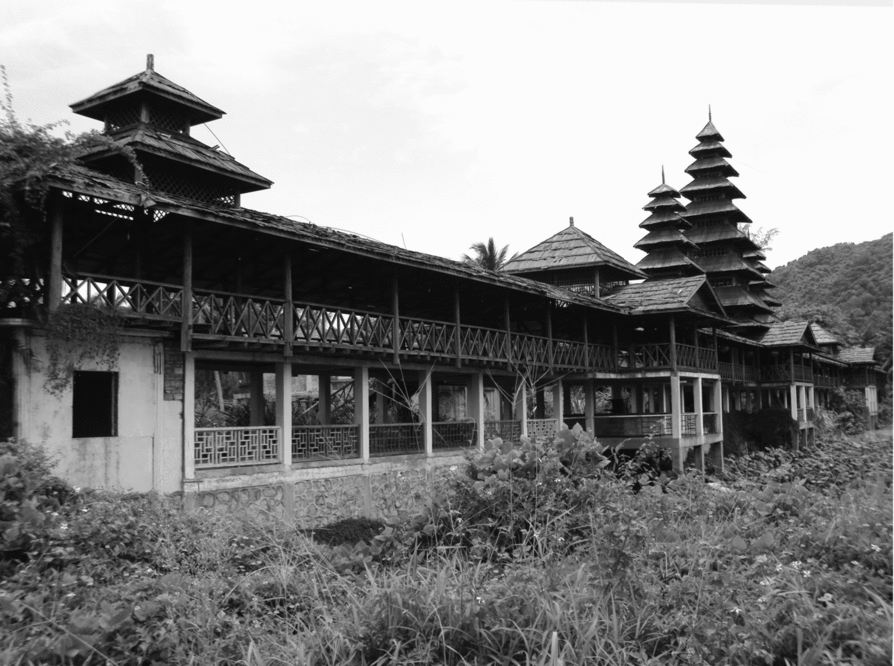
With regard to the tourism development of the farms, the farms’ inhabitants expressed reservations over the sustainability of this economic strategy as a revenue-generating enterprise for the farms. As the research progressed through repeated visits, respondents from one of the farms gradually revealed that the farm's tourism had been a loss-making venture for consecutive years. A respondent identifying as a second-generation inhabitant said, half-jokingly, that the local cultural performance venue known as the fengqingyuan (‘cultural custom garden’; see Figure 1 for an example) ought to be renamed the fengrenyuan (‘madhouse’) because ‘the wages there are so low that it would be crazy to work there’. Another respondent told us that he had scratched away his house number on a signboard that pointed tourists to his home, which had been presented by the tourism planners as an example of how the Southeast Asian refugee-returnees lived. He said that the tourism planners had not obtained his permission to put his house number on the signboard and he felt like he and his family has been put on display like animals in a zoo.
Example of an abandoned performance venue in the Indonesian architectural style. Source: Author's own.

The discussion in this section shows that tourism planners have capitalized on claims to multiculturalism and diasporic consciousness to reinvent the overseas Chinese farms as revenue-generating ventures. However, the multiculturalism featured is superficial and glosses over the tensions between plural cultural groups. It also trivializes and commodifies the Southeast Asian cultures represented on the farms. The next section further highlights how assimilation processes have subsumed the transnational cultural identities of the later generations.
Generational transitions, assimilation processes
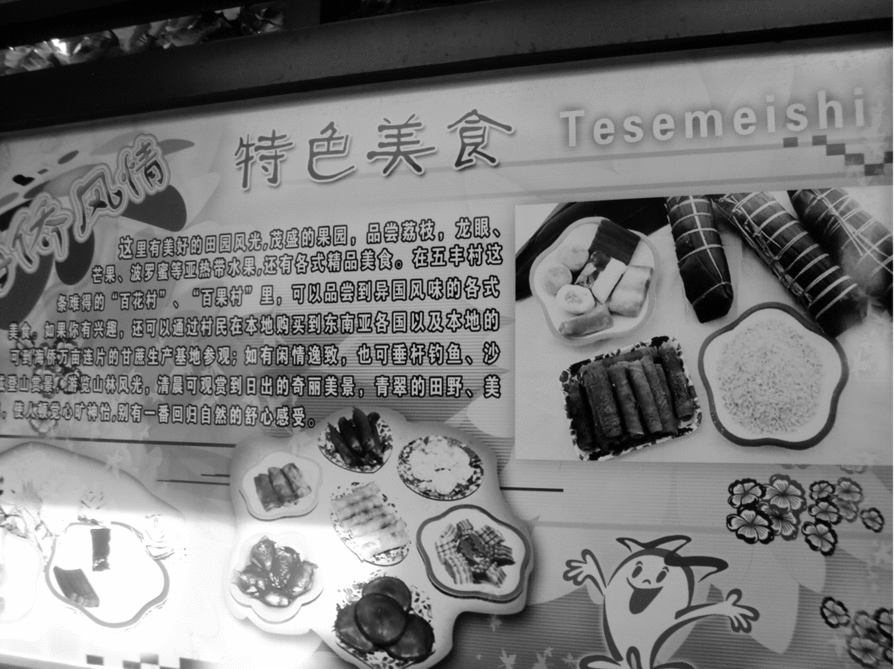
Despite claims to multiculturalism, a prevailing Han Chinese national identity has absorbed aspects of the transnational cultural identities once held by the original cohorts of refugee-returnees. Visits to a local school on one of the farms showed that the school projects a multicultural educational environment for the students who come from the farm and neighbouring villages. The walls are decorated with large, colourful information posters featuring Southeast Asian geographies, festivals, and the multicultural cuisines of the farm's refugee-returnees (see Figure 2). However, there is no mention of the difficult circumstances of the forced migration experienced by the earlier cohorts of refugee-returnees. The language of instruction in school is Mandarin and the only second language the schoolchildren learn is rudimentary English. The school principal divulged that children of new internal migrants and the locally born Chinese from villages in the vicinity make up the majority of children at the school now. The grandchildren of the refugee-returnees, though likely to have returned to the farm to be cared for by their grandparents temporarily, usually move back to the cities to join their parents once they are of school-going age. This is because their parents want them to have a better educational environment provided by urban schools.
The multicultural cuisine of the farm inhabitants, as featured on an information board in the school. Source: Author's own.
Able-bodied adults from the farm have been independently out-migrating to prosperous Chinese cities to find employment (dagong) as peasant workers (nongmingong) since strict internal migration control was lifted in recent years. This mobility is different from the earlier labour deployment policy in which the Qiaoban, acting on behalf of state-owned enterprises, sent the second-generation youths to take up jobs in the cities. The later batch of out-migrants sometimes start small businesses selling cooked food, clothing or electronic items in the cities. Others take on low-paying jobs as factory workers or kitchen help obtained through the recommendation of fellow villagers. Such waged work pays around 2,000 yuan (US$300) a month. These jobs are still considered better paying than those they would have on the farm as cultural performers for the tourism venture. The enterprising out-migrants who persevere are able to save enough to buy a small flat in the city and succeed in relocating their hukou, or household registration, to the city.Footnote 27
But, as Han documents, the nongmingong experience racialization and discrimination in the cities on the basis of their physical comportment and ‘caste’ backgrounds.Footnote 28 So life for the children of the refugee-returnees, unless they are in white-collar professions, is not easy outside of the farms either. Some in the younger generation are unable to endure the toil of working in the cities or are retrenched from their jobs and they end up returning to the farm, waiting for their fellow villagers working in the cities to introduce them to new job opportunities. During conversations with youths who have returned under these circumstances, they confided that they are the subject of village gossip and scorn because they are seen to be ‘failed migrants’. Apart from the young adults who have chosen to stay behind to work on the farms, they represent the other group of youths are still living in the farms—but only because their stints in the cities had been unsuccessful.
Unlike the first-generation's sentimental recounting of their lives in Southeast Asia, the second and third generations still remaining on the farms could tell us little about the countries their parents and grandparents had come from. They do recognize their bicultural identities as Malayan-, Indonesian- or Vietnamese-Chinese. Sometimes with a sheepish grin and at other times matter-of-factly, the Indonesian-Chinese and Vietnamese-Chinese youth would admit that they no longer speak Bahasa Indonesian or the Vietnamese language. They say they were not taught these languages at school since the language of instruction is Mandarin. At home they are unable to communicate with their older family members in Bahasa Indonesian or the Vietnamese language either. Few of the younger generation members we met on the farms have visited the Southeast Asian countries their parents or grandparents fled. This is not only a matter of the expense of travel but also because they lack familiarity with those countries and they don't speak the languages any more. In comparison, several of the older generation have returned to visit the countries they left. One Indonesian respondent in his seventies told us proudly, ‘It was easy for me to get through immigration in Indonesia because I spoke Bahasa to the immigration officer. She even chatted happily to me for a while.’
At a karaoke bar one evening, amid the cacophony of a singalong and caiquan games (a popular finger-guessing ritual accompanied by alcohol consumption), we asked one 18-year-old youth if he knew where his peers’ families had come from in Southeast Asia before they arrived in China. His lackadaisical reply was, ‘I don't know and we are all guiqiao (returnees) so it doesn't matter from which country we came.’ Upon further probing he added, ‘When we are together we don't ask each other things like this.’ Indeed, his response is typical of the later generations who have little interest in family histories that pre-date their arrival in China. Due to their forced migration backgrounds and the earlier societal and migration controls implemented by China, there was a period during which their family and cultural ties with Southeast Asia were severed. Unlike the older generation, they have few personal memories of family members remaining in Southeast Asia. This limits even the ‘emotional transnationalism’ described by Wolf in her study of second-generation children of Filipino immigrants,Footnote 29 which is characterized by sentimental relationships with extended family members left in ‘the home that constitutes their parents and grandparents’ primary point of reference’.Footnote 30
One parent, himself a Malayan returnee who is married to a Vietnamese returnee, related bitterly, ‘My children don't want to listen to our stories when we try to tell them about the difficulties we faced. They say to us, “Do you want us to feel grateful to you for suffering on our behalf?”’ Unlike the older generation who negotiate transnational identities, the sense of belonging experienced by the later generations is not oriented towards Southeast Asia any more. However, it would be incorrect to claim that their sense of belonging is rooted in China because interactions and interviews with the younger generation suggest that even in China they experience rootlessness as they seek direction in their lives. As Zhou notes of the children of Vietnamese refugees in America:
Most [of] the refugees lack education, job skills, and measurable economic resources. They also suffered from the trauma of war and flight and from the severe emotional distress that they experienced at refugee camps . . . The parents’ low socioeconomic status makes it difficult for the children to succeed, even though both parents and children desperately want to get ahead.Footnote 31
The same can be said of the children of the refugee-returnees who grew up in rural China. Even though their parents received state assistance when resettling in China, their families remained impoverished. The younger generation generally have low levels of educational achievement.Footnote 32 Those who move to the cities are doubly excluded from the urban population because, first, their forced migration family histories and status as a group within Chinese society that arrived with few resources disadvantages them, both materially as well as by way of human capital. Second, their rural backgrounds identify them as a ‘caste’ group in urban China.Footnote 33 The social capital that they do have through the chain migration networks limits them to the blue-collar jobs that their fellow villagers have in the cities.
The passage of time leads to forgotten forced migration histories and, in conjunction with language and other assimilation processes, the Southeast Asian cultures featured as multiculturalism on the farms are fast becoming little more than kitsch displays of ‘cultural exoticism’ for tourists’ consumption.Footnote 34 Alongside this, intermarriage trends between the descendants of the refugee-returnees and the locally born Chinese from neighbouring villages or the new internal migrants from other parts of China are common, resulting in the younger generations becoming increasingly distanced from their Southeast Asian heritage.
There is, however, an added dimension to the socially complex trends described above. A number of the earlier out-migrants deployed by the Qiaoban to work in the cities continue to cherish the memories they have of growing up on the farms and their cultural identity associated with the overseas Chinese farms. This group who settled in the cities have limited personal ties and contact with the Southeast Asian countries to which their parents claim a feeling of belonging. However, they filter claims to transnational identities by selectively invoking the labels guiqiao or huaqiao. To emphasize the patriotism associated with their parents’ decision to return to China, they lay claim to a guiqiao (returnee) identity while downplaying the forced migration histories that prompted the return of the nanqiao (refugees). To highlight their distinctive cultural identities fomented by growing up on the overseas Chinese farms populated by Southeast Asian communities, they claim to be huaqiao (overseas Chinese), even though they have not lived overseas. What these observations attest to are the slippery ways in which the categories of huaqiao, guiqiao, and nanqiao have been used historically and even in contemporary times—this is what Spivak terms as ‘strategic essentialism’ but with a Chinese twist.Footnote 35
Conclusion
This article considered the way in which transnationalism, multiculturalism, and assimilation processes co-exist in tension in contemporary China. The historical forced migration of Chinese co-ethnics from Southeast Asia and their resettlement in China are a phenomenon little known outside of mainland China. But their experiences provide a useful analytical lens for understanding the resilience of transnational identities in the lives of forced migrants more generally. The case of China, however, also demonstrates how state planners capitalize upon the distinctive cultural identities of the refugee-returnees to market the farms on which they live as multicultural communities for tourism as a result of wider economic reforms in Chinese society. The end result is a semblance of multiculturalism that is trivialized and disassociated from the everyday experiences of the refugee-returnees, some of whom bear covert racist attitudes towards their fellow villagers.
This article also moves the focus of integration and assimilation debates away from the existing scholarship on Chinese immigrants based on North American, European, and Southeast Asian experiences. The article further enlarges debate on majority–minority relations in China to critically examine the nuanced social differences observable within the category recognized as Han Chinese through the return migration experiences of co-ethnics born and raised abroad (guiqiao). The guiqiao had adopted the cultural habits and language of their host societies in Southeast Asia, which sets them apart from the China-born Chinese. The objectification and commodification of their guiqiao identities for domestic tourism serve to normalize the culture of the locally born Chinese and assert a new national narrative of contemporary China that is distinct from the overseas Chinese identity.
The discussion of the second and third generations signals that the younger generations are experiencing assimilation processes. Among the second generation who had been deployed by the state in earlier years to work in the cities, a sustained period of time away from the farms triggers nostalgia that materializes as an effort to maintain the transnational identities of their parents. However, the cultural practices they retain are limited by the lack of personal immersion in the Southeast Asian cultures their parents knew well. For them and their children in the third generation, claims to huaqiao and guiqiao identities are situationally invoked but their identity framings can be more appropriately described as anchored in and filtered by their experiences of growing up in the overseas Chinese farms, rather than an overseas experience in itself.
As for those who moved to Chinese cities independently when internal migration controls were lifted, the research suggests that they experience a rootlessness arising from their doubly disadvantaged rural and forced migration backgrounds. Their low educational levels coupled with the dynamics of chain migration networks that trap them in low-paying, casual labour jobs limits their upward social mobility.
This article thus suggests that further research might be conducted on the lives of the younger generation who are considered guiguo huaqiao (returnees from abroad) but whose experiences are inflected by the intersection of forced migration family histories, bi-cultural backgrounds, class subjectivities, and rural locations. Moreover, as China opens its doors to new immigration, other types of Chinese diasporic descendants are arriving (or ‘returning’) to study, work or live in the ancestral homeland. The negotiation of their identity as people of Chinese ethnicity born abroad but who are more removed from the nation-building project of contemporary China and its inclination towards assimilation provide new research avenues for overseas Chinese studies and will help develop a better understanding of China in transition.