Whether state repression impedes or exacerbates popular mobilization is one of the oldest questions in comparative politics. Scholars have found that repression can inspire renewed vigor by social movements and backlash against the government (Hess and Martin Reference Hess and Martin2006; Sullivan and Davenport Reference Sullivan and Davenport2018), while in other cases it appears to effectively suppress dissent (Davenport Reference Davenport2014; García-Ponce and Pasquale Reference García-Ponce and Pasquale2019). While these findings appear contradictory at first glance, it is sensible to assume that repression will be ‘effective’ (from the state's perspective) in some cases and ‘counterproductive’ in others. In this article, we make timely contributions to the literature on repression and dissent by exploring the effects of recent actions by the Spanish state against the Catalan independence movement.
Throughout its history, the nationalist movement in Catalonia has involved periods of both civil resistance and peaceful relations with the state (Krause Reference Krause2017). However, a unilateral push by the Catalan government to hold a popular referendum on independence in October 2017 sparked a crackdown that was without precedent in the modern history of the region. The crackdown involved police raids of Catalan government headquarters and ballot printing companies, threats of sedition charges and the violent dispersal of citizens attempting to vote during the referendum, which left approximately 1,000 civilians injured.Footnote 1 Importantly, these events were highly visible and broadly covered in Catalan news outlets and social media.
We leverage polling data from Catalonia, fielded around the time of the referendum, to estimate the effect of repressive actions by the Spanish state on citizens' attitudes toward independence. We focus on attitudes toward independence – the key point of contention between Catalan nationalists and the Spanish state, and a central question to all self-determination movements. We match respondents across a host of key socio-demographic characteristics and compare responses gathered before the referendum crackdown to those collected just two weeks after. We find that state repression increased support for independence among citizens and decreased support for actors seen as either culpable or complicit in the state crackdown, including the EU. Using an original survey, we also find correlational evidence that social proximity to the crackdown is associated with enhanced support for independence and an increased likelihood of participating in post-crackdown protests, underscoring the potential for repression to instigate future dissent.
Our contributions are twofold. First, while the impact of repression on social movement outcomes has been widely studied, we have less individual-level evidence on how the broader public responds to state repression of movements (García-Ponce and Pasquale Reference García-Ponce and Pasquale2019). Understanding public responses to repression in these contexts is critical, since both states and social movements seek to (de)mobilize a wider audience through their actions (De Mesquita Reference De Mesquita2007; McAdam Reference McAdam1986). Our findings are somewhat ambivalent on this front: while we find a rise in support for independence, it is ultimately short-lived. Whether repressive actions fully backfire on states may thus depend on whether social movements can successfully leverage these brief windows of increased support.
Secondly, while much of the literature on repression focuses on cases of substantial levels of repressive violence (for example, killings, disappearances, torture) (Davenport Reference Davenport2014; Lindemann and Wimmer Reference Lindemann and Wimmer2018), we present evidence that publics also respond to ‘softer’ repression (for example, arrests, nonlethal crowd dispersion). This distinction is important both because ‘soft’ repression is much more common than its substantial counterpart and because we expect publics to view certain forms of repression as inherently more justifiable than others (Chenoweth, Perkoski and Kang Reference Chenoweth, Perkoski and Kang2017).
We begin with a synopsis of the Catalan context and 2017 referendum crackdown. We then discuss our empirical strategy and results. Finally, we discuss the implications of our findings for the broader study of repression and mobilization.
The Catalan Context
Contemporary Catalan nationalism has its roots in the nineteenth century, when it emerged as an alternative to Spanish nationalism in a country that did not successfully culminate its nation-building process (Balcells Reference Balcells2013). Over time, national minorities in Spain have gained some level of self-rule through a decentralized system (Beramendi Reference Beramendi2012), though in an uneven manner: the Basque Country and Navarre regions were granted fiscal privileges not afforded to others, including the Catalonia. This uneven access to fiscal autonomy coupled with a broader desire for increased political autonomy have historically spurred tensions between Catalonia and Madrid.
The roots of the most recent wave of escalation date back to 2010, when the Spanish Constitutional Court revised the Statute of Autonomy of Catalonia in a manner that significantly weakened the region's autonomy. In response, support for independence swelled (Centre d'Estudis d'Opinió), and in 2014, the Catalan premier Artur Mas moved to organize a referendum vote on self-determination. The Spanish Constitutional Court rejected the referendum, and as a result, organizers rebranded the vote a ‘participation process’ without legal ramifications. The vote was held on 9 November 2014 without Spanish interference and saw a relatively high turnout and over 80 per cent support for independence. For their part in the process, Mas and his collaborators were later criminally prosecuted and made to pay large fines.Footnote 2 Separatism further gained steam in 2015, when a political coalition called Junts pel Sí (Together for the Yes) won a majority of seats in the Catalan Parliament with a program to achieve independence within eighteen months. In what followed, the new premier Carles Puigdemont called for a unilateral referendum on independence. In defiance of the Spanish Constitutional Court, the referendum was approved amid controversy by a set of laws passed in the Catalan Parliament on 6–7 September and scheduled for 1 October 2017.
In the weeks prior to the referendum the political climate became increasingly heated as the Spanish government made efforts to prevent the vote, including the detention of several members of the Catalan government who were allegedly involved in its organization. In addition, a few days before the vote, the Spanish government sent thousands of national policemen to Catalonia in an attempt to deter voters and activists (Garcia Reference Garcia2017). Finally, at 8:30 AM on 1 October, Spanish policemen began raiding polling stations across Catalonia, frequently using violence against nonviolent protesters in attempts to close polling stations and remove the ballot boxes (Human Rights Watch 2017). Quantitative accounts have found that polling stations where separatist leaders were likely to vote were especially subject to police violence, but that otherwise violence was randomly distributed across polling stations (Barceló Reference Barceló2018; Guinjoan and Rodón Reference Guinjoan and Rodón2017). Images of the violence circulated widely (via social media, but also through cell phones) and in national media, particularly in Catalonia. As a result, many Catalans witnessed the Spanish government's crackdown leading up to and including 1 October, either directly in the streets or through circulation and discussion in various media outlets.
Empirical Strategy
Data
The data for this project comes from two sources. The first is public opinion polling data from Centre d'Estudis d’Opinió (2017) (CEO), an institute funded by the Catalan Government that conducts public opinion surveys that are representative of the adult population of Catalonia. The polls ask approximately 1,500 Catalans a standard set of questions about their political views concerning Catalonia and Spain, which allows us to compare broad changes in attitudes across surveys.
Our primary outcome of interest is a binary variable that asks respondents whether they would vote in favor of Catalonia becoming its own country (Independence Vote). We also collect data on socio-demographic characteristics, including age, income level, work status, family ties to Catalonia (that is, number of parents who are Catalan), primary language spoken at home and education. Finally, we leverage a series of questions that ask respondents about their level of trust in various Spanish, Catalan and international institutions (11-point scale). The exact wording of survey questions is available in the Appendix, along with a description of sample characteristics.
The second data source is an original survey of Catalan citizens, which focuses on the effects of victimization during the referendum crackdown. The survey was fielded online in December 2017, approximately two months after the referendum (Balcells, Fernández-Albertos and Kuo Reference Balcells, Fernández-Albertos and Kuo2020). In addition to socio-demographic characteristics, the survey asks respondents whether and how they voted in the referendum, their level of support for independence, and whether someone close to them was injured in the crackdown (our measure of exposure to victimization). The survey is representative of the Catalan region and captures nearly 2,600 responses among adult Catalan residents. More details on survey wording and sampling are available in the Appendix.
Analysis
We turn first to the CEO polling data. In order to isolate the effectsFootnote 3 of state repression we create a pre- and post-crackdown sample of respondents out of the polling data. Responses before the crackdown come from two polls: Registre d'Estudis d'Opinió (REO) 850 (fielded 6–21 March) and REO 857 (fielded between 26 June and 11 July). Responses after the crackdown come from REO 863, which was fielded just a few weeks after the events of 1 October (16–29 October). We exclude a small number of responses collected after 27 October, when the Parliament of Catalonia unilaterally declared independence, an event that could confound our results.
Who chooses to participate in CEO polling before and after the crackdown might differ along important dimensions that could confound our estimates. While we do not find that response rates differ substantively across polls (Appendix Figure A1), we employ coarsened exact matching (Iacus and King Reference Iacus and King2012) to assuage some of these concerns. We use two pre-treatment polls in our sample to increase the available pool of matches in the post-treatment poll. We match respondents in our sample on all available ‘pre-treatment’ sociodemographic characteristics and compare attitudes towards various outcomes among the subset of respondents that meet our matching criteria.
The nature of the polling data presents us with two limitations. First, we cannot estimate the effects of individual repressive actions, but instead conceptualize the set of repressive tactics by the Spanish state to stop the referendum as a ‘bundled treatment’ (Enos, Kaufman and Sands Reference Enos, Kaufman and Sands2018). We argue that analyzing such bundled treatments is still valuable, as states rarely rely on a singular repressive tactic to curb social movements. A second limitation is the occurrence of other politically relevant events between July and October 2017 that are unrelated to state repression but which might shift public opinion. These include a terrorist attack by Islamists,Footnote 4 actions of defiance by the Catalan government (for example, a quickly retracted declaration of independence by Carles Puigdemont on 10 October) and similar actions by Catalan nationalists (for example, a massive labor strike on 3 October).
To address these limitations, we pursue two additional strategies. First, we replicate our matching and analysis using items on trust in various institutions and test whether the crackdown moved attitudes towards these actors in a manner that is consistent with the repression effect. While the previously described events might move public opinion in disparate directions, we contend that if what we are capturing in our analysis is the effect of the Spanish state's repression of the referendum, then we should observe that attitudes towards actors linked to the Spanish state and government will worsen, but that attitudes towards actors associated with the Catalan government will be unaffected.
Secondly, to address whether acts of dissent (such as holding the referendum at all) might boost support for independence, we leverage polling data around the 2014 referendum attempt, which the Spanish government critically did not violently repress. While the 2014 referendum organizers were ultimately fined and, in some cases, prohibited from holding public office, citizens were able to vote in the referendum without police interference and there were no reported cases of police assaulting protesters. However, there are important differences between the two referendum attempts that make them difficult to compare directly, including that organizers in 2014 reframed the referendum as a ‘non-binding consultation’ to reduce tension with the Spanish state. Accordingly, we present this evidence as suggestive and note its limitations here (more details are available in Appendix).
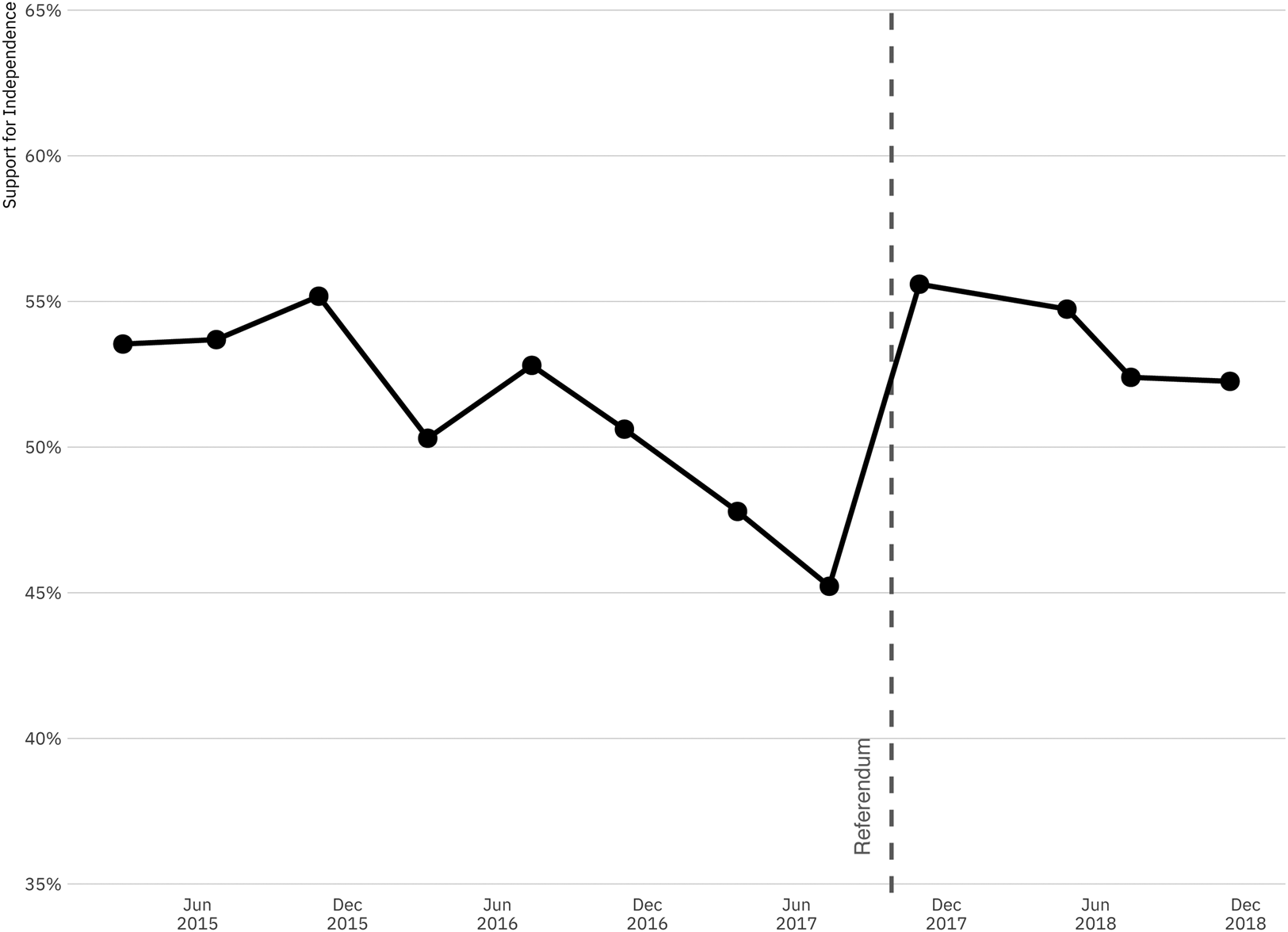
Figure 1 plots the average levels of support for independence over all CEO polls covering the June 2015 – November 2018 period. It shows that Catalan independence is a contentious issue, with the proportion supporting independence hovering around the 50 per cent mark throughout this period. The time series also points to a steady decline in support for independence between 2015 and 2017, hitting a low in July 2017. Foreshadowing some of our findings, the October 2017 poll shows a substantial spike in support for independence. The 2017 referendum crackdown boost slowly tapers off in 2018, but does not fully return to July 2017 levels.
Support for independence over time
Note: points indicate individual polls. Dashed vertical line denotes date of referendum (October 2017).
Source: CEO public opinion polls.

Results
Pre- and post-matching balances are available in Appendix Tables A5 and A6 and indicate improvements in balance across pre-treatment characteristics. In line with the expectation that the crackdown would increase support for independence, we find a statistically significant effect of 0.067 (p < 0.05). This indicates that survey respondents were 7 per cent more likely to support independence after the referendum crackdown, a sizable effect – which could theoretically flip the independence question from minority to majority support – for what is a very polarizing issue in Catalan society.
We conduct additional analyses in the Appendix, including a placebo test of an earlier time period (Appendix Table A10) to rule out secular time trends. We also test for the duration of the effect and find that the pro-independence boost tapers off by January (Appendix Table A10). Finally, as previously noted, we also replicate our analysis around the 2014 referendum and find no evidence that support for independence increased in response to these events (Appendix Table A11). We offer this as suggestive evidence that broad actions of dissent, such as the act of holding a referendum, in and of themselves, are not likely to be driving our main results.
We also consider the effect of repression on attitudes toward key actors in the referendum process and crackdown (Figure 2). The changes reflect a coherent logic: actors perceived to be involved in the crackdown, representative of or loyal to the Spanish state experienced significant drops in confidence, especially the Spanish police, which experienced a whopping two-point drop in trust. The EU's loss of support likely reflects dissatisfaction with the EU leadership's refusal to condemn the crackdown (Henley Reference Henley2018). Conversely, actors associated with the Catalan government experience either positive or no shifts in public confidence. Collectively, these effects fall in line with what we might expect from the crackdown and not some competing event.
Estimated repression effects on trust in various Catalan, Spanish and European institutions

Victimization Analysis
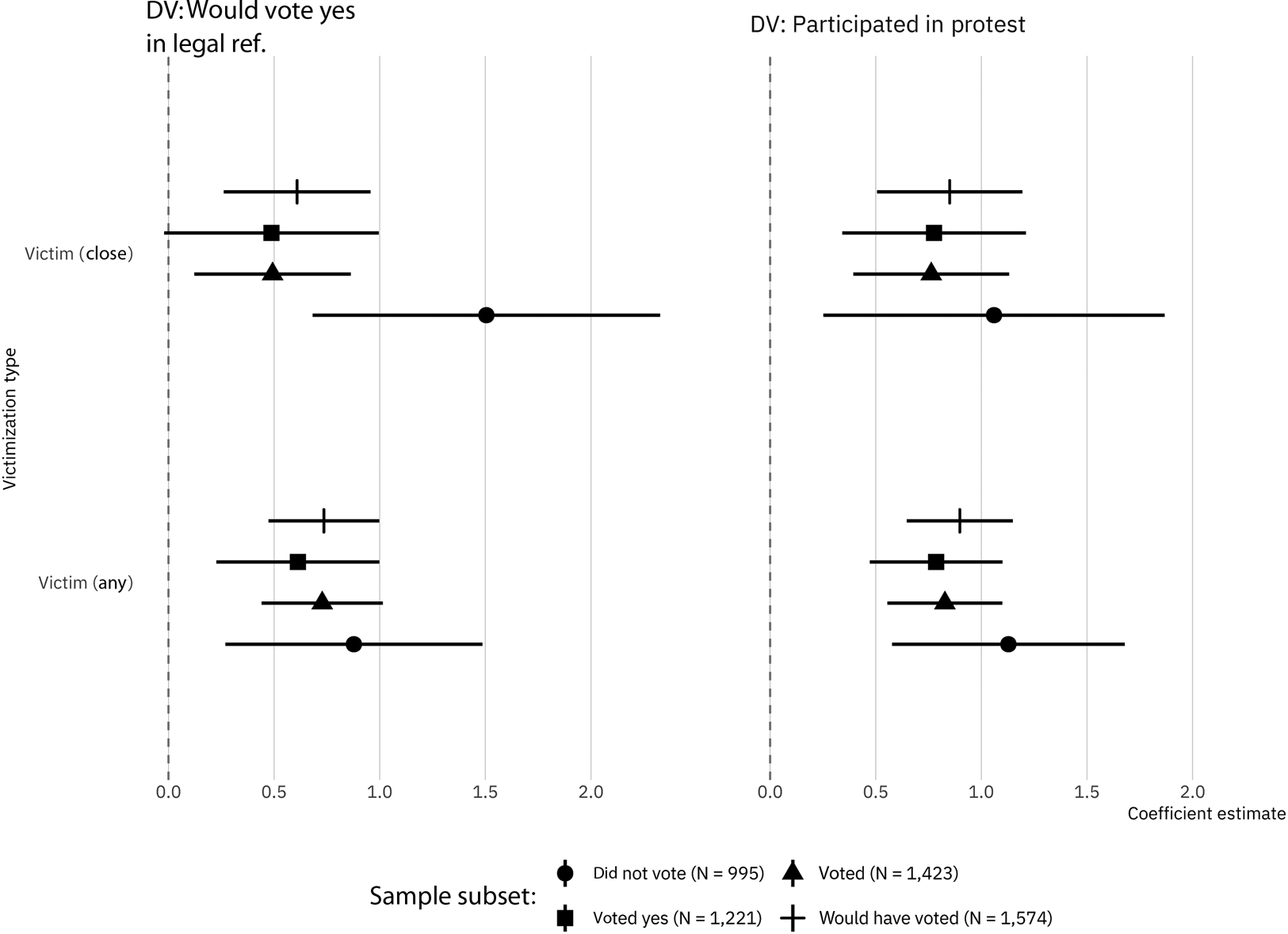
We turn to our original survey of Catalan attitudes and victimization. Our key explanatory variable is an indicator of whether the participant personally knows anyone who was injured in the 1 October referendum (victimization). We also replicate the analysis using an indicator of whether the person was a family member or close friend (close victimization).Footnote 5 Our dependent variables are support for independence and participation in protests against state repression. Thus we include a set of control variables in our regression that are thought to influence attitudes towards independence and propensity to participate in dissent (age, household adjusted income, ideological self-placement, gender, employment status, level of education, indicators for whether the person is primarily a Catalan speaker – vs. Spanish speaker – and an indicator for the individual's ancestry or Catalan origins) (Muñoz and Tormos Reference Muñoz and Tormos2015; Balcells, Fernández-Albertos and Kuo Reference Balcells, Fernández-Albertos and Kuo2020). More details are available in the Appendix.
Of course, victimization is non-random and a major concern here is that the choice to participate in the referendum is correlated with support for independence. We address this concern by estimating the effect of victimization on subsets of citizens who match in their referendum participation. Along these lines, we estimate the effect of victimization on subsets of respondents who: did not vote in the referendum, did vote in the referendum, voted in favor of independence in the referendum, and a subset who either voted in the referendum or indicated they could not go out to vote for logistical reasons (thus avoiding respondents who self-selected out of the referendum). A second potential confounder is differences in who does or does not have friends/relatives who participated in the referendum. As we do not have data directly on this question, we are limited in our ability to address this concern beyond our set of controls and simply acknowledge the limitation here.
The results in Figure 3 show that knowing a victim of the police crackdown is a significant predictor of higher support for Catalan independence, and the results are consistently positive across sample subsets. Importantly, the effects are higher among those who opted out of the referendum, and thus among those who most probably were not in favor of independence before 1 October 2017. Interestingly, those who know someone who was victimized are also more likely to have participated in subsequent protests than those without victims in their social circles. This is true even among non-referendum voters, which is especially striking. These results indicate the potential for repression to instigate future mobilization and backlash against the state (Sutton, Butcher and Svensson Reference Sutton, Butcher and Svensson2014). Taken together, these analyses give us confidence in rejecting the null hypothesis that state repression was ‘effective’ in the 2017-Catalan context.
Coefficient estimates from victimization sample

Conclusion
States often choose to repress separatist demands, even as the effects of repression are often difficult to determine. In the Catalan case, repression could have driven those who were ambivalent about independence to become resolutely against separation over fears of future conflict with the Spanish Government. Conversely, they could also have become defiantly more pro-independence due to moral outrage (Wood Reference Wood2003). Our findings suggest that the Spanish state's actions regarding the independence referendum in Catalonia deepened both pro-independence attitudes and antipathy for Spanish state actors. We further find that those close to someone who was victimized were particularly likely to support separation, and more likely to engage in post-referendum protests against the Spanish state. This finding is notable as the rapid adoption of smartphones and social media around the world increase explicit exposure to victimization within social networks.
Our findings echo the literature on repressive ‘backfire’ or ‘political jiu-jitsu’ (Sutton, Butcher and Svensson Reference Sutton, Butcher and Svensson2014), which suggests state repression can be counterproductive. The backlash to the October 2017 crackdown is particularly striking given that the Spanish state's repressive actions were relatively low intensity. While state actors might argue that the potential backlash of repression is offset by the benefit of impeding secession, we observe that support for independence waned in the wake of the 2014 referendum, where the Spanish state chose not to repress participants. On the whole, our study suggests that states may be more successful at protecting their territory through institutional means than through repression.
Our research raises several questions for future research. Comparing patterns of repression and mobilization in other contexts (for example, Hong Kong, Chile, United States) would help address concerns of generalizability. Further, while extant work has largely assumed uniform responses to repression, future work should explicitly theorize on and test for heterogeneous effects of repression. Lastly, further research should attempt to tease out the precise mechanisms through which state repression produces increased demand for political reform.
Supplementary material
Data replication sets are available in Harvard Dataverse at: https://doi.org/10.7910/DVN/KWS9UD and online appendices at: https://doi.org/10.1017/S0007123420000307.
Acknowledgements
For their comments and suggestions to previous versions of this letter, we thank Consuelo Amat, Carolina de Miguel, Kosuke Imai, Marc Rovik, Raül Tormos, Christopher Sullivan, Johanna Birnir, Joakim Kreutz, three anonymous reviewers, and participants in the FBA Workshop in Stockholm in June 2018, as well as panels at APSA 2018 and ISA 2018. We thank Duke University for research support.