Introduction
The German population is currently one of the oldest in the world and this trend is most likely to continue during the coming decades (Rowland Reference Rowland, Poston and Uhlenberg2009). The steady increase of older age groups is likely to put pressure on the social security and pension systems in the future, especially when the baby-boomers born between 1955 and 1965 enter retirement from 2020 onwards. Against this background, a debate on active and productive ageing has emerged in Germany and also in the Organisation for Economic Co-operation and Development (OECD) countries at large (e.g. Federal Ministry for Family Affairs, Senior Citizens, Women and Youth 2010; Bussolo, Koettl and Sinnott Reference Bussolo, Koettl and Sinnott2015; Kocka and Staudinger Reference Kocka and Staudinger2009; Staudinger et al. Reference Staudinger, Finkelstein, Calvo and Sivaramakrishnan2016). The debate has been focusing on older adults' potential for the labour market, civil society and intergenerational support within the family.
In social gerontology, the term ‘productive ageing’ has a long tradition starting in the 1980s, when the concept was first introduced by Robert N. Butler (Bass and Francis Reference Bass, Francis, Hinterlong, Sherraden and Morrow-Howell2001; Butler and Gleason Reference Butler and Gleason1985). There are different definitions of productive ageing and its underlying dimensions (Bass Reference Bass, Carr and Komp2011). We refer to a definition that includes any activity that contributes to producing goods and services, whether paid or unpaid (Bass and Francis Reference Bass, Francis, Hinterlong, Sherraden and Morrow-Howell2001). According to the third-person criterion, this involves marketable activity which can generally be provided by a third person for payment (Hank and Erlinghagen Reference Hank, Erlinghagen, Erlinghagen and Hank2008; Hawrylyshyn Reference Hawrylyshyn1977). Against the background of this definition, productive activities not only include paid work, but also formal or associational volunteering (Wilson Reference Wilson2000) as well as informal volunteering, which means helping activities within social networks (Hank and Erlinghagen Reference Hank and Erlinghagen2010) or civic participation (Burr, Caro and Moorhead Reference Burr, Caro and Moorhead2002; Martinson and Minkler Reference Martinson and Minkler2006), and family support like child care and care-giving for ailing or disabled persons (Wija and Ferreira Reference Wija, Ferreira, Holmerova, Ferreira and Wija2012). Recent studies showed that older persons' productive activities within some of these areas have increased over recent years in Germany. This is especially true for the rising labour-market participation of retirees who already receive an old-age pension (Deller and Maxin Reference Deller and Maxin2009; Lippke, Strack and Staudinger Reference Lippke, Strack, Staudinger, Schneider, Mergenthaler, Staudinger and Sackreuther2015; Mergenthaler, Wöhrmann and Staudinger Reference Mergenthaler, Wöhrmann, Staudinger, Schneider, Mergenthaler, Staudinger and Sackreuther2015). Moreover, there is also evidence for an increased participation of older people in community volunteering (Mergenthaler, Wöhrmann and Staudinger Reference Mergenthaler, Wöhrmann, Staudinger, Schneider, Mergenthaler, Staudinger and Sackreuther2015).
The study of such productive activities is particularly relevant for the post-retirement phase, which is characterised by large inter-personal differences since there are few societal expectations guiding choices compared to earlier life phases, especially that of active working life. Therefore, a ‘roleless role’ (Burgess Reference Burgess1960) is a typical situation for older adults who just entered the retirement phase, which is accompanied by an individual adjustment process to this new phase in life conjointly affecting multiple areas of life (Shultz and Wang Reference Shultz and Wang2011; Wang and Shi Reference Wang and Shi2014). The entry into the third age which typically coincides with retirement can therefore be described as a highly personalised project: ‘Without taken-for-granted blueprints, people must strategically select their own pathways through this emerging life stage’ (Moen Reference Moen, Carr and Komp2011: 14). Against this background, the study of multiple productive activities among older people with a focus on their intensity and interrelations seems especially fruitful to establish new insights in the complex debate on productive ageing. Apart from the opposing views of active ageing or disengagement (e.g. Cumming and Henry Reference Cumming and Henry1961), analysis of clusters of multiple activities can provide a more comprehensive understanding of the complex way in which productive activities and time commitments are related. Thus, the aim of this study is to investigate whether in the phase immediately after retiring older adults differ in their patterns of productive activities in the sense of forming distinctive clusters and how those clusters differ with regard to individual, familial and economic resources.
Evidence and conceptual approaches on the clustering of productive activities
Generally, national and international studies rather consider productive activities as individual or discrete phenomena than related to activity patterns. This perspective fails to represent the differentiated productive potential of older age groups. Older individuals are engaged in different areas of productivity like the labour market, civil society or the family. They do so by investing various amounts of time (i.e. intensity), from occasional activity to daily engagement. In order to arrive at a full picture of retirees' productive activities, it is important to examine different productive activities simultaneously with regard to their intensity and interrelations.
Only recently, the question whether those activities are interdependent (Burr et al. Reference Burr, Choi, Mutchler and Caro2005; Choi et al. Reference Choi, Burr, Mutchler and Caro2007; Mutchler, Burr and Caro Reference Mutchler, Burr and Caro2003) or even form distinctive clusters among older age groups has been addressed by studies mostly from the United States of America (USA) (Burr, Mutchler and Caro Reference Burr, Mutchler and Caro2007; Morrow-Howell et al. Reference Morrow-Howell, Hong, McCrary and Blinne2011, Reference Morrow-Howell, Putnam, Lee, Greenfield, Inoue and Chen2014). Hank and Stuck (Reference Hank and Stuck2008) compared several European countries on the basis of the Survey of Health, Ageing and Retirement in Europe (SHARE). Those studies support the hypothesis that productive activities like paid work, volunteering and informal help, as well as care at the individual level, form distinctive clusters among higher age groups. On the basis of the Americans' Changing Lives survey (ACL), four clusters of productive activities (helpers, home maintainers, worker/volunteers and super helpers) were identified in a sample of respondents aged 55 years and older (Burr, Mutchler and Caro Reference Burr, Mutchler and Caro2007). Similar findings were reported for a latent class analysis of the Health and Retirement Study (HRS), which revealed five activity profiles among older adults that varied in amount and type of activity: low activity, moderate activity, high activity, working and physically active (Morrow-Howell et al. Reference Morrow-Howell, Putnam, Lee, Greenfield, Inoue and Chen2014).
Studies on formal and informal activities of older adults showed that the amount of resources available to the individual as well as socio-demographic characteristics and social context play an important role in explaining engagement versus non-engagement in later life (Hank and Erlinghagen Reference Hank, Erlinghagen, Erlinghagen and Hank2008; Wilson Reference Wilson2000; Wilson and Musick Reference Wilson and Musick1997a). Regarding the correlation of productive activities, studies report that individual (e.g. health, education), familial and economic resources are positively associated with clusters that are characterised by a greater amount of activities (Burr, Mutchler and Caro Reference Burr, Mutchler and Caro2007; Morrow-Howell et al. Reference Morrow-Howell, Putnam, Lee, Greenfield, Inoue and Chen2014). Additionally, there is evidence for the influence of socio-demographic characteristics. As people get older, their participation in clusters that are mainly characterised by activities outside the home decrease while participation in clusters with activities around the home increase. Moreover, women are more often involved in clusters with familial or household activities (Burr, Mutchler and Caro Reference Burr, Mutchler and Caro2007).
To describe and to interpret the clusters, not only the type of productive activities are important, but also the patterns of correlation between those activities. Regarding the type of productive activity, one can distinguish between obligatory (e.g. care-giving for a disabled or ailing family member) or discretionary (e.g. formal and informal volunteering). The correlation between those two types of productive activities can be complementary or substitutive (Burr, Mutchler and Caro Reference Burr, Mutchler and Caro2007; Choi et al. Reference Choi, Burr, Mutchler and Caro2007). A complementary correlation implies that if someone is active in one domain, the likelihood for him or her to be active in another is higher compared to someone who is not active. By contrast, a substitutive correlation implies that if one is active in one domain, the likelihood of being active in another is lower. This distinction also corresponds to the assumptions of role theory, which refers to role extension, which is likely to be associated with a complementary association between productive activities (Choi et al. Reference Choi, Burr, Mutchler and Caro2007), and role substitution or role overload, which increases the chance of substitutive relations of productive activities (Mutchler, Burr and Caro Reference Mutchler, Burr and Caro2003). The role extension hypothesis argues that engagement in multiple productive activities is likely because larger informal social networks and formal support systems (e.g. work-based contacts) provide opportunities to engage in more than one activity. Moreover, the engagement in several productive roles can be a part of an individual's coping strategy with a sense of burden, stress or anxiety experienced in other activities, especially care-giving (Choi et al. Reference Choi, Burr, Mutchler and Caro2007). Several studies reported evidence in line with the assumptions of this hypothesis. Hank and Stuck (Reference Hank and Stuck2008) found a complementary relationship between productive activities (volunteering, informal help and care-giving). This association was observed for obligatory as well as discretionary activities. A complementary correlation between volunteering and various other activity domains (e.g. adult education, recreational leisure, cultural activities) was also observed in a recent study of 65–80-year-old retirees from Belgium (Dury et al. Reference Dury, Donder, Witte, Brosens, Smetcoren, van Regenmortel and Verté2016). Burr et al. (Reference Burr, Choi, Mutchler and Caro2005) reported a complementary association between care-giving and volunteering among age 50 and older respondents to the ACL survey. Even though the findings of empirical studies on the correlation between paid work and volunteering among older adults is mixed, there is evidence of a complementary correlation between paid work and volunteering in retirement (Dosman et al. Reference Dosman, Fast, Chapman and Keating2006). Wilson and Musick (Reference Wilson and Musick1997b) assume that occupations that demand autonomy or initiative will encourage voluntary participation in civil society since both activities rely on the same individual qualities. Moreover, paid work can be regarded as a discretionary or optional activity in retirement just like volunteering, which means that it is partly based on individual preferences and lifestyle (Burr, Mutchler and Caro Reference Burr, Mutchler and Caro2007) even though financial or normative pressure cannot be ruled out completely (Wilson and Musick Reference Wilson and Musick1997a).
In contrast to the role extension hypothesis, the role substitution or role overload hypothesis argues that there is a competitive correlation between productive activities: care-giving or full-time employment are time-consuming activities which may cause physical and mental stress especially to older people. Therefore, they are considered to compete with each other for the individual's time and energy (Burr, Mutchler and Caro Reference Burr, Mutchler and Caro2007; Choi et al. Reference Choi, Burr, Mutchler and Caro2007). Thus, the role overload theory suggests that the negative association between formal and informal productive activities is caused by role-demand overload as an expression of time constraints or role conflict which is likely to result in psychological strain (Choi et al. Reference Choi, Burr, Mutchler and Caro2007). To cope with these psychological tensions and role conflicts, older adults reduce the number of productive roles or concentrate on one or a few roles that are central to them. Since family engagement is based on societal norms, it leaves people little choice about whether or not to participate. Consequently, care-giving or child care within the family can be regarded as obligatory or compulsory activities. With some exceptions (Burr et al. Reference Burr, Choi, Mutchler and Caro2005), studies have shown that obligatory activities compete with discretionary activities like formal or informal volunteering (Burr, Mutchler and Caro Reference Burr, Mutchler and Caro2007; Choi et al. Reference Choi, Burr, Mutchler and Caro2007). Thus, at least some of the existing evidence points towards the role substitution hypothesis.
Clustering of productive activities against the background of cumulative inequality
The idea of an accumulation of resources and prestige became prominent in the social sciences by Merton's concept of the Matthew effect (Merton Reference Merton1968, Reference Merton1988). In social inequality research, this concept has become the basis for cumulative advantage/disadvantage theory (Dannefer Reference Dannefer1987, Reference Dannefer2003). Cumulative advantage/disadvantage can generally be defined as a systematic trend that increasingly differentiates people across the lifecourse regarding relative inequalities in material prosperity, social prestige, health or life expectancy (Dannefer Reference Dannefer2003). The mechanism of cumulation can generally be applied both to disadvantageous as well as to advantageous living and working conditions. Therefore, an accumulation of disadvantages is typically linked to unfavourable socio-economic starting conditions from lower socio-economic groups in early life phases, which increases the chance of further disadvantages in later life stages (Ferraro and Kelley-Moore Reference Ferraro and Kelley-Moore2003; Shuey and Willson Reference Shuey and Willson2008). An accumulation of advantages in the lifecourse develops analogously from a clustering of favourable socio-economic conditions in early life with further advantageous living conditions in later life phases.
In social gerontology, cumulative inequality theory has gained prominence in the last few years. This approach is specified as a middle-range theory that aims to bridge micro- and macro-sociological concepts (Ferraro and Shippee Reference Ferraro and Shippee2009; Ferraro, Shippee and Schafer Reference Ferraro, Shippee, Schafer, Bengtson, Gans, Putney and Silverstein2009). It basically assumes that ‘social systems generate inequality, which is manifested over the life course via demographic and developmental processes, and that personal trajectories are shaped by the accumulation of risk, available resources, perceived trajectories, and human agency’ (Ferraro and Shippee Reference Ferraro and Shippee2009: 334). Thus, cumulative inequality theory incorporated lifecourse trajectories like the transition to retirement and the individual development and adjustment processes that accompany those transitions. It provides a theoretical framework which points towards the close linkage of structure and agency in the lifecourse, especially with regard to the correlation of productive activities in early post-retirement. Therefore, cumulative inequality theory complements the concepts of role extension or role substitution by including unequally distributed resources that shape the opportunities for productive engagement in later life.
Hypotheses
In the light of the existing evidence, it seems that activities which are obligatory are more likely to be associated with role substitution whereas a strong engagement in discretionary activities is most likely linked with role extension. Against this background, the present study focuses on the following hypotheses regarding the composition of productive activities within the clusters:
• Hypothesis 1: According to the role extension approach, labour-market participation is positively correlated with formal or informal volunteering among retirees.
• Hypothesis 2: Based on the evidence on the role substitution approach, a high share of familial engagement is likely to have a negative correlation to formal or informal volunteering or labour-market participation.
In a second analytic step, we were investigating predictors of cluster membership:
• Hypothesis 3a: According to cumulative inequality theory, we expect that the higher the amount of personal, familial and economic resources, the higher the probability that the cluster displays a complementary interrelation of productive activities as defined by the role extension approach.
• Hypothesis 3b: Following the assumptions of cumulative inequality theory, a relatively deprived socio-economic position in terms of personal, familial and economic resources is likely to display a negative correlation of productive activities within the cluster reflecting role substitution theory or even disengagement from productive roles.
Research design
Data source and sample
The hypotheses were tested using data from the interdisciplinary survey ‘Transitions and Old Age Potential’ (TOP). In early 2013, a representative sample of the German resident population (N = 5,002) between 55 and 70 years of age was interviewed via telephone on the basis of a newly designed questionnaire (Sackreuther, Schröber and Cihlar Reference Sackreuther, Schröber, Cihlar, Schneider, Mergenthaler, Staudinger and Sackreuther2015; Sackreuther et al. Reference Sackreuther, Schröber, Cihlar, Mergenthaler, Micheel and Schill2016).
For the present study, the sample was restricted to those respondents between the ages of 60 and 70 who were already retired at the time of the interview (N = 2,141). Retirement has been defined as receiving an old-age pension based on former labour-market participation. Even though there are numerous other definitions of the multi-dimensional concept of retirement (Ekerdt Reference Ekerdt, Poston and Uhlenberg2009; Ekerdt and DeViney Reference Ekerdt and DeViney1990; Sargent et al. Reference Sargent, Lee, Martin and Zikic2013), the chosen definition provides some advantages when it comes to the study of productive ageing: it does not imply that the respondents have completely withdrawn from the labour market. The lower age limit of the sample was set to 60 in the present study because only some professions, like police officers or aircraft captains, are entitled to receive an old-age pension before that age in Germany (for an overview of the preconditions of retirement in Germany, see Arnds and Bonin Reference Arnds and Bonin2002). Those professions were not represented in the sample in adequate numbers.
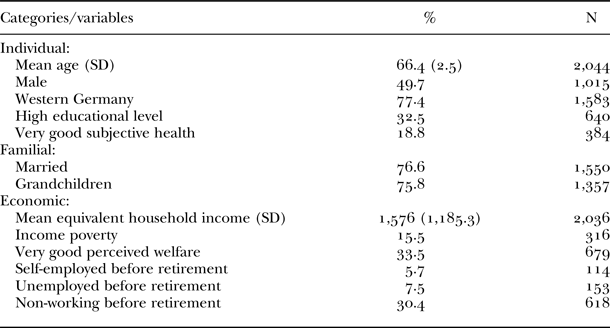
The mean age of the sample was 66.4 years with a nearly balanced distribution of sexes (Table 1). Most of the respondents were living in Western Germany, were married and had grandchildren. About one-third reported a high level of formal education and 18.8 per cent of the respondents reported very good subjective health. The mean equivalent household income as calculated on the basis of the modified scale of the OECD (e.g. Förster Reference Förster1994) amounted to €1,576 per month. The percentage of respondents below the poverty threshold (below 60% of the mean equivalent income of a household) was about 16 per cent. About one-third of the respondents reported very good subjective welfare in retirement (‘How does your household get along with the income available – very well, rather well, rather poorly or very poorly?’). About 6 per cent of the sample were self-employed before retirement, 8 per cent were unemployed and 30 per cent non-working.
Descriptive characteristics of the sample

Notes: N = 2,044. Statistics were based on weighted data. SD: standard deviation.
Source: ‘Transitions and Old Age Potential’ survey, 2013.
Measurement
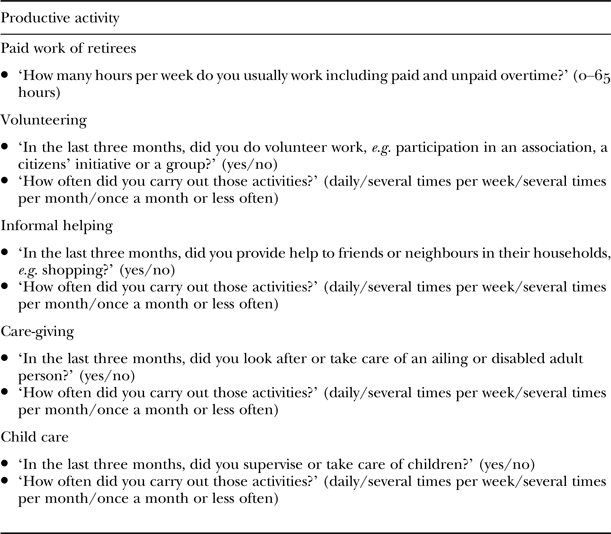
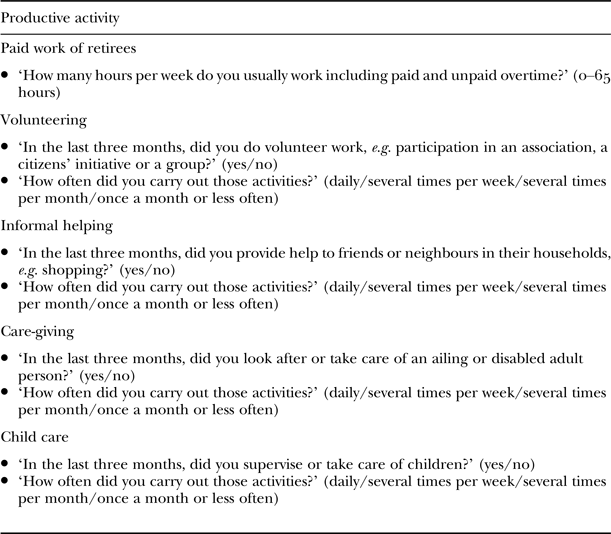
The overall TOP questionnaire included information on a variety of topics which are not part of this study. For the present analysis, we first of all focused on several productive activities. To assess the extent of respondents' productive activities, information on paid employment (including the number of working hours per week), volunteering, informal help for family members, friends or neighbours, care-giving and child care was used (Table 2).
Items used as structuring variables for the cluster analysis
Source: ‘Transitions and Old Age Potential’ survey, 2013.
The frequency of those activities was measured using ordinal frequency scales (‘How often did you carry out a productive activity: daily (4), several times per week (3), several times per month (2), once a month or less often (1)’). Using this information, sum scores were calculated for the frequency of two types of informal activity: (a) activities for persons who do not belong to the respondent's family and (b) activities within the family of the respondent. The sum score for the first type included information on volunteering, informal help, child care and care-giving for persons who do not belong to the respondent's family. The sum score for the second type was calculated using variables on child care and care-giving within the family. Those sum scores were used as two quasi-metric scales in the analysis. The first scale was calculated as the sum of two four-scale items regarding the frequency of informal activities within the family (child care for one's own child or grandchild or care-giving for a family member) which resulted in a maximal score of 8. Thus, the range of the sum frequency score for child care and care-giving within the family was 0 (not engaged within the family) to 8 (highly frequent engagement within the family). The second quasi-metric scale was calculated as an additive score for volunteering, informal help, child care or care-giving for persons who do not belong to the family of the study participants using the same method. Thus, four Likert-scale items were used to calculate the sum score of the frequency of voluntary engagement. Therefore, the score for volunteering, informal help, child care and care-giving outside the family ranged from 9 (no engagement) to 16 (highly frequent voluntary engagement). For descriptive purposes, those two scales were transformed into a categorical variable with the value 2 being ‘frequent’ (mean score of the sum frequency score or higher), 1 being ‘not frequent’ (up to the mean score of the respective sum score) and 0 being not engaged in informal activities. Paid work was categorized into ‘1–65 hours per week’ and ‘none’ for respondents that were not participating in paid work.
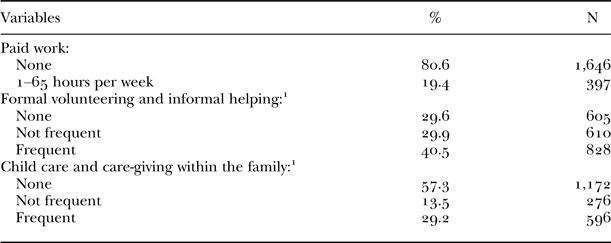
The descriptive statistics revealed that the most common activity reported by the respondents was formal volunteering and informal helping. Around 70 per cent of the study participants were engaged at least once a month (Table 3). Fourteen per cent reported that they were looking after a child or an ailing or disabled member of the family not frequently, which means only several times a month or even less. A higher share of 29 per cent was engaged in caring within the family at least several times per week. A share of 19.4 per cent of the respondents was in paid work at the time of the interview. Among those, only 2.7 per cent worked full time which means that they were working 30 hours or more per week.
Descriptive characteristics of productive activities

Notes: N = 2,044. Statistics were based on weighted data. 1. ‘Frequent’ indicates up to the mean score of the index; ‘not frequent’ indicates mean score of the index or higher.
Source: ‘Transitions and Old Age Potential’ survey, 2013.
The following variables were entered into the analysis to describe differences in cluster membership: individual resources and socio-demographic variables like age (age groups of 60–64 and 65–70 years), sex, place of residence (Western versus Eastern Germany, including Berlin) and formal education of the respondents measured on the basis of the International Standard Classification of Education (ISCED-97). The eight original categories of the ISCED-97 were reduced to three classes with low (ISCED 1–2), middle (ISCED 3A–4A), and high general and vocational levels of education (ISCED 5B–6). Additionally, subjective health of the respondents (‘How would you assess your current health? Very good, good, rather poor or poor’) was summarised to a dichotomous indicator (very good or good versus rather poor or poor subjective health).
Family resources like family status (married versus unmarried) and living grandchildren (yes versus no) were added to the analysis. Finally, economic resources like an indicator of income poverty and the subjective welfare in retirement were also observed. A household net equivalent income of less than 60 per cent of the sample's median income was defined as income poverty (Bäcker and Schmitz Reference Bäcker, Schmitz, Vogel and Motel-Klingebiel2013). Subjective welfare (‘How do you/does your household get by with the money available? Very well, rather well, rather poorly or poorly’) was measured by a dummy variable (very well or rather well versus rather poorly or poorly). This indicator was used complementary with the other ‘objective’ measures of the socio-economic status. Moreover, the employment status before retirement (self-employed versus employed or not employed) was used as a predictor for cluster membership.
Analysis strategy
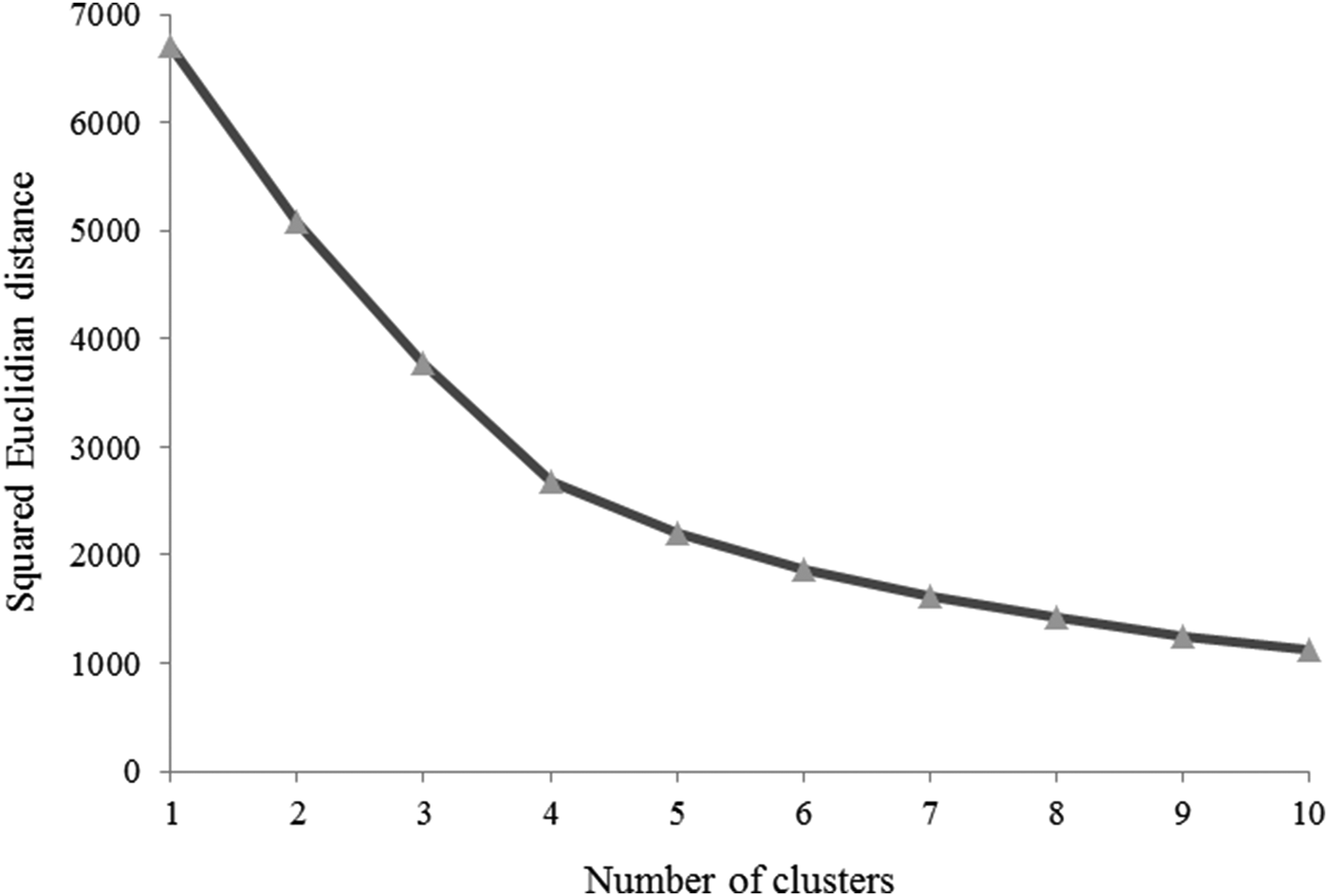
To prepare the data for the cluster analysis, the indicators of productive activities were transformed into z-scores in order to generate continuous indicators and to increase the comparability of the two scores of informal activities to the metric scale of hours per week in paid employment. These indicators were included in a hierarchical cluster analysis based on Ward's method. This method employs the sum of the squared Euclidean distance (or sum of squared errors) as an indicator for heterogeneity that generates clusters with comparable numbers of cases by maximising the variation between the cluster centres (Bacher Reference Bacher1996; Schendera Reference Schendera2010). In sum, 2,044 cases were included in the cluster analysis. Referring to the elbow criterion, which is a graphic representation of the increase of the sum of squared errors explained by the cluster analysis to find the optimal number of clusters (Backhaus et al. Reference Backhaus, Erichson, Plinke and Weiber2003), a cluster solution between four and six groups was suggested (Figure A1 in the Appendix). After interpreting the results of the cluster analysis, a solution with four clusters was chosen which provided the most distinctive groups regarding the clustered variables. To validate the results, a discriminant analysis was carried out in order to search for statistically significant group differences. Additionally, we validated the results of the hierarchical cluster analysis by calculating the average silhouette width for four, six and eight clusters. The average silhouette width was slightly higher for four clusters (s c = 0.52) compared to six clusters (s c = 0.51) and it was lowest for eight clusters. Thus, the average silhouette width shows a structure of four clusters is more valid with regard to cohesion and separation of the groups compared to six clusters (Kaufman and Rousseeuw Reference Kaufman and Rousseeuw2005). Therefore, the solution with four clusters was selected for the following analyses.
To test the assumptions of our first and second hypotheses regarding the interrelation between formal and informal activities within the clusters, we calculated correlations of each pair of productive activities (paid work and formal volunteering or informal helping, paid work and child care or care-giving within the family, formal volunteering or informal helping and child care or care-giving within the family). We used a metric scale of weekly hours in paid work and the two quasi-metric scales for volunteering and informal help as well as for child care and care-giving as described in the section above. Thus, not only the information whether or not a retiree is engaged in a productive activity but also the amount of time spent in each domain was indicated. Spearman's rho was used to calculate the correlation coefficients between the pairs of productive activities. Similar to the other analyses of this study, we defined the level of statistical significance as α = 5 per cent.
To investigate Hypotheses 3a and 3b, multinomial logistic regression models were calculated with cluster membership as the dependent variable and the individual, familial and economic resources as independent variables. This method is commonly applied when questions concerning group membership in three or more mutually exclusive groups is addressed (Petrucci Reference Petrucci2009). A total of three multinomial logistic regressions with shifting reference clusters were calculated to provide a comprehensive comparison between the clusters. Thus, individual, familial and economic differences between the clusters are interpreted using each cluster as a reference to ensure every cluster was compared to all other clusters in the sample. The independent variables were entered into the regression models simultaneously. Three types of measures were reported in order to assess the model fit: −2 log likelihood, χ2 statistics and Nagelkerke's pseudo-R 2. All statistical analyses were carried out using SPSS 20.
Results
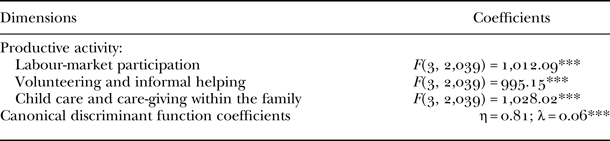
The cluster analysis revealed four groups of retirees regarding their patterns of productive activities: the Multiple Engagers, the Volunteers, the Family Helpers and the Family Disengagers. As expected, it was possible to identify groups of retirees which differed significantly by structure and intensity of productive activities across domains. Discriminant analysis validated the results of the cluster analysis. A canonical discriminant function coefficient was identified as differentiating statistically significantly between the activity patterns of groups of retirees (λ = 0.06, p < 0.001). This coefficient was based on three dimensions which closely match the three indicators of productive activities described above (Table 4).
Group differences among the clusters of productive activities: results of a discriminant analysis

Source: ‘Transitions and Old Age Potential’ survey, 2013; weighted data.
Significance level: *** p < 0.001.
Cluster characteristics
Cluster 1: Multiple Engagers
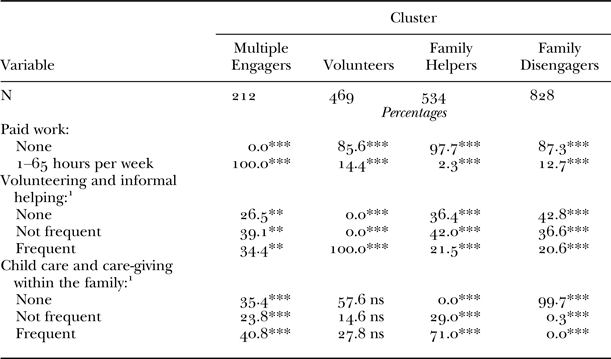
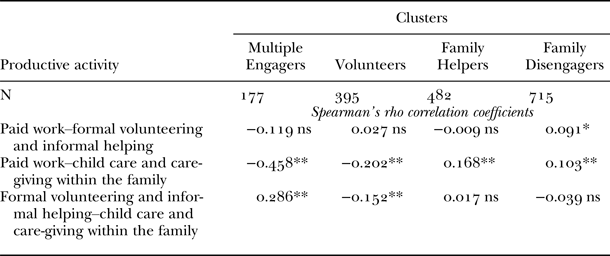
As depicted in Table 5, the Multiple Engagers were the smallest group in the sample (10.4%, N = 212). The most salient characteristic of this group is a high degree of participation in the labour market after retirement: all of the respondents in this group either had part-time (less than 30 hours per week) or full-time employment (30 hours or more per week). The extent of civic engagement slightly exceeded the average of the study sample (φc = 0.069, p < 0.01) even though a lower share of the Multiple Engagers was frequently occupied with volunteering or informal helping. As shown in Table 6, the correlation between the amount of paid work and volunteering was not significant (ρ = −0.119). Regarding supporting activities within the family such as child care or care-giving, the Multiple Engagers are also more often involved compared to the average of the sample (φc = 0.154, p < 0.01). However, the association between weekly hours in paid work and those informal activities within the family is negative (ρ = −0.458, p < 0.01). By contrast, the correlation between the frequency of formal and informal volunteering and family activities is positive (ρ = 0.286, p < 0.01). Thus, the members of this cluster seem to display no clear association between various productive activities in their everyday lives and neither the complementary nor the substitutive rule applies.
Clusters of productive activities of retirees

Notes: 1. ‘Not frequent’ indicates up to the mean score of the index; ‘frequent’ indicates mean score of the index or higher. Statistical significance based on Cramer's V.
Source: ‘Transitions and Old Age Potential’ survey, 2013; weighted data.
Significance levels: ** p < 0.01, *** p < 0.001, ns: not significant.
Complementary versus substitutive relations between productive activities within the clusters

Note: N = 1,769.
Source: ‘Transitions and Old Age Potential’ survey, 2013; weighted data.
Significance levels: * p < 0.05, ** p < 0.01, ns: not significant.
Cluster 2: Volunteers
The Volunteers comprised 23 per cent of the sample (N = 469). The members of this cluster reported extensive engagement in formal volunteering and informal helping. They were all frequently (i.e. at least several times a week) volunteering or occupied with helping activities outside their own household. Regarding the frequency with which they engaged in child care or looked after an ailing or disabled person within the family, the Volunteers did not differ from the overall sample (φc = 0.023, not significant); 14.4 per cent of the Volunteers were occupied with part-time paid work, but there was no significant correlation between the amount of paid work and the frequency of formal and informal volunteering (ρ = 0.027, not significant). However, a negative correlation between volunteering and familial activities (ρ = −0.152, p < 0.01) could be observed, which points towards a substitutive correlation between volunteering and supportive activities within the family. Like the Multiple Engagers, the Volunteers displayed a negative association between the time spent in paid work and the amount of family activities (ρ = −0. 202, p < 0.01).
Cluster 3: Family Helpers
The Family Helpers, which included 26.1 per cent of the sample (N = 534), primarily took care of children or looked after an ailing or disabled person within their own family; 71 per cent of the respondents in this cluster reported to be involved regularly in those activities (φc = 0.691, p < 0.001). Family Helpers were least likely to engage in the labour market, with only 2.3 per cent having a part-time job (φc = 0.258, p < 0.001). The Family Helpers also showed a slightly lower percentage of people involved in formal volunteering or informal helping compared to the sample (φc = 0.233, p < 0.001). Solely the correlation between the weekly hours in paid work and the frequency of family work among the Family Helpers was statistically significant. Unlike the Multiple Engagers and the Volunteers, the correlation was positive, pointing towards a complementary correlation between those activities (ρ = 0.168, p < 0.01).
Cluster 4: Family Disengagers
Finally, the Family Disengagers were the largest group of the sample (40.5%, N = 828). Members of this cluster reported the lowest engagement in most of the formal volunteering and informal helping activities (φc = 0.341, p < 0.001), but especially the engagement within the family was the lowest among all clusters (φc = 0.708, p < 0.001). Only 0.3 per cent of the Family Disengagers were not frequently occupied with child care or care-giving for a family member. By contrast, 12.7 per cent were actively engaged in the labour market, even though only part time (φc = 0.171, p < 0.001). The Family Disengagers showed a positive correlation between the amount of paid work and the frequency of formal and informal volunteering (ρ = 0.091, p < 0.05) as well as family activities (ρ = 0.103, p < 0.01).
Additional analysis showed that the Family Disenegagers comprised a fairly large group of respondents (N = 323, 39.0% of the cluster of the Family Disengagers) who were not engaged in any productive activity at all. Since the cluster analysis did not treat those respondents as a separate cluster, they are only described here as a sub-group of the Family Disengagers with regard to differences in individual characteristics and family or economic resources. A descriptive comparison between the sub-group of disengaged persons with the other respondents within the clusters of the Family Disengagers revealed that women were over-represented in the sub-group (56.7% versus 46.9%, p < 0.01) as well as persons who were not married (31.2% versus 22.8%, p < 0.01). Moreover, the disengaged respondents reported a fairly bad or bad subjective health status (31.6% versus 15.3%, p < 0.001), a lower mean equivalent household income (1.441 versus 1.668, p < 0.05) and a higher share of the lowest formal educational level (12.1% versus 2.9%, p < 0.001). The two groups within the cluster of the Family Disengagers did not show significant differences regarding age or place of residence (Western versus Eastern Germany, including Berlin). Thus, the descriptive analysis reveals evidence that supports the assumption of Hypothesis 3b.
Individual, familial and economic resources as predictors of cluster membership
The Family Disengagers, the Multiple Engagers and the Volunteers were used as the reference groups in the multinomial logistic regression analyses (Table 7). The aim of the analyses was to identify individual, familial or economic resources as predictors of group membership for each cluster, respectively. In this analysis, the assumptions of Hypotheses 3a and 3b are tested.
Results of the multinomial logistic regression for the clusters of productive activities

Notes: N = 1,660 (number of cases included in each model). Ref.: reference category. b: unstandardised regression coefficient. Redundant group comparisons (e.g. Family Disengagers versus Multiple Engagers) are not shown in Models 2 and 3).
Source: ‘Transitions and Old Age Potential’ survey, 2013; weighted data.
Significance levels: * p < 0.05, ** p < 0.01, *** p < 0.001.
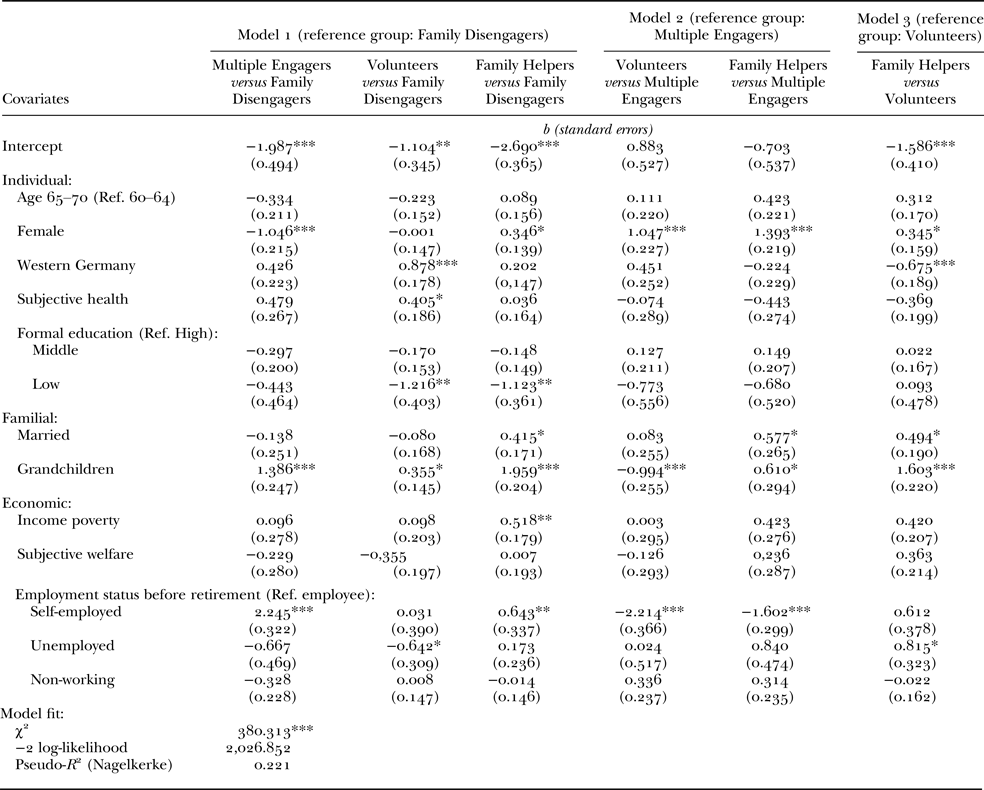
Regarding individual resources, age composition of the clusters showed no significant differences compared to the reference groups. Gender played a role for several clusters. Women were less likely to be Multiple Engagers, and more likely to be Family Helpers compared to the Family Disengagers. Additional analysis showed that women had a higher likelihood of being Volunteers or Family Helpers compared to the Multiple Engagers and were more likely to belong to the Family Helpers compared to the Volunteers. The former is in line with older women's lower labour-market participation, and the latter validates other findings that have shown that women bear the lion's share of family care-taking (e.g. Künemund Reference Künemund, Tesch-Römer, Engstler and Wurm2006). In terms of volunteer activities, it did make a difference whether respondents lived in Eastern or Western Germany. The finding validates results from the German Volunteering Survey that also showed higher percentages of volunteering among respondents in Western Germany compared to respondents living in the East (Kausmann and Simonson Reference Kausmann, Simonson, Simonson, Vogel and Tesch-Römer2016). Complementary to this finding, the likelihood of being a Family Helper was lower in Western Germany compared to the Volunteers. This suggests that older adults in Eastern Germany are more likely to be engaged in activities within the family rather than withdraw from productive activities.
Better subjective health increased the probability of belonging to Volunteers compared to Family Disengagers while it did not differ significantly between the other clusters. Regarding the level of formal education, the Multiple Engagers showed no difference to the Family Disengagers. Respondents with a low level of education have a significantly smaller chance of belonging to the Volunteers or the Family Helpers compared to the Family Disengagers. As the percentage of formal and informal volunteering in those two clusters is relatively high, the findings indicate that productive activities that are primarily discretionary or optional in nature depend strongly on individual resources such as health as well as knowledge and skills. Note that the Multiple Engagers did not show a greater amount of individual resources compared to the cluster with the lowest level of activities (i.e. the Family Disengagers). Most likely this has to do with our selection of individual resources. For instance, we were not able to consider lifecourse influences (e.g. earlier experiences with productive activities).
Family resources, like having grandchildren, led to a significantly higher probability of belonging to the Multiple Engagers, the Family Helpers and, to a lesser extent, the Volunteers compared to the Family Disengagers. The Family Helpers also were more likely to have grandchildren than the Multiple Engagers, the Volunteers and the Family Disengagers. Not surprisingly, the Family Helpers also showed a higher probability of being married compared to the Family Disengagers, the Multiple Engagers and the Volunteers. Therefore, the higher share of family-supporting activities in these groups, especially child care, can be at least partly attributed to relevant opportunity structures within the family.
Regarding economic differences between the clusters, an equivalent income below the poverty threshold increased the chance of belonging to the Family Helpers in comparison to the Family Disengagers. This finding corresponds to the low level of labour-market activity in this cluster. Regarding the precarious financial situation of retired Family Helpers, it seems plausible to assume linkage to low or discontinuous labour-market participation at earlier life stages. Concentrating on supporting activities within the family might have been a substitute for labour-market deprivation which persisted into retirement. Since the probability for women to belong to the Family Helpers compared to the Multiple Engagers and the Volunteers is higher (Table 7), the finding relates to the consequences of gender-specific inequalities on the labour market in early post-retirement. By contrast, perceived welfare in retirement showed no significant difference in any of the clusters in comparison to the Family Disengagers.
Self-employment in the last job before entering retirement was a strong predictor for being a Multiple Engager and, to a lesser extent, a Family Helper, which is consistent with the assumption that the entrepreneurial spirit also supports a more varied activity pattern in retirement. When comparing Family Helpers and Volunteers, the latter had a lower risk of being unemployed before retirement. This finding supports the view of the Volunteers as a rather privileged group with regard to individual and economic resources as well as their chances on the labour market.
Discussion and conclusion
We found that patterns of productive activities – paid work, formal or informal volunteering, care-giving and child care within the family – formed distinct clusters among retirees aged 60–70 years in Germany. The cluster analysis revealed four groups which differed in terms of structure and intensity of their respective activity pattern. However, the analyses did not reveal a group of retirees that could be characterised as entirely disengaged from productive activities. Since disengagement due to an overall increase in severe physical or mental impairment is not likely to start before the age of 70 (e.g. Jagger et al. Reference Jagger, Weston, Cambois, Van Oyen, Nusselder, Doblhammer, Rychtarikova and Robine2011), this finding may be explained by the relatively young age group of early post-retirees. The most prominent cluster was that of the Family Disengagers, which also displayed the lowest level of overall activity. With the exception of the proportionally significant sub-group within the Family Disengagers, who were not engaged in any productive activity at all, even the members of this cluster showed a fairly high share of formal volunteers and informal helpers. Hence, it can be concluded that there is a high level of productive activity among the 60–70-year-old retirees in Germany. Multiple Engagers and Volunteers displayed the highest numbers of activities across domains.
The evidence of our study regarding the clusters of productive activities among older adults supplements the findings of earlier studies. Even though our study focused on a different age group and employed a different statistical method, the four-cluster structure basically corresponds to the findings of Burr, Mutchler and Caro (Reference Burr, Mutchler and Caro2007), who used a sample from the ACL survey. Consistent with the findings of this US-based study, the largest group in our sample (40.5%) belonged to the cluster of Family Disengagers, which overall showed low levels of activity including some volunteering and informal helping but no engagement in paid work or engagement in supporting family members. This cluster seems comparable to the ‘Helpers’ who accounted for 46 per cent of the US sample (Burr, Mutchler and Caro Reference Burr, Mutchler and Caro2007). The authors did not find a group similar to the Multiple Engagers, even though paid work and bridge employment were observed to some degree in all of the four classes identified in the ACL sample. The more widespread presence of paid work in the US study is consistent with the fact that working as a retiree is a relatively recent phenomenon in Germany (Hochfellner and Burkert Reference Hochfellner and Burkert2013; Hofäcker and Naumann Reference Hofäcker and Naumann2015; Maxin and Deller Reference Maxin and Deller2011; Scherger Reference Scherger2013) and has not yet become a common pathway in retirement. By contrast, in the USA, which has not had a mandatory retirement age since the 1960s and has a different social security system, paid work after retirement is a common phenomenon (Beehr and Bennett Reference Beehr and Bennett2014; Bonsdorff et al. Reference Bonsdorff, Shultz, Leskinen and Tansky2009; Cahill, Giandrea and Quinn Reference Cahill, Giandrea and Quinn2006). Nevertheless, a significant share of retirees observed in our study was still participating in the labour market, indicating that working after retirement is likely to become a more frequently observed phenomenon in Germany in the future.
Complementary and substitutive relations between activities
Two hypotheses focused on the relationship of productive activities within the clusters: whether there was a complementary correlation between discretionary or optional activities (e.g. paid work or volunteering) or a competitive correlation between discretionary and obligatory activities (e.g. care-giving for a family member). Findings regarding complementary or substitutive correlation among productive activities within clusters were mixed. We assumed there would be a complementary correlation between paid work as well as formal and informal volunteering, but this was only partially true in the case of Family Disengagers. For the remaining clusters, the association did not prove to be statistically significant. Thus, the evidence for the Multiple Engagers, the Volunteers and the Family Helpers contradicts the assumptions of our first hypothesis.
The second hypothesis, which claimed a substitutive correlation between familial engagement and paid work as well as volunteering, was confirmed for the Volunteers and the Multiple Engagers. However, the Multiple Engagers contradicted our second hypothesis since the correlation between volunteering and family engagement was positive, revealing a complementary correlation. Thus, the findings point towards a more complex correlation of productive activities in retirement going beyond the basic categories of complementary versus substitutive relations. Based on those findings, it seems crucial to assess the amount of time invested in an activity and whether it is discretionary/optional or obligatory. Such additional information would help to provide an overall picture of time-use structures during retirement.
Predictors of clusters membership
Based on cumulative inequality theory, Hypotheses 3a and 3b assumed that cluster membership can be predicted by the amount of individual, familial and economic resources of retirees. The amount of approximately predicted variance (Nagelkerke's pseudo-R 2: 22%) was significant but not overwhelming. This underlines the fact that future studies should examine whether additional predictors such as attitudes and past experiences will be able to increase the amount of predicted variance. Moreover, we expected a richer portfolio of productive activities to be positively related to a greater amount of available resources based on cumulative advantage in earlier life phases. However, the empirical evidence supported this hypothesis only for the Volunteers and partly for the Family Helpers. The members of these clusters differed markedly from the Family Disengagers in terms of amount of individual, familial and economic resources. Moreover, the empirical results do not confirm Hypothesis 3b, especially with regard to the socio-economic resources of the Family Disengagers which do not suggest a general disadvantage to the other clusters. Thus, our analysis revealed that indicators which are reliably associated with individual productive activities are, however, less successful in predicting complex patterns of activities as captured by the clusters.
It is noteworthy that the clusters only showed relatively weak differences regarding economic resources in our analysis even though the sample is representative. This suggests that different levels and patterns of productive activity among retirees are associated only to some extent with economic status, especially low levels of formal education and, in the case of the Family Helpers, with an income below the poverty threshold (60% of the mean equivalent income of the sample). It is noteworthy that these associations remained unchanged after excluding the indicator of subjective welfare, which might have confounded the associations with ‘objective’ measures of socio-economic status, especially income poverty. However, the comparison between the sub-group of respondents who were not engaged in any productive activity at all within the Family Disengagers to the other members of that cluster revealed individual, familial and socio-economic differences which support the assumptions of Hypothesis 3b. Therefore, it can be assumed that social inequality plays a greater role within certain sub-groups of the clusters than between them. Since the findings are only based on descriptive statistics, this hypothesis might be advanced further by more sophisticated methods in future studies.
In fact, individual and familial resources like gender, having grandchildren, region and, at least for the Multiple Engagers and the Family Helpers, also the employment status before retirement seem to best differentiate members of different productive activity clusters. These results contradict the evidence from previous studies, which indicated a close relationship between particular productive activities and indicators of social inequality, like the risk of old-age poverty and working after retirement (Hochfellner and Burkert Reference Hochfellner and Burkert2013) or the effect of formal education on volunteering in older age (Caro and Bass Reference Caro and Bass1997; Choi Reference Choi2003; Tang Reference Tang2006; Wilson Reference Wilson2000). In the study by Burr, Mutchler and Caro (Reference Burr, Mutchler and Caro2007), income as an indicator of material welfare and social status showed a significant association with several classes of productive activities. However, there is also evidence of a U-shaped association of productive activity in later life and socio-economic status, accounting for paid work after retirement (Hofäcker and Naumann Reference Hofäcker and Naumann2015; Scherger Reference Scherger2013). Thus, the association between activity patterns as well as individual and economic resources differs from the correlations which are normally observed when predicting individual productive activities. Additionally, institutional and socio-cultural differences between countries and different cohorts within them might also account for varying associations. Future studies could explore whether our findings can be replicated with another German sample and eventually use country comparisons to analyse the potential influence of socio-economic, cultural and institutional settings.
There are some limitations of the present study which need to be addressed. First of all, the data from the TOP survey are cross-sectional, which means conclusions on the causal relationships between the activity clusters and their predictors cannot be drawn. Furthermore, questions concerning the dynamics of productive activity clusters could not be addressed either. Longitudinal data are needed to answer such questions. Moreover, the cluster analysis is an explorative method that requires a certain extent of interpretation by the researcher. Against the background of the current state of research regarding productive activity patterns in immediate post-retirement, an explorative method seemed appropriate to shed first light on the issue in Germany, where productive activities (paid work, volunteering, family help) have been investigated separately rather than conjointly so far. It certainly remains an important question for future studies whether the clusters found in this sample could be replicated by using different statistical methods such as latent class analysis. Nevertheless, the present study provided first insights into the patterns of productive activities in the immediate post-retirement phase. This might be a helpful basis for future studies that move from an explorative design to a confirmatory analysis of the potential of older adults.
Despite its limitations, the study adds to the understanding of the interrelation of multiple productive activities in early post-retirement in Germany. It provides new empirical evidence on retirement which is a crucial transitional life phase where individual constellations and decisions towards productive engagement in multiple areas are taken or re-evaluated. This is especially true for paid post-retirement work, which is a relatively new phenomenon in Germany which in recent years has been characterised by an active age policy and a change in pension legislation towards a prolonged working life. In this context, Germany has implemented many policy changes to increase the participation in the labour market of older adults. In that regard, the paper shows how these policies have borne fruit. On the basis of those findings, the international state of research on productive ageing and old-age potential can be complemented by using Germany as a sample case of a society with a rapidly ageing population which has been characterised by a recent institutional change in dealing with the associated trends and challenges.
Moreover, the study observed other forms of productive activities such as family support or volunteering and their interrelation with paid work after retirement. The results of the study suggest that predictors of cluster membership are not identical with reliable predictors of individual productive activities. Thus, emphasising the added value of cluster analysis in identifying activity patterns which are also more closely matching individuals' lives is comparable to the benefit of sequence analysis with regard to series of retirement transitions (Calvo, Madero-Cabib and Staudinger Reference Calvo, Madero-Cabib and Staudinger2017). That is especially true for indicators of social inequality which showed only a low predictive power for some of the clusters. Therefore, the findings provide a deeper understanding of the productive potential in older age groups complementing the evidence provided by earlier studies which focused exclusively on individual activities. This is especially important in the case of Germany since it has one of the oldest and fastest ageing populations in the world. Therefore, the study adds a more comprehensive approach to the productive ageing debate that points beyond the case of Germany by challenging concepts of mutually exclusive domains of productivity and disengagement as it provides evidence for more hybrid forms of productive potential in early post-retirement.
Acknowledgements
The authors gratefully acknowledge the researchers at the Federal Institute of Population Research at Wiesbaden, Germany for giving valuable remarks on the first draft of the manuscript, and the anonymous referees for very helpful comments and suggestions. The study and the project staff are financed by the regular budget of the Federal Institute for Population Research at Wiesbaden, Germany. The project did not receive any funding by third parties. The study complies with ethical standards, including informed consent obtained from the participants. This study is based on a large data-set that is available for the scientific community and that can be obtained from GESIS – Leibniz-Institut für Sozialwissenschaften at Cologne, Germany (doi:10.4232/1.12477). The authors have made substantial contributions to conception and design, the acquisition of data, as well as the analysis and interpretation of data as presented in the article. They participated in drafting the manuscript and revising it critically for important intellectual content. The authors gave final approval of the version to be submitted. The authors declare no conflict of interest with respect to the research, authorship and/or publication of this article.
Appendix
Squared Euclidian distance by the number of clusters (elbow criterion).