Introduction
Vaccinium L. (Ericaceae) is a large, almost worldwide genus of between 400 and 500 species. Vaccinium section Bracteata Nakai, with about 165 species, is predominantly Malesian; Sleumer (1966–67) reported only 11 of the species being recorded outside this area. Sumatra is still a relatively poorly collected island and it is not entirely surprising that a new species has been collected.
Species Description
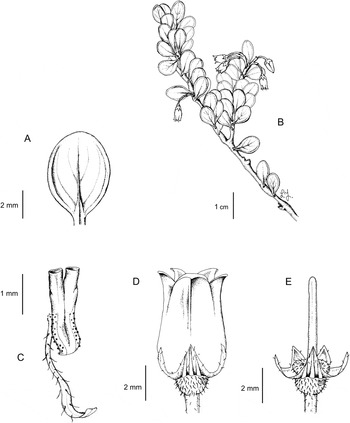
Vaccinium nagamasu Argent, sp. nov.Fig. 1.
Fig. 1.Vaccinium nagamasu Argent. A, leaf; B, habit with both solitary flowers and abbreviated racemes; C, stamen; D, flower; E, pistil with calyx.

Species foliorum marginibus glandulas carentibus, lobis calycis valde porcatis, corollis distincte angulatis atque floribus et in axillis foliorum solitariis et in racemis abbreviatis 2–3-floris tantum dispositis insignis. A Vaccinio scortechinii King & Gamble et V. miquelii Boerl. var. miquelii foliis glandulas marginales carentibus differt, a V. scortechinii etiam racemis abbreviatis paucifloris non multifloris, pedicellis multo longioribus (3–5 mm, non 0.5–1 mm), filamentorum pilis sparsis et longis (non densis et brevibus) distincta. A Vaccinio lucido (Blume) Miq. antheris breviter calcaratis (haud ecalcaratis), tubulis longioribus (1–1.2 mm, non ut in V. lucido brevissimis c.0.5 mm), rhachide inflorescentiae brevissima vel nulla (0–1.5 mm longa, haud 13–30 mm longa) distinguitur. – Type: Indonesia, West Sumatra, Mt. Rasam c.10 km south of Lake Diatas, 1°10–11′S, 100°44–45′E, 18 ii 1989, H. Nagamasu 3604 (holo L).

Shrub to 1.5 m tall. Twigs rounded, but striate, pubescent with grey-white hairs. Leaves densely spirally arranged, blade obovate, broadly elliptic to subcircular, 6–10 × 4–7 mm; apex broadly obtuse, mostly rounded, occasionally with a minute terminal gland and sometimes with a small tuft of white hairs; base broadly cuneate, somewhat decurrent; margin entire, revolute especially in the proximal half without any marginal glands. Mid-vein narrowly impressed above throughout its length, flat or very slightly raised below, lateral veins one pair from near the base, sometimes a second pair from above the base, both pairs curved and arching into the upper half of the leaf but the laterals sometimes obscure, reticulation obscure, smooth and glabrous above, glandular punctate beneath. Petiole 1–2 × c.0.4 mm, grooved above, pubescent. Flowers mostly solitary from the axils of normal foliage leaves, occasionally in abbreviated racemes of up to 3 flowers, flowers hanging, both 4- and 5-merous; rachis 0–1.5 mm long, sheathed in bracts, pedicels 3–5 mm long, hairy with a pair of small elliptic bracteoles at the base. Calyx tube hemispherical, coarsely hairy, c.1 × 1.8 mm, the lobes 1.9 × 1.5 mm with white hairs outside and on the margins, glabrous inside, without any marginal or terminal glands but with 3 conspicuous vertical ribs. Corolla white, tinged with pink, glabrous outside, sparsely hairy inside, broadly urceolate, only slightly narrowed distally when open, conspicuously 4- or 5-angled, 5.5–6 × 3–3.5 mm; the lobes reflexed, pale red, c.1.5 × 1.5 mm, triangular, with revolute margins and hairy on the adaxial side. Filaments 2.5 mm long, slender, sparsely hairy with long spreading white hairs for most of their length, anther cells oblongoid, c.1.2 × 0.4 mm, very finely echinulate, with short spurs; the tubules 1–1.2 mm, as wide as or slightly wider than the cells, the pores truncate or obliquely cut, without projections. Disk hairy. Style c.5 mm long, columnar, glabrous. Stigma disk-shaped. Fruit not seen, described on the field label as black when ripe.
Distribution. Known only from the type locality.
Ecology. Recorded growing at 2500–2565 m in ericoid scrub around the summit of Mt. Rasam.
Conservation status. Data Deficient. There is no indication on the label of the abundance of this species.
Etymology. Named in honour of the collector H. Nagamasu.
This new species is distinct in having no glands on the leaf margins; strongly ridged calyx lobes; distinctly angled corollas and flowers both solitary in the axils of foliage leaves and in short, 2–3-flowered racemes. It keys out in Sleumer (1966–67) to couplet 30 if taken to have persistent bracts, which in the case of the solitary flowers in the axils of normal foliage leaves it certainly has. This leads to Vaccinium scortechinii King & Gamble and V. miquelii Boerl. var. miquelii. It differs from both of these in not having any marginal glands on the leaves. From Vaccinium scortechinii it further differs in that the racemes are not many-flowered and the pedicels are much longer (3–5 vs. 0.5–1 mm); the filaments are not densely short-hairy, and the anther tubules are as wide as or wider than the cells and about twice as long as described for V. scortechinii. Vaccinium miquelii differs in having rounded leaf bases; the racemes are described as densely 10–20-flowered, with much shorter 1–2 mm pedicels, tubules less than half as long and a style described as villous below (completely glabrous in Vaccinium nagamasu).
If keyed without persistent bracts which is the condition of the abbreviated racemes, it keys to couplet 192. The widespread and variable Vaccinium lucidum (Blume) Miq. and the Sumatran endemic V. bartlettii Merr., both superficially somewhat similar, also key out here. However, Vaccinium lucidum has basal leaf glands, a much more substantial rachis (1.3–3 cm long), the anthers lack spurs and the tubules are very short (0.5 mm long). Vaccinium bartlettii is described as also lacking basal leaf glands, but its stamens are very distinctly dimorphic, they lack spurs and have very short, almost non-existent tubules.
Vaccinium nagamasu appears to be a very distinct new species, lacking the marginal glands on the leaves which are so commonly present in Southeast Asian Vaccinium. It also has distinctive ridges on the calyx lobes and extraordinarily long and relatively broad anther tubules. The fact that most of the flowers are solitary in the axils of foliage leaves might lead to it being considered in Vaccinium section Orianthe Schltr. rather than Vaccinium section Bracteata. This would be a considerable extension in range to the west for this section. It would also be a large disjunction as species of this section are not known from Borneo, Java or Peninsular Malaysia. However, none of the species in Vaccinium section Orianthe has the strongly angled corollas of this species nor do they have such long anther tubules and they never have the abbreviated racemes which occur in this specimen. The flowers of Vaccinium nagamasu when solitary are not clustered at the end of the branches, but are scattered lower down on the more mature stems. Again, this is a very unusual feature which occasionally occurs in Vaccinium myrtoides (Blume) Miq. from the Philippines, but that species has leaf blades that are broadly pointed at the apex, rounded corollas and smooth calyces. The angled corollas in this new species, although not unusual in Vaccinium section Bracteata, are very reminiscent of many species of Agapetes D.Don, but the small flowers, spurred anthers and geographical isolation from other Agapetes species would rule out any relationship to this genus. It is interesting that it agrees with some parts of the description of the imperfectly known Vaccinium sumatranum Jack, notably in the sometimes 4-merous flowers, but that species was collected at much lower altitude and Sleumer (1966–67) concluded it was related, if not conspecific, to V. laurifolium (Blume) Miq., a species with very much larger leaves that have marginal glands and that lacks the ridged calyx.
Acknowledgements
I thank Dr Gerard Thijsse and the Nationaal Herbarium Nederland for loaning the specimen described and the Sibbald Trust for funding a visit to the herbarium in Leiden. I am also grateful to Dr Robert Mill for the Latin diagnosis and to Lorna Fraser for drawing the illustration.