




Crossref Citations

This article has been cited by the following publications. This list is generated based on data provided by Crossref.
Smith, Nicholas A.
Martinez, Larry R.
and
Sabat, Isaac E.
2016.
Weight and Gender in Service Jobs.
Cornell Hospitality Quarterly,
Vol. 57,
Issue. 3,
p.
314.
Waung, Marie
McAuslan, Pam
DiMambro, Jeff M.
and
Mięgoć, Natalia
2017.
Impression Management Use in Resumes and Cover Letters.
Journal of Business and Psychology,
Vol. 32,
Issue. 6,
p.
727.
Keith, Melissa G.
Tay, Louis
and
Harms, Peter D.
2017.
Systems Perspective of Amazon Mechanical Turk for Organizational Research: Review and Recommendations.
Frontiers in Psychology,
Vol. 8,
Issue. ,
Cheung, Janelle H.
Burns, Deanna K.
Sinclair, Robert R.
and
Sliter, Michael
2017.
Amazon Mechanical Turk in Organizational Psychology: An Evaluation and Practical Recommendations.
Journal of Business and Psychology,
Vol. 32,
Issue. 4,
p.
347.
Kan, Irene P.
and
Drummey, Anna B.
2018.
Do imposters threaten data quality? An examination of worker misrepresentation and downstream consequences in Amazon's Mechanical Turk workforce.
Computers in Human Behavior,
Vol. 83,
Issue. ,
p.
243.
Zhang, Don C.
2018.
Utility of Alternative Effect Size Statistics and the Development of a Web-Based Calculator: Shiny-AESC.
Frontiers in Psychology,
Vol. 9,
Issue. ,
Zhang, Don C.
Highhouse, Scott
Brooks, Margaret E.
and
Zhang, Yuyan
2018.
Communicating the validity of structured job interviews with graphical visual aids.
International Journal of Selection and Assessment,
Vol. 26,
Issue. 2-4,
p.
93.
Ilbeigi, Mohammad
Lurkin, Virginie
and
Garrow, Laurie A.
2019.
Using Internet-based marketplaces to conduct surveys: An application to airline itinerary choice models.
Transportation Research Part C: Emerging Technologies,
Vol. 103,
Issue. ,
p.
129.
Garrow, Laurie A.
Chen, Ziran
Ilbeigi, Mohammad
and
Lurkin, Virginie
2020.
A new twist on the gig economy: conducting surveys on Amazon Mechanical Turk.
Transportation,
Vol. 47,
Issue. 1,
p.
23.
Sante, Danilo R. Le
Eaton, Asia A.
and
Viswesvaran, Chockalingam
2021.
How Contextual Performance Influences Perceptions of Personality and Leadership Potential.
Revista de Psicología del Trabajo y de las Organizaciones,
Vol. 37,
Issue. 2,
p.
93.
Wayne, Julie Holliday
Vaziri, Hoda
and
Casper, Wendy J.
2021.
Work-nonwork balance: Development and validation of a global and multidimensional measure.
Journal of Vocational Behavior,
Vol. 127,
Issue. ,
p.
103565.
Neroni, Maria Adriana
and
Crilly, Nathan
2021.
How to Guard Against Fixation? Demonstrating Individual Vulnerability is More Effective Than Warning of General Risk.
The Journal of Creative Behavior,
Vol. 55,
Issue. 2,
p.
447.
Aziz, Shahnaz
Bellows, Gerald
and
Wuensch, Karl
2021.
The Relationship between Workaholism and Negative Affect: Mindfulness Matters!.
International Journal of Mental Health and Addiction,
Vol. 19,
Issue. 5,
p.
1605.
Park, Lauren S.
and
Martinez, Larry R.
2022.
Fifty shades of pray: Faith diversity management approaches impact employee satisfaction, support perceptions, and turnover.
Journal of Organizational Behavior,
Vol. 43,
Issue. 6,
p.
1103.
Smith, Claire E.
Wayne, Julie Holliday
Matthews, Russell A.
Lance, Charles E.
Griggs, Tracy L.
and
Pattie, Marshall W.
2022.
Stability and change in levels of work–family conflict: A multi‐study, longitudinal investigation.
Journal of Occupational and Organizational Psychology,
Vol. 95,
Issue. 1,
p.
1.
Motro, Daphna
Pittarello, Andrea
Nolan, Kevin P.
Shahani-Denning, Comila
and
Lenaghan, Janet A.
2023.
The dark side of leave: how voluntary leave shapes preferences for male and female supervisors.
Journal of Managerial Psychology,
Vol. 38,
Issue. 1,
p.
21.
Smith, Nicholas A.
Martinez, Larry
Xu, Shi (Tracy)
and
Waterbury, Christopher J.
2023.
Providing Positive Individuating Information to Reduce Stereotype-Based Negativity in Service Encounters.
Cornell Hospitality Quarterly,
Vol. 64,
Issue. 3,
p.
307.
Zhang, Don C.
Barratt, Clare L.
and
Smith, Rachel Williamson
2024.
The Bright, Dark, and Gray Sides of Risk Takers at Work: Criterion Validity of Risk Propensity for Contextual Work Performance.
Journal of Business and Psychology,
Vol. 39,
Issue. 2,
p.
275.
Henderson, Kevin E.
and
Welsh, Elizabeth T.
2024.
Potential bias when using social media for selection: Differential effects of candidate demographic characteristics, race match, perceived similarity, and profile detail.
International Journal of Selection and Assessment,
Vol. 32,
Issue. 1,
p.
149.
Henderson, Alexandra A.
and
Matthews, Russell A.
2024.
A temporal investigation of experienced incivility and perpetrated counterproductive work behaviour.
Journal of Occupational and Organizational Psychology,
Vol. 97,
Issue. 2,
p.
672.
Landers and Behrend (Reference Landers and Behrend2015) present yet another attempt to limit reviewer and editor reliance on surface characteristics when evaluating the generalizability of study results (see also Campbell, Reference Campbell and Locke1986; Dipboye & Flanagan, Reference Dipboye and Flanagan1979; Greenberg, Reference Greenberg1987; Highhouse, Reference Highhouse2009; Highhouse & Gillespie, Reference Highhouse, Gillespie, Lance and Vandenberg2009). Most of the earlier treatments of sample generalizability, however, have focused on the use of college students in (mostly) laboratory studies. Many industrial–organizational (I-O) scholars have experienced the hostility with which studies using students as participants receives. For instance, Jen Gillespie and I observed, “Reviewers and editors commonly assert that students should not be used to study workplace phenomena as though such a declaration requires no further explanation” (Highhouse & Gillespie, Reference Highhouse, Gillespie, Lance and Vandenberg2009, p. 247). The difference this time, however, is that Landers and Behrend (Reference Landers and Behrend2015) are reacting to dismissals of research using Mechanical Turk (MTurk) workers to make inferences about behavior in organizations. Landers and Behrend (Reference Landers and Behrend2015) make the important point that any research population is likely to be atypical on some dimensions and that all samples are samples of convenience (see also Oakes, Reference Oakes1972). We agree. Furthermore, we make two observations about MTurk: (a) We believe that it should be met with less resistance than student samples have historically faced, and (b) we suggest that it provides a unique opportunity to bring back randomized experimentation in I-O psychology.
Background
The question of whether student samples can be used to study psychological phenomena has been a source of debate throughout the history of behavioral science research (e.g., Farber, Reference Farber1952; Mook, Reference Mook1983; Oakes, Reference Oakes1972; Sears, Reference Sears1986). And, it has been especially contentious in applied areas such as consumer, political, and organizational psychology (Calder, Phillips, & Tybout, Reference Calder, Phillips and Tybout1981; Kardes, Reference Kardes1996; Locke, Reference Locke and Locke1986).
Farber (Reference Farber1952) provided an early forceful defense of student samples, noting that students are only inappropriate for studying phenomena at a descriptive level. When one is doing inferential research, according to Farber, the college student is as indispensable to psychological research as the fruit fly is to the geneticist. Given that most I-O research is aimed at identifying general principles that can be applied across organizational settings, we are interested in understanding and controlling causal mechanisms. If undergraduate students are among the people covered by a theory, then they are indeed an appropriate sample on which to test the theory (see Highhouse & Gillespie, Reference Highhouse, Gillespie, Lance and Vandenberg2009, for an elaboration of this argument). College students, however, continue to be viewed among I-O psychologists as a different species from working people (Aguinis & Bradley, Reference Aguinis and Bradley2014; Shen et al., Reference Shen, Kiger, Davies, Rasch, Simon and Ones2011). This is despite the fact that, comparing across subfields of psychology, laboratory results from I-O psychology [typically using students as subjects] most reliably predicted field results (Mitchell, Reference Mitchell2012).
Like Goes With Like
The historic resistance to student samples for conducting applied psychological research is a classic example of overusing the representativeness heuristic (Highhouse & Gillespie, Reference Highhouse, Gillespie, Lance and Vandenberg2009; Kardes, Reference Kardes1996). The representative heuristic is a reflexive tendency to assess the similarity of things along superficial dimensions and to expect things to conform to the rule that “like goes with like” (Gilovich, Griffin, & Kahneman, Reference Gilovich, Griffin and Kahneman2002). A doctor, for example is more likely to make a diagnosis of a disorder if the patient seems similar to the prototypical patient with that disorder. Similarly, we expect research on organizations to come from studies using members of an organization rather than from studies using college students.
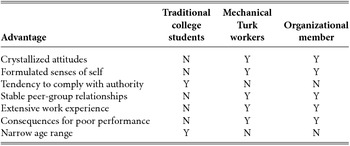
Given the persistence of the representativeness heuristic, student samples are unlikely to overcome their stigmatization in the review process. There is, however, hope for MTurk to replace college students as the new fruit fly for I-O research. This is because research using MTurk workers is more similar to research using members of an organization than it is to research using college students. On the basis of the commonly cited advantages of real-world samples (e.g., Sears, Reference Sears1986), Table 1 compares traditional college students, MTurk workers, and typical organizational members used in research perceived to be generalizable (see Buhrmester, Kwang, & Gosling, Reference Buhrmester, Kwang and Gosling2011; Paolacci & Chandler, Reference Paolacci and Chandler2014).
Commonly Cited Advantages of Real-World Samples
As you can see, MTurk workers have none of the perceived limitations of confused, mercurial, and partially formed college students. As such, there should be no reason for reviewers and editors to dismiss MTurk workers on the basis of external validity—especially if they are not dismissing members of a single organization on that same basis.
Resuscitating Experimentation in I-O
Today's I-O research base is predominately correlational (i.e., passive observation) in nature (Greenberg & Tomlinson, Reference Greenberg and Tomlinson2004; Highhouse, Reference Highhouse2009). Experimentation within I-O psychology—which heretofore has been unable to shake its historical association with college student samples—is becoming a lost art. We will not reiterate the advantages of experimentation for inferring causality (see Colquitt, Reference Colquitt2008; Stone-Romero, Reference Stone-Romero and Rogelberg2002). Our goal is to merely suggest that MTurk provides a unique opportunity in I-O to bring back random assignment to conditions. The use of the Internet provides considerable opportunities to immerse people in realistic situations and gather information on thoughts, feelings, attitudes, and intentions (Aguinis & Bradley, Reference Aguinis and Bradley2014). With MTurk, there is no interaction with the experimenter, which avoids experimenter demand effects. And, there is lower risk of a contaminated sample, as one might get from students or coworkers talking among themselves (Paolacci, Chandler, & Ipeirotis, Reference Paolacci, Chandler and Ipeirotis2010).
Experiments are designed with the goal of generalizing theoretical explanations beyond the specific experimental circumstances, and passive observation can be used to identify boundary conditions of the theoretical explanation as it is directly applied to specific organizational circumstances (Brinberg & McGrath, Reference Brinberg and McGrath1985; Fromkin & Streufert, Reference Fromkin, Streufert and Dunnette1976). Good applied research takes advantage of both random experimentation and passive observation.
Concluding Thoughts
We agree with Landers and Behrend (Reference Landers and Behrend2015) that MTurk workers are highly appropriate for studying workplace phenomena. Moreover, we believe that the use of such samples represents a unique opportunity to reinvigorate experimentation within I-O psychology. As Landers and Behrend noted, quality of data is not contingent on its difficulty to acquire. By embracing MTurk, we are opening new avenues for discovery in our field.