INTRODUCTION
Portunid crabs are ecologically prominent as important elements of trophic webs of the marine and estuarine benthos, and have great influence on the dynamics and structuring of these environments (Pires, Reference Pires1992; Braga et al., Reference Braga, Fransozo, Bertini and Fumis2005). In addition, they constitute a group with economic importance for the extraction of their meat and by-products derived from their industrial processing (Haefner, Reference Haefner and Provenzano1985; Pinheiro & Fransozo, Reference Pinheiro and Fransozo2002; Hattori et al., Reference Hattori, Sant'Anna and Pinheiro2006; Rasheed & Mustaquim, Reference Rasheed and Mustaquim2010), activities that have been conducted successfully in different countries since the 1990s (FAO–GLOBEFISH, 2007).
Achelous spinicarpus Stimpson, 1871 is a species with a wide geographical distribution, from North Carolina, USA to Rio Grande do Sul, Brazil (Melo, Reference Melo1996), and it occurs from shallow waters to 550 m depth (Williams, Reference Williams1984). Although several investigators have described the great abundance of this portunid in the western Atlantic (García-Montes et al., Reference García-Montes, Soto and Gracia1988; Sartor, Reference Sartor1989; Puentes et al., Reference Puentes, Campos and Reyes1990; Bertini & Fransozo, Reference Bertini and Fransozo2004; Braga et al., Reference Braga, Fransozo, Bertini and Fumis2005), as well as its association with the South Atlantic Central Water (SACW) (Pires, Reference Pires1992; De Léo & Pires-Vanin, Reference De Léo and Pires-Vanin2006), little is known about its biology, ecology, or morphological aspects. The few studies on this species include the description by Holthuis (Reference Holthuis1969); its distinction by means of molecular biology from another congeneric species, Achelous binoculus (Holthuis, Reference Holthuis1969), carried out by Mantelatto et al. (Reference Mantelatto, Robles and Felder2007); the complete description of its larval stages by Bookhout & Costlow (Reference Bookhout and Costlow1974); the analysis of its morphometry and relative growth by Sanvicente-Anõrve et al. (Reference Sanvicente-Anõrve, Gómez-Ponce, Vázquez-Bader and Gracia2008); and the study by Mantelatto et al. (Reference Mantelatto, Robles, Schubart, Felder, Martin, Crandall and Felder2009), who proposed the re-elevation of the genus Achelous De Haan, 1833 for the American species formerly assigned to the genus Portunus Weber, 1725, based on molecular phylogeny. In addition, this swimming crab figures in the by-catch of fisheries for the lobster Metanephrops rubellus (Moreira, 1903) and marine shrimps (Severino-Rodrigues et al., Reference Severino-Rodrigues, Guerra and Graça-Lopes2002, Reference Severino-Rodrigues, Hebling and Graça-Lopes2007), which has a negative impact on its populations as a result of this inadequate management.
The objective of this study was to describe the relative growth and to determine the size at maturity through morphological analysis of each sex of A. spinicarpus, as well as to estimate the potential fecundity of this species off the south-eastern Brazilian coast.
MATERIALS AND METHODS
The specimens were collected in December 2007 on the south-eastern continental shelf, using the RV ‘Soloncy Moura', outfitted with an otter-trawl net (mesh size 20 mm knot-to-knot). The sampling consisted of a single bottom trawl over a distance of 2.6 km (1.4 nautical miles), beginning at the coordinates 25°50′31.14″S/46°58′25.16″W and ending at 25°49′24.12″S/46°57′30.12″W, at depths ranging from 95 to 100 m.
After they were caught, the specimens of A. spinicarpus were sorted from the other organisms and kept cold until the analyses. Each specimen had its sex determined based on the abdominal dimorphism and number of pleopods (as recommended by Pinheiro & Fransozo, Reference Pinheiro and Fransozo1998), and was also measured with a digital caliper (0.01 mm) and, when necessary, an image-analysis system. The morphological structures analysed were: cephalothorax (CW, width excluding lateral spines; CWS, width including lateral spines; and CL, length); major cheliped (PL, propodus length; CS, carpal spine length; PW, propodus width; and PH, propodus height); abdomen (AW5, greatest width of the 5th abdominal somite; and AW6, greatest width of the 6th abdominal somite); and gonopods (GL1, length of the 1st pair; and GL2, length of the 2nd pair). Each of the biometric variables was evaluated with respect to its values (minimum, maximum, mean and standard deviation), comparing the means between the sexes by the Student's t-test (α = 0.05) (Zar, Reference Zar1996).
Relative growth and morphological maturity
All biometric relations were submitted to regression analysis, with an adjustment by the power function (y = ax b ) (Huxley, Reference Huxley1950), using CW as the independent variable (x) and the others as dependent variables (y). For the determination of the stages of development the segmented (‘broken-line') linear model (lny = lna + blnx) was used, by means of the ‘segmented' library (Muggeo, Reference Muggeo2008), available in the ‘R Version 2.13.0' environment (R Development Core Team, 2011), because there was no evident morphological dimorphism between the developmental stages (juvenile and adult) for both sexes in this species. The allometric growth rate of each stage was determined based on the value of the constant ‘b', so that b = 1 indicates isometric growth, b > 1 positive allometric and b < 1 negative allometric; the difference of the unit was evaluated by the Student's t-test (α = 0.05). Morphological sexual maturity was determined based on the relations involving the cheliped and gonopods in males (PL × CW, CS × CW, GL1 × CW and GL2 × CW) and the abdomen in females (AW5 × CW and AW6 × CW), considering the inflection point indicated by the segmentation of the log-transformed mathematical model.
Fecundity
Fecundity is defined as the number of eggs exteriorized by a female in each spawning (Sastry, Reference Sastry, Vernberg and Vernberg1983). For the study of this parameter, only females with eggs in the initial stage of embryonic development (end of the blastula and beginning of the gastrula), according to the classification of Boolootian et al. (Reference Boolootian, Giese, Farmanfarmaian and Tucker1959), were included; this minimizes errors stemming from the lack of fertilization or loss of eggs in the later stages (Pinheiro & Terceiro, Reference Pinheiro and Terceiro2000). The pleopods of each female were removed with scissors. The egg mass was dehydrated in 70% ethanol (24 hours), followed by pure ethanol (12 hours); and later dried in an oven (60°C) until constant weight, recorded on an analytic balance (0.0001 g). From each egg mass, three subsamples (2 mg each) were separated; the number of eggs was counted under a stereomicroscope, with a manual mechanical counter; next, the total number of eggs in the egg mass (NE) estimated by the simple rule of three based on the mean of the subsamples, was calculated. The coefficient of variation was determined for each egg mass; values above 10%, caused by methodological error (dehydration and/or counting), were discarded, and the discrepant subsample was replaced by another, in order to reduce this statistical parameter in accordance with the procedure suggested by Pinheiro & Terceiro (Reference Pinheiro and Terceiro2000).
The dependent variable (NE) was related to the independent variables representative of body size (CW and CWS); the empirical points of these relations (NE × CW and NE × CWS) were submitted to regression analysis, adjusted by the power function.
RESULTS
Relative growth and morphological maturity
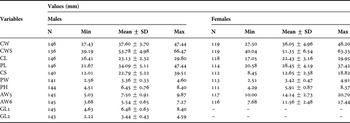
A total of 265 individuals of A. spinicarpus were analysed, 146 males and 119 females (60 ovigerous and 59 non-ovigerous). The descriptive statistics for the biometric variables are presented in Table 1. With the exception of the abdominal somites (AW5 and AW6), which were larger in females (t = 25.1 and t = 25.5, respectively; P < 0.05), as well as PW, which showed no statistical difference (t = 1.09; P > 0.05), the remaining structures (CW, CWS, CL, PL, CS and PH) were significantly larger in males (t = 2.9, t = 3.3, t = 2.02, t = 9.7, t = 20.4 and t = 5.3, respectively; P < 0.05).
Achelous spinicarpus Stimpson, 1871: descriptive statistics of the biometric variables evaluated for both sexes (CW, carapace width without lateral spines; CWS, carapace width with lateral spines; CL, carapace length; PL, propodus length; CS, carpal spine length; PW, propodus width; PH, propodus height; AW5, width of the 5th abdominal somite; AW6, width of the 6th abdominal somite; GL1, length of the 1st gonopod pair; GL2, length of the 2nd gonopod pair).

N, number of specimens; Min, minimum; Max, maximum; SD, standard deviation.
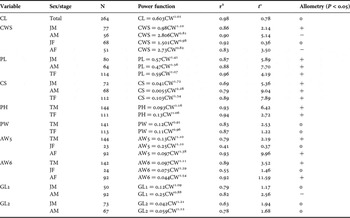
The CL × CW relation was isometric in both sexes (b = 1.01; males: t = 0.807; females: t = 1.50; P > 0.05), allowing it to be represented by a single equation (CL = 0.603CW1.01, N = 264, r2 = 0.98). For CWS × CW, a decrease in the growth rate was noted between the developmental stages of males (positive to negative allometric) and females (isometric to negative allometric) (Table 2), with the break-points estimated at 37.3 and 36.6 mm, respectively.
Achelous spinicarpus Stimpson, 1871: regression analyses of biometric variables of the cephalothorax (CL, carapace length; CWS, carapace width with lateral spines), cheliped (PL, propodus length; CS, carpal spine length; PH, propodus height; PW, propodus width), abdomen (AW5, width of the 5th abdominal somite; AW6, width of the 6th abdominal somite), and gonopods (GL1, length of the 1st gonopod pair; GL2, length of the 2nd gonopod pair), related to the independent variable (CW, carapace width without lateral spines).

*t-test, H0: b = 1, isometry; Total, males plus females; JM, juvenile males; AM, adult males; TM, total males; JF, juvenile females; AF, adult females; TF, total females; 0, isometry; +, positive allometry; −, negative allometry.
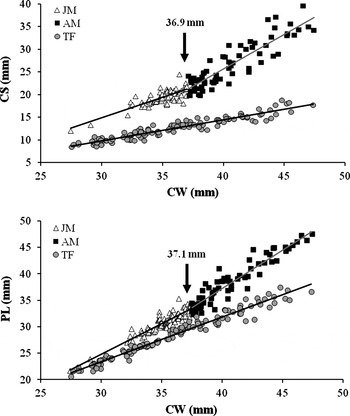
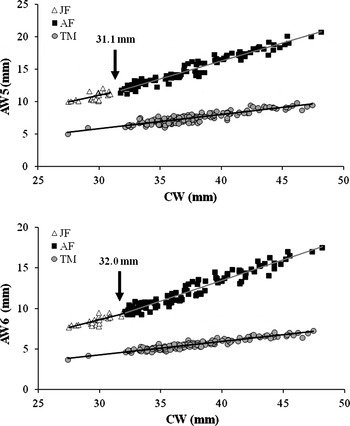
For both sexes, the relations involving the cheliped showed positive allometry, with the exception of PW (Table 2). In males, the greatest variations of the constant ‘b' between the developmental stages were observed for the relations CS × CW and PL × CW, with morphological maturity estimated at 36.9 and 37.1 mm, respectively (Figure 1). In females, on the other hand, no inflection was found in the trend of the empirical points for these regressions. The inverse was observed for the abdomen of females, independently of the relation evaluated (AW5 × CW and AW6 × CW), with a significant positive allometry in the adult stage; whereas in males, no alteration was detected in the growth rate between the juvenile and adult stages for these relations. Females matured at a smaller size than males: 31.1 (AW5) and 32 mm (AW6) (Figure 2).
Achelous spinicarpus Stimpson, 1871: graph of dispersion of points of the biometric relationships CS × CW and PL × CW, for both sexes, with indication of the size at morphological maturity (arrow). CS, carpal spine length; PL, propodus length; CW, carapace width without lateral spines; JM, juvenile males; AM, adult males; TF, total females.

Achelous spinicarpus Stimpson, 1871: graph of dispersion of points of the biometric relationships AW5 × CW and AW6 × CW, for both sexes, with indication of the size at morphological maturity (arrow). AW5, width of 5th abdominal somite; AW6, width of 6th abdominal somite; CW, carapace width without lateral spines; TM, total males; JF, juvenile females; AF, adult females.

The relations of the gonopods showed an inflection point synchronous with that observed for the relations of the cheliped, i.e. 35.5 mm for GL1 × CW and 36.9 mm for GL2 × CW. For GL1 × CW there was a change in the growth rate between the developmental stages (isometric to negative allometric); whereas for GL2 × CW, growth was isometric, although the difference between the constant ‘b' of the juvenile and adult stages was not statistically significant (Table 2).
Fecundity
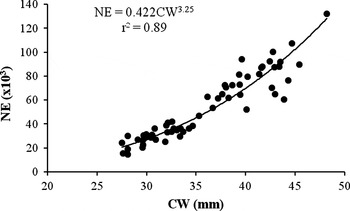
A total of 60 ovigerous females were analysed, with CW ranging between 27.5 and 48.2 mm (36.03 ± 5.72 mm) and CWS between 40.1 and 64.8 mm (51.18 ± 7.3 mm). Potential fecundity was estimated at between 14,745 and 132,392 eggs (53,984 ± 27,658 eggs). Significant positive correlations were observed for the relations NE × CW and NE × CWS (r = 0.93, F = 411.93; and r = 0.92, F = 231.21, respectively; P < 0.0001), which show a curvilinear trend, expressed by the power functions NE = 0.422CW3.25 (r2 = 0.89) (Figure 3) and NE = 0.0416CWS3.55 (r2 = 0.86).
Achelous spinicarpus Stimpson, 1871: relationship between the number of eggs (NE) and the biometric parameter of the cephalothorax (CW, carapace width without lateral spines).

DISCUSSION
Relative growth and morphological maturity
The present study provided important information on the morphology, growth and reproduction of Achelous spinicarpus for the south-eastern continental shelf of Brazil, which adds to the sparse available information on this common and abundant species in the western Atlantic.
Although the smallest specimen collected was a male (CW = 27.43 mm) and the largest was a female (CW = 48.2 mm), the males were significantly larger, as also observed by Sanvicente-Añorve et al. (2008). The larger body size reached by males is common in portunids, and is a result of the differential allocation of energy to somatic growth in this sex, in contrast to the females, which have a large part of their energy directed toward gonadal maturation and egg production (Hartnoll, Reference Hartnoll and Wenner1985). This difference is a reproductively advantageous adaptation during the formation of pairs, a common feature of portunids, in which the larger males provide protection to the females in post-moult (Christy, Reference Christy1987), when they are in copula, until their exoskeleton calcifies (Hartnoll, Reference Hartnoll1969).
The variation in size (CW) of A. spinicarpus found in this study was similar to that observed by other investigators, such as Holthuis (Reference Holthuis1969), who evaluated several populations of this species from the Florida Strait (USA) (25°N) to French Guiana (5°N); and Sanvicente-Añorve et al. (2008) for a population in the south-eastern Gulf of Mexico (22°N). The greater difference of the present data from the second study probably results from sampling selectivity by the trawl net (20 mm knot-to-knot). In addition, Holthuis (Reference Holthuis1969) mentioned that the juvenile of this species occur at depths less than 86 m, which would explain the absence of individuals with CW < 27 mm in the present study (95 and 100 m) and their recording by Sanvicente-Añorve et al. (2008), at depths of 60 m. In spite of these differences, the size distribution of A. spinicarpus in the present study appears to be representative, because the sample obtained at the 100-m isobath was very similar to that recorded by Holthuis (Reference Holthuis1969), although his sampling has been more comprehensive with regard to depth (14 to 406 m) as well as geographical distribution.
In male brachyurans, the greater development of the chelipeds is considered a secondary sexual character, related to the display of agonistic behaviours (e.g. combats for females and territorial defence) and reproductive behaviours (e.g. courtship and maintenance of copulation), according to studies by Hartnoll Reference Hartnoll(1974, Reference Hartnoll1978) and Jivoff & Hines (Reference Jivoff and Hines1998). In females, on the other hand, the widening of the abdomen and opening of the gonopores in the puberty moult are morphological aspects of extreme importance for the success of copulation, providing protection for the egg mass and the genital openings (Pinheiro & Fransozo, Reference Pinheiro and Fransozo1998). For A. spinicarpus, the same pattern was observed with respect to the differential allometry of these appendices in each sex.
The carpal spines of the cheliped proved to be an excellent feature for use in the detection of dimorphism between the sexes (as previously suggested by Sanvicente-Añorve et al., 2008), as well as the size at morphological maturity of the males; the carpal spines were more important than the length of the propodus, a structure that is widely used in this type of study. Similarly, as observed for other species (e.g. Hartnoll, Reference Hartnoll1965; Flores & Negreiros-Fransozo, Reference Flores and Negreiros-Fransozo1999; Pinheiro & Hattori, Reference Pinheiro and Hattori2006; Freire et al., Reference Freire, Pinheiro, Karam-Silva and Teschima2011), the gonopods provided a reliable estimate of this parameter, in synchrony with other body structures, because of their importance in transferring the spermatophores.
In the available literature on portunids, there is no consensus as to which biometric variable is more representative of the cephalothorax (CW or CWS), or which of these should be used as a reference size. Although the majority of investigators use CW, a few use CWS in biometrics, making comparison difficult because it requires a conversion between these variables. In the present study, the relation CWS × CW showed a decrease in the growth rate between the developmental stages for both sexes, in synchrony with the other body structures that are traditionally used in analyses of morphological maturity for males (±37 mm). This signifies that the lateral spines grow proportionately more in juveniles; this possibly represents an anti-predator adaptation, as in the dorsal and rostral spines of the zoeas (Morgan, Reference Morgan1987). For the swimming crabs Arenaeus cribrarius (Lamarck, 1818) and Callinectes ornatus Ordway, 1863, studied by Haefner (Reference Haefner1990) and Pinheiro & Fransozo (Reference Pinheiro and Fransozo1993), respectively, this pattern was not observed, the relation being typically isometric. This regression has been examined in few publications; nevertheless, the result obtained here assures that it will be important in future studies of relative growth, at least in species of Portunidae.
The size at which crustaceans become sexually mature is one of the most important aspects of the biological cycle of these animals (Muiño et al., Reference Muiño, Fernández, González-Gurriáran, Freire and Vilar1999). There are, basically, two methods of studying this parameter: (1) through physiological analysis, which consists of the inspection of evidence directly related to reproduction (e.g. gonadal development: according to Costa & Negreiros-Fransozo, Reference Costa and Negreiros-Fransozo1998; Baptista-Metri et al., Reference Baptista-Metri, Pinheiro, Blankensteyn and Borzone2005); and (2) based on morphological data, which indicate the size at which the animal is able to copulate, considering the differential growth of certain structures (Abelló et al., Reference Abelló, Pertierra and Reid1990; Haefner, Reference Haefner1990; Araújo et al., Reference Araújo, Negromonte, Barreto and Castiglioni2011). However, the results of these different methods do not always agree, although both provide an accurate estimate of the beginning of maturity in these animals. In the present study, females became morphologically mature at smaller sizes than males, following the general pattern of portunids (see the review by Pinheiro & Fransozo, Reference Pinheiro and Fransozo1998). This constitutes an important reproductive adaptation, considering that in the majority of the Portunidae, pair formation and copulation involve males in intermoult and females in recent post-moult, which need protection by the male during the post-copulatory embrace, until the hardening of their exoskeleton (Hartnoll, Reference Hartnoll1969; Christy, Reference Christy1987; Pinheiro & Fransozo, Reference Pinheiro and Fransozo1999).
Fecundity
In females of brachyurans, egg production is limited by the cephalothoracic cavity, where the gonads are located and yolk accumulates (Hines, Reference Hines1982, Reference Hines1992), and the size of the female is the principal determinant of fecundity (Hines, Reference Hines1988). Nevertheless, external factors such as temperature, photoperiod, availability of food, salinity and the lunar cycle can determine the periodicity and length of the reproductive period (Colpo & Negreiros-Fransozo, Reference Colpo and Negreiros-Fransozo2003). According to Sartor (Reference Sartor1989), of 54,260 specimens of A. spinicarpus caught along the northern coast of São Paulo (23° to 24°S), ovigerous females occurred during the entire year, although in greater numbers in the warmer months. Therefore, A. spinicarpus can be assigned to the seasonal–continuous reproductive pattern proposed by Pinheiro & Fransozo (Reference Pinheiro and Fransozo2002). This pattern is characterized by the presence of females that are ovigerous and/or have mature gonads during all months of the year, but in uneven percentages, with greater intensity in certain months or seasons.
The fecundity of A. spinicarpus is relatively low because of its small body size and small size at sexual maturity, compared to other swimming crabs. The family Portunidae shows wide plasticity in the fecundity of the species (see review by Pinheiro & Terceiro, Reference Pinheiro and Terceiro2000). Fecundity reaches a maximum of two million eggs in some members of Portunidae (e.g. Callinectes sapidus Rathbun, 1896, according to Van Engel, Reference Van Engel1958); in contrast to the Polybiinae, which produce fewer eggs per spawning, even when individuals of identical size are compared. According to Pinheiro & Terceiro (Reference Pinheiro and Terceiro2000), this results from the animals of this subfamily reaching sexual maturity at a smaller size, in addition to the effect caused by latitudinal differences, which can affect egg production (Hartnoll & Gould, Reference Hartnoll, Gould, Fincham and Rainbow1988).
The distribution of the Polybiinae is concentrated in temperate regions, where environmental conditions, especially temperature, are more rigorous and limiting. However, although A. spinicarpus is a member of the Portunidae, it has relatively low fecundity, similar to that of the polybiine swimming crabs, which can be explained by tracking the movements of the SACW cold water mass (Pires, Reference Pires1992). According to Hartnoll & Gould (Reference Hartnoll, Gould, Fincham and Rainbow1988), the fecundity of decapod crustaceans showed a negative correlation with the latitude at which the species occur, being lower at higher latitudes as a function of limiting environmental factors, where temperature also tends to be lower and photoperiod shorter. Lardies & Castilla (Reference Lardies and Castilla2001) corroborated this statement, recording a negative correlation between fecundity and size (or volume) of eggs as a function of latitude. Thus, at higher latitudes, larger eggs (with more yolk) are produced, generating larvae that are larger and potentially more likely to survive in the plankton (Schuh & Diesel, Reference Schuh and Diesel1995; Diesel & Schuh, Reference Diesel and Schuh1998; Brante et al., Reference Brante, Fernández, Eckerle, Mark, Pörtner and Arntz2003, Reference Brante, Cifuentes, Pörtner, Arntz and Fernández2004). Other investigators, however, have attributed such differences among populations to different environmental (Bas et al., Reference Bas, Spivak and Anger2007) or genetic factors (Hancock et al., Reference Hancock, Hughes and Bunn1998), rather than to the latitudinal gradient.
Reid & Corey (Reference Reid and Corey1991) compared the fecundity of 15 species of brachyurans and anomurans, including 20 specimens of A. spinicarpus obtained in the Gulf of Mexico. According to these investigators, the mean fecundity of this species was 32,204 eggs, much lower than that found in the present study (53,984 eggs). Possibly this occurred because of the small number of specimens analysed and the low variation in size (16.5 to 23.2 mm CL), which corresponds to 26.7 and 37.4 mm CW, according to inter-conversion by the equation obtained in the present study (CL = 0.5834CW1.017).
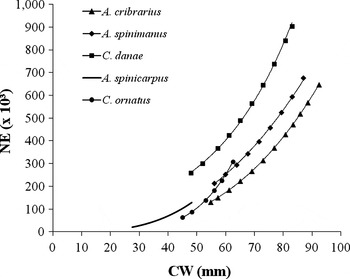
In spite of the low fecundity of A. spinicarpus, one of the smallest members of the family Portunidae, this species is mentioned as the most abundant in benthic samples from the western Atlantic (Sartor, Reference Sartor1989; Puentes et al., Reference Puentes, Campos and Reyes1990; Pires, Reference Pires1992). Figure 4 shows the potential fecundity of the principal swimming crabs that have been studied on the south-eastern continental shelf of Brazil. The variation in this parameter (e.g. five times greater in Arenaeus cribrarius and Achelous spinimanus (Latreille, 1819), and seven in Callinectes danae Smith, 1869) is related principally to the size reached by the females, which is much lower in A. spinicarpus than in the other species studied.
Comparative analysis of the equations for potential fecundity of the regression NE × CW for the portunid crabs of the south-east continental shelf (NE, number of eggs; CW, carapace width without lateral spines). Arenaeus cribrarius, Pinheiro & Terceiro (Reference Pinheiro and Terceiro2000); Callinectes danae, Costa & Negreiros-Fransozo (Reference Costa and Negreiros-Fransozo1996); Achelous spinimanus, Santos & Negreiros-Fransozo (Reference Santos and Negreiros-Fransozo1998); Callinectes ornatus, Mantelatto & Fransozo (Reference Mantelatto and Fransozo1997); Achelous spinicarpus = present study.

Hines (Reference Hines1992) mentioned the small energy investment of this species in egg production (3.2%), as estimated based on the percentage of the egg mass in relation to the total weight of the female, which is 1/3 of the mean value observed for other brachyurans (10% according to Hines, Reference Hines1982). Nevertheless, this portunid is one of the most abundant macroinvertebrates on unconsolidated marine bottoms, and is intimately associated with the frontal zone of the SACW, following its movements during the year. Sartor (Reference Sartor1989) suggested that this distribution pattern favours A. spinicarpus, since the frontal system of this water mass could displace animals that are susceptible to low temperatures, making them easy prey for this carnivore.
This study is the first treatment of morphological and reproductive aspects of A. spinicarpus on the south-eastern continental shelf of Brazil. The data obtained corroborate those described in the literature for other portunids, emphasizing the peculiarity of the carpal spines as indicative of morphological sexual maturity for males, and the association of the species with the SACW, which possibly significantly influences its bioecology, as inferred for the fecundity. In spite of these results, further studies should be carried out in order to better understand the growth and reproduction of this species along the Brazilian coast.
ACKNOWLEDGEMENTS
FAPESP provided financial support to the first author for the conduct of this research (Proc. #2009/11711-0). We thank CEPSUL/IBAMA for making it possible to use the RV ‘Soloncy Moura' during the II Oceanographic Cruise of UNESP/CLP. We are also grateful to students R.R. Melo, W.P. Costa and V.S. Soares, and to Professor Dr B.S. Sant'Anna for their assistance with the laboratory procedures. Finally, we thank Dr Janet Reid (JWR Associates) who provided the editing of our English.