What is it about institutions? Reforming medical governance in Europe
Health policy reform in many countries was for a long time concerned almost exclusively with variables at the macro-level of containing costs. However, the focus is now more firmly on the micro-level of governing health-service delivery. With this shift, doctors, both individually and as a group, have come more sharply into focus. This shift in focus arose because, at the micro-level, doctors control the delivery of services and are the pivot point around which the allocation of financial resources flows. These two facts have major aggregate effects.
This special issue is about understanding current attempts to reform medical governance – in particular, those by third parties (the government or private entities) to control the practice of medicine. More specifically, it analyses how country-specific institutions shape the substance of policy reform. Each country in our study has been forced to control better the way in which doctors practise medicine. We call this, broadly, ‘medical governance’. However, equally important is the fact that each country differs in the path that it chooses in responding to the same imperatives.
There are important interaction effects here: although each country in our study responds to a similar imperative, cost control (cf. Wilsford's (1995) analysis of the ‘fiscal imperative’ at work in all like-countries), the means that each country takes to achieve this goal are different. The instruments and techniques brought to bear in each case vary considerably and are directed by a country's political institutions towards a unique path.
Traditionally, medical governance has been characterised by professional self-regulation, providing doctors considerable autonomy over their work. In exchange, doctors are expected to provide quality care and de-politicise the rationing of health care at the level of individual patients (Salter, Reference Salter2004). However, the trust of the state (and the public) in doctors to deliver on this bargain has decayed in the face of heightened cost concerns, the emergence of assertive patients and the arrival of nouveaux public management reforms on the scene. We no longer assume doctors to be neutral-minded pursuers of the public weal. Hence, new governing instruments that emphasise the importance of public accountability have emerged. These take many forms, including clinical guidelines, evidence-based medicine and reforms of regulatory bodies (see, for example, Allsop and Mulcahy, Reference Allsop and Mulcahy1996; Burau, Reference Burau, Bovens, ‘t Hart and Peters2001; Dent, Reference Dent2003; Dubois et al., Reference Dubois, Dixon, McKee, Dubois, Nolte and McKee2005; Gray and Harrison, Reference Gray and Harrison2004; Salter, Reference Salter2004; Vrangbæk, Reference Vrangbæk, Bentsen, Zeuthen, Erlingsdottir and Sahlin-Andersen1999).
This special issue analyses variation in the pathways towards change and explores how the evolution of medical governance is shaped by country-specific contexts. To do so, we present case studies of selected reforms and associated processes of negotiations in four countries: Denmark, Germany, Italy and the United Kingdom. These countries were chosen because they are characterised by theoretically interesting variations in relation to the institutional contexts of medical governance. We call these patterns in each country a governance regime.
The contribution of this special issue is two-fold. First, we go beyond the dualist perspective of professional self-regulation versus hierarchy. Instead, these country studies map the complex and indeed often nested co-existence between diverse forms of governance. Second, this issue offers a deeper understanding of changes in the governance of medicine and focuses on how such changes have come about, looking at the ways in which sector-specific institutions shape the specific politics of reform. Given the centrality of medicine for health care, this issue also offers important insights for understanding health policy in Europe generally.
Mapping changes in medical governance regimes
Governing doctors and their practice of medicine, or medical governance, has traditionally allowed doctors considerable autonomy over their work, while new governing instruments emphasise the importance of public accountability. Orienting these instruments towards accountability lends a bias towards managerial control, rather than professional autonomy. This tension – between controlling doctors and their desire to safeguard their autonomy – surfaces in all countries when the question of transforming medical governance is addressed.
However, although the dualism between professionalism and managerialism is a starting point, we believe that contemporary governance also includes other elements of both network and hierarchy. This requires dissecting notions of governance, by focusing on shifts in how governments seek to govern in increasingly diverse societies that do not necessarily respond to formal, top-down steering (cf. Bevir and Rhodes, Reference Bevir and Rhodes2003; Kooiman, Reference Kooiman and Pierre2000). This notion of governance highlights heterogeneity, in terms of the arenas and the relationships involved in governing. It also emphasises governing beyond the state (Pierre and Peters, Reference Pierre and Peters2000; Rhodes, Reference Rhodes and Pierre2000).
Often, the heterogeneity of the elements at play in any contemporary governance regime implies that change may be linear, moving away from old forms of governance, or non-linear, combining old and new forms of governance. We therefore break down the notion of governance, following Newman (2001) and Jørgensen and Vrangbæk (2004), to distinguish among four typical models (and associated forms) of governance: hierarchy, the market model, the open systems/network model and the self-governance/clan model. We use these ideal types as a heuristic tool to examine the real world of medical governance, where different forms of governance exist side-by-side, often in a nested form.
Hierarchy – as a form of governance – is oriented towards control and accountability and thus operates through vertical relations. The policy process is formalised and the state has control over the development of policy and the implementation of policies, mainly through bureaucratic structures. Appropriately, the overriding decision-making dynamic is top-down.
The market model, in contrast, focuses on maximising the output (such as measuring money spent on days in bed or number of procedures for X, Y or Z), and governing occurs through competition among multiple and more or less autonomous agents. In principle, this makes for a more horizontal, fragmented and diffuse policy process. In the real world, the market model often assumes some form of managed competition, wherein the government sets overall goals and targets and generally oversees the macro-framework, while multiple diverse agents contend on this controlled playing field. In other words, in health policy, the market model (the United States aside) is not a ‘free’ market. It is a controlled one.
Central to the open systems/network model of governance are reiterative forms of interactions that are based on trust and interdependence regarding each other's resources. The policy process is characterised by multiple centres of power and, although network-based governing is embedded in hierarchies, the government is unable to exert direct control. This is in sharp contrast to the market model.
Finally, the self-governance/clan model most clearly highlights governing beyond the state. Here, Newman (2001) focuses on the role of civil society in governing and suggests that fostering relations of independence and reciprocity is the main feature. Jørgensen and Vrangbæk (2004) use a more narrow definition and look specifically at the role of experts in governing. Professional hierarchies and peer-based control are the main vehicles for governance, which are based on professional norms and the notion of professional autonomy.
In developing this approach, Jørgensen and Vrangbæk (2004) characterise changes in forms of governance as dynamic and non-exclusive. They look for changes within individual forms of governance (such as clan-based governance, which includes stronger control of individual doctors); the changing balance of power among different (co-existing) forms of governance (such as the increasing importance of market-based governance in health care); and the existence of hybrid forms of governance (such as professional autonomy, whose boundaries are circumscribed by hierarchy). Considering the importance of the co-existence of different forms of governance, Newman's (2001) concern for tensions among various forms of governance and her definition of change as negotiating conflicting demands and corresponding dilemmas is also relevant.
Although these analytical notions inform much of what follows in the country studies, there is little in the governance literature about contingencies and institutional contexts that shape a change in governance. Hence, how shall we better understand such contexts and the contingencies that impinge upon them?
Understanding institutional contexts of medical governance
We define institutions as well-established and structured patterns of behaviour, usually structured around continuing relationships. As such, they are always characterised by formal and informal rules and procedures. Moreover, institutions relevant to public policy are often embedded in a particular organisation, such as the state.
For health-care policy, questions central to understanding the politics and policy consequences of medical governance arise from a given country's institutional milieu. In any democratic system, such as the ones we consider, power struggles underpin the organisation of health care; the distribution and application of power, together with the defining of valid interests and perspectives, are all questions central to governance.
In a seminal work, Moran (1999, 2000) presents different types of health-care states, three of which are particularly relevant in the context of Europe. In Moran's ‘entrenched command-and-control’ health-care state, the governance of consumption is based on tax funding and resource allocation through administrative mechanisms. This gives the state a central role in governing the collective consumption of health care. The same applies to the governance of provision: hospitals are publicly owned and providers closely regulated. A variant of this is the ‘insecure command-and-control state’, where private payments and private practice play an important role.
In contrast, in the ‘corporatist’ health-care state, funding through social insurance contributions means that public bodies (such as statutory, non-profit insurance funds) play a central role in the governance of consumption. Here, the role of the state is largely confined to regulating the (procedural and substantive) framework of this form of self-government. The same is true for the governance of provision, wherein statutory organisations of doctors are especially influential. This makes for a particularly extensive, yet integrated form of regulating providers.
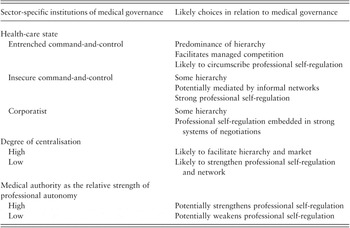
In order to better analyse pathways of change in medical governance, we extend Moran's concept of the health-care state and include the decentralisation of governance arrangements and the normative institutions of medical authority. Although the concept of the health-care state emphasises the embeddedness of the institutions of health care in the institutions of the state, the state nonetheless emerges as a unitary organisational entity. However, in relation to health care in many countries, states are characterised by a considerable degree of decentralisation. Examples include the long-standing importance of counties in Denmark and the regionalisation of health care in Italy. The relative decentralisation of health-care states needs to be taken into account as particularly relevant for analysing changes in a governance regime. Moving away from professional self-regulation and towards strengthening public accountability requires a certain concentration of power in governing arrangements. The extent to which health care is decentralised is an important factor in facilitating or constraining such developments (see Table 2).
In addition, the concept of the health-care state captures the regulatory element of institutions and directs attention towards explicit regulatory processes such as rule setting and enforcement. The focus is on the relationship between different institutions of health governance and in particular on the extent of hierarchy in medical governance. However, the many normative aspects associated with any governance regime need to be further unpacked – for example, as reflected in the importance of informal professional networks (for more details on this point, see Burau, Reference Burau2005). Normative institutions involve conceptual specifications about desirable goals and legitimate means to achieve these goals. As such, normative institutions represent beliefs that create professional roles and standardised patterns of interaction (March and Olsen, Reference March and Olsen1989; Scott, Reference Scott1995). Perceptions of professional authority are crucial here, while formal education and professional networks help to define and sustain such norms and values.
The comparative studies: tensions of medical governance regimes
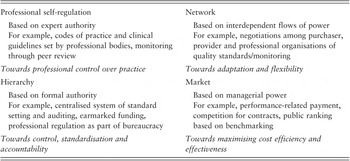
As asserted here, in the real world, reformers of medical governance tend to mix different combinations of hierarchy, market, network and (professional) self-regulation. Any given governance regime is characterised by a distinct logic in terms of defining the problems that governance is supposed to address and defining approaches to change. This makes for tensions and conflicts between different forms of governance, which in turn form the basis for policy change. More specifically, as Newman (2001) states, policy change is a process of balancing competing pressures and addressing a range of dilemmas. Table 1 illustrates what the individual forms of governance mean in relation to medical governance, and points to the tensions between them.
Regimes of medical governance

Newman (2001) suggests that tensions are particularly strong between diagonally opposite forms of governance. The typical forms of medical governance based on professional self-regulation are constituted by the codes of practice and clinical standards set by professional bodies and monitoring through peer review. The authority of medical experts is the basis of power. This stands in stark contrast with a market-based governance regime, which rests on managerial power. Here, the focus of medical governance is on maximising cost efficiency and effectiveness. Examples for this type of medical governance include performance-related payments or provider competition for service contracts in public quasi-markets and public ranking of provider organisations based on benchmarks.
As Newman (2001) suggests, market and hierarchy-based forms of governing are often closely connected in practice. Examples for such a governance hybrid include a centralised system of standard setting and auditing, the use of earmarked funding and embedding professional regulation in the regular public administration of health care. This is markedly different from a network-based governance regime, which is rooted in flows of power among interdependent actors. These flows include joint negotiations of quality standards and monitoring among purchaser, provider and professional organisations. This type of governance pulls in the direction of adaptation and flexibility, in the context of ongoing negotiations that include processes of feedback and learning.
Our case studies go beyond merely mapping changes in medical governance. We are also interested in how sector-specific institutional contexts across countries shape such changes. It is assumed that institutional contexts influence the choices made and that there exist particular pathways of change in relation to medical governance, with these pathways differing from country to country. In other words, in some institutional contexts certain choices in medical governance are more likely than in others, and hence the unique specificity of each case, against the backdrop of the commonality of both problems and dilemmas—because the solution set available in a given country's policy terrain is shaped and channelled by the varied prevailing institutions. Table 2 gives an overview of variations in the three sets of sector-specific institutions identified above and the likely choice of medical governance regime.
Institutional contexts and choices in relation to medical governance

This demonstration of the wide range of choices that exist conceptually in relation to medical governance shows that the choices reflect both different types of institutions and different variants of the same type of institutions. This makes for a broad array of solution sets, the multiplicity of which, in fact, comes to the fore in all of our countries. Yet, evidence shows that prevailing institutions narrow the solution set significantly from the conceptual multiplicity that constitutes the whole set.
What area of governance then is most relevant when studying change in a medical governance regime? Freidson (1970) suggests that controlling clinical work is at the centre of medical governance because the task of doctors is to apply knowledge. Furthermore, compared with education and research, for example, performance is the area of governing doctors that has the most direct effect on the public (as cases of medical negligence demonstrate). This politicises governing doctors and therefore makes performance a logical choice as a measure for studying changes in medical governance.
The governance of medical performance itself consists of all those mechanisms that together influence the performance of medical work in terms of either diagnosis or treatment, broadly understood. Such mechanisms can take the form of setting standards or monitoring, and they include knowledge-based mechanisms such as research and clinical guidelines, as well as economic-based mechanisms such as funding based on diagnosis-related groups (1). In relation to individual countries, the relative emphasis on diagnosis/treatment and standard setting/monitoring may vary and some mechanisms may be more or less central to the new governance of medical performance. Moreover, performance mechanisms may focus on developing clinical pathways or patient episodes rather than on individual doctors, but may nevertheless affect the performance of these doctors.
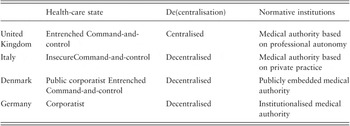
Hence, how can we study changes in the governance of medical performance from a comparative perspective, as well as the manner in which specific institutional contexts shape regime change? The following articles present country-based case studies based on a ‘most similar cases approach’ and based on broadly similar countries. The countries include examples of an entrenched command-and-control health-care state (the United Kingdom, with Denmark as a variant), an insecure command-and-control health-care state (Italy) and a corporatist health-care state (Germany). Health-care states combine with other types of sector-specific institutions in different ways. In the United Kingdom, the entrenched command-and-control health-care state coincides with a considerable degree of centralisation of governing arrangements, whereas Denmark is characterised by substantial decentralisation. Similarly, in relation to the normative institutions of medical authority, the medical authority in Denmark is firmly embedded in, and closely connected to, the predominantly public governance of health care. This contrasts with the United Kingdom, which is a classic example of medical authority being primarily based on professional self-regulation. Italy and Germany are examples of yet other combinations of sector-specific institutions (Table 3).
Sector-specific institutions of governing medical performance

The study of how institutions shape change in governance is, in essence, a study of path dependence (see Wilsford, Reference Wilsford1994). A critical variable in determining the direction of any policy path is the manner in which institutions sustain and reproduce themselves and then channel quasi-autonomous decision agents along a given path trajectory (Wilsford, Reference Wilsford and Rosen2007). The literature on historical institutionalism (for an overview see Mahoney, Reference Mahoney2000; Thelen, Reference Thelen1999; Thelen and Steinmo, Reference Thelen, Steinmo, Steinmo and Thelen1992) identifies feedback mechanisms as central to understanding such processes. The country case studies look at such feedback mechanisms and at how they shape regime change in medical governance by examining the process of negotiating critical instances of reform in the individual countries. (The term ‘critical’ is used to indicate a reform that sets out to address the policy pressures underpinning the way in which governance of medical performance is organised in individual countries.) This also creates differences in the kind of reforms individual case studies consider. For example, the German case study considers the introduction of Disease Management Programmes as a single reform, whereas the UK case study considers a number of reforms.
What do we learn?
From an institutionalist perspective, we have two sets of expectations. First, different health-care states, along with different combinations of sector-specific institutions, shape how doctors are governed. They create specific (and diverse) pathways of governing. Second, such pre-reform policy pathways, along with the sector-specific institutions, shape the substance of reforming medical governance.
Pre-reform policy pathways for governing medical performance
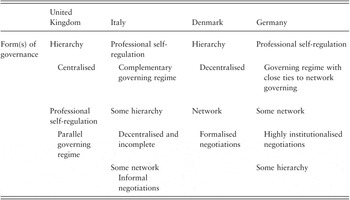
An overview of the pre-reform pathways of governing medical performance (see Table 4) suggests that sector-specific institutions leave their mark, especially on the nature of individual forms of governance and on the balance among them. It is evident that our countries are characterised by differences in the nature of individual forms of governing. First, the nature of hierarchy-based governance varies, reflecting in particular the relative (de)centralisation of power in governing arrangements. In the United Kingdom hierarchical governing is highly centralised and the central government plays a leading role, whereas in Italy, Denmark and Germany hierarchical governing is more decentralised and closely tied to negotiations at the sub-central level.
Pre-reform pathways of governing medical performance

Reforming medical governance regimes

Second, the nature of professional self-regulation varies from country to country, reflecting differences among the national normative institutions of medical authority. In the United Kingdom, professional self-regulation exists as a regime of governance parallel to hierarchy. This is related to the fact that a classical, ‘pure’ form of collective professional autonomy forms the normative basis of medical authority. In contrast, in Germany professional self-regulation presents itself as a governance regime that has close ties to the joint self-administration of doctors and insurance funds (for more details, see the discussion of reforms below). Medical authority is institutionally embedded by law. Italy lies in an intermediate position.
Third, negotiation emerges as an important form of mediation between doctors and the state. Variations exist, especially with regard to how formalised the negotiation is. In Germany negotiation is highly institutionalised; in Denmark it is less so, but still has formal status by virtue of the emphasis on consensus seeking (giving the health-care state distinct ‘public corporatist’ features). In contrast, negotiation is more informal in Italy (and also in the United Kingdom). These differences in the nature of negotiation can be traced to the normative institutions of medical authority and the corresponding relationship with the state. For example, whereas in Denmark publicly embedded medical authority makes for co-operative and integrative norms regarding the relationship between doctors and the state, the relationship between doctors and the state in the United Kingdom and Italy is based on detachment and confrontation, reflected in medical authority based on professional autonomy and private practice, respectively. The latter reflects a hybrid form of organising medical practice, in which the public and private sectors overlap.
Across the four countries studied, there are also differences in the relative balance across different governance regimes and associated tensions between different governance regimes. In the United Kingdom, as well as in Denmark, hierarchy plays a key role, which in many ways reminds us of the thrust of the command-and-control health-care state. This makes for tension with professional autonomy and network-based co-ordination. Hierarchy is weaker in Italy, reflecting a weakness typical of insecure command-and-control health-care states. This is exacerbated by the considerable degree of decentralisation of governance arrangements in combination with the fact that medical authority is weak in the public arena and instead is derived from the importance of private practice. Hierarchy is also weak in Germany but for different reasons, notably the intimate relationship between the arrangements for joint self-administration, seen as a form of network-based governing, and the professional self-regulation typical of a corporatist health-care state. This corresponds to a form of medical authority that is highly institutionalised. Here, governance is characterised by tensions between more transparent processes of adaptation based on independent flows of power and professional control based on expertise.
The case of Denmark, on the other hand, shows that strong hierarchy and network-based forms of governing can co-exist, making Denmark a public corporatist variant of the entrenched command-and-control health-care state. Here, consensus-oriented negotiations are embedded within a hierarchical governing regime, leading to tensions between governance regimes based on vertical and those based on independent power relations. Negotiations provide the link between an entrenched command-and-control health-care state and highly decentralised governing arrangements (and indeed give the health-care state its distinct ‘public corporatist’ features). Strikingly, professional self-regulation formally speaking does not exist, reflecting a publicly embedded form of medical authority. In contrast, the United Kingdom combines hierarchy with strong professional self-regulation, resulting in tensions; such tensions are less pronounced in Italy, as can be expected.
Reforming medical governance
Governing arrangements in a given country end up being variations on the same theme: regulating the performance of medical experts working in publicly funded and controlled health systems. But across countries, differences in pre-reform pathways are related to variations in sector-specific institutions and to the particular mixes of institutions in individual countries. These differences contribute to how reform of governance regimes unfolds in each country, and, ultimately, to what solution set informs the specifics of regime choice to govern the doctors.
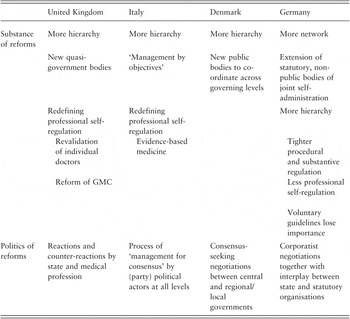
The institutionalist perspective suggests that earlier pathways of governing medical performance shape the specific substance of reforms, making incremental, path-dependent change most likely. The analysis of recent reforms across the countries studied here indeed tells such a story, and this particularly applies to the redefinition of both hierarchy and professional self-regulation and to the strengthening of hierarchy. Here, feedback mechanisms are the link between sector-specific institutions (and corresponding policy paths) on the one hand and the substance of medical governance reforms on the other (Table 5).
Changes in relation to the nature of individual forms of governance are closely related to the emergence of a more explicit regime of governing medical performance. In relation to hierarchy-based forms of governance, the redefinition of the nature of hierarchy is reflected in institution building. This is particularly prominent in the United Kingdom, where the creation of new regulatory bodies has been the central element of policies of ‘clinical governance’. The combination of the entrenched command-and-control health-care state and highly centralised governing arrangements has given the government extensive governing capacities, and all the new regulatory agencies operate at arm’s length from each other as quasi-government bodies. The central government has driven the policy process: policies are introduced top-down.
The introduction of a Systematic Standards-Based Programme in Denmark points to a similar development involving the establishment of a jointly funded secretariat to support the development and implementation of the National Model. Yet, following the focus on consensus finding in the context of highly decentralised governing arrangements, this is a public body, which functions as a co-ordination hub for public authorities at sub-central and central levels. Significantly, the interplay between national and regional governments dominates the politics of reform and even overshadows the conflict between doctors and the state. Not surprisingly, and in contrast to the United Kingdom, the policy was developed gradually through several rounds of negotiations, with the medical profession involved indirectly initially and directly later.
In comparison, the strengthening of hierarchy is less extensive in Germany and, when it takes place, involves subjecting the component parts of the system of joint self-administration to tighter substantive and procedural regulation. More specifically, the fine-tuning of hierarchy through institution building has also coincided with a centralisation of power in governing arrangements; the newly created institutions are all located at the national level. This is particularly significant for Germany and Denmark, whose health-care states have traditionally been more decentralised. In the context of the corporatist health-care state, the governing capacities of the state are mainly related to defining (and redefining) the overall framework in which joint self-administration operates; this includes both procedural and substantive issues and is achieved by initiating legislation. In relation to the politics of reform, the interplay between doctors and insurance funds as part of the statutory joint self-administration mechanism is key, but takes place in the shadow of hierarchy. Compared with earlier reforms, the latter is relatively strong in the present case where procedural issues offer a lever for both indirect and direct influence. At the same time, the medical profession is characterised by internal conflict reflecting intensifying distributional struggles.
In some countries, the fine-tuning of hierarchy-based governance regimes has coincided with a redefinition of professional self-regulation. This is particularly apparent in the United Kingdom, where the revalidation policies developed by the professional organisations have involved clearly spelling out standards of good practice and tightening procedures for monitoring, evaluating and sanctioning medical performance. Besides conjunctural factors such as high-profile cases of medical malpractice, this also reflects the distinction between professional self-regulation and hierarchy-based forms of governance. This makes professional self-regulation more vulnerable to potential challenges from outside. The subsequent reform of the General Medical Council itself is a case in point.
The redefinition of professional self-regulation in Italy is indirect and occurs as a side effect of ‘management by objectives’. This represents a move towards extending hierarchy-based forms of governance, but it remains incomplete, reflecting an insecure health-care state. The corresponding politics is dominated by political party actors fragmented across national, regional and local levels. This type of party governance makes for ongoing negotiations across levels and phases of governing medical performance – a never-ending game. In turn, this allows for the redefinition of professional self-regulation and, more specifically, for the strengthening of collective professional self-regulation through a system of evidence-based medicine. Nevertheless, the influence of the medical profession in politics remains ad hoc, exacerbated by fragmentation among diverse but overlapping professional organisations.
In terms of changes to the balance among different forms of governance, strengthening of hierarchy is prominent in all of the countries studied. This reflects the central role of hierarchy in pre-reform pathways of medical governance, together with the fact that assertion of public control is the main challenge underlying pre-reform governing arrangements. Yet, the extent to which hierarchy gains in strength and how this affects the overall balance among different forms of governance varies among countries. In the United Kingdom, the reforms have generated more hierarchy, challenging the parallel regime of professional self-regulation. In Italy, instead, the strengthening of hierarchy is less extensive and, above all, incomplete. The situation is similar in Denmark, except that here hierarchy is complete. The strengthening of hierarchy is also moderate in Germany, but coincides with both a strengthening of network-based governing and a weakening of professional self-regulation.
Conclusions
Our comparative analysis uncovers areas of important change interspacing layers of stability. Each country pursues a logical pathway of evolution reflecting both the constraints of current institutions and the configuration of interests at play. How far will this go? As with any static recording of forces and events taken as they unfold, only time will tell. This special issue can be seen as a collection of cross-sectional snapshots, with both the commonalities and the differences across countries indicating the general direction that each country's pathway might follow. As they are not longitudinal studies, they do not allow a formal dynamic analysis. However, they may have some important quasi-longitudinal implications. Each of the studies highlights an important area of cumulative incremental change, as opposed to the one-off non-incremental upheaval that could arise from any putative perfect storm in a given policy universe that would provide the extraordinary opportunity necessary for anything non-incremental (Wilsford, Reference Wilsford and Rosen2007).
In concrete terms, in the policy arena we can see each country facing similar imperatives, each country grappling with the same contingencies. Health care costs the state a great deal and, in each health-care system, doctors are the obvious targets for governance regime change. Not unexpectedly, regime change occurs everywhere, impinging upon the traditional practice of medicine by doctors. However, the pathway to change varies by country, because the prevailing institutions that channel change and narrow the solution sets are different in each country.
Notes
(1) We and the other contributors to this special issue use clinical standards and guidelines interchangeably to denote the key tools in reforms of the governance of medical performance. There is a body of literature discussing different ways of controlling medical practice in more detail, but this is less relevant in the context of this special issue. This issue's overall aim is to analyse how country-specific institutions shape the reform of medical governance. It uses the governance literature to identify different logics that can underpin the control of medicine.
Acknowledgements
The research presented in this special issue was conducted as part of an international research project, co-ordinated by Viola Burau and funded by the Danish Social Science Research Foundation. The original research team included Karsten Vrangbæk (for Denmark), Viola Burau (for Germany), Willem Tousijn and Vincenzo Giorgino (for Italy), and Laura Fenton and Brian Salter (for the United Kingdom). George France and David Wilsford came on board in the final phase of the project and facilitated the cross-country comparison. Joe White kindly agreed to write a commentary from a US perspective. Anders Kragh Jensen, Marie Rønde and Mette Andersen Nørgaard offered valuable research assistance at different points of the project, while Robert H. Blank provided careful language editing. We have presented earlier findings of the research project at various conferences and we are grateful for the many helpful comments we received. Finally, we would like to thank two anonymous referees and the editors of the journal for their constructive and detailed feedback.