At Ph. 3.4, Aristotle begins his discussion of the Unlimited. As is customary with him, a preliminary to the investigation proper is set up: he presents and discusses other thinkers' opinions on the subject, from which to draw indications on the meaning—and possibly the existence—of the entity at issue. As for the question of what the Unlimited is, Aristotle points out that there is a complete agreement on two points: the Unlimited pertains to physics, and it presents itself as a principle of sorts. A matter of disagreement concerns the categorial status of the Unlimited: Plato and the Pythagoreans regard it as something existing per se, whereas the Physicists claim that it is only the attribute of something else. A concise exposition of these theories follows.
In explaining the Pythagoreans' position,Footnote 1 Aristotle resorts to an example apparently coming from the Pythagoreans themselves:Footnote 2
καὶ οἱ μὲν τὸ ἄπειρον εἶναι τὸ ἄρτιον· τοῦτο γὰρ ἐναπολαμβανόμενον καὶ ὑπὸ τοῦ περιττοῦ περαινόμενον παρέχειν τοῖς οὖσι τὴν ἀπειρίαν· σημεῖον δ' εἶναι τούτου τὸ συμβαῖνον ἐπὶ τῶν ἀριθμῶν· περιτιθεμένων γὰρ τῶν γνωμόνων περὶ τὸ ἓν καὶ χωρὶς ὁτὲ μὲν ἄλλο ἀεὶ γίγνεσθαι τὸ εἶδος, ὁτὲ δὲ ἕν·
Further, they [sc. the Pythagoreans] say that the Unlimited is the even. For this, when it is cut off, enclosed and limited by the odd, provides things with the element of infinity. An indication of this is what happens with numbers: the gnomons being placed round the one and without, now the species becomes continuously different, now it is one.
The manuscripts do not offer any relevant variant readings. The passage has been an object of scholarly debate: the lack of independent sources on the mathematical construction described by Aristotle, the terseness of the formulation and the resulting syntactical ambiguities make the exact interpretation of the text quite difficult, as already noted by Philoponus.Footnote 3 What does it mean that the gnomons are ‘placed round the one and without’ (περὶ τὸ ἓν καὶ χωρίς)? And in what sense is this an indication of the even being ‘cut off, enclosed (ἐναπολαμβανόμενον) and limited (περαινόμενον) by the odd’? The aim of the present paper is to discuss the available interpretations of the passage and to propose a new one.
Ancient and modern exegeses have assumed the following points as obvious:
-
0) the text is sound and does not require any corrections;
-
1) the example has a non-trivial mathematical content and some kind of construction performed on numbers is described;
-
2) the odd/even dichotomy introduced in the immediate context is concealed somewhere in the mathematical example, and shows up at the level of the construction itself, not simply as a consequence or as the result of it;
-
3) the explicit correlative structure of the principal clause ὁτὲ μέν … ὁτὲ δέ … exactly reflects the odd/even dichotomy;
-
4) the deep grammar of the conjunctive structure … καί … within the genitive absolute is a correlative structure which is exactly parallel to the correlative structure of the principal clause;
-
5) these two correlative structures correspond to two parallel constructions on numbers (henceforth ‘the first’ and ‘the second’ construction);
-
6) εἶδος means ‘(numerical) species’, namely, the form a number takes when the units composing it are represented as an array of identical signs having a ‘natural’ geometric shape (for instance, a 3 × 3-dot square representing number 9);
-
7) a numerical γνώμων is an array of identical signs that can be placed round a number laid out as a species in order to produce another number laid out as the same species;
-
8) the γνώμονες in the first construction are the odd numbers, and they are placed round a unit;
-
9) as a consequence, the even numbers must pop up somewhere in the second construction;
-
10) as a consequence of (8), the numbers laid out as species in the first construction are all squares, whose εἶδος is of course ‘one’ and the same.
It is also assumed without further discussion that the notions in (6)–(7) are firmly attested as belonging to early Pythagorean doctrines, and in particular to the σχηματογραφία, or ‘representation of numbers by means of figures’.Footnote 4
Other implicit assumptions (later to be discussed in greater detail) are typical of modern interpretations and bear on methodological points: that the mathematical example is fully adequate for representing the immediate context; that one is entitled to use later (mainly Neo-Pythagorean) notions and writings not expressly referring to the passage in order to shed light on the doctrines implicit in the mathematical example; that the ancient interpretations truly differ and do not simply amount to the same basic interpretation transmitted and adapted as part of stock exegetic material.
Given all these premises, the range of interpretations hinges upon the following variables:
-
a) a two-valued syntactic variable: whether one has to segment the genitive absolute as (i) περιτιθεμένων γὰρ τῶν γνωμόνων περὶ τὸ ἓν | καὶ χωρίς (the second construction may be of a different nature from the first) or (ii) περιτιθεμένων γὰρ τῶν γνωμόνων | περὶ τὸ ἓν καὶ χωρίς (the operation of placing gnomons round is ‘factorized out’: the two constructions are similar);
-
b) a many-valued semantical variable: the meaning of the adverbial syntagm καὶ χωρίς; this amounts to exactly identifying the second construction.
It is clear that the real crux of the passage lies in the last point, which, however, is to a large extent determined by the shared assumptions (0)–(10) and by the segmentation option chosen in (a).
As it turns out, the range of interpretations was almost entirely investigated in antiquity. Modern interpreters, with one notable exception, have regularly depicted themselves as rediscovering or endorsing ancient interpretations, whether ones proposed by Aristotelian commentators, doxographers or anonymous scholiasts. Let us see how.
ANCIENT INTERPRETATIONS OF THE PASSAGE
We shall first describe the ancient interpretations, with special emphasis on the options chosen in (a)–(b) and on the details of the proposed second construction. The relevant texts are:
-
1. Themistius, in Ph. 80.13–25 Shenkl;
-
2. Simplicius, in Ph. 456.16–458.10 Diels (including, at 457.12–25, Alexander's ἐπιβολή; see infra);
-
3. Philoponus, in Ph. 392.12–394.30 Vitelli;
-
4. Stobaeus, Ecl. 1.prooemium.10, 1.22.16–19 Wachsmuth-Hense (= Doxographi graeci, 96–7);
-
5. scholium ad Ph. 203a14–15, 362a44–b3 Brandis.
We shall refer to each of these texts by a self-evident designation. According to the segmentation option chosen in (a), the ancient interpretations can be distributed between two categories:
-
a i ) segmentation περιτιθεμένων γὰρ τῶν γνωμόνων περὶ τὸ ἓν | καὶ χωρίς
With this option, while the first construction places gnomons round the unit, the second construction must do something other than placing gnomons round. As a consequence of assumption (9) above, and further assuming that every good Pythagorean would have begun a numerical sequence from the unit, the second construction cannot but successively add even numbers to the unit. However, this cannot be done within the framework of Pythagorean σχηματογραφία, since the even numbers do not form a series of gnomons round the unit. This basic idea is implemented as follows by the authors supporting it.
Alexander. He is the first (and only) independent authority explicitly dealing with this point; his discussion has been transmitted in the form of an ἐπιβολή (a ‘supplement’) to the exegesis Simplicius is about to carry out (see infra): even numbers are not placed round the unit (the verb is περιτίθημι), but simply added to it (the verb is προστίθημι), since ἡ τῶν ἀρτίων περίθεσις οὐ ποιεῖ τὸ σχῆμα ὡρισμένον, ‘placing even ‹numbers› round does not produce a well-defined figure’. As a consequence of this exegetic framework, Alexander holds that καὶ χωρίς means χωρὶς περιθέσεως σχηματικῆς, ‘without placing ‹even numbers› round as figures’. Alexander's interpretation was taken up in modern times by Timpanaro Cardini.Footnote 5
All other ancient interpreters avoid facing the problem by tacitly changing the prefix περι- of the Aristotelian passage (carrying an obvious spatial connotation) to προσ-, the verb προστίθημι usually denoting addition in the numerical domain. Let us see how this happens.
Themistius’ paraphrase. Even numbers successively added (verbal form προστιθέμενοι; the verb ἐπισυντίθημι is also employed twice, when odd numbers added to the unit are referred to) to the unit give rise to polygonal numbers that are all different (triangular, heptagonal, etc.).Footnote 6
Simplicius.Footnote 7 Even numbers successively added (verb προστίθημι) to the unit give rise to different εἴδη. These resulting εἴδη are called ἑτερομήκεις by Simplicius in a preliminary, and more general, exposition dealing with the addition of even and odd numbers to the unit or to numerical εἴδη such as squares.Footnote 8 When Simplicius finally paraphrases the Aristotelian passage, just before expounding Alexander's ἐπιβολή (see above), the lexical trick with the prefixes becomes overt.Footnote 9 Since Simplicius introduces Alexander's contribution with the clause καλῶς δὲ καὶ οὕτως ἐπέβαλε τῇ ἐξηγήσει ὁ Ἀλέξανδρος, ‘Alexander rightly supplemented the exegesis as follows’, we may safely surmise that what precedes in Simplicius is identical with what he read in Alexander. Simplicius has something to object to Alexander's supplement: he suggests to ‘factorize out’ between odd and even numbers both the clause περιτιθεμένων τῶν γνωμόνων and the adverb χωρίς;Footnote 10 after all, he says, ‘even if it is not correct to call the even numbers gnomons since they do not preserve the same εἶδος, still, placed round as gnomons, they make dissimilarity manifest also in the σχηματογραφία’.Footnote 11 Simplicius’ reading with Alexander's supplement was endorsed by Zeller, but ‘dismissed as obviously inadequate’ by Ross.Footnote 12
Philoponus.Footnote 13 Even numbers are successively composed (verb [ἐπι]συντίθημι as in Themistius) with the unit (μονάς), with even numbers or with odd numbers: the results are invariably different εἴδη. In the general exegesis, the mathematical example about adding the even numbers to the unit is the same as Themistius' and involves polygonal numbers. The meaning of εἶδος is not specified; ἑτερομήκεις are not introduced. Philoponus expands the explanation of the term γνώμων by referring to the geometric meaning of the term and quotes the definition from the Elements; he also adds a mathematical complement about the formation of square numbers κατὰ δίαυλον, ‘according to the double-stadium’.Footnote 14
-
a ii ) segmentation περιτιθεμένων γὰρ τῶν γνωμόνων | περὶ τὸ ἓν καὶ χωρίς
With this option, one places gnomons round also in the second construction. The problem is: round what?
Stobaeus. His text, allegedly an extract from Plutarch, does not present itself as an interpretation of the mathematical example: the even numbers are successively placed round (verb περιτίθημι) the unitFootnote 15 and give rise to ἑτερομήκεις that are all unequal.Footnote 16 Of course, as Alexander already pointed out, it is graphically impossible to place the even numbers as gnomons round the unit. This text was taken by Burnet and Heath on the one hand, by Taylor on the other,Footnote 17 as being directly pertinent to the Aristotelian passage, and in fact as corroborating their own—incompatible—interpretations of it.
A scholium is contained in a collection of alleged scholia vetera in the sixteenth-century MS Par. gr. 1947. The only difference with respect to Stobaeus' text is that odd and even gnomons are directly placed round squares and ἑτερομήκεις respectively: no mention is made of the starting point of these constructions, be it a unit, a dyad or something else.Footnote 18 The scholiast also criticizes Simplicius' (as a matter of fact, Alexander-Simplicius') exegesis, but on the basis of a misinterpretation: he reads it as asserting that also the odd numbers are added to the unit χωρὶς σχηματογραφίας, ‘without representing numbers by means of figures’. MilhaudFootnote 19 took his own interpretation as being an elaboration on this scholium (which he quotes only in part).
We now proceed to an overall assessment of these interpretations. We shall focus our discussion on two points:
-
A) whether the exegeses we have outlined, in particular Simplicius' and Philoponus', can be said to proceed from a common source;
-
B) whether there is any reason to suppose that the ancient commentators had access to any other reliable source on the Pythagorean doctrine in question, apart from Aristotle himself.
A) As for the structure and the sources of Simplicius' and Philoponus' commentaries, some of their general features find an exact counterpart in the interpretations of the Aristotelian passage.Footnote 20 Both authors set the general exegesis of the passage (clarifying its διάνοια, ‘meaning’) and its paraphrase (or λέξις) after some strictly mathematical material. In our case, Simplicius exchanges the general exegesis and the paraphrase, making the former virtually coincide with Alexander's ἐπιβολή. Simplicius' sourcesFootnote 21 are obviously Alexander, whose commentary he used extensively and whose name he cites over 600 times in his commentary; Themistius, who is mentioned over 30 times; and Ammonius, who in turn had resorted to Alexander's commentary,Footnote 22 and whose course on Aristotle's Physics Simplicius must have attended.Footnote 23 Even if it is clear that Simplicius exploits Themistius' writing more often than he is eager to admit,Footnote 24 the different ways of treating Alexander and Themistius as far as citations are concerned can be explained by a general habit of ancient commentators: exegetic authorities are almost exclusively cited when their opinions are criticized, qualified (as is the case with Alexander's ἐπιβολή) or contradicted. Like Simplicius, Philoponus draws upon Themistius' work much more frequently than he is willing to openly acknowledge (fifteen loci). Like Simplicius, as we have seen,Footnote 25 Philoponus must have attended Ammonius' course on Aristotle's Physics. Philoponus mentions Alexander only ten times, and we must suppose that he did not have the latter's commentary at hand. However, these figures must be taken with a pinch of salt, since it is well known that Philoponus had a tendency to appropriate other interpreters' exegeses.Footnote 26
The mathematical material presented by our commentators includes: the formation of numerical squares by means of repeated additions of odd numbers to the unit; the consequent identification of odd numbers with numerical gnomons (ascribed to the Pythagoreans or ‘the arithmeticians’); the formation of polygonal numbers/ἑτερομήκεις by means of repeated additions of even numbers to the unit/to different species of numbers; the arithmetical and geometrical meaning of ‘gnomon’. All these arguments are quite elementary, and do not need the support of any specific technical sources to be properly expounded on. As for the geometrical signification of the word ‘gnomon’, (fairly similar) explanations by Simplicius and Philoponus themselves can be read in their commentaries on Aristotle's Categories. Footnote 27 The construction ‘according to the double-stadium’ is instead an exegetic finding, and Philoponus includes it in a short digression triggered by his need to explain the formation of numerical squares by means of repeated additions of odd numbers to the unit. As we have seen, its origin must be traced to Ammonius' lecture notes on Nicomachus' Arithmetica or on Aristotle's Physics.
The second segmentation option was never expanded into a full-fledged interpretation of the mathematical example (Stobaeus' is not of this sort, not even in its outline): there was just one ancient interpretation, and the differences between our sources simply arise from the fact that some of them offer a formulation which is too compressed. As for specific relations of dependency, it is important to point out that Themistius' exegesis contains in a nutshell all the mathematical material developed by Simplicius and Philoponus, the double-stadium excepted: adding odd and even numbers to the unit, thereby preserving or not preserving the geometric shape of numbers (which is why odd numbers are called ‘gnomons’); the mention of geometric gnomons and of polygonal numbers. Whether Themistius in turn depended on Alexander' commentary on Aristotle's Physics, we cannot say. The latter was a direct source of Simplicius, as the inclusion of the ἐπιβολή suffices to show. If we exclude the (non-functional) mention of the ἑτερομήκεις, Simplicius does not present any exegetic material that is not also found in Philoponus; on the contrary, his work lacks the (admittedly quite gratuitous) digression on the double-stadium and the mention of polygonal numbers. While Philoponus almost surely owed this mention to Themistius, we may safely surmise that he took his digression from Ammonius' lecture notes. It may be that Simplicius, who probably found the κατὰ δίαυλον-passage in the same lecture notes, regarded its link with the construction of squares by the repeated addition of gnomons as too contrived. We may finally surmise that Alexander's commentary also contained the mathematical material on gnomons, but this is only a hypothesis; once again, the common and direct source of both Simplicius and Philoponus in this regard might well have been (a redaction of) Ammonius' course on Aristotle's Physics. Naturally, it may well be that Alexander himself relied on previous scholarly material (note once more Simplicius' expression ἐπέβαλε τῇ ἐξηγήσει ὁ Ἀλέξανδρος, perhaps implying that what preceded Alexander's supplement was recognizably not his).Footnote 28
B) In the light of point A, we are led to affirm that there is no reason to suppose that the Neoplatonic commentators had access to any other reliable source on the Pythagorean doctrine in question, apart from Aristotle himself. As we have seen, our texts basically contain a single interpretation, supplemented by standard mathematical material about gnomons and the formation of square numbers. The proposed interpretation proves a rather natural one once the Aristotelian text is taken into account; its terse formulation and the resulting syntactical ambiguities notwithstanding, the notional reference frame of the mathematical example is in fact quite clear, namely: adding odd or even numbers as gnomons, thereby preserving or not preserving the geometric shape of numbers. Difficulties arise as to points of detail, but the nature of the small variants to the proposed interpretation and the lexical tinkering with prefixes in an attempt to get rid of one of its major difficulties suggest that Themistius and the Neoplatonic commentators had access to no other reliable source on the Pythagorean doctrine, apart from the Aristotelian passage itself and previous commentaries thereon such as that by Alexander (let us also recall Philoponus' complaints about the obscurity of the text, suggesting that he, and by implication Ammonius, lacked any sources other than previous commentaries). As for Stobaeus' text and the scholium, it is quite likely that the latter depends on the former. In its turn, the idea of adding suitable sequences of numbers as gnomons to the unit—and even numbers were not a suitable sequence, of course—was a standard Neo-Pythagorean doctrine, assumed as a matter of fact in Nicomachus' Introductio arithmetica.Footnote 29
MODERN INTERPRETATIONS OF THE PASSAGE
We now outline the modern interpretations of the passage that differ from all of the ancient interpretations listed above.Footnote 30 The modern scholars who have simply endorsed one of the ancient interpretations have already been mentioned in the above discussion.
In recent scholarship, one interpretation has prevailed on the others; by referring to the two scholars who first proposed it, we shall call it ‘Milhaud-Burnet's reconstruction’.Footnote 31 This interpretation assumes that, if the doctrine is genuinely Pythagorean and correctly reported by Aristotle, there must be a σχηματογραφία throughout the mathematical example; it accepts the second segmentation option; it identifies the second construction with the placing of even numbers as gnomons round a dyad.Footnote 32 Let us see this in detail.
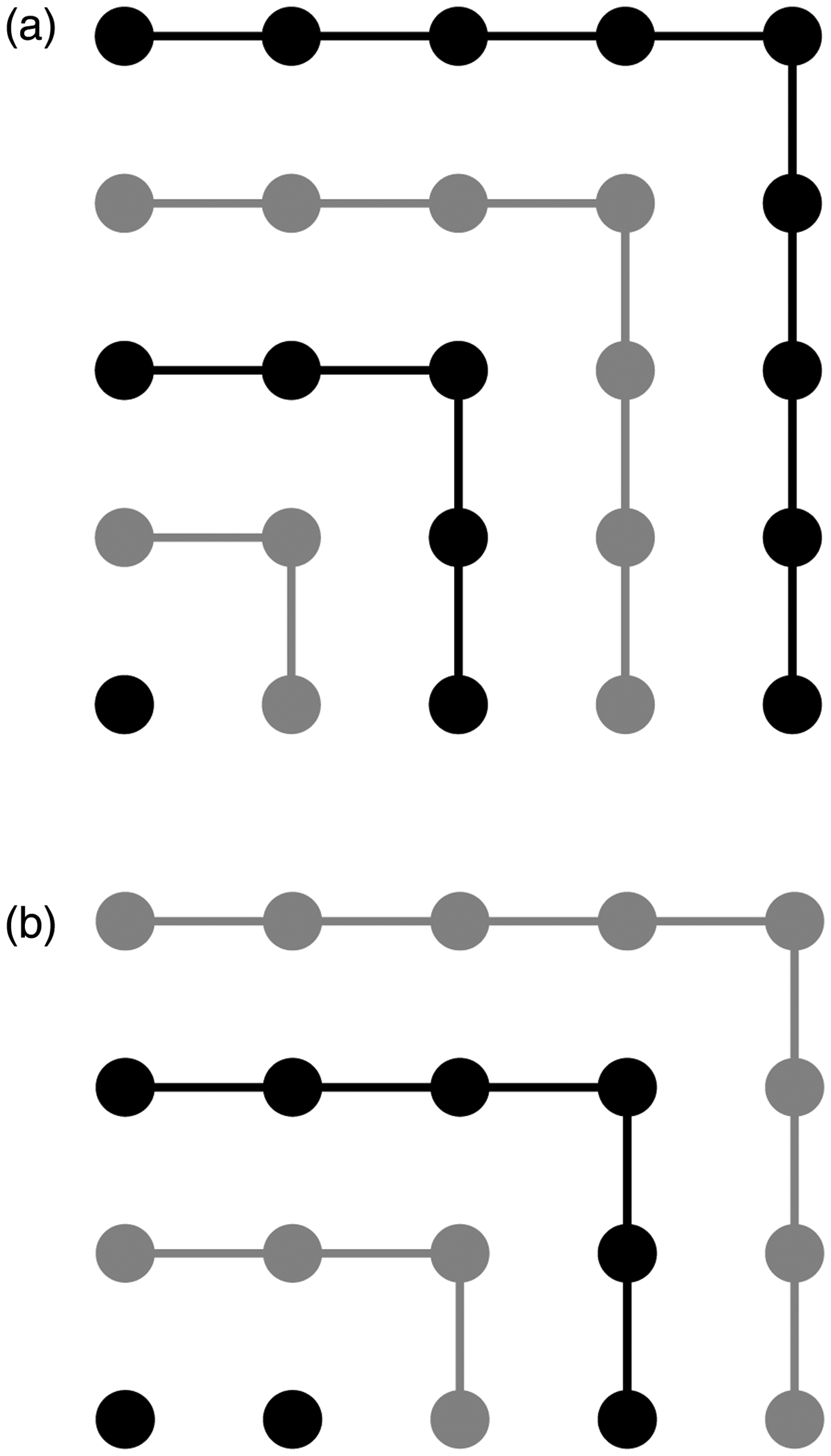
Aristotle refers to two different constructions: on the one hand, the construction of square numbers, associated with limitedness and obtained by successively placing odd numbers as gnomons (περιτιθεμένων τῶν γνωμόνων) round the ‘one’ (περὶ τὸ ἕν, fig. 1a); on the other hand (καί), the construction of ἑτερομήκεις, associated with unlimitedness and obtained by successively placing the even numbers as gnomons either the one round the other (that is, about nothing at the very beginning: Milhaud) or—to keep the parallel with the first construction—round the dyad (subsequent interpreters starting from Burnet), without (χωρίς) any reference to the ‘one’ (fig. 1b). After all, ‘limit’, ‘odd’ and ‘square’ all feature on the same side of the Pythagorean list of opposed principles at Metaph. Α.5, 986a22–6, whereas ‘unlimited’, ‘even’ and ἑτερομήκεις all feature on the other.Footnote 33
Milhaud-Burnet's reconstruction: placing odd and even numbers as gnomons round the unit and the dyad.

The opposition ὁτὲ μέν … ὁτὲ δέ … refers to the two constructions: the εἶδος that ἄλλο ἀεὶ γίγνεσθαι is that of the generic n(n + 1) ἑτερομήκης obtained at every step of the second construction;Footnote 34 the species remaining ἕν is that of the n × n squares originating in the first construction. This interpretation is allegedly supported by a number of passages in which Iamblichus explains the meaning of the term γνώμων and describes the construction and properties of the series of the n(n + 1) ἑτερομήκεις.Footnote 35
There are several reasons why this interpretation is unsatisfactory:
-
a. it is to a great extent arbitrary, as it entails that too much information is read into the Aristotelian ellipses, and especially in the syntagm καὶ χωρίς: nothing in the text suggests that there is an opposition between odd and even gnomons, nothing that there is an opposition between squares and ἑτερομήκεις;
-
b. placing gnomons round nothing is simply a contradictio in adjecto;Footnote 36 on the other hand, taking the dyad as a stepping stone on an equal footing with the ‘one’ would simply have been heresy to the early Pythagoreans: the one/dyad exclusive dichotomy is the outcome of Pythagorean-Platonic syncretism,Footnote 37 not a genuine Pythagorean doctrine; on the contrary, for the Pythagoreans τὸν δ’ ἀριθμὸν ἐκ τοῦ ἑνός ‘the number ‹comes› from the one’ (Metaph. Α.5, 986a20–1), never from the dyad, and the dyad is both a number and even; in the Pythagorean list of opposite principles, tertium non datur between ἕν and πλῆθος ‘multiplicity’;
-
c. the interpretation is allegedly corroborated by ‘parallel’ texts in Stobaeus and Iamblichus that are not exegeses of the Aristotelian passage but general descriptions of the process of forming numbers such as squares and ἑτερομήκεις by piling gnomons; there is no reason to suppose that the correlation between these texts and the Aristotelian passage extends beyond the fact that Iamblichus presents a doctrine that is an evolution of the Pythagorean material presented by Aristotle;
-
d. there is no correlation between the two constructions, which proceed independently by placing odd (even) gnomons round the unit (the dyad): the fact that one construction deals with odd numbers and the other with even numbers is incidental;
-
e. as a consequence, the even can in no way be ‘cut off and limited by the odd’;
-
f. as a further consequence, the example appears to be utterly unsuited to clarifying the notion that it was set out to explain: the philosophical significance of the mathematical example is not clear;
-
g. in the Pythagorean list of principles, the ἑτερομήκης is opposed to the square and hence is on an equal ontological and categorial footing with it: therefore, a ἑτερομήκης is a single numerical species like the square, and its εἶδος can by no means ἄλλο ἀεὶ γίγνεσθαι by placing gnomons round it; what is more, the very notion of ἑτερομήκης as employed by Milhaud and many others after him is anachronistic:Footnote 38 everywhere in Plato and Aristotle, and most likely also in the Pythagorean list of opposed principles, ἑτερομήκης identifies the generic rectangle n(n + m) and not the particular one n(n + 1);Footnote 39 the latter, as far as our sources go, is only designated with the term ἑτερομήκης starting from the first century c.e.
In the modern literature, there are two interpretations that differ on some substantial points from the one just described (as already noted, we are leaving aside Timpanaro Cardini's and Zeller's readings since they build upon one or the other of the ancient interpretations outlined above).
Setting himself explicitly in opposition to Milhaud-Burnet's reconstruction, Taylor summarizes his interpretation in the following points:Footnote 40 (a) ‘the ‘gnomons’ meant are […] the successive series of odd numbers which have to be ‘put round’ 1 to produce the series of squares’; (b) καὶ χωρίς means ‘and in the other case’; (c) the second construction is ‘putting something else round the one’ (the ‘something else’ is explicitly set in contrast to the odd numbers-gnomons of the first construction); (d) εἶδος stands for ‘regular polygon’. Taylor's interpretation, like that of Stobaeus before him, cannot work, simply because it is graphically impossible to place the even numbers as gnomons round the unit: for this reason Burnet and Heath identified the second construction as the placing of even numbers as gnomons round the dyad. But χωρὶς σχηματογραφίας, Taylor's interpretation coincides with Alexander's. What is more, while Taylor correctly expands Stobaeus' formulation of the second construction as ‘if we put the even numbers as gnomons round 1’,Footnote 41 he misreads Themistius' exegesis (that he takes to corroborate his own), since he neglects the crucial difference between the prefixes περι- and προσ-. In short, Taylor's interpretation can be dismissed as an exegetic slip.
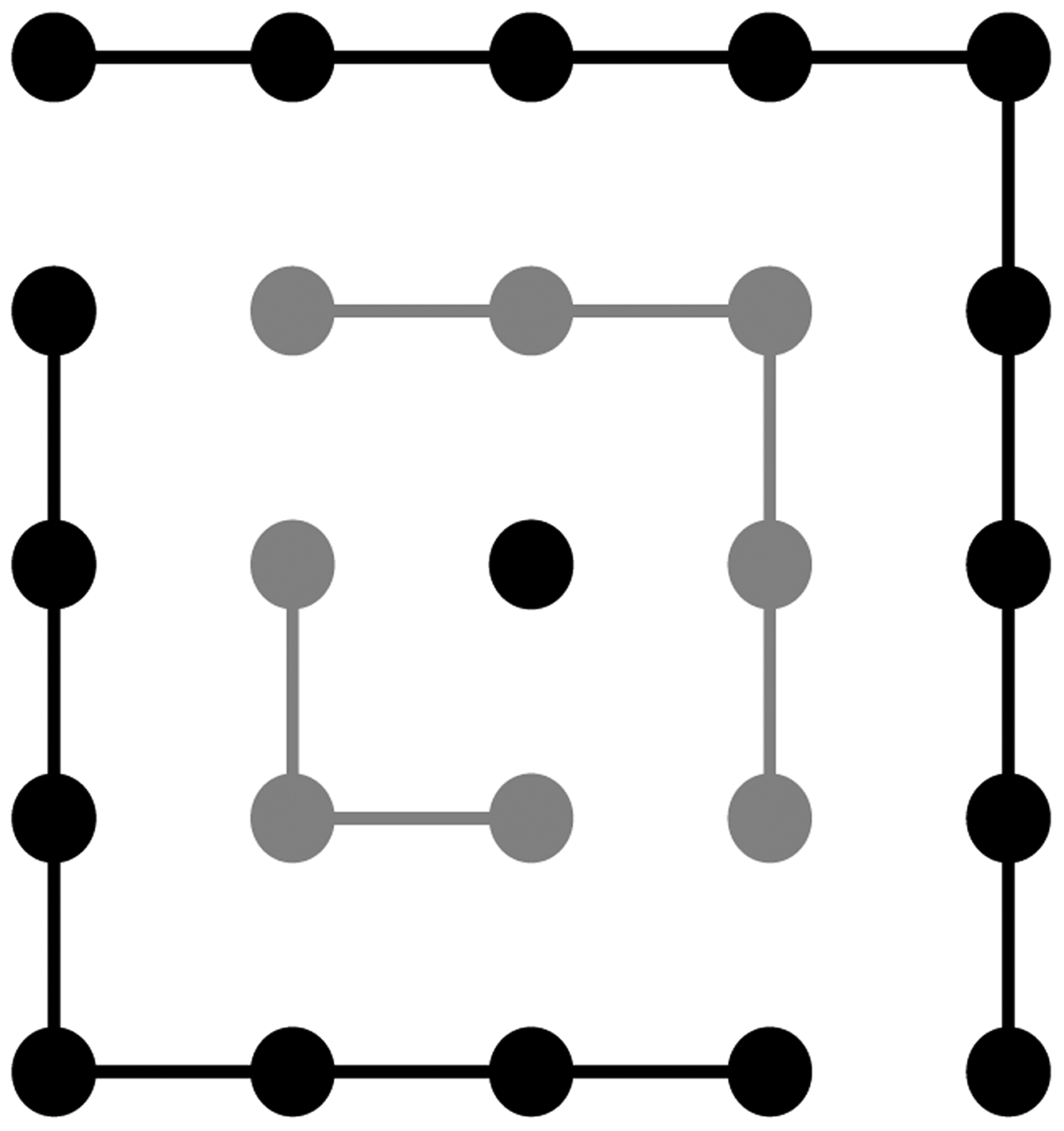
There is a recent interpretation, propounded by N. Vinel, which is more satisfactory in several respects.Footnote 42 The idea is that Aristotle is referring to only one construction, namely, placing at every step consecutive pairs of odd numbers as gnomons round the unit, so as to obtain the sequence of odd squares (fig. 2); in this reading, χωρίς indicates the discontinuity of the action of placing gnomons round, and περιτίθημι is assigned the meaning of ‘to circumscribe (completely)’. Since only one construction is at issue, the correlative structure in the principal clause refers to two facets of its outcome that can be regarded, on the one hand (ὁτὲ μέν), as continuously different in respect of size and, on the other (ὁτὲ δέ), obviously as one of a numerical species. The concentric odd squares can be taken as a primeval symbol of the limited universe, inasmuch as the latter is the result of the harmonizing of the limited odd and the unlimited even, whereas the Indefinite surrounding them, whose continuously absorbed parts are always even since they are the sum of two (consecutive) odd gnomons, can be taken as a symbol of the Unlimited according to what is asserted elsewhere by Aristotle himself.Footnote 43 Vinel backs his interpretation up with three passages in IamblichusFootnote 44 and, most notably, with a careful discussion of arithmo-cosmological issues, showing that they would be utterly ill-represented by the mathematical example if this were describing two independent constructions.Footnote 45
Vinel's reconstruction: placing gnomons pairwise round the unit.

While the discussion of the cosmological background is certainly valuable, this interpretation has the serious drawback of entailing that the Pythagoreans or Aristotle could see different species in a sequence of squares of increasing size. This is straightforwardly contradicted by common mathematical folklore, by what Aristotle himself claims elsewhere in unusually unambiguous terms,Footnote 46 and by the fact that a principle (which is what a square is, according to the list of opposed principles at Metaph. Α.5, 986a22–6) must keep the same εἶδος in all its instances.
A NEW INTERPRETATION
If there is anything agreed upon concerning the Aristotelian passage, it is that its interpretation is greatly underdetermined both by its formulation and by the immediate context. We shall try to offer a reading that at the same time preserves a connection with Pythagorean doctrines and displays a plausible mathematical content.
As for the former, the passage is intended to clarify a basic early Pythagorean tenet: the Unlimited/Limiting opposition.Footnote 47 As Philolaus' genuine fragments testify, the opposition holds between unlimited things and limiting things, understood as the material constituents of the cosmos:Footnote 48
ἁ φύσις δ' ἐν τῷ κόσμῳ ἁρμόχθη ἐξ ἀπείρων τε καὶ περαινόντων καὶ ὅλος ὁ κόσμος καὶ τὰ ἐν αὐτῷ πάντα.
Nature in the cosmos was fitted together both out of things which are unlimited and out of things which are limiting, both the cosmos as a whole and all the things in it.
Contrary to what is the case in the later tradition, in early Pythagorean sources limitedness or unlimitedness is not conceived of as an abstract notion. Both of them are instead features of things, some of which (qualified as ἄπειρα) have the property of being unlimited, while others (περαίνοντα) have the property of limiting them. In this way the principles of the cosmos, τὰ ἄπειρα and τὰ περαίνοντα, also coincide with its material components.Footnote 49 The sources show that the περαίνοντα/ἄπειρα opposition, operating in the domain of things, finds a natural counterpart in the odd/even (περισσόν/ἄρτιον) opposition, operating in the domain of numbers.Footnote 50 As a consequence, the even and the odd must also be located in numbers, in the strong sense that they are materially present in them. While this is true of all numbers, it does not apply to the one (which is not a number): coming from the union of ἄπειρα and περαίνοντα, the one is even and odd at the same time.Footnote 51 Therefore, the even and the odd are not present in the one as separate components.
Once this doctrinal framework has been established, we submit that, if it has to satisfactorily represent the dialectic between Limiting and Unlimited, the mathematical example must refer to one and the same construction. For this reason, we reject assumptions (2)–(6) in the list given at the beginning; most importantly, we reject the idea that the conjunctive structure … καί … in the genitive absolute is a correlative structure exactly parallel to the ὁτὲ μέν … ὁτὲ δέ … correlative in the principal clause. We shall recover the even/odd dualism in the proposed single construction by also rejecting assumption (9), on the basis of a well-known categorization attested in a fragment of Philolaus and discussed below. We adopt segmentation option (a ii ), but once assumption (4) is rejected, the resulting conjunctive structure of the genitive absolute must refer to a single gnomonic construction: περιτιθεμένων τῶν γνωμόνων περὶ τὸ ἓν + περιτιθεμένων τῶν γνωμόνων χωρίς (τοῦ ἑνός). Finally, we assume that σχηματογραφία is at work throughout the whole passage.
In order to present our interpretation, we first offer a detailed discussion of the lexical and syntactical features of the passage, which we shall then summarize in a paraphrase and in a general exegesis. Finally, we reconsider the cosmological statement the mathematical example is intended to illustrate, arguing that the latter satisfies the condition of being a σημεῖον of the former, as Aristotle rightly calls it.
Let us start by discussing the main lexical and syntactical features of the passage.
ἐναπολαμβανόμενον. The double prefix means that the object of the action is first singled out (ἀπο-) and then enclosed (ἐν-) by the subject; this is the reason why we have translated the participle ‘cut off [and] enclosed’. The verb has a wide range of application in the Greek corpus, but we also find it in two passages of Iamblichus that are relevant for our perspective. As for the non-Iamblichean occurrences, technical writings and other treatises in the Aristotelian corpus show that the meaning is always ‘to single out and enclose’, in relation to the air in a vessel (Hero, Pneumatica), the pneuma or heat in plants (Theophrastus, De causis plantarum), stars in constellations (Ptolemy, Almagest), or heat in the air (Aristotle, Meteorology).Footnote 52 As for the Iamblichean passages, they have been presented and discussed by Vinel.Footnote 53 These texts read as follows (the objects referred to by ordinals in the first passage are successive triangular numbers):
ἐν δὲ τῇ ἐπιπεδώσει ἄρξεται ὁ τέταρτος ἐναπολαμβάνειν τὸν πρῶτον, ὁ δὲ πέμπτος τὸν δεύτερον καὶ ἀκολούθως οἱ ἄλλοι […]
In this plane representation, the fourth will begin by cutting off and enclosing the first, the fifth the second, and the others accordingly […]
καὶ ἐν τῇ σχηματογραφίᾳ δὲ τῶν πολυγώνων δύο μὲν ἐπὶ πάντων αἱ αὐταὶ μενοῦσι πλευραὶ μηκυνόμεναι καθ' ἕκαστον, αἱ δὲ παρὰ ταύτας ἐναποληφθήσονται τῇ τῶν γνωμόνων περιθέσει αἰεὶ ἀλλασσόμεναι […]
Also in the graphic representation of polygons, two sides will always stay the same, while being produced each time, whereas the additional ‹sides› will be cut off and enclosed because of the placing round of gnomons, continuously becoming others […]
As for the first passage, the meaning of the verbal form ἐναπολαμβάνειν is ‘to cut off and enclose’, but, most significantly, any parallel with περιτίθημι or its related forms is lacking: later in the sentence, the verb resuming ἐναπολαμβάνω is a more conventional form of περιέχω. As a matter of fact, the construction implied is identical with that propounded by Vinel and explained at the end of the previous section, except that it is applied to triangles. The second text has an obvious lexical affinity (broken underlining) with the Aristotelian passage.Footnote 54 In Vinel's view, both texts confirm his hypothesis that the verb περιτίθημι has the meaning of ‘to circumscribe (completely)’.
Two remarks greatly diminish the value of these parallels. First, it is quite likely that, in his second passage, Iamblichus simply expounds a doctrine that is an evolution of the Pythagorean material partly presented by Aristotle: the lexical coincidences confirm rather than disprove this. Second, since the mathematical example is only a σημεῖον of the Pythagorean doctrine, it is not necessary that all features of the doctrine be exactly reflected in the example. Indeed, in the second passage the meaning of περίθεσις is definitely not ‘(complete) circumscription’, as the sentence itself makes clear: for it refers to the well-known generation of each species of polygonal numbers by means of successive additions of gnomons, during which the gnomons never completely enclose the polygonal numbers. Since in this passage Iamblichus appears to use ἐναπολαμβάνω as a synonym for the nomen actionis associated with περιτίθημι, we must conclude that in this context the meaning of both verbs coincides with that of the latter (see below).
περαινόμενον. It refines the meaning of the preceding verb, with which it forms an hendiadys. It has the stylistic function of strengthening at a lexical level the pair of opposites περαίνοντα/ἄπειρα (ἀπειρία in the passage).
σημεῖον. A σημεῖον links a state of affairs U that obtains in general and a particular case P corroborating it. Of course, the fact that P obtains does not prove U, which in its turn is a sufficient condition for P to obtain.Footnote 55 Since P is only a particular case, it is not said that all features of U can find an exact counterpart in P, but P is usually chosen so as to make the relevant features of U particularly evident. In the Aristotelian passage, U is the fact that τὸ ἄρτιον ἐναπολαμβανόμενον καὶ ὑπὸ τοῦ περιττοῦ περαινόμενον παρέχειν τοῖς οὖσι τὴν ἀπειρίαν, and P is of course what happens in numbers, namely, the mathematical example.Footnote 56
περιτιθεμένων. In the present indicative: it denotes the action of placing gnomons round; in other tenses, the verb might be taken to refer to the final result, which of course cannot be attained in this case (the series of square numbers is unlimited). The prefix περι- does not necessarily mean that each gnomon envelops the preceding square (or the originating unit), as Vinel would have it.Footnote 57 Again, the parallel between the ἐναπολαμβανόμενον of the Pythagorean doctrine and the περιτιθεμένων of the mathematical example that purports to explain it is imperfect. Despite four occurrences in Iamblichus,Footnote 58 the verb περιτίθημι is not a technical term of the Greek mathematical lexicon, but it is frequently used in mechanical writings.
τῶν γνωμόνων. As stated above, a γνώμων is, in the numerical case, an array of identical signs that can be placed round a number laid out as a species in order to produce another number laid out as the same species. In particular, γνώμονες can also be successfully applied to the single numerical species ἑτερομήκης, which is directly related to the square in the Pythagorean list of opposed principles. In general, and by definition, a γνώμων is a numerical/geometrical shape preserving the species/form of the object to which it is applied, but we have no reasons to suppose that, to the early Pythagoreans, a γνώμων was something different from an odd number.Footnote 59
ἕν. The term features twice in the passage, and with different categorial status: it is either the noun ‘one’, namely, a synonym of μονάς, or an adjective qualifying τὸ εἶδος. One might entertain the idea that we are again dealing with a piece of Aristotelian irony intended to ridicule the argument, but we must recall that ἕν and μονάς were used interchangeably by AristotleFootnote 60 and in the early philosophical tradition.Footnote 61 Mathematical requirements later led to a differentiation of the lexicon, a move that in its turn triggered further philosophical speculations about the difference between the two terms.Footnote 62 Aristotle does not write τὸ αὐτό because the species is ‘one’ (namely, the square), not ‘the same’—yet Simplicius and Philoponus do not refrain from paraphrasing ἓν τὸ αὐτό, ‘one and the same’ and ἓν ἀεὶ καὶ τὸ αὐτό, ‘continuously one and the same’.Footnote 63
καὶ χωρίς. The adverb is conjoined to the adverbial phrase περὶ τὸ ἕν and qualifies the verb περιτίθημι, but in fact it modifies the entire statement. It acts as a caveat, needed to limit the applicability of the example: this refers to what happens by placing gnomons round the one, but starting from the first significant step, namely, once the first gnomon has been placed round. In other terms, the one itself must be excluded. The construction has an exact parallel in Metaph. A.6, 987a9–10: μέχρι μὲν οὖν τῶν Ἰταλικῶν καὶ χωρὶς ἐκείνων, ‘down to the Italian school, then, and apart from it’. In an early Pythagorean framework, the caveat is needed because of the particular status of the one, which, as seen above, is neither a number nor even or odd, and hence cannot display the required even/odd alternation. The one is only singled out (‘cut off and enclosed’) by the first odd gnomon, as prescribed in the first step of the construction.
ἄλλο. Since the pattern of alternation is recurrent, ἄλλος is used properly even if there are only two alternating objects.Footnote 64 The nexus ἄλλο ἀεί could be replaced by ἄλλο καὶ ἄλλο, but the presence of ἀεί makes the iterative connotation explicit.
ἀεί. The meaning is iterative, with reference to the successive steps of the (unlimited) process of piling gnomons. For a process, whose input at any step coincides with the output of the preceding step, to be iterative, it is enough that the output of any step be different from the output of the immediately preceding step; it is not required that all outputs be different.Footnote 65 In iterative proofs in Greek mathematics the adverb ἀεί features in formulaic expressions (καὶ τοῦτο ἀεί … ἕως, καὶ ἀεὶ οὕτω, etc.): this fact lends the adverb a technical meaning, to the effect of transforming a single constructive act into a step in a recursive process.Footnote 66 The same meaning is intended in several occurrences in the Aristotelian corpus.Footnote 67
γίγνεσθαι. Constructed ἀπὸ κοινοῦ, it assumes two different meanings in the two correlated cola of the principal clause: ‘to become’ in the first colon, ‘to be’ in the second.
εἶδος. It is a ‘(numerical) species’,Footnote 68 but in two different meanings: it is either the form a number takes when the units composing it are represented as an array of identical signs having a ‘natural’ geometric shape (for instance, a square or a ἑτερομήκης), or the generic denomination of the two main species of the number: the odd and the even. As a matter of fact, this is the only meaning of εἶδος attested in a fragment that can directly be ascribed with some certainty to the early Pythagoreans:Footnote 69
ὅ γα μὰν ἀριθμὸς ἔχει δύο μὲν ἴδια εἴδη, περισσὸν καὶ ἄρτιον, τρίτον δὲ ἀπ' ἀμφοτέρων μειχθέντων ἀρτιοπέριττον· ἑκατέρω δὲ τῶ εἴδεος πολλαὶ μορφαί, ἃς ἕκαστον αὐτὸ σημαίνει.
Number, indeed, has two proper species, odd and even, and a third from both mixed together, the even-odd.Footnote 70 Of each of the two species there are many forms, of which each thing itself gives signs.
Now, as a consequence of the doctrinal evolution outlined in point (b) of the preceding section, the περαίνοντα/ἄπειρα opposition came to be identified with the One/Dyad opposition, where the One represents the Limit (πέρας) and the Dyad the Unlimited (ἄπειρον).Footnote 71 In the same way, in view of the specific meanings assigned to the crucial notion of εἶδος in Plato's and Aristotle's doctrines, the Limit/One, as an abstract notion, came to be quite naturally identified with (Aristotelian) form (εἶδος), the Unlimited/Dyad with matter.Footnote 72 But once εἶδος is identified with Aristotelian form, which in the numerical domain is most naturally seen as the form a number takes when the units composing it are represented as an array of identical signs having a ‘natural’ geometric shape (first meaning above), the ‘material’ opposition between limiting and unlimited components of the cosmos is reduced to the abstract opposition between the Limit and the Unlimited, viz. between Form and Matter. The consequence of all of this on our passage is that its interpretation is inevitably adapted to an Aristotelian mould, the parallel between the philosophical-cosmological states of affairs and the mathematical example thereby getting lost. If we instead return to the ‘material’ opposition between limiting and unlimited components of the cosmos, and read the even and the odd as the material components of numbers, the mathematical example appears significantly different.
ὁτὲ μέν … ὁτὲ δέ … The presence of this correlative structure gives rise to some difficulties. Almost all occurrencesFootnote 73 of the opposition ὁτὲ μέν … ὁτὲ δέ … in Aristotle mark a state of affairs whose irregularity is at issue:Footnote 74 now (ὁτὲ μέν) such-and-such happens, now (ὁτὲ δέ) such-and-such happens, but with no regular pattern. On the contrary, in the mathematical example two states of affairs are correlated displaying a high degree of regularity: on the one hand (ὁτὲ μέν) such-and-such happens, on the other hand (ὁτὲ δέ) such-and-such happens, but what happens in either case happens necessarily, following a constant pattern. Yet, one might wonder how a mathematical process of the kind more or less clearly hinted at by Aristotle in the example could not display a regular pattern, so that, independently of the interpretation adopted for the mathematical example, the use of this correlative does not seem fully justified.Footnote 75 This difficulty can be overcome by noting that, quite frequently in Aristotle, the correlative ὁτὲ μέν … ὁτὲ δέ … simply emphasizes the fact that two facets of the same subject or of the same phenomenon are being singled out, irrespective of their happening according to a constant pattern.Footnote 76 Most importantly, in some cases the two facets are the regular outcomes of a procedure,Footnote 77 which in two occurrences is iterative: in Cael. 1.10 Aristotle alludes to physical theories that describe a cosmos which is alternately generated and corrupted (ἐναλλὰξ ὁτὲ μὲν οὕτως ὁτὲ δὲ ἄλλως),Footnote 78 while in Physics 4.9 the same matter, becoming air from water and again water from air, in one case (ὁτὲ μέν) goes from greatness to smallness, in the other (ὁτὲ δέ) from smallness to greatness.Footnote 79
Another jarring note seems to come from the fact that usually the correlation ὁτὲ μέν … ὁτὲ δέ … is intended to stress an opposition, while the two states of affairs described in the two horns of the example cannot properly be said to be in opposition. The gist of the first horn is in fact that there is an εἶδος which, whatever εἶδος might mean, becomes continuously different, thereby providing things with the element of infinity—and this is enough to exemplify the cosmological point at issue. To claim, as is done in the second horn, that the εἶδος also remains the same appears to unnecessarily complicate the parallel. These difficulties disappear if the εἴδη referred to in the two cases do not coincide. The first horn (ὁτὲ μέν) of the correlation presents the main point of the example: the parity (εἶδος) of the square numbers obtained at every step of the gnomon-construction round the unit is continuously different; this is what makes the mathematical example perfectly adequate for the theory to be explained. The second horn (ὁτὲ μέν) provides additional information: the form (εἶδος) of the number in question is always the same, namely, a square. One might wonder why this additional information is provided. We might surmise that its function is to stress the fact that the sequence of squares obtained by repeatedly adding gnomons to the unit factually displays in a single well-defined static object the arithmo-cosmological interplay between the odd and the even.
The gist of our interpretation lies in an acknowledgement of the semantic ambiguity of εἶδος,Footnote 80 something overlooked by all previous interpreters, and of the priority of its genuinely Pythagorean meaning. We will now summarize this argument in the form of a paraphrase of the mathematical example, followed by a general exegesis.
The odd numbers are successively placed as gnomons round the unit (περιτιθεμένων τῶν γνωμόνων περὶ τὸ ἕν) and apart from it (καὶ χωρίς). The result is a sequence of squares, alternately even and odd (fig. 1a). As a consequence, on the one hand (ὁτὲ μέν), the parity (τὸ εἶδος) of the squares becomes (γίγνεσθαι) continuously different (ἄλλο ἀεί), on the other (ὁτὲ δέ) the numerical species (τὸ εἶδος) ‘square’ remains unique (ἕν).
The result of placing gnomons round the one is a sequence of squares. Each of these squares is a limited object because of the odd gnomon that each time acts as the limiting component. At the same time, however, eachFootnote 81 of these squares contains in itself the Unlimited, namely, the even component (= even squares) which continuously alternates with the odd (= odd squares). Since only genuine gnomons are added (= odd numbers), the even numbers do not show up within the construction but only as partial results of it, in the form of even squares. The fact that one also gets odd squares as partial results is irrelevant, since the logic of the example goes one way: what ‘cuts off and limits’ are only odd numbers, while even numbers are only ‘cut off and limited’ (even if also odd numbers are). The construction displays, on the one hand, the ἀπειρία of the even/odd alternation and of the process of singling out (= generating) and enclosing even (square) numbers by means of odd numbers; on the other hand, the stability of the numerical species. These two features show up as different facets of one and the same process, neither mutually exclusive nor linked by any regular relation.
But the mathematical example is also a σημεῖον: the way in which the even, while being bounded by the odd, persists in square numbers is a particular, and particularly manifest, case of the more general way in which the Unlimited persists in things, although they are limited. Like everything in the cosmos, square numbers materially contain in themselves unlimited and limiting components. But although in general the components of a thing—τὰ ἄπειρα and τὰ περαίνοντα—while present in it, are not apparent, the components of a figurate number—namely, the even and the odd—are. Therefore, the sequence of squares obtained by repeatedly adding gnomons to the unit factually displays the arithmo-cosmological interplay between the odd and the even within a single well-defined static object.