Introduction
The size of the UK Post Office network is in long-term decline; following a peak in the numbers of post offices in the mid-1960s, there has been a year-on-year reduction (The British Postal Museum and Archive, 2012). This trajectory is partly attributable to fewer customer visits to the post office as traditional post office services become available via different means and associated revenue decrease (BIS, 2010). For example, the Department for Business, Innovation and Skills notes a particular drop in revenue resulting from government services moving online. Due to this changing service environment, the Post Office had been making a loss since 2000 (BIS, 2010).
In the context of already declining post office numbers, alternative forms of accessing post office services, reduced customer visits and non-profitability, the Post Office implemented two compulsory closure programmes. The 2003–5 Urban Closure Programme (as part of a broader Network Reinvention Programme) resulted in the closure of over 2,400 post office branches classified as being part of the urban network across the UK (Post Office, 2012). The 2007–9 Network Change Programme involved the closure of roughly 2,500 urban and rural post offices and the introduction of around 500 outreach services (Post Office, 2012).
While the number of customer visits is in decline, it is still close to 20 million each week, with regular use associated with older customers (BIS, 2010). Consumer Focus, a consumer advocacy organisation, suggest that older people are one of the groups who may be most negatively affected by Post Office restructuring (see Burrows and Griffiths, Reference Burrows and Griffiths2010; McAnulty and Brown, Reference McAnulty and Brown2011; Richards, Reference Richards2011). Consumer Focus’ legal obligation to consider the needs of, amongst others, older people and rural residents demonstrates the potential service threat to these groups (Richards, Reference Richards2011). Older people, a key customer group for the Post Office, are overrepresented in the rural population (Defra, 2013a); therefore, changes to rural post office provision may disproportionately affect this group.
Due to the nature of the wider service context, closures and changes to the style of provision of post offices in rural areas raise different issues to urban closures. For example, for service providers, there is an increased cost to delivering services in more sparsely populated, rural areas (Age Concern and Help the Aged, 2005; Dwyer and Hardill, Reference Dwyer and Hardill2011; Rural Services Network, 2011; Fortunato et al., Reference Fortunato, Alter, Bridger, Schramm and Montopoli2013). As a result, some businesses are choosing to centralise services into urban areas. To continue to access these services, rural residents must rely on transport and their own mobility (Age Concern and Help the Aged, 2005; Joseph and Cloutier-Fisher, Reference Joseph, Cloutier-Fisher, Andrews and Phillips2005; Manthorpe et al., Reference Manthorpe, Iliffe, Clough, Cornes, Bright and Moriarty2008). Further, rural residents can incur higher costs of accessing services by travelling longer distances to services, and services being less competitive (see Richards, Reference Richards2011). The trend of closing rural services in favour of urban delivery, and the accumulation effect across different services, may mean that some rural residents are ‘effectively excluded from service provision’ (Dwyer and Hardill, Reference Dwyer and Hardill2011: 246).
Previous studies have highlighted that rural services can become an important setting for social interaction for older people (Gray et al., Reference Gray, Shaw and Farrington2006; Dobbs and Strain, Reference Dobbs, Strain and Keating2008; Dwyer and Hardill, Reference Dwyer and Hardill2011; Ward et al., Reference Ward, Somerville and Bosworth2013). Bosworth (Reference Bosworth2012) emphasises this community focus of rural businesses, pointing to the importance of personal customer service and a sense of social conscience. It is implied that the bond between communities and their rural businesses is highly valued and fiercely defended in the face of closure (Bosworth, Reference Bosworth2012; see also Woods, Reference Woods2006; Burrows and Griffiths, Reference Burrows and Griffiths2010; McAnulty and Brown, Reference McAnulty and Brown2011). In the case of rural post offices, it is estimated that over half are the only shop in the village and are anecdotally associated with being a community hub (see McAnulty and Brown, Reference McAnulty and Brown2011). The increased cost of service provision for some rural, unprofitable, post offices is offset with a rural subsidy from the government (BIS, 2010). The government appears to support the Post Office's continued rural service provision on the basis that there is a social role to the service, and it may be the only (or twinned with the only) business left in a community (BIS, 2010).
The Department for Environment, Food and Rural Affairs (Defra) acknowledges that the impact of service change may be different between rural and urban areas and encourages government departments to consider rural areas when designing their policies (see Atterton, Reference Atterton2008). Whilst the policy of ‘rural proofing’ dates back to 2000, and has undergone restructuring to its monitoring body and some rebranding, it still upholds the same principle of requiring government departments to think about the impact of their new policies on rural areas (Atterton, Reference Atterton2008; Defra, 2012; Cameron, Reference Cameron2015). Rural proofing is currently one of a set of policies under the umbrella title of ‘Making sure government policies and programmes benefit rural businesses and communities’ aimed at addressing the equity of changes (Defra, 2013b). Atterton's (Reference Atterton2008) review of rural proofing highlights the confusion over when, how and by whom policies should be rural proofed, alongside limited evidence of the successful application of rural proofing considerations. Lord Cameron's (Reference Cameron2015) independent review of rural proofing suggests that this confusion remains; around half of impact assessments for new policies did not demonstrate rural proofing considerations. In addition, the review highlighted that some departments were not engaged with rural proofing and there was a lack of appropriate cross-departmental working on rural proofing issues (Cameron, Reference Cameron2015). As a public service, the policy of ‘rural proofing’ covers the decisions made about the Post Office.
Crucially, rural proofing does not mean that urban and rural service provision should be the same, but that they should meet the needs of the local people (Defra, 2012). This suggests an underlying assumption that different forms of service delivery are equivalent, and that the changes from one form to another will not have a detrimental impact (see Defra, 2012). However, Defra's (2012) own rural statement highlights that it is vulnerable rural residents, including older people, who are likely to feel the greatest effect of change. Rural proofing also fails to acknowledge that rural services can fulfil additional roles that contribute to local communities. Atterton (Reference Atterton2008) highlights the arguments around demonstrating the value of rural areas, therefore making them deserving of consideration in policymaking, as opposed to ‘rural proofing being seen as special pleading’ (ibid.: 11).
The Post Office Network Change Programme is a good example of coordinated change in the provision of services that was feared likely to have a negative effect on rural communities and older people within them. However, the existing academic research on the Network Change Programme suggests the differential impact between rural and urban areas is not straightforward. Langford and Higgs’ (Reference Langford and Higgs2010) study into the impact on accessibility of the programme in Wales suggests that rural and urban areas fare differentially depending on the type of impact being assessed. Rural areas experienced greater numbers of closures of traditional branches and had the greatest increase in distance to the nearest, alternative, branch, but urban residents had the greatest loss of choice of branches. Langford and Higgs (Reference Langford and Higgs2010) also assessed the impact of the programme against the national accessibility criteria for post offices;Footnote 1 whilst change in rural areas met the criteria (if outreach services were included), closures in urban areas did not. It is acknowledged that the accessibility criteria are more generous for rural areas than urban areas. The caveat here, however, is that the accessibility criteria were set at a UK level with no requirement for it to be met at the local level (Langford and Higgs, Reference Langford and Higgs2010; Post Office, 2012). This research in Wales thus challenges the assumption that rural areas felt the greatest impact of the Network Change Programme, but highlights that rural and urban areas might have experienced impact differently. Further research by Higgs and Langford (Reference Higgs and Langford2013) suggests that older people were somewhat protected from the effects of the Network Change Programme, in both rural and urban areas. This is based on the evidence of no strong association between output areas with higher proportions of older people and increased numbers of closures.
The approach of the study reported here builds on those of Higgs and Langford and provides a different perspective on the Network Change Programme. The aim is to explore the Network Change Programme in England and the possible impacts of these changes on rural older people. Mixed methods are used to address the following research questions:
• Where were Network Change Programme closures and outreach services implemented in England?
• Was there a rural dimension to Network Change Programme service changes in England?
• What impact, if any, did Network Change Programme service changes have on older people in rural communities?
Methods
This research is part of a wider study examining the possible impacts of basic service change on older people in rural areas that also involved secondary analysis of survey data.
Data source
The Post Office split the UK-wide, pre-set number of closures into smaller regions known as ‘decision areas’ (see House of Commons Public Accounts Committee, 2009; Burrows and Griffiths, Reference Burrows and Griffiths2010; McAnulty and Brown, Reference McAnulty and Brown2011). The boundaries of the decision areas were around clusters of parliamentary constituencies. The rationale behind this appears to be that service provision changes could be considered across the whole decision area, utilising local knowledge in deciding on the distribution of change (Burrows and Griffiths, Reference Burrows and Griffiths2010; McAnulty and Brown, Reference McAnulty and Brown2011).
Routinely collected data about service change did not include information about location; therefore, a Freedom of Information request was submitted to Royal Mail. Decision area booklets were received regarding the 2007–9 Network Change Programme and the information was transferred into datasets. These booklets were also used for their documentary content to supplement the quantitative data. The information for England is used for this study.
The benefit of this data source is the low-level detail provided, with information about each branch that was closed and each branch that was changed to a different service delivery model (outreaches). This allows an examination of the numbers of closures and changes and where these occurred.
Dataset preparation
Network Change Programme closures
This dataset was created from the closures outlined in the area decision booklets provided by the Royal Mail. For each closing branch in England, the Rural Evidence Research Centre's ‘Parliamentary constituencies (2001/05) urban/rural classification’ spreadsheet (RERC, 2006) was used to assign an urban/rural classification. Urban/rural classification at the constituency level was chosen as decisions regarding post office closures were made at the level of constituency groups. There is no facility to match an urban/rural classification to the decision area (these areas would also be too big for the classification to be useful), so the constituency level was deemed most appropriate. The Defra (2007) classification of parliamentary constituencies was used. There are six categories reflecting how urban or rural the constituency is:
• MU – Major Urban – where at least 50 per cent of the population of the constituency live in a major urban area (defined by an area population of more than 750,000 people). Examples of major urban areas are London and Manchester.
• LU – Large Urban – where at least 50 per cent of the population of the constituency live in a large urban area (defined by an area population of between 250,000 and 750,000 people). Examples of large urban areas are Sheffield and Bristol.
• OU – Other Urban – where less than 50 per cent of the population of the constituency live in a rural area and are not part of a major or large urban area.
• SR – Significant Rural – where 33–49.9 per cent of the population live in a rural area.
• R50 – Rural 50 – where 50–74.9 per cent of the population live in a rural area.
• R75 – Rural 75 – where at least 75 per cent of the population live in a rural area (Defra, 2007).
Around half of the area decision booklets did not provide information about which constituency the branch closures were in, therefore the search engine ‘election maps’ (powered by Ordnance Survey) was used to assign each postcode a constituency. When a postcode was not recognised as valid by ‘election maps’, an internet search was made for information about the post office branch closure in order to find any link to a constituency. Where no further information was found, the constituency information for the closest postcode already in the dataset was used.
Where ‘election maps’ were used to find the constituency for a branch closure, the 2010 constituency was given. This created a challenge as some constituency boundaries had changed. Where possible, the Rural Evidence Research Centre's ‘Parliamentary constituencies (2001/2005) urban/rural classification’ spreadsheet (RERC, 2006) was used for consistency. Where there was no match, an updated spreadsheet, the ONS (n.d.) ‘Parliamentary constituencies (2010) urban/rural classification’, was used for a classification.
Network Change Programme outreach services
There were four main types of outreach services detailed in the booklets. They were:
• Mobile – these use accessible vans to offer most post office branch services.
• Hosted – these are services based in a community building. There are set opening days and times and most post office branch services are available.
• Partner – these are services offered through a third party and the majority of post office branch services are available.
• Home – these services allow a restricted number of services to be ordered over the phone. The products can then be delivered to the customer's address or picked up at a local ‘drop-in’. (Post Office, 2013)
In eight cases, the type of outreach was either missing or recorded as something other than the above four, main types. The postcode of each outreach service to the constituency classification was matched using the same process as outlined for the Network Change Programme closures.
Analysis techniques
Tests of significance are used to test an idea about a population through the use of a sample (Morrison and Henkel, Reference Morrison, Henkel, Morrison and Henkel1970; Henkel, Reference Henkel1976; Cowager, Reference Cowger1984). As this study uses the total population of interest, all changes associated with the Network Change Programme in England, the use of significance tests is inappropriate (Morrison and Henkel, Reference Morrison, Henkel, Morrison and Henkel1970; Cowager, Reference Cowger1984). However, the strength of any relationship between variables is important and odds ratios were used to assess this. The odds ratio compares the chances of the outcome occurring, based on two different conditions; it therefore assesses not how likely something is to happen, but how much more likely it is to happen (Rudas, Reference Rudas1998). An odds ratio of one signifies that there is no relationship between the two variables and the strength of the relationship is interpreted through the distance from one (Rudas, Reference Rudas1998). If all the values in the calculations are positive (as is the case with this project's analyses), then there is no upper limit to the value of the ratio (Rudas, Reference Rudas1998). Odds ratios are presented without confidence intervals, as these are used when the data are a sample from a population (Smithson, Reference Smithson2003).
Case study
A case study was carried out to explore older people's views of the impact of service change in their local area. Findings from the case study that are relevant to the Network Change Programme analysis are used to provide illustration and supplementary information. Publicly available information was used to select a case site that was in a ‘R75’ constituency, had experience of service change (not just service loss) and was a small settlement. The chosen case site was a village that had lost its post office, which was based in the village shop, as part of the Network Change Programme and was since served by an outreach mobile. In addition, in recent years, the village had seen its pub close and reopen and the frequency of its bus route diminish.
Older people (sixty-five and over) were recruited to participate in focus groups and interviews; some participants took part in a focus group and a follow-up interview, some were involved with just focus groups or just interviews. People were recruited using a variety of means; an advert was put in the village newsletter, interest groups and clubs allowed recruitment at their meetings and there was recruitment at the mobile post office times. The majority of these approaches to recruitment relied on the mobility of older people. As the fieldwork progressed, it became clear, through the discussions with participants, that there were older members of the community who found it challenging to leave their homes. Efforts were made to snowball sample from existing participants to reach these people, but this was not successful. To try to include, indirectly, the possible views of older people who were not already participants, I decided to recruit representatives of village groups or services who might be able to offer insight.
In total, fifteen people took part in the fieldwork. The eleven participants involved in focus groups, interviews and follow-up interviews were all aged sixty-five or over and living in the case site village. All of the four service and group representative interviewees had retired and all were aged sixty or over. All participants were white British, which is representative of the case site and local area profile. The departmental ethics committee at the University of York approved this element of the research.
Case study data were analysed using the ‘Framework’ approach (Ritchie and Spencer, Reference Ritchie, Spencer, Bryman and Burges1994). This approach is suited to social policy research and appropriate for mixed methods studies. The approach's five stages were completed iteratively and consisted of familiarisation with the data, identifying a thematic framework, indexing the transcripts according to the framework and charting the themes by participant, mapping and interpretation (Ritchie and Spencer, Reference Ritchie, Spencer, Bryman and Burges1994).
Findings
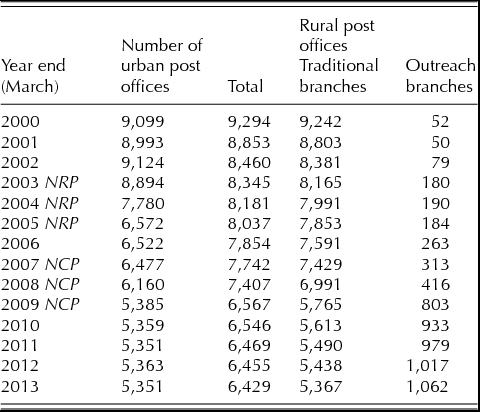
The closures and service provision changes implemented as part of the Network Change Programme built on an existing trend of network shrinking and the expansion of outreach services across the UK. Table 1 demonstrates the level, and type, of change to the Post Office network.
The number of urban, rural and outreach Post Office branches in the UK, March 2000–13

NRP: The 2003–5 Network Reinvention Programme of closures aimed at urban post offices.
NCP: The 2007–9 Network Change Programme that implemented both urban and rural closures (Post Office, 2012).
Source: Hough (Reference Hough2014).
Table 1 shows an overall decline in the number of post offices, with spikes in the decline coinciding with closure programmes. In addition, the proportion of rural post offices that are outreach services grew over the timeframe of 2000–13. The following analysis examines the changes that occurred during the 2007–9 Network Change Programme in England.
Network Change Programme closures (not replaced by outreach services)
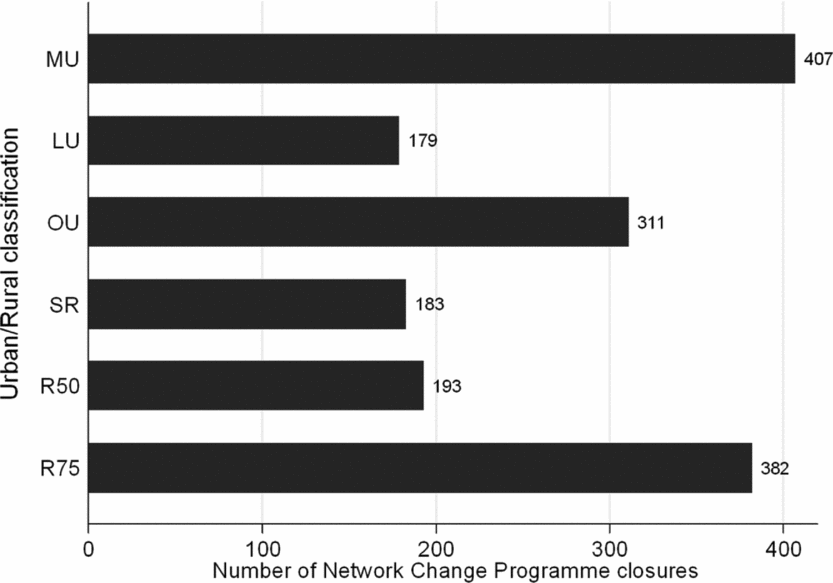
Figure 1 shows that there were similar numbers of 2007–9 Post Office closures in the very urban (24.6 per cent) and the very rural (23.1 per cent) areas. Broadly, 54.2 per cent of the closures were in urban areas compared to 45.8 per cent in rural areas. However, when the categories are broken down, the closures can be seen as polarised between the very urban and the very rural areas. A similar trend also exists when English constituencies are examined to see the proportions that had a closure.
The number of closures by urban/rural classification Notes: ‘MU’ – Major Urban, ‘LU’ – Large Urban, ‘OU’ – Other Urban, ‘SR’ – Significant Rural, ‘R50’ – Rural 50 and ‘R75’ – Rural 75. N = 1,655.
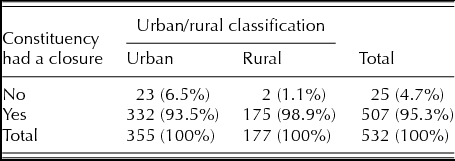
Table 2 shows that rural constituencies were more likely to experience a closure than urban constituencies; this is supported by the odds ratio which highlights that the Network Change Programme closures were 6.1 times more likely to occur in rural than urban constituencies. This is surprising, as the programme of closure was not aimed at either urban or rural constituencies, suggesting that similarities across urban and rural constituencies should have been expected. When the full urban/rural classification is examined, it broadly shows that the more rural the constituency, the more likely it was to have a closure.
Whether there was a closure by urban/rural classification in each Parliamentary constituency
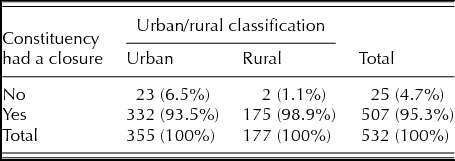
The mean number of closures per constituency was three; rural constituencies were 4.7 times more likely to have more than the mean number of closures than were urban constituencies. Across the full urban/rural continuum, the more rural the constituency, the more likely it was to have more than the mean number of closures.
Network Change Programme outreaches
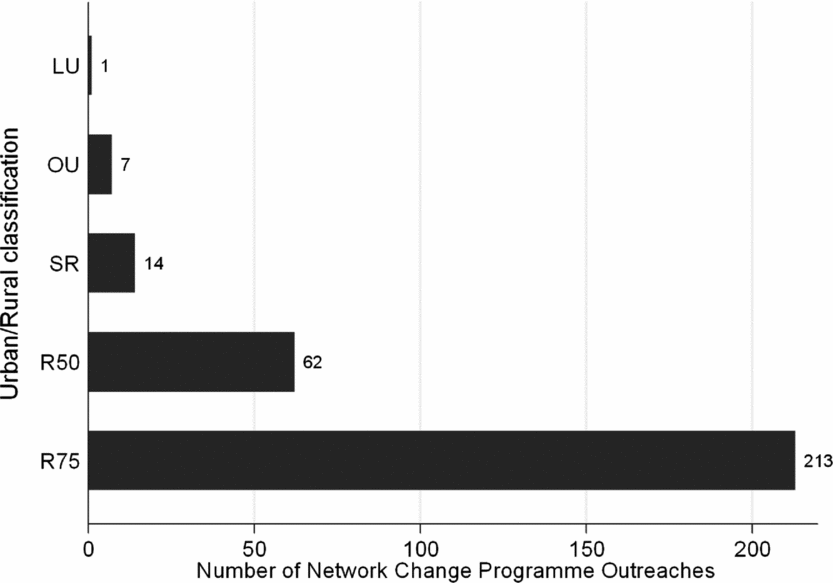
Figure 2 shows that almost all of the outreach services were implemented in rural areas (N = 289, 97.3 per cent) and the majority in the most rural areas (N = 213, 71.7 per cent).
The number of outreaches by urban/rural classification Notes: ‘LU’ – Large Urban, ‘OU’ – Other Urban, ‘SR’ – Significant Rural, ‘R50’ – Rural 50 and ‘R75’ – Rural 75. N = 297.
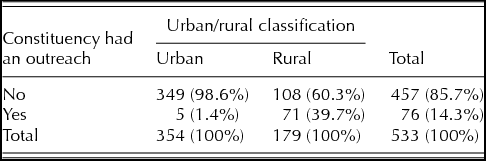
Looking at the broader constituency level for changes (see Table 3), it is still clear that outreach services were overwhelmingly focused in rural constituencies.
Whether there was an outreach by urban/rural classification in each Parliamentary constituency
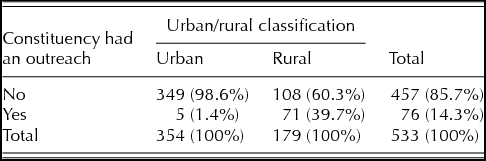
Unsurprisingly, rural constituencies were far more likely to have an outreach service implemented (even though this occurred in a minority of them). The odds ratio demonstrates that rural constituencies were 45.9 times more likely to have an outreach service implemented than were urban constituencies. Across the urban/rural spectrum, the more rural the constituency, the more likely it was to have an outreach service.
The types of outreach services, where they were located and the type of area varied greatly. Hosted services were the most common type of outreach service (N = 132, 44.4 per cent), followed by similar rates of mobile (N = 77, 25.9 per cent) and partner services (N = 61, 20.5 per cent) and fewer home services (N = 19, 6.4 per cent).
There is some suggestion from the decision area booklets that the type of outreach service may be fluid, with the possibility of changes in the future to other types of outreach provision that may offer more limited services. For example, nine (out of nineteen) of the new home services were previously mobile services rather than traditional post office branches, with the area decision booklet attributing the need for home services to the low usage of the previous mobile service (Post Office, 2012). This suggests that home outreach services may be used as a way of scaling down post office services when customers do not make sufficient use of existing outreach provision and could mean that there is the potential for more of these changes in the future.
Where there was a permanent, static location for the outreach services, so excluding home and mobile services, many were in the same location as the previous post office branch (N = 82, 42.5 per cent). This scenario may reduce the impact on physical access to post office services, as the location remains the same; however, service opening times may have changed.
There was an interesting use of local businesses (such as shops and pubs) by the Post Office, which accounted for 26.1 per cent of hosted and partner outreach service locations. This has implications for the survival of both the business and the post office outreach. On the one hand, having the two services at the same location could boost trade for both; however, it could result in post office outreach changes or closures if the local business encounters difficulties.
The case study provides another perspective on post office service change and explores the implications for older residents of having a post office branch replaced by an outreach service. A mobile outreach served the case site, which came to the village for between one hour and fifteen minutes and two hours, four days per week. The outreach provided all the services that the branch it was based from (in a nearby town) offered. The consensus from the participants was that the outreach accommodated their post office needs. One participant, however, noted that the mobile did not hold onto undelivered parcels, which then involved a long round trip to collect them.
Although the outreach provided a good range of services and was in the village frequently, the participants were still angry over the closure of their branch and unhappy with the outreach as a replacement. Reliability problems marred the introduction of the outreach. Originally, the mobile van was going to park in the centre of the village, close to the shop (where the post office used to be). This location was not successful due to insufficient signal coverage required for the post office to run its machines. After identifying this as the problem, the outreach moved to various locations around the village (over time) before finding a suitable spot. At the time of fieldwork, the site for the van was on a quiet side street with ample space for parking cars and close to a bench. Unfortunately, to get sufficient signal, this location was on the edge of the village and up a slope from the centre. For the most part, this position had solved the machine unreliability problem, although this was still remembered, and there had been occasions when the van had broken down or not arrived for other reasons. The site created some accessibility problems due to the incline and the narrow path between the centre of the village and the edge. Some participants also highlighted concerns about the accessibility of the van itself; the high step into the van caused difficulties for some customers.
The change to the provision of post office services in the village had also had wider impacts. Participants noted that the village shop (which used to contain the post office) had suffered as a result of the post office move; customers used to come from the surrounding villages to use the post office, but this had reduced since the move:
We do have a small village shop, but perhaps, this is a feeling, that I mean, that's reduced in size considerably, it doesn't sell the range of things it did, it's still ok, but once the post office was taken away, you know he, that reduced that shop quite a lot. (Service representative)
There was also a social impact to the move to an outreach service; participants felt the village had lost a meeting place:
But I think the post office [referring to previous branch in the shop], not only was it the service that it gave us, it was also a community meeting point. You know people that hadn't spoken to anybody for, because there are people out there as we all know, wandered down to the post office and sit and chat to everybody that came in, because I noticed that. (Focus group)
The mobile van was not seen as a village meeting point for a range of reasons. The lack of shelter for queuing customers meant that many customers drove to the van and waited in a line of cars for their turn. In addition, concerns about privacy meant that customers did not congregate in the van. The post office van was not a particularly sociable place and, from my observations, I saw little interaction (particularly on days when the weather was poor).
Discussion
There are limitations to the data sources and approaches in this research and the discussion and conclusions need to be considered in relation to these. The Freedom of Information response only covered enforced closures and change by the Post Office (meaning it does not include closures for other reasons). This means that the findings could underestimate the number of closures during the years of the Network Change Programme. As the closures and outreaches were compulsory and linked to a programme with specific aims, it would be inappropriate to generalise between these changes and changes made by the Post Office under different circumstances. The same principle applies to the evidence from the case site; the findings are related to their context.
The decision to categorise post office change according to the constituency level urban/rural classification means applying a label to a reasonably large geographical level. Whilst this was chosen to provide consistency with the Post Office's decision area plans, the classification is an indication of the type of area in which change occurred, rather than the precise location of the service. With these limitations in mind, this research does provide evidence exploring the concerns relating to service change and indications of the impact this could have on older people. It also offers an alternative perspective on the Network Change Programme from that of the existing literature (see Langford and Higgs, Reference Langford and Higgs2010; Higgs and Langford, Reference Higgs and Langford2013).
The findings from the research suggest that very rural areas were vulnerable to change under the Network Change Programme. The most rural constituencies experienced more than 20 per cent of closures and around 70 per cent of new outreach services. It could also be argued that the Network Change Programme treated rural and urban areas differently from the outset, as rural areas were targeted with outreach services.
Central to issues around the impact in rural areas of outreach services is whether these alternative forms of service provision are a reduced version of a post office branch. Typically, outreaches are couched in terms of downgrading the service on offer (see Langford and Higgs, Reference Langford and Higgs2010; McAnulty and Brown, Reference McAnulty and Brown2011), which would imply that a lesser service is being provided in these areas. This is at odds with the government criterion for the Network Change Programme that:
The population of any one area, any one country in the UK or any group of people is not to be overall significantly more adversely affected by the Programme than the population of any other area, country or group of people (as appropriate). (Post Office, 2012)
If outreaches are offering a poorer service, and this downgraded service is targeted at very rural areas (as the evidence suggests), then rural residents are a group that are being more greatly affected by the Network Change Programme than other groups and areas. This could be extended to older rural residents as a sub-group, due to their more regular use of post office services and overrepresentation in the rural population (BIS, 2010; Defra, 2013a).
Overall, the evidence is mixed on whether outreaches offer a lesser service, with variability across the different modes of service provision. The case site participants saw their mobile outreach as a downgrading, operating for fewer hours with reduced privacy, alongside concerns about reliability and representing the loss of a village meeting point. Consumer Focus (2009) identified similar concerns in relation to post office vans through their research on outreach services; these could be reasons why the post office prefers to have partner or hosted outreaches (House of Commons Public Accounts Committee, 2009). On the other hand, McAnulty and Brown (Reference McAnulty and Brown2011) noted examples where communities had acted to ensure the change was positive; residents with a new hosted outreach in their Church room used the post office's visit as an opportunity for a coffee morning and mini local market.
The case site highlighted the need to consider impact in different ways. There were clearly immediate impacts that were the direct result of the outreach service, such as reduced reliability and lack of shelter. However, there were also indirect effects of the change that took a longer time to emerge; the loss of the post office branch affected the viability of the village shop, which had to adapt to the loss of custom. This links with McAnulty and Brown's (Reference McAnulty and Brown2011) finding from their Devon-based research that the closure of a post office was often associated with the loss of the village shop. The case site also experienced the perceived loss of a social meeting place, which was an indirect outcome of the outreach implementation.
The potential for unequal outcomes on communities of service provision changes and indirect impacts poses a challenge for rural proofing policy. Whilst alternative forms of service provision can provide equitable services to rural areas, the evidence presented in this article suggests a more nuanced picture. There may be particular problems associated with alternative forms of delivery (such as unreliability) that are not associated with the traditional forms on offer to urban areas. One reason for inequitable outcomes may be the lack of consideration for a range of impacts, such as any effect on the future stability of other local services. The crude approach of rural proofing to examining effect has been criticised by Atterton (Reference Atterton2008), who suggests that policymakers may be rural proofing without any in-depth knowledge of the local circumstances. The current strategy of rural proofing suggests the involvement of local stakeholders in understanding the context of change, to help avoid unintended consequences. However, this appears to be a suggestion rather than an imperative (Defra, 2013c).
The consideration of broader benefits to rural communities of local services can provide the basis for controversy. In an opinion piece, Meadowcroft (Reference Meadowcroft2007) uses the example of the government subsidy of rural post offices to outline a rebuttal. If rural services do perform a social role, in addition to their functional role, then this could represent a benefit to rural communities that is denied to urban areas. Further, if the sustainability of other services is factored into decisions of rural service provision, this suggests that rural businesses are being supported in a way that urban businesses are not (Meadowcroft, Reference Meadowcroft2007). These arguments link to a concern of Atterton's (Reference Atterton2008), that rural proofing has been couched in terms of benefitting rural areas, whereas the underlying principle is fairness.
Conclusion
In addressing the first research question of this article of where Network Change Programme closures and outreach services were implemented in England, the evidence is that closures were predominantly in the most rural and most urban areas. Outreach services were overwhelmingly in the most rural areas. In relation to the second research question, whether there was a rural dimension to the Network Change Programme in England, the findings supports that there was: very rural areas were particularly vulnerable to service change. The most rural areas underwent 23 per cent of the closures associated with the Programme and over 70 per cent of the outreach services. The outreach services overall suggest a rural dimension to change, as rural areas were targeted with alternative forms of service provision. This is a concern, as the impacts of changes in rural areas are likely to fall disproportionately on older people as an overrepresented population group in rural areas and as regular users of post office services.
The case study highlighted that the impacts of service provision change may be broad and unintended by decision makers (answering the third research question). This has broader relevance as other services have replaced traditional branches with mobile alternatives in rural areas, most notably banks. With similar motivations to the Post Office, banks are centralising services in reaction to changing customer access habits (such as increasing online access) and using mobile services to replace traditional branches in some rural areas (see BBC, 2014a, b).
The unintended nature of the impact of alternative service provision suggests that concerns over the effectiveness of rural proofing, and the need for more tailored solutions, can extend to other rural areas. Currently, a policy that addresses service change in rural areas, protecting those most at risk is lacking; the policy of rural proofing has long-standing weaknesses. It is hoped that Defra may be aiming to change this; it has recently commissioned research into how services should respond to an aging population (Connors et al., Reference Connors, Kenrick, Block, Bamford and Kneale2013).
Acknowledgements
This project was funded by the White Rose Collaboration Fund as part of the Studentship Network ‘A Multidisciplinary Approach for Supporting An Ageing Population’. The author would like to thank Gillian Parker and Mary Godfrey for their support and suggestions and the anonymous reviewers whose comments have improved this article.