The Great East Japan Earthquake occurred on March 11, 2011, and caused a massive tsunami with a maximum wave height of 40.1m, which affected over 500km of Japan’s northeastern coastal areas. As of December 2013, over 300,000 victims were reported as still living in temporary housing provided by the Japanese government for those who lost their homes as a result of the tsunami. The city of Rikuzentakata, examined in the present study, was one of the areas most seriously affected by the disaster. Of its total population of 23,302 before the disaster, 1773 people died or are still missing. Of 8550 households, 3368 were affected, and 13,474 people in 3159 households had to move to temporary housing within 3 months of the tsunami. 1 Many of the people who were obliged to move to temporary housing were older adults. The average age of the city’s population was high before the disaster occurred: in 2010, individuals older than 65 years accounted for 34.9% of the total population. 2
Depression and mental illness among victims have been identified as a central issue in major disasters.Reference van Griensven, Chakkraband and Thienkrua 3 The Great East Japan Earthquake was no exception, and mental health care has become a basic aid activity in victim support. After the earthquake, it was widely observed that older residents in temporary housing suffered from multiple physical and mental burdens that were attributable not only to the disaster itself but also to the loss of the communities to which the residents originally belonged.Reference Ogawa, Ishiki and Nako 4 , Reference Shiga, Miyazawa and Kinouchi 5 Such individuals have shown the tendency to be sedentary and to suffer from high stress owing to the loss of their social roles and the opportunity to participate in community life, and these stresses are compounded by coping with the new living environment of small rooms in the temporary housing.Reference Fukudo, Shoji and Endo 6 The weakened physical, cognitive, and mental functioning of older adults following loss of social participation has been observed in connection with previous large-scale disasters in Japan and is known as “disuse syndrome.”Reference Okawa 7 Although agriculture is the primary industry in the study area, many individuals after the disaster were unable to engage in farm work because they had lost their land, were unable to access the land owing to a lack of transport, or did not own any land even if they wished to undertake farm work.
To prevent the development of disuse syndrome by providing opportunities for social participation and physical activities for older residents in temporary housing in Rikuzentakata, Iwate Prefectural Takata Hospital in 2012 launched a farming project called Hamarassen (“let’s get together”) Farm. In theory, social participation may not only improve physical and mental health but also increase community social capital, i.e., as Putnam defined, “the collective value of all ‘social networks’ and the inclinations that arise from these networks to do things for each other.” Empirical evidence also suggests that social capital may play an important role in disaster resilience.Reference Haines, Hurlbert and Beggs 8 - Reference Kage 10 Therefore, the objectives of this study were to evaluate the effect of the Hamarassen Farm project on physical and mental health in terms of differences in changes in bone mineral density (BMD) between participants and nonparticipants and changes in the sense of purpose in life of the Hamarassen participants over a 5-month period. We also qualitatively evaluated narrative comments provided by the Hamarassen participants to consider the potential mechanisms of the effects of Hamarassen Farm on physical and mental health.
METHODS
Hamarassen Farm
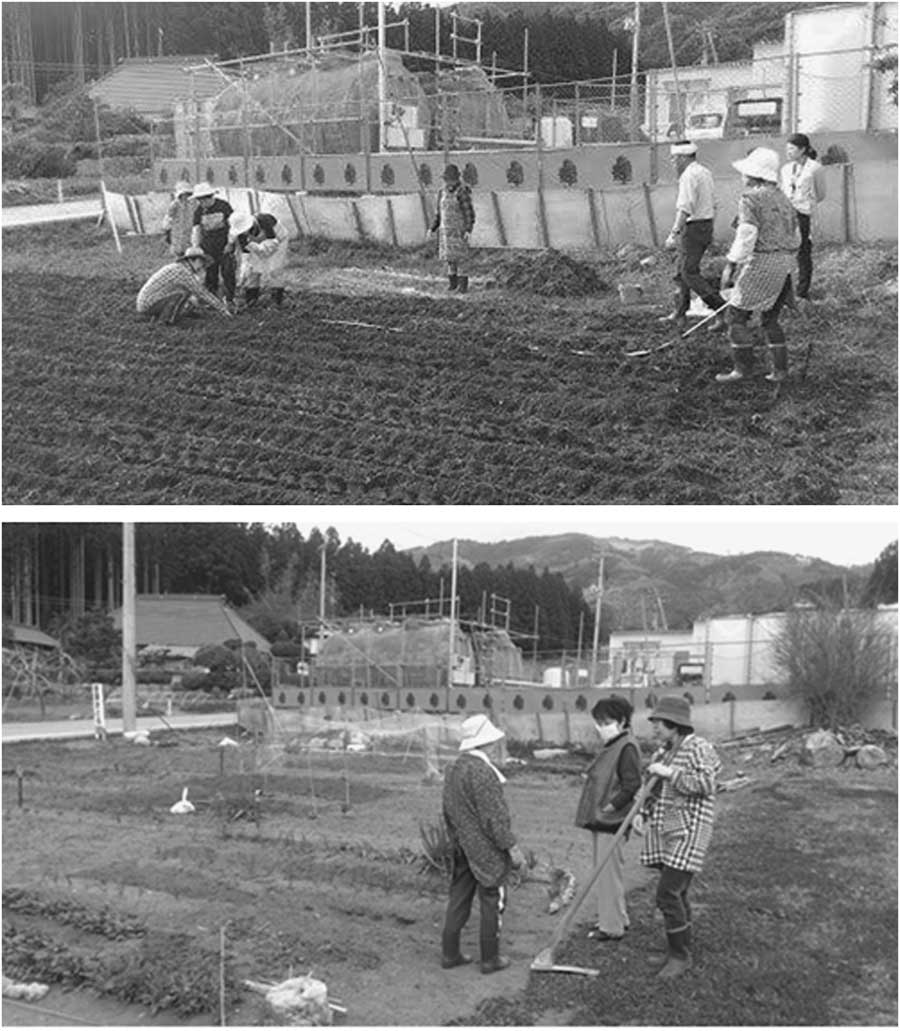
Regardless of age, gender, or experience, all residents in temporary housing in Rikuzentakata were eligible to participate in the Hamarassen Farm project. All leaders of the self-governing bodies of 50 temporary housing complexes in Rikuzentakata were asked to take part in this project. Of those leaders, 41 replied and 11 expressed interest in participation (another 11 were already involved in community farmland projects). In establishing the Hamarassen Farm, from May to August 2012, members of the project team of Iwate Prefectural Takata Hospital looked for fallow farmland adjacent to or within 5 minutes’ walk of the participating temporary housing complexes. Appropriate pieces of farmland were found and negotiation for leasing took place with the landowners. Only free farmland was leased (the landowners received no rent or financial reward). Eventually, 11 farms were set up. Landowners or local residents were asked to help cultivate the farmland (if necessary, hospital workers also cultivated it), and the cultivated farmland was handed over to the study participants. The participants provided their own seeds, seedlings, farming tools, and equipment and they developed their own farming plans (Figure 1).
Participants of the Hamarassen Farm Project in Rikuzentakata, Japan.

Recruitment of Hamarassen Participants
In June 2012, 12 female Hamarassen participants were recruited who were residing in 3 temporary housing complexes that were built shortly after the earthquake and their BMD was measured (Hamarassen group). At the same time, health-promotion seminars for the general population in Rikuzentakata were carried out, and volunteers who were willing to have their BMD measured were recruited. Five months later, the BMD of 19 women who were not engaged in farming activities and 8 women who grew vegetables on their own farms or in their own kitchen gardens were measured; the data of the former were used for the nonparticipating group and those of the latter were used as the self-farming group. For all 3 groups, BMD was measured in June and November 2012. None of the participants received any osteoporosis treatment before or during the project.
As of December 2013, the Hamarassen project was ongoing at 11 locations. There were approximately 80 participants, with the male:female ratio being 1:8. The age range of the participants was from 30 to 95 years, with the median age being 70. Approximately 40% of the participants had no experience with farming. Only female Hamarassen participants participated in our BMD evaluation.
To evaluate the changes in the Hamarassen participants’ psychosocial well-being, the sense of purpose in life (subjective attitude toward living significantly) among an additional 21 participants in 3 Hamarassen farms was measured before the beginning of farming in June and August 2012. Purpose in life was measured only in the Hamarassen group.
Measurement of BMD
Bone densitometry was performed by using quantitative ultrasound methods of the heel bone (GE Healthcare Japan) at the launching of the project at the health lectures in June 2012 and 5 months later in November 2012. The calcaneus is a widely used measuring spot for BMD by quantitative ultrasound. The device used requires the application of alcohol or gel to the foot, after which the foot can be placed in the device for measurement, which takes up to 30 s. The calcaneus of the left foot was measured to assess the lowest value of BMD. T-score-derived variables were used for the evaluation.
Evaluation of the Sense of Purpose in Life
The K-I Scale was included in our self-administered questionnaire survey and the Feeling That Life is Worth Living Among the Aged, a validated psychometric scale designed for older adults in Japan,Reference Kondo and Kamada 11 was used for the surveys. This scale was constructed through the investigation of the notion of purpose in life and has been verified to have high reliability and validity. The scale quantifies the sense of having purpose in life by means of questions on a sense of fulfillment, a desire to improve oneself, motivation, and a sense of being. Participants were also asked retrospectively about their sense of purpose before becoming involved in the farm project. The K-1 Scale consists of four factors: (1) self-actualization and motivation (challenging spirit with purpose and motivation toward everything), (2) satisfaction with life (challenging spirit with self-awareness of making a contribution to others), (3) motivation to live (sense of self-progression), and (4) sense of existence (sense of being approved of by others). There are a total of 16 questions. Each question was scored by using the following scale: (1) agree (2 points), (2) neither agree nor disagree (1 point), and (3) disagree (0 points). The total score was calculated, with 32 points signifying a perfect score. To assess the change in responses before and after the intervention, an additional evaluation using narrative interviews with open-ended questions was performed. Further, to assess the quality of having been involved in the farm project, participants were given an opportunity to provide free comments 5 months after having commenced the farm work.
Statistical Analyses
Changes in BMD among the 3 groups were analyzed with a difference-in-difference estimator, employing generalized estimating equations under the assumption of normal distribution of the BMD parameter. For comparability across groups, the T-score, standardized for average, and standard deviations were used. This approach can formally control the effects of confounding factors. For confounding factors, age, baseline BMD T-score, and residential temporary housing complex were considered. Changes in purpose in life within Hamarassen participants were modeled by using a generalized estimating equation to address within-individual clustering. One subject was omitted whose age information was not provided. All analyses were conducted by using SAS version 9.3 (SAS Institute Inc., Cary, NC, USA).
Ethical Considerations
Participants gave their oral consent to have a physical examination including measuring BMD and brief medical interviews. This research was approved by the Iwate Prefectural Takata Hospital Ethical Committee.
RESULTS
Changes in BMD
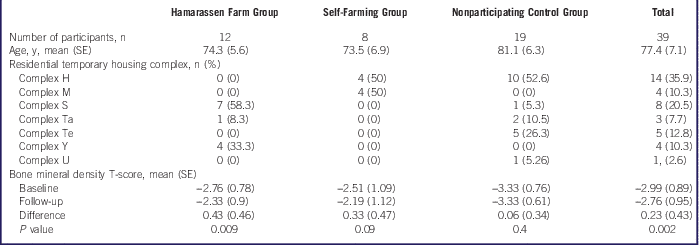
The individuals in whom BMD was evaluated were all women. Those in the Hamarassen group and the self-farming group were younger than the nonparticipants: the participants’ mean ages were 74.3 (SD=5.6), 73.5 (SD=6.9), and 81.1 years (SD=6.3) in the Hamarassen group, self-farming group, and control group, respectively (Table 1). The mean BMD was also high in the Hamarassen and self-farming groups. The change in BMD T-scores in the Hamarassen group was 0.43 (standard error [SE], 0.46; P=0.009); that in the self-farming group was 0.33 (SE, 0.47; P=0.09) and that in non-participating subjects was 0.06 (SE, 0.34; P=0.43).
Characteristics of the Female Participants in Whom Bone Mineral Density Was Evaluated

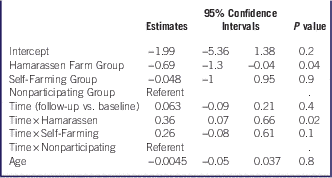
The GEE-based difference-in-difference models showed that even with adjustment for baseline BMD, age, and residential temporary housing complex, the differences in the changes in BMD T-score compared with the control group were 0.36% (95% confidence interval: 0.07 to 0.66) for the Hamarassen group and 0.26 (95% confidence interval: –0.08 to 0.60) for the self-farming group (Table 2).
Differences in the Change in Bone Mineral Density T-score: Results of Difference-Indifference Models With Generalized Estimating EquationsFootnote a

a Fixed effects of residential temporary housing complex (7 complexes) were adjusted for.
Changes in Purpose-in-Life Score
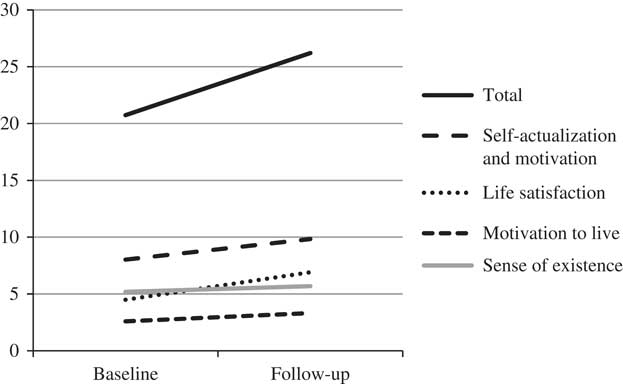
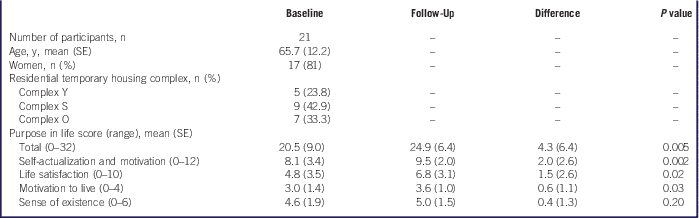
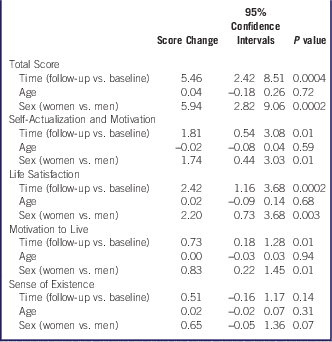
At baseline, the total score was 20.5 (SD, 9.0) on average, and that score increased to 24.9 (SD, 6.4) after 2 months of participation (P=0.005; Table 3 and Figure 2). The GEE models revealed that even after adjustment for age, sex, and residential temporary housing area, the total score and 3 of the 4 components of the K-1 system increased over time after involvement in the Hamarassen project. The total score rose by 5.46 points (P=0.0004), and there were increases in self-actualization and motivation (1.81, P=0.01), satisfaction with life (2.42, P=0.0002), and motivation to live (0.73, P=0.01. However, there was no large increase in sense of existence (0.51, p=0.14) (Table 4). Because the K-1 system was originally designed for application among subjects aged 60 years or older, a sensitivity analysis using only 16 participants aged 60 and above was conducted. However, the results were the same as in the original analyses, with only very small differences appearing in the estimated values.
Estimated Changes in Purpose-in-Life Scores Among Hamarassen Participants. Adjustments were made for age, sex, and residential temporary housing complex.

Characteristics of the Participants in the Hamarassen Farm Group in Whom Purpose in Life Was Evaluated by Use of the K-I Scale

Changes in Purpose-in-Life Score Among Hamarassen Participants: Results of the Generalized Estimating Equation ModelFootnote a

a Fixed effects of residential temporary housing complex (3 complexes) were adjusted for.
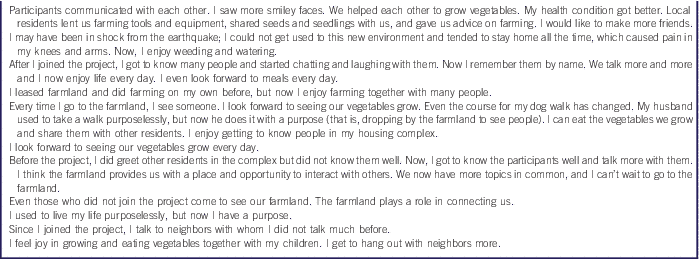
Most of the free comments about the Hamarassen project provided by the participants were positive, and they signaled happiness and enjoyment related to the scheme (Table 5). The participants’ positive feelings were related to the development of new, continuous interpersonal connections with other participants and the acquisition of emotional social support through those communications.
Comments From Hamarassen Participants in November 2012

DISCUSSION
The results of this study showed a remarkable improvement in the participants’ mental and physical health in terms of the sense of having a purpose in life and BMD. The increased sense of purpose in life among Hamarassen participants points to the development of new interpersonal networks and continuous communications among the participants. It appears that collective activities were beneficial to the participants’ health beyond simply the opportunity for physical exercise through farming. An increased social network and community social capital operates as a resource that allows mutual instrumental, emotional, and informational social support among the group members.Reference House, Umberson and Landis 12 - Reference Kawachi, Takao and Subramanian 18 In other disaster settings, Haines and colleagues reported that after Hurricane Andrew, interpersonal network density and local bonds were key determinants of the provision of post-disaster support.Reference Haines, Hurlbert and Beggs 8 Aldrich analyzed data of recent disasters including the 1995 Hanshin-Awaji (Kobe) earthquake in Japan and Hurricane Katrina in New Orleans, Louisiana. He found evidence that recovery was faster in the community where social capital was rich.Reference Aldrich 9 Moreover, Kage discussed that the rapid post-war recovery of Japanese society can be explained by the strong growth of civic engagement in both communities and society.Reference Kage 10 It has also been pointed out that poor social capital is related to functional disability and mortality.Reference Aida, Kondo and Hirai 19 , Reference Kondo, Suzuki and Minai 20 A lack of communication with others has been reported as increasing the development of dementia.Reference Fratiglioni, Wang and Ericsson 21 Because the work in this study was carried out on fallow farmland located outside the complexes, many residents were obliged to go beyond their complex to undertake the farming activities, and in the process they communicated with local people, which led to the development of bridging social capital.Reference Kim, Subramanian and Kawachi 22
Before the earthquake, the area around Rikuzentakata had large numbers of locals who were engaged in farm work. However, approximately half of the Hamarassen participants lacked prior experience with farm work, which suggests that their primary intention in taking part was to have the opportunity for socialization rather than physical activity. This observation was reflected in the respondents’ comments in the questionnaire survey (Table 5).
Among the four components of the purpose-in-life scale used in this study, improvements were observed in self-actualization, satisfaction with life, and motivation to live. This finding supports the notion that farm work and communication among the participants changed their state of mind from emptiness to fulfillment. Nevertheless, no evidence was obtained for a large improvement in the participants’ sense of existence. An individual’s sense of existence is a fundamental component, and enhancing this sense may require more intensive interventions or perhaps the large-scale recovery of the entire community.
An improvement in the participants’ BMD was also observed. A meta-analysis has demonstrated a significant positive effect of exercise on BMD,Reference Marques, Mota and Carvalho 23 and it has also been determined that farm work is correlated with BMD in elderly Japanese women.Reference Nakamura, Saito and Nishiwaki 24 The BMD of postmenopausal women is reportedly related more to high-intensity loads applied to bone rather than to muscle.Reference Sanada, Kuchiki and Ebashi 25
Strengths and Limitations
This study was based on a unique hospital-led program in a disaster-affected area in which farm work was introduced to maintain the mental and physical health of temporary housing residents. The program is highly generalizable to many places, because this study was based on a real-life situation after the Great East Japan Earthquake. Caution is needed, however, when interpreting these results as an evaluation of the health impacts. First and foremost, the participants were not randomly separated into 3 groups for comparison, and there is thus potential selection bias. However, this issue was partly addressed by adjusting for differences in multiple baseline characteristics. Second, because the sample size was small, there is the possibility of type II error. Although the Hamarassen participants had a wide age range and the effect of the activity on physical and mental health might vary across ages, given the limited sample size, the differential effects by age could not be evaluated. Third, information about the purpose in life at baseline was based on the respondents’ recollection of the time when they first participated in the program. Thus, there is also the possibility of recall bias. Moreover, the participants in our evaluation of BMD changes were women only. Evaluation of male participants will be necessary in the future.
CONCLUSIONS
Most similar voluntary activities, such as setting up flower gardens and small farms near temporary housing areas, have been very small or unsustainable owing to the failure of the self-management scheme. The Hamarassen Farm project is thus an exception, being maintained as a large-scale operation. Its success may be attributable to the involvement of a local hospital and its maintenance by the hospital staff as a primary prevention activity as part of its preventive medical practices.Reference Leavell 26 The indirect involvement of familiar hospital workers, rather than complete strangers, may help to remove doubts on the part of residents regarding participation.
The Hamarassen Farm project faced 2 challenges. One is that the number of male participants was limited. This has been observed in other intervention programs promoting social participation.Reference Ichida, Hirai and Kondo 27 After the Hanshin-Awaji (Kobe) earthquake in 1995, Okamoto et al found in their study at temporary housing for victims that social connections could be developed in the community relatively easily among women but not among men, because social connections among men were mostly based not in the community but at the work place.Reference Okamoto, Greiner and Paul 28 Okamoto et al also found that men’s participation in social gatherings in the community was only 50% of women’s. Empirical studies and narrative observations have identified that unlike women men usually require specific roles in the group or other reasons to be a part of group activities. 29 Although Hamarassen Farm did not have a particular gender-oriented strategy to promote men’s participation, one approach to increasing male participation emerged from the experience. In the case of participating married couples, the husbands sometimes visited their wives’ farmlands during their walks, which could lead to a spillover effect on the husbands. A second challenge was the closed nature of the Hamarassen Farm: the members of the farm became basically fixed, and there was subsequently little chance for new participants to join. This has become a barrier to the project’s efforts to increase the total number of participants and their diversity.Reference Portes 30 Recently, community health-promotion activities have been recommended for medical professionals in addition to public health practitioners. 31 Although the limitations mentioned above require further study, health-promotion interventions such as the Hamarassen project, which aim to strengthen social networks and community social capital, may be effective in preventing disuse syndrome among adult disaster victims. With the rapidly aging populations in many countries, similar approaches may be adopted in nondisaster settings as a possible option for the health-promotion activities of medical institutions. 32
Acknowledgment
The authors thank the landowners who supported this project with the gratuitous use of their fallow farmland and the hospital employees who participated in this project. The authors also thank Tsuyoshi Komori and members of the “Let’s Talk Foundation” for technical assistance and Fumiko Osaka, Erika Nakajima, and Ayumi Sato for supporting the fieldwork. NK was funded by the Ministry of Health, Labour, and Welfare (No. H26-ryo-shitei-003, fukkou; and H25-kenki-wakate-015).