Implications
There are currently many different national energy evaluation systems for ruminants, which makes comparisons across borders problematic. The paper suggests that these different systems could be unified by taking ad libitum feeding, that is, the dominant on-farm feeding system, as a starting point. The presented analyses of older as well as more recent data show that the overall efficiency of ME utilisation in ad libitum fed ruminants is (i) virtually independent of feed quality characteristics, (ii) not essentially different between lactating and non-lactating ruminants and (iii) close to a value of 0.6. Using a single value for overall energetic efficiency in ad libitum fed ruminants (i) considerably simplifies existing energy evaluation systems, (ii) avoids the use of different national energy evaluation systems and abolishes the differences between NE and ME systems and (iii) avoids the considerable bias and large errors associated with current energy evaluation systems when applied universally. Recognition of the link between energetic efficiency and voluntary intake regulation could lead to better intake prediction models for ruminants.
Introduction
An animal’s energy requirements for maintenance and production are most readily expressed in terms of net energy (NE) (e.g. Van Es, Reference Van Es1978; Agricultural Research Council (ARC), 1980; Institut National de la Recherche Agronomique (INRA) (1989); Agricultural and Food Research Council (AFRC), 1993; National Research Council (NRC), 2000 and 2001). The NE requirements (NER) for maintenance (NEm) are generally estimated from fasting heat production, that is, the loss of body energy by an animal that is not consuming feed and, therefore, will not be able to defend its energy reserves. The NER for gain (NEg) correspond to the energy content of the lipid and protein that is retained by an animal that is gaining BW. The NER for lactation correspond to the energy content of the protein, lipid and lactose excreted in milk. Additional NER may be added for animals that have a more than minimal level of activity, for energy retained during late pregnancy in the conceptus (i.e. foetus and associated tissues), for NE retained in the wool of sheep, etc. (e.g. Van Es, Reference Van Es1978; ARC, 1980; INRA, 1989; AFRC, 1993). In lactating animals that lose body energy, a ‘negative form’ of NER, that is, the mobilised body energy (BEmob) is usually included in the model. In modern energy evaluation systems for ruminants, total NER are estimated by adding up, in some form (see below), all relevant NER of the animal in question.
The available energy in ruminant feeds, however, is most commonly expressed, at least initially, in terms of metabolisable energy (ME). The ME that an animal can derive from feed is defined as the gross energy of the feed minus the gross energy in faeces, urine and combustible gases (mainly methane). ME is not utilised with 100% efficiency for NE and for that reason energy evaluation systems have been designed to ‘translate’ requirements for NE into ME requirements (MER) or to ‘translate’ the ME supplied by feed into (some form of) NE. Despite many years of international contacts between animal scientists who developed energy evaluation systems for ruminants, there are currently many different national systems in use. Although some systems are more transparent than others, many are so complicated that a reader who is unfamiliar with the energy evaluation system that is used in a publication will generally find it problematic to interpret the reported data and compare these with data based on other evaluation systems.
It is the aim of the current paper to give, first, a brief description of the similarities and differences between some of the more commonly used energy evaluation systems in Europe. Detailed research has shown that there are highly significant effects of diet quality as well as animal state (e.g. lactating v. non-lactating; AFRC, 1993) on energetic efficiency when compared at similar ME intake (MEI). The same research has shown that energetic efficiency decreases with increasing MEI. For some systems, the MEI at which energetic efficiency is measured or estimated appears to be crucial for the estimation of the energy value of feeds, especially for growing animals. This raises the question what the most appropriate MEI level is for evaluating energetic value of feeds of varying quality.
Analyses of efficiency of ME utilisation in growing and lactating ruminants in an older and a more recent system of energy evaluation are presented that suggest that ad libitum feeding seems to minimise variation in energetic efficiency associated with variation in feed quality as well as differences in animal state. On the basis of that observation, a proposal is developed for a new international system of energy evaluation for ruminants that is much more generally applicable than current systems. The proposed starting point for such a system is not only much simpler than current systems but is certain to avoid some of the systematic bias and considerable errors associated with many of them.
ME v. NE
Modern energy evaluation systems are all based on the estimated NER of animals at a given production level. Any ME that is derived from the consumed feed that is not retained as NE (in the body, in milk, etc.) is lost in the form of heat. There is considerable variation in the proportion of ME that is lost as heat. In general, ME is utilised with a higher efficiency for maintenance (i.e. NEm) than for production (e.g. NEf or NEl). This causes the complication that the NE yield per MJ of ME is not constant but declines with increasing MEI. In most systems, ME is also utilised with a higher efficiency for lactation than for weight gain. This causes the complication that, at least in some energy evaluation systems (see below), the units in which available energy of feed is expressed differ for lactating and for non-lactating animals. Finally, there are considerable effects of diet quality on the NE yield of a given amount of consumed ME (e.g. Van Es, Reference Van Es1978; ARC, 1980; INRA, 1989; AFRC, 1993). These factors are the reason that energy evaluation systems for ruminants are generally quite complex and not always very transparent.
Commonly used energy evaluation systems for ruminants
Energy evaluation systems can be characterised as ‘ME-systems’ or ‘NE-systems’. For the purpose of this paper we will use two typical examples of ME-systems, as used in the United Kingdom (i.e. ARC, 1980; AFRC, 1993, v. Feed into Milk (FiM), Agnew et al., Reference Agnew, Yan, France, Kebreab and Thomas2004) and of NE systems, as used in many continental European countries such as France, The Netherlands and Switzerland (Van Es et al., Reference Van Es, Vermorel and Bickel1978; INRA, 1989). Systems similar to (but often slightly different from) these two types are found in many other European countries but also elsewhere, for instance, the NE system of the United States (NRC, 2000 and 2001) and the ME system of Australia (e.g. Commonwealth Scientific and Industrial Research Organisation (CSIRO), 1990). Systems used for growing ruminants will be discussed first and systems for lactating ruminants subsequently.
Growing ruminants
ME-based: the ARC/AFRC system as example. In these ME systems, the energy value of feeds is expressed in ME and animals’ NER are translated into MER to express the energy requirements of the animal and feed energy supply in the same currency. For non-lactating ruminants (the same system is used for cattle, sheep and goats on any farm type), the relationship between the animal’s NE intake (NEI) and its MEI is in the shape of a Mitscherlich curve:

Both NEI and MEI in this equation are scaled with NEm. Parameters B and p are derived from the estimated efficiency of ME utilisation for maintenance (k m) and gain (k f; ARC, 1980). Values for k m and k f are derived from preferred linear equations that relate k m and k f to feed metabolisability q (i.e. the ratio of the ME to gross energy (GE) contents of a feed; ARC, 1980). To estimate MER from NER (both scaled with NEm) for an animal at given production level, the corresponding equation is the logical equivalent of equation
(1):

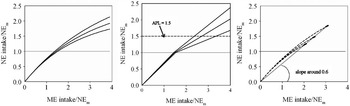
Figure 1a shows the relationships according to equation (1) for ARC (1980) preferred B and P-values for three diet metabolisabilities (i.e. q = 0.45, 0.55 and 0.65, respectively). These relationships predict MER for animals in positive (i.e. NEI > 1) as well as negative (i.e. NEI < 1) energy balance, that is, over the entire possible range of production levels.
The relationship between net energy intake (NEI, scaled with NEm) and metabolisable energy intake (MEI, scaled with NEm) for diets of metabolisability (q) of 0.45, 0.55 and 0.65: (a) according to the Mitscherlich curves used in the United Kingdom (AFRC, 1993), (b) according to the ‘broken-stick’ relationship as used in France (INRA, 1989) and The Netherlands (Van Es, Reference Van Es1978); the NE value of feeds for weight gain is estimated at an animal production level (APL) of 1.5 and (c) as graph a, but predicted for ad libitum fed cattle (ARC, 1980 using Tolkamp and Ketelaars, Reference Tolkamp and Ketelaars1994 regression lines); a line with slope around 0.6 can be drawn through the origin and predictions for ad libitum fed animals.

NE-based: the French, Dutch and Swiss systems as example
In NE systems, the energy value of feed is expressed in terms of NE. These systems generally assume that there are two linear relationship between MEI and NEI, one below maintenance (with slope k m) and one above maintenance (with slope k f; see Figure 1b). The values of k m and k f are derived, very similar to ME systems, through linear relationships with feed metabolisability q (Van Es, Reference Van Es1978; INRA, 1989). Figure 1b illustrates the difficulty that NE systems face: although the NE yield per MJ of ME consumed is constant below maintenance, it decreases with increasing MEI for animal with a positive energy balance. In such systems, the NE content of feeds is, therefore, standardised at a given animal production level (APL, i.e. NEI scaled with NEm) of 1.5 (Van Es, Reference Van Es1978; INRA, 1989). Figure 1b shows that the consequence is that the NE contents of the lowest quality feeds are estimated at higher than average MEI and that the NE contents of the best quality feeds are estimated at lower than average MEI. The estimated NE content of a feed is then divided by the NE value of barley for growing animals to express the energy value of feed in a specific unit for growing ruminants such as VEVI (feed unit for meat production) in the Netherlands (Van Es, Reference Van Es1978) and UFV (feed unit for meat production) in France (INRA, 1989). To link the NER of animals to the units in which feed energy is expressed, NER are also divided by the same NE value of barley for growing animals to provide a ‘common currency’ for requirement calculations. These requirements may be corrected for animals with production levels that deviate from the APL (or the assumed degree of finish) used to calculate the NE content of feeds (e.g. Van Es, Reference Van Es1978).
Criticism and synthesis
Experiments have shown that, without a doubt, the NE yield per MJ of ME consumed decreases as ruminants consume increasing amounts of ME. This is caused by the gradually decreasing efficiency of ME utilisation as MEI increases (along the whole intake range) in ME systems (Figure 1a). ME systems have no problem dealing with this because predictions of MER for growing ruminants incorporate this curvilinear relationship between MEI and NEI. In NE systems (Figure 1b), the decrease in energetic efficiency occurs only at MEI above maintenance and this is caused by (i) k f being lower than k m and (ii) the increasing proportion of MEI that is utilised for gain when MEI increases. The issue whether the relationship between NEI and MEI is curvilinear or in the form of a ‘broken stick’ is contentious (Blaxter and Boyne, Reference Blaxter and Boyne1978; Blaxter, Reference Blaxter1989; Tolkamp and Ketelaars, Reference Tolkamp and Ketelaars1992; Emmans and Kyriazakis, Reference Emmans and Kyriazakis1995; Ketelaars and Tolkamp, Reference Ketelaars and Tolkamp1996) but does not affect the development of the argument here. A feed does not have a single NE value for growing animals in any approach because the NE yield per MJ of ME decreases as MEI increases. What is, then, the most appropriate intake level to estimate the NE value of a feed? There are three possibilities to standardise estimates of the NE value of feeds and these are discussed below.
The NE value can be estimated at a given MEI level. The great disadvantage of such an approach is that this would only allow estimation of the NE value of feeds at very low intake levels (simply because ruminants will not consume large amount of ME from modest or low-quality feeds; see, for instance, ARC, 1980). It also raises the question what practical significance the NE value for high-quality feeds would have if it is estimated at such low MEI levels (see below).
The NE value can be estimated at a given NEI or animal production level. This is how many current systems have standardised the estimation of the NE value of feeds (e.g. Van Es, Reference Van Es1978; INRA, 1989). As pointed out above, this means that the NE value of the lowest quality feeds is estimated at the highest MEI levels. Farmers know very well, however, that ruminants will not consume high amounts of ME when animals have access to low-quality feeds. Farmers will feed their animals such diets only when their production goals and the required MEI are modest. Animals will never achieve an APL of 1.5 on low or modest quality for ages. This means that the NE value of many such feeds, as estimated in current NE systems, are based on pure extrapolations of theoretical models to intake levels that can never be observed in practice. For instance, the overall efficiency of ME utilisation of poor quality forage (q = 0.4) is estimated according to the French (Vermorel, Reference Vermorel1989, equation 2.11) and Dutch (Van Es, Reference Van Es1978) systems at APL = 1.5 as:

This applies to an APL of 1.5, that is, this would require an MEI of 1.5/0.489 = 3.06 times NEm. According to ARC (1980) intake predictions, however, MEI of more than three times NEm can only be expected for very high-quality feeds and the MEI of growing cattle or sheep on forage with q = 0.4 would not be expected to exceed 1.5 times NEm. That means that the NE content of such forages is estimated from extrapolation to MEI levels that are around double the maximum intake of such feeds that can be expected in reality. Such extrapolated estimates have, of course, little value for farmers. Similarly, the NE value of high-quality feeds is estimated at MEI levels that are lower than average. Farmers are unlikely, however, to supply their animals with a restricted amount of high-quality feed to achieve modest or even average production goals. They will supply their animals with high-quality diet only if their production goals are set high and high MEI levels are required. Farmers would, therefore, be better served by a system that estimates the NE value of poor quality feeds at low, and of high-quality feeds at high MEI levels.
A third option is to estimate the NE value of feeds at ad libitum intake level. Farmers will usually feed their ruminants ad libitum, either a complete diet or at least a diet component (usually a forage). Farmers will feed their animals ad libitum modest quality feeds (e.g. rough grazing, old hay, poor silage, even straw or silage/straw mixtures) if they have very modest production goals that translate in relatively low APL’s (e.g. maintaining weight or modest losses or gains in condition in non-reproductive breeding animals). They will supply better quality forages ad libitum (and/or limited additional supplements of concentrates) if their production goals are higher, which translates in higher APL’s (e.g. during late pregnancy, to increase body reserves in dry animals, to achieve desirable weight gains in heifers, etc.). And if farmers want to achieve very high production goals associated with high NEI levels (e.g. fast-growing beef bulls), they have to offer liberal amounts of concentrates in addition to ad libitum access to forage or good quality pelleted diets. For farmers, therefore, the most relevant estimates of the NE value of feeds are not those made at a fixed MEI or NEI level, but at the MEI level that is achieved on farm, that is, for ad libitum fed animals.
Publications that describe energy requirement systems of growing ruminants generally devote a chapter to energy evaluation and a separate chapter (usually written by other authors) to intake predictions (e.g. ARC, 1980; INRA, 1989; CSIRO, 1990; AFRC, 1993; NRC, 2000 and 2001). That seems odd because, as described above, the NE value of feed depends so strongly on the intake level at which it is estimated. Experiments, such as those conducted by Sir Kenneth Blaxter and his co-workers in the United Kingdom (as summarised in ARC, 1980), have shown that, without a doubt, the NEm and NEg yield of a given amount of ME is affected by diet quality. But the chapters on intake in all these publications recognise that also the voluntary MEI level is affected by diet quality. Tolkamp and Ketelaars (Reference Tolkamp and Ketelaars1994) integrated the relevant ARC (1980) chapters and estimated the overall efficiency of ME utilisation of growing cattle that were fed ad libitum on a variety of diet qualities and Figure 1c illustrates their findings. The graph shows that maximum voluntary MEI generally increases with diet quality in ad libitum fed ruminants. Diet quality is characterised here by metabolisability alone, that is, the main or only indicator of diet quality in the energy evaluation systems discussed here. It also shows that, at a given MEI level, ME is utilised with a higher efficiency for maintenance as well as for gain as diet quality increases. And yet, a single line, with a slope of around 0.6, can be drawn through the origin and the predicted ad libitum MEI and NEI combinations relevant for each diet quality (see Tolkamp and Ketelaars, Reference Tolkamp and Ketelaars1994). That means that almost all variation in energetic efficiency disappears when it is estimated or measured in ad libitum fed animals. The (formal) cause of this remarkable consistency in energetic efficiency is clear. Although the ME of modest quality feeds is utilised with relatively low efficiencies for maintenance and gain, MEI levels are low and, therefore, most ME is utilised with efficiency k m that is relatively high compared with k f. Although the ME of high-quality feeds is utilised with relatively high efficiencies for maintenance and gain, MEI levels are also high and, therefore, most ME is utilised with efficiency k f, which is relatively low compared with k m.
Systems such as INRA (1989) and AFRC (1993) use a single diet quality characteristic (i.e. metabolisability q) to estimate k m from a single (preferred) regression line and another one to estimate k f. We know, however, that there is a considerable effect of diet type on efficiency of ME utilisation for maintenance and (especially) for gain. For instance, the best estimates of k f at a given metabolisability generally decrease in the order mixed diets, pelleted feeds and forages (ARC, 1980). In addition, Blaxter (Reference Blaxter1989) showed that also an increase in diet protein content at a given metabolisability positively affects k f. This information is entirely ignored by the ME and NE systems that are currently discussed. Tolkamp and Ketelaars (Reference Tolkamp and Ketelaars1994) showed that ignoring these effects of diet type leads to requirement tables in ME systems (i.e. ARC, 1980) that are totally inadequate for requirement predictions and irresponsibly low estimates of overall energetic efficiency (similar to the 0.489 calculated for the INRA NE system, above). The variation in energetic efficiency between diet types of a given metabolisability are mirrored by effects of diet type on voluntary intake. The ARC (1980) equations for cattle, predict, for instance, higher voluntary ME intakes of pelleted or mixed diets than of forages at the same diet metabolisability. Tolkamp and Ketelaars (Reference Tolkamp and Ketelaars1994) showed that (i) diet metabolisability did not systematically affect overall energetic efficiency in cattle fed forages ad libitum, (ii) diet metabolisability did not systematically affect overall energetic efficiency in cattle fed pelleted/fine diets and most importantly, (iii) that the mean overall efficiency of ME utilisation did not differ between diet types in ad libitum fed cattle. The (formal) cause of this is, again, that animals consume more ME of diets of which the ME is utilised with a higher efficiency for maintenance and gain and, consequently, utilise a larger proportion of MEI with efficiency k f (which is low compared with k m). In addition Ketelaars and Tolkamp (Reference Ketelaars and Tolkamp1992) showed, in data obtained with sheep, that protein content has a positive effect on voluntary intake of forages with a given metabolisability which can be linked to the positive effect of protein content at a given metabolisability on energetic efficiency as modelled by Blaxter (Reference Blaxter1989). The opposite can also occur. Tolkamp et al. (Reference Tolkamp, Emmans and Kyriazakis2006) fed sheep ad libitum for a year one of two pelleted diets that differed considerably in metabolisability (q-values of 0.50 and 0.62, respectively). According to equation (3) this should have resulted in k mf values of 0.56 and 0.63, that is, considerable differences in energetic efficiency. In contrast to this prediction, there were no significant differences in either MEI or sheep performance, that is, the ME of both feeds was utilised with similar efficiency (Tolkamp et al., Reference Tolkamp, Emmans and Kyriazakis2006).
The analyses of Tolkamp and Ketelaars (Reference Tolkamp and Ketelaars1994) resulted in the conclusion that in growing ruminants, effects of diet metabolisability and diet type on overall efficiency of ME utilisation disappeared (almost) entirely by ad libitum feeding. They concluded, therefore, that (i) diet quality did not systematically affect efficiency of ME utilisation and that (ii) a single efficiency (suggested value: 0.6) could be used to translate either NER into feed MER or to translate feed ME values into feed NE values for ad libitum fed ruminants. Although as argued below, the value 0.6 was simply the average of the calculated efficiencies and should be confirmed, it will give a fair indication of what sort of general value can be expected. This was suggested to apply to ad libitum fed growing as well as lactating ruminants (Tolkamp and Ketelaars, Reference Tolkamp and Ketelaars1994). Energetic efficiency in lactating ruminants will, therefore, be discussed next.
Lactating ruminants
NE-based: the French and Dutch systems
For lactating animals, k l is derived from feed metabolisability q according to a linear relationship, similar to that used in ME systems (such as AFRC, 1993; see below) and the NE value of feeds is calculated as the product of its ME content and k l. It is divided by the NE value of barley for lactation to express the energy value of feed in a specific unit for lactating animals. The NER for lactating cows are again divided by the same NE value of barley, making use of the fairly constant ratio between k l and k m (see below), to express animal NER and feed energy value in the same currency, that is, UFL (feed unit for lactation) in France (INRA, 1989) and VEM (feed unit for lactation) in The Netherlands (Van Es, Reference Van Es1978). Corrections for animals in positive or negative energy balance are accommodated in a manner similar to that described below for ME systems.
ME-based: the ARC/AFRC system
Linear relationships below maintenance (k m) and above maintenance (k l) are used for lactating animals in the AFRC (1993) system and, therefore, the MER of a lactating cow in energy balance can directly be estimated (at this point ignoring the applied corrections for feeding level and safety margins) by:

For an animal gaining body NE during lactation, the term NEg/k g is added to equation (4). It is assumed that the efficiency of ME utilisation for gain differs between lactating (k g = 0.95 × k l) and non-lactating (k f) ruminants.
A negative energy balance is treated very differently in lactating and non-lactating ruminants. For non-lactating ruminants, a negative energy balance is a sign that the animal does not defend its body reserves. It is, therefore, assumed to lead to a reduction in MER for maintenance and the MER of such an animal can simply be estimated from equation (2) with NER < NEm. In contrast, for lactating ruminants with a negative energy balance it is assumed that part of the body energy reserves are mobilised (NEmob) and that, therefore, the MER for lactation are decreased, with NEmob multiplied by the estimated efficiency of NEmob utilisation for NEl (i.e. k mob):

There are two (implicit) assumptions in this approach. The first is that k mob is needed only for cows in negative energy balance. This is assumed even though in all cows a considerable proportion of milk energy is not formed in the udder directly from feed ME but is derived from the animal’s body (e.g. Bauman and Davis, Reference Bauman and Davis1974). It seems odd, then, that we would not need this parameter to predict MER in all cows, irrespective of their energy balance. This is linked to a second (again implicit) assumption, related to the cow’s maintenance requirements. The MER for maintenance of a cow in energy balance is, by definition, the amount of ME (i.e. equal to NEm/k m) that allows a cow to defend her body reserves. For a lactating cow in negative energy balance it is assumed that she, first requires exactly the same amount of ME to defend her body reserves as other cows do (again NEm/k m) but that, subsequently, part (equal to NEmob) of these same reserves are ‘mobilised’ anyway for lactation purposes. This seems to be a very odd sort of biology: why would a cow first spend ME to defend body reserves that she mobilises later in the day anyway? This raises the question why a negative energy balance is not treated exactly the same in lactating and non-lactating cows. A negative energy balance would then simply show that a cow (whether she is lactating or not) does not defend her body reserves and that, as a result, her MER for maintenance are reduced. This assumption would result in the following model:

Rearrangement of equations (5) in
(7)and (6) in
(8)using elementary algebra makes these easier to compare:


It is evident that equations (7) and (8) differ in their last term only and will predict the same MER if these are equal, that is, if 1/k m = k mob/k l or, after re-arrangement, if k mob = k l/k m.
It has been known for many decades that the ratio k l/k m is virtually constant. Vermorel (Reference Vermorel1989), p. 26 observed: ‘…Van Es (1975) showed that there is a fairly constant ratio between k m and k l (k m/k l = 1.2) whatever the metabolisability of the feedstuff or the diet’. Since Van Es analysed large data sets obtained in different countries before deriving his equations to predict k m and k l from q, this observation carries some weight. The observation implies that the ratio of k l to k m is independent of feed quality and constant at k l/k m = 1/1.2 = 0.83. Over the relevant range of feed metabolisabilities (q from 0.45 to 0.65) the ratio between estimates of k l ( = 0.24 × q + 0.463) and k m (=0.287 × q + 0.554) is indeed virtually constant (at 0.836) in the energy evaluation systems used in several continental European countries such as France (Vermorel, Reference Vermorel1989) and the Netherlands (Van Es, Reference Van Es1978). This value is very similar to the estimates for k mob used in different energy evaluation systems, that is, 0.84 in the United Kingdom (ARC, 1980; AFRC, 1993) and Australia (CSIRO, 1990), 0.82 in the United States (NRC, 2001) and a rounded value of 0.8 in countries like France (INRA, 1989) and the Netherlands (Van Es, Reference Van Es1978). This means that, for all practical purposes, equations (7) and (8) give the same predictions of MER for cows in negative energy balance. If the same predictions of MER can be made with or without use of the parameter k mob, this raises the possibility that the whole concept of mobilisation of body energy reserves for lactation is an artefact entirely. It could well be that (i) the necessity of including k mob for MER predictions and (ii) the estimate of its parameter value, are simply a direct result of not using the most appropriate model to analyse energy balance data.
If the predicted MER by the two approaches are the same, there are at least three arguments to prefer model (8) over model (7). The first is that it avoids the internal contradictions in current systems (i.e. k mob is used only for cows in negative energy balance and cows are supposed to first defend body reserves that they mobilise later anyway). The second argument is that model (8) is simpler than model (7) because it requires fewer parameters and a more parsimonious model should be preferred over more complicated ones if this does not affect predictions. And finally, the use of model (8) instead of model (7) removes one of the existing distinctions in current energy evaluation systems between lactating and non-lactating ruminants (which will be discussed below in more detail).
Tolkamp and Ketelaars (Reference Tolkamp and Ketelaars1994) analysed predicted effects of feed quality on energetic efficiency in ad libitum fed dairy cows according to ARC (1980) predictions. They concluded that also in lactating dairy cows, overall efficiency (i.e. NEI as a proportion of MEI) was remarkably constant. The derived value for lactating cows (around 0.62) was, however, slightly higher than the value derived for growing cattle (around 0.60). The suspicion that ARC (1980) underestimated MER for dairy cows is now widely recognised (e.g. AFRC, 1993). Tolkamp and Ketelaars (Reference Tolkamp and Ketelaars1994) therefore proposed a single energetic efficiency (of 0.6) for the translation of NER into MER (or vice versa) for lactating as well as non-lactating ruminants. These predictions have been tested against a new energy evaluation system for dairy cows that was developed recently in the United Kingdom.
ME-based: the FiM system
The FiM project (Thomas, Reference Thomas2004) has recently proposed a novel energy evaluation system for lactating cows (Agnew et al., Reference Agnew, Yan, France, Kebreab and Thomas2004) that is now used by part of the United Kingdom dairy industry. The authors felt that the AFRC (1993) and other systems were not generally based on recent data sets obtained with high genetic merit dairy cows and modern dairy cow diets. They considered in particular the estimates of NEm for dairy cows in current systems too low (Agnew et al., Reference Agnew, Yan, France, Kebreab and Thomas2004). The new FiM system was developed on the basis of analyses of more than 600 respiration experiments with ad libitum fed cows that were carried out after the major European energy evaluation systems, such as Van Es (Reference Van Es1978), ARC, 1980, INRA (1989) and AFRC (1993) were formulated (Kebreab et al., Reference Kebreab, France, Agnew, Yan, Dhanoa, Dijkstra, Beever and Reynolds2003; Agnew et al., Reference Agnew, Yan, France, Kebreab and Thomas2004).
The system as proposed by FiM is very interesting for a number of reasons. First, cows in the respiration experiments were fed ad libitum (e.g. Cushnahan et al., Reference Cushnahan, Mayne and Unsworth1995; Gordon et al., Reference Gordon, Patterson, Yan, Porter, Mayne and Unsworth1995 and Reference Gordon, Patterson, Porter and Unsworth2000; Yan et al., Reference Yan, Patterson, Gordon and Porter1996 and Reference Yan, Gordon, Agnew, Porter and Patterson1997; Beever et al., Reference Beever, Cammell, Sutton, Rowe and Perrott1998; Sutton et al., Reference Sutton, Cammell, Beever, Humphries and Phipps1998 and Reference Sutton, Phipps, Cammell and Humphries2001), which is highly relevant for the development of the argument in the present paper. Second, the assumed NEm for dairy cows is around  , that is, around 40% higher than the estimates used in all other energy evaluation systems for dairy cows (Kebreab et al., Reference Kebreab, France, Agnew, Yan, Dhanoa, Dijkstra, Beever and Reynolds2003; Agnew et al., Reference Agnew, Yan, France, Kebreab and Thomas2004). Third, a curvilinear, instead of the usual linear, relationship between NEl and MEI was incorporated in the model (except for cows with very high yields). Finally, the system does not, as all other current systems do, incorporate effects of diet quality on MER because the authors of the FiM system could not find statistically significant effects despite trying out many different models (Agnew et al., Reference Agnew, Yan, France, Kebreab and Thomas2004).
Tolkamp and Kyriazakis (Reference Tolkamp and Kyriazakis2009) critically analysed the assumptions (and expressed doubts about at least some of these) and predictions of the FiM system. Despite these doubts, however, the authors’ conclusion that the FiM model gave good predictions can well be accepted, at least for cows with milk yields between roughly 8 and 45 kg/day (i.e. the range in which almost all observations were concentrated). The same paper showed that the predicted MER by the FiM system, requiring many parameters, were almost the same as those predicted with the Tolkamp and Ketelaars (Reference Tolkamp and Ketelaars1994) model that requires only a few parameters and is based on the assumption of a constant overall efficiency of ME utilisation in ad libitum fed cows of around 0.6 (we refer the interested reader to Tolkamp and Kyriazakis (Reference Tolkamp and Kyriazakis2009) for a detailed analysis).
The analysis so far raises the issue of whether or not there is a need for different NE systems for lactating (frequently also applied to non-lactating animals in dairy production systems) and non-lactating ruminants. This raises two relevant questions: (i) would it be possible to develop a novel international energy evaluation system that has much wider applications and avoids the systematic biases inherent in current ME as well as NE systems, and (ii) why is efficiency of ME utilisation so remarkably constant in ad libitum fed lactating and non-lactating ruminants with access to a wide variety of diets? These questions will be discussed below.
Towards a new international energy evaluation system for ruminants
In current NE systems, for growing animals such as those used in France (INRA, 1989) and The Netherlands (Van Es, Reference Van Es1978), the variation in energetic value of feeds is much wider than in ME systems. According to ME systems, the energetic value of a high-quality feed (q = 0.65) compared with a modest feed quality (q = 0.45), assuming the same GE content for both feeds, is higher by 44% (because 0.65/0.45 = 1.44). The contrast is much stronger in NE systems (77%) because the ME of high-quality feed is calculated, using equation (3), to be utilised with a higher efficiency for maintenance and gain, that is, (0.65 × 0.645)/(0.45 × 0.524) = 1.77. The current analysis shows, however, that in practice, where ruminants are fed ad libitum, overall efficiency of ME utilisation of the consumed diet as a whole varies hardly at all. This suggests that NE systems overemphasise the variation in energy value of feeds as a result of differences in diet quality. The real value of high-quality feeds (over and above their high ME concentration) is not that ad libitum fed animals utilise the ME of such diet ingredients with higher than average efficiency but that that animals consume a lot of ME from diets that include such feeds.
NE values of feeds are estimated at a given NEI (or animal production) level. This means that the NE value of poor quality feeds is estimated from extrapolation of theoretical models to intake levels that can never be observed in practice. This must have less value for farmers than the NE content of such feeds at realistic (i.e. much lower) ad libitum intake levels because that is how such feeds will be fed on farm. Similarly, the NE value of the best quality feeds is estimated at lower than average MEI levels. Again, this cannot be very relevant to farmers, who are unlikely to feed restricted amounts of such excellent feeds to achieve modest production goals. As argued above, the best estimate of the NE content of all feeds that has relevance for practical applications can be obtained at ad libitum intake levels. Vermorel (Reference Vermorel1989) was, of course, right by observing that the bias in such systems is not large if it is used for a specific production system (i.e. beef bulls growing at just over 1 kg/day). These systems cannot, however, be applied to production systems with much lower (or higher) production levels. For that reason alone, these NE systems are not a good basis for the development of a more universal international system with wider application to ruminants in general.
Similarly, systematic bias is also present in ME systems for growing ruminants, such as the ARC (1980) and AFRC (1993) systems in the United Kingdom. Tolkamp and Ketelaars (Reference Tolkamp and Ketelaars1994) analysed the overall energetic efficiency implied by the ARC (1980) tables of predicted MER of growing cattle. They concluded that many of the values in those tables were totally irrelevant for practical farming systems and that energetic efficiency is estimated best for ad libitum fed animals because that is the feeding system applied in virtually all ruminant production systems. When that was estimated, the energetic efficiency was, again, close to 0.6 (see Tolkamp and Ketelaars, Reference Tolkamp and Ketelaars1994 for a detailed analysis). In addition, the use of a single (preferred) regression line relating k m and k f to q is an important other source of systematic bias in NE as well as ME systems, as argued above. As a result of diet quality effects on energetic efficiency as well as voluntary intake, however, overall energetic efficiency in ad libitum fed ruminants is similar (around 0.6) for all these diet types in spite of considerable variation in efficiency as well as voluntary intake for feeds with a given q-value (Tolkamp and Ketelaars, Reference Tolkamp and Ketelaars1994).
For the development of a new international energy evaluation system with wide applications on farm, the practice of ad libitum feeding in virtually all ruminant production systems should be taken as the basic assumption. The best starting point for energy evaluation systems is, therefore, the energetic efficiency in ad libitum fed ruminants. The analyses so far suggest that the overall energetic efficiency of ad libitum fed, lactating as well as non-lactating, ruminants is remarkably constant and very close to 0.6. The prediction errors associated with the use of such a single energetic efficiency are certainly much smaller than the considerable bias and large errors that are associated with current systems, as demonstrated above. The proposed system is extremely simple and can (and should) be subjected to experimental work to test the central assumption that virtually all variation in overall efficiency of ME utilisation disappears when ruminants are fed ad libitum. This would leave open the possibility of future refinement should that prove to be necessary. The assumption that ad libitum fed ruminants utilise ME with an efficiency of 0.6 as the basis of a new international energy evaluation system would (i) abolish current differences between systems specifically for growing animals (with some exceptions) and lactating animals, (ii) differences between NE and ME systems, (iii) automatically account for effects of diet quality on energetic efficiency as well as voluntary intake.
Why is energetic efficiency so remarkably constant in ad libitum fed ruminants?
It is possible that the remarkably similar overall energetic efficiency in ad libitum fed ruminants is entirely coincidental. Even if that were the case (but see below), we could benefit from the observation because it would allow us to design a much simpler energy evaluation system that can be applied to lactating as well as non-lactating animals in a wide range of production systems. In such a system, the differences between NE and ME systems would disappear and this would facilitate making comparisons across national borders.
Another possibility is that the remarkable constancy of energetic efficiency in ad libitum fed ruminants is a result of variation in voluntary intake and variation in energetic efficiency being affected by the same factors. In most energy evaluation systems, feed metabolisability is an important determinant of energetic efficiency; metabolisability (or digestibility) is also thought to have a considerable effect on voluntary MEI (e.g. ARC, 1980; NRC, 2000). At a given metabolisability, feed protein content has been demonstrated to be related to energetic efficiency (Blaxter, Reference Blaxter1989) as well as voluntary intake (Tolkamp and Ketelaars, Reference Tolkamp and Ketelaars1992). Ruminants generally utilise the ME of mixed and pelleted diets with higher efficiency than the ME of forages with the same metabolisability and also generally consume more ME of the former than of the latter (ARC, 1980). Ruminants tend to utilise ME with a higher efficiency for lactation than for gain and also tend to consume more of the same feed when lactating (ARC, 1980). The efficiency with which growing ruminants utilise the ME of a given diet tends to decrease when the animal matures (i.e. when the ratio of lipid to lean in the body gradually increases; Ketelaars and Tolkamp, Reference Ketelaars and Tolkamp1996); at the same time, intake relative to maintenance gradually decreases in maturing animals (Tolkamp et al., Reference Tolkamp, Emmans and Kyriazakis2006 and Reference Tolkamp, Yearsley, Gordon, Illius, Speakman and Kyriazakis2007). There is, therefore, considerable evidence that factors that affect enegetic efficiency also affect voluntary feed intake.
Finally, there is the possibility that feed intake regulation in ruminants responds directly to variation in energetic efficiency. The rationale behind this idea is that feeding behaviour in the medium term (i.e. behaviour that results in the average daily intake of an animal with access to a given feed) is aimed at maximising long-term fitness (i.e. survival and reproduction; Tolkamp and Ketelaars, Reference Tolkamp and Ketelaars1992; Tolkamp et al., Reference Tolkamp, Emmans, Yearsley and Kyriazakis2002). Variation in intake as a result of variation in diet quality can be predicted accurately for growing ruminants on this basis (Tolkamp and Ketelaars, Reference Tolkamp and Ketelaars1992; Ketelaars and Tolkamp, Reference Ketelaars and Tolkamp1996). These models have recently been extended by incorporating effects of animal maturity on voluntary intake and animal performance (Tolkamp et al., Reference Tolkamp, Yearsley, Gordon, Illius, Speakman and Kyriazakis2007). At present, no models exist that can do the same for reproducing (including lactating) ruminants. The incorporation of reproducing animals in feed intake prediction systems requires detailed information on effects of reproduction on energetic efficiency that may not all be available at present. A major challenge remains, therefore, before a general model for intake predictions in ruminants can be completed.
Acknowledgement
SAC is supported by funding from RERAD.