One set of theories has focused on the role of negative appraisals (NA) in depression (Ingram, Reference Ingram1984; see Everaert, Koster, & Derakshan, Reference Everaert, Koster and Derakshan2012). A second set of theories has linked depression to emotion reactivity (e.g., Davidson, Reference Davidson1998; Luby & Belden, Reference Luby, Belden and Luby2006; Rottenberg, Reference Rottenberg2017). A third set of theories has associated depression with cognitive reactivity (e.g., Beck, Reference Beck1963; Ingram, Reference Ingram1984). Despite the fact that appraisals, emotions, and cognitive reactions are almost inextricably interrelated processes, empirical studies have not rigorously examined these constructs together, let alone as responses to the same set of stimuli. Consequently, evidence of their association to depressive symptoms is piecemeal, and their associations with each other are unexamined. Studies of these variables in childhood and adolescence are even rarer, despite the likelihood that this is when these processes are under construction. The goals of the current study were to examine the relation of NA, negative emotion reactivity (ER), and cognitive reactivity (CR) to each other and to depressive symptoms in children and adolescents.
NA
Cognitive models of depression have suggested that depression is closely related to negative or pessimistic appraisals of personally relevant life events. Building on work by Arnold (Reference Arnold1960), Billings and Moos (Reference Billings and Moos1982), and Lazarus (Reference Lazarus1966), Ingram's information processing model of depression defined NA as the process whereby individuals give subjective meaning to external events via the application of beliefs about the parameters and effects of the events (Ingram, Reference Ingram1984). NA of life events activate depressive memory networks, which triggers biased elaborations about the negative material and facilitates deeper encoding of this material, increasing the probability of its elicitation in the future. For example, a child with a history of loss might regard a new loss experience as more devastating than would a child without such a history. Literature reviews support the association of depression with negatively biased interpretations in youth as well as adults (Ackermann & DeRubeis, Reference Ackermann and DeRubeis1991; Dobson & Franche, Reference Dobson and Franche1989; Everaert et al., Reference Everaert, Koster and Derakshan2012; Platt, Waters, Schulte-Koerne, Engelmann, & Salemink, Reference Platt, Waters, Schulte-Koerne, Engelmann and Salemink2017), especially when the stimulus events are ecologically valid and participants’ attention is self-focused.
ER
Three broad theoretical frameworks anticipate relations of depression to ER. First, cognitive theories of depression predict potentiation of negative emotions. Depression is associated with negative self-schemas that, when activated, trigger strong negative affective responses (Beck, Reference Beck1967). The second is general emotion theory from which one can infer that depressed mood will have widespread cognitive and affective repercussions. Rosenberg's (Reference Rosenberg1998) hierarchy of affective responses posits that depressed mood will potentiate negative emotions such as sadness (p. 253). Third, emotion context insensitivity theory predicts the opposite: that depression attenuates(or blunts) negative emotional reactions (Bylsma, Morris & Rottenberg, Reference Bylsma, Morris and Rottenberg2008). A meta-analysis of emotion reactivity studies showed a small but significant blunting effect of major depression on negative ER and a medium blunting effect on positive emotions (Bylsma et al., Reference Bylsma, Morris and Rottenberg2008). Rottenberg (Reference Rottenberg2017) noted the consistency of these results with emotion context insensitivity, although he also raises several questions concerning ER and major depression (e.g., in ER, to what is an individual is emotionally reacting?).
Typically, researchers have operationalized ER as the change in negative emotion from a baseline condition to a negative event condition; however, given individual differences in reactions to similar stimuli, researchers have emphasized the role of appraisals in both emotion generation and regulation (Davidson, Reference Davidson1998; Gross, Reference Gross1998; Gross & Feldman Barrett, Reference Gross and Feldman Barrett2011). Although many studies assess NA as part of their research protocol, they do not incorporate such information into the calculation of ER. Assessments of appraisals are used only to verify event typology or to validate the experimental manipulation; they do not serve directly in the quantification of ER (e.g., Bylsma et al., Reference Bylsma, Taylor-Clift and Rottenberg2011). Most studies operationalize ER as the change in negative emotion from a baseline condition to a negative event condition (Δnegative emotion), irrespective of how negatively either the baseline or negative event condition was assessed. A more refined approach would be to calibrate the change in emotion relative to the change in NA across conditions (Δnegative emotion/Δ NA). The conventional computation tacitly assumes that the difference between the appraisals of the baseline and event conditions is the same for everyone. In depression research, this is almost certainly not true, because we know that depressed individuals often perceive their current (or baseline) situation as more negative than do non depressed individuals. Failure to take appraisals into account could seriously affect the relation of depression to ER.
CR
Beck (Reference Beck1963, Reference Beck1967; Clark, Beck & Alford, Reference Clark, Beck and Alford1999) posited that negative cognitive schemas develop in childhood in response to negative life events. These schemas remain latent until activated by new events that evoke negative emotions reminiscent of those experienced when the schemas were first formed. When activated, such schemas affect attention, memory, and cognitive distortions (Ingram et al., 1998; Segal, Reference Segal1988; Williams, Watts, MacLeod, & Mathews, Reference Williams, Watts, MacLeod and Mathews1988). Mood-activated cognitive schemas are central to the development, maintenance, and recurrence of depression (Kovacs & Beck, Reference Kovacs and Beck1978). The term cognitive reactivity refers to “the relative ease with which maladaptive cognitions or cognitive styles are triggered by mild (nonpathological) mood fluctuations” (Williams, Van der Does, Barnhofer, Crane, & Segal, Reference Williams, Van der Does, Barnhofer, Crane and Segal2008). CR is not simply the existence of maladaptive cognitions, nor is it simply the presence of negative mood. It is a dynamic strength-of-association construct, reflecting the extent to which negative mood triggers maladaptive self-cognitions. As such, it is conceptually similar to the slope of a regression line representing the strength of relation between two variables: slope = Δnegative cognitions/Δnegative emotion (i.e., how much negative cognition changes for a given change in negative emotion). Literature reviews consistently support the relation of mood-activated cognitive schemas to many aspects of and risk for depression (Ingram, Reference Ingram1984; Scher, Ingram, & Segal, Reference Scher, Ingram and Segal2005).
Gender and age
Despite the enormous literature on gender differences in depression (Kessler, McGonagle, Swartz, Blazer, & Nelson, Reference Kessler, McGonagle, Swartz, Blazer and Nelson1993; Nolen-Hoeksema, Reference Nolen-Hoeksema2012), relatively few studies have examined gender differences in NA, ER, and CR. Studies on gender and NA have largely focused on anxiety and threat appraisal, not depression (Rasa & Hopp, Reference Rasa and Hopp1989; Sass et al., Reference Sass, Heller, Stewart, Silton, Edgar, Fisher and Miller2010; Stroud, Salovey & Epel, Reference Stroud, Salovey and Epel2002). In a cross-sectional study of young Polish adults, women appraised traumatic events more negatively than did men, even after symptom severity was statistically controlled; NA and gender also interacted to predict internalizing symptoms (Kucharska, Reference Kucharska2017). Gender studies on emotion are numerous (Nolen-Hoeksema, Reference Nolen-Hoeksema2012), but complicated by the conflation of ER with emotionality, emotion regulation, and mood, which are different constructs. Literature reviews descry the need for studies examining gender as a potential moderator (Bylsma et al., Reference Bylsma, Morris and Rottenberg2008; Rottenberg, Reference Rottenberg2017). Gender studies on CR are rarer, although some theoretical connections can be drawn from the tend-and-befriend literature (Taylor, Reference Taylor, Van Lange, Kruglanski and Higgins2012; Taylor, Klein, Lewis, Gruenewald, Gurung, & Updegraff, Reference Taylor, Klein, Lewis, Gruenewald, Gurung and Updegraff2000). Other work has focused on cognitive style and negative inferences, suggesting that they may be responsible for part of the gender difference in adolescent depression (e.g., Hankin & Abramson, Reference Hankin and Abramson2002). Focusing explicitly on CR, Booij and Van der Does (Reference Booij and Van der Does2007) reported that females scored higher on a paper-and-pencil measure of CR, as well a son a concomitant measure of serotonergic vulnerability to depression. Our focus on middle childhood provides an opportunity to examine gender differences in the roles of NA, ER, and CR just before the time when gender differences in depression begin to emerge.
NA, ER, and CR almost certainly have at least some of their roots in childhood. Beck originally suggested that CR was born out of early negative life events. More specifically, Cole's learning-based model regards NA and CR as early internalizations of repeated pattern of aversive interactions with parents and peers (Cole et al., Reference Cole, Maxwell, Dukewich and Yosick2010, Reference Cole, Sinclair-McBride, Zelkowitz, Bilsk, Roeder and Spinelli2016; Cole, Dukewich, et al., Reference Cole, Dukewich, Roeder, Sinclair, McMillan, Will, Bilsky, Martin and Felton2014; Cole, Martin, et al., Reference Cole, Martin, Sterba, Sinclair-McBride, Roeder, Zelkowitz and Bilsky2014; Sinclair et al., Reference Sinclair, Cole, Dukewich, Felton, Weitlauf, Maxwell and Jacky2012; Tran et al., Reference Tran, Cole and Weiss2012). Some research suggests that these relations strengthen with age. Studying children of divorce, Sheets, Sandler, and West (Reference Sheets, Sandler and West1996) found that older children (10–12 years old compared with 8–9 years old) had more differentiated appraisals of divorce-related events, which predicted psychological symptoms over and above the negative events themselves. Although NA, ER, and CR have all been examined in children, no study has examined age as a moderator of these processes.
Methodological concerns
In an attempt to investigate NA, ER, and CR simultaneously, at least four methodological considerations are critical. First, assessment strategies must be sensitive to the dynamic nature of these constructs. Cole, Martin, et al. (Reference Cole, Martin, Sterba, Sinclair-McBride, Roeder, Zelkowitz and Bilsky2014) advocated methods that directly quantify these constructs in terms of within-person strengths of association. NA is a function of the within-person association of negative events to the subjective appraisal of these events. ER is the within-person association of subjective event appraisals to one's emotional responses. CR is the within-person association of emotional responses to negative self-cognitions.
Second, these processes should be assessed in response to the same set of events. Taken together, these theoretical models describe a collection of cognitive or emotional responses to a particular event: e.g., (a) an event is interpreted as negative; (b) the negatively interpreted event evokes an emotional response; and (c) the emotional response to the event activates depressive schemas. Assessing appraisals, emotions, and cognitions as responses to different events will diminish the inherent connectivity among these constructs (Dalgleish et al., Reference Dalgleish, Taghavi, Neshat-Doost, Moradi, Canterbury and Yule2003; Gotlib et al., Reference Gotlib, Kasch, Traill, Joormann, Arnow and Johnson2004; Mogg et al., Reference Mogg, Bradley, Dixon, Fisher, Twelftree and McWilliams2000).
Third, in the assessment paradigm, the events that trigger these processes should be ecologically valid. Previous research has shown that effects are smaller when the emotion- or cognition-eliciting events involve arbitrary laboratory stimuli as opposed to stimuli that are personally relevant to the participant (Dobson & Franche, Reference Dobson and Franche1989).
Fourth, effects are more evident when these processes are assessed under conditions of self-focused attention. Beck's theory stipulates that negative cognitive schemas are more effectively triggered by events that focus attention on the self. Literature reviews suggest that effect sizes are stronger when participants have their attention focused on themselves (Everaert et al., Reference Everaert, Koster and Derakshan2012; Ingram, Reference Ingram1990; Ingram & Smith, Reference Ingram and Smith1984).
Goals and hypotheses
The overarching goal of the current study was to examine the relation of children's depression symptoms to NA, ER, and CR using methods that are sensitive to the dynamic nature of these constructs and assess all three constructs in response to the same set of ecologically valid, self-focused events. We had five goals or hypotheses. First, we hypothesized that depressive symptoms would be related to NA, irrespective of the objective severity of the negative events being appraised. Our second goal was to examine the relation between depressive symptoms and ER; however, because of conflicting theoretical predictions, we did not make directional hypotheses. Third, we hypothesized that depressive symptoms would be positively related to CR. Our fourth goal was to examine the relations among NA, ER, and CR as responses to the same set of peer victimization scenarios. Fifth, a more exploratory goal was to examine gender and age as moderators of the NA, ER, and CR processes.
Method
Participants
Participants were students in Grades 3–6 attending one of five metropolitan public schools in Tennessee. School principals and the university institutional review board approved the study. Of 1,021 students from 55 classrooms, 571 obtained parental consent and participated in the study (n = 114 in Grade 3, n = 104 in Grade 4, n = 176 in Grade 5, and n = 177 in Grade 6). Differences between participants and nonparticipants on gender, age, and race/ethnicity were not significant (all p > .20). Participants were 55.87% female and had an average age of 10.89 years (standard deviation [SD] = 1.20). The sample race/ethnicity proportionately represented the school district: 69.88% Caucasian, 33.10% African American, 7.36% Hispanic or Mexican American, 5.60% Asian or Asian American, and 4.03% other (participants could endorse more than one race/ethnicity).
Measures
Depressive symptoms
The Reynolds Adolescent Depression Scale - version 2 (RADS-2; Reynolds, Reference Reynolds2002) is a 30-item self-report inventory assessing depressive symptoms in young people. The measure assesses dysphoric mood, anhedonia, negative affect, negative self-evaluation, and somatic complaints. We used the total RADS-2 score. Example items include “I feel lonely” and “I feel I am no good.” Response options range from 1 to 4 (almost never to most of the time). In school-age samples, the RADS-2 has coefficient alphas of .91 to .93, 3-week test–retest reliability of .87, and strong criterion-related validity (Reynolds & Mazza, Reference Reynolds and Mazza1998). The measure has been used successfully with children as young as 9 years old (Painter, Reference Painter2012). In the current sample, coefficient alpha was .91.
NA, ER, and CR
We assessed NA, ER, and CR via an adaptation of Cole, Martin, et al.’s (Reference Cole, Martin, Sterba, Sinclair-McBride, Roeder, Zelkowitz and Bilsky2014) Behind Your Back (BYB) procedure. This method involves audio recordings of 21 brief conversations plus a practice item of a boy and girl talking to each other about a third student. The content of these conversations ranged from mild to mean. Different versions used gendered pronouns so that the third student was of the same gender as the participant. A printed version of the same conversations accompanied the recordings. Instructions are, “Try to imagine that you hear two people talking about you behind your back. Below is what they say. Read each conversation as you listen to them and pretend you could actually hear them. Also pretend that they are talking about you. After each conversation, there will be some questions for you to answer. Circle a number to answer each question.”
Each scenario was enacted and recorded by trained actors with youthful voices. To make the conversations seem more personal, the recordings were transferred to MP3 players, and each participant listened to them through noise-cancelling headphones. Each scenario was preceded by 2 s of ambient noise recorded from a school hallway or cafeteria. The noise abated, cuing the participant's attention to the beginning of the recorded scenario.
Four questions follow each scenario: one assesses perceived meanness of the scenario; one assesses the respondents’ emotional response to the scenario, and two inquire about thoughts the respondent might have (all using 5-point Likert scales: 1 = not at all, 2 = just a little, 3 = somewhat, 4 = pretty much, 5 = a lot.) To control for order effects, we used two versions of the recordings that differed only with regard to the order in which the scenarios were presented. The following is an example of a mild scenario from the girl version, followed by the four questions.
Speaker 1: Here she comes. Do you want to let her work with us?
Speaker 2: I don't know. What do you think?
Speaker 1: Well, I guess I don't mind.
Speaker 2: OK, we'll let her this one time.
Think about what they said
1. How mean were they being?
2. If they were talking about you, how sad would this make you feel?
If you heard this, how much would it make you think:
3. I'll probably mess this up.
4. They aren't going to like me.
The following is an example of a mean scenario from the boy version, followed by the four questions:
Speaker 1: Why did he do that? What's wrong with him anyway?
Speaker 2: He's so clueless!
Speaker 1: I know, right?! Maybe someone should tell him.
Speaker 2: It wouldn't do any good.
Think about what they said
1. How mean were they being?
2. If they were talking about you, how sad would this make you feel?
If you heard this, how much would it make you think,
3. I am an idiot.
4. I don't like myself.
BYB data reduction
Objective (or nomothetic) meanness scores were the average question 1 ratings across all participants for each scenario. Average meanness scores for the 21 scenarios ranged from 2.02 to 4.59 (mean [M] = 3.48, SD = 0.99). Exploratory factor analysis revealed that the 42 negative cognition items (questions 3 and 4 for 21 scenarios) loaded onto a single general factor. Internal consistency was high, with a coefficient alpha of .98. Consequently, we averaged the two cognitive items for each scenario, yielding one cognitive score for each of the 21 scenarios.
Slopes and intercepts
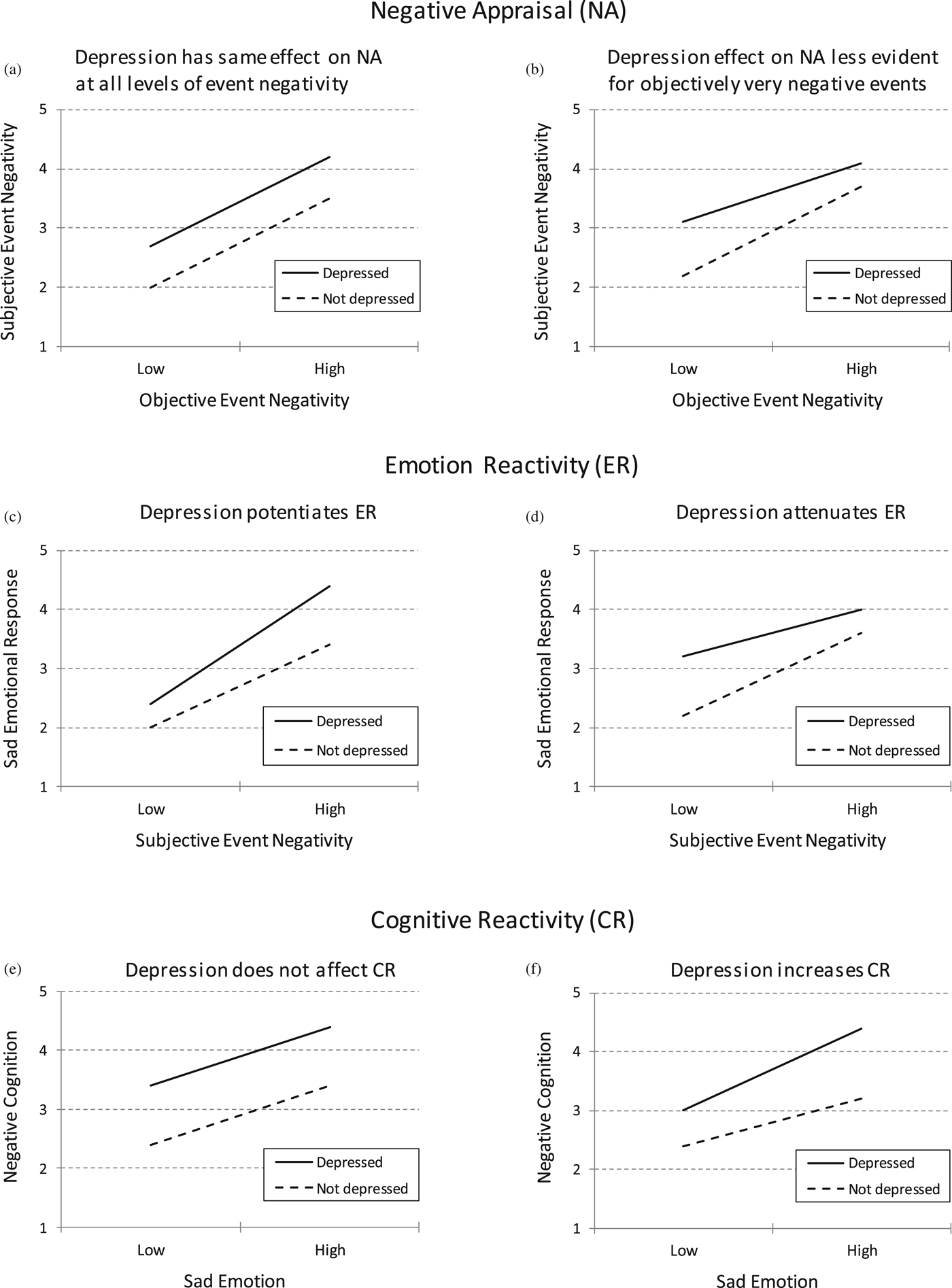
We conceptualized each person's NA, ER, and CR as a function of the within-person relation between two variables across scenarios (Figure 1A–F). First, NA is a function of the relation of perceived meanness to objective meanness. In plot A, the x-axis represents the objective meanness of each scenario. The y-axis represents each person's perceived meanness of the same scenarios. Regression lines represent the relation of each person's subjective ratings to the objective ratings across the scenarios. All participants would have such lines, and the person-specific slopes and intercepts of these lines could vary as a function of the person's level of depressive symptoms. The person-specific slopes and intercepts can be aggregated across subsets of individuals to create average lines. In this context, NA becomes the average perceived meanness at a specific level of objective meanness. This definition allows NA to vary as a function of the objective meanness of the stimulus event. As such, NA becomes especially interesting as a relativistic construct. For example, more depressed individuals might exhibit more NA than less depressed individuals in response to events containing the same amount of objective meanness. In Figure 1A, the upper line might represent a relatively depressed person; the lower line could represent a relatively nondepressed person. Here the lines are parallel, so the difference in intercepts for these lines would signify that people with few depressive symptoms have greater NA than people with more depressive symptoms across all levels of objective meanness. In Figure 2B, however, the lines converge (because of a Depression × Objective Meanness interaction), suggesting that relatively depressed and nondepressed people's levels of NA become more similar when events have high levels of objective meanness. In the absence of such an interaction, we operationalized NA as a person's average subjective meanness. In the presence of an interaction, NA is conditional upon the level of objective meanness.
Hypothetical depictions of depression affecting the slopes and intercepts embedded in the negative appraisal, emotion reactivity, and cognitive reactivity concepts.
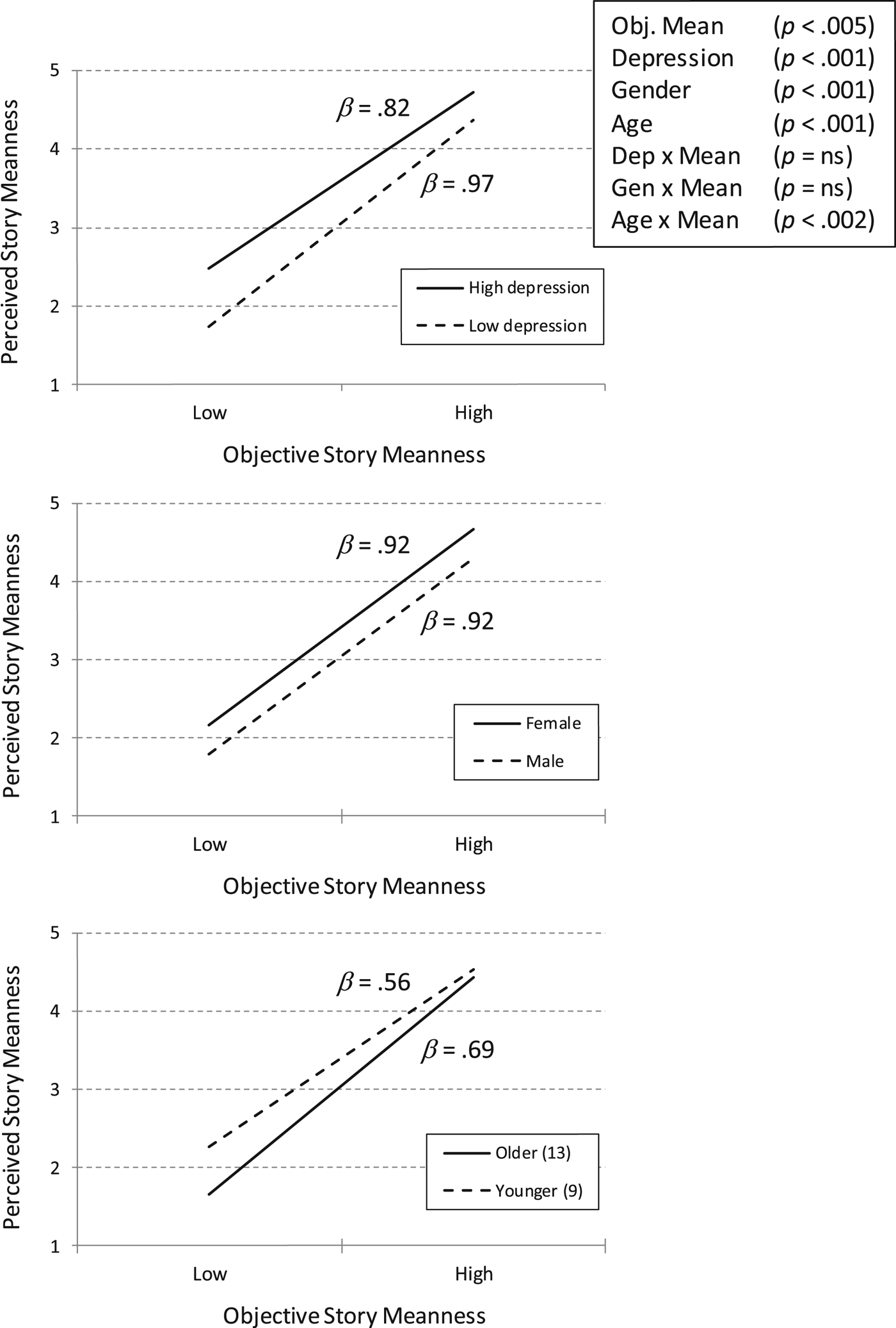
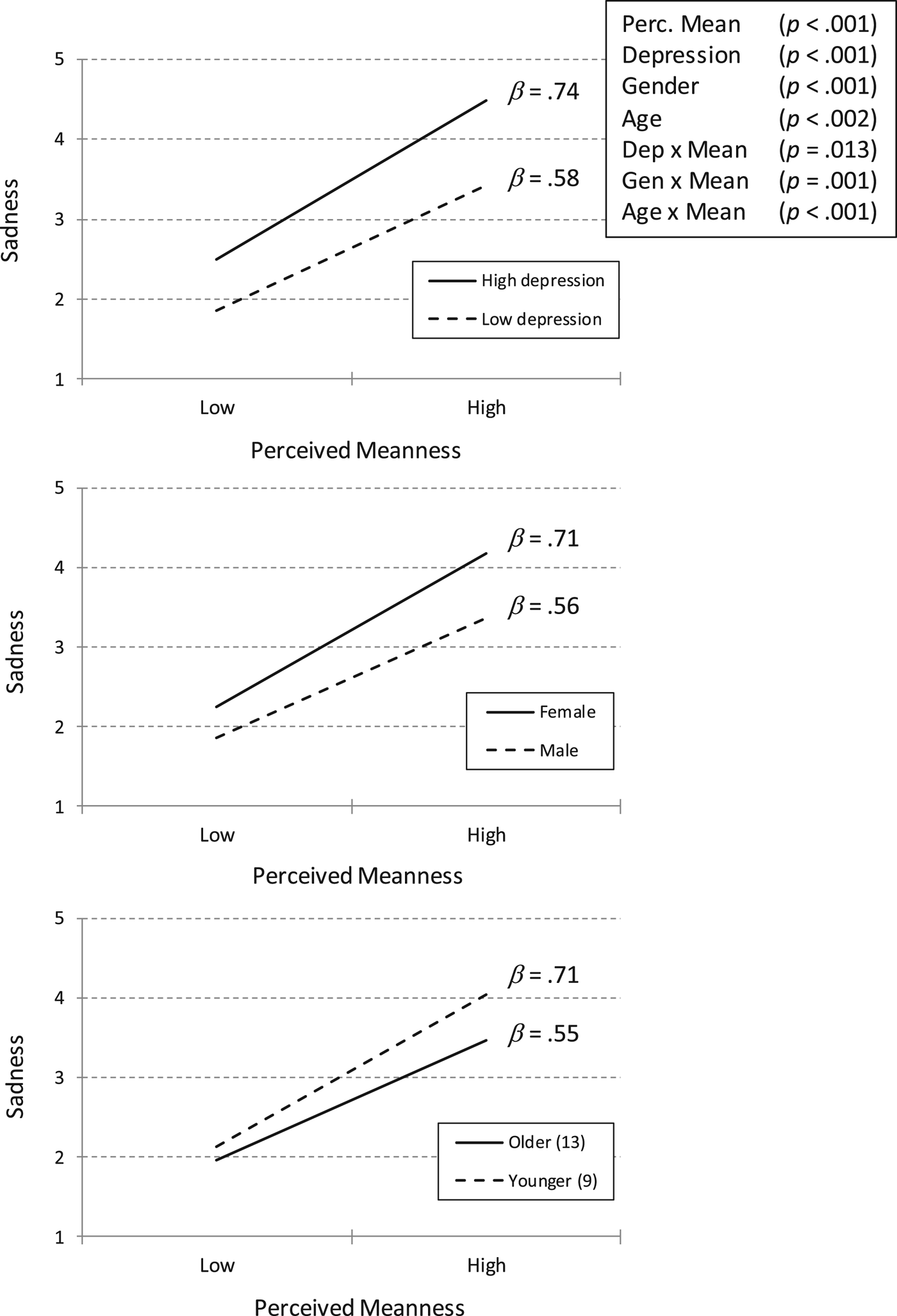
Negative appraisals: Effects of objective story meanness (±1 SD), depression, gender, and age on subjective ratings of scenario meanness.

Second, ER is the strength of a person's emotional response as a function of perceived scenario meanness. For ER (Figure 1C–D), subjective appraisals of the events are plotted on the x-axis and emotional responses to the events on the y-axis. ER is operationalized as the slope of these regression lines. Figure 1C shows an interaction representing the potentiation hypothesis: the effect of perceived event negativity on negative emotion is stronger for people with more versus fewer depressive symptoms. Figure 1D shows a different interaction, representing the emotion context insensitivity hypothesis: the effect of perceived event negativity on emotions is attenuated by higher levels of depression.
Third, CR is the strength of a person's negative cognitive responses as a function of a person's reported emotional responses to the scenarios. For CR (Figure 1E–F), negative emotional responses are plotted on the x-axis and negative self-cognitive responses on the y-axis. CR is operationalized as the slopes of the lines. Figure 1E shows two main effects but no interaction. The strength of relation between negative emotion and negative self-cognitions is not affected by depressive symptoms. Figure 1F shows an interaction supporting the hypothesis that depressive symptoms affect CR: the effect of negative emotion on negative self-cognitions is greater for people with higher levels of depression.
These operationalizations differ from previous ones. For example, Nock et al.’s (Reference Nock, Wedig, Holmberg and Hooley2008) ER scale focuses on emotional response characteristics such as the threshold for reactivity, the peak amplitude of response, the rise time to peak, and the recovery time, but does not consider the stimulus strength of the triggering event. Mood induction approaches to CR do not incorporate individual differences in the emotional response into the index of CR. Questionnaire measures of CR (e.g., Solis, Antypa, Conijn, Kelderman & Van der Does, Reference Solis, Antypa, Conijn and Kelderman2017) ask people to intuit the strength of relation between emotion and cognition instead of measuring it directly. The closest to the proposed methods is Bylsma et al.’s (Reference Bylsma, Taylor-Clift and Rottenberg2011) hierarchical linear modeling approach to ER; however, even it dichotomized events into negative or not, instead of using people's actual ratings of negativity.
Procedure
Data collection occurred in the schools. Research assistants escorted groups of consented students to a meeting room in the school, described the study, answered questions, and administered assent forms for signatures. After distributing paper-and-pencil versions of all measures to the participants, one research assistant read the initial demographic questions aloud while participants marked responses on their printed questionnaires. Other research assistants circulated around the classroom, addressing questions that arose and preventing the occasional off-task behavior. Next, headsets and MP3 players were distributed for the BYB procedure. Students listened and marked their answers to the questions on the forms provided. Next, the RADS-2 was administered; it was read aloud while participants responded on their own hard copies. At the end of data collection, students were thanked for their participation, offered a snack, and given a decorative pencil.
Results
Multilevel modeling
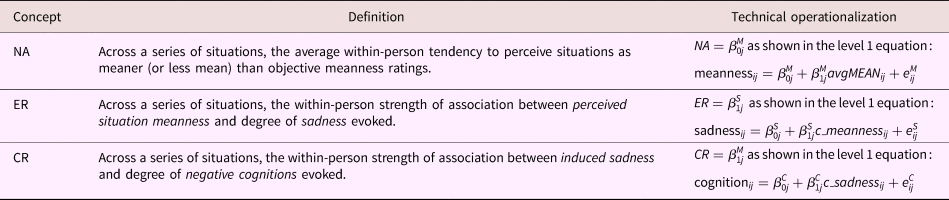
To model the effects of within-person operationalizations of NA, ER, and CR, we used multilevel models in which the 21 scenarios (Level 1) were nested within person (Level 2). This method enabled us to compare the within-person effects to the effects of the more conventional between-person approach. To isolate the within-person variability of perceived meanness and reported sadness, we person-centered both variables by subtracting the person's mean from each of the 21 scenario-specific scores. We refer to these as c_meanness and c_sadness, respectively. The between-person information consisted of the person means for the variables m_meanness and m_sadness, respectively. For ER, we then fit the following two-level model with random intercepts and random slopes:
 $$\eqalign{& {\rm Level\,1\!:}\,\,sadness_{ij} = \beta _{0j} + \beta _{1j}c\_meanness_{ij} + e_{ij} \cr & {\rm Level\,2}\!:\beta _{0j} + \gamma _{00} + \gamma _{01}m\_meanness + u_{0j} \cr & \quad \quad \quad \;\beta _{1j} = \gamma _{10} + u_{1j}} $$
with  $e_{ij} \sim N(0\comma \,\sigma _e^2 )$ and
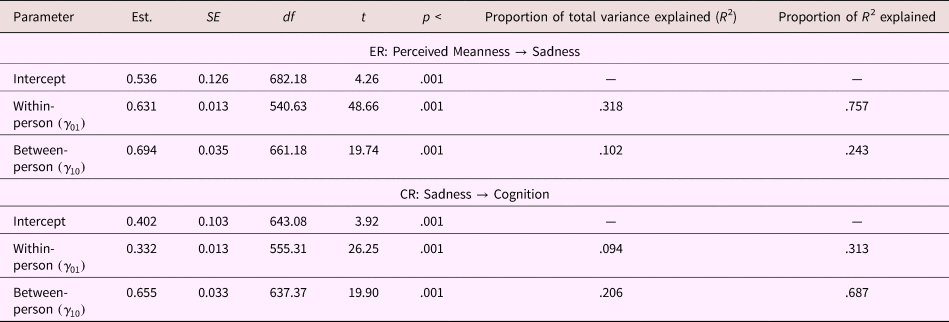
 $\left[ {\matrix{ {u_{0j}} \cr {u_{1j}} \cr}} \right] \sim N\left( {\left[ {\matrix{ 0 \cr 0 \cr}} \right]\comma \,\left[ {\matrix{ {\tau_{00}} {} \cr {\tau_{10}} {\tau_{11}} \cr}} \right]} \right)$. The analysis was repeated for CR, in which the dependent variable was cognition and the independent variables were c_sadness and m_sadness. The correspondence between the verbal and technical definitions of NA, ER, and CR are detailed in Table 1. The maximum likelihood results in Table 2 clearly show that the within- and between-person components of both variables significantly predicted their respective dependent variables. Furthermore, using Rights and Sterba's (Reference Rights and Sterba2018) new method for partitioning variance in multilevel models, we also see that the variance explained by the within-person components was substantial (Table 2, far right column). For ER, 31.8% of the total variance in sadness was explained by c_meanness, whereas 10.2% was explained by m_meanness, meaning that 75.7% of the overall effect of perceived meanness on sadness was due to the within-person component (and 24.3% from the between-person component). For CR, 31.3% of the effect of sadness on cognition was due to the within-person component (and 68.7% from the between-person component).Footnote 1
Technical and conceptual definitions of NA, ER, and CR

Note: CR = cognitive reactivity; ER = emotion reactivity; NA = negative appraisal.
Results of two-level model with random intercepts and random slopes, showing between- and within-person effects

Note: CR = cognitive reactivity; df = degree of freedom; ER = emotion reactivity; SE = standard error.
In keeping with our within-person variable definitions, all subsequent analyses retained only the person mean-centered BYB predictors. Level 2 predictors were added to the model to test the effects of depressive symptoms (RADS-2), gender, and age. For example, the following equations test ER hypotheses regarding the fixed effects of depressive symptoms on random slopes and intercepts from the Level 1 regression of sadness onto c_meanness:
 $$\eqalign{& {\rm Level\,1}\!: sadness_{ij} = \beta _{0\comma \,j} + \beta _{1j}c\_meanness_{ij} + e_{ij} \cr & {\rm Level\,2}\!:\beta _{0j} = \gamma _{00} + \gamma _{01}RADS + \gamma _{02}Gender + \gamma _{03}Age + u_{0j} \cr & \quad \quad \quad \;\;\;\beta _{1j} = \gamma _{10} + \gamma _{11}RADS + \gamma _{12}Gender + \gamma _{13}Age + u_{1j}} $$
Similar methods were used to test hypotheses about CR and NA. All models were tested using maximum likelihood estimation in SPSS MIXED (version 25) and/or Mplus (version 7.4).
Descriptive statistics
Table 2 contains correlations, M, and SD for all study measures. No measure of NA, ER, or CR appears in this table because each represents dynamic latent variables implicit in our multilevel statistical model. Descriptive statistics are included for BYB-based measures of meanness, sadness, and negative cognitions. RADS-2 datawere similar to those reported in other studies of school-based samples (e.g., Reynolds & Mazza, Reference Reynolds and Mazza1998). Approximately 5.8% of participants (n = 33) had RADS-2 raw scores >82 (a conventional cutoff for moderate to severe depression; Reynolds, Reference Reynolds2002).Footnote 2 Intraclass correlations ranged from .17 to .54, necessitating the use of multilevel modeling to account for the dependency of scenarios within person (Table 3).
Correlation, M, and SD

Note: M = mean; RADS-2 = Reynolds Adolescent Depression Scale - version 2; SD = standard deviation.
NA
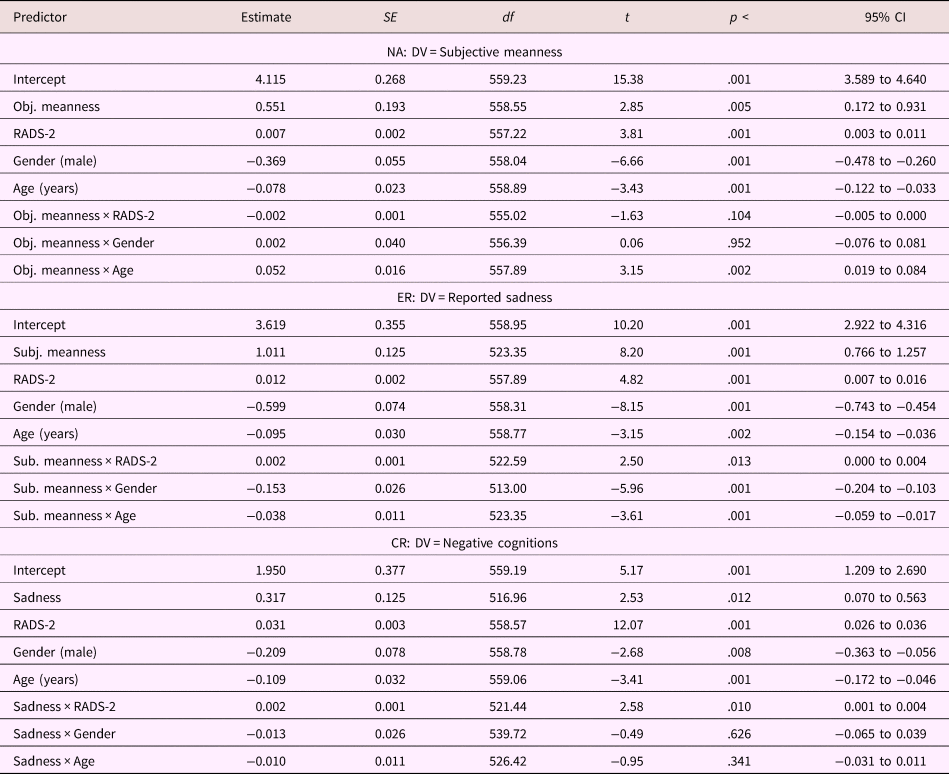
To test the effects of the RADS-2, gender, and age on NA, we estimated a two-level multilevel model with random intercepts and slopes. The dependent variable was subjective meanness ratings of the scenarios. The Level 1 predictor consisted of the person mean-centered objective meanness scores for the same scenarios (avgMEAN). Level 2 predictors of the Level 1 slopes and intercepts were RADS-2, gender, and age. Each person-specific intercept represents the person's average NA. As shown in Table 4, the cross-level Age × Objective meanness interaction was significant, as were all four main effects. This pattern of results is evident in Figure 2. In the upper plot, the main effect of RAD-2 is signified by the difference between the intercepts of the two lines (representing minimum and maximum RADS-2), indicating higher levels of NA among more depressed children (p < .001, d < .80). This effect is commensurate with hypothetical model A in Figure 1. In the middle plot, the intercept was significantly greater for females than males (p < .001, d = .54), indicating moderately higher NA for females. In the bottom plot, the significant interaction and age main effect indicate that younger participants’ subjective ratings were not as strongly associated with the objective ratings (p < .002)and were more negative (p < .001) than were the older participants’ ratings of the same scenarios (d = .31).
Results for two-level multilevel models with random intercepts and random slopes, testing main effects and cross-level interactions of depression (RADS-2), gender, and age in the analysis of NA, ER, and CR

Note: CI = confidence interval; CR = cognitive reactivity; df = degree of freedom; DV = dependent variable; ER = emotion reactivity; SE = standard error; Obj. = objective; RADS-2 = Reynolds Adolescent Depression Scale - version 2; Subj. = subjective; SD = standard deviation.
ER
We used a similar multilevel model to test hypotheses about ER. Specifically, we regressed scenario-based sadness ratings onto person-mean centered subjective meanness at Level 1. Level 2 RADS-2, gender, and age predicted Level 1 slopes and intercepts. All four main effects and all three cross-level interactions were significant (Table 4). Each slope depicted in Figure 3 represents the strength of relation between perceived story meanness and the degree of a sad emotional response to the scenarios. In other words, the slopes represent ER. Taken together, the three significant interactions indicate that more depressed participants, female participants, and younger participants exhibited greater ER in response to the peer victimization scenarios (d = .60, .59, and .59, respectively). These effects are similar to the hypothetical model C in Figure 1.
Emotion reactivity: Effects of subjective story meanness (±1 SD), depression, gender, and age on sad responses to peer victimization scenarios.

CR
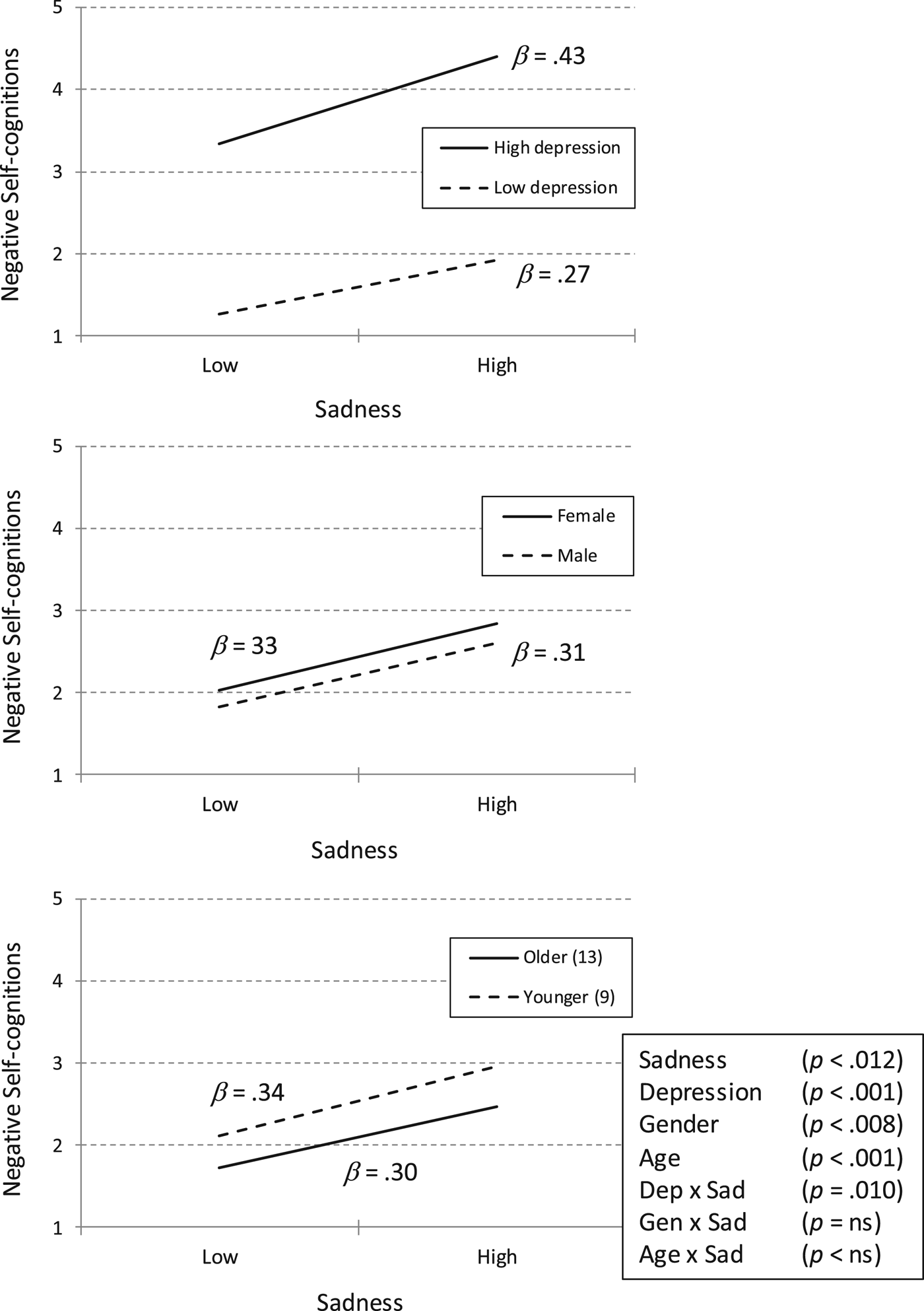
To test hypotheses about CR, we regressed scenario-based ratings of negative self-cognition onto person mean-centered sadness at Level 1. At Level 2, we again tested the effect of RADS-2, gender, and age on Level1 random slopes and intercepts. All Level 1 and Level 2 main effects were significant, as was the cross-level RADS-2× Sadness interaction (Table 4). The Figure 4 slopes represent CR (i.e., the strength of relation between sad emotion and negative self-cognitions). The significant RADS-2 × Sadness interaction therefore indicates that higher levels of depression are associated with greater CR (i.e., the slopes; d = .63). This phenomenon resembles hypothetical model F in Figure 1. Figure 4 also shows that depressive symptoms had a very large effect (d = 2.19), being female had a small but significant effect (d = .20), and being younger had a small to medium effect (d = .42) on negative cognitions (i.e., the intercepts).
Cognitive reactivity: Effects of sad emotional responses (±1 SD), depression, gender, and age on negative self-cognitions.

Relations among NA, ER, and CR
To understand the relations among NA, ER, and CR, we used multilevel structural equation modeling. By definition, ER is the tendency of a person to respond emotionally to events that are perceived as negative. As such, ER presupposes NA. Consequently, we incorporated the NA-predicts-ER relation into our structural model. Also by definition, CR is the tendency to have negative thoughts about oneself in response to negative emotion. As such, CR presupposes ER; therefore, we incorporated the ER-predicts-CR relation into our structural model as well. Taken together, these components combine to form a (cross-sectional) level 2 NA-ER-CR model (i.e., NA statistically predicts ER, which statistically predicts CR). The Level 1 portion of the model was a multivariate combination of the Level 1 portions of the three previous models. The complete model is represented by the following equations:
 $$\eqalign{{\rm Level\,1}\!:\,& meanness_{ij} = \beta _{0j}^M + \beta _{1j}^M avgMEAN_{ij} + e_{ij}^M \cr & {\rm sadnes}{\rm s}_{ij} = \beta _{0j}^S + \beta _{1j}^S c\_meanness_{ij} + e_{ij}^S \cr & {\rm cognitio}{\rm n}_{ij} = \beta _{0j}^C + \beta _{1j}^C {\rm c}\_sadness_{ij} + e_{ij}^C} $$
 $$\eqalign{{\rm Level\,2}\!:\,\,\, & \beta _{0j}^M = \gamma _{00}^M + u_{0j}^M \cr & \beta _{1j}^M = \gamma _{10}^M + u_{1j}^M \cr & \beta _{0j}^S = \gamma _{00}^S + u_{0j}^S \cr & \beta _{1j}^S = \gamma _{10}^S + \gamma _a\beta _{0j}^M + u_{1j}^S \cr & \beta _{0j}^C = \gamma _{00}^C + u_{0j}^C \cr & \beta _{1j}^C = \gamma _{10}^C + \gamma _b\beta _{1j}^S + \gamma _c\beta _{0j}^M + u_{1j}^C\comma \,} $$
 $${\rm where}\,\;\left[ {\matrix{ {e_{ij}^M} \cr {e_{ij}^S} \cr {e_{ij}^C} \cr}} \right] \sim {\rm MVN}\left( {\matrix{ {\sigma\,_M^{2}} & {} & {} \cr {\sigma\,_{MS}^2} & {\sigma\,_S^2} & {} \cr {\sigma\,_{MC}^2} & {\sigma\,_{SC}^2} & {\sigma\,_C^2} \cr}} \right)\; \;{\rm and}\;\left[ {\matrix{ {u_{0j}^M} \cr {u_{1j}^M} \cr {u_{0j}^S} \cr {u_{1j}^S} \cr {u_{0j}^C} \cr {u_{1j}^C} \cr}} \right] \sim {\rm MVN}\left( {\matrix{ {\tau_{00}^{\,M}} \cr {\tau_{10}^{\,M}} \cr {\tau_{00}^{\,MS}} \cr 0 \cr {\tau_{00}^{\,MC}} \cr 0 \cr} \matrix{ {} \cr {\tau_{11}^{\,M}} \cr {\tau_{10}^{\,MS}} \cr {\tau_{11}^{\,MS}} \cr {\tau_{10}^{\,MC}} \cr {\tau_{11}^{\,MC}} \cr} \matrix{ {} \cr {} \cr {\tau_{00}^{\,S}} \cr {\tau_{10}^S} \cr {\tau_{00}^{\,SC}} \cr {\tau_{10}^{\,SC}} \cr} \matrix{ {} \cr {} \cr {} \cr {\tau_{11}^{\,S}} \cr {\tau_{10}^{\,SC}} \cr 0 \cr} \matrix{ {} \cr {} \cr {} \cr {} \cr {\tau_{00}^C} \cr {\tau_{10}^C} \cr} \matrix{ {} \cr {} \cr {} \cr {} \cr {} \cr {\tau_{11}^{\,C}} \cr}} \right).$$
The Level 1 results were very similar to those reported in the previous univariate models. The Level 2 structural parameter estimates appear in Figure 5. Both the NA-predicts-ER relation (γ a) and the ER-predicts-CR relation (γ b) were significant. The NA-predicts-CR relation (γ c) was small and nonsignificant, indicating that most of the NA relation to CR was explained by ER. Using Selig and Preacher's (Reference Selig and Preacher2008) simulation method, we estimated the indirect relation to be γ aγ b = 0.065 (95% confidence interval 0.040, 0.095), hence significant at α = .05.
Level 2 model of Level 1 random intercepts and slopes, where NA =  $\beta _{0j}^M $, ER =
 $\beta _{1j}^S $, and CR =
 $\beta _{1j}^C $. CR, cognitive reactivity; ER, emotion reactivity; NA, negative appraisal.

Discussion
In the current paper, we successfully implemented a new method for assessing three dynamic responses (NA, ER, CR) to personally relevant, stressful events under conditions of self-focused attention. Five major sets of results emerged. First, children with higher levels of depressive symptoms exhibited greater NA, signifying that they evaluated peer victimization scenarios more negatively than did children with low levels of depressive symptoms. Second, children with higher levels of depressive symptoms exhibited more negative ER than did children with low levels of depressive symptoms; that is, the perceived negativity of an event had a stronger negative emotional effect on children with higher levels of depressive symptoms. Third, children with higher levels of depressive symptoms exhibited greater CR than did children with lower levels of such symptoms; that is, sad emotional responses were more strongly associated with negative self-cognitions for children with higher levels of depressive symptoms. Fourth, NA, ER, and CR, related to each other in a manner consistent with an NA-ER-CR model. Fifth, gender and age differences emerged in NA, ER, and CR. In general, these innovative methods yielded important results that help to integrate aspects of diverse cognitive- and emotion-based theories of depression.
Our first set of findings pertains to our novel method for measuring NA, ER, and CR simultaneously and in response to the same set of social stimuli. This method assesses all three constructs as parts of dynamic within-person processes. We operationalized NA as the tendency to over- or underestimate the negativity of hypothetical peer victimization scenarios at a given level of objective meanness. (In the current study, this was the intercept in the within-person regression of perceived meanness onto objective meanness; however, this method allows for the possibility that NA could vary with the degree of objective meanness). Our measure of ER was the strength of relation between the perceived negativity of and a negative emotional response to the same victimization scenarios (i.e., the slope of the within-person regression of sadness onto perceived meanness). Our measure of CR was the strength of relation between one's emotional responses to these scenarios and the endorsement of negative self-cognitions (i.e., the slope of the within-person regression of self-cognitions onto reported sadness).
With these methods, support accrued to a model in which NA predicts ER predicts CR. This statistical model is consistent with two important theoretical phenomena: (a) that ER may be triggered by the subjective NA of stressful events, and (b) that negative self-cognitions may be triggered by emotional reactions to these same events. These results integrate elements of three relatively separate avenues of depression-related research: information-processing models of depression (Everaert et al., Reference Everaert, Koster and Derakshan2012; Ingram, Reference Ingram1984), ER, and emotion context insensitivity models of depression (Davidson et al., Reference Davidson, Lewis, Alloy, Amaral, Bush and Cohen2002; Rottenberg, Reference Rottenberg2017; Rottenberg, Gross & Gotlib, Reference Rottenberg, Gross and Gotlib2005), and emotion-activated cognitive schema models of depression (Beck, Reference Beck1963; Clark et al., Reference Clark, Beck and Alford1999). Previous research has not found substantial correlations among such constructs (Everaert et al., Reference Everaert, Koster and Derakshan2012). The difference between our study and previous work may be due to our assessment of all three constructs as responses to the same set of stimulus events, events that were personally relevant and focused attention on the self.
Our second, third, and fourth findings were that depressive symptoms were associated with stronger NA, ER, and CR when measured as parts of children's responses to the same set of hypothetical, negative, social events. These results support previous NA research, concluding that depressive symptoms are associated with more negative interpretations of events (Everaert et al., Reference Everaert, Koster and Derakshan2012; Platt et al., Reference Platt, Waters, Schulte-Koerne, Engelmann and Salemink2017). Although debate continues as to whether depressed people's more negative views are negatively biased (or whether nondepressed people's more positive views are positively biased), the current study adds to a growing body of literature supporting the NA hypothesis in child populations (Bistricky, Ingram, Siegle & Short, Reference Bistricky, Ingram, Siegle and Short2015; Cole, Martin, Peeke, Seroczynski & Fier, Reference Cole, Martin, Peeke, Seroczynski and Fier1999; Cole, Martin, Peeke, Seroczynski & Hoffman, Reference Cole, Martin, Peeke, Seroczynski and Hoffman1998; Malcarne, Hamilton, Ingram & Taylor, Reference Malcarne, Hamilton, Ingram and Taylor2000).
Our ER results are compatible with models that suggest depressive symptoms are related to greater (not blunted) negative ER: compare Rosenberg (Reference Rosenberg1998), Luby and Belden (Reference Luby, Belden and Luby2006), and Beck (Reference Beck1963) versus Bylsma et al. (Reference Bylsma, Morris and Rottenberg2008) and Rottenberg (Reference Rottenberg2017). Methodological differences could account for the disparity between our results and studies that appear to support the emotion context insensitivity hypothesis. Specifically, studies of ER typically compare emotional reactions after a negative event with similar measures obtained during a baseline condition (Rottenberg, Reference Rottenberg2017). The possibility exists, however, that the natural baseline condition may actually be (or at least be perceived to be) more negative for people with high levels of depression. If true, the discrepancy between the baseline and the negative event conditions may be smaller for relatively depressed people, creating effectively a smaller “dose” of negativity for high-depression individuals, which could create the appearance of a blunted response for people with more depressive symptoms. Our new method for assessing ER avoids this possibility by calibrating the emotion reaction against the empirically assessed change in perceived negativity.Footnote 3
Our CR results expand upon a small but important literature demonstrating a link between depressive symptoms and emotion-induced negative self-cognitions in children (e.g., Martin & Cole, Reference Martin and Cole2000; Taylor & Ingram, Reference Taylor and Ingram1999), similar to the literature for adults (Scher et al., Reference Scher, Ingram and Segal2005). Somewhat surprising in both literatures, however, is the poor correspondence between different methods of assessing depression-related cognitive schemas (Everaert et al., Reference Everaert, Koster and Derakshan2012). We speculate that one reason for such low convergence may be contextual differences among the different assessments. The stimuli that affect responses in an emotional Stroop task are quite different from those that affect recall in an incidental memory task or one's answers to a questionnaire. Even though multiple aspects of depressive schemas all relate to depression, they may not correlate with each other when assessed in response to qualitatively different stimuli. The current paradigm enables researchers to examine multiple aspects of complex cognitive-emotion systems in response to the same set of stimuli.
Our fifth set of results pertains to gender and age differences in NA, ER, and CR. Several literature reviews call for more studies focused on potential moderators of these processes (Bylsma et al., Reference Bylsma, Morris and Rottenberg2008; Ingram, Reference Ingram1990; Rottenberg, Reference Rottenberg2017; Scher et al., Reference Scher, Ingram and Segal2005). Given the profound age-related increase in depression during early adolescence and given the emergent gender difference in depression over this same time interval, gender and age are two potentially important demographic moderators. Gender differences in NA, ER, and CR during middle childhood could pave the way for gender differences in depression during adolescence.
In the current study, several gender differences emerged. Girls evinced higher NA than did boys, in that they perceived the perpetrators of hypothetical peer victimization events as being slightly meaner. Girls also reported slightly more sadness and having slightly more negative self-cognitions in response to these scenarios compared with boys. Girls also had higher levels of ER (but not greater CR) compared with boys. That is, in response to the same increase in perceived scenario meanness, girls’ sadness increased more than did boys’. These findings are consistent with previous studies on gender differences in ER and stress reactivity, in which girls were shown to have higher reactivity than boys, at least for specific emotions and circumstances; e.g., Charbonneau, Mezulis, & Hyde, Reference Charbonneau, Mezulis and Hyde2009; Hankin, Mermelstein, & Roesch, Reference Hankin, Mermelstein and Roesch2007; Luby et al., Reference Luby, Belden, Sullivan, Hayen, McCadney and Spitznagel2009; Prinstein, Cheah & Guyer, Reference Prinstein, Cheah and Guyer2005; Rudolph, Reference Rudolph2002). The results are also consistent with Hyde, Mezulia, & Abramson, Reference Hyde, Mezulis and Abramson2008 model of gender differences in depression, in which enhanced ER combines with other vulnerabilities to produce higher rates of depression among adolescent females versus males.
Several age differences also emerged. Younger children displayed greater NA in response to mild or ambiguous negative scenarios, compared with older participants. This age difference disappeared when the events were extremely mean, in which cases both older and younger children perceived the events as being extremely negative. On ER and CR, age differences resembled the gender differences. Younger participants reported somewhat more sadness and slightly more negative cognitions than did older participants. Younger children also had greater ER (but not greater CR) compared with older children; that is, in response to increased perceived scenario meanness, younger children's sadness increased more than did older children's. These findings may reflect developmental advances in emotion regulation. As Davidson (Reference Davidson1998) noted, “rarely does an emotion get generated in the absence of recruiting associated regulatory processes” (p. 308). Children may become more facile at recruiting emotion regulation responses as they grow older, thus dampening their reactivity to less intense stimuli.
At least four limitations of the current study suggest directions for future research. First, we elected to focus on a community sample of children in Grades 3–6. The generalizability of these results to clinical populations with higher levels of depression or to adolescents remains to be tested. As Salk, Hyde, and Abramson's (Reference Salk, Hyde and Abramson2017) large meta-analysis noted, the largest gender difference in diagnoses of depression occurs between ages 13 and 15. Examining the relations among NA, ER, and CR in a slightly older age group may help elucidate this gender discrepancy. Second, although the current methods of assessing NA, ER, and CR hold considerable promise, an important next step will be direct comparisons to more conventional measures of these constructs. Third, the current study focused on reactivity to hypothetical peer victimization events, a salient and personally relevant set of stressors in children's lives. An advantage of this approach is that all participants respond to the same (carefully constructed) set of events; a disadvantage is that these events may not be equally relevant to all children. An important direction for future research would be to compare methods that use hypothetical events (Cole, Dukewich, et al., Reference Cole, Dukewich, Roeder, Sinclair, McMillan, Will, Bilsky, Martin and Felton2014) with those that use real events (Byslma et al., Reference Bylsma, Taylor-Clift and Rottenberg2011). Fourth, the goal of the current study was to characterize the relation of depressive symptoms to NA, ER, and CR, for which cross-sectional methods are appropriate. Given the significant pattern of results, longitudinal research is warranted to test prospective (and possibly mediational) relations among these constructs.
In conclusion, the present study adds to the growing literature on the relation of NA, ER, and CR to depressive symptoms and the potential interplay among these constructs. We demonstrate a unique methodology that enables the concomitant, dynamic measurement of all three constructs, which enables researchers to test multiple aspects of cognitive–emotion theories of depression simultaneously. Utilization of these methods enabled us to find support for several hypotheses about NA, ER, and CR, assessed simultaneously and in response to the same set of stimuli, potentially paving the way for a more complete, trans theoretical understanding of the cognitive–emotional substrate of depression in children.