Japanese castles are most poetic and picturesque in their expression, and they recall to us so many of the numerous gallant and heroic romances of medieval times. They are indeed so elegant that they do not look like defences for fighting, but rather the expression of a supreme art inherent to the people. Perhaps nothing could, therefore, express better than Japanese architecture that Japan and her people are more interested in the beautiful than the bellicose.Footnote 1
Kishida Hideto (1899–1966), 1936As we read Kishida Hideto's words, published in English for a foreign audience, we are struck by the date of his writing. Is Kishida sounding a subtle but prescient warning, or is he an apologist for Japanese militarism who shoehorned contemporary concerns into a discussion of medieval fortifications? We struggle to reconcile his views with our knowledge of the events of the subsequent decade, including the terrible events at Nanjing and Pearl Harbour, as well as at Hiroshima and Nagasaki. Of course, not even a prominent architectural historian like Kishida would have known what the future held in 1936. On the other hand, Japan had already experienced the Manchurian Incident (1931), withdrawn from the League of Nations (1933) and embarked on the military expansion of its informal empire in China. On the domestic front, the remaining vestiges of the liberal order were under sustained attack, especially by elements within the military, and February 1936 saw a major coup attempt by young officers who seized parts of central Tokyo and assassinated several senior politicians. The focus of this rebellion was the Imperial Castle, home to both the emperor and the First Division of the Imperial Guard, and surrounded by the important ministries of state. Tokyo, like almost all major Japanese cities, continued to be defined by the layout of the pre-modern castle town, with power and authority radiating outward from the castle area.
Castles were more than just historic sites in imperial Japan (1868–1945), and Kishida was one of many scholars who formulated cultural theories on the basis of Japan's castle architecture. The previous year, the architectural historians Ōrui Noboru (1884–1975) and Toba Masao (1899–1979) wrote of Japan's castles that they
were of severe simplicity but of commanding force. Free from any showiness such as might have been born of feminine minds, those castles were so made as to be expressive of fearless composure of mind, invincible fortitude, unshaken faith – the qualities representing the noblest mind and the highest spirit of the samurai.
Further linking past and present, they continued, ‘What may be seen in the same light is the Japanese sword of olden times, as well as the Japanese warship of modern times. Their beauty is of the samurai, viz. of the inherent spirit and soul of the Japanese people.’Footnote 2
Writings in Japanese were even more explicit. In his monumental 1936 study of Japanese castles, the prominent castle researcher and architect Furukawa Shigeharu (1882–1963) argued that castles were vital in this time of ‘national emergency’, that threatened Japan's very existence. According to Furukawa, ‘ancient castles are nothing other than the background for and an extension of the bushido spirit (“the way of the warrior”) that was born from the pure “Japanese spirit”’. Furukawa lauded the recent designation of castles as national treasures, as they were symbols of the ‘solid bushido ideals that flowed through all of the nation's citizens’ and mandated ‘benevolent self-sacrifice’. Furukawa invoked key elements of the imperial ideology, including the notion of warriors ‘falling like cherry blossoms’, and that ‘duty is heavy as a mountain while one's [mortal] body is light as a feather’, paraphrasing the 1882 Imperial Rescript to Soldiers and Sailors.Footnote 3
The parallels drawn by castle researchers reflected the close relationship between castles and militarism, which was mediated through an idealised samurai masculinity that was held up as the model for all Japanese in the first half of the twentieth century. Kishida's English text was also a response to this sentiment, emphasising Japan's supposedly peaceful nature for a foreign readership in the face of contemporary events. A similar contradiction was evident in the Pan-Pacific Peace Exhibition, a ‘mega-event’ held in Nagoya in 1937. In spite of its name, the exhibition drew on castle imagery in its promotional materials, and included live-fire exercises, torpedo demonstrations and many other military events.Footnote 4 As this study argues, castles played a key symbolic and practical role in the militarisation of Japan's urban society in the decades before 1945. This dynamic echoed developments in other countries, but was ultimately unique to Japan's historical conditions.
Historians examining the Second World War in Asia have long debated the applicability of the term ‘fascism’ to Japan, as well as the idea of a Japanese Sonderweg by which modernisation led to war.Footnote 5 Scholarship during and after the war was often teleological, tracing Japanese militarism to at least the establishment of imperial rule at the beginning of the Meiji period (1868–1912).Footnote 6 The supposed Japanese focus on hierarchies, especially the emperor, was fundamental to Ruth Benedict's (1887–1948) influential The Chrysanthemum and the Sword: Patterns of Japanese Culture (1946).Footnote 7 The narrative that a small clique of militarists exploited a traditional ‘cultural weakness’ to manipulate society into imperial expansion and war was useful to Americans and Japanese seeking to bury the past and forge a new alliance in the early Cold War.Footnote 8
More recently, historians of Japan have focused on the role of everyday people in the creation of the ultra-nationalistic system in the 1930s.Footnote 9 Yoshimi Yoshiaki's conceptualisation of ‘grassroots fascism’ is one of the most influential contributions in this context.Footnote 10 The relationship between the people and state in imperial Japan, especially the apparent convergence of popular and official nationalisms in the 1930s, is complicated by our understanding of the Taisho period (1912–26). While the Meiji period and early Shōwa period (1926–89) are often placed into larger narratives of imperial power and military expansion, the era of ‘Taisho democracy’ (Taishō demokurashī) has been portrayed as a progressive and internationalist interlude. To proponents of the longer-term view of Japanese militarism, the Taisho period is often explained as a brief aberration of superficial liberalism.Footnote 11 To others, such as Frederick Dickinson, the significant continuities were between the anti-military feelings of Taisho and the more comprehensive pacifist reaction after 1945.Footnote 12
This study approaches the militarisation of Japanese society by examining physical space, specifically castles. Although the designation ‘Taisho democracy’ is useful for certain political and cultural trends, an alternative concept of ‘Taisho militarism’ explains the gradual convergence of military and civilian interests from the late 1910s onward. Castles were sites of struggles between the army and civil society. Garrisons based in repurposed castles created an unparalleled urban military presence which intimidated and suppressed popular protest movements in the early twentieth century. At the same time, castles were increasingly valued as historic sites and symbols of local civic pride. Castles became subjects of serious and sustained academic study at Japanese universities in the late 1920s, while the army conducted its own castle research with the assistance of Toba Masao and other leading scholars from 1932 onward.Footnote 13 On the ground, civil society groups sought public access to castles that were restricted military spaces. At the heart of these tensions was an almost universal appreciation of castles throughout Japan. Popular interest in castles, combined with the identification of castles with the modern army, led to a convergence of civilian and military culture and space. This convergence in turn contributed significantly to the militarisation of urban society in the decades before 1945.
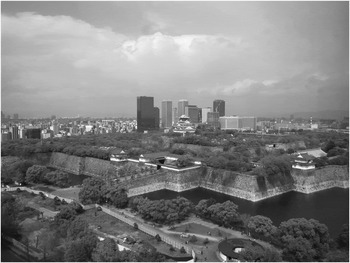
In the following, this paper begins with an overview of castles in the Meiji period, when they were dismissed as feudal relics to be demolished, sold or repurposed, often for use by the newly established military. This paper then examines the rediscovery of castles as historic sites in the early twentieth century, as well as the role they played in the suppression of dissent by the military in the 1910s and early 1920s. The final sections focus on a case-study of Osaka Castle (Figure 1) to examine popular interest in castles, and how the army used its control over castles to leverage this popular interest into support for the military as the heir and guardian of Japan's supposedly ancient and noble martial traditions in a time of national crisis.
Osaka Castle in 2018. Photograph by the author.

I Castles in the modernising process
Between 1867 and 1868, a confederation of domains from south-western Japan overthrew the Tokugawa shogunate that had ruled Japan since the turn of the seventeenth century. Hoisting the banner of imperial loyalty, the victorious rebels created a new government centred around the fifteen-year-old Meiji emperor. This ‘restoration’ of an ancient system of imperial government simultaneously ended more than six centuries of warrior rule. The Tokugawa system had been ostensibly founded on the authority of the samurai class as the martial rulers of Japan, even if this military order oversaw more than 250 years of peace during its tenure. The best-known accoutrements of warrior power included the two swords that all samurai were exclusively obliged to carry, as mentioned by Ōrui and Toba above. In order to ensure the stability of the Tokugawa order, samurai were physically removed from their lands and made to live in the more than 200 castle towns, the main centres of population in early modern Japan. Each castle town was the administrative centre of a domain, the ruler of which pledged loyalty to the Tokugawa but had considerable autonomy in his own lands.
One important restriction on domain lords, or daimyō, in the Tokugawa period was the requirement that they spend alternate years in the capital, Edo (later Tokyo), the ultimate castle town and possibly the largest city in the world by 1700, with over one million inhabitants. In addition to their lavish residences in the capital, the daimyō were each required to maintain a castle in their domain. In order to prevent rebellion against the shogunate, castle modifications and construction had to be approved, and each domain was ostensibly limited by the shogunate to a single castle. Castle maintenance weakened the daimyō financially, as most domains spent roughly 10 per cent of their annual revenue on the upkeep of walls, moats, bridges, residences and other structures.Footnote 14 There was considerable dissatisfaction with this arrangement, as castles were merely symbols of military and state power. There had been no significant military conflict in Japan since the early seventeenth century, and the design of the Japanese castle had changed little since the peak of its development around this time, while developments in weaponry had rendered them militarily obsolete.
For many daimyō, the Meiji restoration presented an opportunity to achieve their long-standing aims to relieve themselves of the burden of castle maintenance. As part of the acknowledgement of imperial rule, the more than 260 daimyō symbolically ‘returned’ their lands and castles to the emperor immediately following the restoration. Most daimyō now became ‘governors’ of their domains, and their stipends were greatly reduced, often by 90 per cent. This meant that castle maintenance might now command all of a domain's revenue, and at least thirty-nine domains applied to the government for permission to demolish their castles between 1868 and 1872.Footnote 15 Castles were also auctioned off to raise much-needed funds to help support former samurai who had lost their livelihoods in the transition.Footnote 16 The Meiji period was envisioned as a modernising age of ‘civilisation and enlightenment’, and applications to demolish castles typically described them as ‘useless things’.Footnote 17 Castles were unpleasant reminders of the ‘feudal’ past.Footnote 18 Hundreds of gates, walls and buildings were sold to be carted off or demolished during the first years of Meiji, while moats and other spaces were repurposed for agriculture and more ‘useful’ purposes.Footnote 19
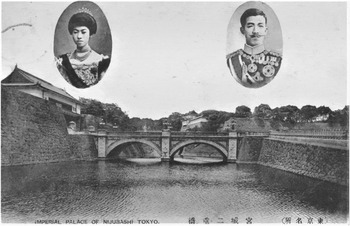
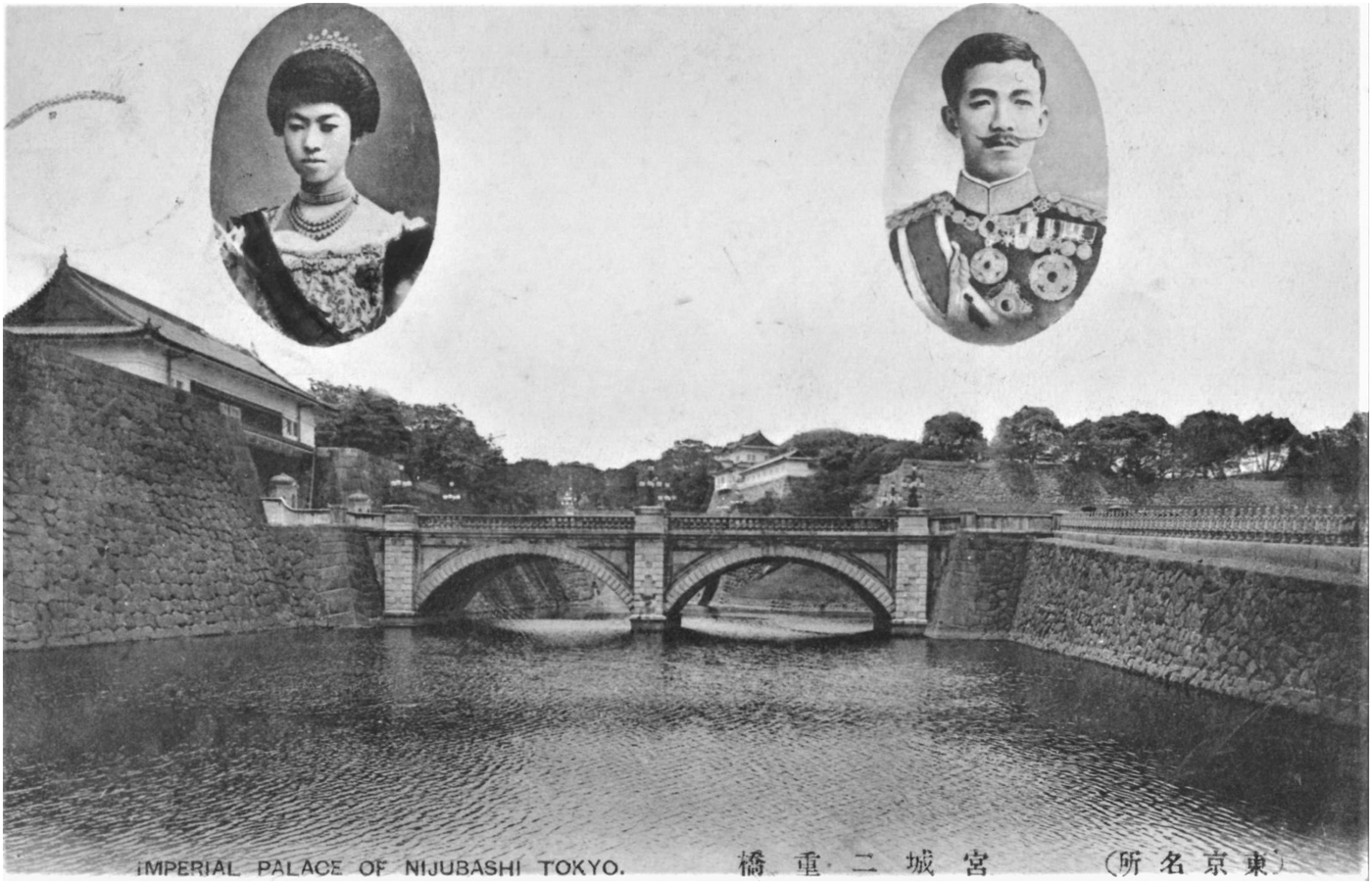
Japanese castles occupied vast areas at the centre of major cities, having initially been built on a far larger scale than their contemporary European counterparts. As Christopher Dresser (1834–1904) wrote of the Imperial Castle in Tokyo following a trip to Japan in the late 1870s, ‘The Castle enclosure is surrounded by a broad moat, on the inner side of which rise the vast walls of the fortress: and if we may judge from its appearance, no castle in Europe is more impregnable.’Footnote 20 Figure 2 shows the main entrance to the Imperial Castle in the Taisho period, with portraits of the emperor and empress.Footnote 21 One reason for the difference in scale was that Japanese cities lacked defensive walls, and all of the fortification work was centred on the castle. The castle in turn had to be of a sufficient size to compensate for the absence of merchant storehouses and other potential supporting infrastructure within. Perhaps the most important factor was the different pace at which changes in the military occurred in Europe relative to Japan.Footnote 22 In Europe, medieval castles had been obsolete for centuries, and urban fortifications were repurposed, sold off, dismantled and worn down as their land and materials continued to be valuable long after they lost their military meaning. Those that survived into the modern period typically did so on a considerably smaller scale than urban castles in Japan.
The Imperial Castle (Kyūjō) in Tokyo. Postcard from the author's collection.
In Japan, these processes which took centuries in Europe occurred at a greatly accelerated rate. The 1860s were dominated by samurai in regional militias, although there were some attempts to introduce Western weaponry and drill.Footnote 23 To consolidate its power, suppress unrest and resist foreign threats, however, the Meiji government created a modern conscripted national army. The samurai were deemed to be obsolete and a potential threat to the new order. The rapid transitions in the early 1870s meant that the planned establishment of the Imperial Japanese Army occurred when the fate of the newly obsolete castles had yet to be resolved, and it was decided that these should hold the new military garrisons. Following a nationwide survey undertaken by a team from the War Ministry in 1872, roughly fifty-eight castles and other fortifications were selected for military use. Another 144 castles, along with over 100 other sites, were given to the Finance Ministry for ‘disposal’.Footnote 24 Many of these surplus castles were auctioned off and dismantled, converted into official or unofficial public parks, repurposed to house schools and administrative buildings, or underwent a combination of these transformations.
The castles designated for military use included the largest and most important structures, and in 1873 regional commands were set up in the castles in Sendai, Tokyo, Nagoya, Osaka, Hiroshima and Kumamoto. Fourteen infantry regiments were subsequently established, of which one was located with each of the six regional commands. The other infantry regiments were located mainly in castle sites elsewhere, in some cases with their battalions spread across multiple sites. Outside of Tokyo, for most of the period 1874–84, infantry regiments and battalions were based in and around fourteen former castles, as well as five other non-castle sites. The expansion of the military in the 1880s added ten infantry regiments, all of which took over former castle sites.Footnote 25 At all of these sites, most or all existing buildings were sold off or demolished and replaced by modern barracks and other facilities. With regard to the few infantry regiments and battalions outside of former castles in the period before 1894, these were located primarily in cities that had not been castle towns, or represented auxiliary sites in cities where the army was already using the castle space.
II Castles and the discovery of heritage
Before the turn of the twentieth century, the military took a practical approach to castles. Its priorities were recruiting and training a modern force, maintaining order through several major rebellions in the 1870s and fighting major wars with China (1894–5) and Russia (1904–5). A few important castle structures were repaired during this time, most significantly the wooden keeps at Nagoya, Himeji and Hikone, which were among the largest in Japan. These structures were unofficially protected by the Imperial Household Ministry, which donated money for the most urgent repairs in 1878 and 1879, but many other gates, outbuildings and walls continued to be demolished or removed at castle sites throughout Japan. These early efforts to preserve castles were limited and driven by a combination of foreigners and Japanese with considerable foreign experience. The German consul Max von Brandt (1835–1920) claimed to have convinced the army to spare the Nagoya Castle keep during a visit in 1872.Footnote 26 Another key figure was the government official Machida Hisanari (1838–97), later the first director of the Imperial Museum. Japanese visitors to Europe in the late nineteenth century were often taken to the dozens of castles that continued to have ties to European royal families, and the Iwakura Mission to the West in 1871–3 visited many such sites. For his part, Machida was impressed by the use of the Tower of London as a military museum during a stay in England in the 1860s, and in 1872 appealed to the statesman Ōkuma Shigenobu (1838–1922) to halt the destruction of the castles at Nagoya and Inuyama.Footnote 27 This appeal may well have been on Ōkuma's mind when he authorised the protection of the castles at Nagoya and Hikone six years later.Footnote 28
These early protection efforts were few and far between, however, and did not extend to a broader appreciation of castles, which were still widely viewed as ‘feudal’ relics. Attitudes only began to shift from the 1890s, in line with a popular reassessment of the Japanese past. While the first two decades of the Meiji period had been dominated by movements towards modernisation and Westernisation under the banner of ‘civilisation and enlightenment’, a nativist backlash against foreign influences began to gather strength from the 1880s as part of a search for a ‘Japanese’ identity.Footnote 29 In Japan, as in other newly created nation-states, the creation of a national identity also entailed the rehabilitation of discredited symbols of the pre-modern past, including both samurai and castles. At the same time, Western practice continued to serve as a model, and the rehabilitation of the Japanese past favoured those aspects that had European equivalents. This could be seen most clearly in the rehabilitation of the samurai, which was done primarily through the formulation of the ideology of bushido, the so-called ‘way of the warrior’. Although bushido was portrayed as an ancient ethic and the very ‘soul of Japan’, it was largely a product of the 1890s, and was heavily inspired by Victorian ideals of chivalry and gentlemanship that were admired in Japan at the time. Promoted as an ethic that guided all Japanese, bushido was given apparent legitimacy by its supposed relationship with the idealised former samurai, as well as by its correspondence with contemporary Western ideals.Footnote 30
Castles experienced a similar rehabilitation in the 1890s, as the passage of time and generational shifts meant that the reality of the pre-Meiji order was becoming a distant memory. This applied to the oppressive nature of the samurai and to castles – the greatest extant symbols of the class-based former order. At the same time, the Meiji government was endeavouring to build national unity and patriotism by pardoning and even celebrating aspects of the Ancien Régime.Footnote 31 Prominent members of the Tokugawa family and their supporters were acknowledged for their contributions to the nation. The conversion of the traditional Tokugawa stronghold Nagoya Castle into an imperial detached palace in 1893 was an important step. The shogun's power and authority had been comprehensively appropriated by the conversion of Edo Castle to the Imperial Castle, but most of the original structures were destroyed in the first decade of Meiji.Footnote 32 In contrast, the protection of the Nagoya Castle keep with imperial funds in 1878, followed by the imperial family's use of the original palace buildings there as a residence, demonstrated an appreciation of the Tokugawa heritage as something other than a ‘feudal’ relic. The widespread invocation of feudal symbols by European royal families, including their use of castles as residences, further legitimised this appropriation of castles by the Japanese imperial house.
In 1889, the Army Ministry sought to expand its existing facilities, and to raise funds for this undertaking it declared nineteen of its castle sites to be surplus to requirements. In a further acknowledgement to the old order, the former daimyō families who had owned the castles before 1868 were given the first option to purchase the castles at very preferential rates.Footnote 33 Many did so, thereby reestablishing their formal links with their former domains, as the daimyō had been compelled to move to Tokyo with the establishment of the prefectural system in 1871. Even if very few former daimyō physically relocated to their ancestral homes after 1889, their symbolic return to their castle towns boosted regional and national pride. By 1905, samurai and Japan's martial heritage were being celebrated in the context of victories over China and Russia. By this time, the popular image of castles had shifted from instruments of oppression to positive markers of identity in many cities, as seen in thousands of postcards, travel guides and other records.Footnote 34 This shift was enhanced by the fact that many former castle sites had been converted into public parks and exhibition sites, furthering popular identification with castles.Footnote 35
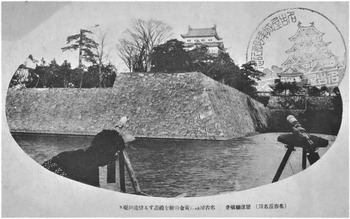
The popular appreciation of castles was reflected in several developments. Civil society groups throughout Japan established local castle preservation societies in a movement that gathered pace from the late 1910s.Footnote 36 One high-profile phenomenon was the adoption of castle imagery by the city of Nagoya and the surrounding Aichi Prefecture. At the Fifth National Industrial Exhibition in Osaka in 1903, the Aichi Prefectural Pavilion was built as a mock castle keep, reflecting Nagoya's status as the home of the largest keep in Japan.Footnote 37 This pattern would continue through to 1945, as the regional representatives from Nagoya and Aichi would almost invariably construct a castle-like structure at national industrial exhibitions. Meanwhile, the real Nagoya Castle keep remained a highly restricted bastion of authority and could only be viewed from afar by ordinary Japanese, as shown in Figure 3.
Tourists using telescopes to view the golden figures atop the Nagoya Castle keep from the far side of the moat. Postcard from the author's collection.

In 1906, Kōfu, a former castle town in the mountains west of Tokyo, held a major regional exhibition in the spacious grounds of its ruined former castle. The organisers used the occasion to build a temporary keep out of wood at the highest point of the ramparts. Illuminated by electric lights, this structure proved widely popular, with over 23,000 people paying the two Sen price of admission to climb the keep during the six weeks of the exhibition.Footnote 38 Four years later, in the city of Gifu north-west of Nagoya, the Gifu City Preservation Society took advantage of a new bridge construction to build their own keep atop the ramparts of Gifu Castle. It had never previously had a keep. Using scrap materials from the old bridge, the Society built a two-storey structure with metal siding atop the mountain overlooking the city, which became a tourist draw and a popular destination for hikers.Footnote 39 The decade after 1910 also saw the first major publications on Japanese castles, as well as articles in national newspapers, including by the art historian Ōrui Noboru, who highlighted the ‘masculinity’ of Japanese castles in 1912.Footnote 40 By the 1910s, castles were popular tourist destinations, and were firmly established as symbols of local, regional and national identity throughout Japan.
III Military castles and urban society in Taisho Japan
The conflicts with China and Russia were accompanied by major expansions of the Imperial Japanese Army. Relative to the period before the Sino-Japanese War, the number of regular infantry regiments doubled to forty-eight by 1902.Footnote 41 This increased further to seventy-two by 1908 in the wake of the Russo-Japanese War. Due to the rapid growth of Japanese cities in the late Meiji period, these troops could not all be garrisoned within and around existing urban castle sites, and the army had sold many of its holdings in the 1880s. Only five of the twenty-four new infantry regiments formed in 1896–1902 were placed in castles.Footnote 42 The cost of land was an important factor in the selection of sites, and regional cities often discounted or even donated land in a fierce competition to attract lucrative military installations.Footnote 43 At the same time, the military also maximised its use of valuable urban space in and around castles, and increased and expanded its presence where this was possible. Several existing ‘military cities’ saw additional infantry regiments, administrative buildings and other units placed in and around the castle site.
Significantly, the army did not vacate urban castle sites for cheaper suburban ones, in spite of the logistical difficulties and expense of being located in the centres of major cities, as well as the much-needed money that could have been generated by selling castle land to eager developers. Events in Tokyo after the Russo-Japanese War demonstrated the utility of having a major armed force at central urban locations. The terms of the Treaty of Portsmouth that ended the war in September 1905 were seen as a major disappointment by the general public, which had been fed a steady diet of glorious victories and sacrifices by the government and media that did not reflect Japan's serious losses or the extent of Russia's remaining resources. Nationalistic groups portrayed the agreement as a treasonous act by the Japanese negotiators, with some even fantastically demanding that the depleted army again take to the field to obtain better terms. On the day of the treaty signing, 30,000 protestors gathered in Hibiya Park, on the south-east corner of the Imperial Castle just across the inner moat. The large police force in place to control the crowd became a target for anti-government hostility, and rioters destroyed the majority of police boxes in the area and burned down two police stations, in addition to causing other damage; 17 people were killed and more than 1,000 injured before the government mobilised the Imperial Guard from the north bailey of the Imperial Castle to restore order. Rioters welcomed the guardsmen with calls of ‘Long live the emperor!’ before dispersing.Footnote 44 This reflected popular respect for the emperor and military, in contrast with distrust of police and elected politicians, but it would also have been clear to the rioters that they stood no chance against the elite troops of the Imperial Guard, who ultimately held a monopoly of physical force in the urban centre.
The Hibiya Riot clearly demonstrated the potential threat of popular unrest, as well as the effectiveness of a formidable military presence in countering this threat. Some scholars have portrayed the Hibiya Riot as the starting point of a period of ‘urban mass riot’ that ended with the so-called Rice Riots of 1918, the largest incident of urban unrest in imperial Japan.Footnote 45 This period of urban violence should be extended to include the aftermath of the Great Kanto Earthquake of 1923, which witnessed politically motivated massacres of Koreans and leftists. Over the course of the 1910s, a major rift developed between the military and the civilian population, as the army and navy were involved in bribery scandals, corruption and high-handed tactics that brought down the government and caused a constitutional crisis. Popular anger boosted the strength of political parties, which often profiled themselves in opposition to the military.Footnote 46 In urban areas, especially, anti-military sentiment was strong, also fuelled by international socialist movements. The hostility was reciprocated by the army, which promoted the myth of the idealised rural recruit who was physically strong with a loyal character of honest simplicity, while urban conscripts were suspected of having been exposed to socialist ideas and other ‘dangerous thought’.Footnote 47
These tensions were heightened by the disruptive behaviour of soldiers in the entertainment districts and elsewhere, as they often failed to recognise the authority of civilian police.Footnote 48 In addition, the military restrictions on access to castle space led many municipalities to try and remove the army from castles and relocate them to the outskirts of the city. It was hoped that this would mitigate the problems associated with the military presence, while continuing to reap the economic benefits it brought. In cities including Himeji, Matsuyama, Kumamoto, Nagoya and Toyohashi, the Taisho period saw civilian movements to remove infantry regiments from castle sites in order to promote economic growth and provide greater public access and movement through city centres.Footnote 49
The conflicts between the public and military in urban Japan reached a climax in August 1918. Beginning in Toyama Prefecture on the Japan Sea coast, disturbances and riots protesting against sudden increases in the price of rice spread throughout Japan, bringing more than a million people to the streets over the course of several weeks. The rioters’ targets included rice sellers’ shops, police stations and other emblems of wealth and authority. Countless buildings were destroyed, and residents of Osaka recounted feeling ‘as though a revolution had really come’.Footnote 50 The police and other civilian authorities were overwhelmed by the scale of the disturbances, and could often only stand idly by or even retreat to avoid falling victim to the violence themselves. In response, many local governments were forced to send requests to the army to suppress the riots, a measure that was especially effective in areas with urban castle garrisons that could be immediately deployed when necessary.
In Osaka, after three days of unrest the mayor's office sent a request to the army to deploy Fourth Division troops, who quickly restored order.Footnote 51 Nagoya saw a similar timeline, with up to 50,000 rioters burning down rice merchants’ shops and police stations over the course of three days, until the prefectural governor requested soldiers from the Third Division in Nagoya Castle, who put down the protests in often violent clashes with protestors.Footnote 52 Newspaper reports from throughout Japan showed the extent of the disturbances and the importance of urban castle garrisons in restoring order. Nationally, army troops were mobilised on sixty occasions during the Rice Riots, using live ammunition and bayonets.Footnote 53 The total number of troops mobilised has been estimated at 92,000, with hundreds of fatalities on both sides.Footnote 54 The majority of soldiers were deployed from castles, as in Nagoya and Osaka. In Kokura, after rioters destroyed trains and ransacked shops for alcohol, soy sauce, clothing and other goods, mounted military police and soldiers from the Fourteenth Infantry Regiment moved out from the castle to pacify the city. In Himeji, troops from the Tenth Infantry Regiment and special forces patrolled the city and arrested thirty rioters. In Sendai and Shizuoka, hundreds of soldiers overpowered thousands of rioters.Footnote 55 In Aizu-Wakamatsu, the Sixty-Fifth Infantry Regiment moved out of the third bailey of the castle to suppress the riots quickly.Footnote 56 Although the rioters often coordinated their movements to outflank the police, they were no match for the soldiers and their weaponry. Riot suppression was more difficult in cities that did not have urban garrisons, as in Kōchi, where several police officers were injured when they attempted to confront the mob.Footnote 57 Here, the castle had already been converted into a public park when the Forty-Fourth Infantry Regiment arrived after the Sino-Japanese War, and the army set up in Asakura Village five kilometres west of the city centre.
The response to the Rice Riots demonstrated civilian authorities’ dependence on the military to suppress serious unrest. In Tokyo, although the capital did not experience as much disturbance as regional cities in 1918, the army played a decisive role in 1923 in the aftermath of the Great Kanto Earthquake. This disaster is estimated to have killed more than 100,000 people, and tremors and fires destroyed much of the city. The army assisted in firefighting and relief efforts, but also used the chaos to pursue groups deemed ‘undesirable’ by the government. The military police murdered prominent anarchists, and contemporary accounts strongly suggest soldiers were involved in the killing of thousands of Koreans living in Tokyo.Footnote 58 Certainly, the declaration of martial law immediately after the earthquake gave the army control over the city. In spite of the atrocities, many people appreciated the superficial stability brought by military authority in the wake of the earthquake, which even led to a moderate improvement in popular views of the army.Footnote 59
By the early 1920s, the army was established as the ultimate arbiter of physical force in major urban areas, and this caused considerable tension with civilian society. Individual soldiers, for example, often suffered abuse when they ventured out of the garrisons into public.Footnote 60 Tensions were also due to the relatively large size of garrisons, as Japan's military developed initially from the German model, maintaining a large standing army relative to Britain or the United States.Footnote 61 Furthermore, in spite of a series of retrenchments in the 1920s that ostensibly shifted the focus towards greater use of military technology such as the tanks and aircraft observed in Europe during the First World War, Japanese military thinking continued to centre around infantry tactics such as bayonet charges.Footnote 62 The infantry had an exceptionally large influence within the military from the early Meiji period, when it provided 90 per cent of total personnel.Footnote 63 Castles further raised the infantry's profile in society by giving it a significant urban presence, especially in contrast with the navy which was massed in dedicated ports well away from major cities.
IV Castles and military soft power
The struggles over the control of urban space in imperial Japan reached a climax in Osaka in the 1920s. At the start of the Meiji period, Osaka was a prime candidate for the new capital of Japan, and the castle was slated to host the emperor, military and civilian government. Although most of these functions were ultimately moved to Tokyo, Osaka Castle became a major military base, the home of the Fourth Division and the Osaka Army Arsenal. The city itself built on the economic power of the military and Osaka's long-standing mercantile traditions to prosper throughout the imperial period, growing to surround the vast castle site. By late Meiji, Osaka Castle was known as the site of the largest arms factory in Asia, and at the time of Japan's surrender in 1945 the arsenal alone employed roughly 66,000 workers.Footnote 64 By this point, the land controlled by the military in and around the castle was more than three square kilometres, similar in size to Central Park in New York City, and considerably larger than London's Hyde Park and Kensington Gardens combined.Footnote 65
The great Tokugawa keep of Osaka Castle had burned down in 1665, and many more buildings were destroyed after the Tokugawa surrender in 1867. The massive ramparts rising up from the broad moat retained their imposing presence, however, and Osaka Castle remained the symbol of the city. Control over the castle was key to demonstrating authority in the region, and the imperial forces conducted the surrender ceremony with the Tokugawa atop the highest ramparts.Footnote 66 Although castles were generally treated as unloved reminders of the feudal past in the early Meiji period, and Osaka Castle was highly restricted military space for most Japanese, the government and military soon observed the fascination that von Brandt and other Western visitors had for castles. English-language newspapers carried instructions for visiting the castle, provided notifications of closures and announced the publication of military postcards ‘illustrating ancient methods of Japanese warfare as well as modern guns, boats, etc.’.Footnote 67 As Nogawa Yasuharu has shown, foreign dignitaries in Japan often requested to visit Osaka Castle, and the government was generally keen to show off its rapid military development through tours of the arsenal. Prospective foreign visitors to these sites submitted applications to the military via their embassies, and these were typically approved. The content of these applications reveals that the historic castle structures were a large draw, comparable to the arsenal, and that by the time of the Russo-Japanese War applications were almost exclusively to the historic sites with few requests to see the arsenal.Footnote 68
As the symbol of Osaka, the castle also became an important site for domestic tourism over the course of the imperial period. By the early 1920s, the central area of the castle was open daily from 8 to 4, welcoming thousands of eager visitors.Footnote 69 This development was also driven by the castle's connection with the warlord Toyotomi Hideyoshi (1537–98), who unified much of Japan and built the ramparts of Osaka Castle. When the Meiji emperor entered Osaka in 1868, he lauded Hideyoshi as a great figure while criticising the Tokugawa house as having usurped his power.Footnote 70 Around the time of the Sino-Japanese War, Hideyoshi was widely hailed in official and popular campaigns for his invasions of Korea in the 1590s, which were portrayed as models for modern Japanese imperial expansion.Footnote 71 In 1915, on the 300th anniversary of the fall of Osaka Castle to the Tokugawa armies and the death of Hideyoshi's son, Hideyori (1593–1615), Hideyoshi was posthumously awarded the highest court rank.Footnote 72 Hideyoshi and the castle became fixed points of identification for Osakans, especially in the Taisho period as the city grew rapidly in size and population.
Having become aware of the popularity of the castle, the army sought to mobilise its symbolic value to mitigate anti-military feeling. The army regularly hosted public events in the parade grounds, and flights to Kyoto also departed from within the castle.Footnote 73 As elsewhere in Japan, military manoeuvres and regimental festivals were highlights of the social calendar and drew thousands of onlookers, including members of the imperial family. These events generated countless souvenirs that relied heavily on castle and samurai imagery. Shops operated by the army in the castle and inside the Takashimaya department store sold official postcards, maps and other souvenirs relating to the castle, army and Toyotomi Hideyoshi.Footnote 74 Newspapers regularly reported visits to the castle by Japanese and foreign dignitaries. Castles also served educational purposes, such as when more than 3,000 students were invited to Osaka Castle in 1919 for a tour of the historic ramparts and demonstrations of artillery and a new tank design. Coverage of the event included photographs of children admiring the tank as well as the commanding views across Osaka from atop the ramparts.Footnote 75 Through these events, the army sought to reduce public animosity and establish its own legitimacy as the caretaker of Hideyoshi and Osaka's heritage as embodied by Osaka Castle.
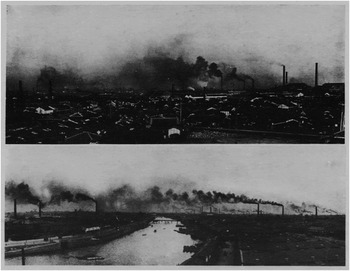
In 1923, the influential Seki Hajime (1873–1935) became mayor of Osaka, following several years in other high offices in the municipal government. Seki oversaw many ambitious plans to raise both the profile of Osaka and general quality of life in the city, even if these aims were sometimes in conflict and not always realised. The first of these goals was attained in 1925, when a redistricting plan helped Osaka's population reach two million people, temporarily surpassing Tokyo and making Osaka the sixth largest city in the world.Footnote 76 This was known as the ‘Great(er) Osaka period’ (Dai Ōsaka jidai). This rapid expansion was difficult to reconcile with one of Seki's other long-standing concerns, to grow ‘the lungs of the city’ by creating more green space in Osaka.Footnote 77 The bleak conditions in industrial Osaka are reflected in photographs of the skyline from 1914 (Figure 4).Footnote 78 The dearth of parks and other public spaces in Japanese cities was a major concern nationwide, and was highlighted by the historian Charles Austin Beard (1874–1948), brought in to consult on Tokyo's urban planning in 1923.Footnote 79 Seki's push for park creation was in response to the miserable living conditions, when it was ‘estimated that the average worker in Osaka before the First World War occupied about the same amount of living space as a Japanese sailor aboard ship’.Footnote 80
The skyline and smokestacks of Osaka in 1914. Image supplied by the National Diet Library.

Miserable conditions for Osaka workers resulted in considerable labour unrest, including strikes at the arsenal, and contributed strongly to the Rice Riots in Osaka.Footnote 81 The army quelled disturbances, further contributing to tensions between the military and citizenry. To Seki, Osaka Castle presented an opportunity for obtaining valuable urban space for a park, and anti-military feeling meant that he could count on popular support. Proponents of the castle park conversion also tied into another movement in the early 1920s to remove the army from the castle centre and to build shrines to Hideyoshi and the legendary emperor Nintoku in the main bailey, instead. This effort was led by a nationalistic education society that claimed to have 80,000 members and sought to boost shrine attendance.Footnote 82 Although this push was unsuccessful, it firmly established the idea of creating a castle park and opened negotiations on the subject with the army. Furthermore, by invoking Hideyoshi, this initiative was in clear competition with the army over claims to his legacy.
These competing agendas came together in 1925 in the Great(er) Osaka Exhibition, in which the castle played a central role. The army agreed to open the main bailey to the public for the duration of the exhibition, and to allow the organisers to construct a keep-shaped tower atop the highest ramparts, offering panoramic views of the city. This mock keep was named after Hideyoshi, and contained extensive displays relating to the castle's early history. Over 700,000 visitors toured the keep during the exhibition, and their approach took them past an impressive array of modern military hardware exhibited by the army for the occasion.Footnote 83 The army thus sought to reinforce its links with Japan's pre-modern martial heritage, including the expansionist hero Hideyoshi. At the same time, the exhibition further boosted popular interest in Hideyoshi and the castle, and whetted appetites for a permanent reconstruction of the castle keep in a new public castle park. This plan was soon taken up by Seki and local business leaders, encouraged by the visiting statesman Gotō Shinpei (1857–1929), who had served as mayor of Tokyo in a long career that included heading several government ministries.Footnote 84
For the army, although the Great(er) Osaka Exhibition had been a useful propaganda event, there was no appetite for surrendering the centre of the castle to the public on a permanent basis. In addition to security issues, army leaders were embarrassed by the poor state of their deteriorating buildings, and were reluctant to expose these to further scrutiny by curious visitors to the castle.Footnote 85 This resulted from the military's dire financial situation following the retrenchments of the 1920s, which simultaneously presented an opportunity for proponents of the castle park. The army was willing to make concessions in exchange for economic support, in this case paying for a new administrative building. Following extensive negotiations, it was agreed that the army would allow the construction of a permanent keep inside a new castle park. In the end, the allocated public green space was only 10 per cent of that originally envisioned by the city, demonstrating the overwhelming power of the army in the negotiations.Footnote 86 Furthermore, the army insisted that the plans include the construction of a monumental new headquarters building for the Fourth Division, to be located directly across from the reconstructed keep in the main bailey.
The city council approved the plans in February 1928, and 1.5 million Yen in donations and pledges were raised from the public in less than six months.Footnote 87 The new army building took up more than half the funds, and was built from concrete to resemble a medieval European castle. The design echoed that of contemporary armouries, prisons and other military buildings in Europe and the United States.Footnote 88 The focal point of the project was the reconstruction of Hideyoshi's castle keep, also built from steel-reinforced concrete at a cost of 471,000 Yen. As the first major concrete reconstruction of a castle keep, the project was beset by problems. With the field of castle research still in its infancy in Japan, the city tasked the municipal architect Furukawa Shigeharu with the project on the basis of his prior experience with shrine construction.Footnote 89 The lack of detailed historical materials complicated the project, as did the selection of Hideyoshi's early keep rather than the more extensively documented Tokugawa keep, for which the ramparts were designed.Footnote 90 The use of concrete also caused problems, as the centuries-old ramparts had to be reinforced to withstand the 11,000-ton keep.Footnote 91 The project was also delayed by personnel issues, with several key people leaving before its completion in 1931. Furukawa himself left early that year due to an unspecified personal conflict, but made his thoughts on the project known in a detailed book on the subject that ran to almost 500 pages and established him as one of the most authoritative castle researchers in Japan.Footnote 92 One of Furukawa's complaints related to the lack of ‘high-level research’ into the historical castle, which frustrated the attempts to recreate accurately the ‘masculine shape’ of Hideyoshi's original keep.Footnote 93
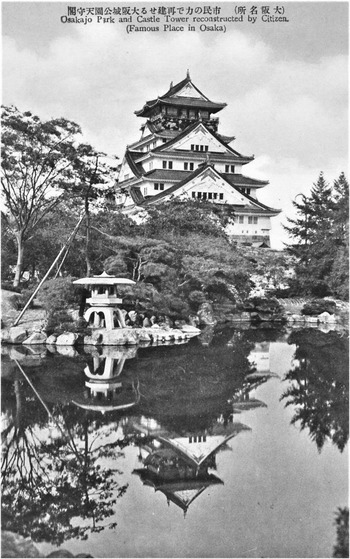
The Osaka Castle keep was opened on 7 November 1931, in a major ceremony attended by hundreds of prominent persons, including Seki, the head of the Fourth Division and the city council. Celebrations were held throughout the city, with parades and extensive decorations. Newspapers focused on the contribution of the ‘people of Osaka’ in rebuilding the keep, which instantly became the symbol of the city (Figure 5).Footnote 94 The connection with Osaka residents was further reinforced by restricting entry to the keep to locals for the first nine days of its opening, while the inside of the keep contained a local history museum as well as a special exhibition on Hideyoshi. The keep also had broader national significance, and its opening officially commemorated the enthronement of the Showa emperor several years before. The national appeal of the keep could be seen in events such as a November 1932 visit by the emperor, Seki and leaders of the Imperial Reservists Association.Footnote 95 In addition to these events, tens of thousands of ordinary people visited the castle, taking in the military installations and the imposing new headquarters building along the way.
‘Osakajo Park and Castle Tower reconstructed by Citizen’. Postcard from the author's collection.

The building of the Osaka Castle keep was a national event that both reflected and influenced broader trends elsewhere, especially major cities with large castles and military presences. In Sendai in the north-east, tensions between the public and the Second Division resulted in an agreement whereby the city built a new gate for the army, which opened part of the castle as a park in 1926.Footnote 96 In Kumamoto in the south-west, the civilian Kumamoto Castle Preservation Society worked to restore a seventeenth-century turret in 1927, attracting over 100,000 visitors in its first year of opening. Kumamoto Castle was controlled by the Sixth Division, and the public interest in the castle resulted in competing plans to reconstruct the lost keep by the army and preservation society. These conflicts contributed to the fact that the keep reconstruction was not realised, even though both sides invoked commemoration of the imperial enthronement, as in Osaka.Footnote 97 In Nagoya, where most of the castle was controlled by the Third Division, the castle keep was opened to the public in 1931. The keep was Japan's largest original castle structure, and after it had served as an imperial detached palace for more than three decades, the Imperial Household Ministry donated the main bailey along with the keep to the city in 1930 to avoid paying for costly maintenance and repair.Footnote 98 Within a few months, the keep and other structures were listed as national treasures and opened to the public, thereby bringing together military, civilian and imperial interests in a popular and publicly accessible space.Footnote 99
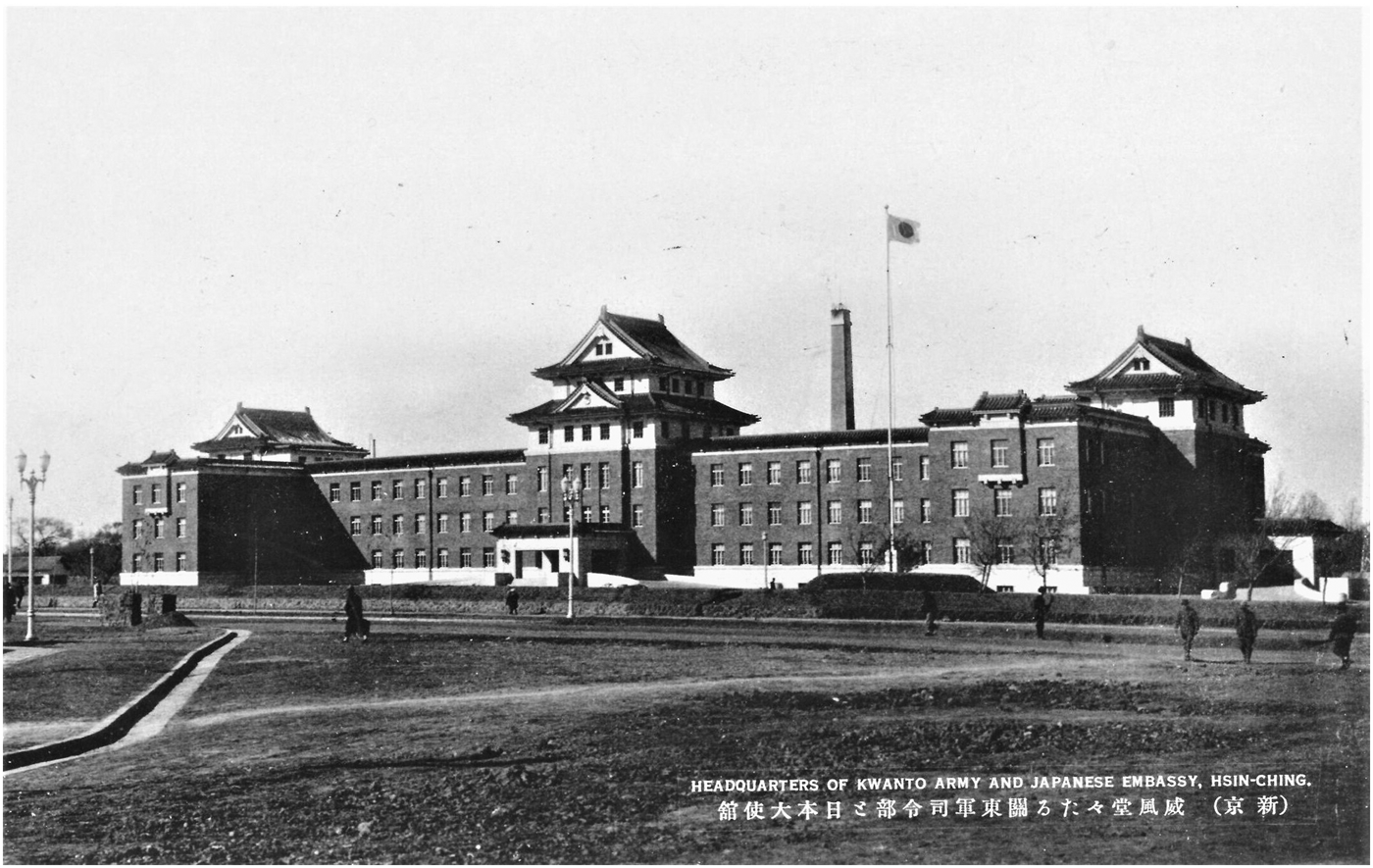
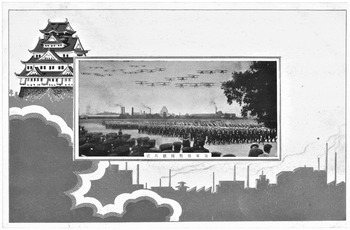
By the early 1930s, vocal opposition to the military in broader society had decreased considerably, as Japanese involvement on the Asian continent expanded. The army projected its castle symbolism across the empire, as seen in the Kwantung Army Headquarters built in Shinkyō/Xinjing (now Changchun) in 1936 in the shape of a Japanese castle (Figure 6). Within Japan, castles also gained symbolic power in Japanese cities throughout the 1930s. Many towns used their castles for tourism and exhibitions, often with a militaristic and imperial theme. Himeji hosted the National Defence and Natural Resources Great Exhibition on the army parade ground in the castle in 1936, celebrating the castle, military, industry and tourism. Even in smaller towns without an army garrison, castles combined Japan's idealised samurai heritage with the modern military and technological advancement. The rural market town of Iga-Ueno rebuilt its lost keep in 1935, celebrating the occasion with an ‘industrial and cultural’ exhibition that included pavilions representing Japan's colonies, as well as a ‘National Defence Pavilion’ of the type that were ubiquitous at exhibitions at the time. The castle keep itself was celebrated as a ‘command tower for industry and Japan's traditional bushido spirit’.Footnote 100 As the demand for new recruits grew, military and imperial exhibitions were important propaganda tools, and increased rapidly in number in the 1930s.Footnote 101 These events were often held in castle spaces or used castle themes to encourage identification with an idealised ancient Japanese martial spirit (Figure 7).
‘Headquarters of Kwanto (Kwantung) Army and Japanese Embassy, Hsin-ching (Xinjing)’. Postcard from the author's collection.

Postcard commemorating a marine review in Osaka in the 1930s. The castle and smokestacks are shown in both the photograph and ornamental frame. From the author's collection.

The local conflicts over the course of the Taisho period and beyond changed the functions of and meanings attached to castles while raising their profile. By boosting popular interest in and identification with castles, the conflicts over castle space ultimately contributed to the militarisation of society in the 1930s. The responses to popular unrest established beyond doubt the physical authority of the military in urban Japan. The struggles over control of castle sites between the military and civil society reaffirmed this hierarchy, while also raising the profile of castles as key symbols of local, regional and national identity. This development was reinforced by the partial conversion of castles to parks, local history museums and sites of memory, typically linked with both the military and the imperial house. In this way, the historical conditions of Japan's urban space contributed significantly to the convergence of popular and official interests that fed into the militaristic totalitarianism of late imperial Japan. To return to Kishida Hideto, the Japanese people, like people everywhere, may well have been ‘more interested in the beautiful than the bellicose’, but the military's appropriation and use of castles made the two most difficult to separate.