INTRODUCTION
Rice (Oryza spp.) is one of the major food crops on which global food security depends. Although most rice is produced in Asia, it is an important food crop in many other parts of the world, including West Africa, especially Guinea, where rice is the staple food. With a per capita consumption of 69 kg per year, Guinea is the second-largest consumer of rice in West Africa after Sierra Leone (WARDA, 2007). Despite production growth of 5.3% (2001–2005), this still cannot meet the local demand: 40% of the rice consumed is imported (MAEF, 2007a). Increasing domestic rice production is a priority in Guinea (MAEF, 2007b), as well as in other African countries.
As with any crop, seed availability and quality are considered bottlenecks in developing competitive agricultural sectors (Bam et al., Reference Bam, Craufurd, Dorward, Asiedu, Kumaga and Ofori2007; McDonald, Reference McDonald1998). Like many countries in the region, Guinea has tried to establish a formal national seed system, with several projects addressing seed production, multiplication and distribution (SNPRV, 2001). However, such efforts have yielded little success: only 8% of the rice farmers have access to seed from the formal sector (SNPRV, 2001). Most smallholder farmers, as in most developing countries, rely on the informal seed system (Almekinders and Louwaars, Reference Almekinders and Louwaars2002; SNPRV, 2001; Tripp, Reference Tripp2001) and depending on the region and crop, 60–100% of the seed is locally produced and exchanged (Almekinders et al., Reference Almekinders, Thiele and Danial2007; Duijndam et al., Reference Duijndam, Evenhuis and Parlevliet2007; Ndjeunga, Reference Ndjeunga2002; Nuijten, Reference Nuijten2005; Okry, Reference Okry2005).
Seboka and Deressa (Reference Seboka and Deressa2000) argue that the lack of seed multipliers and inefficient distribution channels explain why farmers acquire informal seed through indigenous social networks. Witcombe et al. (Reference Witcombe, Joshi, Joshi and Sthapit1996) further argue that low adoption of new varieties is due to insufficient exposure of farmers to them. The formal seed sector's dependency on the extension system has often limited the number of farmers it can reach, especially in marginal and remote areas, making formal seed expensive due to high transaction and information-gathering costs (Almekinders et al., Reference Almekinders, Thiele and Danial2007). Further aggravated by the declining support for public sector extension services, various donors believe that large private seed enterprises could offer a solution.
The formal and informal seed systems generally operate as two parallel systems serving different purposes (Sperling and Cooper, Reference Sperling and Cooper2003). Recently, Almekinders and Thiele (Reference Almekinders and Thiele2003) proposed combining attributes of both systems, but how to do that seems difficult since seed systems are poorly understood, especially informal ones (Thiele, Reference Thiele1999).
This paper contributes to the understanding of how the rice seed sector functions, using Guinea as a case study. It examines the organization of the seed systems, stakeholders, their roles and their perceptions of the other actors. The study:
1. analyses previous formal seed interventions to provide a historical perspective and to shed light on alternative models;
2. identifies the main players in seed supply and seed system governance;
3. explains why the formal interventions (and the formal seed sector) reached few smallholder farmers;
4. assesses how current organizational settings, institutional linkages and perceptions inhibit seed flow towards small-scale farmers.
The paper ends by discussing how engaging local seed dealers may contribute to making the rice seed sector more effective and seed interventions more sustainable.
MATERIALS AND METHODS
Field activities were undertaken in Lower Guinea from June to December 2007 and from June to December 2008. Lower Guinea was chosen for primary data collection because: (i) stakeholders of the rice seed sector and their head offices are based in Lower Guinea, which includes Conakry, the capital; (ii) seed projects using CBSS (community-based seed system) and PVS (participatory varietal selection) approaches began in Lower Guinea in the late 1990s, with successful project components being subsequently copied in other regions of the country; (iii) Lower Guinea hosts two of the four seed centres of the country; (iv) Lower Guinea is the most representative region regarding the diversity of rice cropping systems (Barry et al. Reference Barry, Pham, Noyer, Billot, Courtois and Ahmadi2007).
Field research covered three sub-prefectures (local levels of government): Molota, Friguiagbé and Moussayah in the prefectures of Kindia and Forecariah. We selected 10 villages and, based on their proximity to each other, we grouped them into three research sites. Site 1 consisted of Bokariya (9°20.582N; 12°48.582W; 52.6 m asl) and Sangaran (9°20.538N; 12°48.010W; 66.8 m asl). They were chosen because of their remoteness (about 90 km from Kindia, the regional capital) to learn about farmers’ seed strategies in a situation of poor infrastructure, limited interventions of development organizations and the absence of an important nearby market place. Site 2 consisted of Seifan (9°54.136N; 12°47.21W; 78.1 m asl) and Dentègueya (9°54.303N; 12°48.204W; 73.1 m asl). These two villages were selected because of their proximity to the rice seed centre of Kilissi and the Centre de Recherche Agronomique de Kilissi (CRAK), which is the national rice breeding unit. Site 3 covered Kinyaya (9°58.044N; 12°53.591W; 402 m asl), Hononkhouré (9°57.143N; 12°53.111W; 429 m asl), Tour (9°57.273N; 12°53.25W; 368 m asl), Yaya (9°57.491N; 12°54.479W; 436 m asl), Dandakhouré (9°56.503N; 12°53.897W; 400 m asl) and Sinta (9°57.246N; 12°53.105W; 390 m asl). They were selected because of their proximity to Kindia.
Primary data were also collected from Kindia, Friguiagbé and Sikhourou-Daffira markets, all in Kindia and Forecariah prefectures. These were the markets most often mentioned by the study households. Moreover, Sikhourou market was the major market closest to Site 1. Sikhourou and Daffira are actually two different physical markets. We combined them in this study because of the mobility of dealers from one market to another.
The study used various data collection methods arranged in ways that outputs of one method were complemented, fine-tuned and/or triangulated with data collected using another research method. Archive research, literature review and discussions with resource persons (local agricultural scientists and other experts on the rice seed system) elicited information on agricultural policy in Guinea, past and current rice seed projects and their stakeholders. We then held 14 focus group discussions to understand stakeholders’ roles, their perception of the organization of the seed sector and to explore their views on changes they believe might be necessary for a functional rice seed sector. Focus group discussions involved farmers; representatives of the Fédération des Organisations Paysannes de la Basse-Guinée; representatives of local farmers’ associations; staff of non-governmental organizations (NGOs): Association pour la Promotion Économique de Kindia (APEK) and Structure d'Appui aux Réseaux d'Agriculteurs et d'Agricultrices (SARA); researchers from the Institut de Recherche Agronomique de Guinée (IRAG); agro-input dealers: Comptoir Agricole (CA) and Société de Production et de Commercialisation des Intrants Agricoles (SPCIA) and extension agents from the Agence Nationale pour la Promotion Rurale et du Conseil Agricole (ANPROCA, ex-SNPRV). Focus group discussions involved on average nine participants and lasted for about two hours each.
Two surveys using distinct semi-structured questionnaires complemented the focus group discussions. One survey targeted 91 rice farming households and the other targeted 41 local seed dealers. The questionnaire administered to farmers addressed their seed use, means of seed acquisition, seed sources and preferred sources, and farmers’ relationships with seed dealers. The respondents were selected according to their willingness to participate in the study, since it was conducted during the cropping season, to better capture seed flows and observe seed transactions. The questionnaire administered to seed dealers addressed seed dissemination, origins of seed and varieties sold, seed quality requested by customers, price indications and its progression throughout the year, and dealers’ relationships with their customers. Local seed dealers were identified using the snowball sampling technique (see Vogt, Reference Vogt1999). Informal interviews and participant observation helped to collect data on farmers’ relationships with seed dealers and gain additional insights in farmers’ seed acquisition strategies.
RESULTS
Overview of the organization of the formal rice seed sector from the 1980s to 2007
Archival research, literature review and discussions with resource persons revealed that in the past two decades, the rice seed sector underwent three major types of interventions: a state-led intervention where bodies of the Ministry of Agriculture ran the seed sector, an NGO-led intervention using the framework of a public-private partnership for seed development and a collaborative intervention that opened the door to farmers’ participation in varietal selection and seed development. Other interventions, minor in scope, were organized by local NGOs and agro-input dealers. This section describes the interventions, stakeholders and their roles, and analyses the intervention approaches.
A state-led intervention. This was the first ever formal intervention in the rice seed sector in Guinea. It began in the mid 1980s, as part of a broader food security programme. Two early-maturing and improved upland varieties, CK 5 and CK 7, were chosen among nine to increase national rice production (IRAG, 1996). Four well-equipped seed centres were built in Kilissi, Koba, Guéckédou and Bordo to process (cleaning, sorting and conservation), store and package seed of these two varieties.
The two main bodies of the Ministry of Agriculture, ANPROCA (extension) and IRAG (agricultural research), managed the project, with financial support from the World Bank and the national government. The agricultural research, through its rice breeding unit, was responsible for producing breeder and foundation seed. The newly created seed centres multiplied foundation seed, processed and packaged seed into 5 kg bags and developed, in collaboration with the extension service, technical notes about the characteristics and use of each variety. The extension service was responsible for disseminating the bags of seed and for training the farmers. Seed was distributed free of charge to selected farmers who were expected to diffuse seed and technical information within their community as stipulated by the training and visit extension approach (Benor et al., Reference Benor, Harrison and Braxer1984) in use in the 1980s. Seed distribution was coupled with farmer training sessions carried out with the Unités Expérimentales Paysannes (UEPs). During these sessions improved technologies were discussed and tried out, such as sowing techniques, weeding, mineral fertilization and other farming practices. Before adopting the UEP approach, the agricultural research system undertook conventional on-station research to generate technologies, including seed and varieties. Plant breeding and varietal selection happened on-station and only after registration were varieties released to farmers. In order to improve this classical scientist-led approach, the UEP was introduced in the early 1990s to include farmers’ perspectives. Technological development then evolved through three stages. On-station experiments generated technologies which were tested on decentralized research stations (Points d'Essai). On these stations, farmers hardly interacted with scientists. Promising technologies were then transferred to farmers’ fields (UEP) and the diffusion was believed to start from these on-farm experiments.
The two disseminated varieties (CK 5 and CK 7) did not meet farmers’ expectations and were not adopted. Farmers and extension agents mentioned during focus group discussions that the varieties were susceptible to weeds and too early-maturing, requiring intensive bird-scaring at times when labour is needed for other crops. These varieties also required delicate post-harvest management as they ripened in the middle of the rainy season. The intervention therefore failed to meet its objective of supplying seed to small-scale farmers. The withdrawal in the early 1990s of World Bank and governmental funds as prescribed by the Structural Adjustment Programme did not give opportunities to develop improved follow-up state-led interventions. This led in 1997 to the closure of the seed centres that were unprepared to operate independently without subsidies. The seed centres were handed over to farmers’ associations and agro-inputs dealers (SPCIA) in 2004, after which they have rarely functioned, with the exception of the one in Koba that processed 350 t of seed at request of the FAO (Food and Agriculture Organization of the United Nations) to cope with an emergency in 2007.
An NGO-led intervention. Since its establishment in 1996, Sasakawa Global 2000 (SG 2000) rapidly engaged in rice seed activities (SG 2000, 2005) focusing on the diffusion of improved lowland varieties originating from the national breeding unit (CK 4, CK 73, CK 21, CK 801 and CK 211) and upland varieties (Nerica 1, Nerica 3 and Nerica 4) from the Africa Rice Center (AfricaRice, ex-WARDA). SG 2000 initiating this intervention envisioned professionalizing and privatizing small-scale seed production without relying on the heavily equipped seed centres. The intention was that by the end of the intervention, farmers would have been trained as professional seed producers (hereafter referred to as formal seed producers) capable of establishing their own seed businesses. SG 2000 subsidized inputs (chemicals, fertilizers and seed) to stimulate these seed producers. In practice:
1. Extension and research identified farmers as potential seed producers based on land ownership, integrity and literacy. They recruited and trained them in techniques of seed production.
2. Formal seed producers signed a contract and received subsidized inputs from SG 2000 on credit. At the end of the season, SG 2000 bought the seed produced up to the value of the inputs received and distributed these to seed producers selected in other regions where there was a lack of seed.
In the course of the project SG 2000 continuously needed large amounts of seed to scale-up in other regions of Guinea. SG 2000 thus became the major customer of the formal seed producers and bought the entire seed produced throughout the project's life time. This same organizational setting is currently in use for Nerica multiplication and dissemination under the African Rice Initiative project. SG 2000 reduced its activities in 2003 and withdrew from the country shortly afterwards.
Like the state-led intervention, the NGO-led intervention also decided, based on on-station performance, on varieties that would suit farmers’ conditions. Some did indeed. Interviews showed that 38% of the promoted varieties, namely CK 4, CK 21 and CK 801, were adopted by farmers and entered local seed trade. In 2007 for example, 4%, 2% and 1% of the rice farming households grew CK 21, CK 801 and CK 4 respectively. In 2008, CK 21 was the third most sold variety after Saidou Gbéli and Saidou Firê, the two most cultivated local varieties in the study area. CK 21 represented 14% of the total seed sales and was sold by 32% of the local seed dealers at open markets (Okry et al., unpublished data). The total seed sale was estimated at 99.6 t in 2008. CK 4 and CK 801 were less represented in the seed trade at less than 1% of total seed sales each.
Contrary to the state-led intervention, the NGO-led intervention stressed the professionalization of small-scale seed producers to promote a more lateral seed distribution from many points at community level. It brought farmers into seed development activities and trained them in seed production. It thus built farmers’ capacity, which is an essential step towards any professionalization. But the intervention was less successful in developing seed businesses to service local communities. Farmers, extension agents and researchers said most of the formal seed producers abandoned their seed businesses after the project and subsidies ended.
A collaborative intervention. From 1997 and parallel to the NGO-led intervention, the national agricultural research and extension service in collaboration with international partners (AfricaRice and World Bank), launched a pilot programme to accelerate the diffusion of Nerica (varieties of interspecific hybrid origin: O. glaberrima × O. sativa) in Guinea. In order to allow farmers’ interaction with Nerica, a total of 116 and 210 UEPs were conducted across the country in 1997 and 1998, respectively. Trials involved 15 varieties (3 landraces and 12 Nerica varieties). At the same time PVS was introduced, but at a small scale. In 1999, only PVS trials were conducted and led to the selection of four varieties: Nerica 3, Nerica 4, Nerica 6 and IAC 164 for large-scale diffusion (IRAG, 2000).
The introduction of Nerica was accompanied by a fundamental change in the research approach, triggered by this collaborative intervention. Prior to this intervention, the agricultural research used UEP (described above) as the final stage of research. After 1999 the UEP approach was abandoned in favour of PVS which is still the major on-farm research method in use. PVS and UEP are two similar approaches advocating farmers’ participation in technology development. The difference is that PVS involves farmers throughout the entire process of variety selection while UEP brings in farmers only at the final stage with the sole purpose of distributing improved varieties and other technologies to farmers. The UEP approach was not specifically designed for variety selection as was PVS. The latter belongs to the range of participatory crop improvement approaches developed in the late 1980s to early 1990s to complement and/or improve the impact of the conventional breeding approaches. It advocates farmers’ involvement at earlier stages of variety selection to assess a wide range of existing but novel varieties (Witcombe et al., Reference Witcombe, Joshi, Joshi and Sthapit1996) with the overall objective of valuing their perspectives (Dorward et al., Reference Dorward, Craufurd, Marfo, Dogbe and Bam2007; Morris and Bellon, Reference Morris and Bellon2004). Schematically, four phases commonly compose a PVS: identification of farmers’ needs in cultivars, a search for suitable cultivars to test with farmers, experimentation of suitability of cultivars in farmers’ field and a wider dissemination of suitable cultivars (Witcombe et al., Reference Witcombe, Joshi, Joshi and Sthapit1996). Hence the success of a PVS largely depends on the type of stakeholders involved (farmers, researchers, NGOs and other end-users), the way they have been selected and the degree of their involvement, activities and timing, scale, etc. (Dorward et al., Reference Dorward, Craufurd, Marfo, Dogbe and Bam2007). With PVS, farmers are exposed to more new cultivars, they have a larger stake in the selection of varieties compared to the conventional breeding approaches and seed dissemination is expected to start from PVS sessions using participating farmers as entry points to the community. As such PVS has the potential to link the formal and the informal seed systems. Participatory varietal selection is a flexible approach adaptable to the local context. During the collaborative intervention in Guinea, research and extension co-ordinated PVS activities. According to these stakeholders several technical and organizational aspects deviated the actual implementation of PVS in Guinea from the one recommended (see Witcombe et al., Reference Witcombe, Joshi, Joshi and Sthapit1996; Dorward et al., Reference Dorward, Craufurd, Marfo, Dogbe and Bam2007). Major weaknesses reported included:
1. Field staff were given limited time to learn the approach, to select participants and set up trials. In most cases, in response to time constraints, they selected farmers who were already formally collaborating as contact groups under the ‘training and visit approach’ and/or friends to participate in PVS activities.
2. Trial set-up was left to extension staff who were already involved in many other activities including seed dissemination activities of the NGO-led intervention. They could not devote much time to PVS trials.
3. Limited supervision was given from headquarters because of financial constraints.
4. Frequency of visits of farmers to PVS trials largely depended on budget availability. One or two visits were generally organized, but not always at the most crucial growing stages (tillering, flowering and maturity).
According to informants, these limitations occurred at the beginning of the intervention and were gradually overcome. However, the first two phases of PVS (the identification of farmers’ needs for cultivars and the search for suitable cultivars to experiment with farmers) have often been taken for granted, and the number of farmers involved and frequency of visits have largely depended on budget availability.
Like in the NGO-led intervention, the actual seed multiplication and dissemination after variety selection through PVS were done by formal seed producers. Surveys of 2007 and 2008 did not report any use of the introduced varieties in the study area.
Other interventions. Other interventions were limited in scope. APEK, a local NGO, supported research to implement participatory approaches such as PVS and CBSS. APEK, like many other local NGOs (e.g. SARA), also distributed seed in emergency situations at the request of the FAO and WFP (World Food Programme of the United Nations). In its regular activities of seed dissemination APEK targeted farmers’ associations, rather than individual rice farmers, as requested by its donors and partners (Guinée 44, IFAD, FAO, etc.) and in line with donor-proposed changes in extension. Farmers organized in groups received seed of improved varieties from APEK. They were expected to develop communal seed management strategies to improve everyone's access to seed. The actual seed management varied from one farmers’ association to another, but it often excluded some farmers. For example, in Bokariya-Tassen the farmers’ association loaned seed to farmers at an interest rate of 20%, compared to the 50–100% charged by informal money lenders. However, only group members could borrow seed from the association. In Sangaran, 1.5 km from Bokariya-Tassen, the chairman charged 100% interest on seed loans.
Comptoir Agricole, a medium-sized agro-dealer was also involved in seed relief activities along with APEK at the request of the FAO and WFP. In addition, CA developed a seed business. It bought seed (local as well as improved varieties) mainly from individual farmers during harvest, which it stored and then sold at the start of the next season, but did little or no seed processing. By 2007, it had a market capacity of 200 t of seed per year. But CA met only 50% of this capacity in 2007. In July 2007, CA sold rice seed at about US$ 0.80 per kilogram.
Apart from learning from past interventions, to construct a more sustainable seed sector one also needs to understand the roles, perceptions and linkages of the different stakeholders involved. The next section explores this.
Stakeholders of the rice seed sector
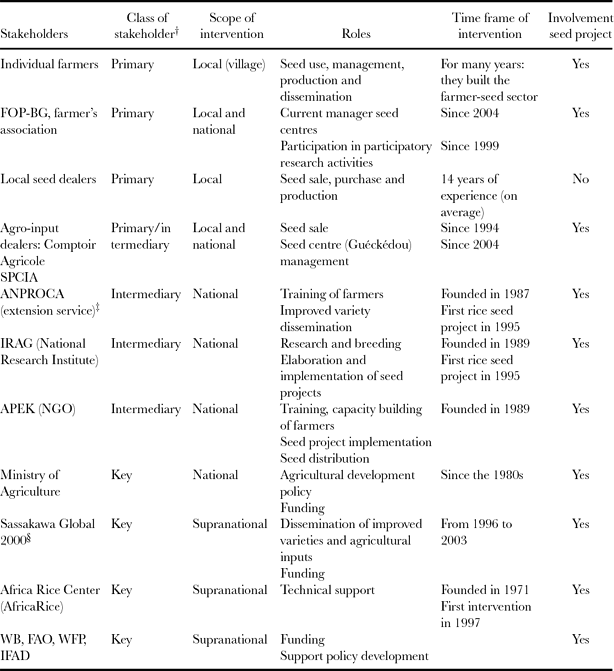
Characteristics and roles of stakeholders. Archival research and focus group discussions with extension agents, researchers, NGO staff and farmers allowed us to identify and characterize stakeholders of the rice seed sector (both formal and informal). Subsequent surveys allowed further characterization. Following Jiggins and Collins (Reference Jiggins and Collins2003), we grouped stakeholders into three classes: primary, intermediary and key stakeholders (Table 1), and characterized them based on the roles they played and would potentially play in the rice seed sector.
Characterization of the stakeholders of the rice seed sector based on archives, surveys and focus group discussions 2007 and 2008.
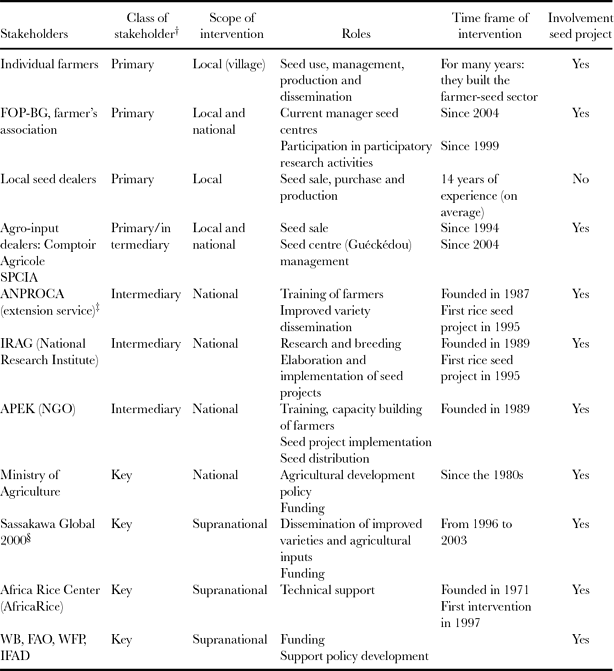
†Primary stakeholders are those who are directly affected, either positively or negatively by seed projects or interventions in the seed sector. Intermediary stakeholders are the intermediaries in the delivery or execution of seed project, research programmes and resource flows. Key stakeholders are those with the power to influence or ‘kill’ activity (adapted from Jiggins and Collins Reference Jiggins and Collins2003).
‡Has suffered from lack of funds since early 2000s.
§No longer intervening in Guinea.
The national government, SG2000, World Bank and AfricaRice were key stakeholders. They steered interventions through financial, technical and institutional support, and policy development. Of these key stakeholders only the national government was involved in all interventions described in the section above.
Research and extension were mandated to implement the state's vision of agricultural development through the Ministry of Agriculture. They also acted as intermediaries for AfricaRice, World Bank and SG2000 to implement the seed projects described above. Research and extension were therefore the most influential intermediary stakeholders. Comptoir Agricole and NGOs (e.g. APEK) were also intermediary stakeholders who: (i) as previously mentioned released emergency seed along with research and extension at request of FAO and WFP; (ii) trained farmers and (iii) implemented seed projects as partner of the national agricultural research and AfricaRice. In addition, CA has developed a seed business.
So far, the role of farmers in the formal seed sector has been limited to contractual labour provision for seed multiplication. Of course, those who took part in PVS helped to make decisions on the varieties to be disseminated by the formal seed sector. Rice farmers play a role mainly in the informal seed sector. Various studies have shown they have experience in seed and variety management (selection, use, production and dissemination) to meet diverse objectives of food production (Louwaars Reference Louwaars2007; Nuijten et al., Reference Nuijten, Van Treuren, Struik, Mokuwa, Okry, Teeken and Richards2009; Richards Reference Richards, Scoones and Thompson2009). From 2005 to 2007 each household used on average 77 kg of rice seed per year of which 70% were own farm-saved. Seed acquired from outside the farm was used for different purposes. For example, in 2007 seeds from outside the farm can be split in seed of new varieties (40%), seed for field enlargement (38%), seed to complement own seed because of shortage (18%) and seed to renew own seed because of mixture (3%). About 2% of it was used to establish new rice fields (youth).
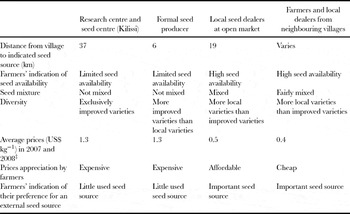
Farmers developed several ways of acquiring seed. Our interviews revealed that from 2005 to 2007 seed from outside the farm was obtained through seed exchange with fellow farmers (50%), purchase with cash (35%), loan (7%), gift (4%), labour exchange (2%) and barter deals (2%). Of seed purchased with cash, 30% came from occasional seed sale by relatives and friends from the same village, 53% came from relatives, friends and seed dealers of neighbouring villages, 15% from local seed dealers established at open markets and 1% from CA. Interviewed households did not mention the formal seed producers as source of purchased seed. They were, however, mentioned as potential seed sources during focus group discussions. Table 2 presents outputs of such focus group discussion conducted in Dandakhouré to compare external seed sources (seed from outside the village). Five external seed sources were in use: the rice research unit of Kilissi (CRAK), the seed centre of Kilissi, a formal seed producer, local seed dealers established at open market and, friends, relatives and local seed dealers from neighbouring villages. According to farmers, seed from local dealers at open markets and seed from non-experienced local seed dealers at village level was often mixed, whereas seed from research and seed centres was pure. Nevertheless, farmers said that they did not often visit research and seed centres for seed because of the high seed prices, the limited choice they offered (exclusively improved varieties), and the limited availability of seed (Table 2). Farmers made similar comments about the formal seed producer even though at points in time he would offer a few local varieties in addition to improved ones (Okry et al., Reference Okry, Dalohoun, Diawara, Barry, Van Mele, Van Mele, Bentley and Guéi2011). Despite the criticism of seed mixture farmers said they preferred seed from local seed dealers because of the relatively low seed price, the large diversity they offered and the large quantities of seed they usually have available.
External seed sources and preferences of farmers for external seed sources.†

Source: Group discussion in the village of Dandakhouré in November 2007 (n = 22).
†External seed sources refer to seed collected from outside the village of Dandakhouré. ‡Prices in the table are averages of price ranges given by participants. They are consistent with prices recorded during surveys. 1US$ = 3800 Guinean franc.
Subsequent interviews with local seed dealers revealed that in 2008 none of them had ever collaborated with a seed project even though on average they had spent 14 years selling rice seed. Local seed dealers distributed seed by sale, loan, barter and even as gifts. Their seed price increased from the beginning to the end of the sowing season with an average of US$ 0.50 per kilogram in July–August 2008. About 40% of the local seed dealers were also seed producers (non-formal), the rest were traders. Barter deals involved palm oil and mainly took place in remote areas (e.g. villages of Site 1). Thirty litres of palm oil were exchanged for about 50 kg of seed. Seed loans were only granted to regular customers. Payment was generally made after six months (at harvest) either in cash or in rice. The interest rate varied widely according to the relationship between client and dealer. Seed dealers occasionally gave gifts of seed in cases of misfortune. Local seed dealers also used seed gifts to secure labour for the coming cropping season. Farmers acquired seed through barter, loan or gift only when they have strong ties with seed dealers; those with weak ties can only buy seed. Purity, good germination rate and adaptability of varieties to local environment were the main characteristics sought by farmers. All seed dealers aimed to offer such seed to secure customers: ‘Only good quality seed establishes customer loyalty and keeps the seed business going,’ dealers said. Good quality seed here refers to seed purity, cleanness and germination rate. Each local seed dealer was linked to several rice growers who, together with their friends and relatives, formed a customer group. Seed dealers therefore entered farmers’ networks and sustained their seed business by selling ‘good quality seed’ in different ways.
Farmers controlled seed dealers through information sharing within their networks. News of any cheating or false information about seed quality or varietal characteristics were said to spread quickly within the farming community and may result in significant loss of customers and even exclusion of suspect seed dealers from the networks. Local seed dealers seemed to be strategic seed suppliers, but their future involvement in seed programmes/interventions will be largely influenced by the perceptions of the various stakeholders.
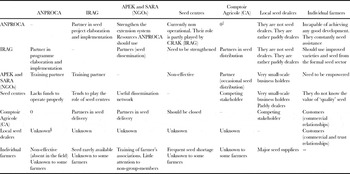
Conflicting roles and perceptions of stakeholders on one another's roles. Focus group discussions with different stakeholders revealed their diverse perspectives on how the seed sector functions. Research, extension and seed centres tended to blame individual farmers when seed and varieties do not flow as expected (Table 3). For researchers, farmers should just use the improved varieties they released. Seed centres thought that farmers do not know the value of ‘quality seed’ of improved varieties. The extension service believed farmers are incapable of achieving any good development unless under assistance. These views, contrasted against farmers’ reasons for using seed of the informal seed distribution channels, reveal poor communication between the actors of the formal seed sector and farmers about the reasons of non-adoption of improved varieties and the limited use of seed from the formal sector. More specifically, the perception of the extension service depicts its top-down vision of seed development showing that the collaboration between extension and farmers (formal seed producers) that occurred during the NGO-led intervention did not alter much the rigid view it held and likely inherited from the training and visit era. It illustrates their negative attitude about farmers’ ability to produce and/or sell seed.
Stakeholders’ perceptions of one another's roles in the seed sector, based on focus group discussions and surveys in 2007 and 2008.†

†In the first column are the respondents. In the top row are the stakeholders on whom the perceptions are expressed.
‡0 means there is no perception expressed on that stakeholder. From this it is deduced that there is no tension between them.
§Unknown means the responding stakeholder does not know the stakeholder or does not know the roles it plays in the rice seed sector.
While local NGOs saw themselves as the main current extension agencies, the extension service perceived the NGOs as simple ‘extension tools’ that should be at their disposal. Since the extension service has suffered from financial problems since 2003, they saw NGOs more as competitors. As both have developed expertise in farmer training, institutional arrangements that favour collaboration might increase their impact.
Extension and research denied the existence of local seed dealers (Table 3). They regarded seed dealers as paddy traders. This perception illustrates the formal sector's tedious distinction between ‘seed’ and ‘grain’. The scant scientific attention paid to local practices and institutions of seed production, selection and management does not allow a fair appreciation of farmers’ capacities to produce and sell seed. It is true that for many crops much remains to be done on quality (purity and sanitary measures) of farmer's seed but one should not deny farmers’ capacity to produce and manage seed of self-pollinated crops like rice (Nuijten, Reference Nuijten2005). In Guinea, research and extension may not have acknowledged the existence of local seed dealers because dealers operate within the informal seed sector, which is still of less importance to them. This poor interaction between the formal and the informal seed sectors could also explain why some farmers and local seed dealers did not know about the existence of stakeholders of the formal seed sector except for the NGOs – likely because the latter train farmers in many domains, such as animal traction, adult literacy and co-operative management.
Institutional linkages. Key stakeholders at the international level are linked one-way with the Ministry of Agriculture and intermediary stakeholders targeting financial resources and assistance through them. Among international key stakeholders, only AfricaRice provided seed of improved varieties, of which multiplication and dissemination rested mainly within research and extension. AfricaRice also provided technical assistance.
At the national level, seed and varieties moved in two different ways. Research, extension and APEK organized a vertical and one-way seed distribution starting from research centres to farming communities via formal seed producers and farmers’ associations. Farmers’ association and formal seed producers would therefore link the farming community to the formal seed system. At the community level seed moves more laterally as a result of the relations between farmers, and those between farmers and local seed dealers. In fact, seed and money flows two ways between individual farmers and local seed dealers who are both seed providers and buyers. Seed is also exchanged between them through a wide range of arrangements (cash, loan, gift and barter) while seed exchange occurred only with cash between farmers and formal seed producers. It is however important to note that local seed dealers had the fewest linkages with other stakeholders: they were linked only to rice growers and to some extent had loose relations with money lenders (because of high interest rate applied – 50 to 100%) from whom they get credit in bad years. They have no direct links with stakeholders of the formal seed sector. Nevertheless, through their informal networks, seed dealers would benefit (indirectly) from technical information that extension, NGOs and research disseminated.
Comptoir Agricole developed business linkages with individual farmers and from time to time received seed from research (CRAK) when these had surplus seed, and also sold seed to farmers exclusively on a cash basis.
Farmers’ associations have a two-way linkage with farmers. Farmers borrowed seed from them and reimbursed at harvest with seed plus an interest. In addition, farmers’ associations linked the formal and the informal seed systems in a more direct way: members of an association who benefited from seeds shared them with other farmers and relatives.
Research, extension and APEK developed one-way links with formal seed producers and farmers’ associations despite the collaborations they previously had. In fact, farmers’ associations and formal seed producers rarely emerged independently. Farmers’ associations were established at the request of extension, and currently of NGOs, and evolved under their financial and technical assistance. Formal seed producers were selected, trained and helped financially by the extension service and research. As a result, research, extension and NGOs tended to have patron-client relationships with farmers’ associations and formal seed producers.
DISCUSSION
Learning from past interventions
Seed programmes in the past two decades have used different intervention approaches that have led to different outcomes. The state-led intervention failed mainly because of the unsuitability of the recommended varieties. It regarded farmers as end-users and did not involve them in the choice of varieties. This attitude likely resulted from the influence of the conventional research approach used in the 1980s. The selection of too few varieties for wide dissemination could also be seen as another cause of failure of this intervention. In fact, small-scale farmers operate in diverse environments and seek a range of varieties that match their specific ecologies and needs (Nuijten, Reference Nuijten2005; Richards, Reference Richards1986). The organization of seed distribution during this state intervention also hampered its success. Distributing improved varieties from a few locations (four seed centres) prevented farmers from remote areas such as Bokariya from accessing these varieties unless they paid for transportation resulting in high transaction costs, which are known to hamper farmers’ use of improved varieties (Almekinders et al., 1994). Cromwell and Tripp (Reference Cromwell and Tripp1994) also remarked that farmers’ decisions on new seed acquisitions are often last-minute decisions and require seed to be readily available and nearby.
The NGO-led intervention that followed the state intervention did not involve farmers in variety selection either. But it increased the number of varieties made available to farmers. Our findings showed that 38% of these varieties successfully entered the informal seed system and were cultivated by 7% of the rice farming households a decade later. Those varieties were likely the most suitable among the distributed improved varieties, suggesting that the dissemination of a larger number of varieties, when farmers are not involved in selection processes, increases chance of adoption. Since our surveys covered only Lower Guinea, different figures may emerge for other regions.
The centralized seed dissemination during the state-led intervention did not service farmers from remote areas. The NGO-led intervention improved on that by training small-scale seed producers in order to multiply and decentralize seed distribution points at the community level. As our findings show this organizational setting successfully built on the capacity of the farmers involved, which is essential to sustain the process of professionalizing small-scale seed production and distribution. However, the actual objective of establishing seed enterprises received insufficient attention. With projects buying all the seed, seed producers did not develop the necessary skills and knowledge to properly market seed, e.g. gauging farmers’ seed demands, determining farmers’ preference for varieties, developing mechanisms of price formation and strategies of advertisement. Other relevant aspects of seed market development, such as packaging and branding, were of less importance in this subsistence rice cultivation. Many formal seed producers saw themselves as service suppliers to the seed projects and quickly left their seed enterprise once projects and inputs subsidies ended. This finding adds to the range of similar experiences across developing countries (Almekinders and Thiele, Reference Almekinders and Thiele2003). Besides, recruitment criteria for formal seed producers (land ownership and literacy) may have led to the selection of better-off or elite farmers who found better livelihood opportunities than seed production after projects ended. In all, the observed spread of improved varieties through the NGO-led intervention likely resulted from the conjunction of the adaptability of cultivars to farmers’ conditions, and the subsequent dissemination through informal channels and to a lesser extent through formal seed producers.
Contrary to the other interventions, the collaborative intervention did involve farmers in variety selection to avoid failure due to the rejection of varieties. The fact that only Nerica varieties were disseminated through this intervention seemed logical since the project was conceived for Nerica dissemination. That our surveys of 2007 and 2008 did not report any use of the varieties introduced via the collaborative intervention could be partly due to the scope of data collection. Extension agents and researchers mentioned that the Nerica varieties were most successful in Forest Guinea and Middle Guinea, rather than in Lower Guinea, even though they were selected in Lower Guinea. In Lower Guinea CRAK is still actively multiplying Nerica varieties for dissemination to other regions of the country. Also the variety naming system at community level may result in different varieties obtaining the same name. Varieties were often named following the person who introduced them or the area where they were first encountered. As such, varieties introduced by this collaborative intervention may have been renamed. Besides, the name ‘chinois’ systematically given, in the study area, to any unknown improved varieties adds to this complexity. Similar complexities in variety naming have been observed in The Gambia (Nuijten and Almekinders, Reference Nuijten and Almekinders2008). A proper tracking of the introduced varieties would require more resources than those available for this study.
Like the NGO-led intervention, the collaborative intervention also formally relied on formal seed producers to multiply and disseminate seed. Here again, the seed produced was entirely bought by projects for large-scale dissemination. To better sustain impacts on the seed sector, projects could have considered enlarging lists of stakeholders to include local seed producers and dealers in addition to the ‘promoted’ formal seed producers. As our findings show local seed dealers operated independently, without any direct support from the formal seed sector and have developed customer networks that could serve the formal seed sector. Even though training might have made formal seed producers technically better than local seed producers, local seed dealers have a better understanding of the seed market than the newly trained formal seed producers.
Unsupervised seed dissemination results from participation in PVS sessions. Dorward et al. (Reference Dorward, Craufurd, Marfo, Dogbe and Bam2007) provided evidence on how a small quantity of suitable cultivars acquired by participants in PVS sessions quickly spread among farmers. Further, Marfo et al. (Reference Marfo, Dorward, Craufurd, Ansere-Bioh, Haleegoah and Bam2008) showed the usefulness of informal channels in disseminating seed of suitable improved varieties in Ghana. Witcombe et al. (Reference Witcombe, Petre, Jones and Joshi1999) specifically highlighted the roles of seed merchants in disseminating seed of varieties selected with PVS in India. Thus, because of the approach used (PVS) the collaborative intervention had the potential to link the formal and the informal seed systems. In practice this potential was not fully utilized. As the study shows, farmers participating in the PVS sessions were not selected on a sound basis, major players in the informal seed system (e.g. local seed dealers) were ignored and seed multiplication systematically given to only the formal seed producers. Unsupervised seed dissemination may add to the efforts of the formal seed sector to supply seed of improved varieties to smallholders. In this regard, we suggest that PVS adapts more to context specificities. In principle, PVS allows flexibility in its implementation like all other participatory approaches. But because of the large geographical coverage (international) projects often use PVS rigidly, not allowing space to adapt to local conditions or be more flexible towards building on local seed systems. In the case of Guinea, proper identification of stakeholders would have revealed the existence of local seed dealers and their involvement at the very beginning of the PVS would have been beneficial. Also, instead of late involvement (only post-harvest) as PVS guidelines often recommend for traders (Dorward et al., Reference Dorward, Craufurd, Marfo, Dogbe and Bam2007), early involvement of local seed dealers would offer opportunities to collect perspectives from their customer networks.
Ways forwards
Getting rid of subsidies for small-scale rice seed enterprises. Since 2004, seed centres have rarely functioned except to supply seed to cope with emergency. Rossignol (Reference Rossignol2008) argued that they could not run cost-effectively to only cover the seed demand of smallholders and meet their price preferences unless there are subsidies. Even though subsidies are indispensable for large seed industries of self-pollinated and orphan crops, maintaining long-term subsidies for the Guinean seed industry may be too demanding for the government even if this might be an option to consider in the future. In the short run, alternatives that reduce overheads might best fit the current rice production context. With the NGO-led intervention, the formal seed producers were indeed promoted as alternatives to reduce the costs of production of seed of improved varieties. Most of them have left their seed enterprise after subsidies ended. The few remaining formal seed producers offered seed at a price that smallholders could not afford, because of expensive inputs (chemicals) required. The high seed production costs, passed on in the final seed prices, prevent farmers from buying formal seed (see also Almekinders et al., Reference Almekinders, Thiele and Danial2007; Ndjeunga, Reference Ndjeunga2002). In addition to the high price of seed from the formal sector, several studies reported farmers’ reluctance to pay more than the grain price for quality seed, especially that of self-pollinated crops (Almekinders and Thiele, Reference Almekinders and Thiele2003; Sperling, Reference Sperling2002). However, many African farmers are willing to pay more for quality seed whenever grain market prices are favourable (Van Mele et al., Reference Van Mele, Bentley and Guéi2011). To Jaffee and Srivastava (Reference Jaffee and Srivastava1994) only small seed enterprises that carry low overheads are likely to profit from and sustain the production of seed of self-pollinated crops. This view is consistent with the findings by Bentley et al. (Reference Bentley, Tripp and Delgado de la Flor2001) who reported the development of several successful small rice seed companies in Peru. Success was mainly due to the fact that small seed companies own capital and resources to enter the seed business and most importantly because they had links with farmers that help them market their seed (Bentley et al., Reference Bentley, Tripp and Delgado de la Flor2001). As our findings show, the local seed dealers have developed consistent expertise in the rice seed trade. Strengthening them is an option to consider when developing independent networks of seed distributors. A recent study in nine African countries revealed that all successful small- and medium-scale seed enterprises were able to bridge the formal and informal seed sector, to manage their cash flow and to market their seed (Van Mele et al., Reference Van Mele, Bentley and Guéi2011).
Bridging the two seed systems. In general the formal seed system fails to serve smallholders (Ndjeunga, Reference Ndjeunga2002; Seboka and Deressa Reference Seboka and Deressa2000; Wiggens and Cromwell, Reference Wiggins and Cromwell1995) and various researchers have explored ways to combine the positive attributes of the formal and informal seed systems (Almekinders and Thiele, Reference Almekinders and Thiele2003; Song, Reference Song1998). To integrate both systems, Seboka and Deressa (Reference Seboka and Deressa2000) recommended a redefinition of the role of extension services. They believe that extension services can improve seed supplies by organizing farmers and promoting institutional linkages. David (Reference David2004) specifically suggested training of farmers groups to become specialized seed producers who will develop into farmer seed enterprises. Our study revealed that even working with farmers’ associations did not guarantee farmers’ access to seed. The relations between formal seed producers and seed projects, along with the exclusive membership and managerial problems of farmers’ associations, did not allow seed to be effectively distributed to most smallholders. Almekinders and Louwaars (Reference Almekinders and Louwaars2002) suggested that the formal seed system feeds the informal one with new technologies, e.g. iron resistant or drought tolerant varieties. To them the role of the formal seed system is to produce relatively small but crucial amounts of high quality seed to be injected into the farmer system at suitable moments and places. In our case of Guinea, and consistent with David (Reference David2004), farmers’ associations and formal seed producers form the current link between the formal and informal seed systems. This might become a functional relation if only government agencies would become more open to and encourage feedback from these actors. Local seed dealers selling both improved and local varieties might also provide a new junction between both seed systems.
Empowering local seed dealers. The extension service in Guinea currently lacks funds to properly function. The few existing local NGOs operate on a relatively small scale. Our findings showed that farmer networks and seed dealers were frequently used channels for information sharing and seed dissemination, as found for many other agro-ecologies and crops (Ndjeunga, Reference Ndjeunga2002; Jones et al., Reference Jones, Audi and Tripp2001; Tripp and Pal, Reference Tripp and Pal2001; Witcombe et al., Reference Witcombe, Petre, Jones and Joshi1999), although social differentiation and geographical distance could raise barriers to seed dissemination through farmer networks (Almekinders and Thiele, Reference Almekinders and Thiele2003). Our study also showed that local seed dealers improved the availability of seed at the community level thus increasing the chance of adoption and spread of improved varieties. This is particularly important since seed availability is considered a prerequisite to adoption (David et al., Reference David, Mukandala and Mafuru2002; Witcombe et al., Reference Witcombe, Petre, Jones and Joshi1999). Encouraging farmer-to-farmer seed dissemination might be an option whereby state organizations and NGOs would (in addition to the formal seed producers) train existing local seed producers and dealers in appropriate techniques of seed multiplication and processing while giving them the managerial skills needed to enlarge their enterprises. Similar suggestions were made for pearl millet (Ndjeunga, Reference Ndjeunga2002) and beans (Rubyogo and Sperling, Reference Rubyogo, Sperling, Scoones and Thompson2009). Local seed dealers and producers would thus provide additional meeting points between the formal and the farmer seed systems. The role of seed projects and research centres would be to introduce new varieties into the farming community via local seed dealers and other agro-dealers, whose capacities they would strengthen to raise the sanitary and physiological quality of the seed they sell. This would reduce seed production and transaction costs rendering seed more affordable to smallholders and leading to the uptake and spread using both formal and informal dissemination channels. But such an approach would function only if cultivars are suitable and their seed available (at least at the beginning), as illustrated in this paper. While seed availability could be somehow solved by political commitment and strong managerial skills, the adaptability of varieties to farmers’ conditions has technical aspects and would require careful methodological recommendations that are beyond the scope of this study. A good use of PVS approaches in combination with a careful consideration of the specificities of each agro-ecology are options to further explore.
Speed of seed dissemination also matters for seed interventions. A good exposure of farmers to suitable varieties would speed up seed dissemination, and hence, improve adoption (Witcombe et al., Reference Witcombe, Joshi, Joshi and Sthapit1996). The recent review of African seed enterprises by Van Mele et al. (Reference Van Mele, Bentley and Guéi2011) also reveals that some agro-dealers have begun to take the lead in testing varieties and communicating results with their (potential) clients. Our study in Guinea shows the importance of local seed dealers in supplying seed to farmers and their potential role in improving farmers’ exposure to new cultivars. Their involvement, in addition to the formal seed producers, in seed multiplication and dissemination could be considered to speed up dissemination processes. However, current perceptions of research and extension do not favour such collaboration. A move away from the hierarchical relations of state and (sometimes) NGOs would allow more flexible and open decision-making and enhance interaction with other, previously marginalized stakeholders. These shifts in mindsets may happen when formal players experience the benefits of working with people who play significant roles in the informal seed system. Scientists and development workers have much to gain by considering farmers as equal partners, who also have knowledge to share. Farmers not only look for better varieties but are also active agents of crop development (Nuijten et al., Reference Nuijten, Van Treuren, Struik, Mokuwa, Okry, Teeken and Richards2009; Richards, Reference Richards1986). Respectful feedback loops between farmers and stakeholders of the formal system are currently lacking.
Acknowledgments
The Netherlands Organization for International Co-operation in Higher Education (NUFFIC) funded this research. The Africa Rice Center (AfricaRice) provided additional funds for field activities. The Institut de Recherche Agronomique de Guinée (IRAG) and the Association pour la Promotion Economique de Kindia (APEK) assisted in practical organization of the field work. The authors would like to acknowledge the contributions of all those involved in the research, in particular farmers and surveyors. We also thank L. Beavogui, J. D. Reece, A. Sinzogan, B. Teeken, H. Biaou and I. Moumouni Moussa for fruitful discussions; and H. Maat, P. Richards, J. W. Bentley and two anonymous reviewers for their comments on earlier drafts of this paper.