Introduction
Bactrocera oleae (Rossi) (Diptera: Tephritidae) is the most harmful olive pest worldwide. Female flies lay eggs in olive fruits, where the newly hatched larvae feed upon the pulp, reducing the quality of olives and olive oil. Larvae pupate and overwinter on the ground, and then emerge in spring as adult flies. The olive fruit fly only attacks plants of the Olea genus, and spreads quickly to nearby olive groves. There are well-reported B. oleae outbreaks in the Mediterranean region and other regions have been seriously affected, such as North, Central and South America, Central Asia (Augustinos et al., Reference Augustinos, Zacharopoulou, Stratikopoulos and Mathiopoulos2002), or East and South Africa (Copeland et al., Reference Copeland, White, Okumu, Machera and Wharton2004). Due to these attacks, economic losses can reach nearly 800 million US dollars per year (Bueno & Jones, Reference Bueno and Jones2002). Therefore, more efficient and safer methods for pest control are required.
For many years, the main method adopted to control this pest has been based on spraying organophosphate insecticides, which have led to the development of B. oleae pesticide resistance and enhancement of the risk of pest outbreaks (Bueno & Jones, Reference Bueno and Jones2002; Vontas et al., Reference Vontas, Hejazi, Hawkes, Cosmidis, Loukas and Hemingway2002; Hawkes et al., Reference Hawkes, Janes, Hemingway and Vontas2005). More recently, there has been an increasing interest for the application of conservation biological control strategies against this pest aiming at conserving and promoting the effectiveness of B. oleae natural enemies and decrease the use of pesticides in olive groves. Thus, accurate identification of B. oleae natural enemies is required, mainly of those soil arthropods which feed on hibernating pupae and could contribute for maintaining pest density at a low level (Gariepy et al., Reference Gariepy, Kuhlmann, Gillott and Erlandson2007). PCR-based techniques have been valuable tools for studying trophic relationships of pest species, such as Bactrocera minax (Enderlein) and Bactrocera tsuneonis (Miyake) (Diptera: Tephritidae) (Jiang et al., Reference Jiang, Li, Wu, Wang and Xiong2014), Ceratitis capitata (Wiedemann) (Diptera: Tephritidae) (Monzó et al., Reference Monzó, Sabater-Muñoz, Urbaneja and Castañera2010) and seven mealybug species found in vineyards (Daane et al., Reference Daane, Middleton, Sforza, Cooper, Walton, Walsh, Zaviezo and Almeida2011). These tools have been also used in large-scale studies describing food webs in ecosystems (Valentini et al., Reference Valentini, Miquel, Nawaz, Bellemain, Coissac, Pompanon, Gielly, Cruaud, Nascetti, Wincker, Swenson and Taberlet2009; Staudacher et al., Reference Staudacher, Wallinger, Schallhart and Traugott2011), as well as in biological control programmes (Agboton et al., Reference Agboton, Junior, Hanna and Tiedemann2009; Jenkins et al., Reference Jenkins, Chapman, Micallef and Reynolds2012). Another helpful molecular approach is DNA barcoding that allows species identification by sequencing a standardized DNA sequence (barcode). Since animal mitochondrial DNA sequences evolve faster than nuclear DNA, they accumulate many nucleotide differences even between closely related species, which has been very useful for phylogenetic studies (e.g., Cameron, Reference Cameron2014). For animal identification, the most suitable barcode has been the 5′ end of the mitochondrial cytochrome oxidase subunit I (COI) sequence, due to the high sequence divergence found between species and at the same time the availability of conserved regions that allows the use of universal primers (Hebert et al., Reference Hebert, Cywinska, Ball and DeWaard2003). This molecular approach has been applied in the identification of insects, including Diptera and several primers have been designed so far for Diptera-specific PCR amplification (Gibson et al., Reference Gibson, Kelso, Jackson, Kits, Miranda and Skevington2011).
Taking into account future applications in ecological studies about pest–predator interactions, the main goal of this work was to design-specific primers within the COI gene to be used in a PCR-based diagnostic method for detecting B. oleae DNA. The effectiveness of such a diagnostic molecular tool was validated in this work by detecting B. oleae DNA in the guts of Pterostichus globosus (Fabricius) (Coleoptera: Carabidae) adults. This species is a generalist predator that has been described as one of the most abundant carabid beetles on the ground of olive groves (Dinis et al., Reference Dinis, Pereira, Pimenta, Oliveira, Benhadi-Marín and Santos2016a ), displaying high predatory activity on B. oleae pupae. In non-choice laboratory experiments, a single P. globosus specimen was able to ingest up to a maximum of 30 pupae in 24 h (Dinis et al., Reference Dinis, Pereira, Benhadi-Marín and Santos2016b ).
Materials and methods
Insect collection
Bactrocera oleae pupae were obtained from infested olive fruits collected in an olive grove (October/November 2013), while Rhagoletis cerasi (L.) (Diptera: Tephritidae) pupae were obtained from cherries collected in an orchard (June 2015), both located in Mirandela (Northeastern Portugal). Drosophila melanogaster Meigen (Diptera: Drosophilidae) pupae were obtained from a laboratory culture maintained at the University of Minho (UM). Calliphora vicina Robineau-Desvoidy (Diptera: Calliphoridae) adults were collected in the Campus of University of Minho (Portugal). Soil insect adults, including P. globosus specimens, were collected by hand in an organic olive grove in the region of Mirandela (Northeastern Portugal), between September of 2013 and May of 2014. All insects were initially identified to species using a binocular stereomicroscope, followed by a molecular identification using the methods described in subsection ‘DNA extraction and amplification of mitochondrial COI gene’. Insects were preserved in absolute ethanol and stored at −80°C to avoid deterioration of DNA.
DNA extraction and amplification of mitochondrial COI gene
For insect molecular identification and to prevent the interference of DNA from ingested preys in the gut content, genomic DNA was extracted from legs, antennae and wings of adult insects using the Ron's Tissue DNA Mini Kit (Bioron GmbH, Germany). The barcode region of mitochondrial COI gene was amplified using the universal primers LCO1490/UEA10 (Folmer et al., Reference Folmer, Black, Hoeh, Lutz and Vrijenhoek1994; Lunt et al., Reference Lunt, Zhang, Szymura and Hewitt1996). The reactions were performed using the FastStart High Fidelity PCR System (Roche Diagnostics GmbH, Germany) in a final volume of 25 µl containing 1× buffer, 100 µM of each dNTP, 2 mM MgCl2, 200 nM of each primer and 0.05 U Taq DNA polymerase. PCR was performed in a MJ Mini BioRad® thermocycler with the following protocol: preheating (94°C, 5 min), 35 cycles at 94°C for 60 s, 55°C for 60 s, 72°C for 90 s, and a final extension at 72°C for 10 min. PCR products (~1500 bp) were run on a 1% (v/v) agarose gel, stained with Green Safe Premium (NZYTech, Portugal) and visualized under UV light. The target amplicons were purified and sequenced (STAB VIDA sequencing services, Portugal).
Design of B. oleae-specific primers and diagnostic PCR
Primers were designed to ensure the amplification of the target sequences from B. oleae, while avoiding cross-reactivity. Available COI sequences for B. oleae and other insects were recovered from GenBank and Barcode of Life Data Systems databases and aligned together with COI sequence of B. oleae specimens collected in Mirandela, using the MegAlign program (DNASTAR, Lasergene Version 7). Two forward primers, SBo1-F (5′CAG TAG TAC TAA CAG CCC TAC T 3′) and SBo2-F (5′TTA GCA GGT ATC TCC TCA ATC 3′) and one reverse primer, SBo1-R (5′CTG GGT CGA AAA AGG AAG TAT′3), were selected as B. oleae-specific primers. The target specificity of these primers was checked by using the Primer-BLAST tool of NCBI (http://www.ncbi.nlm.nih.gov/tools/primer-blast).
In order to specifically detect B. oleae DNA, the PCR amplification conditions were optimized, using the designed primers and all basic components as described above (subsection ‘DNA extraction and amplification of mitochondrial COI gene’). The PCR program was optimized in order to improve the specificity of primers, resulting in the following protocol: an initial preheat for 3 min at 94°C, followed by 30 cycles at 94°C for 30 s, 60°C for 40 s, 72°C for 20 s and a final extension at 72°C for 10 min. The use of bovine serum albumin (BSA) in the diagnostic amplification was tested by adding BSA at a final concentration of 0.5 µg µl−1 to the PCR reaction. The specificity of the primers to B. oleae was evaluated by using genomic DNA (50 ng) extracted from crushed pupae and from legs, antennae and wings of related dipterans and soil insects in a PCR assay, in order to ensure the exclusive amplification of the target sequence from B. oleae. The optimal concentration of gut genomic DNA to be used in diagnostic PCR was determined using DNA extracted from the guts of P. globosus just after they had been fed on B. oleae pupae at different amounts of DNA template amounts (25–150 ng). All PCR products were run on a 2% agarose gel, stained with Green Safe Premium (NZYTech, Portugal) and visualized under UV light.
Feeding assay and digestion of B. oleae
Experiments were conducted by feeding P. globosus adults on B. oleae pupae. First, to ensure that animals had their guts emptied, they were placed in a climate chamber at 21 ± 1°C, with 70 ± 5% relative humidity, and a photoperiod of 16:8 h (L:D) and starved for 7 days. Each individual was then fed on two pupae of B. oleae. After feeding, P. globosus adults were sacrificed at different periods (0, 2, 4, 6, 8, 10, 16 h) and their intestinal apparatus were removed. The genomic DNA extraction from insect guts was performed on individuals by using the Ron's Tissue DNA Mini Kit (Bioron GmbH, Germany). DNA pools from three individuals were prepared using equal amounts of DNA and a total of three replicates were prepared. DNA concentrations were measured by a Qubit Fluorometer 3.0 (Invitrogen, USA) using the Quant-iT™ dsDNA high-sensitivity (HS) Assay Kit (Invitrogen, USA). The digestion profile of B. oleae was then evaluated by PCR using the designed primers and optimal concentrations, in the presence (0.5 µg µl−1) or the absence of BSA. The DNA extracted from the guts of starved P. globosus specimens was used as negative control (C−) and B. oleae DNA was used as positive control (C+). A PCR reaction without template DNA was used as no template control (NTC).
Results
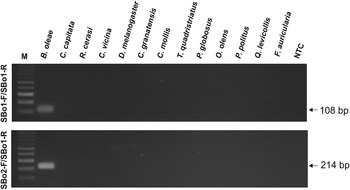
For the specific detection of B. oleae DNA, primers for the variable region of the 5′ end of mitochondrial COI sequence were designed taking into account the specific sequence of this insect. Forty-eight available COI sequences for B. oleae were aligned together with COI sequences from B. oleae collected in Mirandela, for detecting possible nucleotide polymorphisms in COI gene among B. oleae sequences. The B. oleae conservative sequence was then aligned with 120 COI sequences from phylogenetically related insects. B. oleae-specific primers were selected by comparing the highly variable COI regions among this fruit fly and other species, while avoiding intra-specific single nucleotide polymorphisms. Primers were checked for unfavorable secondary structures and compared with other DNA sequences using a BLAST search in the NCBI database to make sure they do not hit other genomic locations in target organisms. All designed primers (SBo1-F, SBo2-F and SBo1-R) amplified B. oleae DNA, resulting in a single DNA fragment. The use of both pairs of primers, SBo1-F/SBo1-R and SBo1-F/SBo2-R, generated a specific amplification with the predicted PCR products of 108 and 214 bp, respectively. Sequence analysis of amplified products indicated that both fragments shared 100% identity with B. oleae COI gene. No amplification was detected when using DNA extracted from legs, antennae and wings of other insects, which reveals the high specificity of the designed primers (fig. 1).
Designed primers specificity for Bactrocera oleae DNA detection. Agarose gel electrophoresis of COI-amplified fragments using B. oleae-specific primer pairs SBo1-F/SBo1-R and SBo2-F/SBo1-R and template DNA from different insect species (100 or 50 ng for each pair of primers, respectively). The selected species belong to Diptera (Tephritidae: B. oleae, Ceratitis capitata and Rhagoletis cerasi; Calliphoridae: Calliphora vicina; Drosophilidae: Drosophila melanogaster), Coleoptera (Carabidae: Calathus granatensis, Calathus mollis, Trechus quadristriatus and Pterostichus globosus; Staphylinidae: Ocypus olens, Philonthus politus and Quedius levicollis) and Dermaptera (Forficulidae: Forficula auricularia). Lane M is a 100 bp DNA ladder and the NTC lane is a no template control.

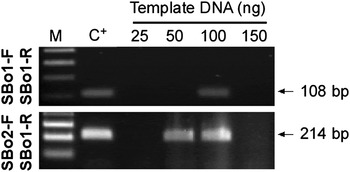
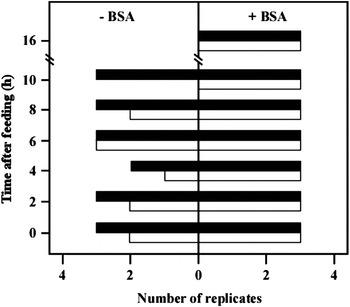
The efficiency of this PCR-based diagnostic test was then validated by the detection of B. oleae remains in the guts of a soil-living insect, P. globosus, as confirmed by the sequencing of the amplified fragments. Taking into account that insect guts could contain several PCR contaminants, and gut genomic DNA should be in sufficient amounts to allow the detection of even limited remains of B. oleae, the template DNA amount to be used in diagnostic PCR was optimized using insects that had just been fed on B. oleae pupae (fig. 2). The optimal DNA template amount was 100 ng for the primers pair SBo1-F/SBo1-R, but only 50 ng for the second primers pair SBo2-F/SBo1-R. These optimized concentrations were used in order to follow the digestion of B. oleae pupae by P. globosus using the designed diagnostic PCR. For testing the enhancer effect of BSA in amplification, all reactions were performed with and without BSA (0.5 µg µl−1). The absence of BSA affected the amplification consistency, since B. oleae DNA was not regularly detected in every replicate (fig. 3). This was more evident when using the primers pair SBo2-F/SBo1-R, resulting in an increased irregular amplification in replicates. Also, the feeding period where B. oleae DNA ceased to be detected in P. globosus was different in the absence of BSA for each: 10 h for SBo1-F/SBo1-R and 16 h for SBo2-F/SBo1-R (fig. 3). On the contrary, PCR amplifications performed in the presence of BSA always resulted in consistent amplifications up to the end of the feeding experiment (16 h).
Gut genomic DNA concentration optimization for detection of Bactrocera oleae DNA in feeding assay experiments. Pterostichus globosus insects just after been fed on B. oleae pupae were sacrificed and their intestinal apparatus used for genomic DNA extraction. Both B. oleae-specific primer pairs (SBo1-F/SBo1-R and SBo2-F/SBo1-R) were used in a diagnostic PCR containing BSA (0.5 µg µl−1) and different amounts of template DNA (25–150 ng). Lane M is a 100 bp DNA ladder and C+ corresponds to a positive control (B. oleae genomic DNA).

BSA effect on diagnostic PCR consistency in detecting Bactrocera oleae DNA on feeding assays. The number of PCR replicates that have resulted in an amplified product are represented in columns. Pterostichus globosus adults were fed on B. oleae pupae, after which they were sacrificed at different digestion periods (0–16 h) and their intestinal apparatus used for genomic DNA extraction. Diagnostic PCR was performed using B. oleae-specific primers [SBo1-F/SBo1-R (white columns) and SBo2-F/SBo1-R (black columns)] and template DNA amount (100 ng for SBo1-F/SBo1-R primers and 50 ng for SBo2-F/SBo1-R primers), in PCR reactions that contained BSA (0.5 µg µl−1) or not. Three replicates of P. globosus gut DNA were tested at each time period (0, 2, 4, 6, 8, 10, 16 h).

Discussion
This study developed a new PCR-based diagnostic assay for B. oleae using specific PCR primers for the COI DNA barcode region (Hebert et al., Reference Hebert, Cywinska, Ball and DeWaard2003). This gene displays high variable regions among different animal species, from which species-specific primers have been designed for performing species identification (Gariepy et al., Reference Gariepy, Kuhlmann, Gillott and Erlandson2007). The use of COI-specific primers in diagnostic PCR has been applied with success for the identification of Bactrocera spp., such as B. minax, B. tsuneonis and B. correcta, through the amplification of DNA extracted from either part or the entire body of an adult, larva or pupa (Jiang et al., Reference Jiang, Li, Deng, Wu, Liu and Buahom2013, Reference Jiang, Li, Wu, Wang and Xiong2014). The PCR-based diagnostic assay proposed in this work, not only presented new designed primers for the successful diagnosis of B. oleae, even in an early stage such as the larva or pupa, but also optimizes the PCR assay for detecting B. oleae remains in the guts of potential soil predators, which will be very useful for describing B. oleae-related food webs in olive grove ecosystems. Primer's specificity was tested to detect target and non-target species, since generalist predators can feed on a wide variety of prey items in olive groves. This reduces the likelihood of getting false positives due to the cross-reactivity of primers (Admassu et al., Reference Admassu, Juen and Traugott2006).
The feeding activity of P. globosus adults against B. oleae pupae was successfully followed by applying the conceived diagnostic PCR assay on the guts of the predator. The choice of the method used for DNA extraction of this kind of sample revealed to be very important to obtain a high quality DNA for downstream analysis. Insects are very rich in polysaccharides, one of the contaminants that can inhibit the PCR reaction, especially when the goal is to check the intestinal content (Staudacher et al., Reference Staudacher, Wallinger, Schallhart and Traugott2011). The use of BSA can improve PCR amplification in samples rich in contaminants acting as a PCR enhancer (Farell & Alexandre, Reference Farell and Alexandre2012). When DNA was extracted from the intestinal content of P. globosus, BSA proved to increase the PCR yield in such low purity templates as the intestinal content of arthropods. BSA had an enhancer effect and should be used in these types of samples to get more accurate and robust results.
The designed B. oleae-specific primers and optimized PCR-based diagnostic assay could provide an effective, fast and inexpensive method for detecting B. oleae predators, which will help to manage a more sustainable olive production system by the future identification of potential predators of B. oleae. Further studies will be performed in order to study predation of B. oleae by soil arthropods. For olive growers, this will represent the production of high-quality olives by reducing the application of insecticides and improving ecosystem services provided by soil arthropods such as biological control of pests.
Acknowledgements
This work was supported by FEDER Funds throughout Programa Operacional Factores de Competitividade – COMPETE and National Funds throughout FCT – Fundação para a Ciência e Tecnologia, within the project EXCL/AGR-PRO/0591/2012: Olive crop protection in sustainable production under global climatic changes: linking ecological infrastructures to ecosystem functions. M. Rejili was supported by a fellowship on the frame of Erasmus Mundus EU MARE NOSTRUM.