1. Introduction
The United Nations declared 2021–2030 as the decade for Ecosystem Restoration with the objective of preventing, halting and reversing degradation of ecosystems across the world.Footnote 1 To achieve these objectives, afforestation and forest restoration have been identified as key components both at the global and national levels (IPCC, 2018). The Government of Germany and the IUCN launched the BONN challenge in 2011 as part of which 61 countries across the world made commitments on planting trees and restoring 350 million hectares of degraded and deforested landscapes by 2030.Footnote 2 India’s pledge to restore 21 million hectares, amounting to just more than 7 per cent of its total land area, has apparently met with considerable progress (Govindarajulu, Reference Govindarajulu2023). As afforestation necessitates a high degree of land use change, the costs incurred during this process might be asymmetrically imposed on developing countries (Griscom et al., Reference Griscom, Adams, Ellis, Houghton, Lomax, Miteva, Schlesinger, Shoch, Siikamäki, Smith, Woodbury, Zganjar, Blackman, Campari, Conant, Delgado, Elias, Gopalakrishna, Hamsik, Herrero, Kiesecker, Landis, Laestadius, Leavitt, Minnemeyer, Polasky, Potapov, Putz, Sanderman, Silvius, Wollenberg and Fargione2017; IPCC, 2018). Even within these countries, the costs of afforestation could fall disproportionately on marginalized communities. To manage such contrasting objectives of forest policy, various alternative policy measures have been proposed over time. This paper contributes to the literature on the effectiveness of monetary incentive-based schemes in promoting afforestation. It underlines the significance of local contexts in the implementation of these schemes based on a framed field experiment (FFE) conducted in a forested location in the Western Ghats in Karnataka, India.
Market-based mechanisms have now become an essential component of the forest policy matrix. Along with carbon credits and a green credit scheme, monetary incentives to encourage forest conservation and restoration have been mooted at various levels. A wide array of these schemes fall under the umbrella of Payment for Ecosystem Services (PES) or Payment for Environmental Services (when amenities provided by built services are also included with ‘nature’ services). PES typically refers to mechanisms which are voluntary transactions involving payment to economic agents for provision of a well-defined ecological service (Wunder, Reference Wunder2005, Reference Wunder2015). For example, paddy farmers in the Indian state of Punjab were provided financial rewards for reducing crop residue burning in their farms (Jack et al., Reference Jack, Jayachandran, Kala and Pande2025). In general, the idea behind these market-based mechanisms is to internalize positive externalities and provide monetary incentives in line with the benefits derived from the protected environment.
PES and PES-type mechanisms have been mooted as a solution not just for forest related concerns but also for varied other environmental issues in the Indian context (Rathod, Reference Rathod2019). There are also demands for such schemes from varied stakeholders. For instance, some of the Indian states in the Himalayan region have demanded provision of a ‘green’ bonus for the forest cover they maintain. Among the other nation-wide initiatives on forest policy, Reducing Emissions from Deforestation and forest Degradation (REDD+), a form of PES, is being implemented with the objective of achieving afforestation goals. Going beyond a monetary incentive-based system, REDD+ involves a performance-based component for improving forest management. The ongoing REDD+ project in the Khari hills, Meghalaya, is an example of a large-scale community-based forest conservation and regeneration programme that generates carbon credits based on a PES mechanism. There have been some other attempts at PES programmes addressing water-related issues in Palampur and Kuhan villages in the state of Himachal Pradesh, India. However, there have been challenges in ensuring long-term sustainability of these endeavours (Ranjan, Reference Ranjan2021).
Given this background, it is imperative to understand the factors determining effectiveness of payment-based mechanisms in the context of countries in the Global South. Designing an effective PES which promotes wide scale participation may be difficult, particularly in a developing country context where the ecological benefits are dependent on heterogeneous opportunity costs faced by various groups in the community (Bulte et al., Reference Bulte, Lipper, Stringer and Zilberman2008; Southgate et al., Reference Southgate, Haab, Lundine and Rodriguez2010). Equally important are concerns related to distribution of monetary incentives among the various stakeholders. Potential ‘distribution’ risks related to who gets what and for what reason in the context of monetary payments could affect the long-term sustainability and benefits of PES (Zilberman et al., Reference Zilberman, Lipper and McCarthy2008; Hegde et al., Reference Hegde, Bull, Wunder and Kozak2015; Duong and de Groot, Reference Duong and de Groot2018). In the Indian context, most studies on PES have been on environmental conservation efforts. Our objective in this paper is to expand the focus in existing literature and evaluate the role of monetary incentive schemes as a part of forest policy, particularly afforestation. This is vital in the context of addressing the multidimensional nature of ‘successes’ in environmental policy-making (Blundo-Canto et al., Reference Blundo-Canto, Bax, Quintero, Cruz-Garcia, Groeneveld and Perez-Marulanda2018).
A critical aspect in the context of afforestation is the importance related to selection of tree species in climate mitigation efforts. Studies have drawn attention to the dangers of monoculture plantations and unplanned afforestation to carbon sequestration and local livelihoods (Fleischman et al., Reference Fleischman, Basant, Chhatre, Coleman, Fischer, Gupta, Güneralp, Kashwan, Khatri, Muscarella, Powers, Ramprasad, Rana, Rodriguez Solorzano and Veldman2020; Ramprasad et al., Reference Ramprasad, Joglekar and Fleischman2020; Rana et al., Reference Rana, Fleischman, Ramprasad and Lee2022). In our paper, we incorporate these concerns into PES policy-making, bringing risk in success of tree planting explicitly into people’s choices. A paper using large-scale meta-analysis on PES research between 2005 and 2019 has found limited engagement in social, political and cultural contexts when studying impacts of PES (Kolinjivadi et al., Reference Kolinjivadi, Hecken and Merlet2023). We address this gap in the literature by taking into account existing land tenure systems and their implications for afforestation policy with the introduction of monetary incentives such as PES.
We examine the potential effectiveness and distributional consequences of PES in promoting afforestation in the Western Ghats of India, a hilly region in Southwestern India. In this paper, we address the following research questions. Do monetary incentives help improve people’s willingness to plant native species trees? Does heterogeneity in the community affect the response to monetary incentives and what are its implications? How do existing tenurial rights affect the ‘distributional’ risk arising out of a PES scheme? We draw out the importance of negotiating existing social and ecological contexts in the success of afforestation policy.
We find the following from conducting our FFEs. Respondents planted more trees when they were offered a combination of money and non-timber forest products (NTFPs) as incentives. Respondents planted 15 per cent more trees and 12 per cent more native species trees when provided with NTFPs and money combination. There was no increase in the number of trees or native species trees planted when they were offered only money as incentives. The responses also varied based on tenurial rights of the respondents. The owners of private forests typically planted fewer trees. They also planted fewer native species trees than others but responded to monetary incentives more than those without access to such a forest. We discuss the policy and implications of these results in detail in our findings.
The remainder of the paper is organized as follows. Section 2 presents a brief overview of PES in forest policy and evaluation of PES using experimental studies, and describes the study area and sampling strategy. Section 3 presents the econometric methods. Section 4 presents the results of the study and Section 5 concludes.
2. PES: applications in forest policy and evaluation studies
This section presents a brief overview of literature across two strands. Section 2.1 presents an overview of the use of PES in forest policy. Section 2.2 presents an overview of experimental studies used in analysing PES.
2.1. PES in forest policy
As a concept, PES is based on Coasian bargaining, which proposed the possibility of internalising externalities if property rights are defined clearly and transaction costs remained negligible. This concept has been widely used in natural resource conservation including forestry (Alix-Garcia and Wolff, Reference Alix-Garcia and Wolff2014). In the case of forest restoration and afforestation, PES has influenced governance related to setting up multi-stakeholder agencies for payments and building contracts for encouraging sustainable practices (Pirard and Lapeyre, Reference Pirard and Lapeyre2014). The perceived success of PES in Latin American and African countries has provided an impetus to implement PES in developing countries in South Asia (ICIMOD, 2015). A major lesson in this field comes from the experiences of these programmes in South America and Africa and in parts of Southeast Asia (Blundo-Canto et al., Reference Blundo-Canto, Bax, Quintero, Cruz-Garcia, Groeneveld and Perez-Marulanda2018). Large-scale experiments in Mexico, Costa Rica and China and studies from there also provide significant insights related to effectiveness of PES (Snilsveit et al., Reference Snilsveit, Stevenson, Langer, Tannous, Ravat, Nduku, Polanin, Shemilt, Eyers and Ferraro2019).
Results across regional studies show that the effectiveness of PES in terms of afforestation and its consequences on heterogeneous groups is varied. In particular, tenure security has been identified as a key factor in determining both effectiveness and engagement of the local community in forest conservation (Holland et al., Reference Holland, de Koning, Morales, Naughton Treves, Robinson and Suárez2014; Monterroso and Sills, Reference Monterroso, Sills, Holland, Masuda and Robinson2022). Sunderlin et al. (Reference Sunderlin, Larson, Cronkleton and Angelsen2009) emphasize the importance of secure tenure rights in ensuring effectiveness, efficiency, and equity in REDD+. This draws upon the Stern Review (Stern, Reference Stern2006) which prioritizes defining property rights on forest land and determining rights and responsibilities of stakeholders as key to effective forest management.
The issue of tenurial rights becomes more complex in developing countries where multiple tenure systems exist simultaneously (Ahlheim and Neef, Reference Ahlheim and Neef2006; Knox et al., Reference Knox, Caron, Miner and Goldstein2011). Even within the village community, there are differing ownership and access rights to forest land. Studies on earlier PES initiatives find that benefit-sharing from PES is associated with pre-existing land tenures and other community norms (Izquierdo-Tort et al., Reference Izquierdo‐Tort, Corbera, Martin, Lillo and Dupras2022). PES incentives may be biased towards wealthy and privileged sections leading to more land consolidation in their hands (Mitchell and Zevenbergen, Reference Mitchell and Zevenbergen2011). Landowners could further monopolize benefits from PES schemes, where they face lower opportunity costs in enrolling in such schemes as compared to marginalized sections, thus exacerbating inequality in the region. Concerns of inclusivity and equity have therefore been prominent in debates related to PES implementation (Calvet-Mir et al., Reference Calvet-Mir, Corbera, Martin, Fisher and Gross-Camp2015; Duong and de Groot, Reference Duong and de Groot2018). Given complex tenurial systems still prevailing in India, we analyse participation in PES across groups with varying tenure rights to allow for insights into distributional consequences of introducing PES incentives in the study region.
Another significant aspect is that all tree planting cannot be considered as equally effective afforestation. The effectiveness of afforestation both in terms of carbon storage potential and impact on local livelihoods is dependent on the type of trees that get planted. Among the most important lessons from forest restoration studies has been the maxim that not all tree planting equates to forest restoration. Existing studies find that a mix of tree species rather than monocultures could enhance carbon sequestration capacities of plantations (Liu et al., Reference Liu, Trogisch, He, Niklaus, Bruelheide, Tang, Erfmeier, Scherer-Lorenzen, Pietsch, Yang, Kühn, Scholten, Huang, Wang, Staab, Leppert, Wirth, Schmid and Ma2018). Afforestation without consideration of local environmental context could deteriorate the local ecosystem as indicated in the context of China (Cao et al., Reference Cao, Xia, Suo and Wei2021). However, policies could be made to enhance afforestation of tree species suited to the local ecology. Countries like New Zealand have specific policies for afforestation of native species (West et al., Reference West, Monge, Dowling, Wakelin and Gibbs2020). Studies based in the Indian context have also found that plantations with a monoculture of exotic species were detrimental to local livelihoods (Coleman et al., Reference Coleman, Schultz, Ramprasad, Fischer, Rana, Filippi, Gunerlap, Ma, Solorzano, Guleria, Rana and Fleischman2021). While evaluating the potential impacts of PES on afforestation, it is thus critical to analyse if the outcomes are going to be equally effective between native and exotic tree species.
2.2. PES in FFEs
We use FFEs to study how incentives and institutional structures influence the individual's forest restoration decisions. FFEs build on lab experiments by incorporating elements that are context-specific to the study. Since FFEs incorporate context into analysing respondent behaviour, they tend to provide a higher level of external validity than laboratory experiments (Harrison and List, Reference Harrison and List2004). While randomized control trials could provide solutions by implementing an intervention on the ground, FFEs help us understand some of the critical aspects at a much lower cost. FFEs have therefore been extensively used to analyse implementation of PES for different environmental concerns. FFE studies on forests have been primarily in the context of forest conservation, with less research in the context of forest restoration.
Apart from Ostrom, the use of FFEs in the context of forest conservation decisions was pioneered by Cardenas et al. (Reference Cardenas, Stranlund and Willis2000) who analysed the impact of regulatory measures on conservation decisions. There have been studies that have analysed the implications of varying levels of fines on conservation behaviour (Rodriguez-Sickert et al., Reference Rodriguez-Sickert, Guzmán and Cárdenas2008). Other FFEs have investigated the effect of a payment-based mechanism on conservation as compared to community forest management (CFM) and command-and-control (CAC) forest management regimes (Handberg and Angelsen, Reference Handberg and Angelsen2015; Ngoma et al., Reference Ngoma, Hailu, Kabwe and Angelsen2020). These studies typically find that CFM performs better than PES and CAC in the context of forest conservation.
There have also been FFEs which have compared the design aspects of PES. Some studies have varied the provision of payment as a group payment or an individual payment (Midler et al., Reference Midler, Pascual, Drucker, Narloch and Soto2015; Salk et al., Reference Salk, Lopez and Wong2017; Andersson et al., Reference Andersson, Cook, Grillos, Lopez, Salk, Wright and Mwangi2018). Other variations in PES design include determining individual payments based on individual performance (Gatiso et al., Reference Gatiso, Vollan, Vimal and Kühl2018). Most of these studies find that individual payments incentivized participants to exhibit better collective behaviour as compared to group payments. A segment of FFEs have also underlined the importance of non-monetary benefits received from forests. While some of these studies incorporate these benefits into the PES design itself, others compare non-monetary benefits against monetary incentives. Rajapaksa et al. (Reference Rajapaksa, Gifford, Torgler, Garcia-Valiñas, Athukorala, Managi and Wilson2019) find that non-monetary incentives had a higher impact on conservation behaviour, particularly if the respondents had a pro-environmental attitude. Turpie and Letley (Reference Turpie and Letley2021) also find that non-monetary aspects like extra peer oversight could influence the effectiveness of PES.
An important element in many studies on PES is the inclusion of heterogeneous resource ownership and endowments of the participants as factors affecting individual decision-making behaviour and conservation results. For this purpose, studies have simulated endowment heterogeneity in the experimental set-up and have found them to play a significant role in effectiveness and equity outcomes of PES (Naime et al., Reference Naime, Angelsen, Molina-Garzón, Carrilho, Selviana, Demarchi, Duchelle and Martius2022; Vorlaufer et al., Reference Vorlaufer, Engel, de Laat and Vollan2023). We expand on this strand of literature to include the impact of socially determined endowment variables on people’s response to incentives in the context of afforestation choices. We propose that this approach would better reflect endowment heterogeneity and capture differential interests across sections of people over resource management and use.
2.3. Study area and data collection
This study was based in the Uttara Kannada district in Karnataka. Substantial regions of the Uttara Kannada district are part of the Western Ghats, making the district the highest in forest cover in Karnataka. The district has a wide variety of ecological zones with three broad categories across its administrative divisions – the coastal region comprising of five blocks, the hilly region comprising of four blocks, and two blocks in the transitional plain region (Bhat et al., Reference Bhat, Naik, Patagar, Hegde, Kanade, Hegde, Shastri, Shetti and Furtado2000).
Forest tenures in the region are an amalgamation of different systems and their characteristics vary across the blocks. These forests are broadly classified into reserved forests and protected forests following the colonial management system of forestry in the Indian sub-continent. In the Uttara Kannada region, reserved forests include forests proper which are designated as inaccessible to the public (only rights to access of water are recognized) and minor forests which are like village common forests (various access rights of the community are recognized). The protected forests are locally referred to as betta land in the study areas. Betta land is a tenure system unique to the areca growing belt of Karnataka and comprises of forest land which is allocated to areca nut cultivators to fulfil their requirements for biomass required for their cultivation (Hegde and Hegde, Reference Hegde and Hegde2013).Footnote 3 The areca cultivators do not have the right to cut trees or sell timber from these forest lands. They are permitted to collect dry leaves and other products such as fruits, nuts, dried grass, wet grass for fodder and fertilizer, and even firewood – which are called NTFPs – as they require. While these forest lands are held as village commons in the Karwar division, they have been distributed as private land in the Sirsi division. The extent of allocation also varies across the district, ranging from 4 to 9 acres of betta forests assigned per acre of areca land. Figures 1 and 2 depict collection of dry leaves and fertilization of areca trees using the leaf litter respectively.
Dry leaves collected for fertilization in betta land.

Areca Gardens fertilized by grass collected from betta land.

There is an extant literature that discusses the history of collectivisation of local elites (and their bargaining to obtain these land rights from the colonial Government), the current situation related to the degradation of this land, and the consequences of such privatized forest land (Bhat and Gadgil, Reference Bhat, Gadgil and Brandl1993; Lele, Reference Lele1993; Sinu et al., Reference Sinu, Kent and Chandrashekara2012). The existence and access to this particular system of protected forests could influence people's preference for specific tree varieties in the village common forests.
Regarding forest management in this region, the forest department plays a predominant role in managing reserve forests and a lesser but still significant role in managing the minor forests. These minor forests are considered village common forests and their management involves the village forest committee (VFC) comprising of members from the village and forest department. These committees usually set up plantations in these village minor forests, which include exotic and commercial trees such as teak, acacia and eucalyptus.Footnote 4 Upon harvest of the trees in the plantations, the returns are shared equally between the forest department and the VFC. The VFC funds are then equally split between a Village Forest Development Fund and a Village Development Fund. The village development fund (25 per cent of the harvest returns) is shared equally across the VFC members, typically as a non-monetary good such as a solar heater, solar cooker, LPG gas, or subsidy for refilling LPG gas. These products are decided based on the community’s demands and are usually inclined towards reducing local dependence on forests.
Apart from the VFCs, afforestation has also been encouraged through a scheme called Krushi Aranya Protsahana Yojane (KAPY). This scheme was launched in 2011–12 by the Karnataka Forest Department that focuses on incentivizing tree planting on private land and resembles a PES-type incentive mechanism. Under this scheme, an incentive of 125 Indian rupees (INR) per tree is given over a period of 3 years for those who plant specific trees. Adoption of the scheme in this region has been slow, predominantly because of low awareness and low pay out of the scheme. The VFCs and the KAPY scheme are currently being reoriented towards encouraging planting of native species trees. While rules banning acacia plantations (except under specified conditions) have been introduced, the monetary incentives under the KAPY exclude commercial trees. Acknowledging this policy shift, our experiment is designed to determine villager’s responses to incentives for restoration of native species trees.
2.4. Sampling
In the study district of Uttara Kannada, we cover two forest divisions, Karwar and Sirsi. We selected three forest ranges in Karwar and four in Sirsi where substantial forest area is part of the Western Ghats (excluding the coastal belt in Karwar and the plains region in Sirsi). The sampling frame included villages in these selected forest ranges with a population above 50 households and having a VFC.Footnote 5 Nine villages each were selected randomly from this sampling frame for both divisions with a sample of 900 households for the larger primary survey on household demographics, socio-economic features and forest restoration choices. A total of 120 individuals (belonging to different households) from 9 of these 18 villages then participated in the experiments. The individual respondents and households were selected such that there was diversity in the caste of the households and gender of the individual respondents. Participants within a village were randomly assigned to one of the three predetermined treatments in groups of five. Long distances between hamlets even within villages in the region reduce the risk of spillover effects.
2.5. Experiment design
The literature on experiments related to forest restoration/afforestation has typically used public goods game for simulating the context (Handberg and Angelsen, Reference Handberg and Angelsen2015; Ngoma et al., Reference Ngoma, Hailu, Kabwe and Angelsen2020). Our experiment is also designed as a public goods game incorporating features from the study region. In this game, participants in groups of five make decisions on the number and type of trees to plant on a piece of common land (associated with the idea of the minor forest in the region). Participation in the games was voluntary (informed consent was obtained) and all participants were given a sum of INR 200 (around half a day’s wage in the study area) for taking part in the experiment. There were three variations of experiments, which we designate as: Game 1 – ‘Only NTFP’, Game 2 – ‘NTFP + Money’, Game 3 – ‘Only Money’, based on the difference in type of returns for native species in the experiment. As the game includes monetary and non-monetary returns, it was played with hypothetical money and a prize (of nominal monetary value) was offered to the winner. There are five rounds in the game. Each player in the five-person group is given an endowment of 10,000 game rupees at the beginning of every round. They can use any portion of this money to purchase trees to plant on the common land, or not invest and retain the money. Each tree costs INR 500 to purchase, so an individual player can plant a total of 20 trees and the group as a whole can plant a total of 100 trees. At the end of the round, the monetary returns are equally shared between all members of the group, bringing in the possibility of free riding. There are two types of trees they can choose from – one is a monoculture plantation type tree which is characterized by a monetary return of INR 800 per tree in all variations of the game and these trees have a 100 per cent survival rate. We proposed the figure of INR 800 based on the estimated commercial returns from growing acacia, a commonly grown plantation tree in the region. Therefore, their returns from planting the native species would match their expected returns from growing acacia.
The nature of payoff for the native species is varied across the three games. In Game 1, all the payoffs from surviving native species were purely non-monetary in nature – bio-mass for agriculture (green leaves, dry leaves) and grass for fodder. This resembles the current VFC system where villagers can access only the NTFPs from native trees. Expected value of returns was set at INR 800 (INR 1,000 returns with 80 per cent survival rate on average) matching the returns from the monoculture trees. In Game 2, returns from the native species involved both monetary and non-monetary payoffs. Each surviving native species tree provided a payoff of non-monetary outcomes worth INR 700 and a monetary return of INR 300 which was paid using the game money. This resembles a PES mechanism with both access to NTFP and a monetary incentive. In game 3, which was played to estimate the risk-return trade-off, each surviving native species tree provided purely a monetary return of INR 1,000. Table 1 presents a summary of returns from both the trees in the three different games played in the study.
Description of the three games

Each round in a session had two winners – one who earned the maximum amount of money and one who planted the greatest number of native species. At the end of the round, money earned by the group was calculated and the winner of the round announced. To represent non-monetary returns as well, since winning was not exclusively based on earning the most money in the experiment, we provided an in-kind gift for the winner(s). The prize was a chocolate typically worth about INR 10 which was popular among the local people, especially when there were children around. This was about 5 per cent of the flat payment everybody received for participating in the experiment. In the case of a tie, multiple winners were declared. After players completed the five rounds, a round was selected randomly, and the prizes were given to the winners in that round. With such a design, there were two dominant strategies available for players to win the prizes. The participant could plant zero trees which would maximize her/his monetary payoffs and they would receive a prize. Alternately, the participant could plant all 20 native species trees and receive a prize. These two optimal actions for winning a prize remained the same for all the games.
The individual payoff for the respondent was based on the number of commercial and native species planted by the individual and the participants in the group. The participants have 20 game notes of INR 500 each for making the contributions. Of this total amount, they can withhold some amount in their private account, give some amount for planting native species and the remaining for planting commercial species trees. The following equations present the individual payoffs in the three games:
Payoff for Game 1 (only NTFP):
 \begin{equation}\begin{array}{*{20}{c}}
{\left( {10{,}000 - 500\ast\left( {{C_{iG}} + {N_{iG}}} \right)} \right) + 160\ast{C_G} + NT{\text{ }}\left( {worth{\text{ }}200} \right)\ast{N_S}}\,.
\end{array}\end{equation}
Payoff for Game 2 (NTFP + Money):
 \begin{equation}\left(10,000-500\ast\left(C_{iG}+N_{iG}\right)\right)+160\ast C_G+140\ast N_S+NT\left(worth\text{ }60\right)\ast N_S\,.\end{equation}
Payoff for Game 3 (only Money):
 \begin{equation}\left(10,000-500\ast\left(C_{iG}+N_{iG}\right)\right)+160\ast C_G+200\ast N_S\end{equation}
where
 \begin{equation}\begin{array}{*{20}{c}}
{C_G} = {\sum_i {C_{iG}}} \\
{{N_S} = \sum_i {N_{iG}}}\ast Survival\ rate
\end{array}\end{equation}
where  ${\text{ }}{C_{iG}}$ is the number of commercial tree species planted by the individual participant
 $i;{\text{ }}{N_{iG}}$ is the number of native tree species planted by the individual participant
 $i;$
 ${C_G}$ is the total number of commercial species planted by the group, NT refers to NTFP and
 ${N_S}$ is the total number of native species that survived, which was decided by planting decisions and a roll of the die (as indicated in Equation (4)). The survival rate is decided by a roll of the die to be either 60, 80 or 100 per cent for each round of the game. The biomass and fodder in Games 1 and 2 were simulated by providing participants with bundles of sticks and grass which were indicative of the non-monetary payoffs. These products were allocated in proportion to the number of native species planted by the group. The participants decided on the distribution of these products among themselves. The public good nature of the trees meant monetary payoffs were divided equally among the individuals. For every commercial tree planted, each participant received a payoff of INR 160 (INR 800 as indicated in Table 1 which was divided among the five players). The monetary payoffs for surviving native species were also decided in the same manner (either INR 1,000 or INR 700 divided by 5 for each surviving trees based on the game they played). A detailed illustration of payoffs from the game is provided in online appendix A.
The native species and monoculture plantation trees vary in their survival rates. Acacia has a very high survival rate — as one of our respondents expressed it: ‘if you plant 100 trees, next season you may have 120.’ But the native species have a lower survival rate. In the game, the expected survival rate is set at 80 per cent following a uniform distribution. Randomness is brought in with survival rates of 60, 80 or 100 per cent determined at the end of the round by a roll of the die thrown by any player in the group. A throw of 1 or 2 would lead to 60 per cent survival rate, a throw of 3 or 4 to 80 per cent and a throw of 5 or 6 to 100 per cent survival rates.
3. Econometric estimation
In our analysis, the key dependent variables are percentage of total trees and percentage of native species trees (out of 20 total trees they could plant) planted by the respondent. In particular, we are keen on the following estimates from the econometric estimation — the effect of the type of game (‘NTFP + Money,’ and ‘Only Money’ in comparison to ‘Only NTFP’) on the outcome variables, and the effect of forest tenure on the game type response to outcome variables. We control for demographic and other socio-economic variables which could affect decision-making. Table 2 presents the descriptive statistics of these variables across participants in these three groups. It indicates that the difference in demographic variables across the groups are not statistically significant. There are differences in the proportion of areca cultivators and betta land owners and we have included them as control variables in the econometric estimation.
Summary statistics of respondents across games

In the econometric formulation, the tree plantation is modeled as follows:
Percentage of total trees planted or Percentage of native species tree planted = f (Game type, Gametype*betta land ownership, Age, Sex, Education, Areca cultivation).
Since we randomized across groups and not across individuals, common group-level effects could affect the outcome variables.Footnote 6 In such cases, there is a case for using ‘Within-between’ estimator or ‘Mundlak approach’ or ‘Mundlak correlated random effects model’ (Mundlak, Reference Mundlak1978; Dieleman and Templin, Reference Dieleman and Templin2014; Bell and Jones, Reference Bell and Jones2015). Using this approach, we model the econometric relationship in the following manner:
 \begin{equation}\text{ }y_{jn}=\sum_i\beta_i\left(x_{jn}-\overline{x_j}\right)+\sum_k\gamma_k\overline{x_j}+u_{jn}\text{ }where\text{ }u_{jn}=\mu_n+\varepsilon_{jn}\end{equation}
where for jth individual in the nth group, ${\text{ }}{y_{jn}}{\text{ }}$ is the proportion of total trees planted calculated as number of trees planted divided by 20 and proportion of native species trees planted calculated as the number of commercial trees planted divided by 20. The
 ${\beta _i}$s in Equation (5) are the estimates indicating the effect of within-group variations of the independent variable,
 ${\gamma _k}s$ are the estimates of the between-group mean variations of the independent variable, and the overall error term is decomposed into group-level errors and errors within the observations in a group. The key independent variables of interest are the dummies indicating whether they played ‘NTFP + Money Game’ or ‘Only Money’ game. The other variables of interest are the interaction of these dummies with a dummy indicating betta land ownership to see if these game effects vary with ownership of betta land. Using this estimation, there would not be any within-group estimators for group level variables like the game type and village in our context. For all the other variables like age, sex, education, areca cultivation dummy, and the interaction variables, there will be estimates for effect of within-group and between-group variations of the variable on the outcome variable. The estimation in this paper is done using STATA command xthybrid as described in Schunck and Perales (Reference Schunck and Perales2017).
4. Results and discussion
The three games we played are denoted as follows based on the payoffs received for the native species: ‘only NTFP’ game (Game 1), ‘NTFP + Money’ game (Game 2) and the ‘Only Money’ game (Game 3). In the following subsections, we provide the detailed results from our analysis.
4.1. Planting of native species and total trees
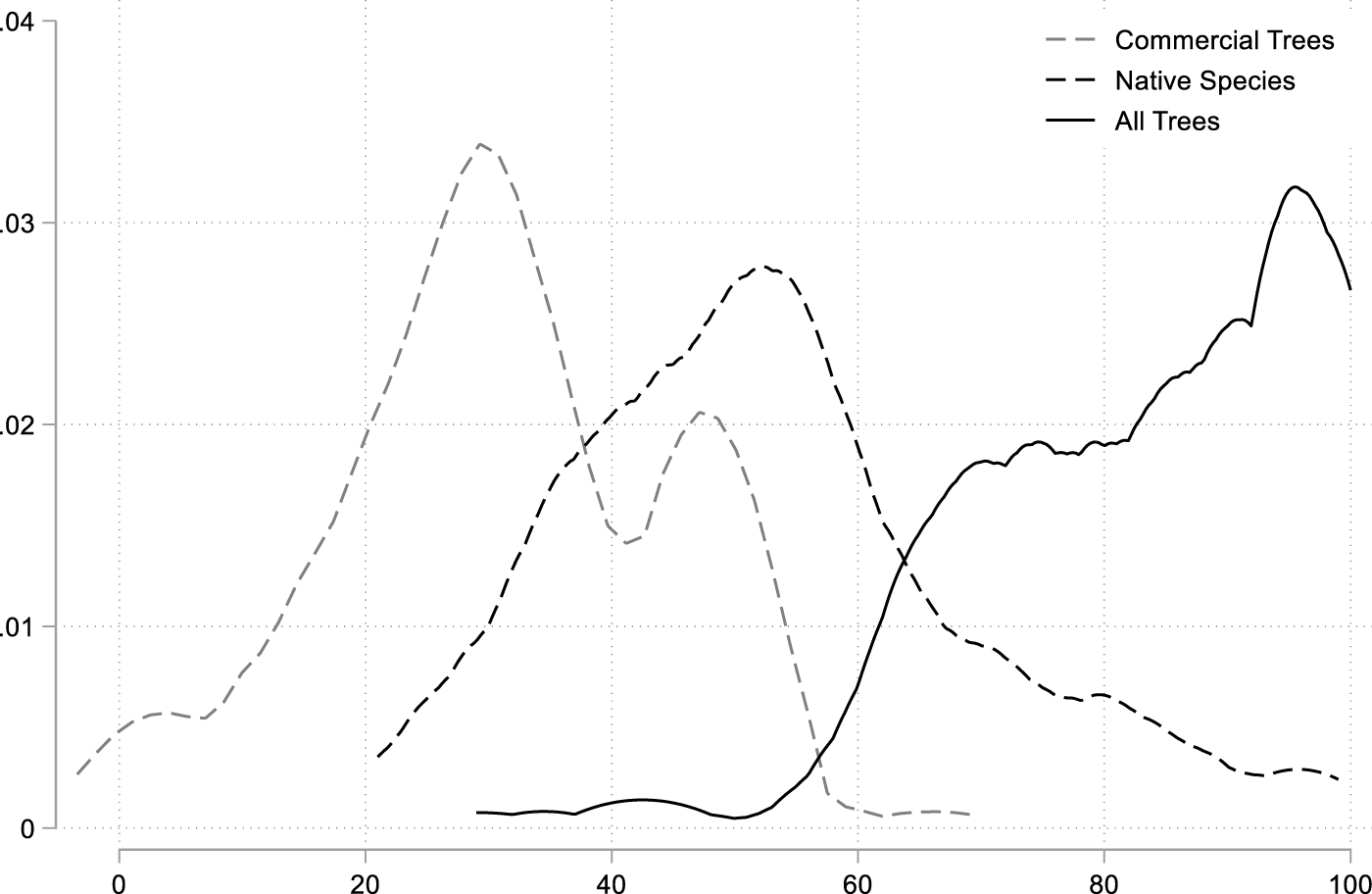
There were two strategies to maximize returns in the game – plant zero trees and be a free rider or plant all native species and win the prize in the game. We find that, across the groups and in all the games, none of the players chose to plant 0 trees. Figure 3 depicts group decision-making behaviour on number of commercial and native species trees planted. Responding to incentives, participants on average planted a higher number of native trees. None of the groups moved towards the no trees planted equilibrium where all members opt to free ride completely and maximize monetary returns to win the game.
K-density distribution of trees planted.

Out of the total 600 choices on afforestation made by the players, there were only 15 instances where five or less trees were planted by any individual. If we analyse their decisions over the five rounds, the minimum trees planted by any individual across the five rounds (out of the total 120) was 22, which was itself an outlier, with all others planting above 50. These results reiterate the community-level repeated game tendency to cooperate and not free ride. It also emphasizes the importance of the use of FFEs which incorporates morality, beliefs and trust within a community in understanding environmental behaviour.
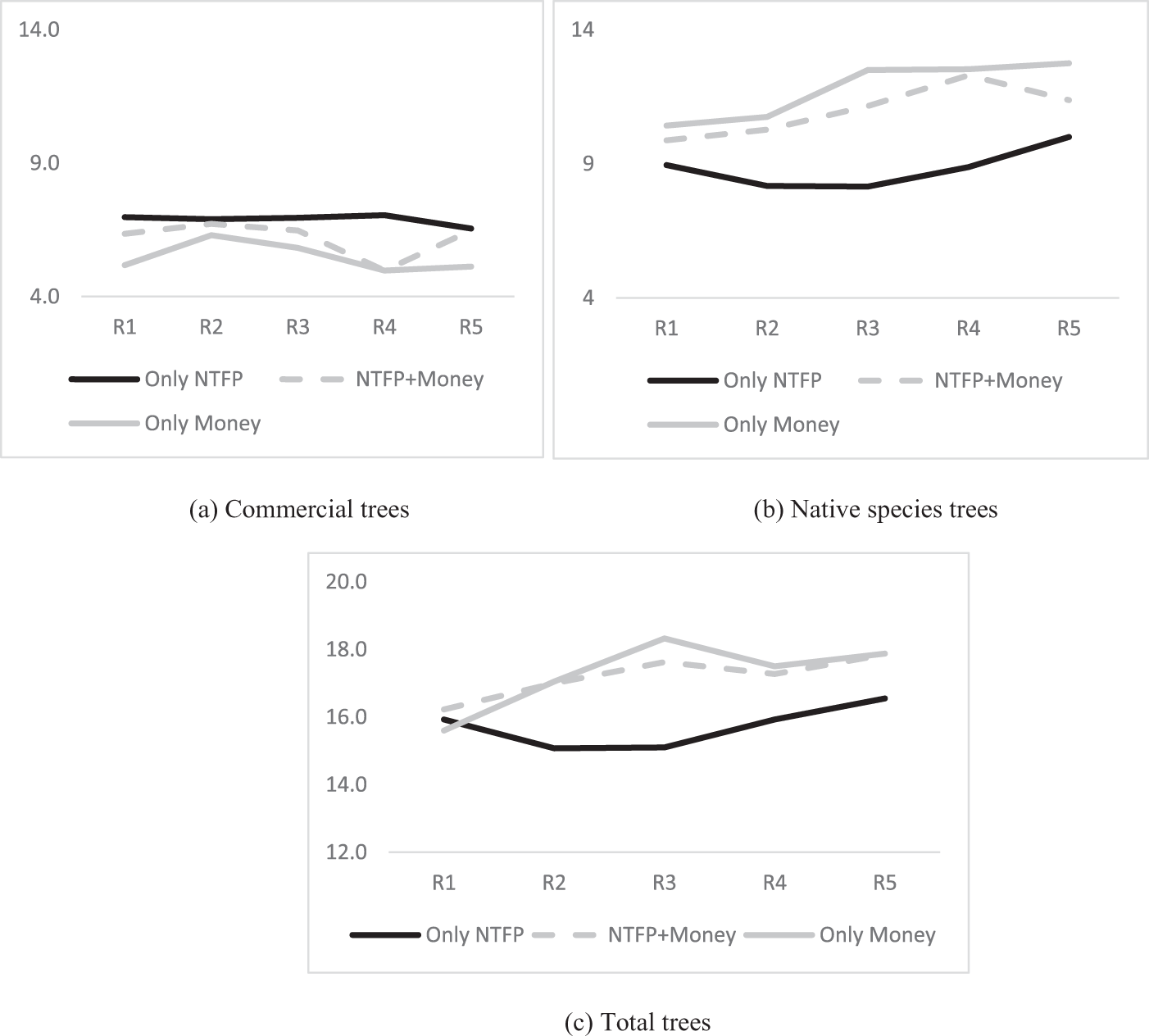
The cooperative behaviour persists across the three different interventions though the distribution between the number of commercial trees, native species trees, and total trees planted varies (panels (a)–(c) in Figure 4). We observe that over rounds, the level of cooperation indicated by total number of trees planted appears to increase in all the games. We also find that, across all the games, more native species were planted compared to commercial trees. The average number of native trees planted seems highest in the monetary incentives only game, followed by the ‘NTFP + Money’ and ‘Only NTFP’. The difference between native and commercial trees planted is the highest in the ‘Only Money’ game. While this may appear to support the hypothesis of PES and monetary incentives providing more optimal policy options, there is significant heterogeneity in decision-making within and across the groups. In the next section, we control for landholding, gender and other demographic and socio-economic parameters to check if this same pattern and results are substantiated.
Number of trees planted across three interventions. (a) Commercial trees. (b) Native species trees. (c) Total trees.

4.2. Results of the econometric estimation
In our analysis, there are estimates at two levels for demographic variables, areca nut cultivation dummy and betta land ownership dummy: a variation within-group estimate and a variation between-groups estimate (Perales, Reference Perales2013). We estimate these models using xthybrid function in STATA which allows for both linear and non-linear mixed-regression estimation. The first model (Model I) estimates proportion of total trees planted, and the second model (Model II) estimates the proportion of native trees planted (Table 3).
Econometric estimation for share of total trees and share of native species trees

The estimates show no clear evidence of higher number of trees or higher number of native species trees planted when the payoffs were in the form of ‘Only Money’ as compared to ‘Only NTFPs’. This finding raises questions on the effectiveness of a purely monetary payment-based system in encouraging tree plantations. Among the interventions, the ‘NTFP + Money’ has a positive and significant effect on both proportion of trees planted and native trees planted. This could indicate a positive response to PES when supported by access to the forest products. This was reinforced in conversations where the villagers emphasized the need for both monetary returns and access to the forest for firewood and other NTFPs. We find that respondents who were offered a combination of NTFP and money planted 15 per cent more trees and 12 per cent more native species trees. There was no increase in the number of trees or native species trees among respondents who were offered only money as incentives. The mechanism driving this could be that players are planting trees for a wider set of requirements – both for monetary returns and for household use. This might imply that respondents value trees that provide varied kinds of benefits. Studies support this proposition of people valuing co-benefits while engaging with the afforestation programmes. For instance, a study on large-scale afforestation in Rajasthan found that an expansion of forest area improved agricultural outcomes when supported by community participation and distribution of monetary and non-monetary benefits (Kamble et al., Reference Kamble, Brewer and Oliver2025). The valuation of co-benefits could also vary based on the existing endowments of the individuals and we test that proposition with regard to betta land ownership.
Findings from previous studies using FFEs have been varied. For instance, Handberg and Angelsen (Reference Handberg and Angelsen2015) find no effect of PES but find 11–14 per cent reduction in harvest rates among participants who faced a CAC policy. Ngoma et al. (Reference Ngoma, Hailu, Kabwe and Angelsen2020) find that PES reduced harvest rates by 15 per cent. Gatiso et al. (Reference Gatiso, Vollan, Vimal and Kühl2018) find that the equality-based and performance-based monetary incentives reduced harvest rates in the range of 4–8 per cent. Andersson et al. (Reference Andersson, Cook, Grillos, Lopez, Salk, Wright and Mwangi2018) find that payments reduced deforestation by 19 per cent and, when combined with communication in the FFEs, this went down by 48 per cent. Importantly, they find that even after monetary incentives were removed, the harvesting rate was 4 per cent lower than the pre-treatment levels for the group that received monetary payments. There have been some FFEs which have simulated security of land tenure in the experiments. Walker et al. (Reference Walker, Alix-García, Bartlett and Calder2025) finds that insecure land tenure, simulated within the experiment, increased tree extraction by 23 per cent. But they do not analyse the effects of monetary or non-monetary incentives along with these tenurial variations.
These results become more distinctive when analysing the socio-economic and demographic factors driving people's choices. In our study, a key finding which is consistent across native species and total trees is that, as the average betta owners in a group went up, the percentage of total trees planted as well as the percentage of native species planted went down. As betta owners in groups increased, the proportion of trees went down by 41 per cent and the proportion of native species planted by respondents went down by 61 per cent. This finding is not just consistent across the presented models but was also consistent with simple ordinary least square estimation. The estimates of these models are presented in Table A1. This finding is critical to our research. As mentioned above, betta land ownership implies access to private forest land (with tenure rights for defined activities including tree planting). The betta land holders are also hereditary areca nut growers and belong to the dominant castes in the region. When a group involves more participants who own betta land (tenure rights on forest land therefore), the model shows a decrease in both the number of trees planted and the number of native species planted. The fall in native species is higher (about 60 per cent) compared to that of total trees (about 40 per cent). Betta land was allocated to areca cultivators based on biomass requirements for areca cultivation. Therefore, their dependence on the village forests (the commons) for biomass is less, which seems to be reflected in their decision-making in the game. This might imply that if the villages have more betta land owners, the ability to make the villagers grow forests with native species trees might be a more difficult task. The private ownership of assets (betta land) by the land owners reduces their investment in and cooperation in maintaining the commons. Similar results have been found on the behaviour of landowners in the case of bore well ownership and tank maintenance (collective water resource) in South India (Krithi, Reference Krithi, Nawn and Elamon2018). The low number of trees, a public good provision, also indicates a reduced sense of cooperation as the number of betta land owners go up in a group.
Even more interesting is the interaction of betta land ownership and changes in incentives. When given ‘money + NTFP’ for native species, the betta land owners plant more native species but not more trees in total. This suggests that betta land owners view commercial trees and native species offering ‘money + NTFP’ as substitutes and reduce commercial trees planted to compensate for the increase in number of native species trees planted. These findings imply that monetary incentives work mainly for betta owners. Among those who were provided monetary incentives, betta ownership increased total trees planted by 44 per cent and native species trees by 64 per cent. As betta owners are not dependent on common forests for their bio-mass requirements, they probably responded more to monetary incentives for planting native trees.
Other sections of the population are still dependent on common forests for various NTFPs such as firewood and leaves. Recent areca growers who do not own betta land collect leaves for biomass from the forests for which native species are required. The model finds that respondents who have planted areca nut trees in their fields have a higher share of native trees planted. This was significant within a group while there was no such effect on the areca nut cultivators across the group. When average areca nut cultivators in a group went up, the share of total trees cultivated went down.
We also find differences in correlates of variables like gender, education, areca nut ownership as a proportion of total trees planted and proportion of native species trees planted. For instance, while women seem to plant a smaller number of total trees than men, there is no difference with regard to native species. Areca nut growers within a group seem to grow more native species trees but do not plant more total trees. These findings demonstrate the importance of developing and analysing afforestation policies for native species and commercial species differently.
When we controlled for round fixed effects, we found that the proportion of native species and total trees went up as the players played more. The proportion of total trees went up from the third round and that of native species started going up from the fourth round. Some of the village controls were also found to be significant. This indicates that the nature and history of the village community and institutional parameters also affect participation in tree planting programmes. Therefore, monetary incentives need to be guided by local social and economic factors for more equitable and effective afforestation policies.
5. Conclusions and policy implications
Our paper analyses the effect of a combination of monetary and non-monetary returns from native species trees on afforestation choices in the district of Uttara Kannada, India. We conduct an FFE which provides the respondents choices between planting an assortment of commercial trees and native species in their village forests. Across three experimental set-ups, we vary the returns from native species into ‘Only NTFP’, ‘NTFP + Money’ and ‘Only Money’.
Based on an econometric estimation that considers the possibility of cluster effects, we find that there is no common response from all respondents towards planting more trees or more native species if provided with only monetary returns. There is an increased plantation of trees, particularly native species trees when provided with a combination of money and NTFPs compared to only providing NTFPs. We find significant heterogeneities in the behaviour of the respondents, and we believe it has significant policy implications for implementation of schemes based on PES in a developing country context.
Our study reiterates the importance of basing PES mechanisms on local context both for efficiency and maximizing participation. In our experiments, we find that the response to PES is dependent on the presence of betta land owners in the group. The betta owners seem to be less interested in planting trees in general but plant more if provided with monetary incentives. This heterogeneity illustrates the importance of tenurial rights and norms and questions the rationale for assuming a uniform effectiveness of PES even within a local region.
Second, any implementation of PES should be aware of the distributional consequences they are likely to have in the region. The study region has a very low population of native tribes, but a significant privileged land-owning class that has practiced agroforestry for centuries. The current afforestation measures using programs such as VFCs have been equitable where the monetary returns have been distributed equally among the villagers. It has also provided higher returns to marginalized groups by providing them with extra benefits like refilling LPGs. These measures have also provided limited access to NTFPs for the marginalized groups. Given that betta lands are typically owned by the privileged classes in the study region (Nadkarni et al., Reference Nadkarni, Pasha and Prabhakar1989), implementing PES without accounting for land relations will exacerbate inequality in the region and perpetuate the ‘distribution risk’ anticipated in the PES literature (Duong and de Groot, Reference Duong and de Groot2018). That PES could increase poverty and inequality is a warning that has been raised based on theoretical and empirical evidence in parts of the world (Engel et al., Reference Engel, Pagiola and Wunder2008). Our study based on experimental evidence also provides potential possibility in the same direction.
We also find that the correlates related to native species planting and total tree planting are different. This emphasizes that PES as a policy needs to be configured differently for commercial and native species trees. This is an important finding as both environmental and local livelihood benefits of afforestation crucially hinge on the type of tree species that are planted (Coleman et al., Reference Coleman, Schultz, Ramprasad, Fischer, Rana, Filippi, Gunerlap, Ma, Solorzano, Guleria, Rana and Fleischman2021; Rana et al., Reference Rana, Fleischman, Ramprasad and Lee2022).
One of the key limitations of this paper is the restrictions that are imposed with the use of FFEs. There could be multiple iterations regarding monetary payments and types of non-monetary incentives. We tried only a few of these variations given the time and budget constraints. Future research could address the impact of alternate non-monetary incentives and quantum of monetary returns in affecting people’s decision-making. More rigorous qualitative studies that could uncover the processes behind decision-making of villagers would lend strength for policy-making and implementation.
Supplementary material
The supplementary material for this article can be found at https://doi.org/10.1017/S1355770X25100417.
Acknowledgements
We would like to acknowledge the excellent research assistance provided by Ms. Divyashree for conducting the field surveys and coordinating the data entry. We also acknowledge Mr. Rahul Kamal for his research assistance. We also would like to thank Ms. Murchana Nath and Mr. Smruti Ranjan Sahoo who assisted in conducting literature review and analysis of data. We also acknowledge the comments provided by Prof. Kavita Sardana as a discussant in the CESP Golden Jubilee Conference on “Economic Theory and Policy in India” held in New Delhi, India, on December 11–13, 2023. This paper is an outcome of a research project titled “A Comparative Assessment of Payment for Ecosystem Services (PES) and Community Action using Norms” funded by the International Centre for Integrated Mountain Development (ICIMOD). We thank Prof. Jeffrey R. Vincent and researchers at South Asian Network for Development and Environmental Economics (SANDEE) for their critical discussions at the Annual Workshops and online progress review meetings.