Introduction
The behavioral theory of the firm (BTOF) argues that firms assess their performance by comparing it to their aspiration level, and performance falling short of the aspiration level triggers problemistic search and subsequent organizational change (Cyert & March, Reference Cyert and March1963). Such performance assessment is associated with both the magnitude and the duration of performance relative to the aspirational level (Iyer, Baù, Chirico, Patel, & Brush, Reference Iyer, Baù, Chirico, Patel and Brush2019; Yu, Minniti, & Nason, Reference Yu, Minniti and Nason2019). It is worth noting that prior studies have focused mainly on the magnitude dimension of performance shortfalls (Chen, Reference Chen2008; Kuusela, Keil, & Maula, Reference Kuusela, Keil and Maula2017; Lin, Reference Lin2014; Tyler & Caner, Reference Tyler and Caner2016). More recently, several studies have begun to investigate the time dimension of performance shortfalls (i.e., the duration of underperformance) (Iyer et al., Reference Iyer, Baù, Chirico, Patel and Brush2019; Yu et al., Reference Yu, Minniti and Nason2019).
Importantly, performance assessment in the performance feedback process is based on the subjective interpretation of performance feedback information rather than on an objective assessment of firm performance (Gavetti, Greve, Levinthal, & Ocasio, Reference Gavetti, Greve, Levinthal and Ocasio2012; Greve & Gaba, Reference Greve, Gaba, Argote and Levine2020; Jordan & Audia, Reference Jordan and Audia2012; Joseph & Gaba, Reference Joseph and Gaba2015; Levinthal & Rerup, Reference Levinthal and Rerup2006). This subjective interpretation of performance feedback can be significantly distorted by the cognitive lenses and behavioral biases of decision-makers (Schumacher, Keck, & Tang, Reference Schumacher, Keck and Tang2020). The extant research has not yet fully explored how cognitive lenses and behavioral biases shape the relationship between underperformance duration and firm responses.
To address this issue, we focus on a specific cognitive lens, the shaping of cognition by the temporal grammar of the language, and explore how this cognitive lens molds the relationship between performance feedback and firm responses. More specifically, we investigate the effect of the future-time reference (FTR) of languages, which reflects whether a language requires its speakers to distinguish grammatically between the future and the present. Strong FTR languages require speakers to grammatically mark future events and present events in different ways; in weak FTR languages, speakers can describe future events and present events in the same manner (Chen, Reference Chen2013).
This difference in FTR can significantly influence individuals' temporal cognition and bias decision-making by individuals (Chen, Reference Chen2013; Pérez & Tavits, Reference Pérez and Tavits2017) or firms (Kim, Kim, & Zhou, Reference Kim, Kim and Zhou2021; Liang, Marquis, Renneboog, & Sun, Reference Liang, Marquis, Renneboog and Sun2018). Specifically, strong FTR languages make people perceive the future as more temporally distant from the present (Dahl, Reference Dahl and Dahl2000), which reduces the psychological importance of the future (Kim, Kim, & Zhou, Reference Kim, Kim and Zhou2017). In line with this reasoning, prior studies have shown that speakers of strong FTR languages save less, retire with less wealth, and smoke more than speakers of weak FTR languages do (Chen, Reference Chen2013). Prior studies at the firm level have also revealed that firms in strong FTR language countries engage less in corporate social responsibility (CSR) and research and development (R&D) (Liang et al., Reference Liang, Marquis, Renneboog and Sun2018) and engage more in earning management (Kim et al., Reference Kim, Kim and Zhou2017).
We argue that temporal cognition shaped by FTR molds the relationship between the underperformance duration and firm responses because FTR can affect subjective judgments regarding the imminence of problems flagged by performance feedback information and the importance of making certain responses. To better reveal the mechanisms through which FTR influences the performance feedback process, we further introduce slack resources and political stability as moderators of the effect of FTR, each of which influences a different mechanism underlying the effect of FTR. On the one hand, slack resources can influence decision-makers' belief in whether they have a sufficient buffer against failure (Deb, David, & O'Brien, Reference Deb, David and O'Brien2017; Vanacker, Collewaert, & Zahra, Reference Vanacker, Collewaert and Zahra2017) and thus are closely related to problem recognition (Posen, Keil, Kim, & Meissner, Reference Posen, Keil, Kim and Meissner2018). On the other hand, political stability affects firms' expectations of investment returns and confidence in obtaining the projected value of investments (Maitland & Sammartino, Reference Maitland and Sammartino2015), which is relevant to the evaluation of the importance of firm responses.
Using a sample of 12,309 firms from 12 countries in the period between 2007 and 2019, we examine how FTR moderates the relationship between the underperformance duration and the acquisition activity of firms. We further investigate the moderating effects of the slack resources of firms and the political stability of countries on the effect of FTR. We use these two moderation effects to support the credibility of the FTR-related mechanisms underlying our hypotheses. We employ firm acquisitions as a response to performance discrepancies in our research context for the following reasons. First, the context of acquisitions has been demonstrated to be an appropriate research setting to apply the BTOF (Iyer & Miller, Reference Iyer and Miller2008; Kim, Finkelstein, & Haleblian, Reference Kim, Finkelstein and Haleblian2015; Zhang & Greve, Reference Zhang and Greve2019). Second, acquisitions are generally resource-consuming (Li, Xia, & Lin, Reference Li, Xia and Lin2017). This means that acquisition decisions are important and hence will be subject to ample consideration. If the expected biases induced by FTR occur in this context, this testifies to their practical significance. Third, as the importance, frequency, and size of acquisitions have greatly increased in recent decades (Cho, Arthurs, Townsend, Miller, & Barden, Reference Cho, Arthurs, Townsend, Miller and Barden2016), acquisition decisions are an important topic in strategic management.
Our study makes three contributions to the literature. First, our study brings a temporal lens to the BTOF and performance feedback literature. Although the important roles of temporal lenses in shaping managerial cognition, decision-making, and organizational changes have been acknowledged in prior research (Nadkarni & Chen, Reference Nadkarni and Chen2014), how temporal cognition affects the performance feedback process has remained largely unexamined. Notably, temporal cognition is crucial for the interpretation of performance feedback information and the judgement regarding the value of a certain response, and thus, the introduction of a temporal lens can advance our understanding of the performance feedback process. Specifically, our study investigates how the temporal cognition shaped by FTR influences performance feedback. We theorize and empirically examine two mechanisms underlying the effects of FTR on performance feedback, i.e., the imminence reduction mechanism and the value-discounting mechanism. To the best of our knowledge, no existing study has explored the role of FTR in shaping the relationship between performance feedback and responsive behaviors. Second, our study enriches the literature on how cognitive and behavioral biases shape the performance feedback process by identifying an important source of cognitive bias that stems from FTR and revealing the significant role of FTR in shaping the relationship between underperformance duration and organizational changes. Third, our study answers the calls to strongly incorporate the concept of time into management research (Ancona, Goodman, Lawrence, & Tushman, Reference Ancona, Goodman, Lawrence and Tushman2001; Huy, Reference Huy2001; Ofori-Dankwa & Julian, Reference Ofori-Dankwa and Julian2001) and the recent calls for more attention to the implications of language differences for management (Tenzer, Terjesen, & Harzing, Reference Tenzer, Terjesen and Harzing2017).
Theoretical Background and Hypotheses Development
Performance Feedback, Underperformance Duration, and Acquisitions
Making acquisitions is an important value-creating strategy because acquisitions enable firms to obtain new capabilities and knowledge (Ahuja & Katila, Reference Ahuja and Katila2001), gain economies of scale and scope (Schweizer, Reference Schweizer2005), enhance market power (Ruth, Iyer, & Sharp, Reference Ruth, Iyer and Sharp2013), enter new markets (Cerrato, Alessandri, & Depperu, Reference Cerrato, Alessandri and Depperu2016), restructure operations (Karim, Reference Karim2006), and create synergies (Iyer et al., Reference Iyer, Baù, Chirico, Patel and Brush2019). However, acquisitions do not always improve the acquiring firm's performance. Sometimes acquisitions may erode firm performance. In fact, firm decision-makers form perceptions regarding the strategic potential of performance-enhancing options (Salge, Kohli, & Barrett, Reference Salge, Kohli and Barrett2015) and make choices on the basis of the perceived gains from making an acquisition (Hoang & Ener, Reference Hoang and Ener2015). This is why even if there are cases in which acquisitions did not increase the acquirers' firm value, decision-makers may still perceive acquisitions to be an appropriate organizational change when responding to performance shortfalls because ‘the rationale for acquisition activity has primarily been that firms seek higher performance’ (Ruth et al., Reference Ruth, Iyer and Sharp2013: 2287), and decision-makers generally assume a value-creating objective when initiating an acquisition (Iyer et al., Reference Iyer, Baù, Chirico, Patel and Brush2019).
The BTOF argues that when a firm fails to attain the aspiration level, its decision-makers will be motivated to initiate a problemistic search for solutions to improve performance and take the risks inherent in organizational change (Ben-Oz & Greve, Reference Ben-Oz and Greve2015). As such, acquisition is a pronounced and common strategic option in the problemistic search process for performance improvement (Cho et al., Reference Cho, Arthurs, Townsend, Miller and Barden2016; Iyer et al., Reference Iyer, Baù, Chirico, Patel and Brush2019; Ruth et al., Reference Ruth, Iyer and Sharp2013).
We expect that the tendency toward firm acquisitions increases with the duration of underperformance. This is because repeated performance shortfalls reveal more information for decision-makers to form a complete understanding of the status of their firm's operations (Joseph & Gaba, Reference Joseph and Gaba2015; Lant & Hurley, Reference Lant and Hurley1999) and prompt them to make organizational changes (Haleblian & Rajagopalan, Reference Haleblian, Rajagopalan, Szulanski, Porac and Doz2005). In addition, repeated performance shortfalls form a strong signal of firm failure, which pushes decision-makers to address this situation. In contrast, if underperformance arises only occasionally, decision-makers may reduce the pressure on them to make organizational changes by ascribing this failure to factors beyond their control (Fang, Kim, & Milliken, Reference Fang, Kim and Milliken2014; Jordan & Audia, Reference Jordan and Audia2012). Therefore, when encountering repeated performance shortfalls, decision-makers tend to screen potential strategies more actively and carefully and will be more likely to use acquisitions to serve the need to increase firm performance (Barkema & Schijven, Reference Barkema and Schijven2008). Hence, our baseline proposition:
The duration of underperformance of a firm has a positive effect on the acquisition-making activity by that firm.
On the basis of this baseline proposition, we will now theorize how this prediction is altered by the introduction of FTR.
The Moderating Role of FTR in the Underperformance Duration–Acquisition Relationship
The FTR of languages
Sociolinguists argue that the structures of languages can shape human cognition and drive certain behaviors (Kim & Filimonau, Reference Kim and Filimonau2017; Tenzer et al., Reference Tenzer, Terjesen and Harzing2017). This is known as the Sapir–Whorf hypothesis. The strong form of this hypothesis is labeled linguistic determinism, which argues that people from different cultures will employ different ways of thinking and viewing the world because of the differences in their languages (Boroditsky, Reference Boroditsky2001). Few sociolinguists strongly support this assertion, but most agree with the weak form of this hypothesis (i.e., linguistic relativity), which argues that ‘language influences perceptions, thoughts and at least potentially, behavior’ (Holmes, Reference Holmes2013: 343).
Prior studies in the psychological and cognitive science domains have found evidence of linguistic relativity. For example, Roberson, Davidoff, Davies, and Shapiro (Reference Roberson, Davidoff, Davies and Shapiro2004) investigated the linguistic relativity of color categories and reported that languages influence children's perceptions of color. By employing experimental methods, recent studies have shown that language influences how people conceptualize events (Athanasopoulos et al., Reference Athanasopoulos, Bylund, Montero-Melis, Damjanovic, Schartner, Kibbe, Riches and Thierry2015; Flecken, von Stutterheim, & Carroll, Reference Flecken, von Stutterheim and Carroll2014; von Stutterheim, Andermann, Carroll, Flecken, & Schmiedtová, Reference von Stutterheim, Andermann, Carroll, Flecken and Schmiedtová2012).
Moreover, in the neuroscience domain, neurophysiological and neuroimaging experiments using magnetoencephalogram, electroencephalogram, and functional magnetic resonance imaging (fMRI) provide evidence for brain-based grammar models (Pulvermüller, Reference Pulvermüller2010). A large body of data suggests a correspondence between brain areas and language-based perceptions (Kemmerer & Eggleston, Reference Kemmerer and Eggleston2010). On the basis of the analysis of evoked potentials (electrical activity in the brain), Flecken, Athanasopoulos, Kuipers, and Thierry (Reference Flecken, Athanasopoulos, Kuipers and Thierry2015) argued that the grammatical properties of a language influence its speakers' perception of motion events and the distribution of attention. Teuscher, McQuire, Collins, and Coulson (Reference Teuscher, McQuire, Collins and Coulson2008) reported that metaphoric expressions about time and space in language influence people's perception of spatial motion, and Davidson (Reference Davidson2010) revealed that language learning changes the electrophysiological response and perception of events. In addition, Schneider and Maguire (Reference Schneider and Maguire2018) identified fluctuations in the brain's electrical field generated by neural activity induced by semantic and syntactic processing of language stimuli. Li, Casaponsa, Wu, and Thierry (Reference Li, Casaponsa, Wu and Thierry2019) showed that when bilinguals operate in their second language, they unconsciously retrieve irrelevant native language metaphors that interfere with time conceptualization.
Human fMRI studies offer structural representations of the activity of the brain and thus provide more detailed evidence regarding language and perception. For example, Gilead, Liberman, and Maril (Reference Gilead, Liberman and Maril2013) reported that activation in the parahippocampal gyrus differentiated between concrete and abstract language used in past and present tense sentences, whereas future sentences activated the ventromedial prefrontal cortex. Parkinson, Liu, and Wheatley (Reference Parkinson, Liu and Wheatley2014) used statistical pattern recognition techniques to analyze human fMRI data and reported that the representational similarity structure within the right inferior parietal lobule reflected participants' own judgments of spatial distance, temporal soon-ness, and social familiarity. Furthermore, Tang et al. (Reference Tang, Takahashi, Shimada, Komachi, Imanishi, Nishiyama, Iida, Otsu and Kitazawa2021) searched for neural correlates of presentness, pastness, and futurity, each of which is automatically evoked when people hear corresponding sentences, and concluded that sentences that evoked ‘presentness’ activated the bilateral precuneus more strongly than those that evoked ‘pastness’ or ‘futurity’. Bergouignan and Paz-Alonso (Reference Bergouignan and Paz-Alonso2022) reported that the inner narration of events that involve the simulation of bodily self-location in space (whether or not they were time-marked: past, future, or daydream) depends on the hippocampo-cortical system. In other words, prior studies have provided strong evidence of the influence of language on individual cognition. There is also evidence of the influence of language on individual behavior (Chen, Reference Chen2013; Kim & Filimonau, Reference Kim and Filimonau2017; Pérez & Tavits, Reference Pérez and Tavits2017), as well as firm behavior (Chen, Cronqvist, Ni, & Zhang, Reference Chen, Cronqvist, Ni and Zhang2017; Cuypers, Ertug, & Hennart, Reference Cuypers, Ertug and Hennart2015; Dow, Cuypers, & Ertug, Reference Dow, Cuypers and Ertug2016; Jiao, Rao, Guo, & Alhaj-Yaseen, Reference Jiao, Rao, Guo and Alhaj-Yaseen2018; Kim et al., Reference Kim, Kim and Zhou2017; Li, Duan, He, & Chan, Reference Li, Duan, He and Chan2018).
As the linguistic structure related to time perception, FTR influences the way of conceptualizing and reasoning about time. This is because the linguistic constructions used to talk about time have both an immediate and a long-term influence on time conceptualization, which will, to a certain extent, shape people's behavioral patterns: ‘[h]ow people conceptualize time appears to depend on how the languages they speak tend to talk about time, the current linguistic context (what language is being spoken), and also on the particular metaphors being used to talk about time in the moment’ (Boroditsky, Reference Boroditsky, Dehaene and Brannon2011: 333).
Technically, FTR refers to how a language encodes time, i.e., whether a language requires its speakers to grammatically mark future events (Chen, Reference Chen2013). According to the criteria of typological linguistics, all languages can be classified as either strong FTR languages or weak FTR languages (Dahl, Reference Dahl and Dahl2000). Strong FTR languages such as English require the obligatory use of grammaticalized future markers when their speakers refer to future events. Conversely, weak FTR languages such as Chinese do not have such an obligatory grammatical requirement.
FTR shapes the time perception of speakers of different languages such that it makes them perceive future events differently (Chen, Reference Chen2013). Compared with weak FTR languages, strong FTR languages make people perceive the future as more temporally distant from the present (Dahl, Reference Dahl and Dahl2000); thus, a strong FTR language ‘increases the psychological distance from and reduces the psychological importance of the future’ (Kim et al., Reference Kim, Kim and Zhou2017: 289), everything else being equal.
The impact of FTR: The imminence reduction mechanism and the value-discounting mechanism
Basically, temporal lenses have a strong impact on how people understand and evaluate events since all activities, events, and behaviors are embedded in temporal contexts in human cognition (Ancona, Okhuysen, & Perlow, Reference Ancona, Okhuysen and Perlow2001; Mainemelis, Reference Mainemelis2001). The basic mechanism underlying the impact of temporal lenses is that a temporal lens can significantly affect subjective judgments regarding the imminence and the importance of taking action to address a current situation (especially the outcome of which is perceived to be uncertain and will be fully revealed only in the future) (Huy, Reference Huy2001; Waller, Conte, Gibson, & Carpenter, Reference Waller, Conte, Gibson and Carpenter2001). As a result, the link between triggers (such as negative performance feedback) and responses is moderated by time conceptions.
The shaping of temporal cognition by FTR (strong FTR languages) affects people's behavioral response through two underlying mechanisms: weakening the imminence of the need to take an action (imminence reduction mechanism) and discounting the value of taking an action (value-discounting mechanism). On the one hand, strong FTR languages reduce their speakers' anxieties about the future (Kim et al., Reference Kim, Kim and Zhou2017). For example, Chen et al. (Reference Chen, Cronqvist, Ni and Zhang2017) suggested that decision-makers of firms in strong FTR language countries perceive adverse credit events as more distant, whereas those of firms in weak FTR language countries perceive such events as more imminent, and correspondingly, weak FTR language firms have higher precautionary cash holdings. Kim et al. (Reference Kim, Kim and Zhou2017) also found that, compared with firms from strong FTR language countries, firms from weak FTR language countries are less likely to engage in earning management (i.e., the manipulation of earnings to reach preset targets) because managers in weak FTR language countries tend to perceive the adverse results of engaging in earning management to be more imminent.
On the other hand, strong FTR languages make people discount future rewards more and thus suppress future-oriented behaviors (Chen, Reference Chen2013; Pérez & Tavits, Reference Pérez and Tavits2017). For example, Chen (Reference Chen2013) found that people speaking strong FTR languages save less and retire with less wealth because they devalue future rewards and thus prefer spending now instead of in the future. Similarly, Liang et al. (Reference Liang, Marquis, Renneboog and Sun2018) found that firms employing strong FTR languages as their official language engage less in CSR and R&D, which are usually regarded as future-oriented strategies.
FTR and the interpretation of performance feedback information
‘Strategy is not the outcome of decisions taken by a monolithic organization but rather is produced in the ongoing interpretations and interactions of multiple organizational participants in practice and over time’ (Kaplan & Orlikowski, Reference Kaplan and Orlikowski2013: 990). In other words, strategic decision-making within a firm is fundamentally a social process where members of the firm interact and negotiate with each other for strategic issues (Kaplan, Reference Kaplan2008). Considering that firm members employ the official language of the home country in their daily communication, discussion, and negotiation processes, the individual-level cognitive bias induced by the FTR of this language will be reinforced within the firm (Liang et al., Reference Liang, Marquis, Renneboog and Sun2018). Moreover, as firm members repeatedly use the country's official language to formulate, express, and justify their propositions and decisions, the language-induced cognitive bias is rationalized and routinized in organizational thinking (Eggers & Kaplan, Reference Eggers and Kaplan2013). Consequently, firm members tend to make sense of events and related information in a similar way (Liang et al., Reference Liang, Marquis, Renneboog and Sun2018; Starbuck & Milliken, Reference Starbuck, Milliken and Hambrick1988). Through such social interactions, firm members' cognitive bias stemming from FTR will be translated into a collective cognition mode of the firm. Thus, the FTR of the official language spoken within a firm will systematically shape that firm's collective cognitive mode and affect how performance feedback information is interpreted.
We expect that FTR will moderate the relationship between the underperformance duration and firm acquisitions. As mentioned earlier, performance feedback is generated by comparing the current performance with the aspiration level (Cyert & March, Reference Cyert and March1963). Performance feedback presents relatively objective information to decision-makers, and decision-makers make ‘an unambiguous interpretation and responsiveness to performance feedback’ (Greve & Gaba, Reference Greve, Gaba, Argote and Levine2020: 323). However, decision-makers, in fact, do not mechanically use objective information to evaluate the performance status but instead form a subjective judgment about the performance situation on the basis of objective information (Greve & Gaba, Reference Greve, Gaba, Argote and Levine2020; Jordan & Audia, Reference Jordan and Audia2012). More specifically, when decision-makers obtain objective performance feedback information, they will interpret this information and then make strategic decisions on the basis of this interpretation (Gavetti et al., Reference Gavetti, Greve, Levinthal and Ocasio2012; Joseph & Gaba, Reference Joseph and Gaba2015). The cognitive biases affecting the interpretation of performance feedback will distort the relationship between performance feedback information and firm acquisitions.
Compared with the context of a weak FTR language, decision-makers in a strong FTR language context will systematically underrate the implications of performance feedback information due to the imminence reduction mechanism and the value-discounting mechanism of FTR. On the one hand, decision-makers in a strong FTR language context will underestimate the imminence of the problem indicated by repeated performance shortfalls, which will make them feel less motivated to take action immediately to solve the underperformance problem. On the other hand, decision-makers in a strong FTR language context will underestimate the expected value of acquisitions, which are taken to solve the problem of repeated performance shortfalls and thus are less likely to take such corresponding actions. This is because when decision-makers decide whether to employ acquisitions as the selected strategic change, they need to evaluate the present value of an acquisition plan, the real value of which will be realized at a future point in time (Faulkner, Teerikangas, & Joseph, Reference Faulkner, Teerikangas and Joseph2012). Compared with weak FTR languages, strong FTR languages make decision-makers perceive the future as more psychologically distant from the present, resulting in decision-makers holding higher discount rates (Chen, Reference Chen2013). In other words, everything else being equal, investments perceived as more psychologically distant from the present will suffer more from a significant value discounting in decision-makers' mental accounts.
Taken together, in a strong FTR language context, the motivation of decision-makers to make acquisitions in response to repeated performance shortfalls will be weakened compared with that in a weak FTR language context.
Hypothesis 1 (H1): For firms in a strong FTR language context, the positive relationship between the underperformance duration and firm acquisitions is less pronounced than for firms in a weak FTR language context.
Three-Way Interactions among FTR, Slack Resources, and Underperformance Duration
In the BTOF, ‘[o]rganizational slack is that cushion of actual or potential resources which allows an organization to adapt successfully to internal pressures for adjustment or to external pressures for change in policy, as well as to initiate changes in strategy with respect to the external environment’ (Bourgeois, Reference Bourgeois1981: 30). In other words, slack resources can be deployed according to a firm's strategic purpose (Cheng & Kesner, Reference Cheng and Kesner1997).
Abundant slack resources create a relatively safe context for decision-makers, in which they have a buffer against failure and a resource base for various strategic options. Thus, abundant slack resources relieve the pressure of improving performance and ‘inhibit the recognition of a problem or diminish the extent a larger performance shortfall increases the intensity of search’ (Posen et al., Reference Posen, Keil, Kim and Meissner2018: 224). On the other hand, abundant slack resources make decision-makers more likely to notice and employ slack resource-related strategies as answers to problems. For instance, reserves can be used to smoothen dividend payments from year to year (Brav, Graham, Harvey, & Michaely, Reference Brav, Graham, Harvey and Michaely2005). In addition, under the pressure of performance shortfalls, firms can improve performance by reducing the resources allocated to R&D and other long-term-oriented investments (Gentry & Shen, Reference Gentry and Shen2013).
Therefore, slack resources are expected to strengthen the influence of FTR such that abundant slack resources will cause decision-makers with a strong FTR language to underestimate the imminence of the problem indicated by repeated performance shortfalls even more and thus further weaken decision-makers' motivation to make essential organizational changes such as acquisition to solve this underperformance problem.
Hypothesis 2 (H2): The moderating effect of FTR on the relationship between the underperformance duration and acquisitions is more pronounced for firms with abundant slack resources.
Three-Way Interactions among FTR, Political Stability, and Underperformance Duration
Political stability can be defined as the probability that ‘the government will be destabilized or overthrown by unconstitutional or violent means’ (Kaufmann, Kraay, & Mastruzzi, Reference Kaufmann, Kraay and Mastruzzi2010: 4). It captures political uncertainty, which is critical but usually cannot be controlled by firms (Nagar, Schoenfeld, & Wellman, Reference Nagar, Schoenfeld and Wellman2019). A stable political condition of a country means that political uncertainty is relatively low in that country. In that case, institutions such as policies, regulations, and enforcement regimes run stably and predictably; thus, firms can estimate and expect to obtain the future value of investment with more confidence (Maitland & Sammartino, Reference Maitland and Sammartino2015). In prior studies, political stability has been found to influence firm-level outcomes, such as employment, sales, investments (Baker, Bloom, & Davis, Reference Baker, Bloom and Davis2016), and acquisitions (Bonaime, Gulen, & Ion, Reference Bonaime, Gulen and Ion2018).
We expect that political stability will weaken the influence of FTR, such that high political stability will reduce the extent to which decision-makers with strong FTR languages will discount the future value of organizational changes such as making acquisitions. This is because firm acquisitions are a time-consuming process in which the completion and value creation of an acquisition are usually realized at a future point in time (Shi, Sun, & Prescott, Reference Shi, Sun and Prescott2012). Thus, decision-makers must evaluate the present value of the planned acquisition event, and such an evaluation will be greatly affected by the discount rate that decision-makers hold in their mental accounts (Faulkner et al., Reference Faulkner, Teerikangas and Joseph2012). Discount rates not only result from the time delay in obtaining returns but are also influenced by the uncertainty of obtaining returns during the time delay (Laverty, Reference Laverty1996). As political uncertainty is influential in acquisition performance (Faulkner et al., Reference Faulkner, Teerikangas and Joseph2012), low political stability (i.e., high political uncertainty) will make decision-makers hold a relatively high discount rate when evaluating the value of an acquisition.
The value-discounting mechanism of FTR implies that strong FTR languages cause decision-makers to perceive a longer time delay in obtaining returns from acquisitions in their mental accounts and thus hold a relatively high discount rate in their value evaluation. If those decision-makers also experience low political stability, they will further increase the discount rate because low political stability means that there is a high possibility of encountering events that will destroy the value of the targeted acquisition. In contrast, in a context of high political stability, strong FTR language decision-makers are more confident in obtaining predictable returns from acquisitions and are consequently inclined to adjust their discount rate downward.
Hypothesis 3 (H3): The moderating effect of FTR on the relationship between the underperformance duration and acquisitions is less pronounced for firms in countries with high political stability and more pronounced for firms in countries with low political stability.
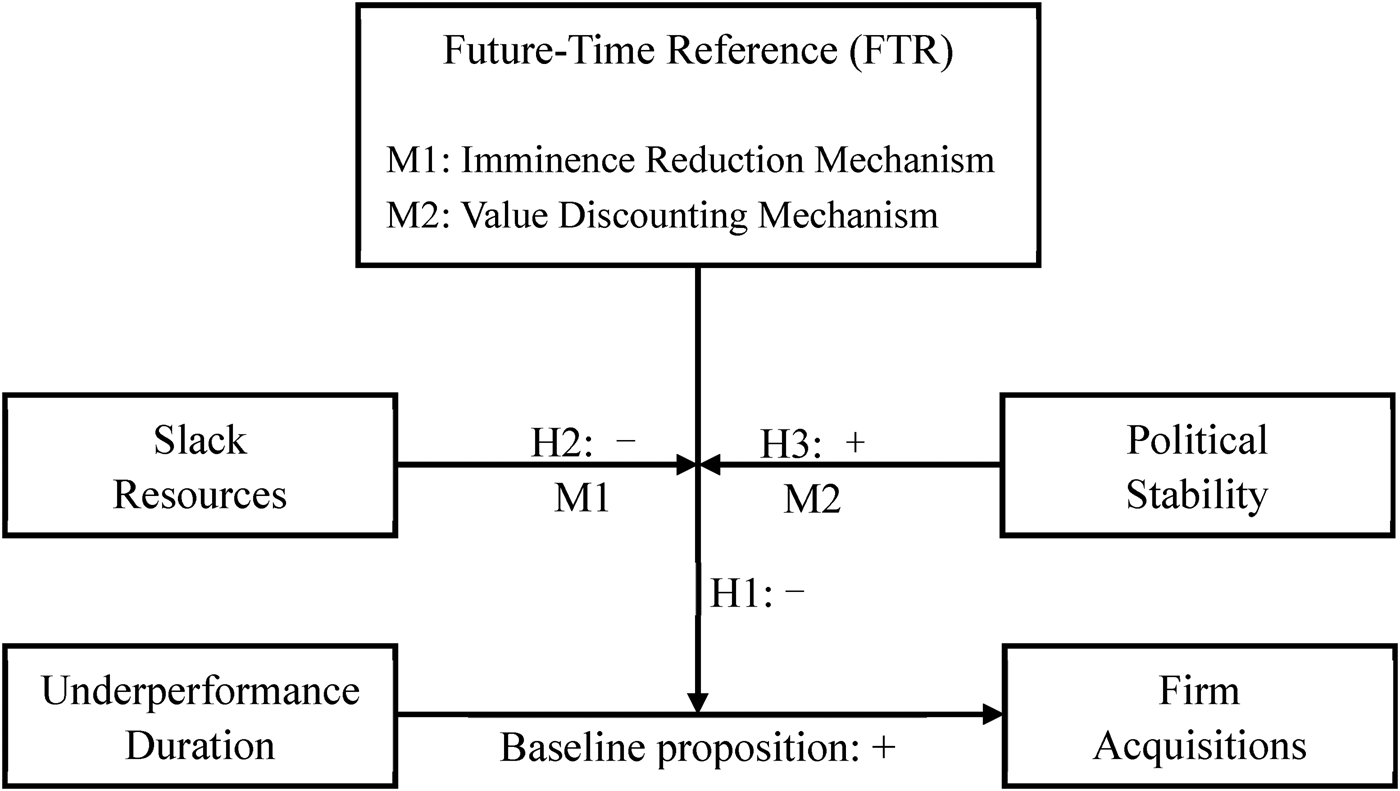
Our predictions are graphically summarized in Figure 1.
Conceptual model

Methods
Data and Sample
To test our hypotheses, we collected data at the firm level and the country level. The firm-level data were drawn from the North America database and the Global database in Compustat, which report detailed financial and acquisition data on publicly held firms in the United States of America and other countries, respectively. The country's characteristic data were obtained from the World Bank database. For economies not reported by the World Bank, we collected the corresponding data from their bureaus of statistics. Language-related data, such as FTR data, were taken from Chen (Reference Chen2013).
We limited our data to the 2007–2019 period. We set 2007 as the starting year to be confident in the data quality. First, data from earlier periods are small in terms of the number of observations and have significant numbers of missing observations. For example, the first year of the Compustat Global database was 1987. In that year, there are only 1,208 observations, and many basic variables, such as the industrial classification code, capital expenditures, and number of employees, are almost completely missing. This problem remained until the year 2003 when the data size began to be comparable to that of later years. Second, most countries in our sample employed or deeply absorbed the International Financial Reporting Standards (IFRS) accounting standards developed by the International Accounting Standards Board (IASB) from 2007 onward, which greatly improved the standardization of data disclosure. European Union countries have employed IFRS accounting standards since 2005, and in the same year, the convergence of the United States' Financial Accounting Standards Board (FASB) and IFRS accounting standards was realized. China began to implement new accounting standards, which absorbed IFRS accounting standards, in 2007 (Han, Bose, Hu, Qi, & Tian, Reference Han, Bose, Hu, Qi and Tian2015). This reform of accounting standards in China made many important financial indicators, such as R&D expenditures, incomparable with those of prior years (Qian, Wang, Geng, & Yu, Reference Qian, Wang, Geng and Yu2017). We set 2019 as the ending year because we wanted to avoid the influence of the COVID-19 pandemic on firms' acquisition strategies.
We implemented a filter to select the firms for our analyses. Prior studies investigating the influence of language characteristics generally assumed that the dominant language of the location in which a firm is headquartered or incorporated is that firm's official language (see, e.g., Li et al., Reference Li, Duan, He and Chan2018). We not only followed this convention but also employed stricter rules to refine our sample. First, we excluded firms that are not headquartered in the same country where they are incorporated. Second, we excluded firms located in countries that have more than one official or representative language.Footnote 1 Third, we excluded countries where the number of firms that are headquartered is very different from the number of firms that are incorporated there. The third criterion excludes tax havens such as Bermuda and the Cayman Islands. Thus, the firms in our sample are headquartered in the same country where they are incorporated, and those countries have only one official or representative language. After using this filter, we obtained 12 countries. Among these countries, there are seven strong FTR language countries, namely, Australia, France, the United Kingdom, the Republic of Korea, Poland, Thailand, and the United States of America, and five weak FTR language countries, namely, China, Germany, Japan, Malaysia, and Sweden. During the 2007–2019 period, the total gross domestic product (GDP) of these 12 countries accounted for approximately 60% of the total GDP of the world (the 189 countries in the World Bank database).
We focused on manufacturing industries for two reasons. First, this method prevents confounding results due to disparities between industries (Iyer & Miller, Reference Iyer and Miller2008) and allows for comparability across acquisitions, avoiding concerns of internal validity (Yu, Umashankar, & Rao, Reference Yu, Umashankar and Rao2016). Second, it enables us to rule out the possibility that the effect of FTR is confounded with that of the temporal orientation at the firm level (which could differ between industries) (Lin, Shi, Prescott, & Yang, Reference Lin, Shi, Prescott and Yang2019). We included only manufacturing firms so that we can calculate asset durability to measure a firm's temporal orientation (FTO) (Souder & Bromiley, Reference Souder and Bromiley2012). We control for FTO in all the models to show that the effect of FTR remains when that of FTO has been taken into account.
To alleviate the potential bias effect of outliers, following Flammer and Bansal (Reference Flammer and Bansal2017) and Liang et al. (Reference Liang, Marquis, Renneboog and Sun2018), we winsorized variables with possible outliers at the 5th and 95th percentiles of their distributions: unabsorbed slack, absorbed slack, potential slack, R&D intensity, free cash flow, Z-score, the intangible assets ratio, and return on assets (ROA).
The original dataset in Compustat contains 818,048 observations, covering 65,342 firms from 127 countries in the 1987–2020 period. Notably, missing data is a significant problem in Compustat, leading to a nonnegligible reduction in the sample size (Nauhaus, Luger, & Raisch, Reference Nauhaus, Luger and Raisch2021). After handling missing values, filtering the dataset according to the rules of year, firm, and industry, and creating lagged variables, the final dataset contains 100,288 observations, covering 12,309 firms from 12 countries in the period between 2007 and 2019. Following Zhu and Chen (Reference Zhu and Chen2015), we use two-sample t-tests to examine the difference between the original and final datasets in terms of firms' total assets, sales, and ROA. The results show that the two datasets are similar in terms of ROA, whereas for total assets and sales, the original dataset is significantly smaller than those of the final dataset. These differences are not significant after we control for firm fixed effects. This indicates the necessity of employing firm fixed-effect models.
Variables
Dependent variable
Firm acquisition at time t. We measured firm acquisition in terms of acquisition value. The acquisition value is closely associated with the financial resource consumption of the acquiring firm and has an intrinsic connection with the financial calculation processes of decision-makers with respect to how they perceive and evaluate the costs and benefits of making acquisitions. The mechanisms of FTR and our three-way moderators (i.e., slack resources and political stability) are directly related to this calculation process of decision-makers. Therefore, the acquisition value is a suitable measurement for our study. The acquisition value has also been widely used to measure acquisition activity (Chen, Crossland, & Huang, Reference Chen, Crossland and Huang2016; Gamache, Mcnamara, Mannor, & Johnson, Reference Gamache, Mcnamara, Mannor and Johnson2015; Sanders & Hambrick, Reference Sanders and Hambrick2007). We use the (logarithmically transformed) ‘Acquisitions’ variable in the Compustat database.
Following prior studies on firm acquisition (Chen et al., Reference Chen, Crossland and Huang2016; Haleblian, Pfarrer, & Kiley, Reference Haleblian, Pfarrer and Kiley2017; Iyer & Miller, Reference Iyer and Miller2008; Meyer-Doyle, Lee, & Helfat, Reference Meyer-Doyle, Lee and Helfat2019; Shi, Hoskisson, & Zhang, Reference Shi, Hoskisson and Zhang2017; Shi, Zhang, & Hoskisson, Reference Shi, Zhang and Hoskisson2017; Yang, Guariglia, & Guo, Reference Yang, Guariglia and Guo2019; Younge, Tong, & Fleming, Reference Younge, Tong and Fleming2015), we used the full sample (i.e., including both cases in which firms engage in acquisitions and cases in which firms do not engage in acquisitions) to avoid potential bias and replace missing values of the variable with zeros. This replacement is regarded as reasonable because firms do not frequently make acquisitions. For example, the percentages of samples in which firms do not make acquisitions are 82.33% in Iyer and Miller (Reference Iyer and Miller2008) and 83.94% in Yang et al. (Reference Yang, Guariglia and Guo2019), which are comparable to the percentage of our sample (82.72%). To control for this data limitation, following Kuusela et al. (Reference Kuusela, Keil and Maula2017) and Zhang and Gong (Reference Zhang and Gong2018), we included a dummy variable (DV_missing) to indicate these observations with the replacement.
Independent variables
Underperformance duration at time t − 1. Following Yu et al. (Reference Yu, Minniti and Nason2019) and Iyer et al. (Reference Iyer, Baù, Chirico, Patel and Brush2019), we measured the underperformance duration as the length of the underperforming period. If a firm's performance falls short of its aspiration, this firm is identified as ‘underperforming’. The underperformance duration of a firm is coded as 1 if it has been underperforming for 1 year, 2 if it has been underperforming for 2 consecutive years, etc.
We used ROA to measure firm performance (Greve, Reference Greve2003; Rudy & Johnson, Reference Rudy and Johnson2016). This is the most commonly used performance variable in BTOF studies (Posen et al., Reference Posen, Keil, Kim and Meissner2018).
We employed social aspiration to represent performance aspiration. Following prior BTOF studies (Gaba, Lee, Meyer-Doyle, & Zhao-Ding, Reference Gaba, Lee, Meyer-Doyle and Zhao-Ding2023; Gaba & Greve, Reference Gaba and Greve2019; Hu, Gu, & Xia, Reference Hu, Gu and Xia2022; Jung, Lee, & Park, Reference Jung, Lee and Park2023; Kavusan & Frankort, Reference Kavusan and Frankort2019; Lee, Lee, & Kim, Reference Lee, Lee and Kim2023; Rudy & Johnson, Reference Rudy and Johnson2016; Salge et al., Reference Salge, Kohli and Barrett2015; Titus, O'Brien, & Dixit, Reference Titus, O'Brien and Dixit2022; Xu, Zhou, & Du, Reference Xu, Zhou and Du2019; Zhang & Greve, Reference Zhang and Greve2019), social aspiration is measured as the average performance of all the other firms in the focal firm's industry. We focused on social aspiration because it is closely related to our research setting. Social aspiration reflects a firm's relative position in the industry (Villagrasa, Buyl, & Escribá-Esteve, Reference Villagrasa, Buyl and Escribá-Esteve2018). ‘The standard strategic management model (see any MBA-level textbook) is an ongoing organizational process aimed at achieving profits above the industry average’ (Andersen & Bettis, Reference Andersen and Bettis2015: 1135). In economic theory, industry average profit is a critical benchmark: ‘firm-specific profit’ is defined as a firm's ROA less the industry mean ROA and a firm will be regarded as having a competitive advantage if it achieves above-average performance (Bennett, Reference Bennett2020; Hawk, Lahiri, & Pacheco-de-Almeida, Reference Hawk, Lahiri and Pacheco-de-Almeida2023). Therefore, industry average performance, as the social aspiration of firms, has ‘powerful effects on decision-maker cognition’ (Gaba & Greve, Reference Gaba and Greve2019: 655). In line with this logic, ‘recent work on aspirations implies that managers first focus on social aspirations as this constitutes the baseline performance level (“how well they should perform”) before they attend to other performance benchmarks’ (Kim et al., Reference Kim, Finkelstein and Haleblian2015: 1365). Moreover, because acquisitions help in gaining economies of scale and scope, enhancing market power (Ruth et al., Reference Ruth, Iyer and Sharp2013), and entering new markets (Cerrato et al., Reference Cerrato, Alessandri and Depperu2016), making acquisitions is intrinsically related to the desire to change a firm's relative position in the industry. For example, the acquisition wave in the pharmaceutical industry in 2008 was largely driven by the desire to compensate for a declining outlook in established positions (Kim, Haleblian, & Finkelstein, Reference Kim, Haleblian and Finkelstein2011). This is especially true for listed firms (as in our sample), as investors vote with their feet, and such a tendency forces firms to pay close attention to their position relative to that of their peers.
Moderating variables
Future-time reference. FTR captures the future-time reference of a language and is coded as a dummy variable. FTR equals 1 if a language is a strong FTR language that requires speakers to mark the future grammatically when describing future events; FTR equals 0 if a language is a weak FTR language.
Slack resources at time t − 1. This is measured as the current ratio (i.e., the ratio of current assets to current liabilities) (Lin, Reference Lin2014; Patel & Chrisman, Reference Patel and Chrisman2014). It refers to currently uncommitted resources (i.e., unabsorbed slack), which have high levels of discretion and can be redeployed easily (George, Reference George2005; Lee & Wu, Reference Lee and Wu2016; Vanacker et al., Reference Vanacker, Collewaert and Zahra2017). It is closely related to firm acquisitions. For example, Iyer and Miller (Reference Iyer and Miller2008) found that the association of unabsorbed slack with firm acquisition existed in more cases than any other type of slack.
Political stability at time t − 1. Political stability is measured as the ‘Political Stability and Absence of Violence/Terrorism’ indicator of the Worldwide Governance Indicators (Kaufmann et al., Reference Kaufmann, Kraay and Mastruzzi2010).
Control variables
We controlled for the FTO by including asset durability, which is measured as ‘the annual investment in property, plant, and equipment (PP&E) divided by depreciation expense’ (Martin, Wiseman, & Gomez-Mejia, Reference Martin, Wiseman and Gomez-Mejia2016: 2471). ‘This yields the weighted-average estimated life (in years) for a firm's fixed assets, providing a measure of the average horizon of a firm's entire PPE portfolio’ (Souder, Reilly, Bromiley, & Mitchell, Reference Souder, Reilly, Bromiley and Mitchell2016: 1209). These authors see this as an adequate measure of the temporal orientation of the top managers of a firm because it reflects their investment horizon. This measure has also been used in other recent studies (e.g., Graafland & Noorderhaven, Reference Graafland and Noorderhaven2020).
We also controlled for sales, logarithmically transformed (firm size) (Joseph & Gaba, Reference Joseph and Gaba2015), the ratio of intangible assets to total assets (intangible ratio), the ratio of selling, general, and administrative expenses to sales (absorbed slack), the ratio of debt to equity (potential slack), and the ratio of R&D expenditures to sales (R&D intensity). We measured acquisition experience (acquisition_EXP) as an indicator variable taking a value of 1 if a firm has engaged in any acquisitions in the past 2 years (Iyer & Miller, Reference Iyer and Miller2008). We included free cash flow, which is defined as follows: (operating income − taxes − interest expense − preferred dividend − common dividend)/equity (Iyer & Miller, Reference Iyer and Miller2008). To control for the risk of bankruptcy, we included the Z-score. This is defined as follows: (1.2 × working capital divided by total assets) + (1.4 × retained earnings divided by total assets) + (3.3 × income before interest expense and taxes divided by total assets) + (0.6 × market value of equity divided by total liability) + (1.0 × sales divided by total assets) (Iyer & Miller, Reference Iyer and Miller2008). Because the Global database in Compustat does not report the market value of equity, following Iyer et al. (Reference Iyer, Baù, Chirico, Patel and Brush2019), we replaced this value with the book value of equity and then calculate the Z-score.
We further considered a number of variables at the industry level, including the number of firms in the focal industry and country, logarithmically transformed (CYI_firm), and the ratio of firms making acquisitions to total firms in the focal industry and country (CYIA_f_ratio).
We also controlled for variables at the country level, including the consumer price index (CPI), GDP, logarithmically transformed, and unemployment rate (Labor_Unemp). We will discuss the reasons for including these societal-level controls in the next section. All controls are measured at time t − 1. We also include year dummies and industry dummies to control for unobserved year effects and industry effects. We do not include country dummies because no firms are changing their countries, and we have included firm fixed effects in the estimation, which make country dummies redundant (Bromiley, Rau, & Zhang, Reference Bromiley, Rau and Zhang2017).
Data Analysis
We employed fixed-effect models to test our hypotheses. Fixed-effect models are expected to solve the problem that the explanatory variables are correlated with unobserved individual effects (Wooldridge, Reference Wooldridge2010). We used Driscoll–Kraay standard errors to correct the problems of heteroscedasticity and serial correlation (Driscoll & Kraay, Reference Driscoll and Kraay1998).
Ruling Out Alternative Explanations
A main concern in our analysis is how to rule out alternative explanations of the observed effects of FTR. Specifically, we should ensure that the effects of FTR are not driven by other societal-level factors, such as the institutional environment or cultural dimensions. We employ eight methods to alleviate this concern.
First, in our sample, the two groups of countries with strong FTR or weak FTR languages are fairly comparable in terms of the number of member countries, cultural origins, and levels of economic development. The strong FTR language group contains seven countries, and the weak FTR language group contains five countries. Every group includes countries with a Western cultural origin and with an Eastern cultural origin. Both groups contain developing countries and developed countries. In other words, the groups defined by the FTR could not be obtained via common grouping criteria such as cultural origin or the level of economic development. This makes the effects found in our sample more likely to be caused by FTR. Second, we controlled for the CPI, GDP, and the unemployment rate to capture important time-variant characteristics of countries that could influence acquisition behavior. Third, we employed fixed-effect models. As there are no firms changing home countries, fixed-effect models can control for the time-invariant characteristics of firms, as well as those of countries, such as culture. Fourth, following Roberts, Winters, and Chen (Reference Roberts, Winters and Chen2015), we employed mixed effects models to include random effects for country, language family, and geographic area, which can isolate the effect of FTR from the potential influence of country, language family, and geographic area. Fifth, following Chi, Su, Tang, and Xu (Reference Chi, Su, Tang and Xu2020), we used a lagged dependent variable to alleviate potential omitted variable bias. Including a lagged dependent variable is a way to control for unobserved factors (Wooldridge, Reference Wooldridge2016). Therefore, it may mitigate the concern that potential unobserved omitted societal-level factors drive the effects of FTR. Sixth, we estimate models on the basis of a sample covering all industries to verify the generalizability of the findings. Seventh, we used a hybrid method to reestimate our models to verify our model specification. Eighth, following the prior literature (Busenbark, Yoon, Gamache, & Withers, Reference Busenbark, Yoon, Gamache and Withers2022; Donovan, Reference Donovan2021; Frank, Reference Frank2000), we evaluated the sensitivity of the FTR-related results to a potential omitted confounding variable by employing a statistical technique called the impact threshold of a confounding variable (ITCV). With the ITCV method, we can quantify the extent to which a potential omitted societal-level factor can invalidate the inference about FTR.
While we use these controls and methods to increase the robustness of our results, prior studies suggest that the influence of FTR is not undermined by other institutional factors, such as the culture or the legal system (Chen et al., Reference Chen, Cronqvist, Ni and Zhang2017; Kim et al., Reference Kim, Kim and Zhou2017). In fact, ‘language is an element that influences human beings earlier than other elements, such as culture, religion, and formal institutions, and therefore has considerable effects on human behavior’ (Kim et al., Reference Kim, Kim and Zhou2017: 303).
Results
Main results
Table 1 presents the descriptive statistics and correlations of the variables used in our study. Table 2 reports the regression results. Our baseline proposition indicates that the underperformance duration has a positive effect on acquisitions. In Model 2, the coefficient of the underperformance duration is positive and significant (b = 0.033, p < 0.01), which supports the baseline proposition. H1 predicts that for firms in a strong FTR language context, the positive relationship between the underperformance duration and firm acquisition is less pronounced. In Model 3, the coefficient of the product term of the underperformance duration and FTR is negative and significant (b = −0.212, p < 0.01), supporting H1.
Descriptive statistics and correlations of the variables

Note: Correlations with values of |0.007| or greater are significant at p < 0.05.
Regression results for FTR

Notes: FTR is a time-invariant variable and has been controlled by fixed-effect models. Standard errors in parentheses. *p < 0.1, **p < 0.05, ***p < 0.01.
H2 states that abundant slack resources will make the moderating effect of FTR more pronounced. In Model 4, the coefficient of the three-way interaction term of the underperformance duration, FTR, and slack resources is negative and significant (b = −0.031, p < 0.01), providing evidence for H2. H3 states that in countries with high political stability, the moderating effect of FTR is less pronounced. In Model 5, the coefficient of the three-way interaction term of the underperformance duration, FTR, and political stability is positive and significant (b = 0.002, p < 0.01), supporting H3.
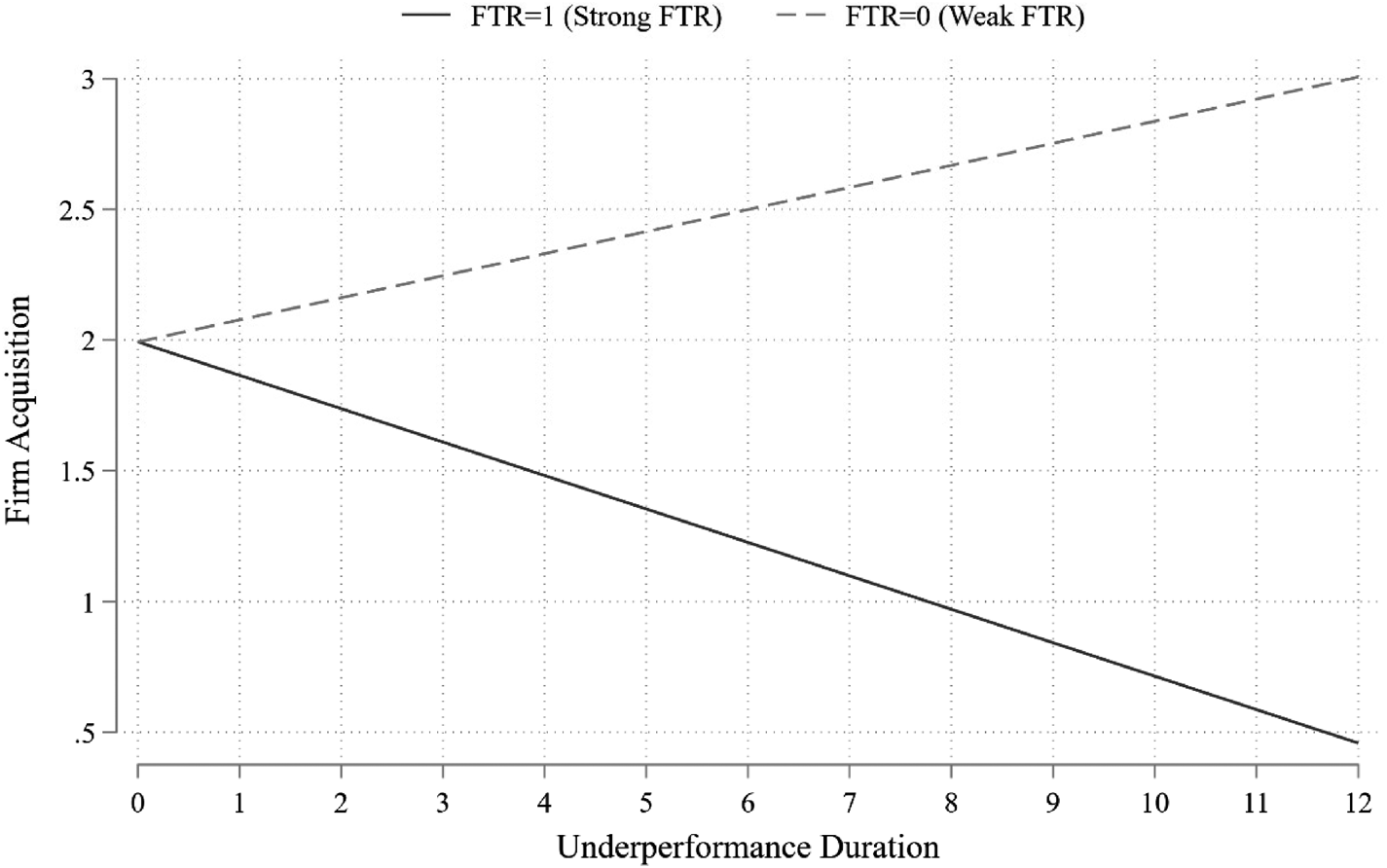
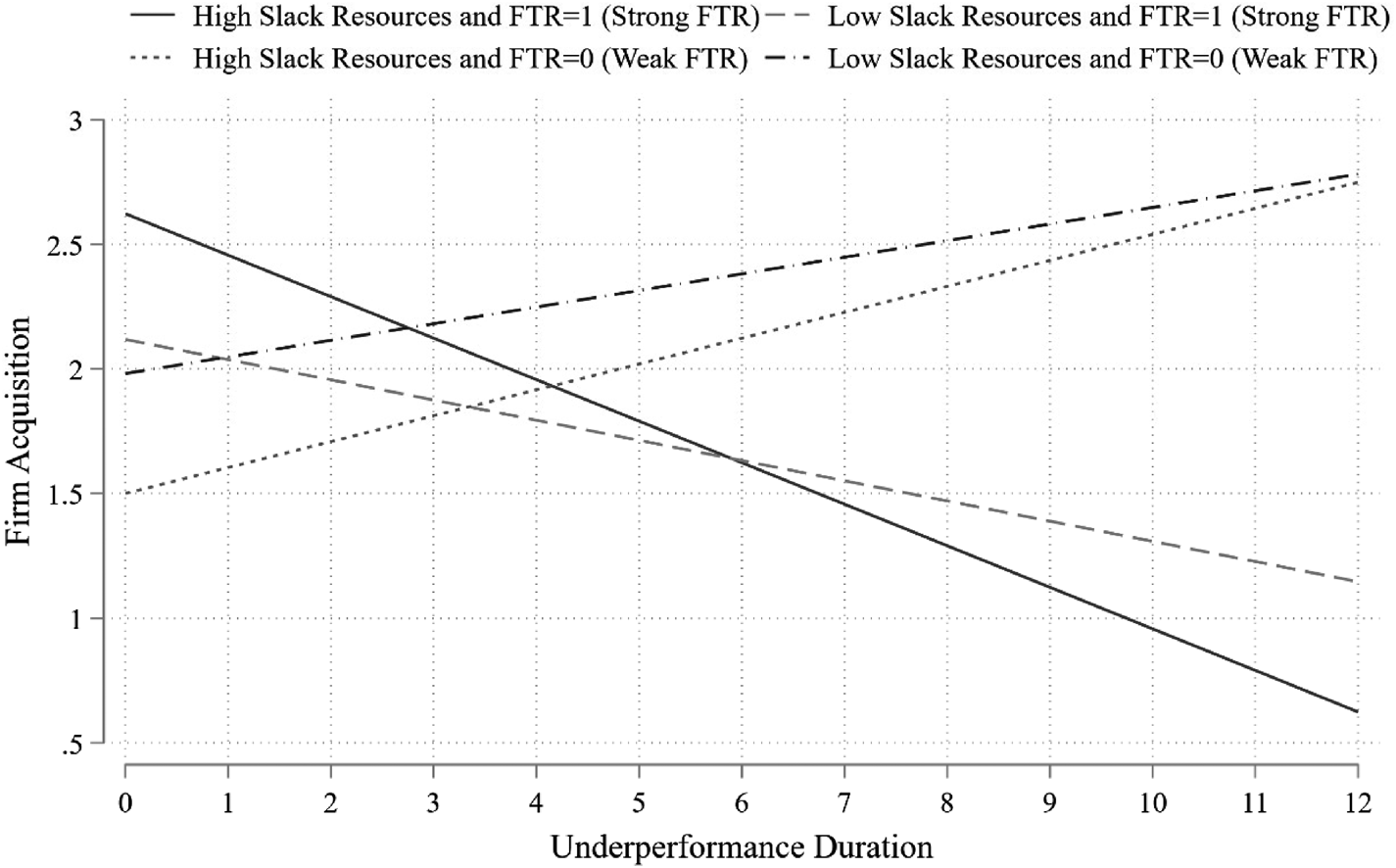
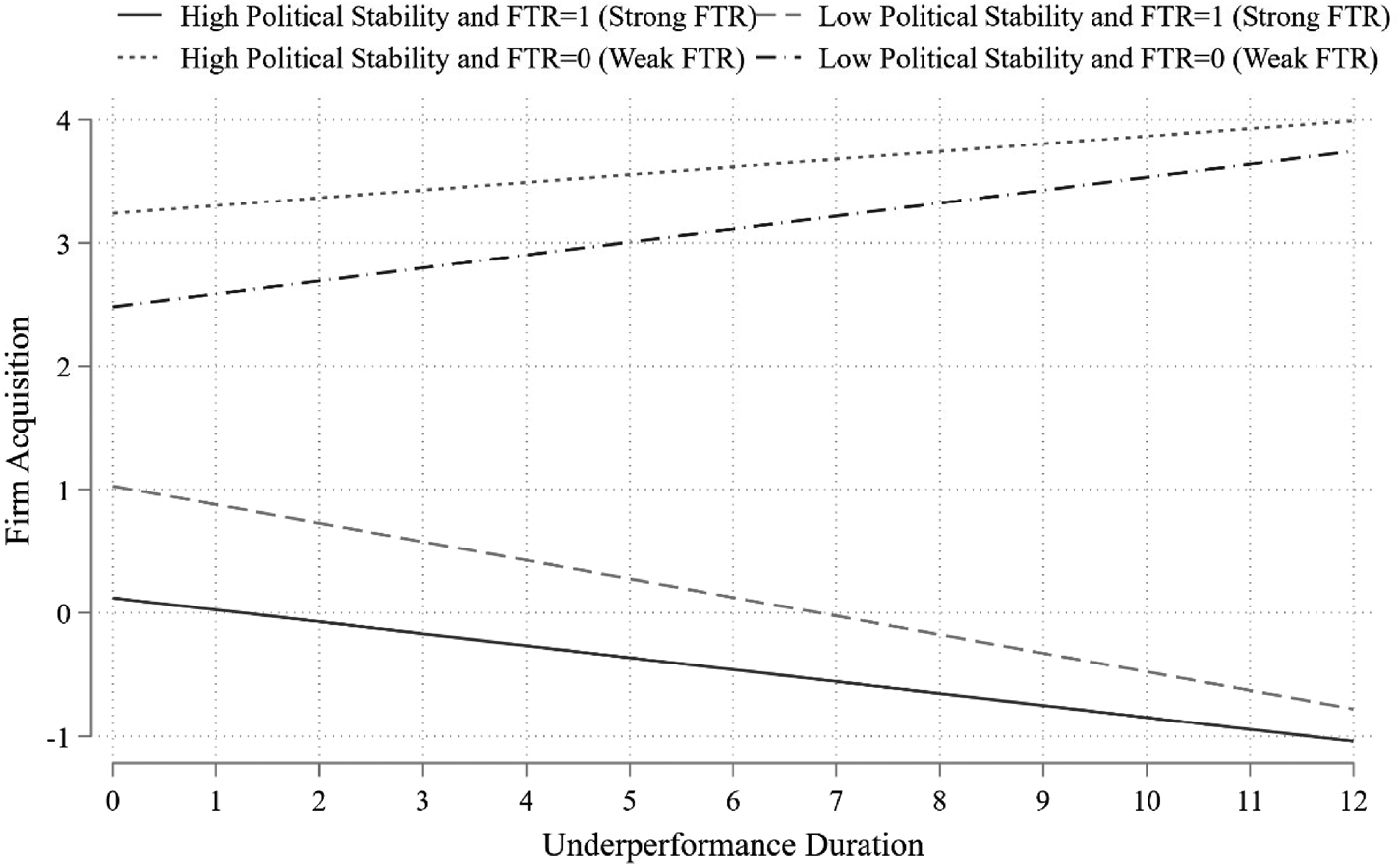
To facilitate the interpretation of the empirical results, we plotted the moderating effects of FTR, slack resources, and political stability. FTR takes values of 0 and 1. Slack resources and political stability take values of one standard deviation below and above the mean. We then plotted the conditional relationship between the underperformance duration and acquisitions in the value range of the underperformance duration. Figure 2 shows the two-way moderating effect of FTR. Figures 3 and 4 depict the three-way moderating effects of slack resources and political stability.
Moderating effect of FTR

Three-way moderating effect of slack resources on FTR

Three-way moderating effect of political stability on FTR

As shown in Figure 2, the positive relationship between the underperformance duration and acquisitions turns around (i.e., has a negative slope) when FTR takes a value of 1 (i.e., strong FTR), indicating that strong FTR languages undermine the positive effect of the underperformance duration on acquisitions.
Figure 3 shows that, compared with firms lacking slack resources, when firms have abundant slack resources, the difference in slope between the two lines depicting the relationship between the underperformance duration and acquisitions in the cases of strong FTR and weak FTR languages is more pronounced. This means that slack resources strengthen the moderating effect of FTR on the relationship between the underperformance duration and acquisitions.
Figure 4 shows that, compared with low political stability, when firms operate in high political stability countries, there is a smaller slope difference between the two lines depicting the relationship between the underperformance duration and acquisitions in the cases of strong FTR and weak FTR languages. This means that political stability weakens the moderating effect of FTR.
Robustness Analysis
Mixed effects models
To isolate the effect of FTR from the potential influence of country, language family, and geographic area, following Roberts et al. (Reference Roberts, Winters and Chen2015), we employ mixed effects models to include random effects for country, language family, and geographic area. These results are in line with our main analysis.Footnote 2
Controlling for a lagged dependent variable
In our main analysis, we control for a number of variables at the firm level, industry level, and country level. To further alleviate concerns about the potential omitted unobserved societal-level factors, we control for a lagged dependent variable (Chi et al., Reference Chi, Su, Tang and Xu2020) and estimate models following Sun and Dhaene (Reference Sun and Dhaene2019). These results are in line with our main analysis.Footnote 3
Using all industries
In our main analysis, we focus on manufacturing industries. Despite the benefits of that method, we acknowledge that it may compromise the generalizability of the findings. Therefore, we estimate models on the basis of a sample covering all industries. The results are in line with our main analysis.Footnote 4
A hybrid method
Theoretically, fixed-effect models focus on within-firm effects. However, panel data contain information about both within- and between-firm effects. Following Certo, Withers, and Semadeni (Reference Certo, Withers and Semadeni2017), we use a hybrid method to reestimate our models. The hybrid method allows us to disentangle and compare the two types of effects. The results show that between-firm effects are not statistically significant, whereas within-firm effects are statistically significant and are consistent with our main analysisFootnote 5. This provides evidence that our model specification is appropriate.Footnote 6
Impact threshold of a confounding variable
In the end, despite the robustness discussed, we acknowledge that we cannot completely eliminate the possibility that our results may be affected by an unobservable omitted confounding variable. In other words, the observed effects of FTR may be driven by other societal-level factors.
Therefore, to further alleviate that concern, we evaluate the sensitivity of the results of FTR to a potential omitted confounding variable following prior literature (Donovan, Reference Donovan2021; Frank, Reference Frank2000). Specifically, we quantify the potential impact of an omitted confounding variable following Frank (Reference Frank2000).
On the basis of Model 6 in Table 2, the ITCV for the interaction of the underperformance duration and FTR is −0.0195, which is the minimum impact to invalidate an inference for the moderating effect of FTR on the relationship between the underperformance duration and acquisition. We also examine the impact of control variables to identify a benchmark for evaluating this ITCV and the possibility that an omitted confounding variable may affect the moderating effect of FTR. The results show that no control variables have an absolute value of impact value greater than the absolute value of the ITCV. Moreover, the ITCVs for the interaction of the underperformance duration, FTR, and slack resources and the interaction of the underperformance duration, FTR, and political stability are −0.0134 and 0.0191, respectively, the absolute values of which are also greater than the absolute values of the impact values of all control variables.
These results indicate that a potential omitted confounding variable would need to have a stronger impact than even the most influential control variable in our model to invalidate the moderating effect of FTR, as well as the three-way moderating effects of slack resources and political stability on FTR. Although no empirical method likely completely eliminates endogeneity concerns, the ITCV analysis and the robustness analysis discussed above considerably alleviate the concern that the observed effects of FTR could be driven by an omitted societal-level factor.
Discussion
Summary of Findings
This study establishes a theoretical framework linking the underperformance duration to firm acquisitions and incorporating the role of FTR in shaping this underperformance duration–firm acquisitions relationship. Using a dataset with 100,288 observations covering 12,309 firms from 12 countries in the period between 2007 and 2019, we find that the underperformance duration stimulates acquisitions such that the longer the underperformance duration is, the more a firm engages in acquisitions. We then introduce FTR into this basic model and investigate how FTR, as the characteristic of languages related to time perception, moderates the relationship between the underperformance duration and firm acquisitions. We argue that FTR can bias the interpretation of performance feedback information and consequently influence firm acquisition decisions. The results reveal that, compared with firms in a weak FTR language context, firms in a strong FTR language context will spend less on acquisitions in response to repeated performance shortfalls.
Moreover, to better reveal the underlying influencing mechanisms of FTR in terms of the imminence reduction mechanism and value-discounting mechanism, we further introduce slack resources and political stability into our research model and validate their influences on the moderating effect of FTR. We find that slack resources strengthen the moderating effect of FTR on the relationship between the underperformance duration and firm acquisitions, whereas political stability weakens such a moderation of FTR.
Theoretical Implications
Theoretical implications for the BTOF
Prior BTOF studies have investigated the relationship between performance shortfalls and organizational changes (Arrfelt, Wiseman, & Hult, Reference Arrfelt, Wiseman and Hult2013; Chen, Reference Chen2008; Kuusela et al., Reference Kuusela, Keil and Maula2017; Lin, Reference Lin2014; Salge, Reference Salge2011; Tyler & Caner, Reference Tyler and Caner2016). However, notably, these studies generally assume an unambiguous interpretation of performance feedback information (Greve & Gaba, Reference Greve, Gaba, Argote and Levine2020). Considering that decision-makers' interpretations strongly influence their firms' responses to performance feedback (Gavetti et al., Reference Gavetti, Greve, Levinthal and Ocasio2012; Jordan & Audia, Reference Jordan and Audia2012), understanding how decision-makers interpret performance feedback information and what will bias their interpretation is very important (Greve & Gaba, Reference Greve, Gaba, Argote and Levine2020). Several recent studies have investigated decision-makers' interpretation processes and reported that these processes vary with the corporate structure (Gaba & Joseph, Reference Gaba and Joseph2013), the ambiguity of the performance feedback information (Joseph & Gaba, Reference Joseph and Gaba2015), the motivation of decision-makers to enhance their self-image (Jordan & Audia, Reference Jordan and Audia2012), CEO power (Blagoeva, Mom, Jansen, & George, Reference Blagoeva, Mom, Jansen and George2020), and CEO overconfidence (Schumacher et al., Reference Schumacher, Keck and Tang2020).
In this study, we focus on the role of ‘time perception’ in the performance feedback process, especially in the interpretation of performance feedback information, which has been much less explored in the literature. This absence of a temporal lens in the BTOF is surprising because, in fact, time is ‘an essential concept for understanding how individuals, teams, and organizations evolve, grow, learn, and change’ (Shipp & Jansen, Reference Shipp and Jansen2021: 299). Moreover, the time perception of decision-makers is quite influential in strategic decision-making and organizational change (Chen & Nadkarni, Reference Chen and Nadkarni2017; Nadkarni & Chen, Reference Nadkarni and Chen2014; Nadkarni, Chen, & Chen, Reference Nadkarni, Chen and Chen2016); thus, the importance of the temporal lens in understanding how firms function has long been recognized (Ancona, Goodman, et al., Reference Ancona, Goodman, Lawrence and Tushman2001, Ancona, Okhuysen, et al., Reference Ancona, Okhuysen and Perlow2001), as revealed in team processes (Marks, Mathieu, & Zaccaro, Reference Marks, Mathieu and Zaccaro2001), strategy making (Kaplan & Orlikowski, Reference Kaplan and Orlikowski2013), strategic risk behavior (Das & Teng, Reference Das and Teng2001), and organizational change (Huy, Reference Huy2001).
There are a handful of BTOF studies that have considered the temporal lens. For example, Souder and Bromiley (Reference Souder and Bromiley2012) examined the effect of performance discrepancies on the temporal orientation of firms. More recently, Iyer et al. (Reference Iyer, Baù, Chirico, Patel and Brush2019) and Yu et al. (Reference Yu, Minniti and Nason2019) emphasized the temporal dimension of performance shortfalls and investigated how the duration of performance feedback influences organizational change. These studies are compatible with the research direction of our study. However, it is noteworthy that there is an essential difference between these studies and our study: their focus of attention is what information different durations of performance feedback will provide for decision-makers, whereas we focus on how decision-makers' time perceptions influence their interpretation of performance feedback.
Drawing on recent studies on the underperformance duration (Iyer et al., Reference Iyer, Baù, Chirico, Patel and Brush2019; Yu et al., Reference Yu, Minniti and Nason2019), we present a baseline proposition about the relationship between the underperformance duration and firm acquisitions and, more importantly, theorize and examine how cognitive biases stemming from FTR affect decision-makers' interpretation of such performance feedback information and their consequent strategic decision-making. FTR biases decision-makers' interpretation of performance feedback information by changing their perception of the imminence (imminence reduction mechanism) and the importance of future events (value-discounting mechanism).
To test the above two mechanisms, we purposively introduce two moderations on the baseline relationship. As stated by Lee et al. (Reference Lee, Lee and Kim2023), researchers have typically uncovered and verified theoretical mechanisms by exploring the moderating factors that could influence those mechanisms. Considering that the first mechanism of FTR concerns the identification of performance problems and the second involves the evaluation of future returns from potential organizational changes, we introduce slack resources and political stability as contingencies, each of which can validate one mechanism of FTR. Abundant slack resources create a context in which decision-makers may believe that they have a sufficient buffer against failure (Deb et al., Reference Deb, David and O'Brien2017; Vanacker et al., Reference Vanacker, Collewaert and Zahra2017). Therefore, abundant slack resources may ‘inhibit the recognition of a problem’ (Posen et al., Reference Posen, Keil, Kim and Meissner2018: 224). If firms in a strong FTR language context possess abundant slack resources, they will further underestimate the severity of the performance problem. As expected, we find that slack resources strengthen the moderating effect of FTR.
Political stability influences firms' expectations of investment returns such that in countries with stable political conditions, firms have more confidence in obtaining the projected value of investments (Maitland & Sammartino, Reference Maitland and Sammartino2015). If firms are in a context of strong FTR languages and stable political conditions, the high discount rate for evaluating future values of organizational changes induced by strong FTR languages will be weakened by stable political conditions. This inference is supported, as we find that political stability weakens the moderating effect of FTR.
Therefore, compared with the extant BTOF studies related to the temporal lens, this study explicitly theorizes and validates two mechanisms of how FTR influences decision-makers' interpretations of performance feedback and alters the relationship between performance feedback and organizational change. By doing so, we contribute to the BTOF literature and advance the understanding of the performance feedback process.
Theoretical implications for temporal research
Time, including objective time (i.e., clock time) and subjective time (i.e., time perception), plays a central role in organizational life (Tang, Richter, & Nadkarni, Reference Tang, Richter and Nadkarni2020) and ‘has always been at the foundation of organization theory’ (Ancona, Okhuysen, et al., Reference Ancona, Okhuysen and Perlow2001: 512). Prior management studies tend to emphasize objective time over subjective time, which is an interesting oversight because subjective time and objective time are inherently intertwined and subjective time lends meaning to objective time (Shipp & Jansen, Reference Shipp and Jansen2021); thus, subjective time concepts can advance our understanding of organizational phenomena (Huy, Reference Huy2001).
In this study, we focus on an important subjective time concept, FTR, which is characteristic of languages related to time perception and can influence people's way of perceiving the future (Chen, Reference Chen2013; Dahl, Reference Dahl and Dahl2000). Specifically, compared with weak FTR languages, strong FTR languages make people perceive the future as more temporally distant from the present and thus reduce the psychological importance and imminence of the future (Kim et al., Reference Kim, Kim and Zhou2017).
A related yet different concept regarding decision-makers' time perceptions is temporal orientation. Gamache and McNamara (Reference Gamache and McNamara2019) argued that temporal focus (also known as temporal orientation) reflects the extent to which decision-makers direct their attention to the past, present, or future and that decision-makers make decisions on the basis of their perceptions of the events they focus their attention on. Specifically, decision-makers with a strong past focus tend to use previous experiences and memories in decision-making; decision-makers with a strong present focus have a ‘here and now’ orientation and emphasize seizing current opportunities and considering current issues when making decisions; and decision-makers with a strong future focus are inclined to envision the future and make long-term plans (Gamache & McNamara, Reference Gamache and McNamara2019; Nadkarni & Chen, Reference Nadkarni and Chen2014).
Notably, FTR affects how decision-makers interpret the current situation by exerting an influence on how they perceive the importance and imminence of the future psychologically; thus, the implications of FTR differ from those of temporal orientation. In short, temporal orientation is about the focus of attention, whereas FTR is about the cognitive bias regarding time perception. Our study contributes to the time perception literature by providing new empirical evidence of how FTR, as an important aspect of time perception in addition to temporal orientation, influences management practices.
Managerial Implications
The FTR of languages biases decision-makers' interpretation of performance feedback information, and such cognitive biases subsequently affect acquisition decisions in response to repeated performance shortfalls. FTR can influence decision-making in a subconscious yet significant way. Being aware of biases stemming from FTR can help decision-makers guard against underestimating both the seriousness of problems indicated by repeated performance shortfalls and the value of acquisitions in overcoming the gloomy picture of firm performance. More generally, the mechanisms of performance feedback theorized by the BTOF are manifestations of decision biases, and managers would do well to consider carefully what forms the best response to repeated performance shortfalls.
As an aside, the important role played by FTR in our explanation of acquisition behavior suggests that language should be taken very seriously in both the negotiation and the integration process of acquired firms. Although this point has already been made in the acquisition literature (Larsson & Finkelstein, Reference Larsson and Finkelstein1999), we add a new perspective that acquiring firms should attach importance to language differences in FTR. More specifically, firms with a strong FTR language will interpret situations differently than firms whose language is weak FTR language and such a difference can lead to conflicting expectations and actions during the negotiation and integration process for acquisitions.
Limitations and Future Research Directions
In this study, we introduce slack resources and political stability as moderators of the effect of FTR on acquisitions because these two factors have the potential to clarify a specific mechanism of FTR. Future studies could consider other contingent factors. For example, CEO overconfidence is a promising factor because CEO overconfidence may also influence the mechanisms of FTR identified by this study: overconfident CEOs may underestimate the seriousness of problems indicated by performance feedback but overestimate the returns from organizational changes in response to performance shortfalls. Investigating whether the overconfidence of CEOs strengthens the effect of a strong FTR language context would be interesting.
Considering that the measurement of FTR used in this study is based on linguistic research, we suggest that future studies employ survey methods and collect data to measure decision-makers' time perceptions directly through questionnaires, especially their perceptions of the imminence and importance of the future.
Moreover, we use a country-level measurement of FTR because we focus on the moderating effect of FTR on performance feedback, and a country-level measurement of FTR may make it convincing that FTR (as a moderating or contextual factor) is not driven by firm characteristics. Notably, such a measurement has been widely employed by prior FTR studies. However, to establish a more direct link between FTR and firm behavior, it would be prudent to measure the FTR of the firm's executive leadership team rather than relying solely on country-level FTR. Using country-level FTR to represent firm-level FTR could introduce bias, as exemplified by the case of a firm headquartered in a strong FTR country but led by executives from a weak FTR culture. Therefore, exploring methods for assessing the FTR of the executive team or decision-makers directly is recommended. For example, future studies can use survey methods to collect detailed executive team members' demographic information in both weak and strong FTR countries. It is also interesting to investigate what will happen when the FTR characteristic of the executive team conflicts with that of the country in which it is headquartered.
In the end, we use the average performance of all the other firms in the focal firm's industry to measure social aspiration (i.e., performance aspiration) because it is built on both the BTOF and economic theory and is the dominant measurement of social aspiration. However, considering the large difference in firm characteristics, performance aspirations vary substantially across firms, even within the same industry. In fact, identifying aspiration is always a great challenge in BTOF studies. Recent studies on aspiration have revealed several interesting findings that have raised many questions. For example, Keum and Ryan (Reference Keum and Ryan2024) found that firms set upward-striving goals when their performance levels approach cognitively salient round numbers (e.g., $100 million). Luger (Reference Luger2023) noted that firms adapt references (i.e., other firms to which they compare themselves) as a function of changes in their comparison needs and purposes (e.g., self-assessment). Empirically, it is difficult for researchers to observe firms' aspirations and reference groups (Greve & Gaba, Reference Greve, Gaba, Argote and Levine2020). Future studies can apply the case study method and the survey method to a refined global sample so that they can obtain the real aspiration of each firm.
Data availability statement
The data that support the findings of this study are available from Wharton Research Data Services (WRDS). Restrictions apply to the availability of these data, which were used under licence for this study. Data are available from the authors with the permission of WRDS.
Acknowledgement
P. Ding acknowledges the support from the National Natural Science Foundation of China (No. 72102027).
Peng Ding (pengding@dufe.edu.cn) is an associate professor at the School of Business Administration, Dongbei University of Finance and Economics. He holds a PhD from Zhejiang University, China. His research interests include the behavioral theory of the firm, innovation management, and strategy. His research has been published in journals such as Decision Support Systems, Management Decision, and Frontiers of Engineering Management.
Niels Noorderhaven (n.g.noorderhaven@uvt.nl) is an emeritus professor of international management at Tilburg University and a visiting professor at Zhejiang University, China. He holds a PhD from the University of Groningen. His research interests include international cooperation between firms, culture, trust, and CSR. His research has been published in journals such as the Academy of Management Journal, Journal of International Business Studies, Research Policy, Organization Science, and Journal of Management Studies.
Bin Guo (guob@zju.edu.cn) is a professor of innovation, entrepreneurship, and strategy at the School of Management, Zhejiang University. He holds a PhD from Zhejiang University, China. His research interests include innovation management, strategy, and digital transformation. His research has been published in journals such as Research Policy, Global Strategy Journal, International Journal of Operations & Production Management, Management and Organization Review, and Journal of International Management.