Introduction
The impact of coronavirus disease 2019 (COVID-19) has been unevenly distributed among various racial and ethnic populations. Several reviews have highlighted significant disparities in COVID-19 outcomes, with higher rates of hospitalization and mortality among racial and ethnic minorities. Reference Mackey, Ayers and Kondo1,Reference Duong, Le and Veettil2 In addition, socioeconomic vulnerability have also been linked to an increased risk of severe disease, compounded by reduced access to healthcare and a higher burden of comorbidities in these communities. Reference Shahbaz, Goldsteen, Jeon, Brown and Issa3,Reference Embury, Nara and Oren4
The introduction of COVID-19 antivirals has demonstrated benefit in preventing the progression of severe disease and reducing hospitalization in both inpatient and outpatient settings. Reference Pitre, Van Alstine and Chick5,Reference Vegivinti, Evanson and Lyons6 The benefit has been seen most consistently in patients with co-morbidities including end stage renal disease, liver disease, cardiovascular disease and pulmonary disease. These end organ diseases already disproportionately affect patients with socioeconomic vulnerability. Reference Valenzuela, Peak and Huguet7 Early reports suggested that disparities in treatment access persist, with lower COVID-19 antiviral prescription rates of these therapies among Black and Hispanic patients. Additionally, large real-world studies of outpatient populations have identified multiple demographic and clinical factors associated with receipt of nirmatrelvir/ritonavir, suggesting that prescribing patterns are influenced by both clinical eligibility and healthcare access factors. Reference Malden, McLaughlin and Hong8–Reference Mafi, Vangala and Kapral10
The current available antiviral treatments for COVID-19 include remdesivir, nirmatrelvir/ritonavir (n/r), and molnupiravir. Reference Adarsh Bhimraj, Baden and Bedimo11 N/r is the first-line outpatient therapy but one key barrier to prescribing n/r is the cytochrome P450 drug interactions. As a potent CYP3A4 inhibitor many medications including anticoagulants, calcineurin inhibitors, anti-epileptics cannot be administered concomitantly, limiting utility. Reference Marzolini, Kuritzkes and Marra12,13 In a study of 637 outpatients, 70% had one or more clinically significant drug–drug interactions requiring adjustment or discontinuation of preexisting medications. Reference Leung, Gill and Llanes14
Remdesivir was the first antiviral approved for treatment of COVID-19 becoming available via emergency use authorization (EUA) in May 2020 and commercially available in October 2020. 15 N/r and molnupiravir were both approved for use through EUA in December 2021. N/r was made commercially available in May 2023 and molnupiravir remained under EUA. 16 At the beginning of their approval (2020–2021), COVID-19 antivirals were distributed through federally coordinated allocation programs with limited supply and targeted expansion to improve equitable access. After commercial availability, medications became more readily available, however insurance coverage still varied. Reference Kahn, Ying and Mathis17
Although prior studies have identified clinical and demographic factors associated with COVID-19 antiviral prescribing, less is known about the role of patient-level socioeconomic factors in influencing treatment receipt during the later phases of the pandemic when therapies became widely available. We hypothesized that one potential barrier to antiviral prescription particularly for n/r prescription is concern over drug–drug interactions, especially in the context of patients that experienced language barriers, advanced age, or lower levels of health literacy. Therefore, this study aims to evaluate the socioeconomic and demographic factors associated with prescription of COVID-19 treatments within a large health system within New England.
Methods
This was a retrospective study that included adult patients with a COVID-19 diagnosis and/or prescription for COVID-19 antivirals. COVID-19 diagnoses were identified through encounter-level diagnostic codes in the electronic medical record or COVID-19 antiviral treatments that included n/r, remdesivir, molnupiravir, or more than one of the three therapies. Patients younger than 18 and those with incomplete comorbidity data were excluded. The Vizient Clinical Database, which captures inpatient and outpatient patient-level data from Tufts Medicine Health Network, was used to identify encounters between Oct/2022 and July/2024. The Tufts Medical Center Institutional Review Board approved this study (STUDY00005664) and determined it to be exempt.
The primary study outcome was evaluating socioeconomic and demographic patient factors associated with the prescription of COVID-19 treatment in outpatient clinics and emergency departments (ED). A secondary outcome was evaluating the factors associated with COVID-19 treatment in the outpatient setting.
Demographic data, including race/ethnicity, age, sex, preferred language as listed in the medical record, insurance coverage, ZIP codes, and Vizient vulnerability index (VVI) were collected. VVI is a novel marker of social drivers of health tracked at the census level. The vulnerability ranges from –3 to 3. 18 Vizient Incorporation is the largest member-owned healthcare services company in the United States. They provide group data and analytics to members to enhance care and improve cost performance. 19 VVI integrates publicly available social determinants of health data from various US government agencies. VVI incorporates 43 social determinants of health data points in 9 social domains that impact health outcomes. These domains include public safety, transportation access, social cohesion, environmental quality, housing ownership, neighborhood safety nets, food security, healthcare access, education, and income level. Patients were categorized by VVI quartiles (Q1 = least vulnerable to Q4 = most vulnerable,). Comorbidity burden was assessed using the Charlson Comorbidity Index (CCI). Reference Radovanovic, Seifert and Urban20
During the study period, there were no formal institutional restrictions or dedicated stewardship protocols governing outpatient or ED prescribing COVID-19 antiviral therapies. Remdesivir and n/r were restricted requiring antimicrobial stewardship approval in the inpatient setting. Emergency medicine and outpatient decisions were guided by national recommendations, including Centers for Disease Control and Prevention (CDC), Infectious Disease Society of America (IDSA) and National Institute of Health (NIH) guidelines, and were made at the discretion of the treating clinician based on patient-specific factors such as comorbidities, medication interactions, and timing of symptom onset. Pharmacist support for medication reconciliation and drug–drug interaction management was available inpatient and in the ED but not standardized across all outpatient settings.
Statistical analysis
Patient characteristics by treatment group were presented as counts and percentages for categorical variables and medians with interquartile ranges for continuous variables if they were skewed and means if not skewed. We tested for differences using Mann-Whitney or χ2 tests. The primary analysis was a logistic regression model evaluating factors associated with COVID-19 treatment. Univariate and multivariate logistic regression models were evaluated. Candidate variables, including baseline patient characteristics and social vulnerability scores that had P value of less than <.1, were included in the final model. Collinearity between candidate covariates was assessed using variance inflation factors.
A subgroup analysis was performed: comparing patients who received COVID-19 treatments in the outpatient setting. The same candidate variables included in the primary analysis were examined.
All statistical analyses were completed using SPSS version 28. A P value of <.05 was considered statistically significant unless otherwise indicated. Given that analyses were prespecified and hypothesis-driven, we did not apply formal adjustment for multiple comparisons, and results were interpreted with emphasis on effect sizes and clinical relevance rather than p-values alone.
Results
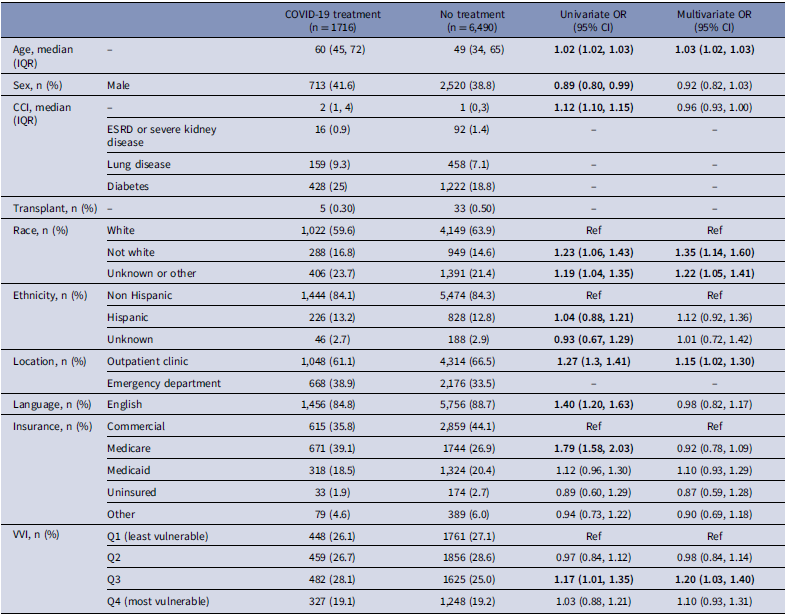
All patient characteristics (Table 1)
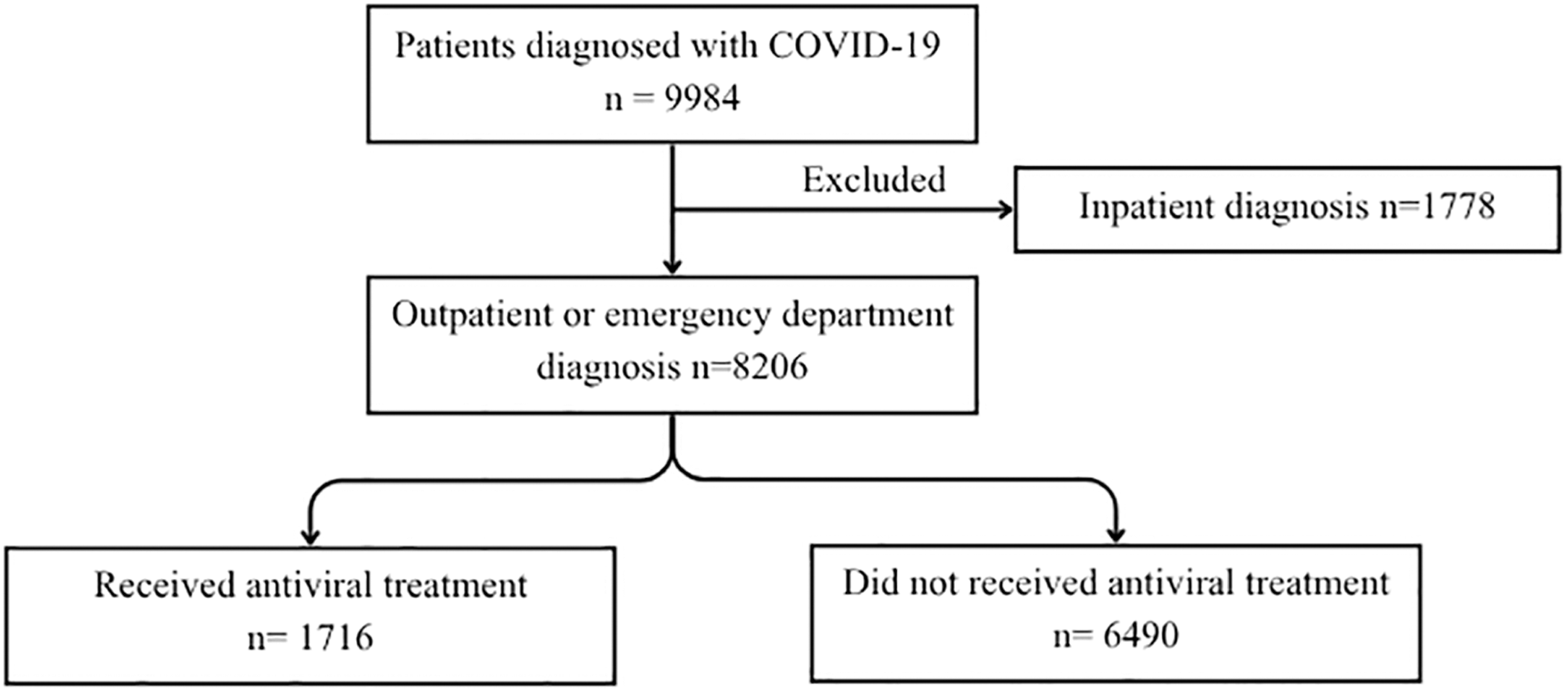
We identified 9,984 patients who received COVID-19 treatment or had a diagnosis of COVID-19 between Oct/2022 and July/2024. A total of 8,206 (82.2%) of patients were seen in outpatient clinics or ED, out pf which 1716 (20.9%) received treatment (Figure 1). The median VVI in our cohort was low indicating overall less vulnerable population –.75 (IQR –1.11, –.03).
Flow diagram of the study population.

Baseline demographic and clinical characteristics of patients by COVID-19 treatment in the emergency department and outpatient

CI: confidence interval, OR: odds ratio, IQR: interquartile range, CCI: Charlson comorbidity index, ESRD: end stage renal disease, VVI: Vizient vulnerability index.
Outpatient and emergency department
Patients who received treatment were more likely to be older (60.0 vs 49.0), male (41.6% vs 38.8%) and have higher CCI scores (median score 2 vs 1). Most patients were seen in outpatient clinics. Non-English speaking patients represented 12.1% of the cohort with the most common languages being Spanish and Chinese.
In multivariate analysis including both ED and outpatient encounters, increasing age remained independently associated with higher odds of receiving COVID-19 treatment (OR 1.03 per year, 95% CI 1.02–1.03). Race was independently associated with treatment, with patients identified as non-White having higher odds of receiving treatment compared with White patients (OR 1.35, 95% CI 1.14–1.60), as did those with unknown or other race (OR 1.22, 95% CI 1.05–1.41).
Encounter location was also associated with treatment, with patients seen in ED having higher odds of receiving treatment compared with those in the outpatient clinics (OR 1.15, 95% CI 1.02–1.30). Sex, CCI, ethnicity, language, and insurance status were not significantly associated with treatment in adjusted models. With respect to socioeconomic vulnerability, patients in the third quartile of VVI had higher odds of treatment compared with those in the least vulnerable quartile (OR 1.20, 95% CI 1.03–1.40), while no significant differences were observed for other quartiles.
Subgroup analysis for patients in outpatient setting
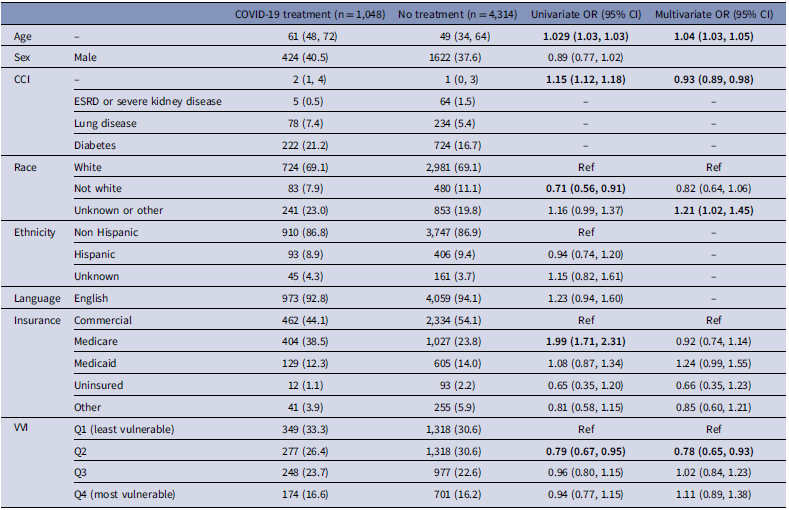
Around 20% of patients seen in outpatient clinics were treated for COVID-19. Similar to outpatient and ED group, increasing age was independently associated with higher odds of receiving COVID-19 treatment (OR 1.04 per year, 95% CI 1.03–1.05) (Table 2)
Baseline demographic and clinical characteristics of patients by COVID-19 treatment in the outpatient

Table 2 Long description
A table comparing demographic and clinical characteristics of patients by COVID-19 treatment in outpatient settings. The table has 12 rows and 6 columns. Column headers are Age, Sex, CCI, Race, Ethnicity, Language, Insurance, and VI. Row labels include Age, Sex, Male, CCI, ESRD or severe kidney disease, Lung disease, Diabetes, Race, White, Not white, Unknown or other, Ethnicity, Non Hispanic, Hispanic, Unknown, Language, English, Insurance, Commercial, Medicare, Medicaid, Uninsured, Other, VI, Q1 (least vulnerable), Q2, Q3, Q4 (most vulnerable). The table provides data for COVID-19 treatment (n = 1,048), No treatment (n = 4,314), Univariate OR (95% CI), and Multivariate OR (95% CI). Row 1: Age, 61 (48, 72), 49 (34, 64), 1.029 (1.03, 1.03), 1.04 (1.03, 1.05). Row 2: Sex, Male, 424 (40.5), 1622 (37.6), 0.89 (0.77, 1.02). Row 3: CCI, 2 (1, 4), 1 (0, 3), 1.15 (1.12, 1.18), 0.93 (0.89, 0.98). Row 4: ESRD or severe kidney disease, 5 (0.5), 64 (1.5). Row 5: Lung disease, 78 (7.4), 234 (5.4). Row 6: Diabetes, 222 (21.2), 724 (16.7). Row 7: Race, White, 724 (69.1), 2981 (69.1), Ref, Ref. Row 8: Not white, 83 (7.9), 480 (11.1), 0.71 (0.56, 0.91), 0.82 (0.64, 1.06). Row 9: Unknown or other, 241 (23.0), 853 (19.8), 1.16 (0.99, 1.37), 1.21 (1.02, 1.45). Row 10: Ethnicity, Non Hispanic, 910 (86.8), 3747 (86.9), Ref. Row 11: Hispanic, 93 (8.9), 406 (9.4), 0.94 (0.74, 1.20). Row 12: Unknown, 45 (4.3), 161 (3.7), 1.15 (0.82, 1.61). Row 13: Language, English, 973 (92.8), 4059 (94.1), 1.23 (0.94, 1.60). Row 14: Insurance, Commercial, 462 (44.1), 2334 (54.1), Ref, Ref. Row 15: Medicare, 404 (38.5), 1027 (23.8), 1.99 (1.71, 2.31), 0.92 (0.74, 1.14). Row 16: Medicaid, 129 (12.3), 605 (14.0), 1.08 (0.87, 1.34), 1.24 (0.99, 1.55). Row 17: Uninsured, 12 (1.1), 93 (2.2), 0.65 (0.35, 1.20), 0.66 (0.35, 1.23). Row 18: Other, 41 (3.9), 255 (5.9), 0.81 (0.58, 1.15), 0.85 (0.60, 1.21). Row 19: VI, Q1 (least vulnerable), 349 (33.3), 1318 (30.6), Ref, Ref. Row 20: Q2, 277 (26.4), 1318 (30.6), 0.79 (0.67, 0.95), 0.78 (0.65, 0.93). Row 21: Q3, 248 (23.7), 977 (22.6), 0.96 (0.80, 1.15), 1.02 (0.84, 1.23). Row 22: Q4 (most vulnerable), 174 (16.6), 701 (16.2), 0.94 (0.77, 1.15), 1.11 (0.89, 1.38).
CI: confidence interval, OR: odds ratio, IQR: interquartile range, CCI: Charlson comorbidity index, ESRD: end stage renal disease, VVI: Vizient vulnerability index.
In contrast, higher comorbidity burden as measured by the CCI was associated with lower odds of treatment after adjustment (OR 0.93, 95% CI 0.89–0.98). Non-White race was not significantly associated with treatment after adjustment, although patients with unknown or other race had higher odds of treatment compared with White patients (OR 1.21, 95% CI 1.02–1.45).
With respect to socioeconomic vulnerability, patients in the second quartile of the VVI had lower odds of treatment compared with those in the least vulnerable (first) quartile (OR 0.78, 95% CI 0.65–0.93), while no significant differences were observed for the third or most vulnerable quartiles (fourth).
Discussion
Our findings highlight persistent differences in COVID-19 antiviral prescribing, with complex and sometimes non-linear associations across race, care setting, insurance type, and social vulnerability.
Overall antiviral treatment of COVID-19 was low with less than third of patients receiving therapy. Outpatient prescribing relies on a complex time sensitive access pathway including testing, clinical evaluation, medication reconciliation, prescription, and access to dispensing sites, which likely contributes to gaps in treatment uptake. Reference Gold, Kelleher and Magid21 Treatment allocation was more commonly seen in older patients as recommended by the IDSA and CDC treatment guidelines. Reference Adarsh Bhimraj, Baden and Bedimo11
One key finding was that non-White race was independently associated with higher odds of receiving any COVID-19 treatment, even after adjustment; however, this association was not observed in the outpatient-only analysis, and only patients with unknown or missing race had higher odds of treatment. This stands in partial contrast to earlier reports suggesting that racial minorities were less likely to receive COVID-19 antiviral treatments. Reference Malden, McLaughlin and Hong8,Reference Boehmer, Koumans and Skillen22 This discrepancy suggests that the observed relationship may be influenced by differences in care setting rather than reflecting a consistent pattern across populations. Reference Bromley-Dulfano and Barnett23 ED encounters may capture patients with higher acuity or fewer barriers to same-day treatment, whereas outpatient prescribing is often more dependent on timely access, testing, and follow-up. Furthermore, patients receiving care in outpatient settings often have established relationships with their providers, which may facilitate trust, communication, and shared decision-making regarding treatment. Reference Birkhäuer, Gaab and Kossowsky24 In addition, outpatient clinicians may have greater ability to arrange follow-up and monitor for signs of disease progression. In contrast, ED encounters are typically episodic, with limited prior knowledge of the patient and minimal ability to ensure follow-up, which may influence both clinical decision-making and perceived feasibility of initiating outpatient therapies. Although these factors were not directly measured in our study, they may represent an important and underexplored contributor to observed differences in treatment patterns across care settings. At the same time, the inconsistency across analyses highlights the need for cautious interpretation, as residual confounding, differences in healthcare utilization, may contribute to these findings. Taken together, these results underscore the complexity of assessing equity in antiviral access and suggest that disparities may manifest differently across care settings. Reference Bromley-Dulfano and Barnett23
VVI demonstrated different patterns across treatment contexts. We selected the VVI as our primary measure of social vulnerability because it was specifically designed to capture health care–relevant dimensions of socioeconomic disadvantage. While commonly used indices such as the Area Deprivation Index and the Social Vulnerability Index have been widely applied in health disparities research, they were developed for different primary purposes, mortality prediction and disaster preparedness, respectively. 25,Reference Abdul-Mutakabbir26 In addition, because VVI does not include race as a component variable, it enables evaluation of structural and socioeconomic drivers of disparities independent of race, which is particularly important when examining access-related inequities.
In our analysis, the relationship between social vulnerability and COVID-19 antiviral treatment was more complex than a simple linear gradient. In the combined outpatient and ED cohort, patients in the third quartile of the VVI had higher odds of receiving treatment compared with those in the least vulnerable (first) quartile, while no significant differences were observed for the most vulnerable (fourth) quartile. In contrast, in the outpatient-only analysis, patients in the second quartile had lower odds of treatment, with no significant differences observed in higher quartiles. Together, these findings suggest that patients with moderate vulnerability may be more likely to receive COVID-19 antiviral treatment, while those at the highest levels of vulnerability do not experience a proportional increase in treatment despite potentially greater need. Reference Wilcock, Kissler and Mehrotra27
In other reports, patients who are more socially vulnerable were less likely to receive treatment. Reference Gold, Kelleher and Magid21 Several studies have demonstrated that patients with higher social vulnerability scores have higher risk of severe COVID-19 disease and worse outcomes such as hospitalization. Reference Tipirneni, Karmakar, O’Malley, Prescott and Chopra28 Greater disease severity may result in patients presenting less frequently to the outpatient setting and more often to the ED or inpatient care. Reference Tipirneni, Karmakar, O’Malley, Prescott and Chopra28,Reference Mullachery, Bilal, Li and McClure29 Patients with moderate vulnerability quartiles may have sufficient clinical risk to meet treatment criteria while retaining enough access healthcare to obtain therapy. In contrast, patients in the least vulnerable strata may have lower clinical risk and fewer indications for antivirals, while patients in the highest vulnerability quartile, despite potentially having higher risk, may face greater structural barriers to accessing timely care.
Additionally, outpatient treatment requires several steps including access to timely testing, quick appointment availability, reliable pharmacy access, and medication reconciliation for drug interactions which disproportionately disadvantage patients in socially vulnerable neighborhoods. Reference Chou, Moore, Zhao, Melly, Payvandi and Buehler30,Reference Catalano, Khan, Chatzipanagiotou and Pawlik31 COVID-19 antiviral agents are of most benefit when started within the first 5–7 days on symptom onset. Delayed presentation may therefore reduce clinician consideration of antiviral therapy. Reference Adarsh Bhimraj, Baden and Bedimo11
A major strength of this study is the use of a large, diverse patient population drawn from a healthcare system encompassing both urban and community practices. This provides robust statistical power and enhances the generalizability of our findings to real-world clinical settings. Additionally, our study examines prescribing patterns during a later phase of the pandemic, a period in which antiviral access was more stable, and guidance was more consistent making it possible to identify persistent inequities.
This study has several limitations. First, prescription data do not confirm medication dispensing or adherence, and we could not determine whether prescriptions were declined, contraindicated, or unavailable at the pharmacy. Second, VVI is less widely validated and has been used in fewer studies compared with established measures of social deprivation, which may limit comparability with prior disparities research. Additionally, provider-level factors like clinician specialty or knowledge of drug–drug interactions could not be assessed. Further, our language variable reflects preferred language recorded in the medical record and cannot determine English proficiency. Lastly, our overall population, when compared to other regions in the United States, appeared less vulnerable which might limit generalizability to severely vulnerable populations seen in other areas of the country.
Conclusion
Our findings demonstrate variability in COVID-19 antiviral prescribing, with complex and sometimes non-linear associations across patient characteristics and care settings. While some previously described disparities may be evolving, differences in treatment patterns persist and may reflect both structural and healthcare delivery factors. Further work is needed to better understand these patterns and to identify strategies to optimize equitable access to COVID-19 therapeutics.
Acknowledgements
There was no sponsored funding was provider for this article.
Financial support
All authors report no financial disclosures relevant to this article
Competing interests
All authors report no conflicts of interest relevant to this article.
Patient consent statement
The Tufts Medical Center Institutional Review Board approved this study. The board approved a waiver since the study does not include factors necessitating patient consent.