Introduction
This is the second of a two-part review on Parkinson's disease and considers current treatment options and focuses on important non-motor features.
Treatment
Levodopa
Levodopa is the single most effective drug for relieving the symptoms of PD. Bradykinesia and rigidity both improve substantially in around 80% of patients. Improvement in tremor is less predictable. Levodopa is administered with a dopa decarboxylase inhibitor (DCI) to reduce peripheral dopaminergic side-effects and improve availability to the brain. The DCI is carbidopa in Sinemet (co-careldopa), and benserazide in Madopar (co-beneldopa). Madopar is available as a dispersible tablet that is useful in the event of swallowing difficulties. Both Madopar and Sinemet are available in modified or ‘controlled’ release (CR) preparations.
Absorption occurs primarily in the duodenum by means of an active transport system for large neutral amino acids (LNAAs). Large protein meals may reduce absorption due to competition from amino acids. Transport across the blood–brain barrier also occurs using an active carrier for LNAAs.
Levodopa has a short half-life of around 90 minutes. Metabolism occurs principally by peripheral decarboxylation of levodopa in the gut but also in other tissues. Demethylation to 3-O-methyl-dopa, catalysed by the enzyme catechol-o-methyl transferase (COMT), is an important subsidiary pathway.
Immediate side-effects of nausea, vomiting and postural hypotension can be reduced by careful dose titration. In older patients, levodopa is usually started at a dosage of 62.5 mg twice or three times daily, increasing cautiously depending on response. Nausea with levodopa is often mild or transient but, if persistent or severe, can be managed by the addition of the peripheral dopamine antagonist domperidone for a few weeks. Psychiatric side-effects and long-term motor complications are discussed below.
Motor fluctuations
Whilst most patients invariably have a good initial response to levodopa (the ‘honeymoon period’ or maintenance stage), complications have occurred in the majority by about 5 years. These consist of fluctuating motor control and the emergence of dyskinesias that manifest as either involuntary choreiform movements or dystonias, which may be fixed and painful.
In early disease, excess dopamine is stored in vesicles by dopaminergic neurones and is available for normal release. Most patients experience smooth control of parkinsonian symptoms from 3–4 levodopa doses per day. The effects of individual doses are not noticed, nor is missing an occasional dose. As the disease progresses, however, response more closely mirrors plasma concentrations of levodopa. To begin with, patients notice predictable ‘wearing off’ of levodopa's effects towards the end of a dosage interval. With further progression, fluctuations worsen with abrupt and random onset seemingly unrelated to the timing of levodopa intake – the ‘on-off’ phenomenon.
Dyskinesias initially occur predictably in association with high plasma concentrations of levodopa (‘peak dose dyskinesia’) and can be managed by a reduction in levodopa dose. With advancing disease, the therapeutic window becomes progressively narrower until the dose of levodopa required to turn a patient ‘on’ inevitably causes dyskinesia. Other forms of dyskinesia with ballistic or dystonic movements can occur as levodopa levels rise or fall – ‘diphasic dyskinesia’.
Motor fluctuations and dyskinesias tend to emerge around the same time and pathophysiology may be linked.Reference Chase and Oh1 The precise mechanism of these phenomena is unknown but is associated with increasing striatal dopaminergic denervation in advancing disease and the effects of pulsatile levodopa therapy.Reference Olanow and Obeso2 These translate into complex changes in downstream striatal pathways involving a number of different neurotransmitter systems and result in abnormal firing patterns in striatopallidal motor pathways.Reference Chase and Oh1 Motor fluctuations and dyskinesia are rather less common or severe in the elderly.3
Agonists
Dopamine agonists (DAs) act directly on the postsynaptic dopamine receptors. They have a number of theoretical advantages over levodopa. They do not require synthesis or storage by diseased and declining dopaminergic neurones. Their half-life is much longer, giving a more physiological, less pulsatile effect. By a feedback mechanism on presynaptic auto-receptors, they reduce dopamine turnover and associated free radical production. Seven oral DAs are available for prescription in the UK, namely the ergot derivatives bromocriptine, lisuride, pergolide and cabergoline, and the non-ergots ropinirole, pramipexole and, most recently, rotigotine. Each has a different profile of receptor subtype specificity, although the clinical relevance of this is unclear. Most are given three times daily but cabergoline, which has a very long half-life, can be given once a day. Rotigotine comes as a transdermal patch, also for once-daily application. All have the potential to cause serious side-effects and must be introduced at low dosage and gradually titrated. Side-effects, as with levodopa, include gastro-intestinal upset (nausea and vomiting usually controllable with domperidone) and cardiovascular problems. Psychiatric side-effects, including hallucinosis, are a concern in older people, especially if there is pre-existing cognitive impairment. The ergot derivatives can rarely cause serosal fibrosis – pericardial, pleural and retroperitoneal. Degenerative cardiac valvulopathy has been described with ergot agonists, with pergolide being mainly implicated.Reference Van Camp, Flamez, Cosyns, Goldstein, Perdaens and Schoors4 Cabergoline and pergolide are now only licensed for use as second-line agents after a trial of a non-ergot agonist and with regular echocardiography.
Reports have linked non-ergot DAs to ‘sleep attacks’ while driving,Reference Frucht, Rogers, Greene, Gordon and Fahn5 but sudden excess daytime somnolence (EDS) may be a dose-related adverse effect of all dopaminergic therapy.Reference Ferreira, Pona, Costa, Coelho, Brefel-Courbon and Montastruc6 EDS may also be a consequence of normal ageing but may be augmented in older people with PD due to more fragmented sleep patternsReference Pal, Calne, Samii and Fleming7 (see below).
DAs can be used both as adjunctive therapy in patients experiencing motor complications with levodopa and as first-line treatment (monotherapy) in early disease. When used as adjunctive treatment, the aim is usually to titrate the dose of DA upwards, whilst making a corresponding decrease in levodopa dosage if possible.
Because of the long-term problems associated with levodopa, DA monotherapy can be employed in early disease as an alternative treatment approach. Studies using ropinirole,Reference Rascol, Brooks, Korczyn, De Deyn, Clarke and Lang8 pramipexole,9 cabergolineReference Rinne10 and pergolide have confirmed that the incidence of motor complications at 2–5 years is significantly reduced, even in those patients requiring levodopa ‘rescue’ treatment following initial DA monotherapy. Contrary to previous belief regarding DAs, these agents were generally as well tolerated as levodopa and seemed to have similar efficacy in the early stages of disease.Reference Rascol, Brooks, Korczyn, De Deyn, Clarke and Lang8 An important recent study is the first trial to evaluate adjunctive treatment with a DA in patients already on levodopa.Reference Watts, Lyons, Pahwa, Sethi, Stern and Hauser11 This suggested that, in patients with sub-optimal control on levodopa, the addition of a once-daily agonist delays the time to dyskinesia compared with increasing the levodopa dose. This may support a strategy of using levodopa first to achieve rapid functional benefits, perhaps followed by an agonist later when motor fluctuations become troublesome.
Monoamine oxidase (MAO) B inhibitors
Dopamine is metabolized by both MAO-A and MAO-B, but MAO-B predominates in the basal ganglia, accounting for 80% of activity. MAO-A inhibition results in the ‘cheese reaction’ or hypertensive crisis by inhibiting the breakdown of dietary tyramine. For these reasons, selective MAO-B inhibitors are employed in the management of PD.
Selegiline was the first MAO-B inhibitor to be used. It can be used both as monotherapy in early PD and as adjunctive therapy to reduce off-time in patients with motor fluctuations. Side-effects are mainly dopaminergic and include nausea and dyskinesia. Orthostatic hypotension may be related to amphetamine-like metabolites. Zelapar selegiline is absorbed buccally; it therefore avoids first-pass metabolism and can be given in much lower dosage, reducing metabolites. In one trial, Zelapar produced a reduction in off-time of 1.6 hours more than placebo without an increase in dyskinesia.Reference Waters, Sethi, Hauser, Molho and Bertoni12
Rasagiline is a newer MAO-B inhibitor. It is 10- to 15-times more potent than selegiline and has no amphetamine-like metabolites.Reference Asif, Siddiqui and Plosker13 In early PD, as monotherapy, it produces modest improvements in motor and disability scores compared with placebo.14 As adjunct therapy in later disease, it has been shown to reduce off-time by around 1 hour per day more than placebo.15, Reference Rascol, Brooks, Melamed, Oertel, Poewe, Stocchi and Tolosa16
Previous concerns that MAO-B inhibitors may be associated with increased mortality have not been confirmed. A meta-analysis of MAO-B inhibitors showed no evidence of increase in mortality, and confirmed the efficacy of these agents in early disease in reducing disability, the need for levodopa, and motor fluctuations, whilst being well tolerated.Reference Ives, Stowe, Marro, Counsell, Macleod, Clarke, Gray and Wheatley17
Amantadine
Amantadine is an anti-viral agent with a modest anti-parkinsonian effect. The precise mode of action of the drug is unknown. It is believed to augment the release of dopamine from central neurones. Other reported mechanisms include delay of dopamine uptake, anti-cholinergic effects and blockade of N-methyl-D-aspartate (NMDA) receptors. Amantadine produces up to a 40% improvement when given as monotherapy for early symptoms. Tolerance may develop in some patients. Controlled studies suggest amantadine may be useful in the management of levodopa-induced dyskinesia.Reference Verhagen Metman, Del Dotto, van der Munckhof, Fang, Mouradian and Chase18–Reference Luginger, Wenning, Bosch and Poewe20 This effect may be mediated through NMDA antagonism. Side-effects include livedo reticularis, insomnia and confusion in the elderly.
Anti-cholinergic agents
Anti-cholinergic drugs are the oldest class of drugs used in the treatment of PD. They are often considered to be effective for the symptom of tremor but individual response is very variable. Rigidity and bradykinesia show mild benefits. These drugs have a significant number of side-effects and should generally not be used in older patients because of the high risk of neuropsychiatric complications.
Catechol-O-methyltransferase inhibitors
The addition of dopa decarboxylase inhibitors to levodopa increases the delivery of levodopa across the blood–brain barrier from around 1 to 10%. This occurs at the expense of shifting peripheral metabolism more to catechol-O-methyltransferase (COMT), an enzyme found in the liver, kidney and intestine as well as CNS neurones and glia. The addition of COMT inhibitor drugs reduces the metabolism of levodopa by this alternative pathway. This results in a prolongation of half-life and area under the plasma concentration curve for levodopa, without increasing peak plasma concentrations (Cmax) or the time taken to reach peak concentation (Tmax).Reference Nutt, Woodward, Beckner, Stone, Berggren, Carter, Gancher, Hammerstad and Gordin21 COMT inhibitors thus permit more levodopa to reach the brain, and reduce daily peak-to-trough variations in plasma levodopa levels.
Two COMT inhibitors, entacapone and tolcapone, are available for use in clinical practice in the UK. Tolcapone was the first COMT inhibitor to become available for clinical use. It acts both peripherally and centrally and increases on time by around 1.5 hours per day.Reference Deane, Spieker, Clarke, Deane, Spieker and Clarke22 Side-effects include diarrhoea, worsening dyskinesia and elevation of transaminases. Three cases of fulminant hepatitis resulted in the withdrawal of the drug in Europe. It has been re-introduced as a second-line agent for patients who have failed on entacapone but with strict monitoring requirements.
Entacapone has a similar half-life to levodopa and is usually given with each levodopa dose. It is available as the combined levodopa–carbidopa–entacapone combination Stalevo. It increases on-time by around 1 hour per day.Reference Deane, Spieker, Clarke, Deane, Spieker and Clarke22 Side-effects are mainly dopaminergic and include increased dyskinesia. Diarrhoea can also occur. There is no effect on liver enzymes and monitoring is not required.
The main role of COMT inhibition is in the management of patients experiencing motor fluctuations of the wearing-off type. Benefits are experienced rapidly, often within the first day of treatment, and extend to patients receiving controlled release levodopa.Reference Brooks, Forsyth, Playfer and Williams23 Because COMT inhibitors reduce fluctuations in plasma levodopa concentrations, a role for early use in combination with levodopa to reduce motor complications, has been suggested. The STRIDE-PD study (Stalevo Reduction in Dyskinesia Evaluation) was formulated to determine whether there was a delay in the onset of motor complications and dyskinesias in patients taking Stalevo compared with those taking a traditional levodopa/decarboxylase inhibitor combination. This large multi-centre study, with an average participant age of 60 years, reported that Stalevo, given four times daily, did not delay the onset of dyskinesia and, in fact, was associated with a shorter time to dyskinesia onset and increased frequency of dyskinesia.Reference Stocchi, Rascol, Kieburtz, Poewe, Jankovic, Tolosa, Barone, Lang and Olanow24
Neuroprotection. At present, no agent has been proven to alter the underlying course of progression of PD. A number of agents have been studied, but trials are difficult to conduct due to the lack of an agreed end-point which might demonstrate neuroprotection. Clinical end-points are confounded by treatment effects of the drugs used, and studies employing functional imaging have also been criticised.
Selegiline was the first agent thought to show evidence of neuroprotection. The DATATOP study showed that, on average, patients randomized to selegiline lasted 9 months longer than those on placebo before needing to start levodopa.25 At the time, this was interpreted as evidence for slowed disease progression, but it is now generally accepted that the result was due to a small but significant symptomatic effect of selegiline.
The REAL-PET (ropinirole)Reference Whone, Watts, Stoessl, Davis, Reske, Nahmias, Lang, Rascol, Ribeiro, Remy, Poewe, Hauser and Brooks26 and CALM PD (pramipexole)27 trials examined the effects of dopamine agonists on the progression of PD compared with levodopa. Both employed functional imaging as a marker (Flurodopa PET and Beta-CIT SPECT, respectively) and each showed a significant reduction in loss of signal in the agonist groups. There was, however, no clinical correlate and the findings have been criticised on the grounds of putative pharmacological effects on the tracers employed.
The ELLDOPA study attempted to examine the effects of levodopa on disease progression.Reference Fahn, Oakes, Shoulson, Kieburtz, Rudolph, Lang, Olanow, Tanner and Marek28 Patients were randomized to one of three different doses of levodopa or placebo. After 40 weeks the study medication was stopped, and patients were assessed after a further 2-week wash-out period. Patients randomized to the highest levodopa dose of 600 mg per day had significantly better clinical rating scores than those on placebo. This could be regarded as evidence for disease modification, but this result is confounded by the fact that 2 weeks is probably inadequate to wash out the symptomatic effects of levodopa. Interestingly, patients on the highest levodopa dose showed the most deterioration on Beta-CIT SPECT scanning, a result at odds with the clinical findings. Also of note was the high incidence of dyskinesia in this group.
Patients in the TEMPO study of rasagiline were randomized to early or delayed (6 months) start of rasagiline.14 After a further 6 months of treatment, the patients in the early start group showed significantly less functional decline than the late start group. This finding suggested a possible disease-modifying effect of rasagiline. The large follow-up ADAGIO study randomized over 1100 PD patients not yet receiving treatment to receive either 1 or 2 mg of rasagiline or placebo.Reference Olanow, Rascol, Hauser, Feigin, Jankovic, Lang, Langston, Melamed, Poewe, Stocchi and Tolosa29 An ‘early-start’ group received active drug for the 72-week trial duration, while a ‘delayed-start’ group started on placebo and then switched to active drug at week 36 for the remainder of the trial. The 1 mg dose met all three prespecified study end-points for ‘disease modification’ but 2 mg met only two end-points. A post-hoc analysis of subjects in the highest quartile of baseline UPDRS scores indicated that both doses met all three end-points. The authors suggest that a symptomatic benefit of 2 mg on milder affected subjects may have masked any disease-modifying property, but the effect of rasagline on disease progression remains controversial.
In summary, therefore, a number of studies on a variety of anti-parkinsonian agents have attempted to show evidence for neuroprotection. All are open to methodological criticism and the consensus is that no agent currently available has proven disease-modifying effects.
Starting treatment. In the absence of any proven neuroprotective agent, it is generally accepted that drug treatment should be started only once the patient experiences significant functional impairment. This strategy has been called into question, with some arguing that patients offered earlier treatment have better functional outcomes.Reference Schapira and Obeso30 The choice of initial therapy should be made after a full assessment. Important factors will include the severity of symptoms and the presence of co-morbidity. Age, per se, is less important but it must be recognized that older patients are more likely to have cognitive and cardiovascular problems and many will not be suitable for DA monotherapy as a result. The eagerly awaited, large pragmatic PD MED trial has just reported, in abstract form, the results in 1620 newly diagnosed patients where participants were randomized 2:1 to levodopa sparing therapy (dopamine agonist or MAOIB) and LD alone. Patient-rated quality of life (QoL) was slightly better in patients receiving levodopa than the other treatments, although more motor complications were reported. MAOIB was reported to be slightly more effective than DA as levodopa-sparing therapy.Reference Gray, Patel, Ives and Rick31
Treatment of fluctuations
Almost all patients will eventually require levodopa therapy and many will experience problems of motor fluctuations after the ‘honeymoon period’. Early ‘wearing off’ with predictable worsening of symptoms towards the end of a dosage interval can be treated initially by increasing the dosage frequency. Fractionation, i.e. very frequent small doses, is now not recommended as this can result in individual dose failure and eventually more chaotic control. In most cases levodopa should be given no more than five times daily before alternatives are considered. CR preparations can be useful when given as a bedtime dose for nocturnal akinesia. Disadvantages of CR include a slow onset of action. Other problems include erratic absorption giving rise to a ‘time bomb’ effect, and an accumulation of levodopa throughout the day resulting in troublesome dyskinesia in the evening. The addition of a MAO-B inhibitor, a COMT inhibitor or a dopamine agonist are alternative strategies for motor complications. Few good comparative trials of these agents have been performed. Rasagline and entacapone have been shown to have similar effects on motor fluctuations,Reference Rascol, Brooks, Melamed, Oertel, Poewe, Stocchi and Tolosa16 as have tolcapone and pergolide.Reference Koller, Lees, Doder and Hely32 The choice of drug, in practice, depends on individual assessment of the patient and the experience of the physician. In patients in whom the decision has been made not to use a dopamine agonist as monotherapy due to concerns over tolerability, it is arguably more logical to extend the effectiveness of levodopa with a COMT or MAO-B inhibitor when ‘wearing off’ occurs. Later unpredictable fluctuations (including ‘on-off’) can be very difficult to control. At this stage, apomorphine may be very helpful, as described below.
The initial results from the PD MED LATER study report no differences in patient-rated QoL in advanced PD, i.e. those with motor complications who receive dopamine agonist or dopamine degradation inhibitor (DDI) therapy (COMT or MAO-B inhibitor drugs). A comparison of DDI therapy found that QoL was slightly better in patients receiving MAO-B inhibitors, but numbers were small.Reference Clarke, Patel, Ives and Rick33
The treatment of dyskinesia can be taxing. CR levodopa may be helpful early on by reducing peak plasma levodopa doses but rarely controls the problem in the long term. Partial substitution of levodopa with a dopamine agonist may be beneficial, but can be complex in practice. COMT inhibitors can be useful, but they tend to worsen dyskinesia. This can be managed by a reduction in the dose of levodopa. Amantadine can be useful as an anti-dyskinetic agent in some patients due to its NMDA antagonist effects (see above).Reference Verhagen Metman, Del Dotto, van der Munckhof, Fang, Mouradian and Chase18 Doses of up to 600 mg daily have been employed but, in practice, older patients rarely tolerate doses above 200 mg per day.
In advanced dyskinesia apomorphine, given by continuous infusion during waking hours, and surgical intervention should be considered (see below). A preparation of levodopa for duodenal infusion via a gastrostomy tube (Duodopa) is available. The stable plasma levels of levodopa achieved lead to improvements in motor fluctuations and dyskinesia with long-term use.Reference Lundqvist, Nystedt, Reiertsen, Grotli and Beiske34 Because of the high cost and technical issues with this treatment it is likely to be used in only a small number of patients.
In advanced late stage disease, drug treatment often becomes ineffective and associated with increasing adverse effects. No effective drugs exist for the treatment of postural instability, communication difficulties such as dysarthria and dysphonia and hypersalivation. In this stage of the illness (the ‘palliative’ phase) the role of the multidisciplinary team becomes increasingly important.
Apomorphine
Apomorphine is a potent dopamine agonist that reverses refractory ‘off’ period dysfunction and painful dystonia in patients with advanced fluctuations.Reference Frankel, Lees, Kempster and Stern35, Reference Stern36 Because of poor oral bioavailability, it is administered as a subcutaneous injection or by continuous infusion. It has a rapid onset of action, which persists for around 1 h after a bolus injection. Apomorphine readily provokes nausea and vomiting and oral domperidone is usually given concurrently as an anti-emetic. As well as stabilizing motor fluctuations, continuous subcutaneous apomorphine infusions during waking hours may produce a marked reduction in severity of dyskinesia, of the order of 65–85% after chronic treatment of around 4 months.Reference Colzi, Turner and Lees37, Reference Wenning, Bosch, Luginger, Poewe and Stern38
Apomorphine infusions can be used on a regular basis for more than 5 years without evidence of significant tolerance.Reference Wenning, Bosch, Luginger, Poewe and Stern38 As time progresses, however, increasingly severe ‘on’ state dyskinesia may limit the utility of apomorphine. Age itself is not a contraindication to apomorphine therapy,Reference Stern36 but side-effects such as drowsiness and neuropsychiatric problems including hallucination and confusion may preclude its use in some older patients. The technicalities of injections or infusion may defeat some patients and carers.
Surgical treatment
An increased understanding of the pathophysiological circuitry in parkinsonism, and better neuroimaging, are responsible for the renaissance of surgical treatment of PD.Reference Obeso, Guridi and DeLong39 The principle targets are the disrupted activities of the motor thalamus, the globus pallidus internus (GPi) or the subthalamic nucleus (STN). Enhanced MRI imaging techniques and microelectrode recording have contributed to increased precision in defining effective targets.Reference Obeso, Guridi and DeLong39 High frequency stimulation (deep brain stimulation or DBS) has largely become the treatment of choice because of the risk of bilateral destructive lesions and concern regarding irreversible effects of destructive or ablative lesions, particularly if lesions are misplaced.
Patients with PD who retain a good response to levodopa, without significant active cognitive or psychiatric problems, and who have medically intractable motor fluctuations, intractable tremor, or intolerance of adverse effects of medication, are the best candidates for DBS.Reference Bronstein, Tagliate and Alterman40
Patients with atypical parkinsonism do not respond well. Although the optimal sequential approach to the treatment of advanced PD is unknown, in practice, most surgical candidates will have failed on optimal medical therapy including apomorphine.
Rigorous screening prior to surgery is mandatory to identify those patients in whom the benefit is likely to outweigh general and specific operative risk. Detailed neuropsychological assessment is essential because of significant post-operative neuropsychiatric complications such as psychoses, mood disorder (including suicidal behaviour), apathy, euphoria and hypersexualityReference Burn and Troster41 and psychosocial maladaptation.Reference Schüpbach, Gargiulo, Welter, Mallet, Béhar, Houeto, Maltête, Mesnage and Agid42
Overall, the effects of DBS on cognitive function in carefully selected patients appear small, although decline in verbal and executive function are reported. Considerable variability is reported in the literature and the underlying susceptibilities and mechanisms, whether related to implantation or stimulation, are unclear.Reference Parsons, Rogers, Braaten, Woods and Troster43
The precise mechanism of action of DBS is not known but appears complex. The effects may be partly related to inhibition or excitation at a local or systemic level. Changes in oscillatory patterning in cortical-subcortical motor loops, rather than from depolarizing block, have been suggested.Reference Freund44 For further exploration of hypotheses, see Montgomery and Gale (2008).Reference Montgomery and Gale45
The optimal target site for DBS is not certain. STN is generally the treatment of choice over GPi, partly because of the ability to reduce dopaminergic medication after surgery. The best evidence comes from a recent randomized study which demonstrates similar efficacy of STN and GPi at 2 years. Dopaminergic therapy was reduced more in the STN group, but the GPi stimulation group appeared to have more favourable effects on mood and visuomotor processing over STN. Adverse effects were similar for both targets.Reference Follett, Weaver, Stern, Hur, Harris, Luo, Marks, Rothlind, Sagher, Moy, Pahwa, Burchiel, Hogarth, Lai, Duda, Holloway, Samii, Horn, Bronstein, Stoner, Starr, Simpson, Baltuch, De Salles, Huang and Reda46 New anatomical targets for DBS, such as the pedunculopontine nucleus, are currently being investigated, particularly for PD gait disorders.
The effect of advanced age as an independent predictor of outcome is uncertain. Rather than an absolute contraindication, the cumulative evidence suggests that associated co-morbidities such as cognitive impairment, more levodopa-resistant axial symptoms and higher risk of surgical complications are most important considerations in selection for surgery. Limited evidence suggests advanced age may be associated with higher risk of frontal and related executive deterioration following STN DBS.Reference Saint-Cyr, Trepannier, Kumar, Lozano and Lang47
The important PD SURG ‘real life’ trial has recently reported the results at 1 year from a randomized, multicentre trial of the effects of surgery plus best medical therapy compared with best medical therapy alone in patients with advanced PD.Reference Williams, Gill, Varma, Jenkinson, Quinn, Mitchell, Scott, Ives, Rick, Daniels, Patel and Wheatley48 Although lesioning and target selection was permitted, in the trial 174 of 178 patients (98%) had DBS of the STN. The results show that DBS of the STN and best medical therapy improved quality of life more than best medical therapy alone (5.0 point decrease in the Parkinson's disease questionnaire score in the surgery group vs. 0.3 point decrease in the medical treatment group). Serious adverse events were higher in the surgical group and the study was not blinded. This study confirms recent large scale trial results of DBSReference Krack, Hamel, Mehdorn and Deuschl49, Reference Weaver, Follet and Stern50 but has larger patient numbers with longer follow-up, and permits treatment of patients in both groups with continuous infusion of apomorphine. This trial follow-up will continue to 9 years and should help determine the long-term effects of surgery, in different subgroups of patients according to age, disease duration and severity, on cognition and behaviour.
Neurotransplantation remains an experimental technique.Reference Lang and Lozano51 Autologous adrenal medulla transplants to the striatum have been abandoned because of poor survival of implanted tissue. Fetal cell transplantation may result in modest improvement in motor symptoms, but severe disabling off-period dyskinesia have negated widespread application.Reference Freed, Greene, Breeze, Tsai, DuMouchel, Kao, Dillon, Winfield, Culver, Trojanowski, Eidelberg and Fahn52, Reference Olanow, Goetz, Kordower, Stoessl, Sossi, Brin, Shannon, Nauert, Perl, Godbold and Freeman53 Furthermore, increased understanding of non-dopaminergic dysfunction in PD has led to the recognition that restoration of the nigrostriatal system is insufficient in a holistic management strategy.Reference Lang and Obeso54
Future surgical applications may utilize advances in gene therapy.Reference Lang and Lozano51 Gene transfer is being studied in animal models utilizing genetically manipulated implantable cells or viral vectors directly injected into the brain. In 2011, Le Witt and colleagues reported the first positive result of a double-blind study of a gene therapy in PD, although concerns about duration of effect and advantages over DBS remain.Reference LeWitt, Rezai, Leehey, Ojemann, Flaherty, Eskandar, Kostyk, Thomas, Sarkar, Siddiqui, Tatter, Schwalb, Poston, Henderson, Kurlan, Richard, Van Meter, Sapan, During, Kaplitt and Feigin55 Modulation of neurotrophic factors (BDNF or GDNF), neurturin, a GDNF-related growth factor, as well as gene coding for molecules that influence apoptosis, free radicals or enhance mitochondrial function may also hold therapeutic promise.
Non-motor symptoms in PD
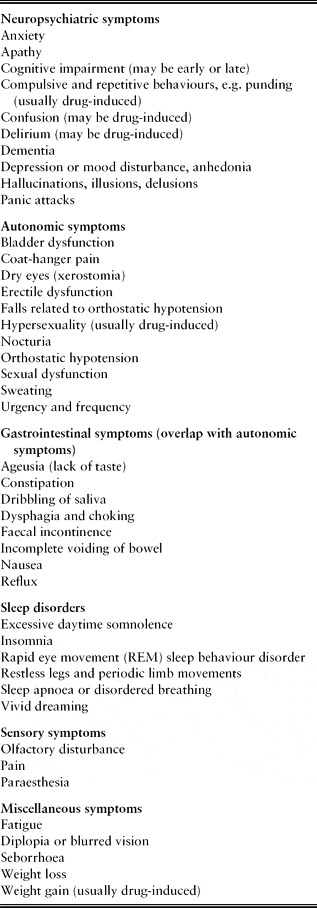
Non-motor symptoms (NMS) such as depression, psychosis, falls and sleep disorder are now receiving increasing attention because of the strong correlation with quality of life measures, increased institutionalization, carer distress and economic costs in PD.Reference Chaudhuri, Healy and Schapira56Table 1 lists a full range of NMS. A 15-year prospective study demonstrates that NMS dominate the clinical picture as disease progresses.Reference Hely, Reid and Trafficante57, Reference Hely, Reid, Adena, Halliday and Morris58 In a study of 545 patients, the mean number of NMS per patient was 10.3, with urinary symptoms, depression and memory problems being the most commonly reported.Reference Martinez-Martin, Schapira, Stocchi, Sethi, Odin, MacPhee, Brown, Naidu, Clayton, Abe, Tsuboi, MacMahon, Barone, Rabey, Bonuccelli, Forbes, Breen, Tluk, Olanow, Thomas, Rye, Hand, Williams, Ondo and Chaudhuri59
Non-motor symptoms in Parkinson's disease (adapted from Chaudhuri et al. 2006)Reference Chaudhuri, Healy and Schapira56

The frequency of NMS increases with disease duration and severity,Reference Barone, Antonini, Colosimo, Marconi, Morgante, Avarello, Bottacchi, Cannas, Ceravolo, Ceravolo, Cicarelli, Gaglio, Giglia, Iemolo, Manfredi, Meco, Nicoletti, Pederzoli, Petrone, Pisani, Pontieri, Quatrale, Ramat, Scala, Volpe, Zappulla, Bentivoglio, Stocchi, Trianni and Dotto60 but NMS occur at any stage in the disease process.Reference Chaudhuri, Healy and Schapira56 Certain symptoms such as depression, constipation, olfactory deficit and REM sleep behaviour may even antedate the motor features, and are considered premotor characteristics. Other putative premonitory symptoms include anxiety, apathy, fatigue and restless legs syndrome.Reference Chaudhuri and Schapira61
NMS do not always respond well to dopaminergic therapy, which may be explained by neurotransmitter dysfunction in extra-nigral cholinergic, serotonergic and noradrenergic pathways. Some NMS such as depression, anxiety and pain may be associated with motor fluctuations or ‘wearing off’ of medication effect, which is important to recognize. In contrast, other key NMS such as psychosis or impulse control disorder may be triggered or exacerbated by dopaminergic therapies. When reviewing NMS, clinicians should keep in mind other common age-related conditions since some ‘declared’ NMS may be due to unrelated co-morbidities, e.g. constipation and weight loss caused by colonic carcinoma.Reference Macphee, MacMahon, Chaudhuri, Tolosa, Schapira and Powe62 Motor symptoms have traditionally held the focus of attention during healthcare consultations, leading to under-recognition and under-treatment of NMS.Reference Shulman, Taback, Rabinstein and Weiner63 Recent evidence highlights the under-reporting of NMS by patients who may not relate them to PD or may feel uncomfortable with sensitive symptoms unless prompted.Reference Chaudhuri, Prieto-Jurcynska, Naidu, Mitra, Frades-Payo and Tluk64
The international Parkinson's Disease Non Motor group (PDNMG) has validated the first comprehensive clinic-based non-motor questionnaire which permits a rapid screening of 30 common NMS.Reference Chaudhuri, Martinez-Martin, Schapira, Stocchi, Sethi, Odin, Brown, Koller, Barone, MacPhee, Kelly, Rabey, MacMahon, Thomas, Ondo, Rye, Forbes, Tluk, Dhawan, Bowron, Williams and Olanow65 The Movement Disorder Society has recently modified the existing Unified Parkinson's Disease Rating Scale,66 the ‘gold standard’ tool for motor disability, and includes 11 non-motor symptoms.Reference Goetz, Tilley, Shaftman, Stebbins, Fahn, Martinez-Martin, Poewe, Sampaio, Stern, Dodel, Dubois, Holloway, Jankovic, Kulisevsky, Lang, Lees, Leurgans, LeWitt, Nyenhuis, Olanow, Rascol, Schrag, Teresi, van Hilten and LaPelle67 Other PD-specific evaluation tools include the scales for outcome in Parkinson's disease programme (SCOPA),68 which assesses motor as well as individual non-motor domains. Some key NMS and individual assessment tools will be discussed below. For more a detailed and comprehensive review of NMS, see Chaudhuri and Schapira (2009).Reference Chaudhuri and Schapira61 In 2010, evidence-based guidance on the treatment of selected NMS was published by the Scottish Intercollegiate Guidelines Network (SIGN)Reference Grosset, Macphee and Nairn69 in Diagnosis and pharmacological management of PD along with a Practice Parameter, Treatment of non-motor symptoms of Parkinson disease, by the American Academy of Neurology,Reference Zesiewicz, Sullivan, Arnulf, Chaudhuri, Morgan, Gronseth, Miyasaki, Iverson and Weiner70 following an earlier AAN publication on treatment of depression, dementia and psychosis.Reference Miyasaki, Shannon, Voon, Ravina, Kleiner-Fisman and Anderson71 The NICE clinical guideline on PD 2006 is shortly due for review.
Cognitive impairment and dementia
Mild cognitive impairment (MCI) is common in PD and has recently been characterized.Reference Dalrymple-Alford, Livingston, MacAskill, Graham, Melzer, Porter, Watts and Anderson72 Up to one-third of PD patients may have early cognitive problems within 2 years of diagnosis. Specific deficits include impaired executive function and reduced verbal fluency and visuospatial abilities.Reference Aarsland, Marsh and Shrag73 Many patients with MCI will develop dementia as the disease progresses and the point prevalence overall in PD is around 30%, with the incidence rate increased 4–6 times compared with controls.Reference Aarsland and Kurz74
In the Sydney cohort follow-up study, 83% of the survivors were diagnosed with dementia at 20 years.Reference Hely, Reid, Adena, Halliday and Morris58 Established risk factors for early dementia are old age,Reference Ebmeier, Calder, Crawford, Stewart, Besson and Mutch75, Reference Stern, Marder, Tang and Mayeux76 severity of motor symptoms (in particular postural and gait disturbances), mild cognitive impairment and visual hallucinations and longer duration of disease.Reference Biggins, Boyd, Harrop, Madely, Mindham, Randall and Spokes77 Genetic factors are increasingly recognized. The CamPaIGN longitudinal study of cognitive impairment and dementia reported that age >72 years, reduced semantic fluency and inability to copy an intersecting pentagons figure, were significant predictors of dementia at 5 years.Reference Williams-Gray, Evans, Goris, Foltynie, Ban and Robbins78
The clinicopathological basis of cognitive impairment and dementia continues to be debated. Lewy bodies are a strong correlate,Reference Hurtig, Trojanowski, Galvin, Ewbank, Schmidt, Lee, Clark, Glosser, Stern, Gollomp and Arnold79 but brain bank study suggests that the presence of limbic or cortical Lewy bodies fulfilling neuropathogical criteria consistent with dementia with Lewy bodies do not always correlate with cognitive decline in PD.Reference Colosimo, Hughes, Killard and Lees80 Co-morbid Alzheimer's disease and vascular pathologyReference Jellinger, Battistin, Scarlato, Caraceni and Ruggieri81 may also be pertinent.
Organic causes of delirium and depression should be excluded before diagnosing dementia. A large number of cognitive assessments for PD have been reported. The MDS task force has published two papers, the second of which suggests two levels of assessment.Reference Emre, Aarsland, Brown and Burn82, Reference Dubois, Burn, Goetz, Aarsland, Brown, Broe, Dickson, Duyckaerts, Cummings, Gauthier, Korczyn, Lees, Levy, Litvan, Mizuno, McKeith, Olanow, Poewe, Sampaio, Tolosa and Emre83 The first level incorporates the Mini Mental State Examination (MMSE) test. No knowledge of detailed neuropsychological testing is required but the MMSE test is insensitive to many aspects of cognitive impairment in PD. Recently, the Montreal Cognitive Assessment (MOCA) has been shown to be more sensitive and easily administered. It deploys a short number of tests to assess executive function, higher level language abilities, memory and complex visuospatial processing in PD.Reference Zadikoff, Fox, Tang-Wai, Thomsen, de Bie, Wadia, Miyasaki, Duff-Canning, Lang and Marras84
Because the cholinergic deficit in PD may be greater than that in Alzheimer's disease, cholinesterase inhibitor drugs may be effective in treating mild to moderate dementia in PD, particularly in those with visual hallucinations, behavioural disorders and psychosis.Reference Burn, Emre, McKeith, De Deyn, Aarsland, Hsu and Lane85 Not all patients benefit, and side-effects such as tremor or vomiting may require dose reduction or withdrawal. The best evidence is for rivastigmine,Reference Emre, Aarsland, Albanese, Byrne, Deuschl, De Deyn, Durif, Kulisevsky, van Laar, Lees, Poewe, Robillard, Rosa, Wolters, Quarg, Tekin and Lane86 which is the only licensed therapy in the UK, although treatment effects as measured by the ADAS Cog and Neuropsychiatric Inventory were modest. Donepezil has also been shown to be partly effective in small randomized controlled studies.Reference Leroi, Brandt, Reich and Lykestos87 Memantine is a low-affinity N-methyl D-aspartate (NMDA) anatagonist drug that has shown some positive results in the treatment of Parkinson's disease dementia (and DLB) in a short-term study.Reference Aarsland, Ballard, Walker, Bostrom, Alves, Kossakowski, Leroi, Pozo-Rodriguez, Minthon and Londos88
Sleep disorders
Sleep disorder in PD may affect initiation and maintenance of sleep and often starts early in the disease.Reference Chaudhuri89 It may be due to secondary causes such as nocturnal stiffness, depression, nocturia or restless legs. Primary sleep disturbance may relate to pathology of central sleep regulation centres in the brainstem and thalamocortical pathways, particularly the pedunculopontine nucleus and locus coeruleus. REM sleep disorder (RBD) is characterized by loss of the normal muscle atonia during REM sleep, allowing patients to act out their dreams, with vocalizations and abnormal violent movements often observed and reported by bed partners.Reference Postuma, Lang, Massicotte-Marquez and Montplaisir90 RBD usually responds to small doses of clonazepam. Other treatments such as melatonin and pramipexole have limited study evidence.
Excess daytime somnolence is common in PD and may be associated with disease process, dopaminergic therapy, nocturnal sleep disruption or obstructive sleep apnoea.Reference Arnulf91 In some patients, sudden and calamitous onset of sleep occurs and may reflect abnormal sleep latency and a narcolepsy-like phenotype, as shown by polysomnography.Reference Arnulf, Konofal, Merino-Andreu, Houeto, Mesnage, Welter, Lacomblez, Golmard, Derenne and Agid92 No consistently effective treatment exists. Specific warnings on driving and operating machinery should be given to patients at initiation, and during dose titration, of dopamine agonist therapy. Sleep hygiene measures should be advised, but no consistently effective drug treatment exists. Modafanil improves patients’ perception of wakefulness in PDReference Ondo, Fayle, Atassi and Jankovic93 but lacks evidence of objective improvements.Reference Zesiewicz, Sullivan, Arnulf, Chaudhuri, Morgan, Gronseth, Miyasaki, Iverson and Weiner70 Modafanil and melatonin are not currently recommended in the latest UK guideline.Reference Grosset, Macphee and Nairn69
Depression
Mood disorders, including depression, are common in PD but the reported prevalence of depression in PD ranges widely from around 5 to 70%Reference Cummings94 because of variable diagnostic criteria and lack of distinction between major affective disorder and depressive symptoms.Reference Weintraub and Stern95 A systematic review suggested that the prevalence of major depressive disorder was 17% in patients with PD, that of minor depression 22% and dysthymia 13%. Clinically significant depressive symptoms were present in 35% of patients.Reference Reijnders, Ehrt, Weber, Aarsland and Leentjens96
Recognition of depression in PD may be difficult because of overlap with motor and cognitive problems, such as hypomimia and apathy.Reference Allain, Schuck and Mauduit97 Classical symptoms such as self deprecation, guilt, delusions and suicidal thought may be less frequent in PD patients with depression.Reference Allain, Schuck and Mauduit97 Many patients have concurrent anxiety.Reference Meara, Mitchelmore and Hobson98
The Hamilton Depression Rating Scale (HAM-D) and the Montgomery-Asberg Depression Rating Scale (MADRS) are clinician rated scales that may be used for screening and assessment of severity,Reference Marsh, McDonald, Cummings and Ravina99 but a structured interview involving relatives and carers is the gold standard for diagnosis.Reference Grosset, Macphee and Nairn69
The aetiology of depression in PD is complex and the construct of depression in PD is the subject of an ongoing study of mood states in PD (PD PROMS study). Most,Reference Allain, Schuck and Mauduit97 but not all,Reference Meara, Mitchelmore and Hobson98 studies have failed to find an association between the severity of PD and depression, suggesting a biochemical basis usually linked to depletion of brain serotonin, catecholamines or dopamine.
Optimal treatment approaches lack a strong evidence base.Reference Burn100 Levodopa treatment is not consistently effective in improving mood disturbance, although may do so in phasic depression and anxiety associated with ‘off’ period dysfunction.Reference Burn100 Dopamine agonists may have more tonic mood-enhancing and motivational effects through D3 limbic stimulation,Reference Rektorová, Rektor, Bares, Dostál, Ehler, Fanfrdlová, Fiedler, Klajblová, Kulist’ák, Ressner, Svátová, Urbánek and Velísková101 and a recent double-blind controlled trial has suggested that the dopamine agonist pramipexole may improve depressive symptoms in PD, largely independently of improvements in motor disability.Reference Barone, Poewe, Albrecht, Debieuvre, Massey, Rascol, Tolosa and Weintraub102 The best evidence for treatment of depression in PD is for tricyclic antidepressantsReference Devos, Dujardin, Poirot, Moreau, Cottencin, Thomas, Destée, Bordet and Defebvre103, Reference Miyasaki, Shannon, Voon, Ravina, Kleiner-Fisman and Anderson104 but trials were short, and these agents commonly worsen or precipitate NMS such as constipation and confusion. Selective serotonin re-uptake inhibitors (SSRIs) appear useful first-line agents, although citalopram may prolong QT interval. Reports of an increase or provocation of parkinsonism appear rare and idiosyncratic. Other anti-depressants that may be used include mirtazapine and venlafaxine.Reference Lieberman105 In patients receiving an MAO-B inhibitor (such as selegiline) caution is needed with SSRIs, particularly fluoxetine, as this combination may rarely produce a serotonin syndrome, with changes in mental status and autonomic dysfunction.Reference Richard, Kurlan and Factor106 Electroconvulsive therapy may be required in refractory cases of depression. Psychosocial counselling is important in managing depression associated with the diagnostic stage of PD. Transcranial magnetic stimulation and fish oil supplementation have recently demonstrated potential benefit in managing depression in PD.
Psychosis
Around 20–40% of patients with PDReference Wolters107 manifest visual hallucinations, confusion or paranoid delusions during long-term therapy with levodopa or dopamine agonists. Visual hallucinations, illusions or a sense of presence may initially occur in isolation with retained insight and a clear sensorium. This is called ‘benign hallucinosis’, although use of this term has been challenged.Reference Goetz, Wenging, Leurgans, Bernard and Stebbins108 Later, insight is lost and paranoid delusions, often involving themes of infidelity and jealousy, emerge. Auditory and tactile hallucinations are less common.Reference Aarsland, Marsh and Shrag73–Reference Goetz, Tanner and Klawans109 Hallucinations and psychosis are strong predictors of nursing home placement,Reference Goetz and Stebbins110 and in the last decade were associated with a high mortality rate.Reference Goetz and Stebbins111 Early hallucinations, with or without levodopa treatment, may suggest co-morbid psychopathology such as dementia with Lewy bodies or atypical parkinsonism.Reference Goetz, Vogel, Tanner and Stebbins112
The precise aetiology of this syndrome is unknown but may be related to dysfunction of multiple neurotransmitter systems, including dopaminergic/serotonergic imbalance and cholinergic deficits.
Other risk factors for hallucinations and psychosis include older age,Reference Tanner, Vogel, Goetz and Klawans113 longer duration of disease, cognitive impairment or dementia,Reference Sanchez-Ramos, Ortoll and Paulson114 REM sleep behaviour disorder,Reference Forsaa, Larsen, Wentzel-Larsen, Goetz, Stebbins, Aarsland and Alves115 polypharmacy including anti-cholinergic drugsReference Tanner, Vogel, Goetz and Klawans113 and use of dopamine agonists.Reference Graham, Grunewald and Sagar116 Importantly, PD psychosis is not clearly correlated with dose or duration of dopaminergic therapy.Reference Merims, Shabtai, Korczyn, Peretz, Weizman and Giladi117 Other factors that may be relevant in older patients include co-morbidities such as deafness and visual handicap or co-existent cerebrovascular or Alzheimer pathology. Vivid dreaming and other sleep disturbances in PD may be a precursor of subsequent dopaminergic psychosis.Reference Sanchez-Ramos, Ortoll and Paulson114
Traditionally, the main management strategy after exclusion of intercurrent delirium in troublesome hallucinosis and dopaminergic psychosis is gradual withdrawal of non-essential drugsReference Friedman and Factor118 such as anti-cholinergics, selegiline, amantadine and dopamine agonists followed, if necessary, by reduction in core levodopa therapy. Gradual withdrawal is essential due to the risk of precipitating Parkinsonism-hyperpyrexia syndrome (also known as neuroleptic malignant-like syndrome) with high fever, autonomic dysfunction, alteration in mental status, rhabdomyolysis and renal failure.Reference Kipps, Fung, Grattan-Smith, de Moore and Morris119
The best evidence for the drug treatment of psychosis in PD is for low dose clozapine,Reference Merims, Balas, Peretz, Shabtai and Giladi120 but this requires the prescriber to be a registered user since potential bone marrow suppression mandates weekly blood counts. Quetiapine may be used as alternate first-line therapy since it does not require blood count surveillance. Quetiapine may prolong QT interval and ECG monitoring during treatment is prudent. Olanzapine and risperidone are unsuitable antipsychotics because motor symptoms invariably worsen.
Unfortunately, in severe psychosis, management may be a compromise between mental stability and poorer motor function. Emerging evidence suggests that acetylcholinesterase inhibitors are also effective in treating hallucinosis and psychosis.Reference Weintraub and Stern95 These agents may become the preferred treatment in PD patients with psychosis and significant cognitive impairment.
Disinhibitory psychopathologies and impulse control behaviour disorders
Diverse impulsive and compulsive behaviours such as pathological gambling, hypersexuality, compulsive shopping and binge eating have been increasingly reported in PD patients in the last decade and significant psychosocial, legal and financial consequences may ensue. Such behaviours are usually ‘triggered’ by dopaminergic therapy, particularly dopamine agonists,Reference Grosset, Macphee, Pal, Stewart, Watt, Davie and Grosset121, Reference MacMahon and Macphee122 and may affect up to 14% of patients.Reference Weintraub, Koester, Potenza, Siderowf, Stacy and Voon123 Crucially, behaviour is often covert and unrecognized by family members and health professionals. The recent SIGN guidelineReference Grosset, Macphee and Nairn69 highlights the need to counsel and review patients and families prior to therapy initiation. Ongoing supervision is necessary as these features may emerge at any time after the introduction of treatment. A reduction or withdrawal of dopamine agonists, with a shift to levodopa-based therapy, is associated with improvement in the majority, but not all cases.Reference Mamikonyan, Siderowf, Duda, Potenza, Horn, Stern and Weintraub124, Reference Macphee, Copeland, Stewart, Grosset and Grosset125
Dopamine dysregulation syndrome akin to a substance addiction occurs in a small number of PD patients who ingest increasing doses of dopaminergic therapy, usually levodopa, in excess of that necessary to treat the motor disorder.Reference Evans and Lees126 Appetitive behaviours such as pathological gambling, hypersexuality and compulsive shopping, as well as ballistic dyskinesias, may emerge. Management is difficult since attempts to reduce therapy often lead to dysphoria with pain and anxiety in the absence of ‘off’ period motor disability. Covert ingestion, hoarding of medication and aggressive behaviours may result.
Other non-motor symptoms
Autonomic dysfunction, although a key feature of multiple system atrophy (MSA), is also found frequently in PD.Reference Chaudhuri127 Orthostatic hypotension (OH) occurs in around 50% of people with PD, associated with central and peripheral autonomic disturbanceReference Allcock128 as well as a side-effect of dopaminergic therapy. Withdrawal or reduction of cardioactive medications, good hydration, elastic stockings and bed head elevation to 30–40 deg may be helpful. Domperidone, a D2 receptor antagonist, and fludrocortisoneReference Schoffer, Henderson, O'Maley and O'Sullivan129 and the sympathomimetic midodrine (currently unlicensed in the UK) are commonly used in practice, although evidence is currently insufficient to recommend these medications.Reference Zesiewicz, Sullivan, Arnulf, Chaudhuri, Morgan, Gronseth, Miyasaki, Iverson and Weiner70, Reference Miyasaki, Shannon, Voon, Ravina, Kleiner-Fisman and Anderson71 Domperidone may prolong QT interval in high doses.
Bladder and bowel symptoms and sexual dysfunction are common and may relate to both dopaminergic and non-dopaminergic pathology. Treatment of constipation is important, not only for patient comfort but may improve PD symptoms, perhaps by improving drug delivery in the upper gastrointestinal tract through a gastro-colic reflex.Reference Stocchi, Chaudhuri, Schapira, Tolosa and Poewe130 Constipation may be managed by regular exercise, ensuring adequate fluid and fibre, followed if necessary by stool softeners, laxatives, suppositories and enemata. Polyethylene glycol solution (Movicol, Laxido) is usually the most effective agent.Reference Zangaglia, Martignoni, Glorioso, Ossola, Riboldazzi, Calandrella, Brunetti and Pacchetti131 After obstruction is excluded, anti-cholinergic drugs can be used to treat urinary urgency, but may exacerbate constipation and confusion. Such ‘therapeutic conflicts’ are common in managing NMS.
Pain is a common co-morbidity in PD, affecting up to 40% of patients.Reference Ford132 It may be related to primary causes such as centrally mediated pain, motor fluctuations, i.e. pain when ‘off’, dystonia, akathisia or radicular and neuropathic pain and secondary musculoskeletal causes. Oral (burning mouth) and genital pain are unusual, and often unrecognized, primary pain symptoms in PD. Further assessment and management is reviewed in Ford (2010).Reference Ford133
Future developments
The management of PD is becoming increasingly complex, with an expanding number of drugs and surgical therapies. Future symptomatic treatment options under development include dopamine re-uptake inhibitors, adenosine receptor antagonists, glutamate antagonists and release inhibitors, opioid kappa receptor agonists, nicotinic receptor agonists, neurotrophic factors, and new non-dopaminergic agents targeting serotonin, noradrenergic and cholinergic systems. This area is of particular pertinence in addressing NMS in PD. Neuroprotective agents remain an unmet clinical need, and robust biomarkers will permit earlier intervention in clinical trials. Putative neuroprotective agents include mitochondrial modulators such as Co-enzyme Q10, iron chelators, green tea polyphenols, calcium antagonists and inosine, a urate precursor. A future cure for PD is likely to result from a greater understanding of the genetic mutations and susceptibility factors in PD as well as the pathogenesis of PD, particularly in the premotor phase. There are still unresolved issues regarding the translation of preclinical animal models of PD into clinical research. More rigorous clinical trial design in neuroprotection studies, dyskinesia and quality of life in PD continue to evolve. A meaningful advance in the management of PD may be dependent on the ability to modulate molecular and pathogenetic processes with a combination of therapeutic agents, i.e. a PD ‘polypill’.
Declaration of interests
Dr Macphee and Dr Stewart have received honoraria or travel support from Abbott, Boeringher Ingelheim, Genus, Glaxo Smith Klein, Orion, Teva Lundbeck, UCB who manufacture anti-Parkinson's drugs, and GE who manufacture an isotope for DAT scanning.