


1. Introduction
This article deals with the distribution of auxiliary-like elements in Peranakan Javanese (PNJ). We shall argue that the language makes a structural distinction between auxiliaries and main verbs. Auxiliaries are unique in that they undergo optional head movement to C. Not only do single auxiliaries move to C, as in familiar languages, but sequences of two or three auxiliaries can move to C as well. Significantly, the order of the moved auxiliaries is always the same as the order in their unmoved position. We shall show that the distribution of auxiliaries in PNJ is predicted if a ‘tucking in’ (Richards Reference Richards1997) analysis of head movement similar to that of Collins (Reference Collins2002) is adopted.
The PNJ facts are of special interest not only because they are an example of an additional language/construction that shows the distribution expected on the basis of ‘tucking in’, but also because PNJ provides evidence that helps to distinguish between a head movement analysis and the ‘standard’ version of the remnant movement analysis, in which adverbs occupy fixed positions in the clause. It is quite difficult to distinguish between these approaches empirically, so the PNJ auxiliary facts are important in this regard.
Before turning to our analysis, it may be useful to provide some information on the language under study. Javanese is a member of the Western Malayo-Polynesian branch of the Austronesian language family and is spoken in Central Java, throughout East Java, to the eastern region of Banyuwangi where there are a number of different Javanese dialects. It is the native language of more than 75,000,000 speakers (about 30% of the population of Indonesia). Well-known dialects include (i) Central Javanese, including the dialects of Semarang, Solo, and Yogyakarta, (ii) East Javanese, spoken in Malang-Pasuruan and Surabaya, and (iii) West Javanese, spoken in Cirebon, Banyumas, and Tegal. Javanese is known as a language that exhibits well-defined speech levels. As noted by Dardjowidjojo (Reference Dardjowidjojo1973), Javanese has two main speech levels: Ngoko, the colloquial, informal, and non-polite variety, and Kromo, its formal and polite counterpart (though many dialects have three speech levels, and the ‘standard’ dialects of Solo/Yogyakarta have five distinct levels).
The topic of this paper is the Ngoko variety of Central Javanese as spoken by ethnically Chinese native speakers of the language in the city of Semarang, the capital city of Central Java.Footnote 2 Following Wolff (Reference Wolff1997), we refer to this variety as Peranakan Javanese. (The term peranakan refers to ethnically Chinese Indonesians who grow up speaking local languages like Javanese and Indonesian. Peranakan is to be contrasted with pribumi, the ethnically Javanese population of Java.) As the name of the dialect suggests, our consultants are ethnically Chinese and grew up in Semarang. The primary language of the speakers is PNJ, but, like most speakers of PNJ, they are also completely fluent in Indonesian and code switch frequently between the two languages.Footnote 3 While Peranakan and Pribumi Javanese (PBJ) are entirely mutually intelligible, as Wolff (Reference Wolff1997) and Wolff & Poedjosoedarmo (Reference Wolff and Poedjosoedarmo1982) point out, the two linguistic systems are quite different in a number of areas. In addition, many forms from Indonesian have been borrowed into PNJ. This occurs to a much lesser extent in PBJ than in PNJ. Furthermore, Peranakan Javanese is not standardized, and thus is subject to considerable variation from speaker to speaker. (Some speakers know more Standard Javanese than others, etc.) It therefore goes without saying that the facts described in this paper are not claimed to hold for Standard Javanese or for other varieties of Pribumi Javanese.
There are, in PNJ, a number of words that show a resemblance to auxiliaries in European languages. For instance, the word order in (1) and (2) is identical to that in English. Isa ‘can’ and pernah ‘perf’ appear in the position occupied by an auxiliary in European SVO languages, i.e. in the ‘inflectional region’, where projections intermediate between the main verb and the surface subject might be expected to occur.
(1) Aku isa ngomong Inggris. 1sg can speak English ‘I can speak English.’
(2) Aku pernah mangan sega. 1sg perf eat rice ‘I have eaten rice before.’
Isa ‘can’ and pernah ‘perf’ must occur to the left of the verb. It is ungrammatical for these elements to appear in immediately postverbal position, as in (3), or in sentence-final position, as in (4).
(3) *Aku ngomong isa Inggris 1sg speak can English ‘I can speak English.’
(4) ??Aku ngomong Inggris isa.Footnote 4 1sg speak English can ‘I can speak English.’
While forms like isa and pernah show an immediate similarity to auxiliaries in European languages, the proposal that there are auxiliaries in PNJ remains controversial. Is it justified on the basis of language-internal evidence to claim that the PNJ VP is the complement of a series of ‘auxiliary verbs’, as has been proposed for English and other languages? In recent work on a related language, Riau Indonesian, Gil (Reference Gil, Elena and Yakov1999) has argued that the structure of at least some Austronesian languages of Indonesia differs radically from that of European languages. If Gil is correct, the proposal that PNJ should be analyzed in a fashion similar to French or English might be viewed as Eurocentric, and as lacking language-internal motivation. However, whatever the status of the evidence may be with respect to certain Indonesian dialects, we shall argue that the grammar of PNJ does in fact treat auxiliaries quite differently from main verbs: we shall demonstrate that PNJ shows differences in distribution between verbs and auxiliary-like elements.
Our argument will be structured as follows. First (section 2), main verbs and auxiliaries differ morphologically: verbs can take a variety of affixes, which we shall refer to collectively as ‘verbal morphology’. In contrast, seeming auxiliaries lack these affixes. Second (section 3), and more importantly, PNJ allows the fronting of auxiliaries to presubject position. This fronting process is possible only for auxiliaries and not for main verbs. Furthermore, in multiple auxiliary constructions (section 4), the pattern of fronting suggests that the movement pattern of auxiliary-like elements is derived by head movement and that the auxiliaries are not in fact adverbs of time.
In addition, we shall show that auxiliaries divide into two classes, movable and non-movable auxiliaries (section 5), which, we argue, correspond to lexical and functional auxiliaries. The interaction of the two types of auxiliaries (section 6) provides evidence that both movable and non-movable auxiliaries are heads that take VPs as their complements. Finally, the pattern of fronting of multiple auxiliaries is predicted if a ‘tucking in’ analysis of head movement is posited (sections 7–10). Thus, the grammar of PNJ provides new evidence in favor of the universality of the ‘split INFL’ approach to sentence structure, as well as evidence for head movement along the lines proposed by Collins (Reference Collins2002).
2. PNJ verbal morphology
We shall first show that seeming auxiliaries do not permit PNJ verbal affixes. Most active transitive verbs in PNJ are preceded by a nasal prefix, as seen in (5)–(6).Footnote 5 The verb stems in these examples are omong and ambung, while ng- marks the active voice.
(5) Mben peserta ngomong Inggris.every contestant n-speak English ‘Every contestant speaks English.’
(6) Budi ngambung Siti.Budi n-kiss Siti ‘Budi kissed Siti.’
However, as shown in (7)–(9), seeming auxiliary elements do not take the nasal prefix, even when they appear to take a direct object. The following sentences are grammatical with the bare auxiliary form, but the forms with prenasalization, ngisa, nggelem and mernah, are ungrammatical.Footnote 6
(7) Aku *ngisa/isa ngomong Inggris. 1sg n-can/can speak English ‘I can speak English.’
(8) Aku *nggelem/gelem kopi. 1sg n-want/want coffee ‘I want coffee.’
(9) Aku *mernah/pernah mangan sega. 1sg n-perf/perf eat rice ‘I have eaten rice before.’
In contrast to the active form with ng-, the passive form of the transitive verb is derived by attaching the passive morpheme ‘di-’ to the verb stem. Hence, transitive verbs typically show an alternation between the nasal prefix and the di- prefix: diomong is the passive counterpart of ngomong, and diambung is the passive counterpart of ngambung.
(10) Inggris diomong mben peserta.Footnote 7 English pass-speak every contestant ‘English is spoken by every contestant.’
(11) Siti diambung mbek Budi. Siti pass-kiss by Budi ‘Siti was kissed by Budi.’
As is true for active verbal morphology, passive verbal morphology is ungrammatical with these auxiliaries like isa, gelem and pernah. Even in constructions in which seeming auxiliaries like isa, gelem and pernah appear to have an NP object, as in (12), (14), and (16), passivization is not possible. Thus, the forms in (13), (15), and (17) are ungrammatical.Footnote 8
(12) Mben peserta isa Inggris. every contestant can English ‘Every contestant can handle English.’
(13) *Inggris di-isa mben pesertaEnglish pass-can every contestant ‘English is handled by every contestant.’
(14) Dheen gelem kopi. 3sg want coffee ‘He wants coffee.’
(15) *Kopi di-gelem dheenFootnote 9 coffee pass-want 3sg ‘Coffee is wanted by him.’
(16) Aku pernah sugeh. 1sg perf rich ‘I have been rich.’
(17) *Sugeh di-pernah akurich pass-perf 1sg
Furthermore, when a seeming auxiliary co-occurs with a verb as in (18), the passive morpheme di-, like the active morpheme ng-, is attached only to the verb and not to the auxiliary. If isa ngomong were, for instance, a single complex predicate consisting of two verbs at the sublexical level, we would expect the passive morpheme di- to be attached to isa. However, isa and similar lexical items can never take the passive morpheme, as is shown below.
(18) Mben peserta isa ngomong Inggris. every contestant can speak English ‘Every contestant can speak English.’
(19) Inggrisi [isa di-omong] ti mben peserta. English can pass-speak every contestant ‘English can be spoken by every contestant.’
(20) *Inggrisi [di-isa ngomong] ti mben peserta English pass-can speak every contestant ‘English can be spoken by every contestant.’
(21) *Inggrisi [di-isa di-omong] ti mben peserta English pass-can pass-speak every contestant ‘English can be spoken by every contestant.’
Therefore, we conclude that isa and other apparent auxiliaries do not show the characteristic inflectional morphology of main verbs.
We next examine whether auxiliary-like elements behave like verbs with respect to derivational morphology, e.g. the causative/applicative morphemes -ke and -i (the choice is lexically conditioned). These derivational morphemes add an extra argument to the argument structure of the verb or mark the presence of a certain argument.
(22) Wong lanang kuwi mati gek wingi.Footnote 10 person boy this die yesterday ‘The boy died yesterday.’
(23) Dheen mate ni wong lanang kuwi gek wingi. 3sg die-appl person boy this yesterday ‘He killed the boy yesterday.’
(24) Dheen entuk kerjaan. 3sg get job ‘She got a job.’
(25) Dheen ngentuke Mary kerjaan. 3sg n-get-appl Mary job ‘She got a job for Mary.’
(26) Dheen ngentuke kerjaan nggo Mary. 3sg n-get-appl job for Mary ‘She got a job for Mary.’
While these suffixes are used very productively with verbs, they cannot be attached to seeming auxiliaries.
(27) Dheen gelem mateni wong lanang kuwi. 3sg want die-appl person boy this ‘He wants to kill the boy.’
(28) *Dheen nggelemi/gelemi mate wong lanang kuwi 3sg n-want-appl/want-appl die person boy this
(29) *Dheen nggelemi/gelemi mateni wong lanang kuwi 3sg n-want-appl/want-appl die-appl person boy this
(30) Dheen isa ngentuke kerjaan (nggo) ibu-e. 3sg can get-appl job for mother-his ‘He can get a job for his mother.’
(31) *Dheen ngisake/isake entuk kerjaan (nggo) ibu-e 3sg n-can-appl/can-appl get job for mother-his
(32) *Dheen ngisake/isake ngentuke kerjaan (nggo) ibu-e 3sg n-can-appl/can-appl get job for mother-his
The ungrammaticality of these suffixes with apparent auxiliaries is another piece of evidence that these elements are distinct from main verbs.Footnote 11
In sum, seeming auxiliaries do not accept the characteristic morphology of the PNJ main verb. This suggests that auxiliaries and main verbs are distinguished in the language.
While the morphological evidence is suggestive of a structural or categorial distinction between auxiliaries and main verbs, it is not conclusive. Not all transitive verbs in PNJ take ng- and di-, and not all verbs accept the causative/applicative suffixes. Our next argument, which is based solely on the syntactic distribution of verbs and seeming auxiliaries, will provide stronger evidence for the claim that such a distinction must be made.
3. The fronting of auxiliaries
Our second argument that auxiliaries and main verbs are distinguished in PNJ is based on instances of ‘subject-aux inversion’ for yes/no questions. We will show that the fronting of seeming auxiliary elements is possible, but the fronting of main verbs is not.Footnote 12
The following sentences illustrate the fronting of auxiliaries to a position above the subject.Footnote 13
(33) [Isa]i dheen ti ngomong Inggris?Footnote 14 can 3sg speak English ‘Can he speak English?’
(34) [Gelem]i dheen ti mangan sega?want 3sg eat rice ‘Does he want to eat rice?’
(35) [Pernah]i Tono ti sugeh?perf Tono rich ‘Has Tono ever been rich?’
In contrast to (33)–(35), it is ungrammatical to front main verbs, as is shown in the following examples:Footnote 15
(36) *[V Ngepruk]i Budi ti bale alon-alon hit Budi ball slowly ‘Did Budi hit the ball slowly?’
(37) *[V Ngomong]i dheen ti Inggris speak 3sg English ‘Does he speak English?’
(38) *[V Turu]i dheen ti enak mau mbengi sleep 3sg well last night ‘Did he sleep well last night?’
These contrasting patterns can be explained if we hypothesize a structural distinction between the position of auxiliaries and that of main verbs, i.e. that elements like isa, gelem and pernah appear in the tree in a position intermediate between CP and VP. We shall now examine the nature of the position in which these elements appear.
The tree in (40) provides a partial structure for sentence (39).
(39) Aku isa ngomong Inggris. 1sg can n-speak English ‘I can speak English.’
(40)


According to (40), apparent auxiliaries differ in position from main verbs. The position of the ‘auxiliary’ in (40), however, is compatible with two analyses: one in which such elements are generated as heads of intermediate projections (as has been proposed for auxiliaries in European languages) and another in which they are adjoined to VP as adverbial modifiers. We shall next argue that apparent auxiliaries are not adverbial modifiers but are, in fact, intermediate heads, like auxiliaries in European languages.
4. Multiple auxiliary constructions
We now turn to sentences with more than one apparent auxiliary, and show that the pattern found is that expected if auxiliaries are in fact heads of intermediate projections rather than adverbial modifiers. Before examining how these sentences work, it may be useful to make explicit our assumptions regarding the expected behavior of auxiliaries and the structures in which they occur. As we have already stated, we assume that true auxiliaries are heads of projections intermediate between that headed by the lexical verb and the subject. As a result, the occurrence of variable word orders involves head movement, which is constrained by the Head Movement Constraint (Travis Reference Travis1984). (The HMC has sometimes been analyzed as a special case of Relativized Minimality (Rizzi Reference Rizzi1990), but we shall take the position below that these effects are due to the Minimal Link Constraint. We compare head movement and remnant movement analyses in section 9.)
(41) Head Movement Constraint (HMC)
An X0 category can only move to a position that governs its maximal projection.
The HMC has the consequence that head movement cannot cross an intervening head.
While there are a number of contemporary analyses for auxiliaries and quasi-auxiliaries (e.g. Cinque Reference Cinque1999 and Koopman & Szabolcsi Reference Koopman and Szabolcsi2000), we shall adopt the proposal of Wurmbrand (Reference Wurmbrand2001) that auxiliaries do not differ from main verbs in terms of grammatical category, but rather in terms of featural content and the structural position in which the auxiliary occurs. The overall structure for the clause in this framework is given in (42).Footnote 16
(42)
FP may be iterated n times. The maximal number of F projections is determined by the inventory of functional heads in the language in question. In addition to functional projections above the vP, it is assumed that V can take a variety of complement types, among them VP. We shall propose below that some auxiliaries in PNJ are instances of F0 while others are examples of V0 that take VP as its complement. (We shall elaborate our analysis further below as new facts are presented.)
PNJ double-auxiliary constructions are illustrated below. In such constructions, the order in which the auxiliaries may occur is fixed. It is ungrammatical to have multiple auxiliaries with the reversed order, as shown in (43)–(45):
(43)
(a) Dheen gelem isa ngomong Inggris. 3sg want can speak English ‘He wants to be able to speak English.’
(b) *Dheen isa gelem ngomong Inggris 3sg can want speak English
(44)
(a) Dheen pernah isa ngomong Inggris. 3sg perf can speak English ‘He has been able to speak English.’
(b) *Dheen isa pernah ngomong Inggris 3sg can perf speak English
(45)
(a) Aku pernah gelem mangan sega. 1sg perf want eat rice ‘I have wanted to eat rice.’
(b) *Aku gelem pernah mangan sega1sg want perf eat rice
Examples (43)–(45) and similar sentences show that auxiliaries occur in a fixed order. This is expected if they are heads since heads are expected to select for their complement and therefore, when occurring in a monoclausal structure, to be found in a fixed order: pernah>gelem>isa. This is not necessarily the case for adverbs since adverbs can be licensed by projections in a variety of positions, and hence frequently have multiple positions where they can occur in the sentence.Footnote 17 Thus, the existence of a fixed order among auxiliaries provides an initial (though clearly inconclusive) argument in favor of the claim that they are heads rather than adverbs.
While the existence of a fixed order among seeming auxiliaries is compatible with the claim that they are true auxiliaries rather than adverbs, this fact is no more than suggestive since there could be a variety of other explanations for the fixed order. To provide stronger support for our claim we therefore turn to a comparison of the fronting possibilities in multiple auxiliary constructions with those for adverbials and negation. Before turning to fronting in sentences with multiple auxiliaries, we shall examine the pattern found when putative auxiliaries are fronted over clear instances of adverbs and negation, which, in PNJ, we take to be XPs in a specifier position rather than heads. As shown in (46)–(48), it is possible to front the auxiliaries isa, gelem and pernah over negation.
(46)
(a) Dheen ora isa ngomong Inggris. 3sg neg can speak English ‘He cannot speak English’
(b) [Isa]i dheen ora ti ngomong Inggris.can 3sg neg speak English ‘Can't he speak English?'
(47)
(a) Dheen ora gelem turu. 3sg neg want sleep ‘He does not want to sleep.’
(b) ?[Gelem]i dheen ora ti turu.want 3sg neg sleep ‘Doesn't he want to sleep?'
(48)
(a) Dheen ora pernah mbayar tagihane. 3sg neg perf pay bill ‘He has never paid the bill.’
(b) [Pernah]i dheen ora ti mbayar tagihane.perf 3sg neg pay bill ‘Has he ever paid the bill?’
We see from (49)–(50) that fronting over adverbs is also possible. The normal order for the auxiliary gelem and the adverb sesok ‘tomorrow’ is shown in (49). We know gelem cannot precede the adverb when fronting of gelem has not occurred (e.g. (50a)). Hence, in (50b) gelem must have been fronted over the adverb:
(49) Dheen sesok gelem lungo blonjo. 3sg tomorrow want go shopping ‘He wants to go shopping tomorrow.’
(50)
(a) *Dheen gelem sesok lungo blonjo 3sg want tomorrow go shopping ‘He wants to go shopping tomorrow.’
(b) [Gelem]i dheen sesok ti lungo blonjo?want 3sg tomorrow go shopping ‘Does he want to go shopping tomorrow?’
If we assume that isa, pernah and gelem are heads of projections, and that negation and adverbs are XPs, isa, pernah and gelem would be predicted to be able to move over negation and adverbs. Fronting of a head over negation and adverbs should be possible because, according to the HMC, the movement of heads is blocked only by the presence of an intervening head, not by an XP.
We now examine the fronting possibilities in ‘double auxiliary’ constructions. We shall see that a different pattern of fronting possibilities emerges. (In this section we shall restrict our discussion to the fronting of only one of the two auxiliaries. Simultaneous fronting of two or more auxiliaries will be considered in a later section.) In such examples, it is possible to front the first auxiliary in the sequence, as shown in (51).
(51) [Gelem]i dheen ti isa ngomong Inggris.want 3sg can speak English ‘Does he want to be able to speak English?’
The second auxiliary, however, cannot be fronted, crossing the first auxiliary and the subject in the process.
(52) *[Isa]i dheen gelem ti ngomong Inggriscan 3sg want speak English ‘Does he want to be able to speak English?’
(53) *[Isa]i dheen pernah ti ngomong Inggriscan 3sg perf speak English ‘Has he ever been able to speak English?’
(54) *[Gelem]i dheen pernah ti nduwe pacarwant 3sg perf have girlfriend ‘Has he ever wanted to have a girlfriend?’
This pattern is expected if auxiliaries are heads of projections. Fronting of one head over another would be ruled out by the Head Movement Constraint. In contrast, if the seeming auxiliaries were adverbs, we would expect a pattern similar to that seen in (46)–(50). Fronting over an adverb should be well-formed; there would be no reason to expect that fronting should be restricted to the first element in the sequence. Note that clear instances of adverbials can indeed be fronted over an intervening adverbial or negation:Footnote 18
(55) Tono mlindes asu nggon dalan gek wingi.Tono n-run-over dog on street yesterday ‘Tono ran over a dog on the street yesterday.’
(56) Gek wingi Tono mlindes asu nggon dalan.yesterday Tono n-run-over dog on street ‘Yesterday Tono ran over a dog on the street.’
(57) Nggon dalan Tono mlindes asu gek wingi.on street Tono n-run-over dog yesterday ‘On the street Tono ran over a dog yesterday.’
(58) Tono ora mlindes asu nggon dalan gek wingi.Tono neg n-run-over dog on street yesterday ‘Tono did not run over a dog on the street yesterday.’
(59) Gek wingi Tono ora mlindes asu nggon dalan.gek yesterday Tono neg n-run-over dog on street ‘Yesterday Tono did not run over a dog on the street.’
(60) Nggon dalan Tono ora mlindes asu gek wingi.on street Tono neg n-run-over dog yesterday ‘On the street Tono did not run over a dog yesterday.’
Examples (55)–(57) show that an adverbial can be fronted over another adverbial, while (58)–(60) show that an adverbial can be fronted over negation. The possibility of fronting adverbials over other adverbials and negation contrast with the pattern in (52)–(54), where we saw that a putative auxiliary cannot be fronted over another putative auxiliary. The discrepancy between the two patterns can be explained if gelem, isa and pernah are auxiliaries, and hence heads of projections, which are subject to the HMC, while adverbials and negation are XPs.
5. Type II auxiliaries
We conclude, on the basis of the arguments in the previous sections, that gelem, isa and pernah are indeed auxiliaries, heads that take the VP and/or other categories as their complement. We shall, for convenience, refer to these three auxiliaries as Type I Auxiliaries. We now turn to another group of auxiliary-like elements, which we shall refer to as Type II Auxiliaries. Type II Auxiliaries have characteristics similar to those of Type I Auxiliaries except with regard to fronting. We will argue that Type II Auxiliaries are also heads of projections, but, for reasons that will be discussed below, they are blocked from undergoing fronting.
Like Type I Auxiliaries, Type II Auxiliaries occur in preverbal position and are ungrammatical in postverbal and sentence-final positions, as shown below.
(61) Siti meh/gek/wis/harus ngomong Inggris.Siti will/prog/already/must speak English ‘Siti will speak/is speaking/has already spoken/must speak English.’
(62) *Siti ngomong meh/gek/wis/harus InggrisSiti speak will/prog/already/must English ‘Siti will speak/is speaking/has already spoken/must speak English.’
(63) *Siti ngomong Inggris meh/gek/wis/harusSiti speak English will/prog/already/must ‘Siti will speak/is speaking/has already spoken/must speak English.’Footnote 19
Type II Auxiliaries are similar to Type I Auxiliaries in that they lack such verbal morphology as the nasal prefix (as is shown in (64)), the di- prefix for passivization (as in (65)–(66)) and the suffixes ke and i (as in (67)). In addition, as in the case of Type I Auxiliaries, we observe that the passive morpheme is attached to the verb and not to the seeming auxiliary.
(64) Mben peserta wis/*n-wis ngomong Inggris.every contestant already/n-already speak English ‘Every contestant has spoken English.’
(65) Inggris meh di-omong/*di-meh ngomong mben peserta.English will pass-speak/pass-will speak every contestant ‘English will be spoken by every contestant.’
(66) *Inggris di-meh di-omong mben pesertaEnglish pass-will pass-speak every contestant ‘English will be spoken by every contestant.’
(67) *Wiske/i, *mehke/i, *haruske/i, *gekke/i
Type II Auxiliaries differ from Type I Auxiliaries in that Type II Auxiliaries cannot undergo head fronting.
(68) *[Meh]i dheen ti ngomong Inggriswill 3sg speak English ‘Will he speak English?’
(69) *[Harus]i dheen ti ngomong Inggrismust 3sg speak English ‘Must he speak English?’
(70) *[Wis]i dheen ti mbayar tagihanealready 3sg pay bill ‘Has he paid the bill already?’
(71) *[Gek]i dheen ti mangan segaprog 3sg eat rice ‘Is he eating rice?’
The fact that Type II Auxiliaries have different fronting properties from Type I Auxiliaries suggests that Type II Auxiliaries would be expected to occur in a different region of the tree from Type I Auxiliaries. On initial examination, however, this expectation would appear to be incorrect because Type II Auxiliaries seem to be interspersed among Type I Auxiliaries. The surface order of auxiliaries is shown in (72), from left to right.Footnote 20 Type I Auxiliaries are shown in italics while Type II Auxiliaries are in boldface.Footnote 21
(72)
The surface order of auxiliaries
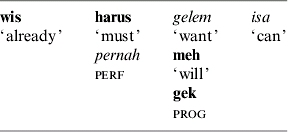
As is seen in table (72), Type II Auxiliaries generally appear to the left of Type I Auxiliaries. This pattern, if it were exceptionless, would provide a clear basis for an argument that Type II Auxiliaries are higher in the tree than Type I Auxiliaries. For instance, on the assumption that the overall structure of the clause approximates (42) (repeated), Type I Auxiliaries might be instances of V (similar to Wurmbrand's lexical restructuring predicates) while Type II are examples of F.Footnote 22
(42)
We shall, in fact, suggest that Type I Auxiliaries are examples of V rather than F because they are able to occur both as main verbs (cf. (12), (14) and (16)) and as auxiliaries. In contrast to Type I, Type II Auxiliaries can never be used in the absence of a main verb. Furthermore, Type I Auxiliaries are at least plausible candidates for V (i.e. lexical auxiliaries) following Wurmbrand's criteria. According to Wurmbrand, the key characteristic of lexical auxiliaries (e.g. lexical restructuring predicates in German) is the ability to assign a theta role to the external argument of the predicate. This property clearly holds for gelem ‘want’. It is also a likely analysis for isa ‘can’, for which the ability in question is attributed to the external argument of the predicate. While we acknowledge that pernah ‘perf’ does not fall into the same semantic class as that posited by Wurmbrand, it should be remembered that Wurmbrand's classes of restructuring predicates are also not semantically uniform. It should also be recalled that other syntactic classes of predicates that appear to have a semantic core, like unaccusative predicates, have turned out to show considerable semantic variation in their crosslinguistic distribution. Thus, it does not strike us as surprising that the match between grammatical distribution and semantic class should be less than perfect in the case of PNJ lexical auxiliaries.
While we consider the analysis of Type I Auxiliaries as lexical and Type II Auxiliaries as functional to be an attractive one, there are two types of exceptions to the generalization that Type II Auxiliaries precede Type I. These exceptions must be explained if the proposal that Type II Auxiliaries are higher in the tree than Type I Auxiliaries is to be adopted. The first problem is the ordering of meh ‘will’ with respect to other auxiliaries. As is shown in the following examples, meh can either precede or follow gelem ‘want’ but it must precede isa ‘can’.
(73) Dheen meh isa nyetir montor. 3sg will can drive car ‘He can drive a car.’
(74) *Dheen isa meh nyetir montor 3sg can will drive car ‘He can drive a car.’
(75) Dheen meh gelem ngomong Inggris. 3sg will want speak English ‘He will want to speak English.’
(76) Dheen gelem meh ngomong Inggris. 3sg want will speak English ‘He wants to speak English in the future.’
The fact that meh can sometimes follow gelem would appear to be a counterexample to the claim that meh is a functional head while gelem is an instance of V. However, the variable order of meh and gelem suggests another possibility, that gelem can subcategorize for either a VP or a clause. From this perspective, sentences like (75) are monoclausal structures, in which meh is an instance of F0 and gelem is an instance of a V0 that takes a VP (ngomong) as its complement: [FP [F meh] [VP [V gelem] [VP ngomong...]]]. In contrast, sentences like (76) are biclausal structures in which gelem subcategorizes for an embedded clause as its complement. Gelem appears to the left of meh because gelem is in a higher clause than meh:
(77) [VP [V gelem] [CP … [FP [F meh] [VP ngomong...]]]]Footnote 23
The ordering of the Type I auxiliary pernah and the Type II Auxiliaries meh and gek presents a similar problem. It would be expected that pernah should follow meh and gek, not precede them. Again in this case, a possible solution may be that pernah can take a clause as its complement. In such a case meh and gek would follow pernah because they are in a subordinate clause, not because pernah precedes meh and gek within a single clause.Footnote 24 (Additional evidence for the biclausal analysis will be presented in section 6.) We shall, therefore, make the assumption that the apparent counterexamples to the claim that Type II Auxiliaries precede Type I Auxiliaries can be overcome along these lines, and will assume that the structure of the PNJ clause is roughly (78):
(78)
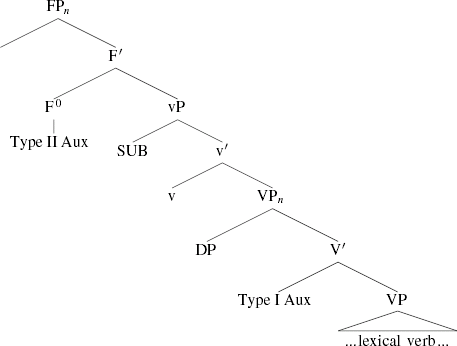
This approach is corroborated by the order found when three or more auxiliaries occur in a single sentence. In sentences like (79), the fact that it is possible to have a Type II Auxiliary intervening between two Type I Auxiliaries is taken to indicate a biclausal structure.
(79) Aku gelem meh isa ngomong Inggris. 1sg want will can speak English ‘I want to be able to speak English in the future.’
6. The interaction of Type I and Type II auxiliaries
We turn next to an examination of fronting possibilities involving a combination of Type I and Type II Auxiliaries. We saw in the previous section that meh, as a Type II auxiliary, is generated higher than isa, a Type I auxiliary. Let us compare the predictions of two hypotheses regarding the fronting of isa when meh is present. On the assumption that meh is a functional head, on the basis of the HMC, it should block the movement of isa to a presubject position. If, on the contrary, meh is an adverb of time meaning ‘in the future’ rather than an auxiliary, fronting over meh should be well-formed. As shown below, the facts support the hypothesis that meh is a functional head. Type II Auxiliaries like meh block the fronting of Type I Auxiliaries:
(80)
(a) *[Isa]i dheen meh ti nyetir montorcan 3sg will drive car ‘Will he be able to drive a car?’
(b) *[Meh isa]i dheen ti nyetir montorwill can 3sg drive car ‘Will he be able to drive a car?’
(81)
(a) Dheen harus isa nyetir montor. 3sg must can drive car ‘He must be able to drive a car.’
(b) *[Isa]i dheen harus ti nyetir montor
(c) ??[Harus isa]i dheen ti nyetir montor.
(82)
(a) Dheen meh gelem ngomong Inggris. 3sg will want speak English ‘He will want to speak English.’
(b) *[Gelem]i dheen meh ti ngomong Inggris
(c) *[Meh gelem]i dheen ti ngomong Inggris
(83)
(a) Dheen harus pernah ngomong Inggris. 3sg must perf speak English ‘He must have spoken English.’
(b) *[Pernah]i dheen harus ti ngomong Inggris
(c) *[Harus pernah]i dheen ti ngomong Inggris
Example (80a) shows that isa cannot cross meh in moving to preverbal position. Example (80b) shows that isa is not able to pied-pipe meh with it in movement to presubject position. Similar facts for the other Type I Auxiliaries are given in (82)–(83). These examples show that the interaction of Type I and Type II Auxiliaries is indeed controlled by the HMC.
Before leaving the topic of the interaction of Type I and Type II Auxiliaries, the ungrammaticality of (82b) requires discussion. If the order of gelem and meh is variable due to the ability of gelem to select for either a VP or a clausal complement, it would be expected that (82b) would be well formed on the derivation in which gelem is underlyingly higher that meh. Note, however, that according to the biclausal hypothesis, when gelem precedes meh, gelem is a superordinate-clause main verb and not an auxiliary. We have seen in footnote 24 that inversion is ill-formed with main verb gelem. On the assumption that when gelem takes a clausal complement it is a main verb, it would be expected that subject-auxiliary inversion should be ill-formed when gelem precedes Type I Auxiliaries. Thus, example (82b), showing that inversion is blocked in precisely the predicted environment, provides independent corroboration for the biclausal hypothesis.
7. Post-movement structure
We have presented a series of arguments showing the existence of auxiliaries in PNJ, and arguing that they are heads that take as their complement the VP or an intermediate projection. We have also shown that auxiliaries are divided into two subclasses, Type I Auxiliaries and Type II Auxiliaries. The two classes of auxiliaries differ in terms of whether they undergo optional fronting to a presubject position in yes/no questions. The proposal that a tree like (78) represents the premovement structure for the PNJ clause explains the premovement linear order of the auxiliaries and their interaction under movement. Two important questions, however, remain unanswered: (i) Why can Type I Auxiliaries move to presubject position while Type II Auxiliaries cannot? and (ii) What is the structure subsequent to movement?
We would like to frame the discussion which follows in a slightly more technical fashion than has been necessary up to now. First, we will show how the movement of auxiliaries to a higher position in the tree, and how the blocking of Type I Auxiliaries by Type II Auxiliaries, are to be realized. The discussion below of how the movement is to be carried out is somewhat tangential to the main thrust of the paper, but the facts appear to us to require a feature system that is somewhat different from that usually presupposed in current discussions. While we are not wedded to the system employed here, we think that it is useful to make our assumptions explicit, thereby highlighting the problems involved in motivating the movement of the auxiliaries.Footnote 25
Given the usual assumptions of the principles and parameters/minimalist framework, movement is due to attraction by a c-commanding head. From this perspective, the optional fronting of Type I Auxiliaries is due to the presence of a c-commanding head that (optionally) bears an uninterpretable feature [+A]. This feature requires the presence of a feature [+F] on the auxiliary. We take [+F] to be the categorial feature of the auxiliary, presumably [+V] (which we take to be the categorial feature of both Type I and Type II Auxiliaries). While [+V] is sufficient to satisfy the featural requirements of the attracting head, the situation is more complex with respect to the featural requirements of the auxiliary itself. In order to allow only Type I (and not Type II) auxiliaries to undergo movement to the attracting head, it must be the case that both Type I and Type II Auxiliaries have the feature [+F], i.e. the categorial feature [+V], which, therefore, must be shared by both Type I and Type II Auxiliaries; however, only Type I Auxiliaries and not Type II Auxiliaries must have a second uninterpretable feature [+F′], which is not required by the attracting head but which must itself be satisfied by the attracting head. It follows, then, that the failure of Type II Auxiliaries to undergo movement is due to the absence of [+F′] on the auxiliary. That is, movement occurs only when the featural needs of both heads are satisfied.
This symbiotic attraction analysis may appear unnecessarily complex, but it will be remembered that the presence of a higher Type II Auxiliary blocks the movement of a Type I Auxiliary. We assume that these HMC effects are due to minimality effects which are the result of the Minimal Link Condition (MLC). In order for the MLC to block the movement of a Type I Auxiliary which is lower in the tree than a Type II Auxiliary, it must be the case that the Type II Auxiliary bears the feature needed to satisfy the featural needs of the attractor. Otherwise the Type II Auxiliary would be irrelevant for the MLC, and the higher head would attract the Type I Auxiliary without minimality effects. However, in order to block the movement of the Type II Auxiliary to the attractor, it must be the case that the lower head will not undergo movement unless the higher head also satisfies the featural needs of the lower head. Thus, it must be the case that the higher head does not satisfy the featural needs of the Type II Auxiliary, i.e. the Type II Auxiliary does not bear any feature that needs to be checked off by the higher attractor. As a result, the MLC blocks the movement of the Type I Auxiliary but the higher Type II Auxiliary does not itself move.
The feature system we are positing raises a number of questions, issues which are tangential to the goals of this paper, but which will ultimately demand examination in future work. How common is symbiotic movement? Is the feature system posited to capture the symbiotic nature of movement in PNJ necessary for language in general? The architecture of the feature system is not the sort of thing that would be expected to vary from construction to construction or language to language, so the generality of the need for such a system is relevant. Putting aside the details of our analysis, how in general should optionality of the sort found in the PNJ auxiliary system be captured in natural language? These matters, though of great importance, go far beyond the scope of this article. We limit ourselves here to noting that the assumptions necessary to handle the movement of auxiliaries in PNJ have serious implications for linguistic theory.
We turn next to the question of the identity of the head that attracts auxiliary fronting. We established earlier that auxiliary fronting is associated with yes/no question formation in PNJ. This would suggest that subject-auxiliary inversion in PNJ, like subject-auxiliary inversion in English, is an instance of attraction of the PNJ equivalent of INFL by C. There is, however, a problem with this analysis. While yes/no questions in PNJ can be signaled by subject-auxiliary inversion, they can also be formed by the insertion of a question word apa, as shown in (84).
(84) Apa dheen isa ngomong Inggris?Q 3sg can speak English ‘Can he speak English?’
Furthermore, as shown in (85), subject-auxiliary inversion can co-occur with the question particle apa.
(85) Apa isai dheen ti ngomong Inggris?Q can 3sg speak English ‘Can he speak English?’
Therefore, before we can determine the landing site of the moved auxiliary, we must first establish the position of apa.
Crosslinguistically, question particles frequently occupy C. To support the claim that apa is generated in C, we offer an argument based on Stowell (Reference Stowell1981). In English, the preposition about selects a CP with a null head, as shown in (86).
(86) I was wondering about [CP who [C e] John saw].
When C is filled, as in (87)–(88), the construction is ungrammatical.
(87) *I was wondering about [CP [C that] John saw Bill]
(88) *I was wondering about [CP [C if ] John saw Bill]
In PNJ, we find a comparable restrictions. In (89), where the preposition tentang ‘about’ selects a CP headed by a null C, the sentence is grammatical.
(89) Aku pingin ngerti tentang [CP sapa [C e] sing didelok John]. 1sg want know about who rel pass-see John ‘I want to know about who it was that was seen by John.’
However, in (90), in which C is occupied by nek, a complementizer selecting for an embedded declarative clause, the sentence is ungrammatical.
(90) *Aku pingin ngerti tentang [CP[C nek] John sing didelok Bill]1sg want know about that John rel pass-see Bill ‘*I want to know about that it was John that was seen by Bill.’
We are now in a position to test whether apa is a complementizer. As expected on the basis of our analysis, if apa is a complementizer, when the preposition tentang is followed by the question word apa, the result should be ungrammatical. This is indeed the case, as in (91).
(91) *Aku pingin ngerti tentang apa John sing didelok Bill1sg want know about Q John rel pass-see Bill ‘*I want to know about if it was John that was seen by Bill.’
In contrast, the same sentence without the preposition is grammatical, as in (92):
(92) Aku pingin ngerti apa John sing didelok Bill. 1sg want know Q John rel pass-see Bill ‘I want to know if it was John that was seen by Bill.’
Thus, we conclude that apa occupies C.
On the assumption that apa is in C, we now consider the derivation of questions with both apa and fronted auxiliaries. A possible derivation is that shown in (93), in which the fronted isa is right-adjoined to C.Footnote 26
(93)
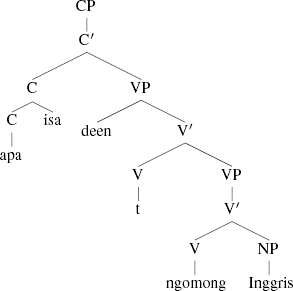
This structure is not only suspect because it involves right adjunction, but it makes incorrect empirical predictions. It would predict that no constituent should occur between apa and isa. This prediction is incorrect since it is possible for an adverb to intervene between apa and the fronted head:
(94) Apa mau-mbengi isa dheen turu enak?Q last-night can 3sg sleep well ‘Could he sleep well last night?’
(95) Apa alon-alon gelem Budi ngepruk bale?Q slowly want Budi hit ball ‘Does he want to hit the ball slowly?’
(96) Apa mbiyen pernah Siti sugeh?Q before perf Siti rich ‘Was Siti ever rich before?’
On the assumption that apa is generated in C, but that the adjunction of isa to C is not possible, we propose a recursive CP structure like that shown in (97). That is, we propose that a CP headed by apa selects for another CP whose head is the landing site of head-moved auxiliaries.Footnote 27
(97)
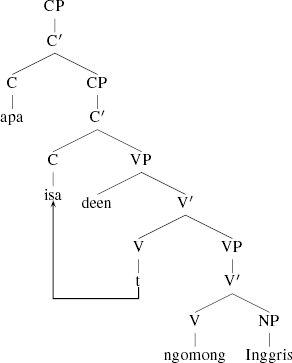
To sum up our conclusions so far, we have argued that in PNJ, auxiliaries are distinct from main verbs, occupying a distinct region in the tree. There are two classes of auxiliaries, movable and non-movable. Movable auxiliaries are generated lower in the tree than non-movable auxiliaries, perhaps in the structure given as (78). The interaction of auxiliaries when fronted is also explained by the analysis that fronting is attraction to a higher head, which we have argued occurs in a recursive CP structure.
8. The fronting of multiple auxiliaries
In the previous sections, we have examined the conditions surrounding the movement of a single auxiliary to C, and how that movement was affected by an intervening non-moving auxiliary. We shall now examine the fronting possibilities of sentences with more than one frontable auxiliary. On the basis of the structures given in the previous section, it might be expected that the fronting possibilities would be like those in English. In (standard) English only the leftmost auxiliary can front:
(98) John should have been being kissed by Mary.
(99) Should John have been being kissed by Mary?
(100) *Have John should been being kissed by Mary?
(101) *Been John should have being kissed by Mary?
(102) *Being John should have been kissed by Mary?
Sentence (99) shows that subject-auxiliary inversion in which the leftmost auxiliary is fronted is grammatical. Sentences (100)–(102) show that when an auxiliary other than the leftmost auxiliary is fronted and the leftmost auxiliary is left in situ, the result is ungrammatical. Furthermore, the simultaneous fronting of more than one auxiliary is ill-formed:Footnote 28
(103) *Should have John been being kissed by Mary?
(104) *Have should John been being kissed by Mary?
The distribution observed in English is explained by assuming that there is a single comp node that attracts the closest target auxiliary to C, thereby checking off the relevant features of both the auxiliary and the comp node. The fact that sentences like (100)–(102) are ungrammatical (HMC violations) is presumably due to the fact that they would violate the Minimal Link Constraint, the principle that it is the closest target that is attracted. Examples (103)–(104) are blocked in the following way. Two auxiliaries cannot be fronted simultaneously because the target of attraction must be a constituent and the two auxiliaries do not constitute a constituent. They cannot be attracted sequentially because the movement of the closest auxiliary checks off the relevant feature of the attractor. Thus, the movement of the second auxiliary would be unmotivated.
Multiple auxiliaries in PNJ display a pattern different from that observed in English. When two Type I Auxiliaries are present in yes/no questions, there are three possibilities: it is possible not to front any auxiliary (as in (105)), one auxiliary can front (as in (106)), or both auxiliaries can front (as in (107)):
(105)
(a) Dheen gelem isa ngomong Inggris? 3sg want can speak English ‘Does he want to be able to speak English?’
(b) Dheen pernah gelem ngomong Inggris? 3sg perf want speak English ‘Has he ever wanted to speak English?’
(106)
(a) Gelem dheen isa ngomong Inggris?want 3sg can speak English ‘Does he want to be able to speak English?’
(b) Pernah dheen gelem ngomong Inggris?perf 3sg want speak English ‘Has he ever wanted to speak English?’
(107)
(a) Gelem isa dheen ngomong Inggris?want can 3sg speak English ‘Does he want to be able to speak English?’
(b) Pernah gelem dheen ngomong Inggris?perf want 3sg speak English ‘Has he ever wanted to speak English?’
There is, however, a critical restriction on the fronting of two or more auxiliaries. When both auxiliaries front, the order of the auxiliaries must be the same as the order of the auxiliaries when no fronting has occurred. It will be remembered that the order of unfronted Type I Auxiliaries is pernah ‘perf’ >gelem ‘want’ >isa ‘can’, as is illustrated in (108)–(110).
(108)
(a) Dheen gelem isa ngomong Inggris. 3sg want can speak English ‘He wants to be able to speak English.’
(b) *Dheen isa gelem ngomong Inggris 3sg can want speak English
(109)
(a) Dheen pernah isa ngomong Inggris. 3sg perf can speak English ‘He has been able to speak English.’
(b) *Dheen isa pernah ngomong Inggris 3sg can perf speak English
(110)
(a) Aku pernah gelem mangan sega. 1sg perf want eat rice ‘I have wanted to eat rice.’
(b) *Aku gelem pernah mangan sega1sg want perf eat rice
The examples of (111)–(113) show that the same order of auxiliaries occurs when two auxiliaries are fronted as is found when no fronting has occurred.
(111)
(a) Gelem isa Tono ngomong Inggris.want can Tono speak English ‘Tono wants to be able to speak English.’
(b) *Isa gelem Tono ngomong Inggriscan want Tono speak English
(112)
(a) Pernah isa Tono nyetir montor?perf can Tono drive car ‘Has Tono ever been able to drive a car?’
(b) *Isa pernah Tono nyetir montorcan perf Tono drive car
(113)
(a) Pernah gelem Tono ngomong Inggris?perf want Tono speak English ‘Has Tono ever wanted to speak English?’
(b) *Gelem pernah Tono ngomong Inggriswant perf Tono speak English
Multiple auxiliary fronting is not limited to two auxiliaries. It is also possible to front all three Type I Auxiliaries.
(114) Pernah gelem isa Tono ngomong Inggris? perf want can Tono speak English ‘Has Tono ever wanted to be able to speak English?’
As is true for the fronting of two auxiliaries, when three auxiliaries are fronted, the only possible order is that observed when no fronting has occurred.
When three auxiliaries are present, there are three fronting possibilities: there can be no auxiliary fronted (as in (115)), one auxiliary can be fronted (as in (116)), or all three auxiliaries can be fronted (as in (117)).
(115) Tono pernah gelem isa ngomong Inggris.Tono perf want can speak English ‘Tono has wanted to be able to speak English.’
(116) Pernah Tono gelem isa ngomong Inggris? perf Tono want can speak English ‘Has Tono ever wanted to be able to speak English?’
(117) Pernah gelem isa Tono ngomong Inggris? perf want can Tono speak English ‘Has Tono ever wanted to be able to speak English?’
Notably, it is not possible to front two auxiliaries and to leave one in situ.Footnote 29
(118) *Pernah gelem Tono isa ngomong Inggrisperf want Tono can speak English ‘Has Tono ever wanted to be able to speak English?’
Finally, as in the case of two auxiliaries, when one auxiliary is fronted, it must be the leftmost auxiliary (based on the unfronted order of pernah ‘perf’ >gelem ‘want’ >isa ‘can’):
(119)
(a) *Gelem Tono pernah isa ngomong Inggriswant Tono perf can speak English
(b) *Isa Tono pernah gelem ngomong Inggriscan Tono perf want speak English
The pattern observed with multiple auxiliary fronting thus presents the following puzzles:
(120)
(a) Why is multiple auxiliary fronting possible in PNJ but not in many other languages?
(b) Why is the order of fronted auxiliaries the same as the order of unfronted auxiliaries?
(c) Why does fronting obey the HMC, i.e. why can't one auxiliary move over another auxiliary?
(d) Why is it ungrammatical to move two auxiliaries, stranding a single auxiliary in situ?
9. The derivation of multiply fronted auxiliaries
In this section we shall examine alternative theories of how multiple fronted auxiliaries are derived. In doing so, we shall provide answers to the puzzles noted in (120). Our claim will be that multiple fronting is derived by the head movement of the auxiliary to comp, and that the peculiarities of the construction are explained by a ‘tucking in’ analysis along the line of Richards (Reference Richards1997, Reference Richards2001) and Collins (Reference Collins2002). We shall argue, furthermore, that there exists evidence which, while not conclusive, casts doubt on an attractive alternative to head movement, the remnant movement analysis.Footnote 30
On first examination, sequential head movement of the auxiliary to comp would appear to give incorrect results. Consider the derivation given in (121).
(121)
As can be seen from (121), the successive adjunction of the auxiliaries to comp results in a surface string in which the fronted auxiliaries appear in an order which is the reverse of that in their original position. (We assume that right adjunction does not occur.) This would, on initial examination, appear to militate against successive adjunction of the auxiliary to comp.
However, similar problems have been encountered in other constructions. Richards (Reference Richards1997, Reference Richards2001) has provided a novel analysis of the word order restrictions on multiple fronted wh-forms in Bulgarian and similar languages. As was first noted by Rudin (Reference Rudin1988), when multiple wh-forms are fronted in Bulgarian, the order of the wh-forms in presubject position must be the same as the order in their premoved positions. Richards explains this pattern in terms of two conditions, minimal link and local move:
(122) Minimal Link Condition (MLC)
α can raise to target K only if there is no legitimate operation Move β targeting K, where β is closer to K.
(123) Local Move (LM)
Let X have a selectional feature F, and let Y satisfy F. Then Y must move to the closest possible position to X.
According to (122), it is the closest potential target which will move to an attractor. According to (123), the moved element will move to the closest possible position with respect to the attractor.
These two conditions explain why in Bulgarian a wh-fronted subject must precede a wh-fronted object:
(124)
(a) Koj kogo vizda?who whom sees ‘Who sees whom?’
(b) *Kogo koj vizdawhom who sees
The two wh-forms move to comp sequentially. A feature on C attracts both the subject and the object wh-forms. The MLC forces the subject to move first because the subject is closer to C than the object. LM then forces the ‘tucking in’ of the object wh-form: the object must move to the ‘inner specifier’ because that position is closer to C than the outer specifier. (Note that the trace of the subject is assumed not to count as a target for movement.) The result of this derivation is that the order of the two wh-forms is the same after wh-fronting as it was prior to movement.Footnote 31
Collins (Reference Collins2002) extends Richards' approach to verbal compounds in the Khoisan language ≠Hoan. Collins assumes that verbal compounds in ≠Hoan like (125) are derived from a structure like (126):
(125) Ma a- q||hu |'o djo ki kx'u na. 1sg prog pour put.in water part pot in ‘I'm pouring water into the pot.'
(126)
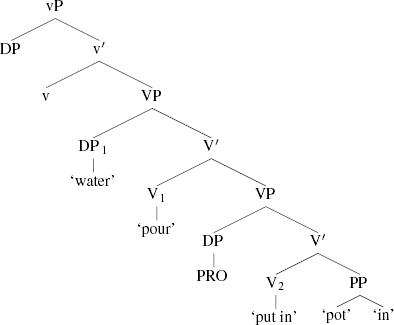
In ≠Hoan verbal compounds, the order of verbs cannot be reversed, just as the order of auxiliaries cannot be reversed in PNJ auxiliary fronting:
(127) *Ma a- |'o q||hu djo ki kx'u na1sg prog put.in pour water part pot in
Collins explains the fixed word order in ≠Hoan compounds on the basis of the following assumptions:
(128)
(a) The light verb (v) is [+multiple], forcing all verbs to adjoin to v.
(b) The MLC.
(c) LM.
(d) No adjunction of V to V is possible.
(e) Adjunction is always left adjunction.
(f) The trace of V does not block verb movement.
Given the ‘tucking in’ analysis of ≠Hoan verb movement, which is the effect of LM, the correct word order is predicted.
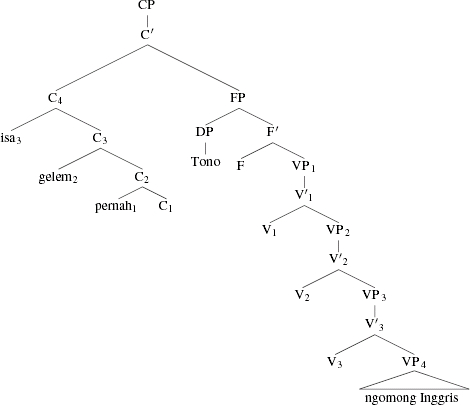
Collins' verb movement analysis of verbal compounds in ≠Hoan provides an explanation of the word order facts regarding fronted auxiliaries in PNJ as well.Footnote 32 We assume a premovement structure along the following lines:Footnote 33
(129)
Comp (C1) attracts the closest auxiliary, pernah, which left-adjoins to C1:
(130)

Next, C1 attracts the second auxiliary, gelem, which left-adjoins to the inner C, i.e. to C1:
(131)
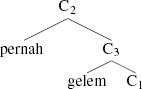
Finally, the lowest auxiliary, isa, is attracted to C, and is left-adjoined to the innermost C, namely C1, as well:
(132)
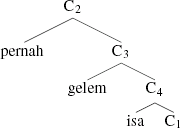
Thus, the Richards–Collins ‘tucking in’ analysis produces the correct word order with PNJ auxiliaries, just as it does with ≠Hoan verbal compounds.
It is of interest that, unlike Bulgarian wh-forms, PNJ auxiliaries obey ‘tucking in’, and hence display a fixed word order, even when three auxiliaries are fronted. In contrast, it will be remembered, when three wh-forms are fronted in Bulgarian, only the order of the first form remains fixed, contrary to the predictions of Local Move (recall footnote 32). It appears that head movement is subject to the strict requirements of Local Move, while XP movement is somewhat freer. It is not immediately apparent why the greater freedom found in XP movement should occur, but it is notable that X0 movement displays precisely the predicted pattern and not the looser version seen in XP movement.
Furthermore, the ‘tucking in’ analysis provides answers to the questions raised in (120). Multiple auxiliaries are fronted in PNJ because the attractor, C, has the feature [+multiple], which requires the movement of all potential targets, i.e. all auxiliaries bearing the relevant feature.Footnote 34 (We assume that the presence of this feature on an auxiliary is optional, to account for the optionality of multiple auxiliary fronting.) If the feature [+multiple] occurs, all auxiliaries will move, making it impossible to move only two auxiliaries of three and strand the third. The fact that the order of fronted auxiliaries is the same as the order of unfronted auxiliaries is, as was just shown, due to ‘tucking-in’ (i.e. to LM). Finally, the process of fronting obeys the HMC because auxiliary fronting is claimed to be an instance of head movement. As such, it is expected that the process would obey the HMC.Footnote 35
Head movement versus remnant movement
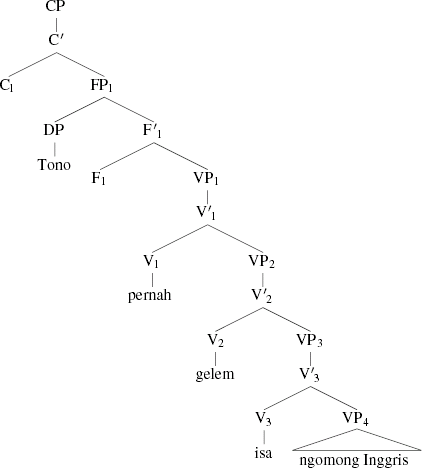
While the ‘tucking in’ analysis of Richards and Collins produces the correct word order with regard to PNJ fronted auxiliaries and provides answers to the questions in (120), there is an alternative analysis, the ‘remnant movement’ analysis, that produces the correct word order as well and which does not assume LM (123). Under the remnant movement analysis, the fact that the auxiliaries are in the same order before and after fronting would be explained by claiming that the postmovement structure is the premovement structure, except that the VP is moved away from the auxiliary phrases prior to the movement of the remnant (the auxiliaries plus VP trace) to a presubject position.
The underlying structure according to the remnant movement analysis would be the same as that posited for head movement ((129), repeated here as (133)):
(133)
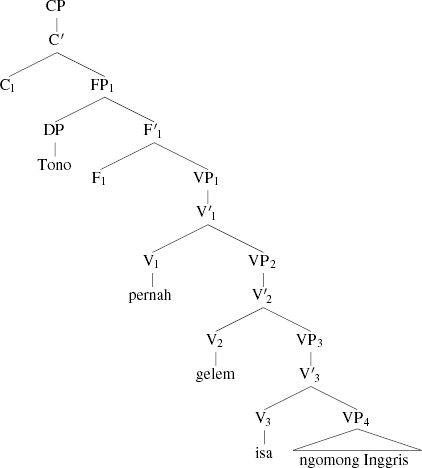
VP4 adjoins to F′1, yielding the following structure:
(134)
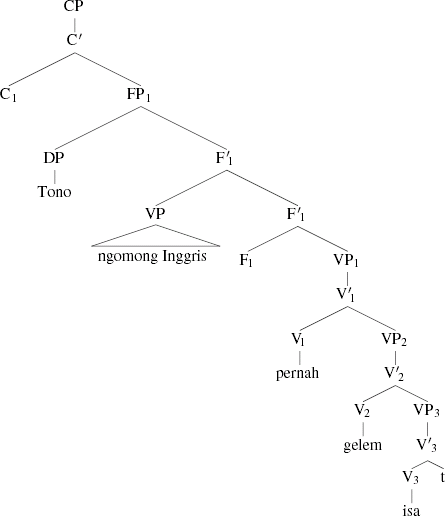
Finally, VP1 (or, perhaps, the lower F′1) adjoins to FP1, yielding the following structure:
(135)
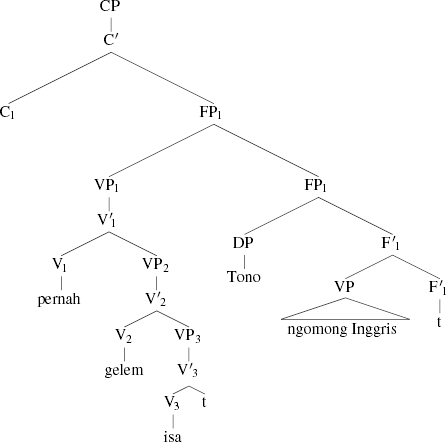
As can be seen from (133)–(135), remnant movement preserves the premovement word order because the auxiliaries are not themselves moved out of their premovement structure. Rather, it is the structure in which they are contained that undergoes movement as a whole to presubject position.
While remnant movement provides a natural explanation for why the fronted word order is the same as the unfronted order, there are several potential problems with this approach. First, the analysis provides no obvious account of the distinction between movable and non-movable auxiliaries. It will be remembered that auxiliaries fall into two classes with respect to whether they are able to undergo fronting, those that can front and those that cannot. This is easily explained under the head movement analysis since the mechanism for movement requires that the auxiliary contain features matched by features of the attractor. In the absence of an appropriate feature on the auxiliary, the auxiliary will not move. In the case of the remnant movement analysis, however, the auxiliary itself never moves. Rather, it is part of a larger structure that undergoes movement. It is not immediately apparent how a property of the auxiliary itself could block movement of the larger constituent in which it is contained.
Thus, in order to maintain the remnant movement account, it would be necessary to emulate the feature matching conditions found in the head movement account. The critical step in the remnant movement account is the adjunction of VP1 to FP1. On the assumption that movement receives a feature-theoretic explanation, VP1 must move because it is attracted by some feature of an attracting head, e.g. VP1 is able to move because it is attracted by some feature of C1.Footnote 36 Let us now examine what happens if the movable auxiliary pernah is replaced by the non-movable auxiliary meh:
(136)
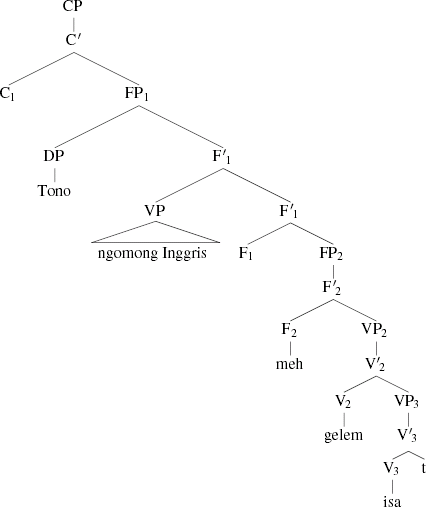
In order for FP2 to be adjoined to FP1, the appropriate feature of FP2 must match the relevant feature of C1. However, by hypothesis, meh lacks the appropriate feature, and hence movement does not occur. Thus, the explanation for the failure of fronting in the head movement analysis generalizes to remnant movement as well.
There is, however, a second and more persuasive argument in favor of head movement. The two analyses make different predictions regarding whether adverbials can be interspersed between fronted auxiliaries.Footnote 37 The head movement account is compatible with the presence of adverbials between unmoved auxiliaries. (The analysis makes no prediction regarding whether or not this will actually occur in a particular language.) However, head movement predicts that adverbials should not be found in between fronted auxiliaries. This is because, according to the head movement analysis, auxiliary fronting is adjunction of the auxiliary to comp. On the assumption that adverbials cannot themselves undergo adjunction to comp, there is no way that an adverbial could intervene between two fronted auxiliaries.
In contrast, the remnant movement analysis claims that the auxiliaries have not moved, but rather are contained in a larger constituent that is itself moved to presubject position. It follows that if adverbials can occur between auxiliaries in premoved position, they will occur between auxiliaries in postmoved position as well. (The same claim is implicit in the raising analysis which was discussed in note 30 above.)
The following is an example of an adverbial occurring between two unfronted auxiliaries:
(137) Budi pernah alon-alon gelem mangan sega.Budi perf slowly want eat rice ‘Budi has wanted to eat rice slowly.’
The head movement analysis predicts that while (137) is well formed, the analogous question with fronted auxiliaries will be ill-formed. In contrast, the remnant movement analysis (and the raising analysis) predict that the analogous sentence with fronted auxiliaries will be grammatical.
The facts favor the head movement analysis:
(138) *Apa pernah alon-alon gelem Budi mangan segaQ perf slowly want Budi eat rice ‘Has Budi wanted to eat rice slowly?’
Thus, on the assumption that adverbials do not themselves move (but only sometimes give the impression of movement because their licensers can occur in various positions), the distribution of adverbials provides support for the head movement analysis as opposed to the remnant movement analysis (and the raising analysis).Footnote 38 We recognize, however, that a version of the remnant movement analysis that posits the movement of adverbials as well would be able to account for the adverb facts.
11. Conclusion
Multiple auxiliary fronting in PNJ provides support for the Richards–Collins ‘tucking in’ analysis of movement. Collins (Reference Collins2002) notes that the ≠Hoan facts are compatible with either head movement or remnant movement. The PNJ facts are of special interest because they are not only an example of an additional construction that shows the distribution expected on the basis of ‘tucking in’, but also because PNJ provides evidence that helps to distinguish between a head movement analysis and the ‘standard’ version of the remnant movement analysis in which adverbials occupy fixed positions in the clause.


