Introduction
Persons with schizophrenia have difficulties with social functioning that can affect the course and outcome of their illness (Mueser et al., Reference Mueser, Bellack, Morrison and Wixted1990). The ability to meet various social goals (“social competence”) includes two components – “social adjustment” and “social skills” (Mueser et al., Reference Mueser, Bellack, Morrison and Wixted1990). The former deals with the ability to attain instrumental and affiliative needs, and the latter refers to the ability to deal effectively with interpersonal interactions. Although the ability to manage interpersonal conflict is considered to be one of the key components of social skills, there has been little attention paid to the various tactics that persons with schizophrenia display in conflict situations. In this paper, we examine the prevalence and clinical relevance of various strategies to deal with conflicts among older adults with schizophrenia.
Interpersonal conflict is part of the process by which inequities and problems are corrected (Straus, Reference Straus and Jackson2007). One aspect of this phenomenon involves “conflict management,” which refers to the methods used to resolve the conflict. Two people may have similar conflicts but use vastly different strategies for resolving the conflict. Identifying the optimal types of conflict strategies may be especially important with respect to clinical outcome and treatment because indirect evidence from studies in mixed age samples have found that poor social skills and deficits in social cognition (i.e. how people think about themselves and others in the social world) are associated with both increased positive and negative symptoms (Mueser et al., Reference Mueser, Bellack, Morrison and Wixted1990; Appelo et al., Reference Appelo, Woonings, Van Nieuwenhuizen, Emmelkamp, Slooff and Louwerens1992; Penn et al., Reference Penn, Sanna and Roberts2008; Jaramillo et al., Reference Jaramillo, Inmaculada Fuentes and Ruiz2009). Moreover, the family literature has found that interpersonal conflicts are associated with exacerbation of positive symptoms (Kavanagh, Reference Kavanagh1992; Scott et al., Reference Scott, Fagin and Winter1993). In one study that looked specifically at conflict strategies, Bergman and Ericsson (Reference Bergman and Ericsson1996) found that persons with schizophrenia were more likely than depressed patients to use violence to solve interpersonal difficulties.
Very little is known about conflict strategies used in older adults with schizophrenia. However, within the general population, there is evidence that interpersonal conflict strategies vary as a function of age. Socioemotional selectivity theory posits that there will be age differences in reactions to interpersonal tensions (Birditt and Fingerman, Reference Bergman and Ericsson2005). Older adults are typically more concerned with maintaining close relationships and avoiding negative emotions (Carstensen et al., Reference Carstensen, Gottman and Levenson1995). Consequently, they may report fewer interpersonal problems, have a greater propensity toward avoidant behaviors, be less confrontational in the presence of interpersonal tension, and de-escalate conflicts to establish harmony (Carstensen et al., Reference Carstensen, Gottman and Levenson1995; Birditt and Fingerman, Reference Bergman and Ericsson2005; Blanchard-Fields et al., Reference Blanchard-Fields and Beatty2005; Fingerman et al., Reference Fingerman, Miller and Charles2008).
Based on the findings with older persons in general, it might be expected that interpersonal interactions would change as persons with schizophrenia grow older and might come to resemble their age peers in the general population (i.e. “normalize”). There are limited data to support this view. Ciompi (Reference Ciompi, Miller and Cohen1987) observed that “with advancing age, the probands were better adapted, in so far as relationships to their environments had become predominantly free of conflicts, calm and peaceful.” Some long-term studies on social function and schizophrenia have revealed that social functioning is often restored, and might even undergo further development after the psychosis diminishes in intensity (Harding et al., Reference Harding, Zubin and Strauss1987). Using cross-sectional data, Cohen and Kochanowicz (Reference Cohen and Kochanowicz1989) found networks of older patients were smaller than younger patients, although they experienced greater satisfaction with and less criticism from network members. Semple and coauthors (Reference Semple, Patterson, Shaw, Grant, Moscona and Jeste1999) found that middle-aged and older persons with schizophrenia were significantly worse than a normal comparison subject in their mean scores on a two-item measure of conflict management (being able to put bad feelings aside after fighting with someone; being able to accept someone has a valid point of view even when you do not agree). Better conflict management scores did not correlate significantly with any of the clinical measures such as depressive, positive, or negative symptoms, but did correlate with higher education and being male. Better conflict management also correlated with age (r = 0.18), albeit non-significantly. These earlier studies had several limitations including small sample sizes (<100) and the absence of a comprehensive instrument for examining conflict tactics.
To assess conflict management in this study, we used the Conflict Tactics Scale (CTS). Straus (Reference Straus and Jackson2007) developed the CTS to delineate the behavior directed toward an important other person with respect to interpersonal conflicts. The instrument focuses on self-reported behaviors rather than cognitive appraisals, the latter being more often denied or unrecognized. Straus found that conflict tactics cannot be regarded a singular global strategy. Rather, conflict resolution involves at least three types of tactics: rational discussion, verbal and non-verbal acts that symbolically hurt the other, and the use of physical force. The CTS is one of the most widely used instruments for examining family conflict, and it has been employed in general geriatric populations (Consedine and Magai, Reference Consedine and Magai2002).
Using a sample of persons aged 55 years and over with schizophrenia spectrum disorders living in the community, we address the following two hypotheses concerning the prevalence and clinical implications of conflict tactic strategies:
1. Conflict tactic strategies normalize in older adults with schizophrenia so that there will be no significant differences in the relative prevalence of various conflict tactics strategies in older adults with schizophrenia versus their age peers in the general community.
2. One or more of the conflict tactics strategies will be associated with higher rates of positive symptom remission in the schizophrenia group.
Methods
Details of the study methods are provided elsewhere (Bankole et al., Reference Appelo, Woonings, Van Nieuwenhuizen, Emmelkamp, Slooff and Louwerens2007). Briefly, we recruited participants aged 55 years and over living in the community with early-onset schizophrenia (onset prior to age 45) using a stratified sampling method in which we attempted to interview approximately half the participants from outpatient clinics and day programs, and the other half from supported community residences. All subjects resided in New York City. Inclusion was based on a DSM IV diagnosis of schizophrenia or schizoaffective disorder that was conducted by clinical agency staff and by a lifetime illness review adapted from Jeste and associates (Reference Jeste, Symonds, Harris, Paulsen, Palmer and Heaton1997). We excluded persons with cognitive impairment too severe to complete the questionnaire, i.e. scores of <5 on the Mental Status Questionnaire (Zarit et al., Reference Zarit, Miller and Kahn1978).
We recruited a community comparison group using Wessex Census STF3 files for Kings County (Brooklyn), which is one of the boroughs in New York City. We used randomly selected block groups as the primary sampling unit. An effort was made to interview all persons aged 55 years and over in a selected block group by knocking on doors. In order to enhance response rates, participants from the selected block group were also recruited at senior centers, churches, and through personal references. We excluded persons with histories of treatment for schizophrenia or schizoaffective disorder. The study had Institutional Review Board approval, and we obtained written informed consent.
The rejection rate was 7% in the schizophrenia group and 48% of those contacted in the community group. The schizophrenia group consisted of 198 persons. Among these, 39% were living independently in the community and 61% in supported community residences. From the original community comparison group (n = 206), we selected 113 persons who more closely matched the schizophrenia group for age, gender, race, and income. There were no significant gender or racial differences between groups. Forty-nine percent of the schizophrenia group were women versus 49% of the community comparison group. The racial distribution was African American (35%), Caucasian (57%), Latino (7%), and other (2%) in the schizophrenia group versus African American (36%), Caucasian (60%), Latino (2%), and other (2%) in the community comparison group. The mean ages of the schizophrenia group and community comparison group were 61.5 and 63.0 years (t = 2.37, df = 306, p = 0.02), respectively. Thus, although the latter was statistically significant, the absolute difference in age between the two groups was very small. Both groups were in the same median income category ($7,000–$12,999).
Measures
Based on a previous study of examining symptom remission in older adults with schizophrenia (Bankole et al., Reference Bankole, Cohen, Vahia, Diwan, Kehn and Ramirez2007) and our literature review of variables that may covary with conflict tactics, we derived predictor variables of positive symptom remission from six broad categories: demographic factors (age, gender, being white), life achievements (education), social integration (total network size), vulnerability factors (cognitive functioning, remission of negative symptoms defined <4 on all seven items, evidence of alcohol abuse in lifetime, number of depressive symptoms, instrumental activities of daily living), provoking agents (financial strain, lifetime trauma and events), and coping strategies (number of psychotropic medications, frequency of visits for psychiatric care, conflict tactic strategies). All the variables served as covariates in our analyses with the exception of the conflict tactics strategies, which served as the independent (predictor) variable. For the dependent variable, positive symptom remission, we used a conservative cut-off value. To be in remission, persons had to score below 3 (i.e. none or minimal symptoms) on each of the seven positive symptom items of the Positive and Negative Syndrome Scale (PANSS; Kay et al., Reference Kay, Opler and Fiszbein1992). In addition to the PANSS, the following instruments were used to create the variables used in the model: Center for Epidemiological Studies-Depression Scale (Radloff, Reference Radloff1977); Dementia Rating Scale (Coblentz et al., Reference Coblentz, Mattis, Zingesser, Kasoff, Wisniewski and Katzman1973); Instrumental Activities of Daily Living Scale derived from the Multilevel Assessment Instrument (MAI; Lawton et al., Reference Lawton, Moss, Fulcomer and Kleban1982); the Network Analysis Profile (Sokolovsky and Cohen, Reference Sokolovsky and Cohen1981); Financial Strain Scale (Pearlin et al., Reference Pearlin, Lieberman, Menaghan and Mullan1981); the CAGE (Ewing, Reference Ewing1984); and the Lifetime Trauma and Victimization Scale (Cohen et al., Reference Cohen, Ramirez, Teresi, Gallagher and Sokolovsky1997). All the scales had internal reliability (Cronbach's α) scores of ≥0.71. The intra-class correlations of the raters ranged from 0.79 to 0.99 on the various scales.
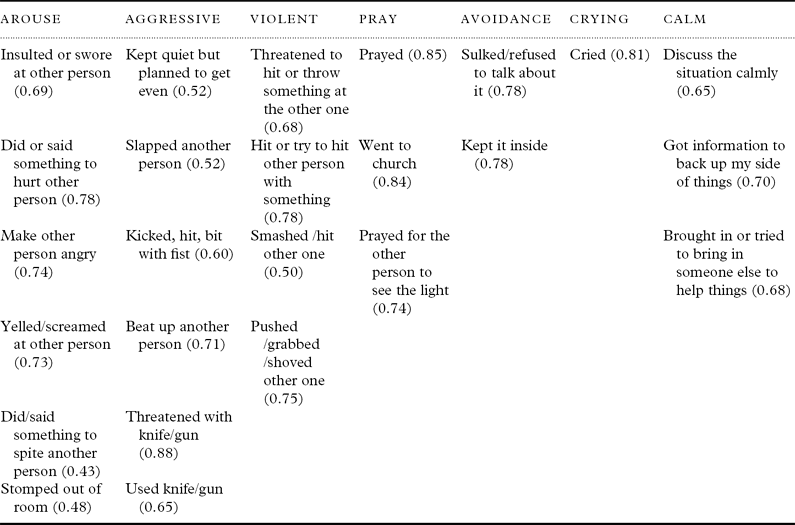
Straus’ CTS (Straus, Reference Straus and Jackson2007) was used to assess the ways that respondents handled interpersonal conflicts. The CTS consists of 25 items assessing how the respondent handles major and minor differences in reference to the person with whom they have the most interaction. Respondents are asked to indicate the frequency (“never,” “sometimes,” “always”) of the various ways they have settled differences in the past year. The items are listed in Table 1. There were group differences in the distribution of persons selected with whom they had the most interaction (χ 2 = 48.70, df = 9, p < 0.001). The three most commonly selected persons for the Schizophrenia Group were a friend (44%), spouse/intimate partner (17%), or sibling (10%), whereas for the Community Comparison Group the three most commonly selected persons were a spouse/intimate partner (53%), friend (19%), or child (12%).
Subscales with items determined by factor analysis
Principal component analysis with equamax rotation and factor loadings in parentheses; percent variance explained by each factor: Arouse = 19.7%, Aggressive = 13%, Violent = 8.8%, Pray = 6.1%, Avoidance = 5.7%, Tearfulness = 4.6%, Calm = 4.2%; eigenvalues: Arouse = 4.9, Aggressive = 3.3, Violent = 2.2, Pray = 1.5, Avoidance 1.4, Tearfulness = 1.2, Calm = 1.0.
Data analysis
Factor analysis of CTS scale items was conducted using a principal component analysis with equamax rotation. Since each of the tactic subscales contained a different number of items, we divided the total score by the number of items, thereby yielding a mean item score for each tactic that allowed for prevalence comparisons. Mann–Whitney U tests were used to contrast the CTS subscales mean item scores for the schizophrenia and community comparison groups as well as for persons with schizophrenia in positive symptom remission and non-remission. A logistic regression analysis was used to examine the impact of each of the CTS subscales on positive symptoms, with the remaining 14 predictor variables listed in the measures section serving as covariates. There was no evidence of collinearity among the variables in the analysis.
Results
Factor analysis of the items in the CTS yielded seven components (Table 1). None of intercorrelations of the factors was greater than 0.31 which is considered an acceptable level of independence among factors, i.e. <10% shared variance. These factors were used to create corresponding subscales: Calm (three items; Cronbach's α = 0.58), Arouse (six items; Cronbach's α = 0.83), Pray (three items; Cronbach's α = 0.80), Avoidance (two items; Cronbach's α = 0.62), Crying (one item), Aggressive (six items; Cronbach's α = 0.79), and Violent (four items; Cronbach's α = 0.74). The Calm subscale corresponded to Straus’ (Reference Straus and Jackson2007) category of rational discussion; the Arousal corresponded to the category of the use of verbal and non-verbal acts that symbolically hurt the other, and the Aggressive and Violence subscales corresponded to the category of the use of physical force. The Pray, Avoidance, and Crying subscales formed separate groupings that related to more internalized emotional and behavioral strategies. Each subscale had acceptable internal reliability; i.e. internal reliability of 0.60 and greater are considered acceptable and scores of 0.50 and above are acceptable for exploratory studies (Nunnally, Reference Nunnally1967).
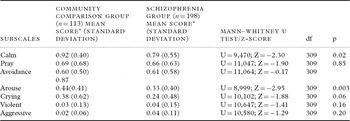
We found significant differences between the Schizophrenia Group and the Community Comparison Group on the Arouse and Calm CTS subscales with the Community Comparison Group using these tactics more commonly (Table 2). However, the order of the frequency of the tactics that were used was similar in both groups. The Calm, Pray, and Avoidance tactics were the most commonly used, and the Violent and Aggressive tactics were rarely utilized.
Comparison between schizophrenia and community groups on conflict tactics subscales

Item scoring: 0 = never, 1 = sometimes, 2 = often.
*Mean score per item.
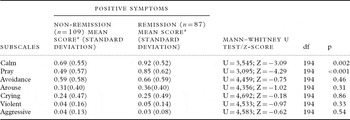
For the schizophrenia group, in bivariate analysis, we found that the Calm and Pray subscales were significantly associated with positive symptom remission (Table 3). None of the other conflict tactics were associated with positive symptom remission. Therefore, we tested our model using only these subscales. In two separate logistic regression analysis, with the 14 variables in the model as covariates, we found that the positive symptom remission remained significantly associated with both the Calm (Wald = 4.56; OR = 2.26, 95% CI 1.07–4.77, p = 0.03) and Pray (Wald = 14.20; OR = 4.13, 95% CI 1.98–8.64, p = <0.001) subscales.
Comparison between persons in positive symptom remission and non-remission on conflict tactics subscales

*Mean score per item.
Discussion
With respect to our first hypothesis – that older persons with schizophrenia will tend to have patterns of conflict strategy use that were similar to their age peers in the community – we found that while there were some absolute differences in the subscale scores between the two groups, they were similar patterns in the ordering of the subscales. The ordering of the frequency of the variables as seen in Table 2 is consistent with findings in the literature that older adults in general tend to use strategies that are more harmonious and to use fewer emotional and confrontational strategies (Carstensen et al., Reference Carstensen, Gottman and Levenson1995; Birditt and Fingerman, Reference Birditt and Fingerman2005; Blanchard-Fields and Beatty, Reference Blanchard-Fields and Beatty2005; Fingerman et al., Reference Fingerman, Miller and Charles2008). That persons with schizophrenia had similar distribution of conflict strategies to their age peers in the general population suggests that older adults with schizophrenia have attained more “normalized” patterns of strategies for dealing with interpersonal conflict. This suggests that older adults use conflict strategies that are consistent with higher levels of “social cognition.” The latter is a construct that involves emotional and cognitive processing (Penn et al., Reference Penn, Sanna and Roberts2008), and is thought to underlie the various components of social competence. Thus, both the calm and praying strategies involve components that incorporate effective cognitive and emotional strategies whereas the other strategies do not. Because the data are cross-sectional, we cannot determine whether the use of particular conflict strategies changed as persons grew old. Moreover, it should be noted that the community group scored higher than the schizophrenia group on the use of the Calm subscale. Thus, although the patterns are similar, community adults are still more likely to employ these types of strategies than persons with schizophrenia. Also, it is not clear to what extent our results may have been influenced by the differences between the two groups with respect to whom they identified as having the most interaction.
With respect to our second hypothesis concerning the impact of conflict strategies on positive symptoms, our data indicated that the most commonly used strategies in both the schizophrenia and community groups (Calm and Pray) also had the highest associations with positive symptom remission among persons with schizophrenia. These variables remained significant even after controlling for other variables that might affect positive symptom remission or that might covary with the conflict strategies. The other tactics had no association with positive symptom remission in the schizophrenia group. Although causal direction cannot be determined from our data, our findings indicate that more favorable symptom outcome among older schizophrenic persons is associated with more “normalized” interpersonal coping styles. On the other hand, higher scores on the more emotionally or behaviorally intense strategies were not associated with lower positive symptom remission rates. Perhaps, as people with schizophrenia grow older, these interpersonal strategies are no longer as toxic as they appear to be in younger populations. Notably, by using factor analysis to categorize various conflict strategies, we were able to determine specific strategies that impacted on positive symptoms. Thus, our findings differed from earlier work by Semple and coauthors (Reference Semple, Patterson, Shaw, Grant, Moscona and Jeste1999) that had found no association between conflict tactics and positive symptoms.
This study has several strengths. It uses a large multiracial group of older adults with schizophrenia and compares them with a demographically similar group of their peers in the general community; it uses a well-established and psychometrically validated measure of interpersonal conflict; we created seven subscales that had acceptable levels of internal reliability; and we used a multivariable model to examine the relationship between positive symptoms and conflict tactic strategies. However, the study is limited by the use of cross-sectional data, it is confined to one geographical area, and we conducted multiple comparisons that may have created the possibility of a type 1 error. However, because this is an exploratory study, we were more concerned about avoiding type 2 errors.
In summary, older adults with schizophrenia demonstrated patterns of conflict management strategies that were similar to those of their age peers in the general community. Calming strategies and prayer were the most commonly used tactics, and more verbally and behaviorally aggressive strategies were least commonly employed. The former two strategies were also associated with higher rates of positive symptom remission. Thus, our findings suggest that older persons approximate normal distribution patterns of conflict management strategies and the most commonly used strategies may contribute to symptomatic well-being. From a clinical standpoint, several innovative programs have begun to target social skills and social cognition in older adults with schizophrenia (Granholm et al., Reference Granholm2005; Mueser et al., Reference Mueser2010). Our findings suggest that greater attention must be paid to developing and/or strengthening conflict tactic strategies, especially those such as calming and praying because of their association with positive symptom remission.
Conflict of interest
None.
Description of authors' roles
Dr Cohen supervised the research project and led the statistical analyses. Drs Solanki and Sodhi assisted Dr Cohen with the analysis of the data. All authors contributed to the interpretation of results. Drs Solanki and Sodhi did the literature review. All authors worked on the preparation of the final version of the paper.
Acknowledgments
This study was funded by the National Institute of General Medical Sciences grants SO6-GM-74923 and SO6-GM-54650. The authors thank Paul M. Ramirez, PhD and Robert Yaffee, PhD for their assistance.