Healthcare-associated infection (HAI) is considered a global health burden. Based on data from a recent US study, catheter-associated urinary tract infections (CAUTIs) and central-line–associated bloodstream infections (CLABSIs) are leading causes of HAI.Reference Zimlichman, Henderson and Tamir 1 Similarly, CAUTIs, and CLABSIs are the leading causes of HAI in Thailand.Reference Korbkitjaroen, Vaithayapichet, Kachintorn, Jintanothaitavorn, Wiruchkul and Thamlikitkul 2
Various infection control strategies and bundles have proven effective in preventing CAUTIs and CLABSIs.Reference Korbkitjaroen, Vaithayapichet, Kachintorn, Jintanothaitavorn, Wiruchkul and Thamlikitkul 2 – Reference Blot, Bergs, Vogelaers, Blot and Vandijck 5 However, most of these strategies require full-time infection control personnel, which may not be practical in resource-limited settings. Effective but less labor-intensive interventions to prevent HAIs are needed. In this study, we primarily aimed to determine the effectiveness of a simple and less labor-intensive intervention for reducing the duration of urinary catheter use and preventing CAUTIs.
During February–July 2013, an open-label cluster-randomized controlled trial was conducted at Siriraj Hospital, a 2,300-bed tertiary care hospital in Thailand. A total of 6 general medicine wards were randomly allocated to receive the usual infection control care either with or without the Catheter Reminder and Evaluation (CARE) program. The study was approved by Siriraj Institutional Review Board, which waived the subject’s informed consent (ClinicalTrials.gov identifier: NCT01797146).
The usual infection control care includes universal precautions and cohorting of patients who are infected or colonized with a multidrug-resistant pathogen. The CARE program consists of 2 steps. The first step is performed by a ward nurse who evaluates each patient daily. If a given patient receives a urinary catheter or central venous catheter, his or her doctor’s order sheet is marked with a CARE self-inking stamp (Supplementary Online Figure 1) indicating the first day of catheter use. The second step is performed by the responsible physician who documents an indication for catheter use during a service round in the morning. If an appropriate indication for catheter use is not written, the ward nurse reminds the responsible physician to do so. Both steps are repeated daily as long as the catheter is in place.
All necessary data were obtained from the hospital pharmacy database, the microbiology database, and patient medical records. Appropriateness of urinary catheter use was evaluated according to the Healthcare Infection Control Practices Advisory Committee guideline for prevention of CAUTIs.Reference Gould, Umscheid, Agarwal, Kuntz and Pegues 6 Hierarchical model and clustering effect adjustment were used to evaluate the effectiveness of the CARE program. For all calculations, a 2-tailed P<.05 was considered statistically significant. All calculations were performed using the STATA/IC version 14.0 (Stata Corp, College Station, TX, USA).
We enrolled 433 patients into the CARE group and 441 patients into the control group. Mean ages of the CARE and control groups were comparable (61.5±18.6 years vs 61.4±17.9 years; P=.93). Approximately one-third of both groups had a history of previous hospitalization within the past 3 months. Baseline characteristics were comparable between the groups (as shown in Supplementary Online Table 1) except for history of organ transplantation, which was slightly lower in the CARE group (0.7% vs 2.5%; P=.03).
Overall, ward nurse compliance was 83%, whereas overall responsible physician compliance was only 74%. Furthermore, only 68% of responsible physicians gave the appropriate indication for retaining the catheter or decided to remove the catheter when there was no appropriate indication. The most common inappropriate indication of urinary catheter use was monitoring urine output in a non–critically ill patient. The overall program compliance of both groups did not decline over time (Supplementary Online Figure 2).
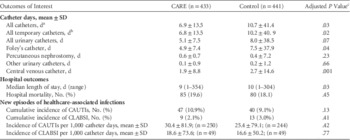
Table 1 shows the outcomes of interest. Mean duration of all catheter days in the CARE group was significantly shorter than in the control group (6.9±13.5 vs 10.7±41.4; P=.03). The CARE group had a significant shorter duration of temporary catheter days (6.8±13.5 vs 10.2±40.9; P=.02), Foley’s catheter days (4.9±7.4 vs 7.5±37.9; P=.04), central venous catheter days (1.9±8.8 vs 2.7±14.6; P=.001), and median length of hospital stay (9[1–354] vs 10[1–304]; P=.03). However, the cumulative incidence (infection episode per hospitalization), incidence rate (infection episode per catheter day) of CAUTIs and CLABSIs and hospital mortality were comparable between the 2 groups.
Outcomes of Interest

NOTE. CARE, catheter reminder and evaluation; CAUTIs, catheter-associated urinary tract infections; CLABSI, central line-associated bloodstream infection; SD, standard deviation
a All catheters included both temporary and permanent urinary and central venous catheters.
b All temporary catheters included all temporary urinary catheters and temporary central venous catheters.
c P value adjusted for clustering effect (population-averaged models).
Our study confirmed that this simple intervention is effective for reducing the duration of catheter use and shortening the length of hospital stay. However, we did not detect any significant impact on CAUTIs, CLABSIs, or hospital mortality. Our findings were different from a previous study, which showed that applying a reminder sticker on medical records could reduce CAUTIs.Reference Bruminhent, Keegan, Lakhani, Roberts and Passalacqua 7 These findings may be the result of a small sample size and an imbalance of unmeasured characteristics.
Program compliance was only 83% among ward nurses and 74% among responsible physicians. Surprisingly, compliance did not decline overtime. This finding may be a result of the simplicity of the program.
Our study had several strengths. While many studies evaluating infection control intervention used only simple pre- or post-study design, our study was a cluster-randomized controlled study using a hierarchical model. Second, our study collected all important characteristics and clinical outcomes, whereas many previous studies collected only aggregate data on catheter use and catheter-associated infections.Reference Bruminhent, Keegan, Lakhani, Roberts and Passalacqua 7 , Reference Apisarnthanarak, Rutjanawech and Wichansawakun 8
This study has some potential limitations. First, it was conducted to evaluate a behavioral intervention, so we could not mask responsible physicians. Second, cluster randomization was necessary to avoid contaminating the intervention effect but may lead to an imbalance of characteristics. Third, in this study, wards were covered by rotating residents; therefore, it is possible that residents in the CARE ward may transfer their positive behavior when rotating to the control ward.
In conclusion, our study results confirm that this simple program could reduce the duration of temporary catheter use, urinary catheter use, and central venous catheter use, and that it could also shorten the length of hospital stay. This simple intervention is a promising alternative for resource-limited settings where sophisticated infection control bundles are not feasible.
ACKNOWLEDGMENTS
The authors wish to thank all ward nurses of the Department of Medicine and the infection control nurses for their cooperation.
Financial support: This study was primarily supported by the Health Systems Research and Development Project, Faculty of Medicine Siriraj Hospital and Health Systems Research Institute (Thailand).
Potential conflicts of interest: All authors report no conflicts of interest relevant to this article.
SUPPLEMENTARY MATERIAL
To view supplementary material for this article, please visit http://dx.doi.org/10.1017/ice.2015.262