Coagulase-negative staphylococci (CNS) are the most frequently isolated pathogens from bovine milk samples in several large scale surveys worldwide (Makovec & Ruegg, Reference Makovec and Ruegg2003; Tenhagen et al. Reference Tenhagen, Koster, Wallmann and Heuwieser2006). Despite their relative frequency, few studies have focused on risk factors that lead to intramammary infection (IMI) with these pathogens, or on the efficacy of specific control measures. There is evidence that post-milking teat disinfection with certain products can prevent new CNS infections from occurring (Foret et al. Reference Foret, Corbellini, Young and Janowicz2005), and recently a vaccine against CNS approved by the European Medicines Agency showed a significant reduction in the number of new mastitis cases and a significant increase in spontaneous cure rate, when compared with a placebo group (Noguera et al. Reference Noguera, Foix, Prenafeta, Guix and March2010). Antimicrobial treatment would seem to be an effective way to control CNS IMI as it has been found to lead to high cure rates for clinical mastitis (Waage et al. 2000), subclinical mastitis during the lactation (Wilson et al. Reference Wilson, Gonzalez, Case, Garrison and Grohn1999), subclinical mastitis during the dry period (Rajala-Schultz et al. Reference Rajala-Schultz, Torres, DeGraves, Gebreyes and Patchanee2009) and in pre-calving heifers (Oliver et al. Reference Oliver, Gillespie, Ivey, Lewis, Johnson, Lamar, Moorehead, Dowlen, Chester and Hallberg2004). Despite the high cure rates reported in the literature, it is questionable whether antimicrobial treatment is an efficient way to control CNS IMI, or even if it should be part of a control plan, because the somatic cell count (SCC) increase that occurs when there is a CNS IMI tends to be low (Djabri et al. Reference Djabri, Bareille, Beaudeau and Seegers2002), and there is some debate as to whether CNS IMI actually lead to a milk production loss (Schukken et al. Reference Schukken, Gonzalez, Tikofsky, Schulte, Santisteban, Welcome, Bennett, Zurakowski and Zadoks2009). This excludes treatment of clinical mastitis, in which animal welfare issues also need to be taken into account.
Several economic studies that could support decision-making have been published on different areas of udder health including teat disinfection (Ruegg & Dohoo, 1997), antimicrobial treatment (Steeneveld et al. Reference Steeneveld, Swinkels and Hogeveen2007), breeding strategies (Steine et al. Reference Steine, Kristofersson and Guttormsen2008) and vaccination (Allore & Erb, Reference Allore and Erb1998). Most mastitis economic studies resort to mathematical models to predict most likely outcomes of different strategies considering various scenarios. These models either rely on set values for the parameters included, in which case they are termed deterministic, or rely on probability distributions to deal with uncertainty in the systems’ behaviour, in which case they are called stochastic (Dijkhuizen & Morris, Reference Dijkhuizen and Morris1997). The initial studies published on lactational treatment of subclinical mastitis focused on blitz therapy of Streptococcus agalactiae IMI (Yamagata et al. Reference Yamagata, Goodger, Weaver and Franti1987; Edmonson, Reference Edmonson1989), but since then studies addressing other pathogens have been published including Staphylococcus aureus (Swinkels et al. Reference Swinkels, Hogeveen and Zadoks2005a), Streptococcus uberis and Streptococcus dysgalactiae (Swinkels et al. Reference Swinkels, Rooijendijk, Zadoks and Hogeveen2005b). These publications incorporate information derived from scientific studies and from prices that farmers are confronted with, allowing for a transition from scientific evidence to practice.
Many of the input parameters used in the current study were obtained in a previous study (unpublished observations) by our research team, which followed IMI due to CNS over 48 weeks at 4-week intervals on 4 farms. In that study, genotypic identification was performed to strain level, which allowed for 111 CNS IMI to be followed through time. A mean duration of infection of 188 d and a geometric mean quarter SCC of 132 000 cells/ml for CNS-infected quarters were recorded.
It is important for practitioners and milk quality consultants to advise the most efficient mastitis control measures, which are farm-specific and highly dependent on the most prevalent udder pathogens on each farm. CNS are highly prevalent and therefore the need for specific measures for their control is often considered. Despite its proven efficacy, antimicrobial treatment for CNS subclinical mastitis may not be cost efficient. The objective of the current study was to evaluate the economic consequence of lactational antimicrobial therapy of subclinical mastitis caused by CNS.
Material and Methods
A partial budget was used to estimate the economic effect of treating subclinical IMI due to CNS during lactation. Partial budgeting is a quantification of the economic consequences of a specific change in farm procedures (Dijkhuizen & Morris, Reference Dijkhuizen and Morris1997). Partial budgets include only the items of returns and expenses that are predicted to be affected by a particular change in management. As a deterministic approach, partial budgeting uses discrete values instead of the probability distributions used in stochastic modelling. This method includes four components: extra revenue, reduced costs, reduced revenue and extra costs. A decision is economically justifiable if by adding extra revenue and reduced costs and subtracting reduced revenue and extra costs, a positive value is obtained.
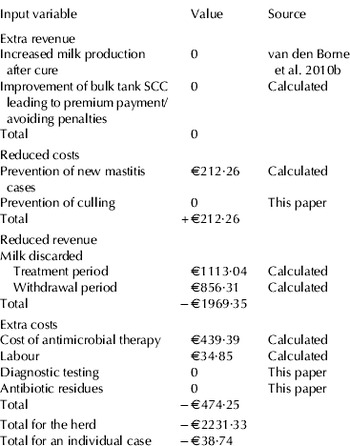
The model inputs were obtained from the scientific literature, from mean prices for Portugal in 2009–2010, and from mean values obtained for a longitudinal study focusing on CNS (unpublished observations). The input parameters were estimated considering a 100-cow herd. Inputs into the model were not rounded off for the calculations, but are presented in the text as rounded off. A summary of input variables to the model is displayed in Table 1.
Input variables into the economic model and their respective sources

Extra revenue
This was considered potentially to include the increase in milk production after cure and the potential benefit of a reduction in the bulk tank SCC after treatment.
Studies that measured milk production after treatment for subclinical mastitis found no significant improvement after treatment of Str. uberis and Str. dysgalactiae (St.Rose et al. Reference St.Rose, Swinkels, Kremer, Kruitwagen and Zadoks2003) or of Staph. aureus and CNS (van den Borne et al. Reference van den Borne, van Schaik, Lam and Nielen2010b).
As for the extra revenue potentially derived from a lower bulk tank SCC resulting from cure and reduction in individual quarter SCC, data from our own study were used (unpublished observations). In that study, the mean proportion of infected quarters was 14·4% across the 4 farms studied, which for a 100-cow herd would be equivalent to 58 infected quarters. Geometric mean SCC for CNS-infected quarters was 132 000 cells/ml, for culture-negative quarters was 38 000 cells/ml and for the bulk tank 353 000 cells/ml. Each infected cow had on average two infected quarters with CNS. Considering two quarters with a CNS IMI and two quarters with no IMI and assuming equal contribution from all quarters to the cow SCC, such an animal would have a SCC of 85 000 cells/ml. Cure after antimicrobial treatment has been shown to lead to significant drops in quarter SCC (van den Borne et al. Reference van den Borne, van Schaik, Lam and Nielen2010b), therefore one can assume that a cured cow would have a SCC of 38 000 cells/ml, the same as the mean quarter SCC for culture-negative quarters. A decrease of 47 000 cells/ml (85 000–38 000) would therefore be obtained for a cured animal. However, cure rates for subclinical mastitis due to CNS are not 100%. Aggregating data from three studies on treatment of CNS subclinical mastitis (McDougall, Reference McDougall1998; Wilson et al. Reference Wilson, Gonzalez, Case, Garrison and Grohn1999; Taponen et al. Reference Taponen, Simojoki, Haveri, Larsen and Pyörälä2006) we estimated a cure rate of 81·9% (154 cured quarters out of 188), which means the SCC reduction would only be 81·9% of 47 000 cells/ml on the treated animals or 38 500 cells/ml, considering SCC at cow level. Considering that this reduction would occur on 29 cows (2 quarters affected per animal, for a total of 58 quarters) the expected reduction on bulk tank SCC would be 11 000 cells/ml (0·29×38 500). Such a low reduction in bulk tank SCC would probably not lead to improved farm gate milk price in most situations, as this tends to occur over wider SCC differences. Therefore it was decided to consider extra revenue from improved bulk tank SCC to be zero.
Reduced costs
These were considered to include the prevention of culling and the prevention of new infections.
Mastitis is one of the main reasons for culling dairy cows across several countries, with reported figures of 3·6% (Whitaker et al. Reference Whitaker, Kelly and Smith2000), 10·1% (Esslemont & Kossaibati, Reference Esslemont and Kossaibati1997) or 12·4% (Seegers et al. Reference Seegers, Beaudeau, Fourichon and Bareille1998) of culls occurring due to mastitis. Most culls due to mastitis will probably occur because of incurable clinical mastitis or persistently high SCC. Either situation would be a relatively rare occurrence with CNS, since these microorganisms usually lead to mild clinical mastitis (Taponen et al. Reference Taponen, Simojoki, Haveri, Larsen and Pyörälä2006) and to low SCC (Djabri et al. Reference Djabri, Bareille, Beaudeau and Seegers2002). Therefore it was considered that treatment of subclinical mastitis due CNS would not lead to reduced culling.
Prevention of new IMI would result from a reduced transmission occurring because a proportion of the existing cases of CNS subclinical mastitis would be cured. Transmission of infection can be estimated by the reproductive ratio, R, which is the product of the transmission parameter β, a measure of a pathogen's contagiousness and the duration of infection τ, which is the inverse of the cure rate α (Swinkels et al. Reference Swinkels, Hogeveen and Zadoks2005a). β is the average number of new infections caused by an infected individual per unit of time and R is therefore the total number of new infections caused by an existing infection during its infectious lifetime. To estimate R we resorted to data from our study: average duration of a CNS IMI was 188 d (unpublished observations). As for β we used the best case scenario for transmission of Staph. aureus during a steady-state period with post-milking teat disinfection (Barlow et al. Reference Barlow, White, Zadoks and Schukken2009) which corresponded to 0·0028. It is well established that Staph. aureus frequently behaves in a contagious manner (Barkema et al. Reference Barkema, Schukken and Zadoks2006) whereas for CNS there is evidence that the most frequent form of IMI acquisition might be different for different species (Taponen et al. Reference Taponen, Björkroth and Pyörälä2008). Therefore the lowest value recorded for transmission of Staph. aureus was used. The R obtained was 0·53 (0·0028÷1/188), which means that without treatment each infected quarter would on average lead to a new infection in 0·53 other quarters. We considered that if the IMI was cured, duration of infection would be 30 d because it would take that long for the case to be detected, the aetiology to be known and for treatment to be performed. Again, only 81·9% of the cases would be cured, with the remaining cases persisting for 188 d. On average, infection in treated quarters would last 58·6 d [(0·819×30 d)+(0·181×188 d)], corresponding to an R of 0·16 (0·0028×58·6). Hence, with treatment, transmission of infection in one quarter would be reduced from 0·53 to 0·16.
The average cost of a new infection was also estimated. We considered that each new infection would result in mastitis of clinical onset 5% of the times and in mastitis of subclinical onset 95% of the times. These values were used because there is no evidence in the literature as to how often a new IMI due to CNS has clinical onset. Estimated values for clinical onset of new infections are scarce in the literature and include 5% (Jayarao et al. Reference Jayarao, Gillespie, Lewis, Dowlen and Oliver1999) and 15% (Zadoks et al. Reference Zadoks, Gillespie, Barkema, Sampimon, Oliver and Schukken2003) for Str. uberis, which is more pathogenic than CNS. Out of all the infections that had a subclinical onset, it was considered that 64·5% would self-cure after the first month of infection and the remaining 35·5% would lead to an infection with the average 188-d infection, based on reports by McDougall (Reference McDougall1998). Thus, out of the new infections, 5% would have a clinical onset, 61·3% would have a subclinical onset that would spontaneously cure within one month and 33·7% would have a subclinical onset and last on average 188 d.
These infections would have different costs associated with them. A clinical case would include the costs of antimicrobial treatment (€7·63), of labour associated with the treatment (€0·60) and of discarded milk due to administration of antimicrobials (€34·20), for a total of €42·43. The sections ‘Extra costs’ and ‘Reduced revenue’ contain a full explanation of the costs of treatment and of the value of discarded milk. No milk production loss was considered because CNS normally lead to mild clinical mastitis. A subclinical case that self-cured within the first month was considered to last 15 d. Losses associated with this type of IMI (€1·66) and the longer IMI (€20·85) were due to the impact of increased SCC on milk production: considering the proportion of heifers and cows affected in the herd, the average SCC increase and the milk production losses associated with those increases as described under the section ‘Reduced Revenue’. The average cost of a new infection would then be €10·16 [(0·05×€42·32)+(0·61×€1·66+0·34×€20·85)].
If no treatment was performed, each infected quarter would transmit the infection to 0·53 quarters. Considering 58 infected quarters, this would lead to 30 new infections, representing a cost of €308·38. By comparison, treatment would reduce the infection to only 9 quarters, which would cost €96·11, corresponding to a saving of €212·26.
Extra costs
Extra costs included the costs associated with antimicrobial therapy: cost of antimicrobials, labour, diagnostic testing and the cost of antimicrobial residues.
Cost of antimicrobial treatment was calculated based on data-sheet recommendations for the duration of treatment and on prices of 11 intramammary antimicrobials sold in Portugal at the time of the study. An arithmetic mean was estimated for the treatment cost (€7·63), for number of intramammary tubes (3·36) for duration of treatment (1·9 d) and for duration of milk withdrawal period (3·5 d). Labour costs for the act of treatment were calculated based on employees earning twice the minimum wage in Portugal for the year 2010 (2×€475), working 22 d a month and 8 h/d. If one considers that each treated quarter would take 2 min per infusion, a cost of €0·60 (€0·18×3·36 tubes) in labour could be assumed per treated mastitis or €34·85 for the whole herd (€0·60×58 quarters).
Costs associated with diagnostic testing were considered to be zero because the focus of the current study was the development of a support tool when the aetiology of IMI was already known. However, these diagnostic costs could easily be added to the final value for each quarter. Cost of antimicrobial residues accidentally going into the bulk tank after treatment were also assumed to be zero.
Reduced revenue
This included the value of discarded milk due to treatment. Milk produced during treatment was considered a complete loss, whereas it was considered that milk in the withdrawal period was fed to calves, a current practice among dairy farmers, saving the equivalent volume in milk replacer costs. Two types of milk production were estimated: a baseline milk production, which corresponded to the milk production when no infection was present and that was used for the calculation of the milk production loss associated with new cases of clinical mastitis, and a milk production for animals affected with subclinical mastitis.
Baseline milk production was calculated considering milk recording values for the 4 farms enrolled in our study for its duration (12 months). Animals with a SCC<50 000 cells/ml, considered to be uninfected, had an arithmetic mean daily milk production of 31·5 l for primiparous (35% of the animals) and 36·9 l for multiparous (65% of the animals), which considering the structure of the population led to an overall average daily milk yield of 35 l/animal. Milk production for animals with an ongoing subclinical mastitis due to CNS was based on the previous estimated production but discounted for the effect of the increased SCC. According to Seegers et al. (Reference Seegers, Fourichon and Beaudeau2003) there is a daily reduction of 0·4 kg of milk for heifers and 0·6 kg for cows, per 2-fold increase in the SCC from a baseline of 50 000 cells/ml at cow level. Considering 2 affected quarters per cow, each with a SCC of 132 000 cells/ml and 2 quarters with no infection, each with a SCC of 38 000 cells/ml, and an equal contribution in terms of milk yield, a cow SCC of 85 000 cells/ml would be defined. This would lead to daily milk production losses of 0·28 l/heifer and of 0·42 l/cow or to a milk production of 34·6 l/d. No effect of stage of lactation on milk yield was considered in this study, despite Hagnestam-Nielsen et al. (Reference Hagnestam-Nielsen, Emanuelson, Berglund and Strandberg2009) observing that the magnitude of daily milk loss associated with increased SCC depended on stage of lactation, being most extensive in late lactation. There is some evidence that CNS infection is not associated with days in milk (Østerås et al. Reference Østerås, Sølverød and Reksen2006) and therefore we assumed the impact would be equally distributed throughout lactation periods.
The price of a litre of milk (€0·299) was based on the rolling 12-month mean in mainland Portugal (Gabinete de Planeamento e Políticas) for the year 2009. The cost of milk replacer was based on the arithmetic mean of prices of three milk replacers sold in Portugal at the time of the study, considering 125 g/l of milk replacer at a price of €0·178, each litre of milk in the withdrawal period fed to calves would result in a loss of €0·121/l (0·299–0·178).
Treatment of subclinical mastitis due to CNS, would lead to a loss of €19·33 (34·6 l×1·9 d×€0·299/l) through discarded milk plus €14·86 being lost as milk fed to calves during the withdrawal period (34·6 l×3·6 d×€0·12) for a total of €34·19. For the total number of quarters affected, this would be €1969·35.
Treatment of mastitis of clinical onset, which would be a reduced cost with fewer cases being transmitted, would occur in animals with a baseline milk production. Therefore the value of discarded milk would be slightly higher at €34·56 [(35 l×1·9 d×€0·299)+(35 l×3·6 d×€0·12)].
Sensitivity analysis
A sensitivity analysis is performed to evaluate how systematic variation to the input variables of the model (assumptions) leads to outcome changes (Dijkhuizen & Morris, Reference Dijkhuizen and Morris1997). This helps determine the impact of uncertain estimates on the outcome of decisions and allows consideration of best and worst case scenarios.
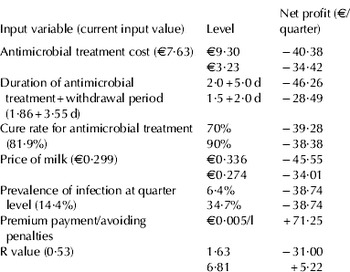
Several different inputs to our model were considered possible and their impact estimated, with two alternatives considered for most inputs. These included antimicrobial treatment cost and duration, cure rate for antimicrobial treatment, price of milk, different prevalence of infection, a change to the price of milk due to premium payment/avoiding penalties with lowering of the bulk tank SCC and different R values.
Antimicrobial treatment costs included the highest and lowest available price for intramammary antimicrobial treatment according to data-sheet recommendations (€3·23 and €9·30 respectively). Duration of antimicrobial treatment and of milk withdrawal period included the shortest (1·5+2·0 d) and the longest in duration (2·0+5·0 d). Cure rates for antimicrobial treatment of CNS subclinical mastitis seem not to vary much. Reported cure rates of 81·0 (Wilson et al. Reference Wilson, Gonzalez, Case, Garrison and Grohn1999), 81·8 (McDougall, Reference McDougall1998) and 88·9% (Taponen et al. Reference Taponen, Simojoki, Haveri, Larsen and Pyörälä2006) are close to the average value of 81·9% we used in our model, so cure rates of 70 and of 90% were used in the sensitivity analysis. Milk prices used in the sensitivity analysis were the highest and lowest recorded values during the time period considered for construction of the model, €0·336 and €0·274, respectively. Different prevalence of infection included the highest and lowest quarter-level prevalence recorded for the farms in the previous study (unpublished observations), 34·7 and 6·4%. The possibility of a change in farm gate milk price due to improvement in bulk tank SCC was considered, with an improvement of €0·005 to the baseline milk price being tested. Two different R values were considered taking into account mean β values proposed by Barlow et al. (Reference Barlow, White, Zadoks and Schukken2009) for major Gram-positive mastitis pathogens, including a value for farms performing post-milking teat disinfection (β=0·00868, R=1·63) and a value for farms not performing it (β=0·0362, R=6·81).
Results
Net profit for antimicrobial treatment of subclinical mastitis due to CNS was negative at −€38·74 per treated quarter or −€2231·33 for a whole-farm approach, considering the average situation in a 100-cow herd and assuming that the aetiological agent is known.
Table 2 displays the results for the sensitivity analysis. This showed that variation to the model inputs would nearly always lead to negative results except in two situations: if the decrease in bulk tank SCC was sufficient to result in an improvement in payment class after antimicrobial treatment had been performed, and if the number of new infections caused by an existing infection was set at its highest, in which case prevention of transmission through treatment would also be highest. Different prevalence of CNS IMI at quarter level did not lead to different financial net results per treated quarter as the higher costs would be divided by a higher number of quarters.
Sensitivity analysis considering possible scenarios for different input variables

Discussion
Considering the input variables used in the present model, antimicrobial treatment during the lactation seems not to be economically advisable for subclinical mastitis due to CNS. For the average situation, such treatment would lead to a net loss of €38·74 per treated quarter. The highest cost would be the reduced revenue that occurs when discarding milk during antimicrobial treatment, and feeding it to calves during the withdrawal period. The cost of the treatment itself was next. These costs were not offset by extra revenue, which was actually zero, or by reduced costs, which corresponded to the predicted reduction in the occurrence of new mastitis cases.
Treatment of subclinical mastitis due to different udder pathogens has been addressed in several studies. Initial studies were performed for Str. agalactiae, a contagious pathogen with reportedly high cure rates after antimicrobial treatment (Yamagata et al. Reference Yamagata, Goodger, Weaver and Franti1987). These authors report a gain for treatments performed during early and mid lactation, but a net loss for treatments performed in late lactation (over 120 d). Swinkels et al. (2005) studied the economic benefits of treatment of subclinical mastitis due to Staph. aureus, and found a positive or a negative effect depending on whether the transmission between quarters was high or low, respectively. The same authors studied the effect of treating chronic subclinical mastitis due to Str. uberis during the lactation through two different methodologies, a deterministic and a stochastic approach. In the deterministic model, treatment resulted in an average profit of €11·62 over no treatment (Swinkels et al. Reference Swinkels, Rooijendijk, Zadoks and Hogeveen2005b), whereas the stochastic model predicted a net loss of €11 when treatment was performed (Steeneveld et al. Reference Steeneveld, Swinkels and Hogeveen2007). A recently published study on the economics of lactational treatment of subclinical mastitis with different udder pathogens points to different economic outputs, depending on whether pathogens involved are transmitted between animals or acquired from the environment (van den Borne et al. Reference van den Borne, Halasa, van Schaik, Hogeveen and Nielen2010a). Therefore, it would seem that even for the so-called major pathogens, results of economic studies for lactational therapy are not unanimous and quite often lead to net losses. It is not surprising then that lactational therapy for CNS, which are considered minor mastitis pathogens, results in a net economic loss.
As stated previously, the deterministic approach used in this study resorts to definite predictions for quantities (e.g. mean price of antimicrobials used, mean price of milk, etc). Owing to the multifactorial nature of mastitis, use of a stochastic approach, resorting to probability distributions to deal with uncertainty, would probably lead to a more informative result in as far as it would provide a distribution of potential outcomes with the possibility of separating variability and uncertainty. Nevertheless, the quantity and quality of data to parameterize such a model adequately would add considerably to the complexity and duration of the analysis, if not to render it unworkable. Given the convincing nature of the outcome of the analyses conducted, it is felt that the simple calculations used in this study, with the essential inclusion of the sensitivity analyses, have the advantage of being easily understood and could plausibly be replicated in farm-specific conditions by practitioners.
There is an on-going debate about the role of CNS as udder pathogens with some authors considering them a potential problem (Taponen et al. Reference Taponen and Pyörälä2009) whereas others consider them to be potentially beneficial owing to an observed improvement in milk production (Schukken et al. Reference Schukken, Gonzalez, Tikofsky, Schulte, Santisteban, Welcome, Bennett, Zurakowski and Zadoks2009). Two previous studies have approached the subject of the economic benefits of treating CNS IMI, although strictly speaking they also included other pathogens in the analysis (Oliver et al. Reference Oliver, Lewis, Gillespie, Dowlen, Jaenicke and Roberts2003; Borm et al. Reference Borm, Fox, Leslie, Hogan, Andrew, Moyes and Oliver2006). Both these trials studied the effects of pre-calving treatment of heifer subclinical mastitis, with CNS being the most frequently isolated udder pathogens. One such trial concluded there was no economic benefit (Borm et al. Reference Borm, Fox, Leslie, Hogan, Andrew, Moyes and Oliver2006) whereas the other led to some economic benefit through increased milk production (Oliver et al. Reference Oliver, Lewis, Gillespie, Dowlen, Jaenicke and Roberts2003). There are not many studies reporting on milk yield after antimicrobial treatment of subclinical mastitis, but the ones available are suggestive of no improvement in milk yield after lactational treatment for both CNS (van den Borne et al. Reference van den Borne, van Schaik, Lam and Nielen2010b) and other species (St. Rose et al. Reference St.Rose, Swinkels, Kremer, Kruitwagen and Zadoks2003). In the present study, we assumed that no improvement in milk production would result from antimicrobial treatment.
Effects of CNS infection on milk yield are not well established. Some authors found that CNS IMI led to milk production losses (Timms & Schultz, Reference Timms and Schultz1987; Borm et al. Reference Borm, Fox, Leslie, Hogan, Andrew, Moyes and Oliver2006) whereas others found evidence of the opposite effect (Schukken et al. Reference Schukken, Gonzalez, Tikofsky, Schulte, Santisteban, Welcome, Bennett, Zurakowski and Zadoks2009; Piepers et al. Reference Piepers, Opsomer, Barkema, de Kruif and De Vliegher2010). There is a link between increased SCC above a certain threshold and milk production losses (Green et al. Reference Green, Schukken and Green2006). However, publications on this subject generally consider only the SCC level and not the pathogen involved. Some studies have addressed the issue of milk loss associated with specific pathogens. Grohn et al. (2004) observed higher milk production losses associated with clinical mastitis due to Staph. aureus, Escherichia coli, Klebsiella spp. and for samples that were culture-negative. Schukken et al. (Reference Schukken, Gonzalez, Tikofsky, Schulte, Santisteban, Welcome, Bennett, Zurakowski and Zadoks2009) studied records of 4200 herds and found that CNS-infected cows produced slightly but significantly more milk (0·45 kg/d) than culture-negative cows, whereas cows infected with a major mastitis pathogen produced significantly less milk (between 1·6 and 3·6 kg/d depending on the agent). Reksen et al. (Reference Reksen, Sølverød and Østerås2007) also studied the effect of the isolation of specific pathogens in milk samples and test-day milk yield and found that pluriparous cows infected with Streptococcus spp. actually produced more milk than their culture-negative herdmates. Judging from these studies, there is still plenty of scope for improvement of our understanding of species-specific impact on milk production, without forgetting a possible role for increased susceptibility of higher producing cows. This is probably not easily achieved without measurement of quarter milk production and compensatory effects, a logistically complex task.
Another possibility for extra revenue to be gained with treatment for subclinical mastitis due to CNS would be the improvement in bulk tank SCC. In the initial assumptions we considered this to be zero, because we estimated a likely improvement of only 11 000 cells/ml in the bulk tank SCC with treatment, which would only lead to a premium being paid or to avoidance of penalties if the bulk tank SCC was on the verge of a change in payment category. Were that to occur and a premium of €0·005 be paid, then treatment would actually lead to positive results in the conditions considered. Different contributions of CNS to the bulk tank SCC could potentially be included in the model, based on cow-level bacteriology and level of bulk tank SCC (Schukken et al. Reference Schukken, Gonzalez, Tikofsky, Schulte, Santisteban, Welcome, Bennett, Zurakowski and Zadoks2009). This premium payment has a different effect than simply increasing the farm gate milk price. When we performed the sensitivity analysis, increasing the farm gate milk price led to negative results because during antimicrobial treatments, it would lead to milk being discarded at those prices. A premium being paid for better quality milk would mean that the higher prices would come after the treatments were performed, therefore not being affected by discarded milk.
One of the parameters included under reduced costs was prevention of new infections. Several of the assumptions made in estimating this parameter are debatable. We initially considered an R value (total number of new infections caused by an ongoing infection) of 0·53, which is fairly low, implying that infection would not sustain itself on a farm through transmission between animals and would only persist because of an outside reservoir of infection. There is emerging evidence that different CNS species behave differently in terms of the most likely source of infection being the environment or other cows (Taponen et al. Reference Taponen, Björkroth and Pyörälä2008), so predominance of a certain CNS species on a particular farm might affect this parameter. Two additional R values were considered in the sensitivity analysis based on β values cited by Barlow et al. (Reference Barlow, White, Zadoks and Schukken2009). If we consider the highest of these values, with one infected quarter transmitting infection to 6·81 quarters during its infectious lifetime, lactational antimicrobial treatment would lead to a net profit through prevention of transmission.
The sensitivity analysis revealed that the prevalence of infection at quarter level would not change the outcome of the model. Other factors would have an impact on the level of loss consequent to treatment. Duration of treatment and of withdrawal period would have the largest impact on the economic result of treatment, leading to the highest and lowest loss when considering the longest and shortest duration respectively. Treatment and withdrawal period duration were according to label use of the antimicrobials considered. The duration of treatment and choice of antimicrobial would probably have an impact on cure rates, as these have been reported to vary for different antimicrobials used in the treatment of CNS mastitis (McDougall, Reference McDougall1998). However, variation in the cure rates would not actually have a major impact on the economic outcome of treatment.
Besides the direct financial loss likely to occur with lactational treatment with antimicrobials, other potential negative consequences need to be considered, namely selection for antimicrobial resistance. There is much debate around the effects of antimicrobial usage on the emergence of antimicrobial resistance at farm level (Call et al. Reference Call, Davis and Sawant2008) but there is some evidence of such relationship, mainly through the comparison of conventional and organic farms (Tikofsky et al. Reference Tikofsky, Barlow, Santisteban and Schukken2003). These authors compared antimicrobial susceptibility profiles for Staph. aureus from 22 organic and 16 conventional dairy herds and found differences for 7 of 9 antibiotics studied. Public perception and consumer choices may also be affected by higher antimicrobial usage. Even though feeding milk to calves during the antimicrobial withdrawal period is not recommended from the point of view of emergence of antimicrobial resistance, it was decided to assume that farmers feed this milk to calves in the model, as this may occur frequently.
As other pathogens come under control on farms, there is currently much attention devoted to the impact of CNS on udder health. Judging from our deterministic approach, it would appear that lactational antimicrobial treatment for subclinical mastitis due to CNS should not be part of a control programme, as it would lead to a net financial loss in most situations.
R Bexiga holds grant number SFRH/BD/36759/2007 from the Foundation for Science and Technology. The financial support of the Interdisciplinary Centre of Research in Animal Health (CIISA) is gratefully acknowledged.