1. Introduction
A number of models of general relativity seem to contain “holes” that are thought to be “physically unreasonable.” One seeks a condition to rule out these models. We examine a number of possibilities already in use. We then introduce a new condition: epistemic hole-freeness. Epistemic hole-freeness is not just a new condition—it is new in kind. In particular, it does not presuppose a distinction between space-times that are “physically reasonable” and those that are not.
2. Preliminaries
We begin with a few preliminaries concerning the relevant background formalism of general relativity.Footnote 1 An n-dimensional, relativistic space-time (for  ) is a pair of mathematical objects
 . Object M is a connected n-dimensional manifold (without boundary) that is smooth (infinitely differentiable). Here,
 is a smooth, nondegenerate, pseudo-Riemannian metric of Lorentz signature (+, −, … , −) defined on M. Note that M is assumed to be Hausdorff; for any distinct
 , one can find disjoint open sets
 and
 containing p and q, respectively. We say two space-times
 and
 are isometric if there is a diffeomorphism
 such that
 .
For each point  , the metric assigns a cone structure to the tangent space
 . Any tangent vector
 in
 will be time-like if
 , null if
 , or space-like if
 . Null vectors create the cone structure; time-like vectors are inside the cone, while space-like vectors are outside. A time orientable space-time is one that has a continuous time-like vector field on M. A time orientable space-time allows one to distinguish between the future and past lobes of the light cone. In what follows, it is assumed that space-times are time orientable.
For some open (connected) interval  , a smooth curve
 is time-like if the tangent vector
 at each point in
 is time-like. Similarly, a curve is null (respectively, space-like) if its tangent vector at each point is null (respectively, space-like). A curve is causal if its tangent vector at each point is either null or time-like. A causal curve is future directed if its tangent vector at each point falls in or on the future lobe of the light cone.
An extension of a curve  is a curve
 such that I is a proper subset of
 and
 for all
 . A curve is maximal if it has no extension. A curve
 in a space-time
 is a geodesic if
 , where
 is the tangent vector and
 is the unique derivative operator compatible with
 . Let
 be a time-like curve with unit tangent vector
 . The acceleration vector is
 , and the magnitude of acceleration is
 . The total acceleration of
 is
 , where s is elapsed proper time along
 .
For any two points  , we write
 if there exists a future directed time-like curve from p to q. We write
 if there exists a future directed causal curve from p to q. These relations allow us to define the time-like and causal pasts and futures of a point p:
 ,
 ,
 , and
 . Naturally, for any set
 , define
 to be the set
 , and so on. A set
 is achronal if
 . A space-time satisfies chronology if, for each
 ,
 .
A point  is a future endpoint of a future directed causal curve
 if, for every neighborhood O of p, there exists a point
 such that
 for all
 . A past endpoint is defined similarly. A causal curve is future inextendible (respectively, past inextendible) if it has no future (respectively, past) endpoint.
For any set  , we define the past domain of dependence of S, written
 , to be the set of points
 such that every causal curve with past endpoint p and no future endpoint intersects S. The future domain of dependence of S, written
 , is defined analogously. The entire domain of dependence of S, written
 , is just the set
 . The edge of an achronal set
 is the collection of points
 such that every open neighborhood O of p contains a point
 , a point
 , and a time-like curve from r to q that does not intersect S. A set
 is a slice if it is closed, achronal, and without edge. A space-time
 that contains a slice S such that
 is said to be globally hyperbolic.
3. A Condition to Disallow Holes?
Consider the following example (see fig. 1).
Example 1. Let  be Minkowski space-time and let p be any point in M. Consider the space-time
 .
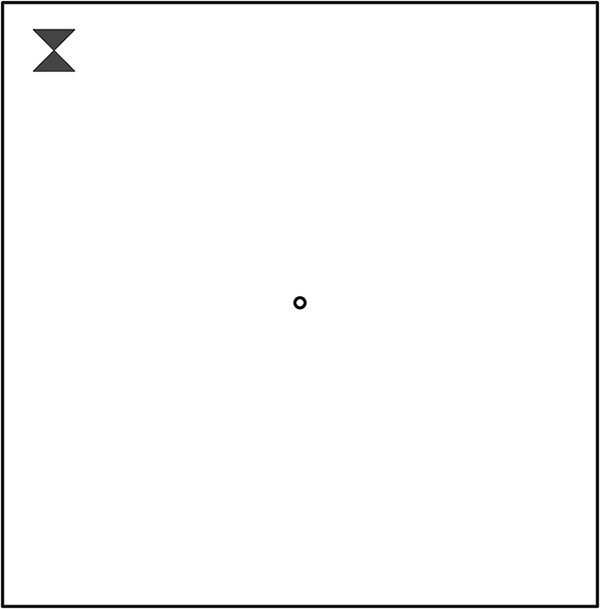
Minkowski space-time with a point removed from the manifold.

The space-time seems to have an artificial “hole.” One seeks to find a (simple, physically meaningful) condition to disallow the example. (The condition need not be a sufficient condition for “physical reasonableness”; it need only be necessary.) But “although one perhaps has a good intuitive idea of what it is that one wants to avoid, it seems to be difficult to formulate a precise condition to rule out such examples” (Geroch and Horowitz Reference Geroch, Horowitz, Hawking and Israel1979, 275).
Many of the conditions used to rule out the “hole” in example 1 require that certain regions of (or curves in) space-time be “as large as they can be.” For example, geodesic completeness requires every geodesic to be as large as it can be in a certain sense. Hole-freeness essentially requires the domain of dependence of every space-like surface to be as large as it can be. Inextendibility requires the entirety of space-time to be as large as it can be. Let us examine each of these three conditions in more detail. First, consider geodesic completeness.
Definition. A space-time  is geodesically complete if every maximal geodesic
 is such that
 . A space-time is geodesically incomplete if it is not geodesically complete.
If an incomplete geodesic is time-like or null, there is a useful distinction one can introduce (which we will need later on). We say that a future directed time-like or null geodesic  without a future endpoint is future incomplete if there is an
 such that
 for all
 . A past incomplete time-like or null geodesic is defined analogously. Next, consider inextendibility.
Definition. A space-time  is extendible if there exists a space-time
 and an isometric embedding
 such that
 is a proper subset of
 . Here, the space-time
 is an extension of
 . A space-time is inextendible if it has no extension.
Finally, consider hole-freeness. Initially, one defined (Geroch Reference Geroch, Earman, Glymour and Statchel1977) a space-time  to be hole-free if, for every space-like surface
 and every isometric embedding
 into some other space-time
 , we have
 . The definition seemed to be satisfactory. But surprisingly, it turns out the definition is too strong; Minkowski space-time fails to be hole-free under this formulation (Krasnikov Reference Krasnikov2009). But one can make modifications to avoid this consequence (Manchak Reference Manchak2009).
Let  be a globally hyperbolic space-time. Let
 be an isometric embedding into a space-time
 . We say
 is an effective extension of
 if, for some Cauchy surface S in
 ,
 and
 is achronal. Hole-freeness can then be defined as follows.
Definition. A space-time  is hole-free if, for every set
 such that
 is a globally hyperbolic space-time with Cauchy surface S, if
 is not an effective extension of
 where
 , then there is no effective extension of
 .
What is the relationship between the three conditions? There are only two implication relations between them (Manchak Reference Manchak2014).
Proposition 1. Any space-time that is geodesically complete is hole-free and inextendible.
Now, any of the three conditions can be used to rule out the “hole” in example 1. But due to the singularity theorems (Hawking and Penrose Reference Hawking and Penrose1970), geodesic completeness is now considered to be much too strong a condition; it seems to be violated by “physically reasonable” space-times. In what follows, let us focus on the remaining two conditions that are usually taken to be satisfied by all “physically reasonable” space-times. Indeed, these two conditions are still in use (see Earman Reference Earman1995). Might hole-freeness or inextendibility (or their conjunction) be the condition we are looking for? Consider the following example.
Example 2. Let  be Minkowski space-time, and let p be any point in M. Let
 be a smooth positive function that approaches zero as the point p is approached. Now consider the space-time
 .
The space-time in example 2 is inextendible and hole-free. Nonetheless, it seems there is still an artificial “hole” in the space-time. One seeks a (simple, physically meaningful) condition to rule out even these holes.
4. A New Condition
Consider the following definition form.
Definition. A space-time  has an epistemic hole if there are two future inextendible time-like curves
 and
 with the same past endpoint and which __ such that
 is a proper subset of
 .
The physical significance of the definition form is this: Suppose two observers are both present at some event. Now suppose (subject to the restrictions in the blank) they go their separate ways. If it is the case that one observer can eventually know everything the other can eventually know and more, then there is a kind of epistemic “hole” preventing the latter observer from knowing the extra bit. One might require the region of space-time that an observer can eventually know to be “as large as it can be.” In other words, one might require space-time to be free of epistemic holes.
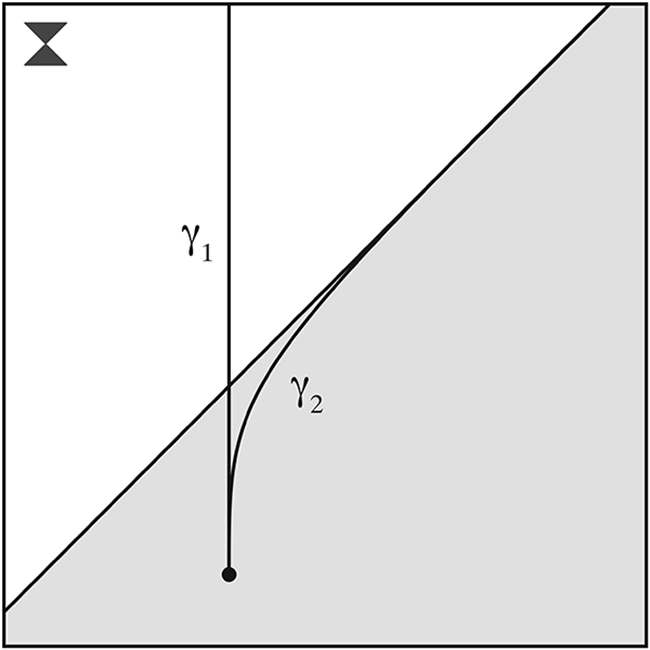
If no restrictions are given in the blank, examples 1 and 2 count as having epistemic holes as we would hope. But, unfortunately, this version of the condition is too strong; it rules out space-times that are usually thought to be “physically reasonable” in some sense. Take Minkowski space-time, for example. It counts as having epistemic holes. (Consider any point in the Minkowski space-time. Now consider any observer at the point who, with infinite total acceleration, reaches “null infinity” and another observer at the point who does not. See fig. 2.)
Observers  and
 in Minkowski space-time. The set
 (the shaded area) is a proper subset of
 (the entire manifold).

In order to not count Minkowski space-time as having epistemic holes, one seeks to fill the blank with reasonable restrictions. Let us consider two natural possibilities: “are geodesics” and “have finite total acceleration.” Let EH(g) and EH(f) respectively denote these two versions of the epistemic hole definition. In addition, if a space-time fails to have an EH(g), let us say it is EH(g)-free (and respectively for the EH(f) case).
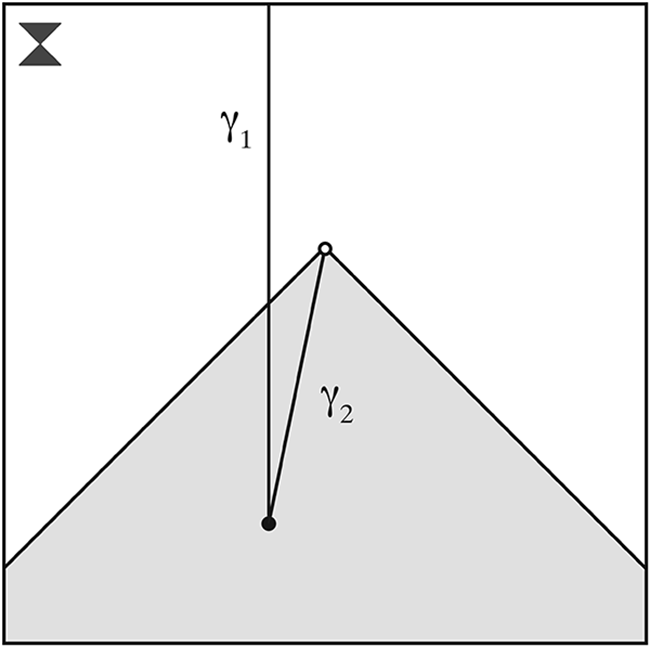
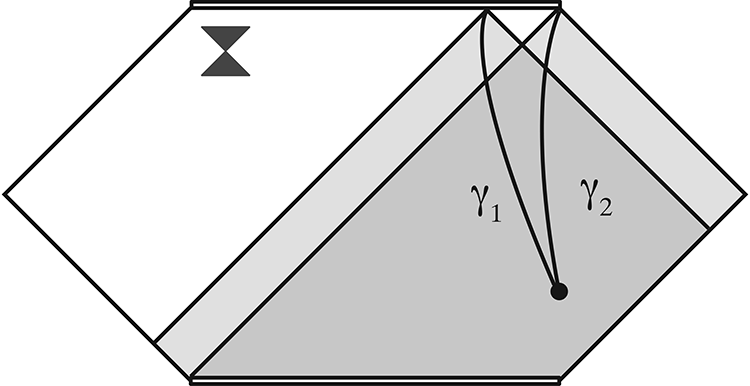
Clearly, if a space-time is EH(f)-free, then it also EH(g)-free.Footnote 2 And as we would hope, examples 1 and 2 each have an EH(g) and therefore an EH(f) (see fig. 3). Indeed, acausal examples aside, it seems almost every artificially mutilated space-time will have an epistemic hole of some type. Now, Minkowski space-time is EH(f)-free and EH(g)-free by construction. What about other “physically reasonable” space-times? The Schwarzchild solution is a good test case; its future inextendible time-like curves have event horizons that might allow for epistemic holes.Footnote 3 But this is not the case; it and its Kruskal extension count as EH(f)-free and EH(g)-free (see fig. 4).
Geodesic observers  and
 in Minkowski space-time with one point removed from the manifold. The set
 (the shaded area) is a proper subset of
 (the entire manifold).

Conformal diagram of Kruskal-Schwarzchild space-time. Any observers  and
 with finite total acceleration are such that if
 and
 (shaded areas) are distinct, then they do not fully overlap.

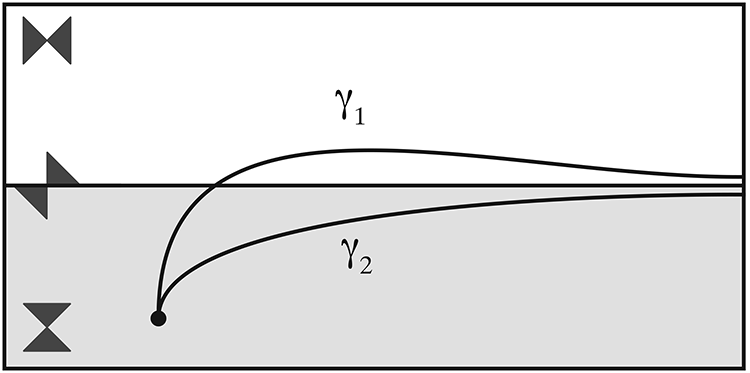
One can also show that the de Sitter, anti–de Sitter, and Gödel models all count as both EH(f)-free and EH(g)-free. Misner space-time is neither EH(f)-free nor EH(g)-free (see fig. 5). However, Misner space-time harbors “naked singularities” thought to be physically unreasonable. Consider the following influential definition (Geroch and Horowitz Reference Geroch, Horowitz, Hawking and Israel1979; Earman Reference Earman1995).Footnote 4
Definition. A space-time  is nakedly singular if there is a point
 and a future incomplete time-like geodesic
 such that
 .
Unrolled Misner space-time. Geodesic observers  and
 are such that the set
 (the shaded area) is a proper subset of
 (the entire manifold).

What is the relationship between naked singularities and epistemic holes? Consider the following examples.
Example 3. Let  be Minkowski space-time, and let p be any point in M. Let
 be a smooth positive function that approaches infinity as the point p is approached. Now consider the space-time
 .
Example 4. Let  be two-dimensional Minkowski space-time in standard t, x coordinates that is “rolled up” along the t direction. Let p be any point in M. Consider the space-time
 .
Example 3 is geodesically complete (and therefore contains no naked singularities). But it has both an EH(f) and an EH(g). However, example 4 contains naked singularities but is EH(f)-free and EH(g)-free. Now, example 4 is not causally well behaved. If one were to limit attention to space-times satisfying chronology, can one still find examples with naked singularities and without epistemic holes? At least in the case of EH(f), no.Footnote 5
Proposition 2. Any EH(f)-free, chronological space-time is not nakedly singular.
Proof. Let  be a chronological, nakedly singular space-time. Let
 be a future incomplete time-like geodesic with past endpoint
 such that
 for some
 . Let
 be any time-like curve with finite total acceleration with past endpoint q that runs through p and is future inextendible. Clearly,
 . Suppose
 . Since
 , we have
 . So, there is a point
 such that
 . But
 . It follows that
 , which is a violation of chronology: a contradiction. So,
 . Thus,
 is a proper subset of
 . So, there is an EH(f) in
 . QED
The proposition shows that, if one takes EH(f)-freeness as a necessary condition of physical reasonableness, then the weak causality assumption of chronology rules out naked singularities. Contrast this result with one (Geroch and Horowitz Reference Geroch, Horowitz, Hawking and Israel1979) which shows that the strong causality assumption of global hyperbolicity is, by itself, enough to exclude naked singularities.Footnote 6 Now, what is the relationship between global hyperbolicity and epistemic holes? Consider the following example.
Example 5. Let  be Minkowski space-time, and let p be any point in M. Let
 be the set
 . Let
 be a smooth positive function that approaches infinity as the boundary of
 is approached. Now consider the space-time
 . (See fig. 6.)
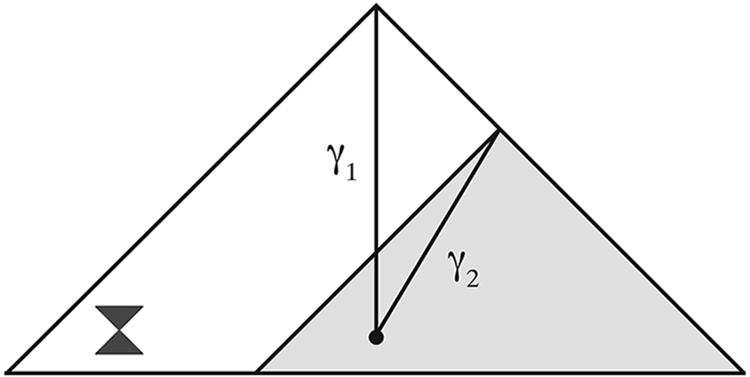
Geodesic observers  and
 in a portion of conformal Minkowski space-time. The set
 (the shaded area) is a proper subset of
 (the entire manifold).

Example 5 shows that a globally hyperbolic space-time, indeed even a globally hyperbolic space-time that is geodesically complete, can nonetheless fail to be EH(f)-free and EH(g)-free. However, example 4 shows that a space-time that is nonglobally hyperbolic, indeed even a nonchronological space-time that fails to be inextendible and hole-free, can nonetheless be EH(f)-free and EH(g)-free. In sum: epistemic holes are very different from “holes” and “singularities” of various kinds.
5. A New Kind of Condition
Stepping back, one may ask: what justifies the use of epistemic hole-freeness? As we have seen, the condition rules out many intuitively “physically unreasonable” space-times (including those, like example 2, that inextendibility and hole-freeness fail to rule out). However, no model with epistemic holes has yet been found that is clearly “physically reasonable.” It is our position that this alone provides sufficient justification for the condition. In any case, the proper sorting of the intuitively “physically reasonable” and “physically unreasonable” examples is, at root, the justification for the widely used conditions of inextendibility and hole-freeness (Earman Reference Earman1995; Manchak Reference Manchak2011). And, as with these other two conditions, one can hope to put epistemic hole-freeness to work in proving theorems of interest (such as proposition 2).
In addition, we wish to highlight an important way in which the condition of epistemic hole-freeness is far superior to the conditions of inextendibility and hole-freeness. The definitions of the latter two conditions make reference to (and are functions of) the entire class of relativistic space-times; they require that certain regions of space-time be “as large as they can be” in the sense that one compares them, from a God’s eye point of view, to similar regions in all possible space-times. And whether a space-time counts as inextendible or hole-free depends crucially on the makeup of this class of all possible space-times. But what is this class? We would like to emphasize that whatever the answer winds up being depends on assumptions concerning what “physically reasonable” space-times are. And the fact that we have yet to pin down the class of “physically reasonable” space-times should give us pause. In essence, the fact implies that we have yet to pin down the class of inextendible space-times and the class of hole-free space-times.
An example might serve to illustrate the point. Following standard practice, we have assumed in the preceding that all manifolds are Hausdorff. Under this assumption, Minkowski space-time counts as inextendible. The space-time is “as large as it can be” in the sense that it cannot be properly and isometrically embedded into another space-time. But note that if the Hausdorff assumption is dropped, Minkowski space-time now counts as extendible (see fig. 7). The example shows that, whatever else is the case, the class of “possible” space-times, as standardly interpreted, is not a class of merely logically or mathematically possible space-times; non-Hausdorff space-times are logically and mathematically well defined (Earman Reference Earman and Dieks2008), and Minkowski space-time is standardly interpreted as inextendible. Thus, the use of the condition of inextendibility has, all along, presupposed a distinction between space-times that are “physically reasonable” and those that are not. Once this important fact is clear, one is naturally “tempted to revise the principle of inextendibility” (Geroch Reference Geroch, Carmeli, Fickler and Witten1970, 278). But how should one revise? Any revision is dubious given that we do not know, and arguably cannot know (Manchak Reference Manchak2011), the makeup of the class of “physically reasonable” space-times.
Non-Hausdorff extension of Minkowski space-time.

To see why this might be, consider another example: the bottom half of Misner space-time (see fig. 5). It is globally hyperbolic and counts as extendible in the preceding. But suppose the cosmic censorship conjecture of Penrose (Reference Penrose, Hawking and Israel1979) is correct, and all “physically reasonable” space-times are globally hyperbolic. Then the bottom half of Misner space-time now counts as inextendible. It cannot be embedded properly and isometrically into a globally hyperbolic space-time; the space-time is “as large as it can be” if the possibility space is limited in just the way some experts think it is. It follows that whether the bottom half of Misner space-time counts as inextendible depends crucially on the outcome of the cosmic censorship conjecture—a conjecture that is far from settled (Earman Reference Earman1995; Penrose Reference Penrose1999). One is seemingly forced to conclude that the very content of the condition of inextendibility is unavoidably murky. (A similar argument can be given for the case of hole-freeness.)
Now consider epistemic hole-freeness. It requires that certain regions of space-time be “as large as they can be” in the sense that one compares them to similar regions within the very same space-time. The condition does not make reference to the class of all “possible” space-times. And thus, the condition does not presuppose that a distinction has been made between space-times that are “physically reasonable” and those that are not.Footnote 7 The content of the condition is perfectly clear. Among conditions used to rule out “holes” in space-time, epistemic hole-freeness appears to be alone in possessing this desirable quality.Footnote 8
 γ1
 γ2
 I−[γ2]
 I−[γ1]
 γ1
 γ2
 I−[γ2]
 I−[γ1]
 γ1
 γ2
 I−[γ2]
 I−[γ1]
 γ1
 γ2
 I−[γ2]
 I−[γ1]
 γ1
 γ2
 I−[γ2]
 I−[γ1]