1. Introduction
Ask a classroom of American college undergraduates for a show of hands on how many of them read poetry for pleasure, and one or two may tentatively signal this secret interest. Query the same group of students about how many of them listen to ‘music’ and everyone understands right away that songs with lyrics are meant. Hands shoot up and the class quickly divulges 24/7 cravings for the rock bands Radiohead, Cold Play, and U2. As the contemporary German writer Hans Manus Enzensberger puts it in the poem ‘Old Medium’, we end up at the start of the 21st century apologizing for poetry to those who seem not to have grown up around any type of literature, lamenting to them and ourselves, ‘You'd rather have it audio-visual/digital and in colour’ (Enzensberger Reference Enzensberger, Hamburger and Enzensberger1999: 67, my translation).
Every teacher today feels that stiff competition from virtual reality, especially those of us who contemplate bringing a poem text into the classroom. Widely regarded as the most ‘literary’ of genres, poetry is often excluded from language instruction due to the perception that it is archaic, inherently difficult to understand, and permanently lapsed into marginalized status. Indeed, we even take it for granted that students lack foundational literary competence without which, Culler cautions, any reader would be perplexed when faced with a poem because ‘[h]is knowledge of the language would enable him to understand the phrases and sentences, but he would not know, quite literally, what to make of this strange concatenation of phrases’ (1975: 114; emphasis in the original). Yet our awkwardness about poetry and the silence of our students when they encounter it produce a unique teaching opportunity. They reveal a peculiar idealization of the lyric genre that opens a myriad of questions about why and how to read literature (see Jackson Reference Jackson2008).
In the imagined classroom that we have before us, several lesson plans might unfold. If discussion proceeds with the teacher glossing unfamiliar vocabulary and parsing syntax, the text's surface difficulties may be negotiated, but the students will sit in silence, drained of appreciation of the poem as an aesthetic object (see Kramsch Reference Kramsch1993: 157). If, on the other hand, poetry is celebrated with choral readings and creative re-writings, in the ways Claire Kramsch advocates in Context and culture in language teaching (1993: 157–175), the class still may not achieve the breadth of interpretation that the literary scholar Marjorie Perloff seeks when advocating readings informed by, in her words, ‘a sense of history and a sense of theory’ (Perloff Reference Perloff1998: xi). In either case, it will not be apparent until years later that study of the poem has enriched the life of a student or secured a job, though one of our greatest rewards as teachers in the Humanities is learning anecdotally that our work has achieved such ends (see Walther Reference Walther2007: 13). The risks of teaching poetry, the strangest of texts, seem huge. Given that risk, the present paper reflects on the ways in which we teach poems in language classes because this act provides us with a much-needed opportunity to reflect broadly on the pedagogy of literature.
Poetry is characterized by extreme tensions: between private and emotional expression and public speech, between precise and concrete language and abstraction, between highly condensed wording and open space between the lines. Like all works of art, poetry presents itself on one level as unmediated expression. Its rhythmical language, rhyme, line, breath, and form can be appreciated even before we understand the meanings of every word. We imagine that the poet speaks directly to us, for immediacy is one of its conventions. At the same time, poetry shares rhetorical structures (metaphor, personification, irony, and the like) with other genres. Thus, on the level of discourse, poems often blur the boundaries between the lyric and prose or formal and informal speech. We recognize, too, that the individual voice of a poem, the meaning of its symbols, and its relationship to authorial biography are too dense and idiosyncratic to be exhausted through one interpretation. In other words, poems want to be read in at least two ways: as texts that require no prior knowledge and as works of art infinitely embedded in linguistic, historical, and social conventions, hence artifacts that require a deep interpretive framework. At stake is the challenge that such divergent qualities present to teachers: what it means, ultimately, in the L2 classroom to treat poetry texts as literature.
My interest in this question intersects with the current resurgence of discussions in the USA about how to teach literature. Curiously, these conversations are in part the outcome of the Modern Language Association (MLA 2007) report ‘Foreign languages and higher education: New structures for a changed world,’ which called on faculty to re-conceive the curriculum to address the problematical divide at some colleges and universities between the teaching of languages and literature. Even before the report urged us to aspire to a curriculum that would achieve deep ‘translingual and transcultural competence’ (MLA 2007: 237), many departments were engaged in self-reflection about the curriculum. The MLA itself laid some of the groundwork for this discussion of reform to the traditionally conceived, literature-based curriculum with the publication of Learning foreign and second languages: Perspectives in research and scholarship, edited by Heidi Byrnes (Byrnes Reference Byrnes1998), and Remapping the foreign language curriculum (Swaffar & Arens Reference Swaffar and Arens2005). Other scholars have also advocated a re-conceived curriculum (including Kern Reference Kern2000; Levine et al. Reference Levine, Eppelsheimer, Kuzay, Moti and Wilby2004; Magnan Reference Magnan2004; Maxim Reference Maxim2006). This work has promoted greater attention to the teaching of culture, multiple literacies, technology-mediated experiences, and genre awareness. Collectively, it has persuasively argued for a multi-dimensional approach to curricula for foreign languages, not a return to literature. Yet those efforts have raised a fundamental question: How do we, in fact, do literature?
To be clear, I am not proposing that we reinstate a traditional literature curriculum. Rather, I am interested in considering what the teaching of literature can add to foreign language pedagogy. Here, I believe, poetry should play a heuristic role from which it has thus far been excluded and it is my hope that by considering the role of poetry we can begin to think about curricular interventions that can be profitably extended to other literary genres as well. Poems stubbornly demand pedagogical approaches that have the potential to reshape our teaching of literature and language. In advocating the centrality of poetry to the foreign language curriculum, then, I want to imagine the sort of dialogue that should exist among the departments and faculties of national literatures, cultural studies, and literary theory, on the one hand, and language pedagogy and second language acquisition (SLA), applied linguistics, and related research fields on the other, for such a collaborative exchange has the potential to realign the teaching of literature with current discussions of what we want students to achieve.
The present paper triangulates three different ways of looking at this problem. First, I seek to provide a more adequate schematic overview of the knowledge base and instructional assumptions that inform the teaching of literature. Our current understanding of ‘literature pedagogy’ derives from remarkably disparate sources, including the aesthetic, historical, and philosophical traditions in literature and cultural studies; the quantitative and qualitative research methodology of SLA; and the experientially-driven practices of individual teachers. Though literary scholars and theorists, researchers in applied linguistics, creative writers, and other experts in related fields like EFL (English as a foreign language), ESL (English as a second language), Rhetoric, Writing, and Cognitive Psychology do not necessarily talk with each other about literature pedagogy, much common ground exists among their positions. In the second part of this paper, I compare two common approaches to teaching poetry, close reading and genre-based analysis. Thirdly, I propose an alternate, holistic approach – teaching poetry with attention to performance, poiesis (the making of poetry), and the cultural function of literature. It is a model that embeds poetry throughout the curriculum. My paper concludes with several recommendations about how to teach poetry.
2. Why and how do we ‘do’ literature?
In his 2008 article in Language Teaching, Amos Paran provides an excellent survey of research on the teaching of literature in foreign language (FL) and EFL contexts. Paran charts the evolution in the teaching of literature from generalized practices of ‘group guidance’ to the more systematic approaches developed in the 1990s to take into account ‘literary theory, reader response, and communicative language teaching’ (Paran Reference Paran2008: 465). He also points to the growing body of empirical research that contributes to our understanding of the teaching and learning of literature (see also Fowler Reference Fowler1981; Carter Reference Carter1997; Simpson Reference Simpson1997; Hewitt Reference Hewitt2008). To this discussion, I want to add points raised by a number of US colleagues, including the voices of scholars who work in literature, theory, and creative writing – fields outside the scope of Paran's survey. This expanded perspective shows that while the teaching of poetry in language courses has received relatively limited attention per se (especially through empirical research), many core principles and common practices have been solidly articulated by advocates of poetry. My point is that we cannot afford to dismiss these divergent, often individualistic perspectives if we are serious about advancing the teaching of literature. Instead, we should compare fundamental reasons why we teach literature with certain pedagogical approaches and proceed in a way that fosters broad, critical dialogue across the professional spheres that will create intellectual synergies around this topic. To start, let's consider ten arguments commonly given for teaching literature in FL classes.
2.1 Focus on language versus literature relationship
Much has been said about the opposition of language and literature teaching, yet this purported split is a false dichotomy. It is my contention that we ‘do’ literature best by embracing the pull between teaching a text for linguistic purposes and teaching the same text as literature (see Paran Reference Paran2008: 467). This dynamic tension forces us to realize anew that task design for FL settings is contingent on teaching purpose (see, for example, pedagogical treatments recommended by Spinner Reference Spinner1984; Maley & Duff Reference Maley and Duff1989; Paesani Reference Paesani2005). The ‘jump’ from teaching language to teaching literature, and back again, shifts us from thinking about a text in terms of linguistic purposes (such as communication, grammar, or syntactic structure) to conceiving of the text as connected by theme, grammar, or discourse to other materials in a course. It also prompts us to notice that a literary text often breaks with communicative referentiality to engage in representation through language of a self-organized, alternative world (see Widdowson Reference Widdowson1992: 24). Teaching poetry as literature, rather than as a representative ‘exemplar’ of language, means that the classroom discussion we lead must advance the larger intellectual trajectory of a course. Description of formal properties, paraphrase of content, and explication of symbols or metaphors become a starting, but not a stopping, point for this conversation. However, the two most commonly used approaches to this task, the close reading/reader response and genre-based analyses, have important differences in orientation in this regard and inherent limitations. The former tends to focus on exemplary status of literary texts while the latter uses literature as an example of discourse, less fully acknowledging its aesthetic qualities.
2.2 Enhance learning
Given the notorious ‘language–literature divide,’ it's striking that disciplinary perspectives strongly converge around a rationale for studying literature that is linked to enhanced learning. So, David Hanauer (who is engaged in quantitative and qualitative research related to literary competence of particular interest to applied linguists) and Charles Altieri (a professor of English who focuses on 20th-century literature and whose scholarship represents here the philosophical humanist perspective), agree on the importance of teaching poetry, even though they approach this project with very different intentions. Hanauer sees its value in promoting understanding and tolerance: ‘Poetic discourse promotes understanding of individual experience and thus can play a role in advancing concepts of human diversity’ (Hanauer Reference Hanauer2003: 79). Altieri prizes the ability of the lyric genre to help us conceive the world: ‘If we are to clarify what poetry makes possible for cultural life, the teaching of poetry will first have to attune students to the work that poems do in binding the forms of syntax to the possibilities of feeling. Then this teaching needs to be able to characterize those possibilities of feeling so that we understand the imaginary as a mode of realization’ (Altieri Reference Altieri2001: 277). Translated into concrete terms, it is often argued that poems promote enhanced learning by calling on specific abilities that are not exercised by other types of materials: students can play with the language of concrete poems (Maxim Reference Maxim, Retallack and Spahr2005), notice conspicuous organizing structures (Peskin Reference Peskin1998; Rosenkjar Reference Rosenkjar2006), and better remember poems than other texts (Hanauer Reference Hanauer1998). What type of enhanced learning occurs, to be sure, depends on the orientation of the curriculum and specific task design.
2.3 Select works of significance
Poetry, it can be argued, belongs in the expanded curriculum because it is accepted as accessible, significant, and transformative. Peskin's bold statement that ‘Poetry communicates universal human truths’ (Peskin Reference Peskin1998: 235) emphasizes that significance. Indeed, many poets themselves make the point that poems are transformative. Writing polemically, Enzensberger (Reference Enzensberger and Bender1964: 146–147), for example, asserts that ‘[p]oems are not consumer goods, but instead means of production, with whose help the reader can succeed in producing the truth’. This dual concreteness and idealization is fundamental to modern conceptions of the lyric genre.
2.4 Explain literary convention
The style, rhetoric, and conventions of poetry make it fertile ground for the study of the formal properties of literary works by students (see e.g., Culler Reference Culler1997). The skilled reader needs to be able to appreciate what Altieri calls poetry's ‘restraint and excess’ (Altieri Reference Altieri2001: 266), not as distractions, but as qualities intrinsic to textual thinking (see also Peskin Reference Peskin and Astington2000: 28). So conceived, the study of literary convention corresponds to other fundamental exercises of the mind, such as gestalt powers of visual perception (see Arnheim Reference Arnheim1954). Similarly, in the MLA's Introduction to scholarship in modern languages and literatures (Nicholls Reference Nicholls2007), language poet and critic Charles Bernstein asserts, ‘[t]o practice poetics is to acknowledge the inevitability of metaphor, the linguisticality of perception, the boundedness of thought, the passion of ideas, the beauty of error, and the uncanny delight of chance’ (Bernstein Reference Bernstein2007: 127). Bernstein acknowledges that poetry counterweights this excess with literary convention and thoughtfully concludes his article with a very useful ‘Poem Profiler’ list of terms that, much like the checksheets created by Mick Short (Reference Short1996), catalogues features that need to be discussed when interpreting poetry (Bernstein Reference Bernstein2007: 138–139; see also McGovern Reference McGovern1993; Thalmayr Reference Thalmayr2004).
2.5 Define teacher roles
One of the generally unstated motivations for teaching literature has to do with our conception of ourselves as teachers. We can conceive of the teaching of poetry as a way either to stabilize or to shift our roles. Paran notes that a number of studies have concluded that literature classes tend to be more teacher-centered and are often characterized by a mixture of L1 and L2, combined with an idiosyncratic approach to the materials (Paran Reference Paran2008: 473–475). Teacher-centered instruction, however, is not the inevitable result of a more literary curriculum. As short texts, poems can be effectively taught through scaffolded activities in the target language that raise language awareness about formal patternings, grammatical nuances, and the multiple meanings of words (see Etienne & Vanbaelen Reference Etienne and Vanbaelen2006; Paran Reference Paran2008: 484–485). Ensuring there is negotiation with peers to uncover implied meanings would make linguistic discovery by the students central to classroom interactions.
2.6 Elicit learner response
For their part, students who read poems learn to begin an encounter with literature through personal reactions and build confidence in exercising that ability. Literary scholars are increasingly interested in this primary response of how literature makes us feel on a visceral level because it helps us understand the role the intimate act of reading plays in appreciating the literary qualities of a text. As Susan Stewart observes in Poetry and the fate of the senses, ‘[l]yric poetry in particular as the expression and record of the image of the first-person speaker across and through historical and cultural contexts provides us with a form on the boundary among sense impressions, somatic memory, individuation of agency, and social context’ (Stewart Reference Stewart2002: 41).
2.7 Use technology and multi-media resources
One of the trends yielding more student-friendly approaches to literature is the growth in use of instructional technologies in and outside our classrooms. Multi-media capacities have expanded the possibilities for studying poetry beyond bland interaction with a two-dimensional print text. The potential benefits of such multi-media enhancements include strengthened vocabulary acquisition when studying literature (Chun & Plass Reference Chun and Plass1996). Students can also experience author readings on-line, experiment with poem-generating software (Reinartz & Hokanson Reference Reinartz and Hokanson2001), and research context more freely (see Paran Reference Paran2008: 482–484). As Etienne & Vanbaelen suggest (Reference Etienne and Vanbaelen2006), awareness of the metaphorical capacities of language is heightened through comparison with other symbolic uses of language (e.g., TV commercials) and examples of public speech. Far from being dead in the digital age, poetry can be delivered as on-line manuscript, hyperlinked illustrated edition, graphic wallpaper, text-message, or You-Tube clip. These modes of delivery invite classroom discussion of how meaning changes as poems are translated into different modalities, and yet they also demand that teachers be critically prepared to use an increasingly complex array of material supports, for each new form or genre potentially requires different interpretive approaches.
2.8 Practice creative writing
The vitality in the USA of writers’ workshop tradition and positive classroom experiences with creative exercises have led many teachers to conclude that reading poetry and writing poetry go hand-in-hand (see Moore Reference Moore2002; Spiro Reference Spiro2004; Spiro forthcoming; see also Gordon, Zaleski & Goodman Reference Gordon, Zaleski and Goodman2006 on creative writing). Bernstein (Reference Bernstein2007: 126) stresses the dynamic nature of this process, commenting: ‘While poetics suggests a long history of laws of composition, poetics can also stress poiesis – the actual making or doing: poetry as process. Every doing carries the potential of something new, emergent, something not already predicated by poetics. Practice overtakes theory, practice changes theory. And not just writing practice but performance practice, the practice of sound’. While creativity is often the value stressed by such writing exercises, such experiences can also be defined by a series of planned exercises that includes systematic corpus study and imitation of commonly used rhetorical techniques (Hunley Reference Hunley2007), combined with interventions designed to improve the success of at-risk learners (Schneider & Evers Reference Schneider and Evers2009: 66), or lead to production of an anthology of student writing (see Bates Reference Bates1999; University of Portsmouth 2009).
2.9 Explore culture
Poetry is intrinsically, but subtly, connected to culture, and the two main approaches to teaching literature regard this cultural context very differently. Close reading, following the interpretive heritage of New Criticism, tends to de-emphasize culture. Genre-based approaches, on the other hand, can readily incorporate cultural aspects, including material culture, yet may de-emphasize the literary. Culture is where the interests of language and literature scholars partially intersect, and it is one of the most frequently cited reasons for teaching literature in language classes (Alvstad & Castro Reference Alvstad and Castro2009: 177–179). Poems participate in everyday discourse, stand as canonical works in national literatures, and display the ideological underpinnings of our society. Thus, Altieri argues that readings of poetry must reach far beyond an interpretation of surface meaning. ‘Perhaps the lyric is important for our culture,’ he explains, ‘because it invites our exploring values that are opposed to the entire psychological apparatus set in place by Enlightenment idealizations about knowledge and judgment in accord with stateable criteria’ (Altieri Reference Altieri2001: 260). Such deep exploration of cultural values would, however, require either the professional investment of a scholar-teacher engaged in on-going research about the topic at hand or a practical compendium of resources that would annotate texts for the classroom with supporting materials for teachers (e.g., Internet resources, historical documents, illustrations, and interpretative essays by scholars or critics).
2.10 Reflect on reading and the function of literature
Finally, poetry for all its strangeness, has a powerful capacity to help us (and our students) reflect on the fundamental conditions of reading: the connection of the text with readers. As Rita Felski explains in Uses of literature, ‘[m]ost readers . . . have no interest in the fine points of literary history; when they pick up a book from the past, they do so in the hope that it will speak to them in the present. And the teaching of literature in schools and universities still pivots, in the last analysis, around an individual encounter with the text’ (Felski Reference Felski2008: 11). These conditions, Felski argues, call for more robust explanations of our experience of texts, even as we remain cognizant that reading is not simply about learners projecting themselves into works of literature.
3. Three approaches
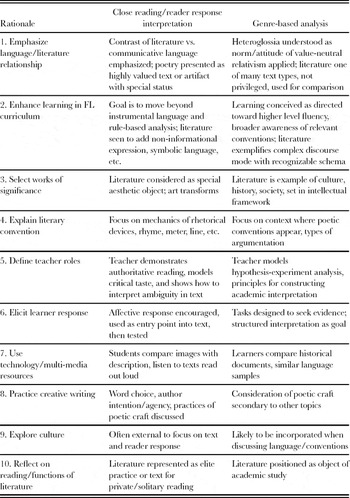
With these ten potential arguments concerning the teaching of literature (and in particular poetry) in mind, let us turn to my next question: To what extent do current pedagogical approaches advance or constrain the teaching of literature in the foreign language classroom? Clearly, different interpretive procedures will yield differing results, and for the sake of rethinking our teaching, I want to consider above all distinctions between the strongly aesthetic orientation of close reading and reader response interpretation and the arguably more pragmatic focus of genre-based analysis. In Table 1, I suggest that we think about the different procedures of these interpretations in terms of two modes of interpretation that value distinct outcomes and give different weight to the purposes of teaching we have discussed. In considering close reading and reader response interpretation together, I do not mean to suggest that these approaches are identical. Each has a rich critical history and highly developed set of practices. My interest in uniting them is to foreground their common ability to address questions pertaining to aesthetic appreciation. To be sure, there is no rigid division in classroom practice between close reading and reader response interpretation and genre-focused analysis, and I have formulated the descriptions of the two approaches in heightened terms for the sake of argument. My intention in doing so, however, is to direct our attention to areas of contrast and the potential limitations of these two ways of thinking about literature in FL instruction.
Arguments for teaching poetry and implications of interpretive focus.

Let's consider how these different approaches would tackle a poetic text in distinct ways. I will use the poem ‘Abendnachrichten’ (‘Evening News’) by Hans Magnus Enzensberger as an example and the audio clip version available at the poetry website http://www.lyrikline.org. It's a poem ten lines in length, written in uncomplicated language, that records the thoughts of a poet thinking about massacres reported on the evening news as he listens to rain tapping on the roof like dancing rice grains (Enzensberger Reference Enzensberger, Hamburger and Enzensberger1999: 67). The sound of the rain, which he compares to drumfire (Trommelfeuer) makes him aware that distant wars are eerily close in the modern world, so there is a subtle interplay of private and public persona that students readily notice when encountering the poem. Sadly, he muses, massacres occur over ‘a handful of rice’. In translation, the poem reads as follows:
3.1 Close reading and reader response
For the purpose of this discussion, I'm treating close reading and reader-response readings together as similar modes of interpretation and greatly simplifying how these approaches would work (for a discussion of the legacy of close reading, see Bredella & Delanoy (Reference Bredella and Delanoy1996: vii–xi); concerning reader-response, see Rosenblatt Reference Rosenblatt1978). To perform a close reading of this poem, the teacher might: a) present the text; b) gloss unfamiliar words, e.g., Trommelfeuer ‘drumfire’, Hütten ‘huts’, Ziegeln ‘tiles’; and c) elicit from the students a paraphrase of the text that elucidates the implied meanings, poetic imagery, and aesthetic unity of the text (see Altieri Reference Altieri2001; Dutta Reference Dutta2001). Alternately, one reader-response exercise, following Benton's (Reference Benton1995: 338) recommendations, might involve a) copying out the poem text, b) asking students to annotate it with responses and to map their readings and reading strategies, and then c) setting the task of writing a single-sentence comment before these responses are discussed by the class in pairs.
In the first case, classroom interactions would likely remain teacher-centered because students’ experience of the poem would consist of engaging with unfamiliar material that would be difficult to negotiate independently (vocabulary, syntax, aesthetic quality). A strict New Criticism interpretation would also not necessarily include the biographical information that Enzensberger was born in 1929, is a prolific author of poetry and essays, and shortly before1964 when this poem appeared in Blindenschrift, was intensively engaged in translating the work of William Carlos Williams, to whose work this poem is clearly indebted. Such background information, of course, would make American students more comfortable with the text because it would provide them with concrete reference points and would make the poem more accessible.
We could further enhance this discussion by providing a visual image and asking students to comment on both the picture and the poem, thus inviting personal responses. Discussion would be more student-centered, but the lesson structure might still provide few opportunities to introduce relevant historical and cultural background. So, the class might never learn, for example, about Enzensberger's deep concerns about the consciousness-shaping powers of the media or about attitudes in Germany concerning the Cold War political tensions that made distant conflicts like the Vietnam War a part of daily life.
3.2 Genre-based readings
A genre-based approach to study of this same poem would proceed quite differently (see Kern Reference Kern2000; Byrnes Reference Byrnes2007). Genre-based teaching is constructed, according to Maxim (Reference Maxim, Katz and Watzinger-Tharp2009: 177), ‘as a teaching–learning cycle that consists of three phrases: modeling, joint negotiation, and independent construction’. This paradigm was, of course, not specifically designed for discussing poetry, yet Maxim offers a constructive adaptation of its principles to the study of poems. Following the treatment he recommends, students could be asked to a) brainstorm associations for key words; b) complete cloze versions or partial texts of poems; c) study other examples of similar poetic types; d) learn about historic linguistic context (e.g., the significance of news reporting and propagandistic language in the German context); and, finally, e) write and present their own poems in class (2005).
An alternative path to genre-focused teaching is described by Swaffar & Arens (Reference Swaffar and Arens2005) in Remapping the foreign language curriculum. A major tool for the approach they describe is a structured worksheet, which they call a précis, a scaffolded exercise used for analysis. The worksheet consists of four parts: a) a framing statement for the interpretation of the text the students will perform, b) a working hypothesis for the argument to be made, c) a partially scripted table that students complete by citing examples from the text under analysis, and d) a prompt that asks them to write a concluding statement or brief interpretation. While the teacher generates the statement and hypothesis (parts a and b), and thus conceptually guides the results, students are responsible for producing the evidence and summary (c and d), using at-level linguistic skills. This type of hypothesis–experiment instruction lends itself well to classes in which students are expected to write academic papers about literature because the scaffolding provided helps clarify expectations about how texts should be analyzed and shows the type of evidence that needs to be presented to make interpretive assertions (see also Knapp Reference Knapp2002). However, unless the précis is carefully set up to help students identify the stylistic and aesthetic features of the text, it may not succeed in guiding them to treat the analyzed work as literature.
4. Embedding poetry: a holistic approach to teaching literature as performance
Though both of the approaches have merit, they pose potential constraints as well. Reader response and close reading analysis, as we have seen, may inadequately address issues of culture and history. The genre approach, by contrast, lends itself well to prose and journalistic writing, for it is designed in part to help students learn to imitate the style of works they are studying. Poetry, arguably, has less direct connection to linguistic tasks learners may want to perform if they are focused on the use of language for communicative purposes. In addition, without careful handling, the précis worksheet treatment could seem to suggest that literature is always amenable to hypothesis–experiment analysis, when what makes literary texts so rich is their intrinsic resistance to formulaic analysis. Finally, neither approach gives us satisfactory tools for treating literature as a ‘live’ text. The poem remains an ‘old medium’.
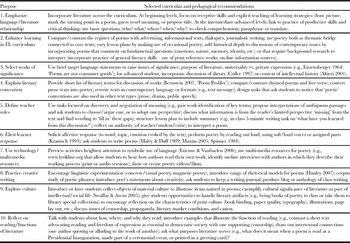
A more holistic approach to teaching poetry, I argue, must take into account writerly perspective, readership issues, and performative aspects. Given the profound decline in the numbers of individuals who read literature, which has been widely reported by the American press (see, for example, McLemee Reference McLemee2004), I believe that as teachers we need to seek out ways to meaningfully discuss the value and nature of literary culture with our students. In advocating what I have chosen to call a holistic approach, I hope to accomplish this conceptual realignment by incorporating into our classes urgent consideration of the broad questions of literary culture, such as why writers write, where we experience literature, and how market systems restrict or open our access to texts. To accomplish this shift, close reading and genre-based analysis treatments must be abundantly supplemented with materials and exercises that emphasize the broader functions of literature. Not only does poetry need to be brought into classes on a regular basis at all levels (which would allow it to become a vehicle for consistent reading practice), as teachers we need to rise to the challenge of analyzing the function of literature in the digital age by embracing the multi-media tools. As Table 2 suggests, the purposes commonly cited as reasons for teaching literature can be well aligned with the aspirations of this alternative approach, particularly at the early and middle stages of language learning, where literature tends to receive less emphasis in US classrooms.
Teaching poetry throughout the curriculum.

To illustrate how this approach can work, let me describe a third-year course that I recently taught. In ‘Introduction to Literature’ students who have completed a fifth-semester German conversation and composition course make the transition to a course in which they study literary texts as primary materials. It's a challenging class and for this particular run of the course, we read drama and prose fiction by Brecht, Schiller, Grass, Lessing, and Mann, all demanding works for even native speakers of German. Jonathan Culler's useful handbook for students, Literary theory: A very short introduction (Culler Reference Culler1997), was assigned as a required text. Throughout the semester, poems were read in class (where they were presented using a wide variety of treatments) and assigned as homework readings (including on a daily basis in April, the official ‘poetry month’ in the USA).
Briefly, the contributions of the writer, readers, and performance to our literary experience were systematically foregrounded through the selection of materials and task design. From the outset in this poetry-infused curriculum, the perspective of writers was consistently emphasized and the culture of reading made an explicit topic of discussion. On the first day of class, students read a short excerpt from a handbook for writers by poet Ursula Krechel in which she provocatively reflects on how an opening sentence sets the tone for a text (Krechel Reference Krechel2003). Subsequent discussion of Brecht's Good person of Szechwan was spread over three weeks and was interspersed with mini-lectures on the author's biography and selected reading of background and secondary literature. The perspective of writers was regularly introduced and debated (e.g., Brecht's epic theater, Enzensberger's view that poems should be a ‘means of production,’ Grass's commentaries on his working process). Resonant phrases, key questions of interpretation, and literary affinities motivated the choice of poems we read. Thus, the class was introduced to Enzensberger's ‘Evening News,’ seminal poems by Brecht, excerpts from Goethe's Faust, and asked to notice how certain phrases (like ‘good person’) intriguingly recurred across works by different authors. To raise awareness of the role of reader and performance modes, students were asked to consider who the intended audience might be when writers’ theories about the purpose of writing were discussed. They were also presented with examples that show the broad reach and quasi-ethical function of literature in society and asked to think about the meaning of performing a poem in different contexts (for example, when a poem by Brecht is quoted in the film The lives of others, from which the class viewed an excerpt). A creative writing assignment was also built into the course as the second paper that tasked students with writing a fictional interview with an author that incorporated a series of quotations from primary and secondary readings.
Work with individual poems consistently included: a) preview activities that drew in part on task designs recommended by close-reading and genre-based approaches; b) audio clip or out-loud reading exercise; c) a question-and-answer segment to elucidate unfamiliar terms/phrases, using peer-feedback whenever possible; d) teacher-led discussion of key aspects of the poem (e.g., register, implied meanings, symbolism, construction of turning points) and issues of readership; and e) a short writing task designed to help students sum up and consolidate what they had learned, in part by asking them to reflect on the interpretive strategies they had applied. The focus of this cycle of tasks was consistently the dynamic, heuristic quality of reading and writing. While the goal of exercises designed to support close-reading or genre-based analyses is the mastery of material (usually shown by evidence of linguistic comprehension or the production of a ‘correct’ interpretation), the objective of this holistic approach is the experience of reading as a process. This procedure also strives to go beyond reader approaches that end with students’ first reactions to texts by explicitly raising awareness that interaction with a literary work is not a discrete operation. From being attentive to the diverse strategies applied to interpreting literary works, students gain appreciation of the multi-dimensional functions of poetry.
5. Implications
The holistic approach I have suggested shares interpretive techniques associated with close reading and genre-based tasks, yet it treats literature very differently. Emphasizing that literature is part of, not separate, from other domains of culture, and by incorporating it into language learning from the outset, it helps us give literature a larger and more robust role in our curriculum. By treating literature as performance rather than dusty artifact, we can legitimately raise questions about context, readership, and the uses of literature. Drawing on multi-media realizations of poetry, for example, the teacher can foreground its cultural and social importance and stimulate broader classroom discussion about the relevance of literature. We understand better that poetry is paradoxically both ‘occasional poetry’ and texts of profound meaning. Students realize that writers conceive of the world in words and actively converse with texts other than their own. As we move in the direction of talking about literature as a living text, our relationship to these materials is utterly changed as well. Today, literature that is alive exists in vital relationship to readers – in the popularity of book clubs, in poetry slams before live audiences, in bookstores with coffee shops, in Harry Potter, the novel that every one of our students has read. You Tube and multi-media poems bring home the reality that literature – indeed, even poetry – has always been, finally, about creating a literate community.
Charlotte Melin is an Associate Professor of German studies and former Director of Language Instruction in the Department of German, Scandinavian and Dutch, University of Minnesota. Her publications are on issues in language teaching, post-secondary language program design, and post-war German poetry. In addition to her scholarly book Poetic maneuvers: Hans Magnus Enzensberger and the lyric genre (North Western University Press, 2003), she is one of the co-authors (with Cecile Zorach and Elizabeth A. Kautz) of English grammar for students of German (Olivia and Hill Press, 2009).