

Partycentric and candidatecentric inclinations by voters reflect two conflicting yet important normative principles that are foundational to democratic rule. The first understands democratic governance and policy implementation as a team effort, in which free riding should be prevented in order to achieve collective goals (Aldrich Reference Aldrich1995; Cox Reference Cox1997; Downs Reference Downs1957). The second expects public office to be led by principled politicians who are willing to challenge the party line if it endangers the public interest, or at least the interests of those in a position to elect them (Frohlich and Oppenheimer Reference Frohlich and Oppenheimer2015; Aldrich and Rohde Reference Aldrich, Rohde, Bond and Fleisher2000; Weber Reference Weber, Lassman and Speirs1994).
These competing principles actively inform citizens’ votes (Rogowski and Tucker Reference Rogowski and Tucker2014). Yet the decision to trust presidential candidates or their parties is not always easy (Wattenberg 1991).Footnote 1 Candidates who defy their partes create policy uncertainty among voters (Bartels Reference Bartels1986), and voters are often unable to anticipate who is more likely to fail them and who is more likely to defend their interests (Stokes Reference Stokes, Przeworski and Stokes1999; Wattenberg 1991).
Voters may reasonably expect presidential contenders to challenge the party line when necessary, but they may also expect party elites to rein in unruly candidates (Aldrich Reference Aldrich1995). Examples of this normative conflict have proliferated in recent years. From Donald Trump in the United States to Hugo Chávez and Keiko Fujimori in Venezuela and Peru, respectively, a long list of presidential candidates have increased their popular appeal by challenging their parties or running without them altogether (Katz Reference Katz2001). Popular enthusiasm that comes with the rise of a populist candidate, however, is often met with suspicion by those who see untethered candidates as an unacceptable risk or even a threat to democratic governance (Mudde and Kaltwasser Reference Mudde and Kaltwasser2012). Yet little experimental research has analyzed the extent to which voters hold partycentric or candidatecentric inclinations, or the extent to which they can be primed to favor candidates who work with party elites or who are willing to challenge them (Ditto and Mastronarde Reference Ditto and Mastronarde2009).
The present study addresses this gap. It examines the extent to which priming on the trustworthiness of candidates or their parties elicits candidatecentric or partycentric attitudes among voters. It then tests the extent to which priming candidate- or partycentric attitudes alters respondents’ votes.
We understand candidatecentric attitudes as citizens’ inclination to weigh more heavily the quality of candidates when deciding their vote (Aragones and Palfrey Reference Aragones, Palfrey, Austen-Smith and Duggan2005; Carson et al. Reference Carson, Engstrom and Roberts2007). By comparison, partycentric attitudes are based on voters’ belief in the party’s capacity to advance collective goals effectively. We argue that priming on the trustworthiness of the candidate’s judgments or on the party leaders’ capacity to rein in rogue candidates is an important determinant of presidential voting.
To test this argument, we implemented a large survey experiment during the 2015 national election in Argentina, a country that has a long lineage of leaders who have created their own parties or who have been willing to challenge their parties’ elites (Levitsky Reference Levitsky2003; Levitsky and Murillo Reference Levitsky and Murillo2005; Lupu Reference Lupu2016). In the 2015 presidential election, the contrast between party insider and maverick was central to the leading campaigns of Daniel Scioli (Frente para la Victoria, FPV), Mauricio Macri (Cambiemos), Margarita Stolbizer (Generación para un Encuentro Nacional, GEN), and Sergio Massa (Unidos por una Nueva Argentina, UNA). While the opposition portrayed Scioli as the ultimate party insider with puppetlike loyalty to the Peronists, the government described Macri, Stolbizer, and Massa as risky candidates running personalist parties.
The results of our survey experiment show that priming voters on the risks of unchecked candidates elicits partycentric responses, while priming them on the value of independence increases candidatecentric responses. These effects are stronger among low-income voters, who reveal deeper candidatecentric attitudes.Footnote 2 We then estimate the effect of party- and candidatecentric frames on party vote, showing that partycentric frames increased the vote for Peronist Daniel Scioli, who ran under the established FPV, while candidatecentric frames increased support for Margarita Stolbizer and Sergio Massa, who both created new parties for the 2015 presidential election.
Playing Along or Playing Alone? Insiders Versus Mavericks
Let us begin with a restrictive definition of an insider candidate and a maverick candidate. We define an insider candidate as one whose nomination is agreed on by, and whose stated preferences align with, the stakeholders of an existing party during the campaign. Maverick candidates, on the other hand, make their own party or upend party structures to become the presidential candidate. Consequently, the insider candidate is expected to play along with the party’s elite, while the maverick candidate is willing to play alone if and when the need arises.
Mauricio Macri, Sergio Massa, and Margarita Stolbizer created the parties they ran with in 2015; in two of those cases, they did so by breaking up with their previous parties. Daniel Scioli, by contrast, had been a Peronist member of Congress closely aligned with President Menem, vice president for Néstor Kirchner, and a Peronist governor under Cristina Fernández de Kirchner, as well as the consensus candidate and president of the Justicialista Party during the 2015 election campaign. Since we are interested in the voters’ perception at the time of the election, our definition of insider or maverick candidate is independent from any policy decision that may reshape their party once they are elected.Footnote 3
The horse race between unpredictable charismatic leaders and established party bureaucrats goes all the way back to Max Weber and is a recurrent normative challenge in democratic politics. Weber wrote at length about the perils of a rising charismatic leader, but was also equally adamant that the bureaucratization of institutions was an “iron cage” that ensured a predictable and stable political environment at the cost of political creativity and freedom. In his seminal essay “Politics as Vocation,” political compromise—what Weber describes as realpolitik—cannot be reached by politicians who are unfettered from institutions and solely motivated by principles. The tension between these two motivations—what Weber called the ethics of responsibility, when the politician is willing to compromise, and the ethics of ultimate ends, when the politician is guided solely by principle—is critical to the author’s understanding of politics and policymaking (Weber Reference Weber, Lassman and Speirs1994, 368).
Breaking with the party line, however, is not without costs. In Why Parties? (1995), John H. Aldrich states that political parties emerge in democratic regimes in order to secure the access of their membership to collective benefits. Political parties are “collections of individuals, so that everything they do involves collective action, and they provide public goods for their members, since much of what they do affects many, if not all, partisans” (Aldrich Reference Aldrich1995, 31). Indeed, party defection can lead to lower legislative success, greater office turnover, and long-term coordination failures (Nokken Reference Nokken2000; Tavits Reference Tavits2009). Rifts between candidates and their parties thus reduce the supply of collective goods, which, in turn, negatively affects both party elites and constituents.
The literature also reveals that maverick candidates and party insiders differ in how they signal their policy intentions to voters (Tomz and Van Houweling Reference Tomz and Van Houweling2009; Rogowski and Tucker Reference Rogowski and Tucker2014; Somer-Topcu Reference Somer-Topcu2015). Rogowski and Tucker (Reference Rogowski and Tucker2014), for example, note that party insiders are able to communicate clear policy signals to voters, while maverick candidates are unable to do so. Initially, the outsider politician may be successful in tailoring different messages to distinct constituencies, they argue, but over time she or he will be less reliableWe understand candidatecentric(Rogowski and Tucker Reference Rogowski and Tucker2014)). Similarly, Somer-Topcu shows how parties, rather than candidates, are able to make broad appeals to different groups of voters (Somer-Topcu Reference Somer-Topcu2015).
The question remains whether voters are aware of the trade-offs between restraint and independence. Do voters understand that parties are necessary to advance collective political goals that require compromises among elites? That is, are voters aware of the need for a predictable supply of collective goods, which is the basis of the responsible party model? Or, alternatively, are voters driven by the desire to elect maverick candidates who perform “housecleaning,” shaking up the political inertia that they feel has a negative effect on their lives?
This trade-off was unequivocal in the 2016 U.S. presidential election. Conservative voters, disenchanted with the Republican Party’s political establishment, selected Donald J. Trump as their presidential nominee. With his unorthodox, brash approach to politics, this never-elected real estate businessman and reality television star promised to shake up the political system. At the same time, as reported in focus groups carried out by the Wall Street Journal with likely voters, “Trump’s ‘loudmouth’ style had alienated voters” who saw him as “a ‘bully,’ ‘racist,’ ‘arrogant,’ ‘hateful,’ and ‘inappropriate’” (Hart and Hunt Reference Hart and Hunt2015)).
Why Argentina? Party Insiders vs. Mavericks in the 2015 Presidential Election
Both political mavericks and loyal party insiders have been salient actors in Argentina’s presidential elections for close to a century (Conniff Reference Conniff2012). The rise of mass political parties in Argentina—such as the Radical Civic Union (UCR) in the first half of the twentieth century and the Justicialist Party (PJ) in the second half— originated in the leadership of charismatic figures such as Hipólito Yrigoyen and Juan Domingo Perón, who openly challenged the existing political elite and their parties. Perceptions of policy competence were transferred from these maverick candidates to their parties once they were elected, rather than the other way around.
Yet despite the country’s (and region’s) tradition of electing charismatic leaders, and a common perception of mavericks’ dominating politics, the Argentine presidents of the democratic era were well-established party leaders before becoming their parties’ nominees (Calvo Reference Calvo2013).Footnote 4 Raúl R. Alfonsín was the leader of the 90-year-old UCR when he defeated Peronist candidate and fellow party leader Italo Luder in 1983. Peronist governor Carlos Menem reached the presidency in 1989 by first beating the reformist faction of his own Justicialist Party and then defeating UCR governor Eduardo Angeloz.
In 2003, Néstor Kirchner (another governor) defeated two fellow Justicialist members, former president Menem and Adolfo Rodríguez Saá, former governor of San Luis Province, to become president. Cristina Fernández de Kirchner, a former representative and senator, won the presidency twice, in 2007 and 2011. At the end of her second term, she endorsed the ultimate party insider, Scioli, to be her successor. Scioli lost the 2015 presidential election to Macri.
Argentina, therefore, is a country dominated by political insiders whom voters often perceive as mavericks willing to challenge their parties. At the same time, voters are sensitized to the possible risks of electing candidates who lose their parties’ favor and subsequently are unable to govern. Twice since the 1983 democratization of the country, citizens have seen major economic crises lead to the resignation of two sitting presidents (Alfonsín in 1989 and Fernando de la Rúa in 2001), who lost the backing of their own party as well as the support of the rest of the political system (Calvo and Murillo Reference Calvo and Murillo2012). Less dramatically, President Menem became a party switcher when he abandoned the PJ’s traditional statist platform and adopted radical market reforms, which, in turn, hurt the party’s core constituency.
Voters in the 2015 presidential election were reminded of the risks both of electing a president without strong party backing and of choosing the consummate party loyalist. Macri, the ultimate winner, was a candidate from a small, center-right party (PRO), who formed the Cambiemos (Let’s Change) coalition for the presidential election. His main rival, the Peronist Scioli, was, as noted, the loyalist. Both campaigns played up the risks associated with the opponent. Macri, lacking a party with national presence, was compared to disgraced former president De la Rúa, who was unable to maintain party support and resigned in the midst of a major economic crisis. Scioli, on the other hand, was portrayed by the opposition as a rigid and unimaginative politician who would continue to follow orders (presumably from outgoing president Cristina Kirchner) even if elected (Freytes and Niedzwiecki Reference Freytes and Niedzwiecki2016).Footnote 5
Thus, at the time our survey experiment was conducted in Argentina, between October and September of 2015, conflicting narratives of Mauricio Macri—as a candidate who could shake up “politics as usual” or as an electoral risk with limited party support—were firmly in place. Daniel Scioli, on the other hand, was portrayed as a candidate who would ensure the Kirchner legacy and guarantee continuity of popular social plans or as a virtual “Manchurian candidate” of Kirchnerismo. We sought to prime on those narratives to assess their effect on Argentine voters.
Instruments and Data
To test voters’ sensitivity to mavericks and party insiders, we embedded a framing experiment in the 2015 Argentine National Election Survey (in Spanish, ENPEA).Footnote 6 The ENPEA is a large telephone (landline and mobile) annual survey; the 2015 wave included 3,212 respondents who were 16 (the voting age in Argentina) and older. Our survey was conducted between September 14 and October 25 of 2015, immediately before the first round of the presidential election.Footnote 7
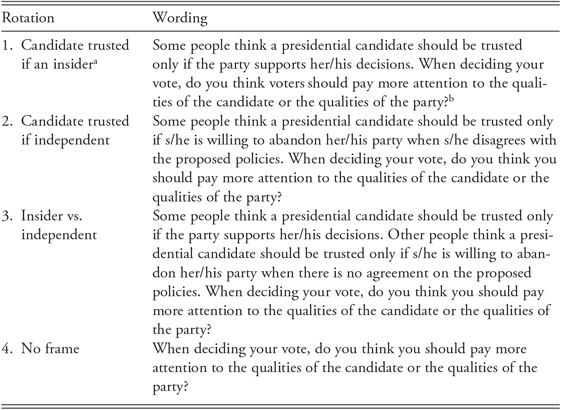
The dependent variable of the experiment is the survey item that asks respondents to indicate whether the qualities of the candidate or the qualities of the political party are more important when deciding their vote for a presidential candidate: “When deciding your vote, do you think you should pay more attention to the qualities of the candidate or the qualities of the party?” (see table 1).
The Four Rotations of Party- and Candidatecentric Frames

a Two anonymous reviewers correctly noted that this first vignette is ambiguous. While respondents are primed to see the candidate and the party working as a team, this could result from politicians’ realigning the party to their preferences or their willingness to submit to the party. As a result, while the second vignette primes respondents to the value of a candidate who is willing to “abandon the party” if needed, the first vignette fails to distinguish between a party insider and a leader who steers the party. This means that respondents could value the unity of party and candidate (as an outcome) or a candidate’s decision to accommodate the party’s preferences (as a behavior). We understand that this is a design flaw and that a different interpretation of our frames could be that the partycentric attitude we observe is the result of trusting a party that is willing to work with the candidate.
b We direct readers’ attention to a problem in the wording of the instrument. The question starts in the second person: “When deciding your vote” [Al decidir su voto], but then uses the third person, “should people pay more attention” [la gente tiene que prestarle más atención]. As noted by one of the anonymous readers, the wording introduces desirability concerns into the response. There is little that we can do to correct this oversight beyond adding this footnote so that readers can properly assess our results.
The response ranged from more attention to the candidate (−1) to the same attention (0) to more attention to the party (1), with positive values in the model indicating more partycentric inclinations. Four different frames were randomly administered to respondents, with each rotation including approximately eight hundred cases. The four different rotations primed voters on party oversight (1), candidate independence (2), competing oversight and independence (3), and the baseline (4).
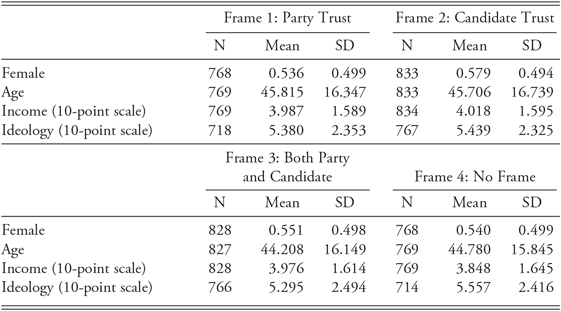
The survey included a slightly higher proportion of women and older respondents than the prevalence rate in the overall population (four points higher), but similar in gender and age to the voting population. Random rotations of the frames ensured a well-balanced sample for all independent variables, as shown in table 2. Balance was excellent on all key sociodemographic and attitudinal indicators and, consequently, no further corrections or adjustments were made.
Sample Balance Across Rotations

Note: Summary information for the independent variables across the four rotations.
Results
Considering all respondents, summary results show that 57 percent of voters (1,794 out of 3,212) placed the quality of the candidate above that of the party in making vote decisions. Meanwhile, 23 percent of voters (735) placed the quality of the party above that of the candidate, and 20 percent (628) considered both the party and the candidate equally important. The mean for all respondents on a scale from candidatecentric (−1) to partycentric (1) was −0.33, indicating that most voters placed a higher premium on the quality of the presidential candidate.
Priming on Party Trustworthiness vs. Candidate Trustworthiness

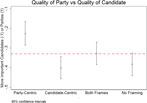
Results for the four rotations are shown in figure 1, with the mean survey response (−0.33) described by the dotted horizontal line. The first cue, that presidential candidates can be trusted only if they are supported by their party, reduces the number of respondents deciding their vote on the qualities of the candidate from 56 percent to 49 percent. In contrast, the second cue, presidential candidates should be independent and willing to give up on their party in the face of disagreement, increases candidatecentric voting choices to 62 percent. It is worth noting that priming on the trustworthiness of the candidate is indistinguishable from the no-frame rotation.
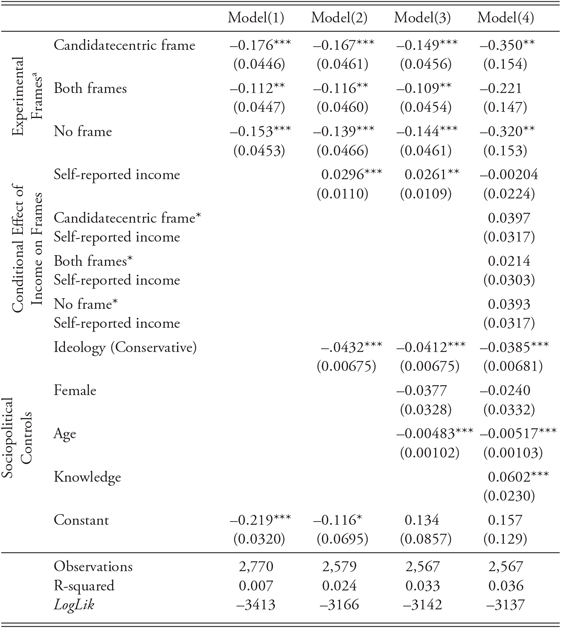
Table 3 presents four different models that test for the effect of ideology (ten-point scale), self-placed subjective income (ten-point scale), education (seven categories), gender, and political knowledge. Given that the samples are balanced, as shown in table 2, findings remain substantively similar and statistically significant when we include all covariates. However, the new models allow us to test for the conditional effect of income, education, and ideology.
Priming on Party Quality vs. Candidate Quality

a Experiment baseline is the “partycentric” frame.
***p < 0.01, **p < 0.05, *p < 0.1
Standard errors in parentheses.
Note: Dependent variable: “When deciding your vote, do you think you should pay more attention to the qualities of the candidate or the qualities of the party?” Candidate = −1, both = 0, party = 1.
The results of the full models show that more conservative and older voters display stronger candidatecentric attitudes. In contrast, as income goes up, so does the negative effect of unrestrained candidates, resulting in increased partycentric attitudes. This finding aligns well with Wattenberg’s classic study on candidatecentered politics, which shows stronger antiparty sentiments and more support for candidate-centered politics among conservative U.S. voters (Wattenberg 1991).
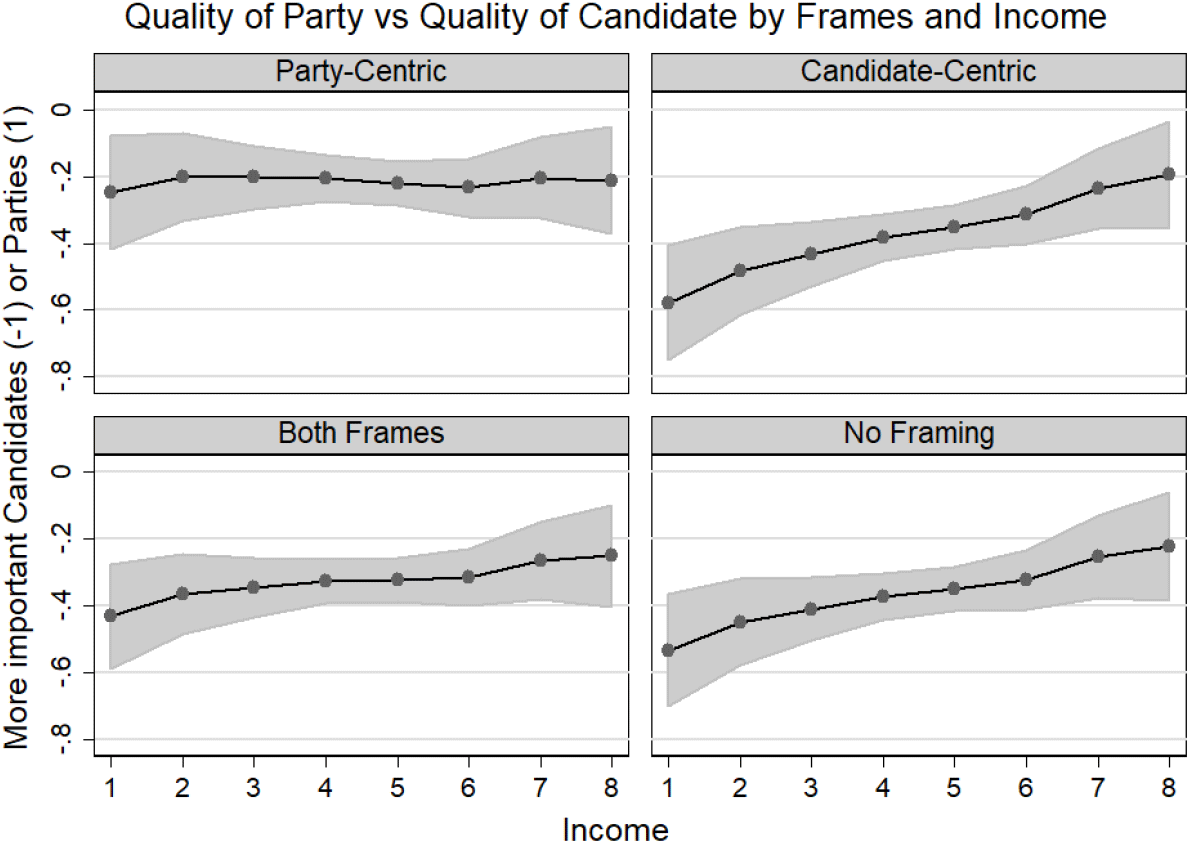
Figure 2 presents the full conditional relationship between income and party-centric attitudes for each of the four different frames. As it shows, high-income respondents (located at 7–8 in each plot of figure 2) are unaffected by the different frames, with a mean value of approximately −0.2 in all four plots. Low-income respondents (located at 1–2) are considerably more likely to espouse candidatecentric views (−0.6), but they moderate those inclinations when primed about the importance of a party that keeps presidential candidates in check (−0.2). In all, results show that low-income respondents espouse more candidatecentric attitudes and are more sensitive to priming effects. Higher-income voters are less candidate-centric and their attitudes are unaffected by priming.
Priming on Party Quality vs. Candidate Quality by Self-Reported Income Status

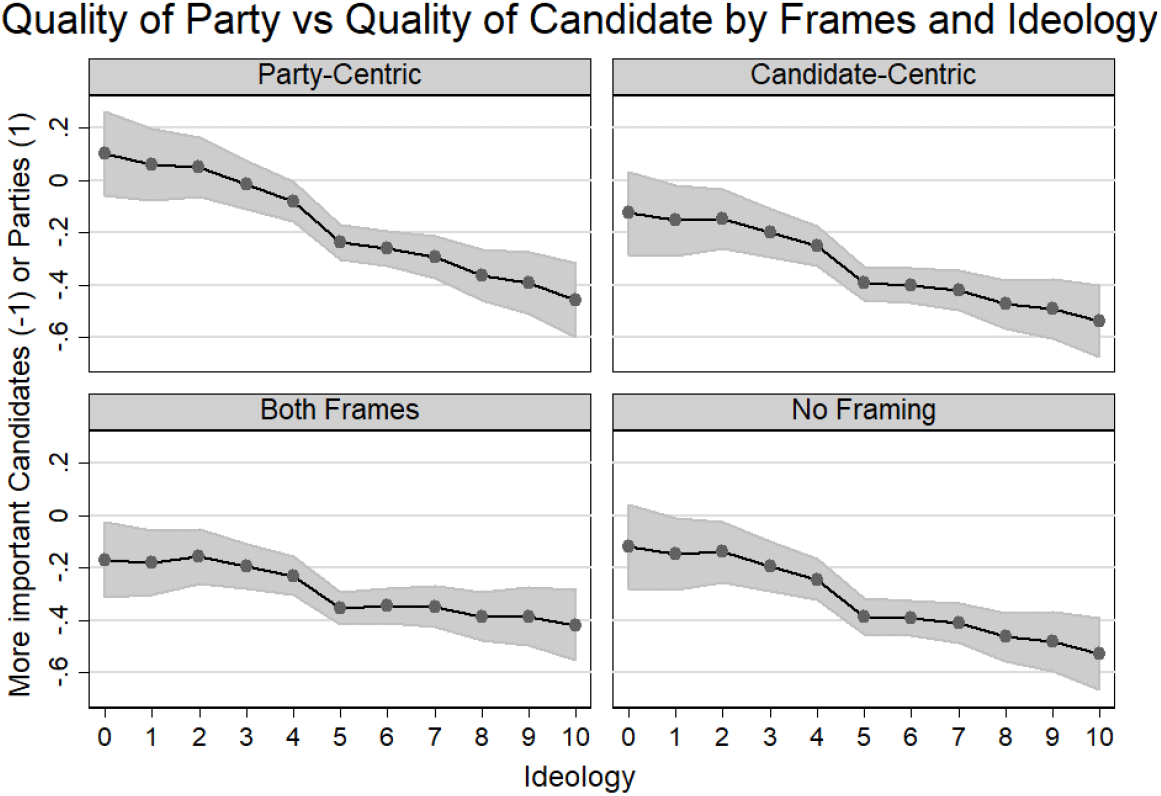
The online appendix provides a saturated model, interacting the four frames with the other covariates. This model provides further insight into the determinants of party- and candidatecentric attitudes, including the full set of estimates. More conservative and older voters display more candidatecentric attitudes: every unit of increase in conservatism leads to a decline of −0.0416, and every unit of increase in age leads to a decline of −0.00434. More interesting, figure 3 also shows that candidates on the left are more sensitive to the partycentric framing.
Priming on Party Quality vs. Candidate Quality by Self-Reported Ideology

As we can see, the framing effect is statistically significant for respondents on the left, displaying a change from .13 to −.11 when moving from a partycentric to a candidatecentric frame. By contrast, the candidatecentric inclinations of conservative voters remain unchanged for all four frames. Results also show that more knowledgeable respondents have more partycentric attitudes.
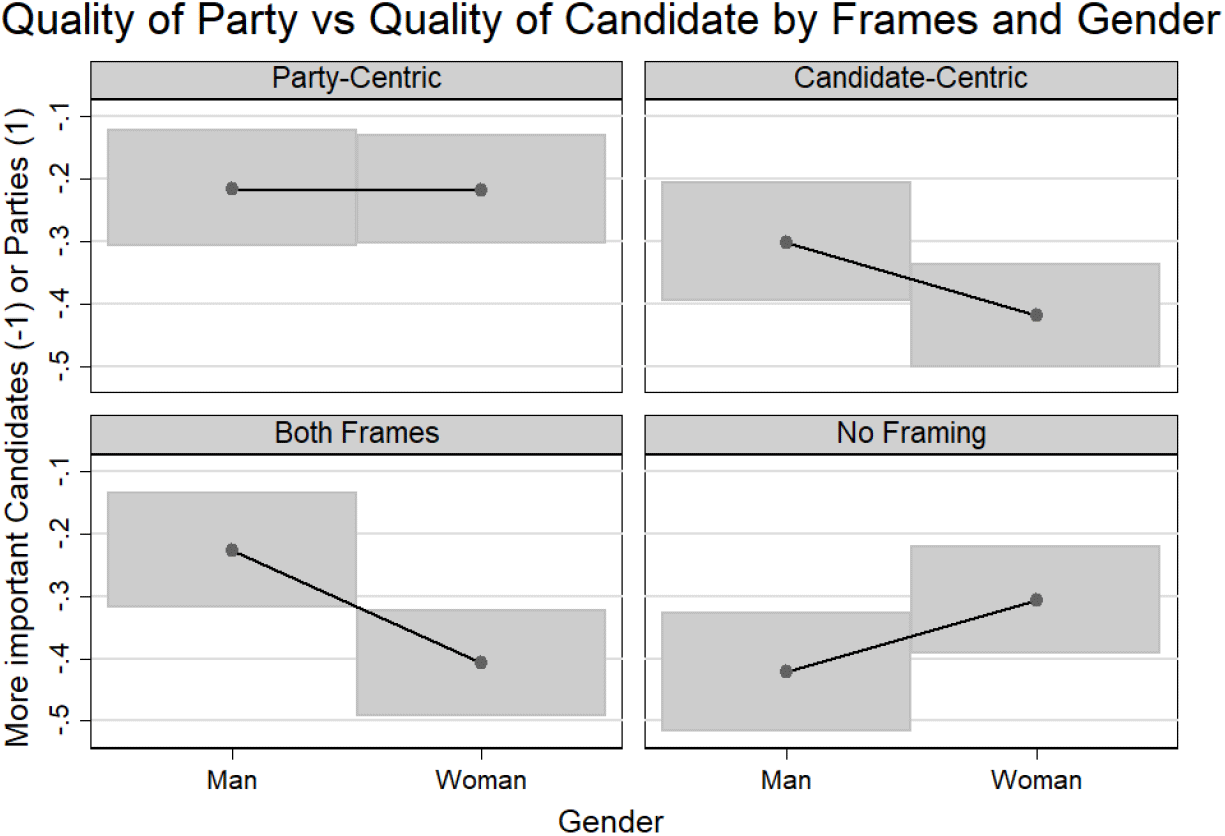
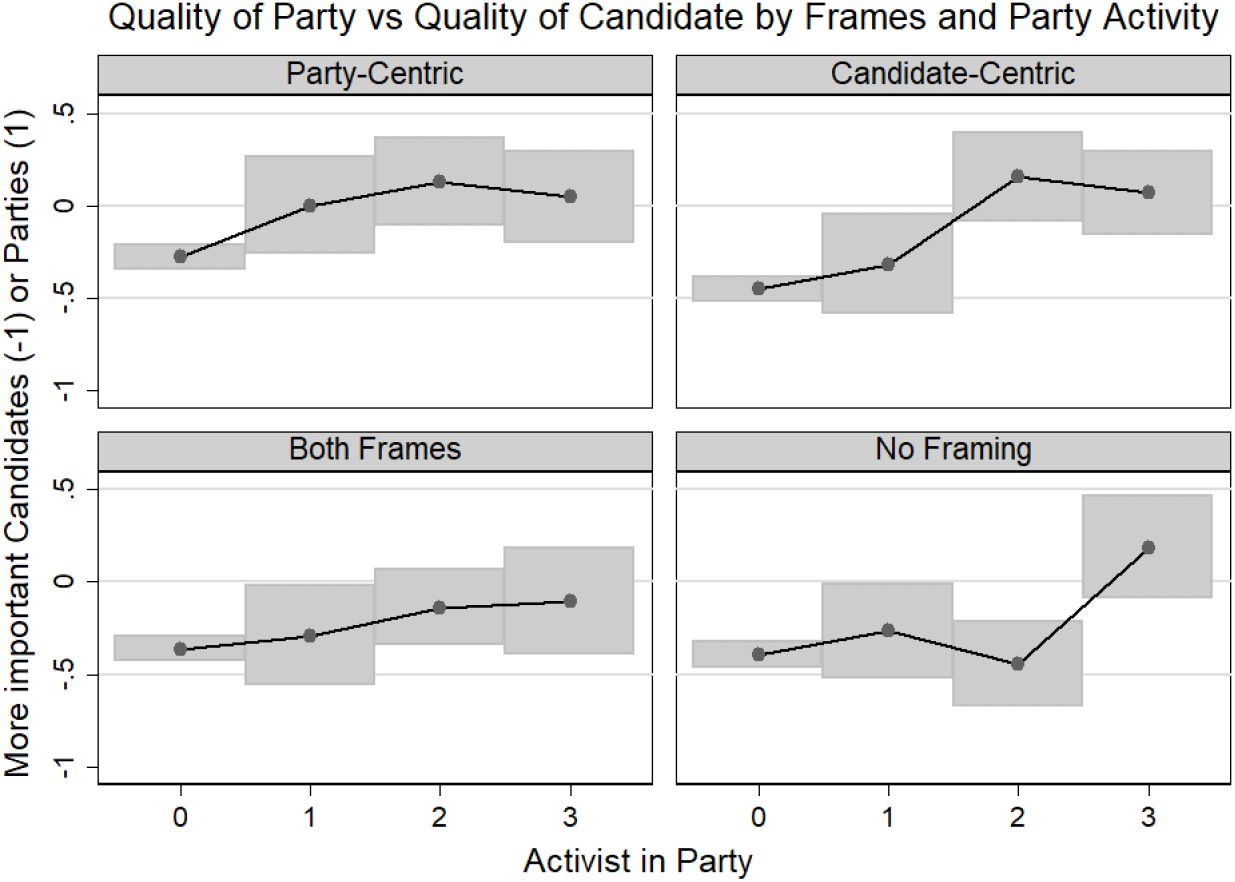
Results also provide evidence of higher sensitivity to the candidatecentric frames among women (figure 4) and among respondents who do not frequently participate in party activities (figure 5). Not surprisingly, political activists who commit time and resources to their party have the lowest candidatecentric inclinations and are not persuaded by any of the treatments in the survey experiment.
Priming on Party Quality vs. Candidate Quality by Gender

Priming on Party Quality vs. Candidate Quality by Party Activist

The Effect of the Party- and Candidatecentric Frames on Party Vote
In the previous section, we showed that partycentric and candidatecentric frames have a statistically significant effect on respondents’ attitudes, increasing the weight they give to the perceived quality of the party or the candidates when making vote decisions. In this section, we take a step further and measure whether these frames yield a measurable response on party vote.
Three questions after the framing experiment, the ENPEA survey introduced a vote choice question that asked respondents whom they would vote for “if the election were to take place tomorrow.” Respondents were given the choice set available in the general election: Daniel Scioli (FPV), Mauricio Macri (Cambiemos), Sergio Massa (UNA), Margarita Stolbizer (GEN), Nicolás del Caño (Frente de Izquierda), and Adolfo Rodríguez Saá (Compromiso Federal). Using vote choice as the dependent variable, we estimated two specifications: a restricted model that included the frames described in the previous section and an unrestricted model with the covariates of the previous section. Figure 6 reports the results, with all estimates available in the online appendix.
Figure 6 presents the predicted probabilities of voting for each party, with marginal effects reported in table SIF1 of the appendix. Results show the statistically significant effect of partycentric frames on the vote for Scioli of 7.5 points (p < .001) when compared to the candidatecentric frame. By contrast, the candidatecentric frames increase the support for Sergio Massa by 4.4 points (p < 0.05) and for Margarita Stolbizer by 2.2 points (p < .01). Both candidates benefited directly from the declining support for Daniel Scioli when the frame emphasized the quality of the candidate over that of the party.
Effect of Partycentric and Candidatecentric Priming on Vote

While results show that Daniel Scioli received significant electoral benefits when respondents were primed with partycentric frames, we find no equivalent benefits for Mauricio Macri when respondents were primed with candidatecentric frames. Indeed, all gains went to candidates who abandoned their previous parties and ran campaigns centered on their images (Margarita Stolbizer and Sergio Massa).
Concluding Remarks
The emergence of maverick candidates in the United States, Europe, and Latin America makes it crucial to understand candidatecentric and partycentric voter attitudes. The question of whether voters should trust candidates who lack the support of their parties or stand by candidates who are unwilling to challenge the party line has become a practical one with important political implications.
This article has argued that partycentric and candidatecentric inclinations reflect conflicting yet important principles that are foundational to democratic rule: one, that politics is a team effort; and two, that public office should be led by principled politicians who are willing to challenge the party line. This study has provided evidence that voters understand these different viewpoints. Voters are sensitive to alternative candidatecentric and partycentric frames and are willing to alter their evaluation of candidates when presented with frames that highlight the risks or benefits of candidate independence or party oversight.
A different interpretation of the results shows that elites who are willing to emphasize these alternative frames can manipulate voters. Elite discourses that emphasize the benefits of decisive leaders or the risks of unaccountable ones should yield measurable effects on voters’ opinions. Further extensions of this research should measure the resilience of these frames over time, as well as the political environments in which the different frames are more or less effective.
Some interesting results address this last question. Students of populist leaders, whether in Latin America, Europe, or the United States, have noted the link between the rise of populism and lower wages (Inglehart and Norris Reference Inglehart and Norris2016). This study, however, questions this finding. While low-income respondents display stronger candidatecentric inclinations, the results provide evidence that they are also more sensitive to the alternative candidate- and partycentric frames. That is, they are more likely to change their positions, while the opposite is true for high-income voters. The difference in the sensitivity to these competing frames may explain why low-income voters may be more likely to support charismatic leaders in some political contexts but may also develop strong partycentric inclinations in others. After all, the linkage between low-income voters and populism, this research suggests, may be a spurious one.