1. Introduction
For over 30 years there has been a project in the scientific realism debate to ‘confront’ the scientific realist position(s) with ‘evidence’ from the history of science. Assuming (pace Schickore Reference Schickore2011) that such a confrontation model is viable, how should the debate develop? One should take the best contemporary realist positions and test them as thoroughly as possible against relevant episodes in the history of science. In the 1970s and ’80s Larry Laudan—the arch confrontationist of that era—got things off to a superb start, in particular with his “Confutation of Convergent Realism” (Laudan Reference Laudan1981). Therein he presented a list of 12 examples from the history of science that challenged the simple realist view of the day that successful scientific theories must be at least approximately true. The realist was indeed moved to clarify and revise her position. Instead of mere ‘success’, the emphasis has turned to novel predictive success as providing the warrant for realist commitment. Then in addition, instead of realist commitment extending to the ‘whole theory’ in question, the realist has sought to ‘divide up’ the theory into certain parts that do deserve realist commitment and other parts that do not: this is the basic ‘divide et impera’ strategy.
With the emphasis now on novel predictions, most of Laudan’s 12 examples are no longer relevant: the realist dismisses them immediately on the grounds that certain types of scientific ‘success’ should not persuade us to make a realist commitment. This given, the next step in the debate is clear: the new realist position needs to be thoroughly tested against relevant episodes from the history of science. This means presenting cases from the history of science in which novel predictive success was achieved by a scientific theory later rejected as (very) false and then asking whether one or another variation on the divide et impera strategy succeeds for such cases. Although the emphasis on novel predictive success was already fully established at the time of Psillos (Reference Psillos1999), and goes back much further (even to Duhem; see Psillos Reference Psillos1999, 32–33), since Laudan (Reference Laudan1981) very few new, relevant cases from the history of science have been properly debated in the relevant literature.
This should not give anybody the impression that there are not many important new cases that merit serious, sustained discussion. There are in fact many examples of novel predictive success issuing from rejected hypotheses and theories in the history of science. In the next section I present 20 pertinent examples from the history of science. I then consider in more detail the modern scientific realist position to try to get a handle on the significance of these 20 examples for the debate. In sections 3–5 I look at three of the historical cases in more detail in order to clarify three different ways in which the modern realist can respond to examples of novel predictive success issuing from (significantly) false hypotheses and theories. In the process I indicate ways in which the divide et impera position needs significant refinement, especially concerning the crucial concepts scientific success and responsible for on which so much weight is placed. In section 6 I draw on the lessons learned to consider the prospects for the elusive ‘holy grail’ of divide et impera realism: the prospective identification of (at least some of) the working posits of contemporary science. Section 7 is the conclusion.
2. Confronting the Contemporary Realist
It is widely acknowledged that not all of the cases on Laudan’s original list are irrelevant to the modern realist position. Indeed, the examples of phlogiston, caloric, and the optical ether (including Fresnel’s theory of light) are still being debated in the literature.Footnote 1 Other relevant cases are not so easy to come by since the history of science is not indexed in the way required. Timothy Lyons stands out as a philosopher who has made a serious effort to uncover new, relevant cases that the post-Psillos (Reference Psillos1999) realist ought to consider. In a paper that deserves more attention (Lyons Reference Lyons, Clarke and Lyons2002), he identifies a number of potentially important cases that I include in the list below. In addition, there are a handful of other cases available in the recent literature. Finally, I identify some pertinent cases completely new to the literature. All of these cases are collected together here for the first time.
1. Caloric. It is sometimes said that the caloric theory of heat enjoyed only explanatory successes. But in fact it enjoyed various successes that are reasonably described as ‘novel predictions’. The speed of sound in air is perhaps the most well known, but Lyons (Reference Lyons, Clarke and Lyons2002, 70) identifies various others. And given how central the concept of caloric was to the theory, it is usually said that caloric theory is definitely not approximately true (or words to that effect).
2. Phlogiston. As with caloric, some have doubted that phlogiston theory enjoyed novel predictive successes, but Lyons (Reference Lyons, Clarke and Lyons2002) and Ladyman (Reference Ladyman2011) give various examples of such successes. Most notably, perhaps, Priestley predicted and confirmed that heating a calx with ‘inflammable air’ (hydrogen) would turn it into a metal.
3. Fresnel’s theory of light and the luminiferous ether. The obvious example here is the prediction of the Poisson white spot, confirmed by Arago. But Lyons (Reference Lyons, Clarke and Lyons2002) identifies some other predictive successes. Various realists have tackled this case, but there is little consensus. Antirealists still cite it as a serious problem for the realist.
4. Rankine’s vortex theory of thermodynamics. This case was introduced to the realism debate by Hutchison (Reference Hutchison, Clarke and Lyons2002). Lyons (Reference Lyons, Clarke and Lyons2002, 81) is especially explicit here, writing, “This theory appears to provide exceptional counterevidence to the realist’s suggestion that the false parts of theories were not used in the derivations of novel predictions.”
5. Kekulé’s theory of the Benzene molecule. Kekulé’s theory of the Benzene molecule enjoyed a number of novel predictive successes (as noted in Lyons Reference Lyons, Clarke and Lyons2002, 71) but is today seen as false, in light of contemporary molecular orbital theory.
6. Dirac and the positron. Brush (Reference Brush1995) provides some possible cases from twentieth-century particle physics. In particular, Lyons (Reference Lyons, Clarke and Lyons2002, 72) picks on the prediction of the positron following from Dirac’s vision of the vacuum as an infinite ‘sea’ of particles and positrons as ‘holes’ in that sea. Certainly the predictive success is novel and impressive since the positron was confirmed to exist in 1932, 2 years after its prediction. In a recent paper, Thomas Pashby argues in some detail that this case presents a serious challenge for realists (Pashby Reference Pashby2012).
7. Teleomechanism and gill slits. Teleomechanists thought of organic causal processes, such as the development of the human embryo, as determined by an irreducible, teleological ‘vital force’ directing organic development toward a particular goal or outcome (see esp. Stanford Reference Stanford2006, 53–60). In 1811, one teleomechanist thinker—Meckel—predicted that gill slits should be found in the course of human ontogenetic development, and this was found to be true in the late 1820s.
8. Reduction division in the formation of sex cells. Weismann’s theory of inheritance was false in significant respects when compared with what we now believe. But he nevertheless successfully predicted (retrodicted) that germ cells receive half of the germinal material of the parent cell. Is this successful prediction impressive enough for realist commitment? Votsis (Reference Votsis2007) suggests that it might not be. In addition, Votsis points out that Stanford does not do anything to show that the ‘working posits’ in Weismann’s theory are not approximately true. However, no realist (including Votsis) has shown that the working posits are approximately true.
9. The Titius-Bode law. Lyons (Reference Lyons2006) introduces this case. In 1764 Titius presented a law stating that the mean orbital radius r of the planets in the solar system is given by
 , where the radius of Earth’s orbit is normalized to 10 units and where n is negative infinity for Mercury and 0, 1, 2, … for succeeding planets (Lange Reference Lange2001, 585). This law predicted the position of Uranus to within 2%, and this prediction was novel since Uranus was unknown at that time (Herschel discovered it in 1781).
10. Kepler’s predictions concerning the rotation of the sun. In the 1610s Kepler predicted (correctly) that the sun rotates and that it rotates in the same direction as the planetary orbits, rotates along the ecliptic, and rotates faster than any of the planets revolve around it (Lyons Reference Lyons2006, 546). These predictions were born of some hypotheses that surely were not approximately true, concerning the nature and behavior of the ‘anima motrix’.
11. Kirchhoff’s theory of diffraction. In the 1880s Kirchhoff had a theory concerning how light would behave if it passed through an aperture in a screen, and his final ‘diffraction formula’ enjoyed impressive predictive successes. This case will be further considered in section 5, below.
12. Bohr’s prediction of the spectral lines of ionized helium. Bohr’s 1913 model of the atom successfully predicted the spectral lines of ionized helium, and of course Bohr’s theory was a long way from the modern quantum theory of atomic behavior. Vickers (Reference Vickers2012) argues that the divide et impera realist can provide some sort of answer to this example, but he admits that important questions remain to be answered before we have a fully satisfying realist response.
13. Sommerfeld’s prediction of the hydrogen fine structure. Vickers (Reference Vickers2012) goes on to present Sommerfeld’s prediction of the hydrogen fine structure as a much greater threat to divide et impera realism. Sommerfeld’s prediction in this case was quantitatively impressive, but his route to that prediction made heavy use of hypotheses concerning relativistic effects on electron trajectories that have no place whatsoever in the modern theory.
14. Velikovsky and Venus. Velikovsky had a rather wild theory concerning the (relatively) recent history of the solar system. And on the basis of that theory he made several successful, novel predictions. This case will be further considered in section 3.
15. Steady state cosmology. In the 1950s and ’60s, cosmologists committed to belief in a ‘steady state’ universe (Hoyle, Fowler, the Burbidges, Tayler, etc.) had some impressive predictive successes. For example, Hoyle and Fowler are often credited with predicting the existence of quasars, and Tayler, Gamow, and others are often credited with predicting the helium abundance (at roughly 25%). The modern realist may be able to avoid commitment to significantly false posits, but this remains to be seen.Footnote 2
16. The achromatic telescope. In the 1750s some lens makers took inspiration from the fact that there is no chromatic aberration in human vision and successfully manufactured an achromatic double lens. This example will be further considered in section 4.
17. The momentum of light. Peierls (Reference Peierls1991, 39) discusses a case that is prima facie relevant. On the basis of Minkowski’s theory of the momentum of light, it is possible to derive the correct prediction for the thrust of a light wave on a given body. Peierls writes, “One obtains correct predictions from the (incorrect) assumptions that Minkowski’s result gives the momentum, and that the thrust balances the change in momentum of the light wave” (39).
18. S-matrix theory. This theory of particle physics from the 1960s was significantly different from contemporary particle physics: for example, the theory included the posit that there is no such thing as an elementary particle. But it did make some successful, novel predictions, including the prediction of the pomeron, a new type of particle.
19. Variation of electron mass with velocity. In the 1890s, more than 10 years before Einsteinian relativity, Lorentz developed an ether theory of the electron and on that basis predicted (correctly) the variation of mass with velocity of the electron.
20. Taking the thermodynamic limit. For statistical mechanics to explain and predict phase transitions, one has to assume an infinite number of particles. Thus a (very) false posit appears to be a ‘working posit’, in the realist sense. As Callender (Reference Callender2001, 549) puts it, “Statistical mechanics for finite N [particle number] is incomplete, unable to describe phase transitions.”Footnote 3
 , where the radius of Earth’s orbit is normalized to 10 units and where n is negative infinity for Mercury and 0, 1, 2, … for succeeding planets (Lange
And of course, there may well be many further cases.Footnote 4 The advantage these cases have over most of those on Laudan’s (Reference Laudan1981) list is that the realist has to say at least something about them, given that they are all instances of novel predictive success. This is not to say that the realist cannot accommodate many of them relatively easily. As Psillos (Reference Psillos1999, 110) and other realists have put it, the divide et impera realist makes a commitment only to the ‘working posits’ within a theory that ‘really fuel the derivation’ of the relevant prediction and are, thus, ‘responsible’ for the success. This means that one cannot expect to make any mark on contemporary realism by simply presenting cases of novel predictive success issuing from significantly false theories. This is still assumed in much of the antirealist literature, but such literature attacks a straw man. The 20 cases presented leave the realist having to say something, but they will only pose a problem if the posits that ‘really fuel the derivation’ turn out to be definitely not approximately true.
So the task remains to go through the examples one at a time, seeing whether there are cases in which the posits that ‘fuel the derivation’ are definitely not approximately true. But this will only settle disagreements between realists and antirealists if both sides of the debate first agree how exactly we should understand the phrase ‘fuel the derivation’. This issue will be taken up in sections 4 and 5. In addition it must be noted that sometimes even ‘novel predictive success’ is not sufficient for any kind of realist commitment. This latter point is brought to life in the next section, in a discussion of Velikovsky’s theory of Venus.
3. Learning from the Case of Velikovsky and Venus
There has been much discussion in the literature of the importance of novel scientific successes in the warrant for realist positions and precisely how ‘novelty’ should be defined in this context. There are some interesting subtleties that make the question of how we might define ‘novel’ a difficult question (see, e.g., Leplin Reference Leplin1997, chaps. 2 and 3; Psillos Reference Psillos1999, 104–8; Barnes Reference Barnes2008, 33–38). But we do not need a definition to be able to point to some cases in which we definitely do have novel predictive success. One thing that is not usually acknowledged is that there are examples where, although we definitely do have novel predictive success, there is no warrant for realist commitment. This happens when we have novel predictive success of an unimpressive kind.
The case of Velikovsky and Venus is a case in point (case 14 on the list). In his book Worlds in Collision (Velikovsky Reference Velikovsky1950), Velikovsky predicted that the surface of Venus would be ‘hot’ (relative to Earth). Gradually in the years and decades after 1950, this was confirmed: the surface of Venus is indeed very hot relative to Earth. And this certainly was not known at the time of Velikovsky, so there is little chance that he devised his theory in such a way that it would entail this result. Indeed, in 1950 most scientists thought there was good reason to believe that the surface of Venus would be cold, given the reflectivity of the cloud cover.
So this is a straightforward case of novel predictive success, but if the divide et impera realist had to make a commitment to the ‘working posits’ in this case, she would be in trouble. Velikovsky reached his prediction by positing (on the basis of old myths, legends, ancient manuscripts, etc.) that Venus was emitted from Jupiter, born as a ‘comet’, which then orbited the sun in a highly eccentric ellipse. This orbit brought it very close to the sun, and then a few thousand years ago Earth and Venus very nearly collided. Some time after that, Mars nearly collided with Venus, affecting Venus’s orbit again so that it came to orbit the sun much as it does today. These dramatic events affected the temperature of Venus via “a conversion of motion into heat” (Velikovsky Reference Velikovsky1950, 368) and also because Venus had regularly passed very close to the sun. Because this happened relatively recently, Velikovsky concludes, “Venus must still be hot” (371).
Given just how fantastic Velikovsky’s ideas were, the realist has no chance of arguing that the ‘working parts’ of Velikovsky’s theory were approximately true. So this case stands as a counterexample to divide et impera realism as it is usually defined. The problem is the reference simply to ‘novel predictive success’ when what we really need is a restriction to cases in which we have novel predictive success sufficiently impressive to elicit the no-miracles intuition. We clearly do not have this in the case of Velikovsky’s vague prediction that the surface of Venus would be ‘hot’. The vagueness of this prediction allows for ‘success’ if the temperature turns out to be anything higher than about 50°C. It is hard to put a ‘prior probability’ on this prediction since it depends how seriously we take the ‘reflectivity of the cloud cover’ point. But we do not need to draw on Bayesian analysis to see in a clear, qualitative way that Velikovsky’s predictive success is unimpressive, despite being novel. The reason is not that it is not quantitative, as has often been claimed. Few if any realists restrict their commitments to cases of quantitative predictive success: that would rule out classic cases such as the Poisson white spot. Qualitative predictive success can sometimes be just as impressive as quantitative success, especially when the predicted phenomenon in question could not feasibly have been conceived without the help of the theory in question (quantum effects being an obvious example). Instead the realist has to admit that the impressiveness of a novel predictive success—whether quantitative or qualitative—will be a matter of degree.
This complicates the realist’s position. It has often been assumed that the realist emphasis on novel predictive success is justified by the fact that this type of success is qualitatively more significant (more impressive) than other types of scientific success. But if novel predictive success can be relatively unimpressive, and there is no ‘step change’ sharp distinction between cases deserving and not deserving realist commitment, then it seems natural to introduce a corresponding scale of ‘strength of realist commitment’. A further complication here is that the stated matter of degree might manifest itself in quite different ways. Even with quantitative predictions to many significant figures, the impressiveness of the prediction will depend on the degree of correspondence between that prediction and the results of experiments. As Fahrbach (Reference Fahrbach2011) has recently emphasized, even with just a single experiment the match between theory and experiment may only be somewhat close, but in fact any significant scientific prediction is bound to be tested by experiment many times, by many different teams, and over a period of years or even decades. So one might identify a ‘degree of impressiveness’ of a novel predictive success on two different axes: the degree to which the prediction could be true just by luck (perhaps corresponding to the Bayesian’s ‘prior probability’) and the degree to which the prediction matches experiment(s).
If the realist’s position will make reference to a scale of impressiveness of a novel predictive success, then that will be most naturally accompanied by a scale of confidence in the relevant scientific hypotheses. And when we consider a particular case, we will stand at a different point on that scale of confidence, depending on the specific theoretical and experimental considerations at hand. So for several distinct cases of ‘novel predictive success’, one might stand at several different levels of doxastic confidence vis-à-vis the working posits, ranging from ‘not very confident’ to ‘absolutely certain’. Being a realist, then, simply amounts to believing there to be at least some circumstances in which, all things considered, the scientific success is sufficiently impressive that we ought to have high doxastic confidence in the relevant working posits. This is consistent with the belief that we ought to have little or no doxastic confidence in the vast majority of cases. In such circumstances there is a real danger of ‘realists’ and ‘antirealists’ talking past one another.
Stanford (Reference Stanford2009, 384) has recognized this possible move by the realist of identifying ‘criteria of novel prediction’ that would exclude certain cases of novel predictive success from the debate. In this context he introduces the ‘threshold problem’, whereby the realist cannot identify in any principled way some threshold above which scientific success is sufficiently impressive that we ought to believe that the theory in question “must be true” (384 n. 3). Let me offer here a response to this objection. First, the case of Velikovsky’s novel predictive success shows that the realist can sometimes dismiss a case of novel predictive success as irrelevant for the debate—because it is obviously insufficiently impressive—without having to worry about any ‘threshold’. Second, Stanford assumes (as is so often assumed) that having a realist commitment is an all-or-nothing thing and corresponds to believing the relevant propositions must be (approximately) true. But if we take the degree-of-confidence approach suggested above, talk of a ‘threshold’ is inappropriate. There is still the problem of marrying up the degree of doxastic confidence with the degree of success. But this is not necessary for the realist to identify some examples in which the predictive (and explanatory) successes of some theory are so profound that one’s degree of doxastic confidence—at least in the working posits—will have to be very high indeed.
This leaves the realist needing to spell out more clearly just what needs to be added to ‘novel predictive success’ to warrant a strong realist commitment (i.e., high degree of doxastic confidence) in the working posits. This is not an easy task, but that does not amount to a criticism of the basic realist position. Since Bayesians put degrees of belief at the heart of their reconstructions of epistemic attitudes to scientific hypotheses and theories, the realist might do well to draw on relevant literature to a greater extent than has been seen in recent years.Footnote 5 In addition, Fahrbach (Reference Fahrbach2011) has recently emphasized the importance of incorporating degrees of scientific success into the realist position, and he makes several suggestions as to how this might be done. And Forster (Reference Forster2007) is the latest in a line of significant steps toward a better understanding of what predictive success really amounts to.
4. Learning from the Case of Chromatic Aberration
In cases in which we definitely do have sufficiently impressive success, it is usual—following Kitcher (Reference Kitcher1993), Psillos (Reference Psillos1999), and so on—to describe the divide et impera move as one of making a commitment to ‘working’ posits or ‘essentially contributing’ parts of a theory and not to ‘presuppositional’ posits or the ‘idle’ parts of the theory. Restricting ourselves to predictive successes deduced from ‘upstream’ posits in a derivation, the basic idea is this: the prediction turns out to be true because the upstream posits contain truth that is passed down to the prediction via truth-preserving inferences.Footnote 6 Crucially, these upstream posits are not necessarily the ‘working posits’ since any individual posit might ‘contain within it’ some other posit that is the real working part. By ‘contain within it’, the realist means simply that some weaker proposition can be inferred from the original proposition: so ‘The passengers are too heavy’ is contained within ‘The passengers are 50 kg too heavy’ (see Saatsi Reference Saatsi2005, 532).Footnote 7
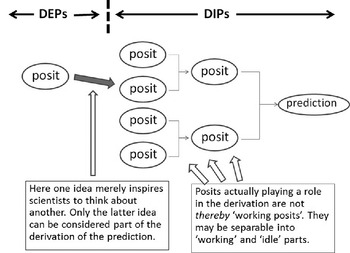
Even if the realist can satisfactorily draw this distinction between working and nonworking parts of a derivation (see secs. 5 and 6), there is another issue that thus far has not been discussed in the literature. This is the problem of identifying the derivation in the first place. If we consider a particular prediction, how do we decide which posits were actually involved in the derivation of that prediction and which were not? How do we decide which posits merely influenced the thinking of scientists and which really acted to bring about the prediction in question? This is something altogether separate from the matter of identifying the ‘working parts’ of individual posits (see fig. 1).
Two different distinctions the realist might make use of. Derivation external posits (DEPs) may play some role in guiding the thoughts of scientists but do not deserve realist commitment because they cannot be considered part of the derivation of the prediction in question. Realist commitment does not extend simply to the derivation internal posits (DIPs) but instead to the working parts of DIPs. Thin arrows represent logical entailment.

This discussion can be brought to life by taking a look at the case of chromatic aberration (case 16 in the above list). At the beginning of the eighteenth century, perhaps the most serious problem in telescope design was the problem of chromatic aberration. The basic idea is simple: lenses refract different wavelengths of light by different amounts, so that white light entering a prism is divided into the different colors of the rainbow on exit. This means that any simple single lens in a telescope will provide the viewer with distorted images, and the problem is exacerbated for stronger lenses. How was this to be overcome?
Scientists and engineers of the day took inspiration from the human eye. Clearly human beings do not see colored fringes and distorted images. Does that not show that the construction of the eye somehow works to eliminate chromatic aberration? In the mid-eighteenth century Chester Moor Hall, John Dollond, and others followed up this suggestion. The eye is made up of a convex lens surrounded by humors, and so light entering the eye is influenced by two different media, with different refractive indices. Thus the hypothesis was made that chromatic aberration could be eliminated in telescopes by way of a double lens, with two different kinds of glass with different refractive indices.
In the 1750s Hall and Dollond independently constructed an achromatic dual lens. The two different lenses used were made of flint glass and crown glass, one convex and one concave. Clearly the same glass could not be used for both lenses since then, even if chromatic aberration was eliminated, so too would any magnifying power of the (double) lens. But with two different types of glass, the convergent lens can be made more powerful than the divergent lens, such that the overall result is still a convergent lens (see Carson Reference Carson1969, 4-23 to 4-24). In this way, chromatic aberration is indeed eliminated, and the achromatic telescope was born.
But the remarkable fact is that Hall, Dollond, and others were quite wrong to think that chromatic aberration is eliminated in human vision by the refractive properties of the lens and humors. In fact it is now known that chromatic aberration is not eliminated by the human eye and that the brain acts to eliminate this effect instead.Footnote 8 Some writers have remarked on how lucky Hall, Dollond, and others were in managing to successfully eliminate chromatic aberration by following the model of the human eye, when it turns out that the human eye itself is unsuccessful in this task. As Ronan (Reference Ronan1961) writes, “It must be noted that Hall was wrong in his theory. We do not see chromatically aberrated images, it is true, but although the reasons are not yet fully understood, it is certain that the cause is not the different refractive properties of the lens and the humour. The wrong theory, but the right results!” (134–35).
The success achieved by Hall, Dollond, and others was quite impressive; let us assume for the sake of argument that it was impressive enough for (strong) realist commitment. Then one might try to claim that the realist is in trouble since it is clear that it is not approximately true that chromatic aberration is eliminated in human vision by the actions of two different media with different refractive indices. But here the realist might try to separate herself from the false posit in question by labeling it ‘derivation external’. The story would go something like this: lens designers actually reached the achromatic lens by making inferences from posits concerning the nature of light and how it would behave if passed through two different media. They were inspired to think about these things because of the design of the eye. But anyone who followed the design of the eye too closely would not be successful because the eye simply does not eliminate chromatic aberration. And one would have to follow the design of the eye closely if this belief about human vision were really to play a role in the development of a specific lens. To be clear, the posit ‘Chromatic aberration is eliminated in human vision by the actions of two different media with different refractive indices’ is a derivation external posit (DEP) corresponding to the posit on the far left of figure 1.
Precisely how the realist characterizes the success is crucial here. Suppose we choose as the success in question the prediction ‘There will be some way of creating a dual lens to eliminate chromatic aberration’. This would indeed be a correct prediction, and this time the prediction does follow directly from the false idea that the two media of the eye act to eliminate chromatic aberration in human vision. In other words, this time the false posit is ‘derivation internal’ (a DIP). But in this case the realist can object that the ‘success’ in question is extremely unimpressive. In fact it is a vague prediction that can be compared with Velikovsky’s prediction concerning the surface temperature of Venus: it will be confirmed if any one of a very large number of possibilities ends up being true. The success, as with the case of Velikovsky, can reasonably be attributed to luck: there is a relatively high prior probability, so there is no ‘miracle’. Thus once again the realist need not make a commitment to the false posit in question.
My intention in this section is merely to flag this up as another tool in the divide et impera arsenal. I think the strategy works well in the case of chromatic aberration, but at least two important issues require attention. First, sometimes it is entirely unclear—given the complexities of science and its history—how to identify the derivation of some predictive success or even whether there is such a thing. Posits external to one reconstruction of a derivation might be internal to another reconstruction, such that there is no simple matter of DIPs and DEPs. Second, there is the question of ‘implicit posits’. Suppose (as here) we are only considering deductive derivations. Then the distinction between DIPs and DEPs is prima facie simple to characterize: DIPs are those posits deductively connected to the prediction, and DEPs are those that are not. But whether some posit is or is not derivation external might then depend on whether we do or do not admit certain ‘implicit posits’ that act to close the gap from not deductively connected to deductively connected. These issues will not affect every case, and I do not think they cause problems for the case of chromatic aberration, but they will need to be worked out before the strategy of distinguishing DIPs and DEPs can be declared well understood and generally applicable.
5. Learning from Kirchhoff’s Theory of Diffraction
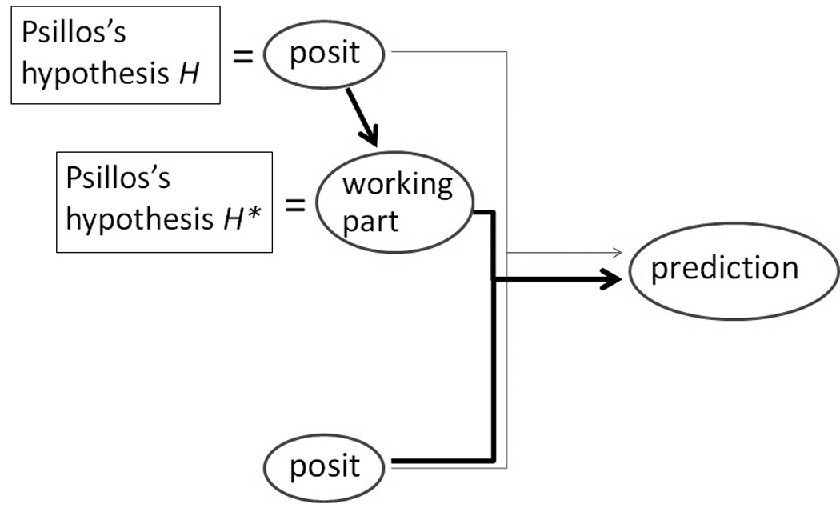
The discussion in the previous section is not really a criticism of Kitcher and Psillos, but it does show one way in which their accounts might be misleading. If one describes DEPs as ‘presuppositional’ in the style of Kitcher, or as ‘idle’ in the style of Psillos, then one might assume that DIPs are ‘working’. But (as indicated in fig. 1) this would be a mistake. Historically active posits in a derivation upstream of an impressive prediction might be working posits, but they might not. Sometimes only part of such a historically active DIP actually contributes to a given derivational step. And if that is the case, the realist I have been describing should not make a realist commitment to those other parts of the DIP. These other parts constitute idle ‘surplus content’ (cf. Saatsi Reference Saatsi2005, 532).
It remains to explain precisely how we should identify the ‘essentially contributing’ or ‘working’ parts of DIPs. Psillos (Reference Psillos1999) is not especially clear on this important point. He writes as follows:
Suppose that H together with another set of hypotheses H′ (and some auxiliaries A) entail a prediction P. H indispensably contributes to the generation of P if H′ and A alone cannot yield P and no other available hypothesis H∗ which is consistent with H′ and A can replace H without loss in the relevant derivation of P. (110)
This is suggestive but somewhat unsatisfactory as it stands. For one thing, weight is put on the word ‘available’, and it is not clear what ‘being available’ amounts to. Lyons (Reference Lyons2006, 540) urges that the question of whether H can be replaced by another available hypothesis H∗ is “irrelevant to the question of how H connects to the prediction.” However, if we put some meat on the bones of Psillos’s word ‘available’, we can perhaps answer Lyons’s concern. One obvious candidate (perhaps the only candidate) for an ‘available’ hypothesis H∗ that can replace H “without loss in the relevant derivation” is precisely some posit ‘contained within’ H (as explained in the previous section), which contains only the content of H necessary to ensure that the derivation goes through (see fig. 2).Footnote 9
How the divide et impera realist might identify a ‘working part’ of a derivation internal posit (DIP). Working part H∗ is deducible from the original posit H. The realist must only commit to the smallest part H∗ contained within H that is still sufficient to derive the prediction when combined with other DIPs. Thin arrows represent the original line of derivation; thick arrows represent the realist’s reconstructed derivation.

Kirchhoff’s theory of the diffraction of light at an aperture (case 11 in the above list) makes for a revealing case study here. In a recent paper (Saatsi and Vickers Reference Saatsi and Vickers2011), Juha Saatsi and I presented this case as an example in which (a) the realist is bound to make a realist commitment given how impressive the predictive success is and (b) one can identify a working posit that is definitely not approximately true (or ‘radically false’ as we put it). If that is the case, then, had the realist lived in the late nineteenth or early twentieth century, she would have told us we should believe X, and then later X would have been found to be ‘radically false’. In other words, the realist would have made an embarrassing mistake concerning the future development of science.
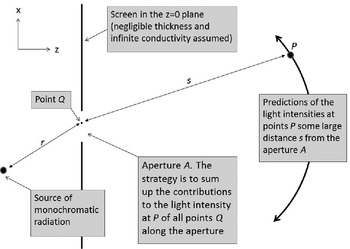
Were we right to say that one can identify a working posit that is definitely not approximately true? This depends on whether the posit in question is definitely a working posit. Figure 3 shows the basic setup of Kirchhoff’s theory. The strategy is to first set up a boundary value equation, which gives the light amplitude at a point of interest P in terms of the light amplitudes at all points Q on an imaginary surface completely surrounding P. Kirchhoff then reasons that the only nonnegligible contributions in this equation will come from points within the aperture A, leading to the following equality:

This gives the light amplitude U at point P in terms of (i) the light amplitudes at all points along the aperture A and also (ii) the derivative of U with respect to (+z) normal n at all points along the aperture. The integral is a double integral, since we also consider the Y-axis (going into/coming out of the page), and k is a constant dependent on the wavelength of the incident light.
Kirchhoff’s approach to predicting the diffraction pattern of monochromatic radiation incident on an aperture in a plane screen. He assumes that the only contributions to the diffraction pattern will come from points in the aperture A and also that light within the aperture A will behave just as if the screen were not there.

Many interesting questions can be raised already concerning the derivation of equation (1), but the focus here (as in Saatsi and Vickers Reference Saatsi and Vickers2011) will be the next step in the derivation. The reasoning is straightforward: take the equation for U at the aperture, find its derivative with respect to n, and plug these into equation (1). The equation we need is as follows (where K is a constant dependent on the light amplitude at the source):

Plugging this into equation (1) in the appropriate way, we soon reach predictions for the light amplitude, and we can turn this into a light intensity by taking the square of the modulus of the amplitude. When this is done, and the predictions compared with experiment, the match is phenomenally accurate (see, e.g., Brooker Reference Brooker2008, fig. 5, 434).
The problem for the realist comes when we see that the boundary conditions assumed by Kirchhoff are not closely matched to the boundary conditions as now understood via a rigorous calculation directly from the Maxwell equations (something only recently made possible with the help of modern computers). Thus, a posit being used in Kirchhoff’s derivation—concerning the boundary conditions within the aperture—turns out to be “wildly wrong” (Saatsi and Vickers Reference Saatsi and Vickers2011, 42), and yet this error does not translate into an error in the predictions of the diffraction pattern. How can the realist hope to make sense of this?
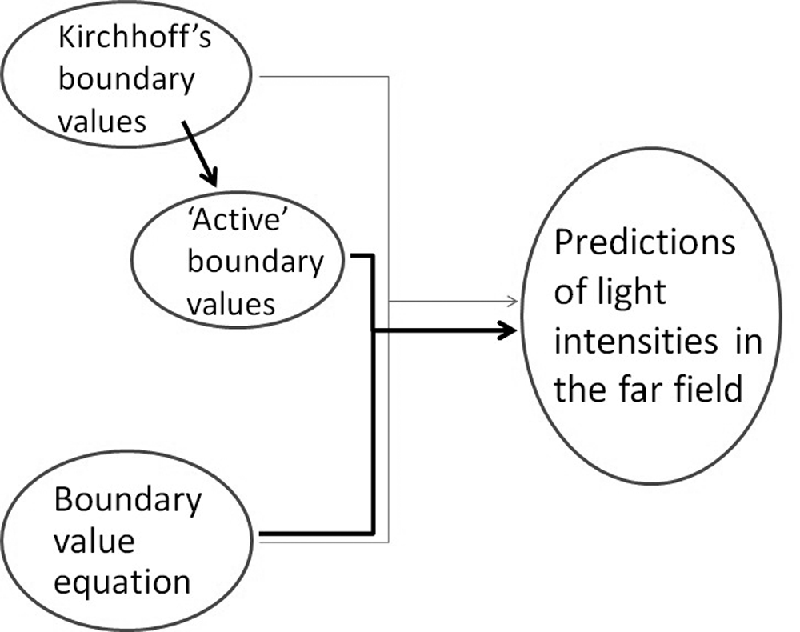
The serious oversight in Saatsi and Vickers (Reference Saatsi and Vickers2011) is this: just because a posit is definitely ‘derivation internal’, and plays an obvious and explicit role in the derivation of interest, does not thereby make it a ‘working posit’ to which realists are obliged to make a commitment (this is the point of fig. 2). The boundary conditions Kirchhoff makes use of contain a great deal of information: we have both U and the derivative of U with respect to n at all points Q within the aperture. So, if the boundary conditions taken as a whole are definitely not approximately true, divide et impera realism predicts that there will be some subset of those conditions that (i) are all we need for the derivation of the diffraction pattern to go through and (ii) are at least approximately true (see fig. 4). Indeed, if this could be shown, a potentially serious problem for the realist would turn into a vivid demonstration of the divide et impera strategy in action.
Figure 2 applied to the particular case of the final derivational step in Kirchhoff’s theory of the diffraction of light at an aperture.

At first it looks like the story the realist needs to tell here has already been told in a recent physics paper (Brooker Reference Brooker2008). Brooker writes as a physicist, in complete ignorance of the scientific realism debate, but he nevertheless wishes to explain the ‘problem’ of how Kirchhoff could be so successful in his predictions when he was so misguided in his basic assumptions. He does this by identifying ‘active’ boundary conditions that really do make a nonnegligible contribution to the far-field diffraction pattern (440). The other ‘inactive’ boundary conditions do not make any difference to the far-field diffraction pattern, so if they are ‘radically false’ that will not affect the relevant predictions.
Now, this sounds perfectly aligned with the divide et impera strategy. If we consider the double integral within equation (1) as an infinite sum, then one might imagine the ‘inactive’ boundary values corresponding to terms the same as, or sufficiently close to, ‘ ’ within that sum. But in fact this is not what Brooker is saying. Brooker’s first move toward identifying the ‘inactive’ parts of the theory is to mathematically translate the Kirchhoff boundary conditions into an infinite series of components using Fourier analysis. He then ‘discards’ certain (inactive) components within this infinite series. Now one might worry that these components do not correspond to anything physical and were not really ‘contained within’ Kirchhoff’s original conditions. If so, a fortiori they were not idle posits within Kirchhoff’s original conditions. Similarly, if I posit that my car’s weight in kilograms is
 (for some constant K), and I then choose to represent this quantity as
 , then I am not somehow saying that certain parts of my car’s weight are negative. The components of this series do not correspond to anything physical; only the total sum does.
Is this analogy unfair? Brooker (Reference Brooker2008, sec. 6) tells us that the relevant components in the Kirchhoff case correspond to ‘high space frequencies’, electromagnetic disturbances in the +z direction with many peaks/troughs per unit distance. But the objection can be pushed further: Are these high space frequency disturbances truly physical things (in the hypothetical system under discussion)? Certainly one can represent the field traveling toward the far field as ‘made up of’ both high space frequency disturbances (which decay rapidly) and lower space frequency disturbances (which do not). But why should we take this to be anything more than mere mathematical representation? Brooker himself states that the far-field diffraction effect “can be seen as” being caused by certain components in the slit plane (440). Underlying the words ‘can be seen as’ is the idea that there are certain pragmatic benefits to conceiving of the field behavior at the slit (and beyond, in the  half space) as a combination of various different ‘components’. But these components should not be interpreted as ‘real things’. And, even if some thinkers today do think of the Fourier components as ‘real things’, it is clear enough that Kirchhoff did not. Insofar as the boundary conditions are concerned, Kirchhoff was committed to the field amplitudes and their derivatives with respect to normal n at all points Q in the aperture, as given by equation (2). He was also committed to anything entailed by these commitments. But Brooker’s components are not so entailed, and so no such components can be identified as implicit idle wheels within Kirchhoff’s theory.
This is not to say that the divide et impera strategy fails for this case. It remains possible that not all of Kirchhoff’s boundary conditions contribute to the successful far-field predictions. If this can be demonstrated, one would then have to show that what remains from Kirchhoff’s conditions—after the idle conditions have been discarded—is at least approximately true according to our best current understanding. Altogether, this is a complex technical problem that cannot be tackled here. What is established is that Saatsi and Vickers (Reference Saatsi and Vickers2011) do not show that a working posit within Kirchhoff’s theory is ‘radically false’.
6. Prospective Identification of (In)active Posits
The holy grail of divide et impera realism is to prospectively identify the working posits in a theory. There is an important lesson concerning this goal that falls out of the Kirchhoff case. Even if it is possible to identify idle wheels within Kirchhoff’s original boundary conditions, that does not mean that what remains is ‘working’. It remains possible that some of what remains, even concerning the boundary conditions, is also idle. Even if the mathematics expressing those conditions must remain, certain features of the interpretation of the relevant equations may be idle. And this is just one small part of the overall picture Kirchhoff paints. Many of Kirchhoff’s other posits will be false of any real system: the screen will not be ‘ideal’, the light will not be perfectly monochromatic, Kirchhoff’s scalar treatment is a simplification, and there are further significant idealization assumptions made in the derivation of equation (1) (see, e.g., Born and Wolf Reference Born and Wolf1999, chap. 8, sec. 8.3.2).
How, then, would the divide et impera realist proceed from here to reach the actual working posits within Kirchhoff’s derivation? One option is to consider what remains of Kirchhoff’s theory in the contemporary scientific picture, but—as Stanford (Reference Stanford2006, 167–80; Reference Stanford2009, 385–87) has argued—this is to give up on what the realist cares most about. If we cannot identify the working posits of a theory until it has been superseded by some other theory, then realism is no longer about identifying what we ought to believe to be true: one is always waiting for the next theory to come along to tell us which parts of our current theory are working posits. Saatsi (Reference Saatsi2009, 362) agrees with Psillos (Reference Psillos1999, 112–13) that the philosopher should leave it to the scientist to evaluate the ‘working’/‘idle’ status of theoretical posits. But this is fuel to Stanford’s fire (Reference Stanford2006, 173–80; Reference Stanford2009, 385) since many scientists in the history of science have made an incorrect evaluation.Footnote 10
The discussion in sections 4 and 5, above, suggests a more positive realist response. Indeed, a general recipe for the prospective identification of working posits suggests itself:
(i) Take a contemporary, impressive, novel predictive success, where the derivation of the prediction can be identified in a relatively uncontroversial way.Footnote 11
(ii) Work backward in the derivation of that success one derivational step at a time.Footnote 12
(iii) In the first step, retain only those posits contained within the upstream posits (deducible from them) that contain the content absolutely necessary to derive the downstream prediction.Footnote 13
(iv) In the second step, retain only those posits contained within the upstream posits (deducible from them) necessary to derive the working parts of the DIPs retained in the first step.
And so on for all further derivational steps as we move upstream.Footnote 14
Unfortunately, this is inadequate as it stands and still leaves things rather opaque. It is inadequate since a posit deducible from P will always be ‘as if P’, and this will always be enough to see the derivational step go through. This will have to be ruled out somehow. Perhaps the realist can insist that (intuitively) the working part of ‘as if P’ is P itself, that the words ‘as if’ are mere flatus vocis, as least insofar as scientific ‘work’ is considered. As Leplin (Reference Leplin1997, 27) has argued of the ‘as if’ operator, “such explanation as it does provide is actually parasitic on realist explanation.”Footnote 15 But even if the realist has an answer here, the recipe remains opaque because it remains unclear what the ‘content absolutely necessary’ will be. Perhaps it will be only the Ramsey sentence or Votsis’s ‘minimally interpreted equations’ (Votsis Reference Votsis2011) or similar. Psillos (Reference Psillos1999, 110) attempts to sidestep such a ‘modest’ realism by insisting that the working posit be (among other things) ‘potentially explanatory’ in a sense that a Ramsey sentence is not. But this is a thorny debate that is far from settled.Footnote 16
Suppose we agree that the realist is still some distance from prospectively identifying (even some of) the working posits of contemporary science. If this is—for now—too ambitious, a more modest ambition is suggested by the Kirchhoff case. Suppose Kirchhoff had attempted to follow the general recipe given above. Then, feasibly, at step iii he would have asked himself a crucial question: Does everything within the posited boundary conditions actually affect the successful predictions? If not, then he would have prospectively identified at least some of the idle posits in the theory. And this would lead to an interesting and substantial prediction concerning future science: that those idle aspects of the boundary conditions would not survive future scientific change.
At first this sort of prospective identification does not appear to be any comfort to the realist whatsoever. What would the realist commit to in such a case? Well, she would commit to just some (unspecified) parts of what remains after the identified idle posits have been removed. This is vague and unsatisfying, but it does at least narrow down the target of realist commitment. And this will help those involved in this debate to better assess the challenge from the history of science. In the Kirchhoff case, if there are boundary conditions that are idle, and if the remaining conditions (closely) match our current best theory, then this particular challenge from the history of science disappears. And we do not need to prospectively identify the working posits to establish this: we only need to find that certain particular DIPs are idle. The same goes for any one of the cases listed in section 2.
7. Conclusion
Divide et impera realism needs to be challenged by, and developed in light of, the full historical record, and this record is much richer than the long-standing discussions of Fresnel, caloric, and phlogiston make apparent. The 20 examples presented in section 2 may well be the tip of the iceberg. And each example has the potential to bring something new to the debate. In section 3, the case of Velikovsky showed clearly how the usual realist restriction to ‘novel predictive success’ is inadequate, and in sections 4 and 5, the cases of chromatic aberration and Kirchhoff’s theory of diffraction showed different ways in which the ‘working’/‘idle’ distinction needs refinement. In all this, we find ourselves—even 30+ years after Laudan (Reference Laudan1981)—unsure of the extent to which the divide et impera strategy can succeed. Even if the ‘working posits’ of contemporary science cannot be prospectively identified, it remains possible that we might develop a recipe for identifying certain idle posits. This would be a significant achievement, even if not quite what the realist originally had in mind.