Mass casualty events (MASCALS; defined as disaster events with a large number of victims that require rapid triage, acute assessment, few resources, and time pressure) Reference Killeen, Chan and Buono1 such as natural disasters (eg, storms, earthquakes, wildfires, floods), terrorist attacks, active shooter situations, and war battles are increasing. For example, the number of mass shooting incidents grew in the decade of 2008-2017 over 2.4 times greater than the preceding decade, 2 and major weather events (eg, extreme precipitation events, such as Hurricane Harvey) are increasing in intensity and frequency. Reference Kunkel, Karl and Brooks3 MASCALs require rapid triage, stabilization, and treatment of multiple patients simultaneously, and individuals injured in MASCALs often have complex or unclear injuries requiring diagnoses and/or care from specialized medical expertise that is not readily available on site (eg, head trauma). Many first responders lack the training to triage and provide care for severely injured patients and those with complex injuries. Reference Rolston and Meltzer4 In these cases, telemedicine (defined as the provision of health services at a distance through technological means) can allow more experienced health-care providers to advise, assist, and act as surrogate caregivers to first responders on the site of the disaster. Reference Rolston and Meltzer4
While evidence suggests that telemedicine in mass casualty settings can be beneficial for patient outcomes, Reference Garshnek and Burkle5 prior work has not provided guidance on how to best use telemedicine in MASCALS. The implementation of telemedicine has been mostly studied in hospital and primary care settings Reference Ross, Stevenson and Lau6 ; settings that commonly have conditions such as controlled spaces, quiet telemedicine rooms, and buildings with reliable Internet connection. Such work has provided recommendations for telemedicine implementation and use, such as engaging in “more eye contact,” Reference Bulik7 using “active listening,” Reference Bulik7 and ensuring “robust support infrastructures.” Reference Broens, Huis in’t Veld and Vollenbroek-Hutten8 However, MASCALs have conditions that differ vastly; conditions of loud noises, continuous danger, few resources, time pressure, multiple patients, and often unreliable Internet connections are inherent to the MASCAL context. These conditions make using telemedicine more challenging and make applying traditional telemedicine implementation recommendations often impossible.
The goal of the current study is to begin to close this gap, by examining both how telemedicine is used, as well as end users’ perceptions of the usefulness of telemedicine in a MASCAL setting. In so doing, we seek to provide recommendations to help inform future design and implementation of telemedical devices for use in mass casualty and disaster events.
METHODS
We used a mixed method design that included both quantitative and qualitative approaches to best understand the perceived benefits and drawbacks of telemedicine in this setting. Specifically, we used surveys to glean perspectives quantitatively, and structured debriefs to supplement and serve an explanatory role to the survey responses. Below, we provide detail on the simulation itself and both data collection approaches.
Participants
Participants were the potential end users of telemedicine in mass casualty and disaster situations: members of US Army Forward Surgical Teams (FSTs), which are medical teams that are highly mobile, agile, and largely disconnected from outside support. Reference Valdiri, Andrews-Arce and Seery9 The purpose of these teams is to deploy to areas in which urgent US Army medical care may be needed on-site. This care is essential for stabilization of critically ill or wounded patients who would not otherwise survive transfer to the hospital. As such, FSTs are mobile, working often in or alongside battles and other MASCAL situations, and typically work with few resources. FSTs operate in tents of 900-1000 square feet powered by generators that include emergency, operating, and recovery rooms. Reference Valdiri, Andrews-Arce and Seery9 These teams typically have enough supply to perform 30 operations over a 72-h period before needing to be replenished. Reference Valdiri, Andrews-Arce and Seery9
FSTs typically are composed of 20 personnel, including 3 general surgeons, 1 orthopedic surgeon, 2 certified registered nurse anesthetists (CRNAs), 1 operating room (OR) nurse, 1 emergency room (ER) nurse, 1 intensive care nurse, 1 administrative officer, and a varying numbers of additional support staff including OR technicians, licensed practical nurses (LPNs), and combat medics. 10
While participating in the training was mandatory as part of the FST members’ jobs, participation in the study was voluntary. This study was approved by the University of Miami Human Subjects Research Office.
MASCAL Simulation
The nature of the work FSTs complete requires specialized training to allow team members to become familiar with one another and learn to work in MASCAL conditions to provide emergency care for critically wounded patients with few resources. Members of FSTs are often unfamiliar with one another and do not typically train together until arrival at what was previously called the U.S. Army Trauma Training Center (ATTC; now the Army Trauma Training Detachment, ATTD) in Miami, Florida. Each FST spends 2 weeks together at ATTC (now ATTD) before deployment, undergoing a variety of training initiatives.
The training provided at ATTC/ATTD is in partnership with the University of Miami and Jackson Memorial Hospital/Ryder Trauma Center. At the time of this study, the facility allowed for realistic simulation of a variety of conditions encountered by deployed FSTs, including a treatment area housed in a tent set up to mimic the layout of real FST treatment tents. In addition to didactic training, the facility had access to a variety of simulators to train teams on management of particular injuries they were likely to be exposed to when deployed. Training ended with a capstone event in which the FST trained together in the simulated tent. FST members were dispersed between 4 different clinical areas (triage, pre-op, surgery, post-op) in the treatment tent, creating 4 treatment teams within each FST.
FSTs trained with only the resources that would be available to them in deployment, with simulated realistic conditions, to treat a complex load of simulated patients. In the current study, FSTs worked under numerous simulated conditions that resembled a MASCAL scenario. Specifically, we manipulated noise by playing music and noises that were likely to be encountered in the region teams would be deployed to (eg, helicopters whirring, gunfire, explosions). We manipulated time stress by scripting in a large number of incoming simulated patients with complex and emergent injuries, who arrived intermittently, with the number of upcoming arrivals unknown by participants. The simulation took place over a 12-h period in the overnight hours to ensure fatigue, a likely condition encountered in a MASCAL setting. We also simulated other realistic features that would pose additional challenges to the team, such as a patient with a simulated improvised explosive device (IED) that exploded and “killed” team members, and a simulated suicide bomber entering the treatment tent, removing team members from the simulation who did not notice the bomber and were, therefore, “killed.” These “kills,” realistic issues in this context, posed a challenge by resulting in a loss of manpower and expertise for the team.
Telemedicine Implementation
We introduced telemedical devices to the MASCAL simulation and trained participants on how to use it. In addition to receiving technical training on using the system (including information, demonstration, and opportunity to practice using the device), participants were told that the telemedicine would connect them with experienced surgeons in neurology and orthopedics who could help guide them in treating cases. Participants were told that activating the telemedicine was voluntary and could be used as needed. They were instructed that any member of any team could initiate the use of the telemedicine.
Equipment
The telemedical device used was an Apple® iPad (Apple, Cupertino, CA) using DiMobile Care. We placed 1 iPad at the foot of each bed, at each station (eg, emergency, operation, recovery) in the treatment tent to allow all team members to access it. To provide an opportunity for the use of telemedicine, we scripted 2 complex patient cases that were likely to require expertise outside of the team to treat. The 2 cases were (1) a head trauma and (2) a pelvic fracture. These particular cases were selected as physician faculty at the ATTC believed that the competencies to treat these cases generally lay outside of the FSTs’ expertise (eg, requiring neurosurgery and advanced orthopedic expertise), and as prior evidence suggests that diagnosis and treatment of extremity and pelvic injuries is among the most common reasons for teleconsults. Reference Lambrecht11 The telemedicine could be activated with the simple push of a button. On the receiving end of the telemedical device was an expert physician who gave guidance to the FST members that called in. The physician’s responses were scripted so that each team who called in received a standardized response.
Measures
As previously stated, we used both quantitative (survey) and qualitative (structured debrief) measures.
Survey-Based Measures
The survey examined demographics, use of telemedicine during the simulation, and participants’ perceptions regarding the usefulness of the telemedical device.
Demographics
We asked participants to indicate their gender, professional role, number of months of experience in trauma care, and prior experience with telemedicine, to examine potential confounders. We also asked about the clinical area(s) in which the participant worked during the simulation (triage, pre-op, surgery, post-op).
Telemedicine Use
To measure use of telemedicine, participants were asked whether they used the telemedicine during the simulation, and if so, for which patient case.
End Users’ Perceived Telemedicine Usefulness
To determine end users’ perceived usefulness of telemedicine in this context, we asked FST members to fill out a self-report measure. Items were on a 5-point Likert scale (1 = not at all; 5 = very much), and asked about multiple dimensions of telemedicine usefulness, including perceptions of its impact on improving patient care, facilitating attainment of expert resources, improving decision-making, increasing adaptation, and its effect on timeliness of patient care. A sample item includes, “To what extent did the use of telemedicine improve patient care?” See the Online Data Supplement for all survey items used in this study.
Structured Debrief
To better understand end users’ experiences with telemedicine in this setting, we conducted postsimulation debriefs, also called “after action reviews” with each group of participants. The intent was to gather additional data that would serve to explain in richer detail the objective data. We used a semi-structured protocol that allowed for flexibility in the debrief process. Debriefs were facilitated by a trained facilitator.
Opinions on Telemedicine in the MASCAL Setting
To better understand opinions on how telemedicine was (or was not) useful in the MASCAL setting, we used the following debrief questions: “We noticed some teams initiated telemedicine, and some did not. Can those who did not please describe why? Can those who did describe their experience?”, “What were barriers and facilitators to initiating telemedicine; that is, what made it more or less difficult/useful?”, “How did treating the patient with [the head injury, the pelvic fracture] differ with and without use of telemedicine?”, “What did you find to be the most valuable component of telemedicine?”, “What did you find to be the least valuable component of telemedicine?”, “Was telemedicine a distraction; that is, did it detract from patient care?”, “What are implications of using telemedicine to enhance teamwork in emergency situations?”, and “Would you find telemedicine useful on the job?”
Analyses
We examined descriptive statistics for the demographics. For telemedicine use, we computed frequencies and percentages. We examined usefulness of telemedicine for the subgroup that indicated that they did use the telemedicine. Due to the small sample size of this group, only descriptives were computed. Missing data were dropped. To examine opinions on telemedicine in the MASCAL setting, we identified overarching common categories and themes and used them to help explain survey data.
RESULTS
Demographics
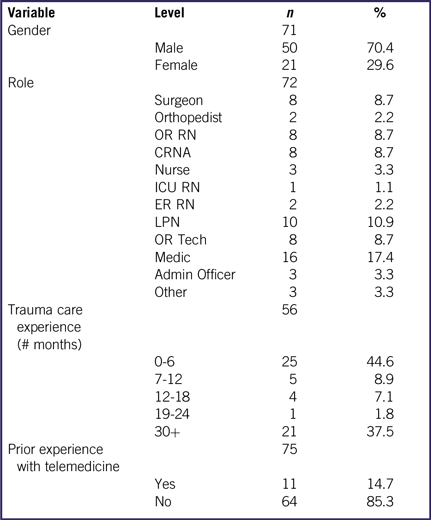
Ninety-two clinicians participated. Team size ranged from 18 to 20 team members. Participants were mostly male (70.4%), had a variety of professional roles (eg, surgeon, nurse, medic, etc.), had a range of trauma experience levels, and most (85.3%) had no prior experience with telemedicine (see Table 1 for demographics).
Demographics

Abbreviations: RN = registered nurse; CRNA = certified registered nurse anesthetist; OR = operating room; ICU = intensive care unit; ER = emergency room; LPN = licensed practical nurse.
Use and Usefulness of Telemedicine in the Mass Casualty Context
Only 10 of the 92 participants (10.9%) used the telemedicine system. This small sample size precluded advanced statistical analyses; thus, we examined the descriptives in depth. Telemedicine users included 3 surgeons (30.0%), 2 nurses (20.0%), 1 orthopedist (10.0%), 1 administrative officer (10.0%), and 3 people who did not state their role (30.0%). Users had similar levels of trauma experience than nonusers (M = 40.00 [SD = 37.25] versus M = 24.50 [SD = 39.40] months, respectively; t(39) = 0.83, P = 0.41). Users and nonusers also had similar levels of previous experience with telemedicine (n = 1; 10.0%, and n = 7; 11.7%, for users and nonusers, respectively).
The treatment areas in which telemedicine users worked included surgery (n = 4; 40.0%), post-op (n = 1; 10.0%), and those who moved between areas (eg, an admin officer floating between areas, a nurse providing advanced trauma life support, etc.; n = 4; 40.0%). Seven (n = 7; 70.0%) used the telemedicine for a neurology consult in relation to the head injury case, 1 (n = 1; 10.0%) indicated using the telemedicine for the pelvic fracture case, and 2 (n = 2; 20.0%) did not say for which case they used the telemedicine.
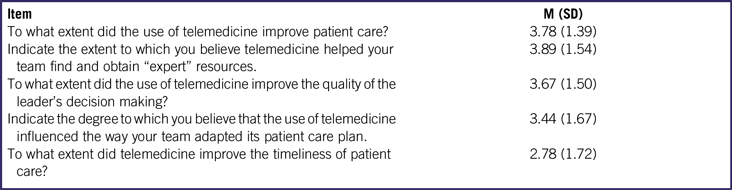
Those who used the telemedicine believed it somewhat improved patient care (M = 3.78; SD = 1.39), attainment of expert resources (M = 3.89; SD = 1.54), decision-making (M = 3.67; SD = 1.50), adaptation (M = 3.44; SD = 1.67), and that it did not improve the timeliness of patient care (M = 2.78; SD = 1.72) in the MASCAL context (see Table 2).
Perceived Usefulness of Telemedicine in the MASCAL Context as Reported by Telemedicine Users

n = 10; Scale for all items was 5-point Likert scale, with 1 = not at all, 5 = very much.
Opinions on Telemedicine in the MASCAL Setting
Participants reported that the simulation felt realistic, yet there were several barriers to using the telemedicine. Major barriers identified from themes included: (1) confusion around team roles, (2) time constraints, and (3) difficultly using telemedicine in the MASCAL setting. We expand on each of these themes in the discussion section.
DISCUSSION
Despite the fact that the current sample had relatively little experience in trauma care, with almost half having 0-6 months of experience, only 10.9% of participants chose to use the telemedicine in the simulated MASCAL context to consult an expert to assist with complex trauma procedures. This indicates that there were likely several barriers to choosing to use the telemedicine in this setting, despite its purported benefits. Furthermore, those who used it found it only moderately or not useful in the mass casualty context. As previously mentioned, we explored these issues in more depth during postsimulation debriefs. Themes from these debriefs and lessons learned are summarized below.
Barriers to Telemedicine Use in the Mass Casualty Setting: Lessons Learned and Three Key Recommendations for Design and Implementation
Role Ambiguity
Team role ambiguity was cited as a barrier to telemedicine use. Specifically, participants reported that they were not sure if there was a particular team member that was designated or should lead the decision to initiate the telemedical consultation. This lack of clarity and direction led to diffusion of responsibility and, ultimately, low rates of telemedicine use. Supporting this, our results show that a variety of roles used the telemedicine, including surgeons, orthopedists, nurses, administrative officers, and others. As such, we recommend that response teams be trained to select a designated team member who is responsible for initiating use of the telemedicine. This recommendation is echoed by Rolston and Meltzer (2015), Reference Rolston and Meltzer4 who state that “designating a telemedicine leader within the incident command system could improve planning, communication, and coordination of disaster relief efforts.”
We recommend that the team member selected to lead the choice to activate and use telemedicine be assertive, respected by the team, and have the latitude to lead this decision. Alternatively, a shared model could be used wherein 1 team member makes the decision to use telemedicine, and another is responsible for then activating the system and coordinating its usage. While it has been recommended to fill such roles by dedicated resource such as a technician or specialized nurse, Reference Gagnon, Duplantie and Fortin12 this is not logistically feasible in a mass casualty response team that has limited resources. Thus, clinicians will need to be trained to engage in, and in roles for using, telemedicine.
Perceived Time Constraints
In addition, participants reported that they believed they did not have time to initiate and participate in a telemedical consultation, despite its benefits. In hindsight, this finding makes sense, as teams were overwhelmed with an influx of critically wounded simulated patients in a chaotic and time-stressed context. Activating the telemedicine would require describing the patient’s condition and engaging in a potentially time consuming 2-way conversation. To address this barrier, we recommend that the system be designed and marketed to provide the most benefit for users with the least perceived time loss. Reference Obstfelder, Engeseth and Wynn13
Additional work should be done to determine the conditions and assistance that is of greatest need by responders to mass casualty and disaster settings. Initial recommendations include providing telemedical resources for triage, stabilization, and treatment of complex trauma conditions that occur in these settings but whose treatment is typically outside the scope of a first responders’ skillset, eg, neurological trauma, cardiology, ophthalmologic issues. For instance, in this study, we found that the telemedicine was used most frequently to consult on a closed head injury with neurological implications, requiring advanced expertise that lay outside of the typical FST. Furthermore, these resources should be quick and easy to access and use. That is, the system should be able to be activated with little preparation; complicated operation and protection features, such as multiple buttons, clicks, and passcodes can be a potential barrier to use under time pressure. Reference Gagnon, Duplantie and Fortin12,Reference Oviatt14
Along these lines, work investigating user-centered design of other types of emergency response technologies used in MASCAL events (eg, patient monitoring systems) suggests that users prefer simple systems that hide unnecessary functions and show only essential, nonredundant information. Reference Gao, Kim and White15 Furthermore, the response by the person or resource on the other end of the telemedicine should be quick, accurate, and reliable. Having a system that is slow to respond or unreliable will disincentivize future use. In addition, providing ample training opportunities for participants to learn and practice using the telemedicine in lower-stakes conditions should also decrease the barrier of perceived time constraints. That is, having sufficient experience initiating and using the telemedical device during training should reduce the technological learning curve of this system. The increased familiarity and comfort with the system gained from this should lead users to increase their perceptions that the telemedical system can be used easily and swiftly in a context in which their cognitive resources are more limited.
Perceived Utility of Telemedical System in MASCAL
For those participants who did use the telemedicine, as shown in Table 2, they perceived that it had only moderate or low utility in this setting. When discussed in the debriefs, a key issue that was mentioned was noise. Simply put, it was difficult to hear the expert on the other end of the telemedicine consultation, given the conditions of loud noise in this setting. This is similar to other studies on technological communication in mass casualty disasters, wherein participants commonly reported issues with radio and phone communications, miscommunications, and associated delays due to communication issues. Reference Stanescu, Boerlu and Copotoiu16
For a similar reason, prior work examining the needs of mobile users in MASCAL settings has cautioned against hardware features such as operation by means of voice commands. Reference Mentler, Herczeg and Jent17 Prior work has recommended providing headphones to overcome the challenge of communicating in a noisy environment. Reference Latifi, Weinstein and Porter18 Additional work should be done to explore this in more depth. For example, wireless Bluetooth headphones are now widely available, which can allow for the provider to be mobile rather than being wired into a telemedicine system. Emerging research is also exploring the use of augmented reality headset systems with real-time feedback for warzone telecare. Reference Rojas-Munoz, Cabrera and Andersen19 However, it is unknown how features such as Bluetooth functionality and augmented reality would work in many mass casualty and disaster settings with limited or destroyed technological infrastructure. In addition, such headset augmented reality systems as well as traditional headphones would allow for only 1 person on a team to hear and interact with the specialist, unless multiple headsets were provided for the entire team (more of a logistical, and financial, burden). It is often beneficial for the whole team to be in the communication loop to develop shared mental models and facilitate work. Reference Mathieu, Heffner and Goodwin20,Reference Cannon-Bowers, Salas, Converse and Castellan21 Thus, more work needs to be done to determine best practices for using telemedicine in a noisy environment.
Another hardware challenge identified in prior user-centered work in this area is that of touchscreen technologies. Reference Mentler, Herczeg and Jent17 The touchscreen functions on many tools are inoperable when wearing gloves, thus creating a barrier to use in a medical setting. While many technologies that rely primarily on touchscreen functions also support use by means of voice commands, as mentioned above, use of voice commands to operate technology could be difficult in the MASCAL setting due to noise. As both of these features are prevalent in mobile technologies that support telemedicine, future work should examine these issues in more depth.
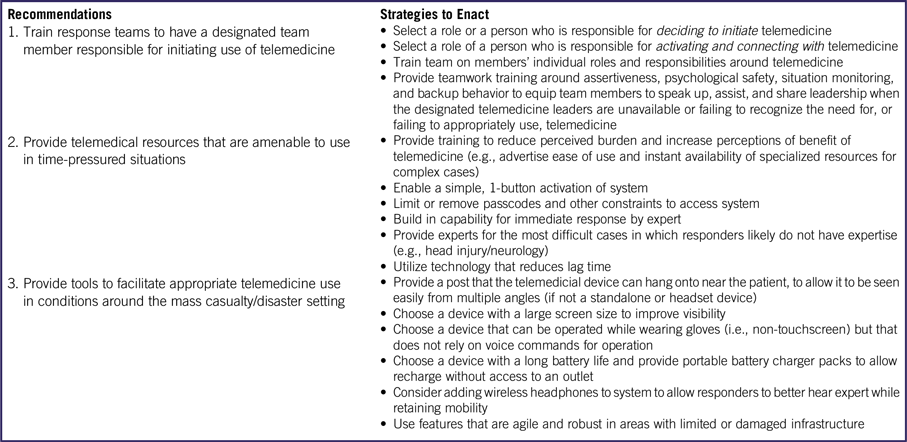
These barriers and associated recommendations are summarized in Table 3.
Recommendations for Telemedicine Design and Implementation in Mass Casualty and Disaster Settings

LIMITATIONS AND FUTURE RESEARCH
As with any study, there are several limitations in the current study. First, our work was conducted under simulated conditions. While this simulation was highly realistic, and allowed us to manipulate and control some factors in the study, further study is needed to examine the usability (ie, the extent to which an interface facilitates the device’s ability to be used) of telemedical device interface designs in real mass casualty and disaster settings. Namely, user design needs may change in the presence of extreme environments, including the presence of increased stress (eg, MASCAL). Reference Hancock and Szalma22 It is beyond the scope of the current study to provide complete guidance on usability assessment(s); however, we direct readers to the common usability assessments that leverage subjective and objective metrics Reference Han, Hwan Yun and Kim23 often including (but not limited to): satisfaction, learnability (ie, how quickly a device’s use can be learned and applied), contextual features, and outcomes. Reference Coursaris and Kim24
In addition, 10 participants chose to use the telemedicine. This was an important finding in itself, showing that there were barriers to using telemedicine in this setting. However, this small sample size also limited our ability to assess a potentially wider range of opinions on the use of telemedicine in this setting. It is possible that with a larger sample of users, we would have uncovered additional interesting usability barriers. Future work should be done requiring participants to activate the telemedicine in this setting to help uncover additional issues. Similarly, as our data were subjective and based on simulated patients, we are limited in what we can conclude with regard to objective outcomes of telemedicine in the MASCAL context. Future work should investigate factors such as the time difference between triage and treatment with and without telemedicine in the MASCAL context, as well as patient outcomes.
Despite these limitations, there are several strengths in this study. Key among these is our sample of real FSTs, clinicians who are true first responders to mass casualty situations, increasing external validity. Thus, while our sample was small, it was composed of a select group of key end users of the technology in this context. In addition, the simulation used was high-fidelity, in that it was designed by faculty with trauma care expertise and military experience, and supported by the Army to ensure conditions were as realistic to a real mass casualty as possible. This increases external validity of our findings.
CONCLUSIONS
Telemedicine has the potential to improve disaster and mass casualty response by connecting responders with global experts who can consult and assist in patient triage and treatment. However, we uncovered several barriers to the use of telemedicine in this context. We recommend that teams designate a member to lead the use of telemedicine, to provide telemedical resources whose benefits outweigh the perceived cost in lost time, and to ensure telemedicine systems are designed for the conditions inherent to mass casualty and disaster settings (eg, noise, time pressure). More work should be done to uncover additional barriers and to test potential solutions to improve telemedicine design, implementation, and usefulness in this setting.
Acknowledgments
This project was conducted in conjunction with members of the Ryder Trauma Center and University of Miami. The views expressed in this work are those of the authors and do not necessarily reflect the organizations with which they are affiliated or their sponsoring institutions or agencies. The views expressed in this presentation are those of the authors and do not necessarily reflect the position or policy of the Department of Veterans Affairs or the United States Government.
Authors’ Contributions
M.E.G. helped to design the measurement and evaluation plan, analyzed the data, and wrote the first draft. S.C.S. helped guide the study design and measurement plan and oversaw evaluation. A.M.H. helped to design the measurement plan and evaluation. A.M. helped to design the study, and designed the physician cases used in the simulation, including the telemedicine cases. C.S. helped to design the study, and designed the physician cases used in the simulation, including the telemedicine cases. E.S. designed and oversaw the study. All authors read and approved the final version of the manuscript.
Funding
This project was funded by Telemedicine and Advanced Technology Research Center (TATRC) Department of Defense (W8IXWH-11-2-0211).
Supplementary material
To view supplementary material for this article, please visit https://doi.org/10.1017/dmp.2019.156