Productivity is the ability to generalize linguistic knowledge. In English, examples of morphological productivity include adding a plural -s to the end of a noun that has been heard only in the singular form or affixing an -ed to an uninflected verb. One question is how children become productive. Some researchers argue that they learn the morphological and syntactic patterns associated with each word individually, and are initially conservative in generalizing these patterns to new words (e.g. Bybee, Reference Bybee1985, Reference Bybee2001; Tomasello, Reference Tomasello1992; Marchman & Bates, Reference Marchman and Bates1994; Wilson, Reference Wilson2001).
For example, in learning verbal inflections, children have shown productivity with -ing (adding it to a novel verb stem) before -ed (Akhtar & Tomasello, Reference Akhtar and Tomasello1997). There are a number of reasons why children might become productive with -ing first. These include phonological regularity (-ing sounds the same on all words, whereas -ed varies in sound depending on the last phoneme of the verb it is attached to), greater facility with aspect over tense (Conti-Ramsden & Windfuhr, Reference Conti-Ramsden and Windfuhr2002; Armon-Lotem & Berman, Reference Armon-Lotem and Berman2003) and the greater frequency of verbs that take -ing but not -ed (Plunkett & Marchman, Reference Plunkett and Marchman1991, Reference Plunkett and Marchman1993).
Most studies of productivity with these verbal inflections define productivity as the ability to add an inflection to a novel verb stem. However, several studies suggest that children may also evidence productivity by appropriately dropping inflections from novel verbs they have heard only in inflected forms. Akhtar & Tomasello (Reference Akhtar and Tomasello1997), Tomasello, Akhtar, Dodson & Rekau (Reference Tomasello, Akhtar, Dodson and Rekau1997) and Olguin & Tomasello (Reference Olguin and Tomasello1993) all showed that young two-year-olds occasionally dropped -ing from novel verbs that were always modelled in the present progressive. While this dropping may represent productivity with -ing, it is important to rule out the possibility that children dropped the inflection only because the words were more difficult for them to say with the inflection attached. That is, it is necessary to examine whether dropping occurs primarily in appropriate syntactic contexts. For example, if young children hear a novel verb inflected with -ing (e.g. tamming), they could drop this inflection appropriately (e.g. using the verb in a command, Tam it!, or as the main verb in a more complex frame, I want to tam it now) or they may do so inappropriately (e.g. He tam it). Only appropriate dropping should be considered evidence of productivity, so assessing the relative use of appropriate and inappropriate drops is essential.
The present experiments were designed to assess young two-year-olds' ability to appropriately drop verbal inflections, and to determine if this type of productivity is easier for them to demonstrate than the more typical measure of adding an inflection to a bare stem. In the first experiment, children were tested to see whether they would add -ed or -ing to bare stem verbs and whether they would drop these inflections appropriately from verbs that were modelled only in the present progressive or the past tense. In the second experiment, we presented them with novel nouns and novel verbs ending in -ing. If they drop -ing from verbs but not from nouns, we can conclude that they do not drop simply because it is easier to pronounce words without inflections, but because they have some productive understanding of the appropriate use of -ing.
EXPERIMENT 1
METHOD
Participants
Twelve (six female) young two-year-olds (M=1 ; 11·24, SD=57 days; range=1 ; 9–2 ; 3) and 12 (six female) older two-year-olds (M=2 ; 6·24, SD=66 days; range=2 ; 4–2 ; 10) participated. All were monolingual English speakers except for one older two-year-old who was learning both English and Spanish at home, but spoke only English.Footnote 1 Children whose parents agreed to participate were tested at their childcare facility. Five additional children participated but were excluded because they never used the test words (n=2), participated in only one of the two sessions (n=2) or had language difficulties (n=1).
Materials
Children learned 3 novel verbs (dack, gop, pim) associated with 3 different action props. One prop consisted of a wooden base with a spring attached to a wooden box. When the spring was shaken, a toy character placed inside the box above moved about in an unusual fashion. Another prop consisted of a plastic ring attached to the end of a tape measure. When the tape was pulled out, a small toy was placed in the ring and pulled along by retracting the tape. The third prop consisted of a springy bracelet attached to a small metal bucket. Objects inside the bucket were bounced by moving the bracelet up and down. The toys on which the actions were modelled were plastic figurines familiar to young children, e.g. characters such as Winnie the Pooh and common animals such as a dog. A video camera mounted on a tripod recorded all sessions.
Design
There were two between-subjects groups (younger and older two-year-olds) and three within-subjects conditions (bare-stem, -ing and -ed). Assignment of verb to action and verb to condition was counterbalanced across participants.
Procedure
Children were tested individually on two separate days (two days apart) in a quiet location at their childcare facility. During the first session children engaged in free play with the experimenter to establish rapport and to record a language sample for computation of Mean Length of Utterance in morphemes (MLU). During this session the figurines were introduced. Each free-play session lasted approximately 15 minutes. Because conversation may have been stilted by unfamiliarity with the researcher, children's MLU was calculated in two ways. The first used the first 50 spontaneous utterances. The second involved the five longest of these 50 utterances (MLU5), which may provide a better estimate of what children at this age are capable of.
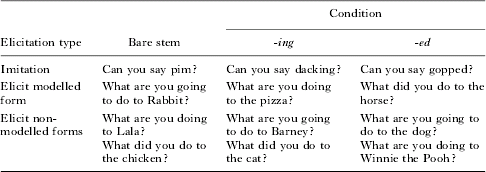
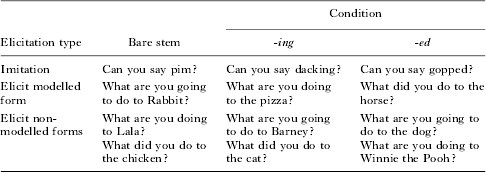
The first of two test sessions began by introducing the three novel verbs along with their associated actions. Each verb was modelled 40 times per session. Verbs were modelled one at a time (in random order). As illustrated in Table 1, the experimenter elicited both imitative and non-imitative uses of the verbs during each session. For each verb, the experimenter asked the child to imitate the modelled form three times, tried to elicit the modelled form three times and attempted to elicit the non-modelled verb forms once each.
Examples of elicitation types in each verb condition of Experiment 1
The second session was identical to the first session; that is, verbs were presented with their actions 40 times each, in the same order and with the same elicitations as in session 1. An assistant filmed the sessions for later coding and kept count of the experimenter's uses of the verbs.
Coding
Of interest was how many times children used non-modelled verb forms (e.g. -ed in the bare stem condition). Each time children used one of the novel verbs, coders categorized it morphologically (i.e. bare, -ing, -ed). Also coded was whether they used the verbs in grammatically appropriate ways (categories included appropriate, inappropriate and ambiguous). Inappropriate uses included dropping -ing or -ed in syntactic contexts calling for an inflected form (e.g. I dack in response to ‘What are you doing to Tinky-Winky?’). Note that uses were considered ambiguous if they consisted of a single word (e.g. pimming), even if the word was in response to a question, thus yielding a conservative estimate of appropriate uses. Both authors and an independent rater coded 20% of the data and agreed on the morphological coding 100% of the time and agreed on appropriateness in 81% of the cases. Disagreements were resolved by discussion.
RESULTS AND DISCUSSION
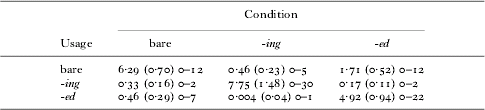
As there were no age differences in any of the three conditions (Fs (1, 22) <3·97, n.s.), Table 2 displays the means in each condition collapsed over age. Children most often used the verbs as they were modelled: -ing was used more than -ed and bare in the -ing condition (Bonferroni comparisons ps<0·001); -ed was used more than -ing and bare in the -ed condition (Bonferroni comparisons, ps<0·03); and bare uses occurred more in the bare stem condition than did -ing and -ed (Bonferroni comparisons, ps<0·001).
Means (standard deviations) and range of frequency of use of novel verbs in Experiment 1 in each condition
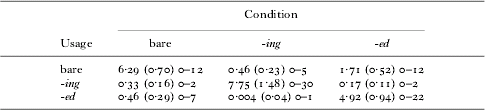
With the exception of the three cells showing mean use of the verbs as modelled, most of the means in Table 2 are based on very little data; that is, most children contributed zeroes to these means. For this reason, the remaining analyses focus on the number of children who showed different patterns of use of the inflections in the various conditions. These analyses examine only non-modelled uses of the novel verbs; that is, adding and dropping of inflections. The first three sections below examine all non-modelled uses, collapsing over appropriateness.
Adding inflections
To determine whether older children were more likely to add verb endings than younger children, we compared the number of younger and older children who added inflections in the bare verb condition. Only one younger child added -ing and none added -ed, whereas four older children added -ing and four added -ed. The age groups did not differ significantly in the number of children who added -ing to a bare stem (Mann–Whitney U=55·5, ns), but significantly more older children added -ed (Mann–Whitney U=48·0, p=0·03). Collapsed over age, children were not more likely to add -ing than -ed to a bare stem verb (Wilcoxon Signed-ranks test z=−0·11, n.s.).
Dropping inflections
More older children (9) dropped -ed, than younger children (3) (Mann–Whitney U=31·5, p=0·02), but there was no difference between age groups in the number of children who dropped -ing (four older children and two younger children; Mann–Whitney U=62·00, n.s.).
In a comparison of the -ed and -ing conditions, children were more likely to drop -ed than -ing (Wilcoxon Signed-ranks test, z=−2·158, p=0·03), but this was true only of the older children (Wilcoxon Signed-ranks test z=−2·16, p=0·03). Younger children did not show this difference (z<1·00). Interestingly, two children in the -ed condition and one in the -ing condition dropped the modelled inflection and added another (e.g. said dacking when dacked was modelled). In sum, dropping -ed was more common than dropping -ing. It is possible that -ed is phonetically more difficult to say than -ing. However, if the issue were purely that the phonology of -ed as a suffix is more difficult than of the suffix -ing, we would expect fewer children to have added -ed than -ing in the bare stem condition; but that was not the case. This is why it is critical to examine the relative number of drops that were appropriate versus inappropriate, which we do after a brief section comparing adding and dropping.
Adding versus dropping
Overall, children dropped inflections more frequently than they added them (Wilcoxon Signed-ranks test z=−2·24, p=0·03), but this result was carried largely by the older group of children. Younger children were equally likely to drop as to add (z<1·00), whereas older children were more likely to drop than add inflections (z=−2·23, p=0·03).
Appropriateness
When children used the verbs as modelled, they used them in a way that was deemed ambiguous 70% of the time (though 87% of ambiguous uses were single-word utterances following the elicitation ‘Can you say......?’). Inappropriate uses of the verbs as modelled were rare (3 uses; less than 1%). Only two children (both older) used the verb inappropriately as modelled. One child used two verbs inappropriately, saying ‘Dacking is where the rabbit lives’, failing to understand that dacking was a verb, and ‘He's gonna gopped him’, neglecting to drop -ed from the verb. The second child inappropriately said ‘I gopped’ in response to the question, ‘What am I doing now?’, simply repeating the phrase she heard the experimenter say earlier without changing the subject to you. The remaining 29% of novel verb uses as modelled were coded as appropriate.
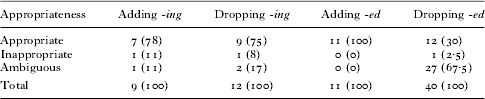
Table 3 presents the frequency of appropriate, inappropriate and ambiguous non-modelled uses of the two inflections. At first sight, the most striking finding is that there were very few clearly inappropriate uses, such that both dropping and adding -ing and -ed appear to reflect a productive understanding of these inflections. The most frequent pattern was dropping -ed; however, it is not clear that these drops can be considered productive as so many were coded as ambiguous. With the exception of dropping -ed, the majority of uses categorized as non-modelled were appropriate.
Number (percentage) of appropriate, inappropriate, and ambiguous non-modelled uses of the inflections
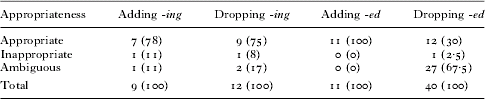
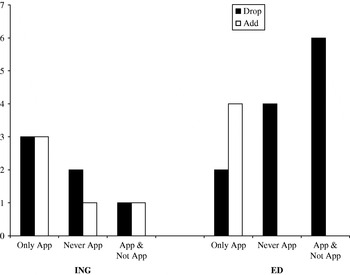
Figure 1 shows the number of children with different patterns of appropriate and inappropriate dropping and adding of the two inflections. All 4 of the children who added -ed always did so appropriately, whereas only 2 of the 12 children who dropped -ed always did so appropriately. Three of the 5 children who added -ing always did so appropriately and 3 of the 6 children who dropped -ing always did so appropriately. Finally, the 3 children who added an inflection after dropping another (e.g. model=dacking, child said dacked) only did so appropriately.
Number of children in Experiment 1 who added and dropped -ing and -ed always appropriately, never appropriately, or both appropriately and inappropriately.

Relations with MLU
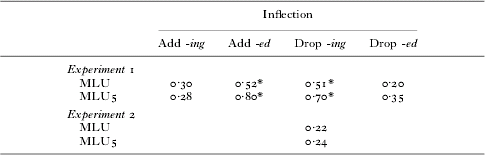
Both measures of MLU distinguished the two age groups. Older children's overall MLU (M=2·48, SD=0·95) was higher than that of younger children (M=1·71, SD=0·84; F(1, 22)=4·36, p=0·05, η=0·17). Older participants' MLU5 was also higher (M=5·37, SD=2·59) than that of younger participants (M=3·08, SD=1·15; F(1, 22)=7·78, p=0·01, η=0·26). As can be seen in Table 4, MLU and MLU5 were both related to ability to add -ed to a novel verb stem. However, the ability to add -ing was not significantly related to MLU or MLU5. In contrast, the dropping of -ing was positively correlated with both MLU measures, whereas dropping -ed was not correlated with MLU5. Thus, children whose overall expressive ability was high were more likely to drop -ing and add -ed; however, expressive ability was unrelated to adding -ing or dropping -ed.
Correlations between Mean Length of Utterance (MLU, two measures) and novel verb use in Experiments 1 and 2
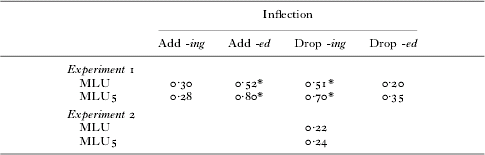
* Correlations were significant at p<0·01.
In summary, there were few age differences. More older than younger children dropped -ed from novel verbs, but dropping -ing or adding either inflection was not related to age. While children dropped -ed more frequently than -ing, overall their adding and dropping of both of these inflections was appropriate about half the time (54% of uses). Children may have dropped -ed more often than they dropped -ing due to a greater difficulty in producing -ed inflections, but we cannot know this for sure, because so many of children's drops of -ed were not codeable as clearly appropriate or inappropriate. Thus, the question of whether phonological difficulty accounts for dropping of -ed requires further testing. Interpreting -ing dropping is less difficult because the majority of drops were appropriate, and because this type of dropping was correlated with MLU. Children with higher MLUs were more likely to drop -ing than children with lower MLUs.
These data suggest that appropriate dropping of -ing may be a valid measure of morphological productivity in two-year-olds. To provide further evidence for this hypothesis, we next examined whether children would drop -ing from nouns as well as verbs. If children are dropping the verbal inflection simply because it is easier to say a verb that is monosyllabic, then they should also drop inflections from two-syllable nouns that end in -ing. In the next study, we tested two-year-olds' tendency to drop -ing from verbs as opposed to nouns. Children were taught novel nouns and verbs ending in -ing and all uses of the novel words were examined.
EXPERIMENT 2
METHOD
Participants
Ten two-year-olds (M=2 ; 3·25, range=1 ; 11–2 ; 7, five females) completed this experiment. Children were recruited from childcare facilities as in Experiment 1. Seven additional children participated but did not complete the experiment: one had a developmental disability and six did not complete all four sessions.
Materials
Children were tested individually and taught novel words to accompany four toys developed especially for this study. The four novel words (dacking, gopping, pimming, tebbing) were associated with two novel objects and two novel actions. The objects were tennis ball sized and had eyes, a mouth and feet. Children heard the nouns used in complete sentences (e.g. ‘Did you hear the dacking squeak?’). The spring prop and the tape-measure prop from Experiment 1 were used. Children heard each verb used in transitive sentences such that either the experimenter or the child was acting on the small toy placed inside either the wooden box or the plastic ring (e.g. ‘See, I'm tebbing Winnie the Pooh’).
Design
Each child participated in both the novel verb condition and the novel noun condition, and the main dependent measure was a dichotic variable that measured whether or not the child dropped the -ing from the novel words in either or both conditions. Assignment of word to condition was counterbalanced across participants.
Procedure
Children were seen individually in a quiet location at their childcare facility. Testing was preceded by a free-play session used to obtain an index of the child's expressive language (MLU) and to familiarize the child with the experimenter and the testing situation. During the free-play session several small toys were introduced to the child as in Experiment 1; this session lasted approximately 15 minutes.
After children had participated in the free-play session, they were seen four times (5 children were seen six times; data are included from only the first two noun and the first two verb sessions for these children). In half of the test sessions, children heard sentences containing novel nouns in reference to the novel objects. The other half of the sessions included sentences that incorporated novel verbs to accompany the novel actions. Sessions were counterbalanced for order of presentation so that half of the children heard novel nouns in the first two sessions, whereas the other children heard novel verbs in the first two sessions.
Each novel word ending in -ing was modelled 40 times per session. An assistant to the experimenter controlled the video camera and kept track of the number of times the experimenter used each word. Children were asked to use the verbs in imitative and non-imitative ways (as in the second column of Table 1). In the case of the nouns, we also wanted to see whether children would ever drop the -ing. However, there was no way to elicit such usage. So, in the interests of providing a similar number of elicitations in both conditions, children were asked to produce a plural in the noun condition (e.g. ‘Look, here's another dacking. Now there are two what?’) at the end of each session, following the 40 models and elicitations of modelled use.
Verbs were always presented in transitive sentence frames as in Experiment 1; several different subjects and objects were used to make the testing session more natural. Nouns were presented as labels for the novel objects. Several sentence frames were used for the noun presentations: as a subject (e.g. ‘The dacking has orange feet.’); as a direct object (e.g. ‘Can you roll the gopping?’); or as part of a prepositional phrase (e.g. ‘What are you doing to the gopping?’). Nouns were not produced in the possessive form so that children would not be exposed to /s/ following the novel noun.
Coding
Free-play sessions were transcribed and the average number of morphemes per utterance (for the first 50 spontaneous utterances, and the five longest of those utterances) was calculated as in Experiment 1 (MLU and MLU5).
Test sessions were transcribed and children's use of the novel words was coded by noting whether children dropped -ing from any of them. In addition, we examined whether children ever used the novel words in ways that were different from the models (e.g. plural for nouns or past tense for verbs). The second author coded these data and 20% of the sessions were coded for reliability by the first author. Agreement was 100%.
RESULTS AND DISCUSSION
Children used the nouns (M=34·50, SD=22·86) and the verbs (M=39·20, SD=32·24) equally frequently (t(9)=0·88, n.s.). Only 7 of them dropped -ing from at least one of the novel words. In all 63 instances they dropped -ing from verbs and not nouns; no child ever dropped -ing from a noun. Fifty-three of these drops (84%) were appropriate, and only three (5%) were inappropriate. A single child who was 2 ; 6 dropped -ing inappropriately three times, saying ‘I'm teb this one,’ ‘We have teb the piggy yet?’ and ‘I'm pim Tinky Winky’. Appropriate drops were roughly equally divided between imperatives and infinitives following another verb (e.g. ‘Dack the dog’ and ‘I'm gonna pim Tinky-Winky now’).
There were seven uses (11%) that were coded as ambiguous because it was unclear whether the child was trying to issue a command (appropriately dropping -ing) or inappropriately answer a question requiring an -ing inflection (e.g. ‘What were you doing to Lala?’, ‘Dack him’). There was no correlation between the number of times -ing was dropped from the verbs and MLU or MLU5 (rs(9)=0·22 and 0·24, n.s., respectively, though sample size was small).
Finally, five of the seven children who dropped -ing from the novel verbs also added a plural -s to the novel nouns. Of the remaining three children, two only used modelled forms and one added -s to the nouns but used the verbs only as modelled. Because children never dropped -ing from the nouns, but readily did so from the verbs, they indicated an understanding that nouns and verbs could be treated differently. Therefore, at this age children appeared to have begun to form a concept of how to treat verbs inflectionally, at least with respect to aspect.
GENERAL DISCUSSION
In these two experiments, we have shown that two-year-olds have some knowledge of how verbal inflection functions. They were not more likely to drop than add -ing, but they were more likely to drop than add -ed. However, because of the high number of ambiguous drops of -ed, it was not clear whether children were dropping -ed mainly appropriately or inappropriately. So it is possible they did so for phonological rather than grammatical reasons. In contrast, in the case of -ing, children seemed to drop the inflection for grammatical reasons. They never dropped -ing from two-syllable nouns, but sometimes did so from two-syllable verbs, almost always appropriately. Unlike in Experiment 1, in Experiment 2 there was no relation between MLU and dropping of -ing. Perhaps this difference was due to the greater sample size and range of ages in Experiment 1, allowing for more variability in overall language ability.
Contrary to Olguin & Tomasello (Reference Olguin and Tomasello1993), these children appeared to have a nascent grammatical category of verb in that they treated novel nouns and verbs differently (i.e. they dropped -ing only from verbs). However, they were conservative overall in their use of verbal inflections in that most of their uses of the novel words replicated the modelled forms. In fact, even with 80 models of a word in the bare stem form, some children did not add any inflection to these forms. Using verbs conservatively early on is consistent with Tomasello's Verb Island Hypothesis (1992), which proposes that until children have gained enough experience with many different verbs, they will only use verbs in ways they have heard them used before.
We recognize that our findings may apply only to English, which is a relatively morphologically sparse language. Other languages such as Hebrew (Berman, Reference Berman and Slobin1985) and Polish (Dabrowska, Reference Dabrowksa2001) are morphologically richer and seem to cause children few problems in learning inflectional morphology. In addition, children learning Spanish – a morphologically rich language – who have Specific Language Impairment have few problems with inflection (Leonard, Reference Leonard, Bishop and Leonard2000). However, it must be noted that, to our knowledge, analogous studies of productivity (adding and dropping inflections) with novel nouns and verbs have not been conducted in these languages. Future studies should examine whether appropriate dropping of inflections emerges earlier in young children learning morphologically rich languages.
This initial study provides support for the idea that children's understanding of grammatical categories may best be thought of as mosaic in nature (Rispoli, Reference Rispoli1991); that is, children gradually become productive with some aspects of grammar before others, rather than acquiring them all simultaneously. At the age of two, children seem to know at least something about dropping and adding verbal inflections appropriately. They understand that one does not drop -ing from nouns but that sometimes it is appropriate to drop -ing from verbs. Their use of verbal morphology was, however, on the whole conservative. And though productivity continues to develop for several years, it is not that at this young age they have not acquired grammatical categories; they are merely incomplete in their understanding of when and how to use these categories.