The brown spruce longhorn beetle, Tetropium fuscum (Fabricius) (Coleoptera: Cerambycidae), is an invasive insect native to Europe that has been established in Nova Scotia, Canada since at least 1990 (Smith and Hurley Reference Smith and Hurley2000). In both Europe and Nova Scotia, it primarily infests spruce, Picea Dietrich (Pinaceae) species, that are stressed, weakened, or of low vigour (Juutinen Reference Juutinen1955; Flaherty et al. Reference Flaherty, Quiring, Pureswaran and Sweeney2013a). Flaherty et al. (Reference Flaherty, Quiring, Pureswaran and Sweeney2013b) showed that adult T. fuscum preferred to land on and lay more eggs on red spruce trees (Picea rubens Sargent) that had been moisture stressed by girdling compared with unmanipulated trees, and further showed that the beetles were more discriminating before they landed on the host than afterward. As larval development rate and survival of T. fuscum were also greater in girdled trees than in healthy trees (Flaherty et al. 2011, Reference Flaherty, Quiring, Pureswaran and Sweeney2013a) the preference for girdled trees supported the preference–performance hypothesis (Jaenike Reference Jaenike1978; Flaherty et al. Reference Flaherty, Quiring, Pureswaran and Sweeney2013b).
Tetropium fuscum also tends to colonise mature trees of large diameter. In Europe, T. fuscum infestation has not been observed in trees smaller than 9 cm in diameter at breast height (Juutinen Reference Juutinen1955) and in Nova Scotia, the mean diameter at breast height of red spruce is significantly larger in trees infested with T. fuscum than in uninfested trees growing on the same site (J.D.S., unpublished data). The positive association observed between host diameter and T. fuscum infestation could result from a preference of foraging females to land on and/or subsequently lay eggs on larger versus smaller diameter trees. Ito (Reference Ito1999) observed greater numbers of adult Semanotus japonica Larcordaire (Coleoptera: Cerambycidae) on larger diameter Japanese cedars, Cryptomeria japonica (Thunberg ex Linnaeus) Don (Cupressaceae), than on smaller ones, and positive correlations between host diameter and oviposition have been recorded for both S. japonica (Shibata et al. Reference Shibata, Waguchi and Yoneda1994) and another cerambycid, Aerenea quadriplagiata Boheman (Riquelme et al. Reference Riquelme, Ansa and Santadino2013). Alternatively, it may be that T. fuscum landing rate and oviposition are random with regard to host diameter, but that larval survival and colonisation success tend to be higher on larger diameter trees because they have more food and space for developing larvae, or that T. fuscum both prefers and performs better on larger diameter hosts. Attack density of the mountain pine beetle, Dendroctonus ponderosae Hopkins (Coleoptera: Curculionidae), increases with host tree diameter (Safranyik and Carroll Reference Safranyik and Carroll2006) and larger diameter trees tend to have thicker phloem that is positively associated with brood survival (Amman Reference Amman1972).
In the current study, we tested the hypothesis that T. fuscum host selection is influenced by host tree diameter by measuring adult landing rate on red spruce trees of varied diameters. We assumed that landing rate on sticky bands indicated pre-alighting host selection for oviposition (Flaherty et al. Reference Flaherty, Quiring, Pureswaran and Sweeney2013b). If the positive association between T. fuscum infestation and host diameter is due to greater attack rate on larger diameter hosts, we predicted a positive relationship between the number of T. fuscum adults landing per sticky band and diameter at breast height. If T. fuscum preferentially and actively selects larger diameter hosts based on visual cues, then we predicted a positive relationship between the number of adults per m2 of sticky band and diameter at breast height.
Our study site was a mature forest dominated by red spruce, balsam fir (Abies balsamea (Linnaeus) Miller (Pinaceae)), and red maple (Acer rubrum Linnaeus (Sapindaceae)), located near Sandy Lake in Bedford, Nova Scotia (44°44'13.74"N, 63°41'30.60"W). On 21 May 2015, near the beginning of the flight period of the beetle, we selected 29 red spruce trees with diameter at breast height ranging from 12.2–37.5 cm, and wrapped a 15.2-cm-wide sticky band (Alpha Scents, Portland, Oregon, United States of America) around the bole of each tree at breast height (1.3 m above the ground). Host diameter near the basal 1–2 m of the stem is particularly relevant to T. fuscum as this is the area of the tree that is most often colonised by the beetle (Juutinen Reference Juutinen1955). All trees had full green crowns and no sign of infestation by T. fuscum (e.g., unexplained resinosis, exit holes on the main stem) and were within a total area of ~1.5 ha. On each tree, we pruned three to five branches from the basal 1.3 m to allow easier attachment of the sticky band. We also baited each tree with the same three lures used to bait traps for T. fuscum surveys: (1) a rubber septum emitting racemic fuscumol at ~1 mg/day (Sylvar Technologies, Fredericton, New Brunswick, Canada); (2) a brown spruce longhorn beetle kairomone lure emitting a blend of five spruce monoterpenes (Sweeney et al. Reference Sweeney, Gutowski, Price and de Groot2006) at ~2000 mg/day (Scotts Canada; Delta, British Columbia, Canada); and an ethanol lure with a release rate of ~275 mg/day (Scotts Canada). (S)-fuscumol (2S,5E)-6, 10-dimethyl-5,9-undecadien-2-ol, or “fuscumol”, is the aggregation pheromone emitted by male T. fuscum that attracts both sexes when combined with the volatiles emitted by stressed host trees (spruce monoterpenes and ethanol) (Silk et al. Reference Silk, Sweeney, Wu, Price, Gutowski and Kettela2007; Sweeney et al. Reference Sweeney, Silk, Gutowski, Wu, Lemay, Mayo and Magee2010). We baited the trees to increase overall landing rates and to try to make them equally attractive to T. fuscum in terms of olfactory cues, thereby increasing the probability that any discrimination among trees would be based on visual stimuli such as tree diameter.
Sticky bands were checked every two weeks between 21 May and 26 August 2015. On each check, all Tetropium adults were counted and removed from sticky bands using forceps and transported in centrifuge tubes to the Atlantic Forestry Centre in Fredericton, New Brunswick, Canada for identification to species and sex. On 18 September 2015, a 0.52-cm-diameter core sample was taken from the north and south side of each tree with an increment borer. Mean phloem thickness between cores was measured on site with a digital vernier caliper.
Simple linear regressions were used to evaluate the relationship between diameter at breast height and (1) phloem thickness, (2) total number of T. fuscum adults per sticky band, and (3) total number of T. fuscum adults per m2 of sticky band. Full factorial analyses of covariance (SAS: PROC GLM) (SAS Institute 2008) were used to test whether the slopes of the regressions between landing rate (per sticky band and per m2 sticky band) and diameter at breast height differed between males and females. The residuals of each regression were checked for normality by examining scatterplots and histograms and by the Shapiro–Wilk test (SAS: PROC Univariate); residuals did not depart significantly from normality for any regression (P=0.25–0.97). A χ2 test with Yates’ correction for continuity was used to test whether the sex ratio departed significantly from a 1:1 ratio (Zar Reference Zar1999).
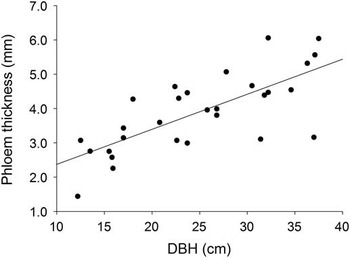
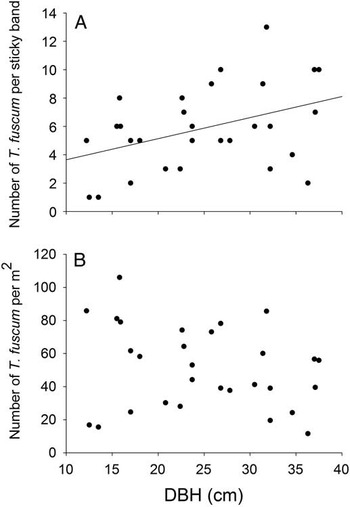
In total, 170 T. fuscum were captured; 92 were female, 66 were male, and the sex of 12 could not be identified due to missing or damaged genitalia, likely caused by predation. The sex ratio was significantly female biased (χ2=3.96, P<0.05), as previously observed in traps baited with the same lures, i.e., fuscumol, spruce monoterpenes and ethanol (Sweeney et al. Reference Sweeney, Silk, Gutowski, Wu, Lemay, Mayo and Magee2010). Phloem thickness increased significantly with tree diameter at breast height (F(1,27)=31.3, P<0.0001, r 2=0.54) (Fig. 1). There was also a positive linear relationship between the total number of T. fuscum adults per sticky band and tree diameter at breast height (F(1,27)=5.4, P<0.05, r 2=0.16) (Fig. 2A), and the slopes of the regression did not differ significantly between sexes (F(1,27)=0.07, P=0.80). However, the regression between the number of T. fuscum per m2 of sticky band and diameter at breast height was not significant for either sex (F(1,27)=0.67–0.81, P>0.38) or when sexes were pooled (F(1,27)=1.49, P=0.23, r 2=0.05) (Fig. 2B).
Phloem thickness versus diameter at breast height (DBH) of red spruce near Sandy Lake, Nova Scotia in 2016 (F(1,27)=31.3; df=1, 27; P<0.0001, r 2=0.54).

The number of Tetropium fuscum adults collected on sticky bands versus diameter at breast height (DBH) of red spruce trees baited with fuscumol and host kairomones, near Sandy Lake, Nova Scotia from May to August 2016. (A) Number per sticky band (F(1,27)=5.4; df=1, 27; P=0.028; r 2=0.17). (B) Number per m2 surface area of sticky band (F(1,27)=1.49; df=1, 27; P=0.23; r 2=0.05).

The positive relationship between the number of T. fuscum landing per sticky band and host diameter at breast height is consistent with our hypothesis that host diameter positively influences the number of T. fuscum landing per tree and may partially explain the positive association between infestation and host tree diameter. Furthermore, the significant positive linear relationship between phloem thickness and tree diameter at breast height indicates that, all other things being equal, larger diameter red spruce should contain more food as well as more space for developing T. fuscum larvae, and that preference for larger diameter hosts may be adaptive. However, we found no evidence for diameter-based host selection by T. fuscum. The regression between number of T. fuscum landing per m2 and diameter at breast height was not significant, suggesting the positive relationship between landing rate and host diameter was not due to any active preference or selection of larger diameter trees by the beetles. Our results suggest instead that larger diameter trees are more likely to intercept airborne beetles than are smaller diameter trees, simply due to their greater surface area. Other host factors, such as tree condition and associated pre-alighting olfactory cues, which may be correlated with tree diameter, likely have a much greater effect on T. fuscum host selection than visual cues associated with tree diameter (Flaherty et al. Reference Flaherty, Quiring, Pureswaran and Sweeney2013b).
Acknowledgements
The authors thank Halifax Regional Municipality and John Simmons for granting them permission to work in the Sandy Lake forest in Bedford, Nova Scotia; Kate Van Rooyen, Cory Hughes, and Mary Luco for technical assistance; Leah Flaherty, Rob Johns, and two anonymous reviewers for helpful comments on earlier versions of the manuscript; and the Forest Invasives Alien Species Project of Natural Resources Canada and the Canadian Forest Service for funding.