Introduction
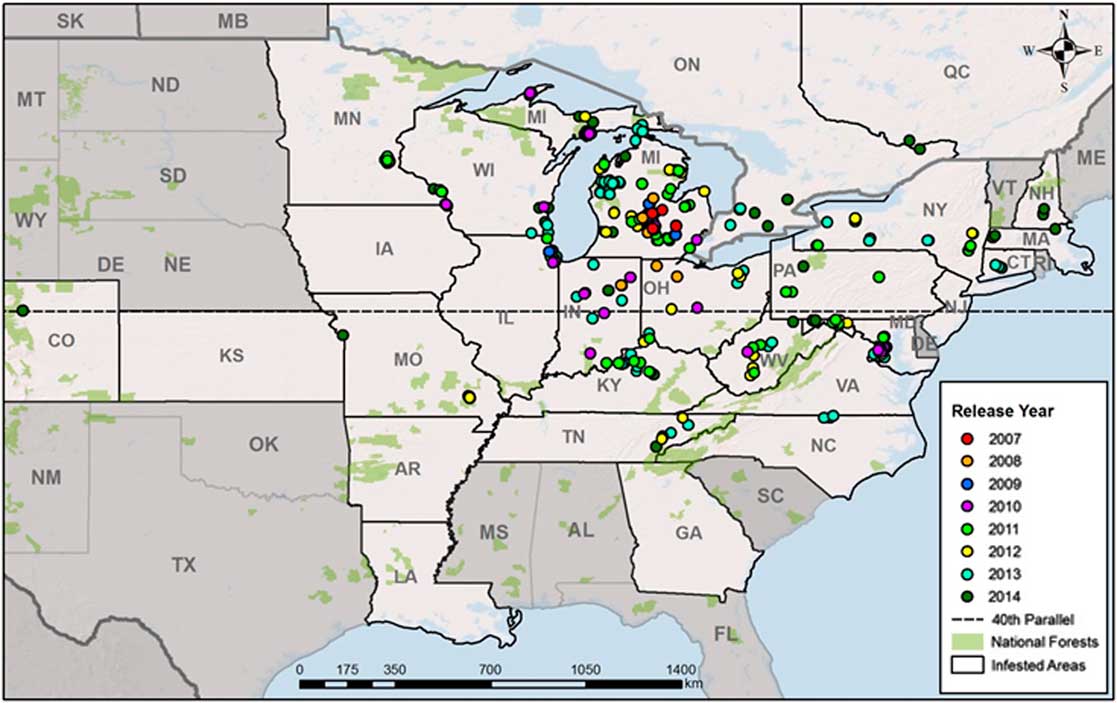
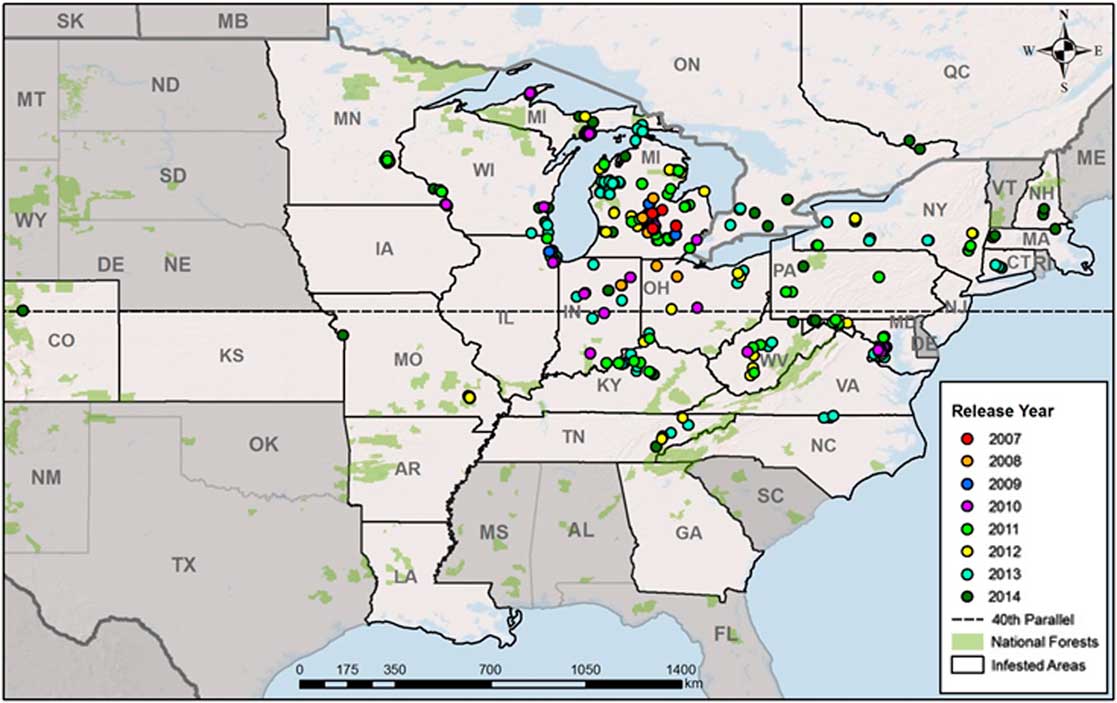
The emerald ash borer (EAB), Agrilus planipennis Fairmaire (Coleoptera: Buprestidae), is an invasive phloem-feeding beetle from Asia that attacks and kills ash trees (Fraxinus Linnaeus; Oleaceae) in North America. First discovered in Michigan, United States of America and nearby Ontario, Canada in 2002, EAB was accidentally introduced from China during the 1990s, presumably in solid-wood packaging materials (Haack et al. Reference Haack, Jendek, Liu, Marchant, Petrice and Poland2002; Cappaert et al. Reference Cappaert, McCullough, Poland and Siegert2005; Bray et al. Reference Bray, Bauer, Poland, Haack, Cognato and Smith2011; Keever et al. Reference Keever, Nieman, Ramsay, Ritland, Bauer and Lyons2013; Siegert et al. Reference Siegert, McCullough, Liebhold and Telewski2014). Soon after the discovery of this invasive pest, regulatory agencies began surveying for EAB infestations, establishing quarantines, and initiating eradication activities (Federal Register 2003; Poland and McCullough Reference Poland and McCullough2006; Herms and McCullough Reference Herms and McCullough2014). However, efforts to eradicate EAB were eventually abandoned due to limited efficacy of EAB-surveillance tools, long-distance human-mediated movement of EAB, and natural dispersal of EAB through flight (Federal Register 2003; Cappaert et al. Reference Cappaert, McCullough, Poland and Siegert2005; Government Accounting Office 2006; Taylor et al. Reference Taylor, Bauer, Poland and Windell2010; Canadian Food Inspection Agency 2014; United States Department of Agriculture, Animal and Plant Health Inspection Service (APHIS) 2014). As of February 2015, EAB is known to infest trees in 25 states in the United States of America (Arkansas, Colorado, Connecticut, Georgia, Illinois, Indiana, Iowa, Kansas, Kentucky, Louisiana, Maryland, Massachusetts, Michigan, Minnesota, Missouri, New Hampshire, New Jersey, New York, North Carolina, Ohio, Pennsylvania, Tennessee, Virginia, West Virginia, and Wisconsin) and two Canadian provinces (Ontario and Québec) (Fig. 1).
Known distribution of emerald ash borer, Agrilus planipennis, in North America as of February 2015, and the locations of EAB biocontrol agents, Oobius agrili, Tetrastichus planipennisi, and Spathius agrili, introduced to North America from China from 2007 to 2014. Service layer credits: United States National Park Service. Data sources: United States Department of Agriculture, Animal and Plant Health Inspection Service; Canadian Food Inspection Agency; and www.mapbiocontrol.org. Map created by Applied Spatial Ecology and Technical Services, Department of Entomology, Michigan State University (East Lansing, Michigan, United States of America).
Natural enemy surveys of EAB populations are conducted to understand the population dynamics of EAB in North America. Although a variety of native mortality factors, including woodpeckers, insect predators, hymenopteran parasitoids, and fungal pathogens have been found to prey on EAB at high densities, their impacts are lower than that experienced by native Agrilus Curtis species and insufficient to regulate EAB in indigenous ash species (Loerch and Cameron Reference Loerch and Cameron1983; Lindell et al. Reference Lindell, McCullough, Cappaert, Apostolou and Roth2008; Bauer et al. Reference Bauer, Liu, Miller and Gould2008, Reference Bauer, Duan and Gould2014; Cappaert and McCullough Reference Cappaert and McCullough2009; Duan et al. Reference Duan, Fuester, Wildonger, Taylor, Barth and Spichiger2009, Reference Duan, Ulyshen, Bauer, Gould and Van Driesche2010, Reference Duan, Bauer, Abell and Van Driesche2012a, Reference Duan, Taylor, Fuester, Kula and Marsh2013b, Reference Duan, Abell, Bauer, Gould and Van Driesche2014a; Jennings et al. Reference Jennings, Gould, Vandenberg, Duan and Shrewsbury2013; Bauer et al. Reference Bauer, Duan and Gould2014). In Asia, where EAB, insect natural enemies, and Asian ash species co-evolved, however, researchers are finding host-specific parasitoids that are capable of suppressing EAB populations to tolerable levels (Liu et al. Reference Liu, Bauer, Gao, Zhao, Petrice and Haack2003, Reference Liu, Bauer, Miller, Zhao, Gao and Song2007; Bauer et al. Reference Bauer, Liu, Miller and Gould2008; Rebek et al. Reference Rebek, Herms and Smitley2008; Duan et al. Reference Duan, Yurchenko and Fuester2012c).
Classical biological control, a long-range and sustainable approach to pest management, involves the introduction and establishment of natural enemies from the native range of an invasive pest. Before initiating a classical biological control programme, however, researchers compare mortality factors of the pest in newly invaded areas to regions where it originated. Herein, we provide an overview of the developing classical biological control programme for EAB that began with the first introductions of EAB parasitoids from China to the United States of America in 2007 (Federal Register 2007; Bauer et al. Reference Bauer, Liu, Miller and Gould2008, Reference Bauer, Duan and Gould2014, 2015) and Canada in 2013 (Canadian Food Inspection Agency 2014).
Natural enemies of EAB in North America
Soon after EAB was discovered in North America in 2002, natural enemy surveys began in Michigan, Ontario, and other regions. Woodpeckers, which forage on immature wood-boring insects under tree bark, are the dominant natural enemy of EAB throughout infested areas of North America. For example, woodpecker predation on individual trees, accounted for up to 95% EAB larval mortality (Cappaert et al. Reference Cappaert, McCullough, Poland and Siegert2005), although mortality rates generally averaged 35–40% (Anulewicz et al. Reference Anulewicz, McCullough and Cappaert2007; Lindell et al. Reference Lindell, McCullough, Cappaert, Apostolou and Roth2008; Duan et al. Reference Duan, Bauer, Abell and Van Driesche2012a, Reference Duan, Abell, Bauer, Gould and Van Driesche2014a; Jennings et al. Reference Jennings, Gould, Vandenberg, Duan and Shrewsbury2013). In a separate study of bird populations in the vicinity of older EAB infestations in the United States of America, Koenig et al. (Reference Koenig, Liebhold, Bonter, Hochachka and Dickinson2013) reported higher populations of certain woodpecker and other bird species following the EAB invasion. A diversity of entomopathogenic fungi are also found as natural enemies of EAB larvae, with an average 2% rate of infection at field sites in southeast Michigan (Liu and Bauer Reference Liu and Bauer2006; Castrillo et al. Reference Castrillo, Bauer, Houping, Griggs and Vandenberg2010).
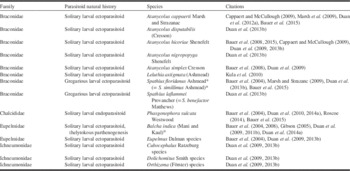
Field studies of native insect natural enemies attacking EAB larvae in the United States of America and Canada reveal a diversity of hymenopteran parasitoids; however, their combined prevalence is generally low (<1–5%), and no native egg parasitoids have been reported (Table 1) (Bauer et al. Reference Bauer, Duan, Lelito, Liu and Gould2015). These parasitic Hymenoptera are more specific to niche than to host, generally attacking larvae of the larger species of Agrilus (Taylor et al. Reference Taylor, Duan, Fuester, Hoddle and Van Driesche2012; Bauer et al. Reference Bauer, Duan and Gould2014). Much of the research on EAB natural enemies has been done in Michigan (Cappaert and McCullough Reference Cappaert and McCullough2009; Tluczek et al. Reference Tluczek, Cappaert and McCullough2010; Bauer et al. Reference Bauer, Duan and Gould2014) although similar work has been done in Pennsylvania (Duan et al. Reference Duan, Fuester, Wildonger, Taylor, Barth and Spichiger2009; Reference Duan, Taylor, Fuester, Kula and Marsh2013b), Ohio (Kula et al. Reference Kula, Knight, Rebbeck, Cappaert, Bauer and Gandhi2010), and Ontario (Roscoe Reference Roscoe2014). In southeast Michigan, several species of predaceous Coleoptera in the genera Enoclerus Gahan (Coleoptera: Cleridae), Catogenus Westwood (Passandridae), and Tenebroides Latreille (Coleoptera: Trogossitidae) were found under the bark of ash trees heavily infested by EAB; the larvae and adults of these coleopteran predators were confirmed to prey on EAB larvae in the laboratory (Bauer et al. Reference Bauer, Liu, Haack, Miller and Petrice2004).
Indigenous or naturalised parasitic Hymenoptera known to attack emerald ash borer, Agrilus planipennis, larvae in North America before introduction of the three classical biological control agents from China.

* Differences in natural history and genetics indicate that S. floridanus and S. simillimus are distinct species (Bauer et al. Reference Bauer, Duan, Lelito, Liu and Gould2015).
≅ Inadvertently introduced from southeast Asia and naturalised in the eastern United States of America.
Of the native parasitic Hymenoptera attacking EAB larvae in North America (Table 1), solitary ectoparasitoids in the genus Atanycolus Förster (Hymenoptera: Braconidae) and the solitary endoparasitoid Phasgonophora sulcata Westwood (Hymenoptera: Chalcididae), are the most common (Bauer et al. Reference Bauer, Liu, Miller and Gould2008, Reference Bauer, Duan, Lelito, Liu and Gould2015; Duan et al. Reference Duan, Fuester, Wildonger, Taylor, Barth and Spichiger2009, Reference Duan, Taylor, Fuester, Kula and Marsh2013b). Some species of Atanycolus and P. sulcata, however, are responding numerically to increasing EAB populations at some sites in Michigan (Cappaert and McCullough Reference Cappaert and McCullough2009; Duan et al. Reference Duan, Abell, Bauer, Gould and Van Driesche2014a). Other less common larval parasitoids include gregarious ectoparasitoids in the genus Spathius Nees (Hymenoptera: Braconidae) and several solitary ectoparasitoid species including Leluthia astigma (Ashmead) (Hymenoptera: Braconidae) (Kula et al. Reference Kula, Knight, Rebbeck, Cappaert, Bauer and Gandhi2010) and species of Eupelmus Dalman (Hymenoptera: Eupelmidae), Eurytoma Illiger (Hymenoptera: Eurytomidae), and Dolichomitus Smith (Hymenoptera: Ichneumonidae) (Duan et al. Reference Duan, Fuester, Wildonger, Taylor, Barth and Spichiger2009, Reference Duan, Taylor, Fuester, Kula and Marsh2013b). Emerald ash borer larvae are also parasitised sporadically by the solitary larval ectoparasitoid Balcha indica (Mani and Kaul) (Hymenoptera: Eupelmidae), which was inadvertently introduced to North America from southeast Asia. This exotic parasitoid is now naturalised in the eastern United States of America and attacks the larvae of several woodboring Coleoptera (Bauer et al. Reference Bauer, Liu, Haack, Miller and Petrice2004; Gibson Reference Gibson2005; Duan et al. Reference Duan, Fuester, Wildonger, Taylor, Barth and Spichiger2009, Reference Duan, Taylor and Fuester2011c, Reference Duan, Abell, Bauer, Gould and Van Driesche2014a).
Natural history of key EAB parasitoids native to North America
Five species of native braconids in the genus Atanycolus are known to parasitise EAB larvae (Bauer et al. Reference Bauer, Liu, Haack, Miller and Petrice2004, Reference Bauer, Liu, Miller and Gould2008, Reference Bauer, Duan and Gould2014, Reference Bauer, Duan, Lelito, Liu and Gould2015; Duan et al. Reference Duan, Fuester, Wildonger, Taylor, Barth and Spichiger2009, Reference Duan, Ulyshen, Bauer, Gould and Van Driesche2010, Reference Duan, Bauer, Abell and Van Driesche2012a, Reference Duan, Taylor, Fuester, Kula and Marsh2013b, Reference Duan, Abell, Bauer, Gould and Van Driesche2014a; Cappaert and McCullough Reference Cappaert and McCullough2009; Marsh et al. Reference Marsh, Strazanac and Laurusonis2009) (Table 1). These relatively large wasps are solitary, ectoparasitic idiobionts of late-instar Agrilus larvae, with one or two generations per year. The natural history of A. cappaerti Marsh and A. hicoriae Shenefelt are synchronised with the one-year or two-year life cycle of EAB in Michigan (Cappaert and McCullough Reference Cappaert and McCullough2009; Marsh et al. Reference Marsh, Strazanac and Laurusonis2009). Although parasitism of EAB larvae by native parasitoids is generally low, A. cappaerti proved to be capable of significant parasitism in some heavily infested ash trees in Michigan; it also parasitises native Agrilus species in other host trees (Cappaert and McCullough Reference Cappaert and McCullough2009).
Another increasingly important native parasitoid of EAB larvae in eastern North America is P. sulcata, a solitary, endoparasitic koinobiont also known to parasitise the larvae of native Agrilus species (Barter Reference Barter1957, Reference Barter1965; Côté and Allen Reference Côté and Allen1980; Haack et al. Reference Haack, Benjamin and Schuh1981; Bauer et al. Reference Bauer, Liu, Haack, Miller and Petrice2004, Reference Bauer, Duan and Gould2014, Reference Bauer, Duan, Lelito, Liu and Gould2015; Duan et al. Reference Duan, Bauer, Abell and Van Driesche2012a, Reference Duan, Abell, Bauer, Gould and Van Driesche2014a; Roscoe Reference Roscoe2014). In Michigan, P. sulcata adults oviposit in young EAB larvae in July and August, their larvae develop in the posterior hemocoel of EAB larvae, and pupation occurs after one or two years during the host prepupal period (L.S.B. and J.J.D., personal observation).
Insect natural enemies of EAB in Eurasia
Native range of EAB in Asia
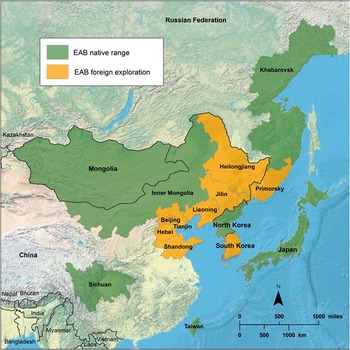
Less than a decade before EAB was discovered in North America, Agrilus planipennis (type locality in China) was synonymised with Agrilus feretrius Obenberger (type locality in Taiwan), Agrilus marcopoli Obenberger (type locality in Mongolia), and Agrilus marcopoli ulmi Kurosawa (type locality in Japan), leading to a known native range extending throughout China, Japan, Korea, Mongolia, the Russian Far-East, and Taiwan (Yu Reference Zhang, Chen, Yang, Huang and Huang1992; Jendek Reference Jendek1994; Jendek and Grebennikov Reference Jendek and Grebennikov2011) (Fig. 2). Although Fraxinus species were the only larval hosts reported for A. planipennis in China (Yu Reference Zhang, Chen, Yang, Huang and Huang1992; Liu et al. Reference Liu, Bauer, Gao, Zhao, Petrice and Haack2003; Zhao et al. Reference Zhao, Gao, Liu, Bauer and Sun2005), larval host records for A. marcopoli and A. marcopoli ulmi in Korea and Japan included Juglans, Pterocarya, and Ulmus (Ko Reference Ko1969; Akiyama and Ohmomo Reference Akiyama and Ohmomo1997).
Known native range of emerald ash borer, Agrilus planipennis, in Asia and other regions where foreign exploration for EAB natural enemies has occurred since 2003. Service layer credits: United States National Park Service. Data source: https://sites.google.com/site/eduardjendek/world-distribution-of-agrilus-planipennis. Map created by United States Department of Agriculture, Forest Service, Northeastern Area State and Private Forestry, Office of Knowledge Management (Durham, New Hampshire, United States of America).

At that time, only limited literature on EAB was available, mainly from China, where EAB was considered a minor and periodic pest of native Fraxinus chinensis Roxburgh and F. mandshurica Ruprecht (Yu Reference Zhang, Chen, Yang, Huang and Huang1992; Liu et al. Reference Liu, Ma and Li1996). However, there were also reports of EAB outbreaks in F. velutina Torrey, an ash species native to North America and widely planted for landscape in the region of Tianjin, China (Zhang et al. Reference Zhang, Huang, Zhao, Liu and Bauer1995; Liu et al. Reference Liu, Ma and Li1996). Emerald ash borer was also known from the provinces of Hebei, Heilongjiang, Inner Mongolia, Jilin, Liaoning, and Shandong, China (Chinese Academy of Science 1986); more recently, EAB was reported from Sichuan province (Jendek and Grebennikov Reference Jendek and Grebennikov2011) (Fig. 2).
Foreign exploration for EAB natural enemies in Asia
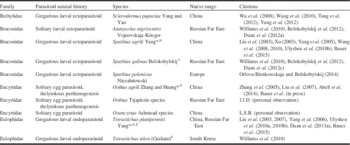
In 2003, foreign exploration for insect natural enemies of EAB began in China when researchers began surveying ash trees in the provinces of Hebei, Heilongjiang, Jilin, Liaoning, Tianjin, and Shandong, and the cities of Beijing and Tianjin (Liu et al. Reference Liu, Bauer, Gao, Zhao, Petrice and Haack2003) (Fig. 2). During this survey, EAB infestations were found in each region except Shandong, and higher EAB densities were consistently found in North American ash species growing in China than in native Asian species (Zhao et al. Reference Zhao, Gao, Liu, Bauer and Sun2005). Additional foreign exploration for EAB natural enemies was done in areas of South Korea (Williams et al. Reference Williams, Lee and Jo2005, Reference Williams, Lee, Jo, Yurchenko and Mastro2006, Reference Wu, Wang, Li, Yang, Zeng and Wang2010), the Russian Far East (Williams et al. Reference Wu, Wang, Li, Yang, Zeng and Wang2010; Duan et al. Reference Duan, Yurchenko and Fuester2012c), and more recently in European Russia, subsequent to EAB’s discovery near Moscow, Russia (Orlova-Bienkowskaja and Belokobylskij Reference Orlova-Bienkowskaja and Belokobylskij2014) (Table 2).
Parasitic Hymenoptera attacking emerald ash borer, Agrilus planipennis, in Asia and Europe, and classical biological control agents in North America.

* Releases began for EAB biocontrol in the United States of America in 2007.
≅ Approved for EAB biocontrol in Canada in 2013; only T. planipennisi is being released in northern regions.
⊥ Pending approval in the United States of America, releases for EAB biocontrol may begin in 2015
§ Establishment and spread is confirmed in the United States of America.
|| Tentative identification.
Insect natural enemies of EAB in Asia
After a decade of field research in northeast China (2003–2013), the dominant insect natural enemies of EAB discovered were the larval parasitoid Tetrastichus planipennisi Yang (Hymenoptera: Eulophidae) and the egg parasitoid Oobius agrili Zhang and Huang (Hymenoptera: Encyrtidae) (Table 2). These two species were reared from EAB-infested Asian and North American ash trees in Beijing, and Hebei, Heilongjiang, Jilin, Liaoning provinces (Liu et al. Reference Liu, Bauer, Gao, Zhao, Petrice and Haack2003; Zhang et al. Reference Zhao, Gao, Liu, Bauer and Sun2005; Yang et al. Reference Yu2006; Bauer et al. Reference Bauer, Duan and Gould2014, Reference Bauer, Duan, Lelito, Liu and Gould2015; L.S.B. and J.J.D., personal observation) (Fig. 2). In a study of EAB population dynamics (2004–2005) in Jilin province, Liu et al. (Reference Liu, Bauer, Miller, Zhao, Gao and Song2007) reported the phenology of T. planipennisi and O. agrili to be closely synchronised with the life cycle of EAB and estimated that the combined larval and egg parasitism reduced EAB densities by 74%. The only other egg parasitoid reared from EAB eggs was an undescribed species of Ooencyrtus Ashmead (Hymenoptera: Encyrtidae) (a single adult female) from Jilin province; EAB egg parasitism was confirmed in the laboratory with the successful emergence of an adult male (L.S.B., personal observation).
In the port city of Tianjin southeast of Beijing, the larval parasitoid Spathius agrili Yang (Hymenoptera: Braconidae) attacks EAB infesting North American F. velutina planted as plantation and landscape trees, with an average parasitism rates of 30–50% (Liu et al. Reference Liu, Bauer, Gao, Zhao, Petrice and Haack2003; Xu Reference Yang, Achterberg, Choi and Marsh2003; Yang et al. Reference Yang, Wang, Gould and Wu2005) (Fig. 2). Also in Tianjin, a generalist parasitoid of woodborer larvae and pupae, Sclerodermus pupariae Yang and Yao (Hymenoptera: Bethylidae), parasitises up to 13% of EAB (Yang et al. Reference Yang, Yao and Wang2012).
In the Russian Far East in the region of Primorsky near Vladivostok, Duan et al. (Reference Duan, Bauer, Abell and Van Driesche2012a) reported three species of larval parasitoids: T. planipennisi, Spathius galinae Belokobylskij (Hymenoptera: Braconidae) (Belokobylskij et al. Reference Belokobylskij, Yurchenko, Zaldívar-Riverón, Strazanac and Mastro2012), and Atanycolus nigriventris Vojnovskaja-Krieger (Hymenoptera: Braconidae) and an egg parasitoid, undescribed in the genus Oobius Trjapitzin (Hymenoptera: Encyrtidae) (Fig. 2) (Table 2). Spathius galinae and a species of Tetrastichus, tentatively identified as T. telon (Graham), were also reported attacking EAB in South Korea (Williams et al. Reference Wu, Wang, Li, Yang, Zeng and Wang2010). In European Russia, near Moscow another larval parasitoid, Spathius polonicus Niezabitowski (Hymenoptera: Braconidae) known to attack woodborers in Europe, was recently discovered parasitising EAB (Orlova-Bienkowskaja and Belokobylskij Reference Orlova-Bienkowskaja and Belokobylskij2014).
Natural history and host range studies of key EAB biocontrol agents
Tetrastichus planipennisi.
A gregarious endoparasitic koinobiont of EAB larvae, T. planipennisi was discovered in 2003 during the initial foreign exploration for EAB and its natural enemies in northeast China (Liu et al. Reference Liu, Bauer, Gao, Zhao, Petrice and Haack2003; Yang et al. Reference Yu2006). In Jilin province, the adults begin emerging in May, up to four generations may be completed during each year, and mature larvae or prepupae overwinter in host galleries (Liu et al. Reference Liu, Bauer, Miller, Zhao, Gao and Song2007; Ulyshen et al. Reference Ulyshen, Duan and Bauer2010a; Duan et al. Reference Duan, Oppel, Ulyshen, Bauer and Lelito2011b; Bauer et al. Reference Bauer, Duan, Lelito, Liu and Gould2015).
Following importation of T. planipennisi from Jilin province to the United States Department of Agriculture Forest Service quarantine laboratory in East Lansing, Michigan, a breeding colony was developed in EAB larvae. The host specificity of T. planipennisi was evaluated with paired no-choice assays using EAB larvae as positive controls (Badendreier et al. Reference Badendreier, Bilger and Kuhlmann2005; Federal Register 2007; Bauer et al. Reference Bauer, Duan and Gould2014). The larvae of 14 species of wood-boring insects, including eight species of Buprestidae (Coleoptera) (five of Agrilus Curtis and three of Chrysobothris Eschscholtz), five species of Cerambycidae (Coleoptera) (one each of Neoclytus Thomson, Megacyllene Casey, Astylopsis Casey, Monochamus Megerle, and an unknown cerambycid from apple), and one species of wood-boring sawfly (Janus abbreviates (Say); Hymenoptera: Cephidae), were tested in their respective host plants. Larvae of non-wood-boring insects were also tested after they were inserted into ash branches, including one beetle in the family Tenebrionidae (Coleoptera) and two moths, one each in Pyralidae and Sphinghidae (Lepidoptera). Overall, T. planipennisi parasitised only the larvae of EAB. After careful risk-benefit analyses in 2006, the North American Plant Protection Organization (NAPPO) approved the release of T. planipennisi as an EAB biocontrol agent in North America, and in 2007, United States Department of Agriculture, APHIS issued permits for its environmental release in Michigan (Federal Register 2007; Bauer et al. Reference Bauer, Liu, Miller and Gould2008, Reference Bauer, Duan and Gould2014, Reference Bauer, Duan, Lelito, Liu and Gould2015).
Oobius agrili.
A solitary egg parasitoid, O. agrili reproduces through thelytokous parthenogenesis and was first reared from EAB eggs collected in Jilin province, China in 2004 (Zhang et al. Reference Zhao, Gao, Liu, Bauer and Sun2005). In this region of China, O. agrili adults emerge from parasitised EAB eggs in late June (Liu et al. Reference Liu, Bauer, Miller, Zhao, Gao and Song2007). After emergence, these tiny wasps parasitise EAB eggs laid on the bark of ash trees. The first generation of O. agrili takes about a month, and wasps complete one or more generations during summer and early fall, when EAB egg parasitism peaks. This parasitoid spends the winter as diapausing mature larvae or prepupae inside EAB eggs until the following June when EAB oviposition begins (Liu et al. Reference Liu, Bauer, Miller, Zhao, Gao and Song2007; Bauer et al. Reference Bauer, Duan, Lelito, Liu and Gould2015).
Eggs of EAB from Jilin province, some parasitised with O. agrili, were imported to the United States Department of Agriculture, Forest Service quarantine laboratory in Michigan from 2004 to 2009. These were used to develop colonies of O. agrili using laboratory-reared EAB eggs. Although males were occasionally reared from EAB eggs collected in China, only females were used to establish the laboratory colonies. Host specificity was tested by exposing the eggs of other insect species, on branches of their respective host trees, to adult O. agrili in no-choice assays and paired-choice assays, with EAB eggs on ash used as positive controls (Badendreier et al. Reference Badendreier, Bilger and Kuhlmann2005; Federal Register 2007; Bauer et al. Reference Bauer, Duan and Gould2014). Six species of buprestids in the genus Agrilus and two species of cerambycids were reared in the laboratory and eggs, laid on their respective hosts, were exposed to adult O. agrili. Similarly exposed were the eggs of four Lepidoptera species that had been laid on ash branches from the following families: Bombycidae, Pieridae, Sphingidae, and Tortricidae. In no-choice tests, researchers found O. agrili parasitised only eggs of the three largest Agrilus species (A. anxius Gory, A. bilineatus (Weber), and A. ruficollis (Fabricius)), each with eggs similar in size to EAB eggs. To further evaluate parasitoid host preferences, paired-choice assays were conducted by exposing O. agrili adults to the eggs of EAB on ash and the eggs of the above mentioned species on their respective hosts (A. anxius on Betula pendula Roth (Betulaceae), A. bilineatus on Quercus rubra Linnaeus (Fagaceae), or A. ruficollis on Rubus Linnaeus (Rosaceae)). In paired choice tests, O. agrili showed a consistent preference for EAB eggs on ash versus the eggs of these three Agrilus species on their host plants. Due to the known risk of EAB to ash in North America, NAPPO also approved the release of O. agrili as an EAB biocontrol agent in 2006, and United States Department of Agriculture, APHIS issued permits for its release to start in Michigan in 2007 (Federal Register 2007; Bauer et al. Reference Bauer, Liu, Miller and Gould2008, Reference Bauer, Duan and Gould2014, Reference Bauer, Duan, Lelito, Liu and Gould2015).
Spathius agrili.
Spathius agrili, a gregarious ectoparasitic idiobiont of late-instar EAB larvae, was the most abundant natural enemy of EAB found in the region of Tianjin, China (Liu et al. Reference Liu, Bauer, Gao, Zhao, Petrice and Haack2003; Xu Reference Yang, Achterberg, Choi and Marsh2003; Yang et al. Reference Yang, Wang, Gould and Wu2005). It overwinters as mature larvae or prepupae inside silken cocoons in EAB host galleries, emerges in July and August with a female:male sex ratio of 4:1, and completes one or two generations per year in this region of China (Wang et al. Reference Wang, Yang, Wu and Gould2006, Reference Williams, Lee and Jo2008; Gould et al. Reference Gould, Ayer and Fraser2011; Bauer et al. Reference Bauer, Duan, Lelito, Liu and Gould2015).
Laboratory colonies of S. agrili from Tianjin were reared in EAB larvae at the Chinese Academy of Forestry in Beijing China and in a quarantine laboratory at the United States Department of Agriculture, APHIS laboratory in Buzzards Bay, Massachusetts (Wang et al. Reference Williams, Lee and Jo2008; Yang et al. Reference Yang, Wang, Yao, Gould and Cao2008; Gould et al. Reference Gould, Ayer and Fraser2011). At both laboratories, similar no-choice tests of S. agrili host specificity were used to compare parasitism of EAB larvae inserted in ash branches to larval parasitism of other insect species inserted in their respective host plants (Yang et al. Reference Yang, Wang, Yao, Gould and Cao2008). Nine Agrilus species, three from the United States of America (A. anxius, A. bilineatus, and A. ruficollis) and six from China were tested. Species of buprestids, one cerambycid, and one Curculionidae from China and six Lepidoptera larvae (in Pyralidae, Cossidae, and Carposinidae) were also tested. Although S. agrili successfully parasitised the larvae of six of the nine Agrilus species (A. anxius, A. bilineatus, A. inamoenus Kerremans, A. mali Matsumura, A. zanthoxylumi Hou), rates of larval parasitism by S. agrili was significantly lower in these non-target species than in EAB (Yang et al. Reference Yang, Wang, Yao, Gould and Cao2008). Yang et al. (Reference Yang, Wang, Yao, Gould and Cao2008) also studied the behavioural responses of S. agrili females to the leaf volatiles from 14 species of woody plants growing in China using a Y-tube olfactometer. Foliage from the plant families Oleaceae (to which ash belongs), Rutaceae, Rosaceae, Salicaceae, Celastraceae, Juglandaceae, Leguminosae, and Simaroubaceae were tested, and only the foliage of F. velutina (Oleaceae), F. pennsylvanica (Oleaceae), Prunus persica Linnaeus (Rosacea), and Ailanthus altissima (Miller) (Simaroubaceae) were attractive to S. agrili. The attraction of S. agrili females to ash leaf volatiles was also demonstrated in a more recent study (Johnson et al. Reference Johnson, Lelito and Raffa2014). The results of these and other studies supported the view that EAB in ash is the primary host of S. agrili. In 2006, NAPPO also approved the release of S. agrili as an EAB biocontrol agent in North America, and USDA APHIS issued permits for its release in Michigan in 2007 (Federal Register 2007; Bauer et al. Reference Bauer, Liu, Miller and Gould2008, Reference Bauer, Duan and Gould2014, Reference Bauer, Duan, Lelito, Liu and Gould2015).
Spathius galinae.
Spathius galinae, a gregarious ectoparasitic idiobiont of late-instar EAB larvae (Belokobylskij et al. Reference Belokobylskij, Yurchenko, Zaldívar-Riverón, Strazanac and Mastro2012), is known from the Russian Far East and South Korea near Daejeon (Williams et al. Reference Wu, Wang, Li, Yang, Zeng and Wang2010; Duan et al. Reference Duan, Yurchenko and Fuester2012c). In the Vladivostok region, mature S. galinae larvae or prepupae diapause inside cocoons in host galleries, emerge in early spring as adults, and complete two to three generations per year (Belokobylskij et al. Reference Belokobylskij, Yurchenko, Zaldívar-Riverón, Strazanac and Mastro2012; Duan et al. Reference Duan, Yurchenko and Fuester2012c).
Host range studies were completed after importation of S. galinae in 2010 to the United States Department of Agriculture, Agricultural Research Service quarantine laboratory in Newark, Delaware, where a colony was developed in EAB larvae reared in ash bolts (Duan et al. Reference Duan, Yurchenko and Fuester2012c, Reference Duan, Watt and Larson2014b). Using choice and no-choice assays, the host specificity of S. galinae was evaluated by United States Department of Agriculture researchers at quarantine laboratories in Delaware and Massachusetts (J.J.D. and J.R.G., personal observation). The larvae of 15 wood-boring insect species from North America were tested: 13 wood-boring beetles, one clearwing moth (Lepidoptera: Sesiidae), and one sawfly (Hymenoptera: Cephidae). Of the beetles, five were in Agrilus and another in the same family (Buprestidae). Researchers found that S. galinae parasitised the larvae of both EAB (in ash) and the larvae of gold-spotted oak borer, Agrilus auroguttatus Schaeffer (in oak), an invasive woodborer of oaks in California. However, parasitism rates were lower in A. auroguttatus (41%) than in EAB (71%). In 2013, NAPPO received and approved a petition to release S. galinae for EAB biocontrol in North America. In 2015, United States Department of Agriculture, APHIS posted an environmental assessment on the federal register for public comment on the release of S. galinae in the United States of America (Federal Register 2015). If a finding of no significant impact is determined, release permits will be issued in certain states for the 2015 field season.
EAB classical biological control
Parasitoid releases
After release permits were issued in July 2007 for O. agrili, T. planipennisi, and S. agrili in Michigan, adult wasps were released onto infested ash trees at peak EAB densities in seven different field sites during late summer and fall; from 2008 to 2009, similar release sites were started in Illinois, Indiana, Maryland, Ohio, and other areas of Michigan (Bauer et al. Reference Bauer, Liu, Miller and Gould2008) (Fig. 1). All sites are natural forested ecosystems, and although comparatively few parasitoids were released these first few years, parasitoid-recovery efforts over the following years indicated parasitoid establishment was successful at several research sites (Duan et al. Reference Duan, Bauer, Abell, Lelito and Van Driesche2013a; Abell et al. Reference Abell, Bauer, Duan and Van Driesche2014). These early successes led to the development of a United States Department of Agriculture EAB Biological Control Program and construction of the APHIS EAB Biocontrol Facility in Brighton, Michigan (United States Department of Agriculture 2009). To provide guidance for land managers and regulatory agencies interested in managing EAB using classical biocontrol, researchers prepared a detailed guideline, which is updated periodically as new information and methods become available (United States Department of Agriculture 2013). To track, monitor, and map parasitoid releases, recoveries, and spread, researchers at Michigan State University and United States Department of Agriculture developed an online geospatial database known as MapBioControl.org (MapBioControl 2014).
In the EAB biocontrol guidelines (United States Department of Agriculture 2013), we recommend locating parasitoid-release sites in forested areas, woodlots, wooded wetlands, and riparian zones of at least 40 acres where the removal of declining ash is unlikely, with low to moderate EAB densities, at least 25% ash with a range of ash size classes, and interconnected with other forested ecosystems via ash corridors (e.g., rivers, ditches), which facilitate parasitoid dispersal. Although most of the larger ash trees die off within a few years of release, they provide abundant host (EAB eggs and larvae) for reproduction and establishment of the introduced parasitoids. After mortality of the larger ash trees, EAB densities collapse, and ash saplings, stump sprouts, and seedlings grow rapidly, supporting populations of EAB and the introduced parasitoids (Duan et al. Reference Duan, Abell, Bauer, Gould and Van Driesche2014a; Kashian et al. in press). The establishment of T. planipennisi and O. agrili has also been confirmed after their release in 2011 at study sites in several aftermath forests of southeast Michigan where ash trees are regenerating and EAB densities are relatively low (L.S.B. and J.R.G., personal observation).
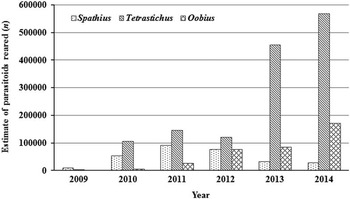
Parasitoid production at the United States Department of Agriculture Brighton EAB Biocontrol Facility has increased over the years due to improvements in rearing methods (Ulyshen et al. Reference Ulyshen, Duan and Bauer2010a; Duan et al. Reference Duan, Oppel, Ulyshen, Bauer and Lelito2011b, Reference Duan, Watt, Taylor, Larson and Lelito2013c; Gould et al. Reference Gould, Ayer and Fraser2011) and recent changes in release methods (Fig. 3). From 2007 to 2012, adult parasitoids were released onto the trunks of EAB-infested ash trees from small plastic cups provisioned with honey as their food source. By 2013, however, the parasitoid-release methods transitioned from the release of adults to the self-emergence of adults in the field, with O. agrili emerging from parasitised EAB eggs held in cups with screening, and S. agrili and T. planipennisi emerging from small ash bolts containing parasitised EAB larvae (United States Department of Agriculture 2013). The labour-intensive process of harvesting, feeding, and packaging the adult wasps provided more time for United States Department of Agriculture employees to focus their efforts on parasitoid production. Less demand for S. agrili (see section below on parasitoid establishment) also allowed for increased production of O. agrili and T. planipennisi (Fig. 3). As a consequence, hundreds of thousands of parasitoids have been available for release during the past few field seasons, with release sites in 19 American states; T. planipennisi were also provided to Canada for releases in Ontario starting in 2013 and in Québec the following year (Fig. 1).
Approximate number of parasitoids reared at the United States Department of Agriculture Emerald Ash Borer Biocontrol Facility in Brighton, Michigan since it became operational in 2009 through 2014. Data source: United States Department of Agriculture, Animal and Plant Health Inspection Service EAB Biocontrol Facility, Brighton (Michigan, United States of America).

Parasitoid establishment
A wide variety of sampling methods have been developed to evaluate EAB populations for parasitoid establishment and prevalence in the field one or more years after releases are completed (Duan et al. Reference Duan, Bauer, Ulyshen, Gould and Van Driesche2011a, Reference Duan, Bauer, Hansen, Abell and Van Driesche2012b, Reference Duan, Taylor, Fuester, Kula and Marsh2013b; United States Department of Agriculture 2013; Abell et al. Reference Abell, Bauer, Duan and Van Driesche2014; Bauer et al. Reference Bauer, Duan and Gould2014). Sampling is done from late summer through early spring before parasitoid emergence begins (early April). If study objectives are to determine the presence or absence of the introduced parasitoids, adults of the three introduced species can be trapped in the field using yellow pan traps during late summer or reared from ash logs placed in rearing tubes in the laboratory following a period of chill to break obligate diapause in O. agrili and S. agrili (United States Department of Agriculture 2013). Sentinel eggs and larvae of EAB have been used for parasitoid recovery and to study their natural history, phenology, and abundance in the field (Duan et al. Reference Duan, Bauer, Ulyshen, Gould and Van Driesche2011a, Reference Duan, Bauer, Hansen, Abell and Van Driesche2012b). In addition, EAB eggs laid on trees by caged adults or laboratory-reared EAB eggs grafted onto trees have been used to establish cohorts for life table analyses (Duan et al. Reference Duan, Abell, Bauer, Gould and Van Driesche2014a), assessment of woodpecker predation (Jennings et al. Reference Jennings, Gould, Vandenberg, Duan and Shrewsbury2013), and the relation between tree diameter, bark thickness, and larval parasitism (Abell et al. Reference Abell, Duan, Bauer, Lelito and Van Driesche2012). However, to estimate the prevalence of EAB larval parasitism (i.e., level of mortality caused to host population) in the field, ash trees must be felled and debarked, and EAB and parasitoids collected and returned to the laboratory. Immature parasitoids must be reared to the adult stage for identification, except for immature Spathius, which can be identified to species through genetic sequencing (Kuhn et al. Reference Kuhn, Duan and Hopper2013). Emerald ash borer larvae must be dissected under a microscope and examined for the presence of endoparasitoids (Duan et al. Reference Duan, Bauer, Abell and Van Driesche2012a, Reference Duan, Bauer, Hansen, Abell and Van Driesche2012b, Reference Duan, Bauer, Abell, Lelito and Van Driesche2013a, Reference Duan, Abell, Bauer, Gould and Van Driesche2014a). Estimating the prevalence of EAB egg parasitism in field populations is also labour intensive, but can be done successfully by collecting EAB eggs or bark samples from infested ash trees, and looking under the microscope at each EAB egg for the signs and symptoms of O. agrili (Abell et al. Reference Abell, Bauer, Duan and Van Driesche2014).
At some of the first release sites in Michigan, the results of ongoing EAB-population dynamics studies confirm the sustained establishment of T. planipennisi and O. agrili from 2008 through 2014 (Duan et al. Reference Duan, Bauer, Abell, Lelito and Van Driesche2013a, Reference Duan, Abell, Bauer, Gould and Van Driesche2014a; Abell et al. Reference Abell, Bauer, Duan and Van Driesche2014; L.S.B. and J.J.D., personal observation). In Michigan, the three parasitoid species were released from 2007 to 2010 at six long-term study sites, each site being comprised of a release and control plot (at least 1 km apart). At these sites, EAB larval and egg parasitism have been determined annually since 2008. By fall 2012, Duan et al. (Reference Duan, Bauer, Abell, Lelito and Van Driesche2013a) reported 92% of ash trees in release plots and 83% in controls had at least one EAB larva parasitised by T. planipennisi, with an average larval parasitism of 21% in release plots and 13% in control plots. From ash bark samples taken in 2012 and 2013, Abell et al. (Reference Abell, Bauer, Duan and Van Driesche2014) reported the percentage of sampled trees with O. agrili-parasitised EAB eggs was 28% in release plots and 11% in control plots, with an average EAB-egg parasitism of 19% in release plots and 9% in control plots. Overall, our research results demonstrate that populations of T. planipennisi and O. agrili are established, spreading, and increasing in prevalence in Michigan.
To assess establishment of the introduced parasitoids at non-research sites, EAB natural enemy surveys are performed by researchers or land managers at least one year after parasitoid releases are complete. As a result of these efforts, populations of T. planipennisi have been detected in other areas of Michigan including the Upper Peninsula (UP), and in Illinois, Indiana, Maryland, Minnesota, New York, Ohio, and Wisconsin (MapBioControl 2014; personal observation). In addition, populations of O. agrili have been found at other Michigan release sites and in the UP, and at other release sites in Indiana, Maryland, Minnesota, New York, Ohio, and Pennsylvania (MapBioControl 2014; personal observation). As in regions of China, T. planipennisi and O. agrili may play a critical role in the long-term management of EAB populations in surviving and regenerating ash.
Establishment of S. agrili in the United States of America, however, remains less certain. After its release at four Michigan EAB-infested sites in 2007, S. agrili was recovered in 18% of larvae at one of those sites the following spring, but none were found in 2009 (Gould et al. Reference Gould, Fraser, Yang, Wang, Mastro and Williams2009). After seven years of sampling EAB populations at the six Michigan study sites, S. agrili parasitism was confirmed in only two EAB larvae at one site in 2011 (Duan et al. Reference Duan, Bauer, Abell, Lelito and Van Driesche2013a, Reference Duan, Abell, Bauer, Gould and Van Driesche2014a; personal observation). However, S. agrili adults have been sporadically recovered in yellow pan traps at these and other release sites in Michigan (J.R.G. and L.S.B., unpublished data). A year or more after release, S. agrili was also recovered in Illinois, Indiana, Maryland, Ohio, Pennsylvania, New York, and Tennessee. Subsequent larval sampling in Maryland and Ohio revealed S. agrili has not persisted (L.S.B., J.J.D., and J.R.G., unpublished data). At this time, the status of possible sustained establishment of S. agrili remains unknown in the other states where it has been released.
The apparent lack of S. agrili persistence in many regions of the United States of America may result from an asynchrony between adult emergence and host availability (J.R.G., unpublished data) or limited cold tolerance for some northern regions (Hanson et al. Reference Hanson, Venette and Lelito2013). Although S. agrili was found sporadically in northeast China (Liu et al. Reference Liu, Bauer, Gao, Zhao, Petrice and Haack2003), the population reared at the Brighton EAB Biocontrol Facility for release in the United States of America originated from Tianjin, China, a coastal city along the 39th parallel (J.R.G., unpublished data). This population of S. agrili may be better climate-matched to more southerly regions of the United States of America. In 2013 as a consequence of these findings, release of S. agrili was restricted to regions below the 40th parallel (United States Department of Agriculture 2013) (Fig. 1). Researchers and regulatory agencies in the United States of America are currently seeking approval for the introduction of a similar, large EAB larval parasitoid, S. galinae from the Russian Far East, which may be better climate matched and synchronised with EAB in northern regions of North America (Duan et al. Reference Duan, Yurchenko and Fuester2012c; Federal Register 2015).
Conclusions
As EAB continues to invade areas of North America, high mortality of ash trees will continue due to limited EAB-host resistance and the lack of coevolved EAB natural enemies. Although researchers are seeking to understand EAB-resistance mechanisms in ash species, it may be decades before for EAB-resistant ash genotypes are available in North America. On the other hand, classical biological control of EAB was initiated within five years of the pest’s discovery in Michigan in 2002, with the release of three EAB parasitoid species from China starting in 2007. The establishment and spread of two EAB biocontrol agents is now well documented at release sites in Michigan and other states, and researchers are continuing to monitor these parasitoid introductions as well as indigenous natural enemies on EAB population dynamics using life table analyses (Duan et al. Reference Duan, Abell, Bauer, Gould and Van Driesche2014a). In addition, studies of ash survival, health, growth, and regeneration are also being performed at several long-term study sites in Michigan to assess the effects of EAB biocontrol in forested ecosystems (Kashian et al. in Reference Kashian, Bauer and Speipress). Similar studies are ongoing in New York following more recent parasitoid releases there (J.R.G., personal observation).
Researchers generally agree that the long-term management of EAB in North America will require an integrated approach that includes the use of classical biological control and silvicultural methods in forested ecosystems, systemic insecticides to protect high value trees in urban settings, and the development of EAB-resistant ash cultivars or hybrids (McCullough and Mercader Reference McCullough and Mercader2012; Bauer et al. Reference Bauer, Duan and Gould2014; Herms and McCullough Reference Herms and McCullough2014). The high ash tree mortality rate created a strong selection event and may have favoured the selection of EAB-resistant ash genotypes. These surviving ash trees are being evaluated for innate resistance mechanisms. The introduced parasitoids may be crucial in supporting the continued survival of these ash trees, as well as ash seedlings, stump sprouts, and saplings developing in North American forests in the aftermath of the EAB invasion. Indeed, the longevity and condition of North American ash species planted in regions of China and the Russian Far East provide us with optimism. Continued foreign exploration for parasitoid species and genotypes in different regions of Asia, however, will be needed to provide effective natural enemies capable of establishing in the diverse climate zones of North America. Clearly, the ability of native, naturalised, and introduced parasitoids to suppress EAB population growth and ash mortality will require long-term evaluations over broad geographical regions as EAB continues to spread throughout North America
Acknowledgements
The authors thank our many coworkers, research associates, students, and colleagues who provided assistance, collaborations, and information on emerald ash borer, natural enemies, and biological control research in the United States of America, Canada, and China during the last 12 years. They greatly appreciate federal, state, county, city, township, and other landowners for granting us permission to use their lands for the long-term studies on EAB biological control and ash recovery. They also thank T. Perkins (Michigan State University) and T. Luther (United States Department of Agriculture, Forest Service) for preparing the maps, two anonymous reviewers for their helpful comments on an early draft of this manuscript, the Department of Entomology at Michigan State University for their ongoing support and laboratory space, and United States Department of Agriculture, Forest Service and United States Department of Agriculture, Animal and Plant Health Inspection Service for partial funding of this research.