Can states afford to protect human rights when facing a terrorist threat? Contemporary academic literature suggests that the answer to this question is no, concluding that states that afford their citizens basic political rights and civil liberties leave themselves more exposed to terrorist attacks (Piazza Reference Piazza2008; Wade and Reiter Reference Wade and Reiter2007; Pape Reference Pape2003; Eubank and Weinberg Reference Eubank and Weinberg1994).Footnote 1 American policymakers seem to agree. Both the Bush and Obama administrations regard the curtailment of physical integrity rights as a necessary element of effective counterterrorism policy. The Bush administration responded to the terrorist attacks of September 11, 2001, with policies permitting indefinite detention, extraordinary rendition, use of physically abusive interrogation practices, and increased and largely unchecked surveillance and wiretapping of suspected terrorists. Although it banned abusive interrogation and announced plans to close the detention facility at Guantanamo Bay, the Obama administration has maintained the practice of wiretapping, reserved the option of rendition, and dramatically increased unmanned drone attacks against suspected terrorists in Pakistan, which often results in civilian casualties. Both presidents have claimed that these policies are necessary to keep Americans safe from terrorism (Hosenball Reference Hosenball2009; “Bush Defends Policy on Terror Detainees” 2005).
However, recent research provides evidence contradicting the conventional wisdom that protecting human rights invites more terrorism. In a recent article, we suggested that states that violate the overall physical integrity rights of their citizens—the rights to not be physically mistreated by state agents—are actually more frequently targeted by terrorists than those characterized by a fuller respect for such rights (Walsh and Piazza Reference Walsh and Piazza2010). This finding corresponds with the historical record of governments that have pursued counterterrorism strategies that seriously compromised physical integrity rights—for example, Britain in Northern Ireland in the early 1970s, France in Algeria in the 1950s, Israel in Lebanon in the 1980s, and U.S. rendition policy regarding U.S.–European counterterrorism cooperation—and found that these policies hampered counterterrorism while increasing terrorist activity. Reversing independent and dependent variables in another study, we also determined the relationship between human and civil rights protections and terrorism to be more complex than the conventional wisdom allows. Rather than reacting to terrorist threats in a uniform manner, we found that states experiencing terrorist attacks are slightly more likely to engage in extrajudicial killings and disappearances, but they do not respond by restricting many other rights, including the right not to be tortured or rights to freedom of speech and association (Piazza and Walsh Reference Piazza and Walsh2009).
These unexpected findings suggest that research on the relationships between terrorism and human rights could benefit from taking two steps. The first is a consideration of the effects of different types of human rights abuses on a state's susceptibility to terrorist attack. In the next section, we conduct a simple empirical analysis of this issue. The second step is to carefully parse out the causal relationship between terrorism and human rights. This approach presents a significant challenge, and we suggest ways of addressing the endogeneity that complicates understanding of the relationship between human rights and terrorism in future studies.
TYPES OF PHYSICAL INTEGRITY ABUSE AND TERRORISM
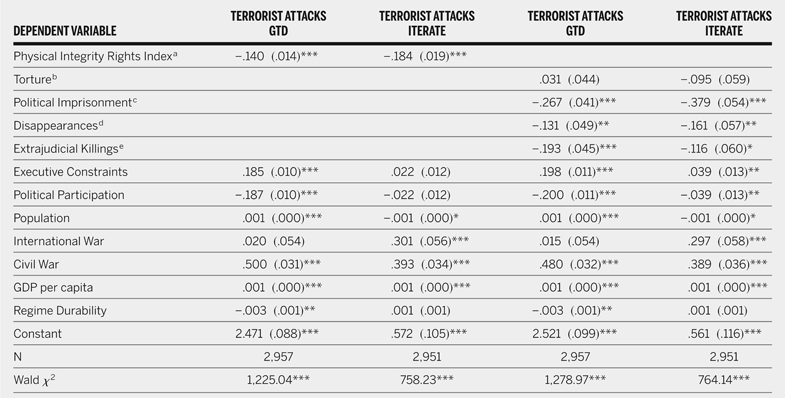
In this article, we assess as predictors of terrorism four specific elements of physical integrity rights: torture, political imprisonment without due process, disappearances suspected to result from the workings of state agents, and extrajudicial killings perpetrated by government officials. Our goals are to investigate how the use of more granular and high-quality data can produce results with more specific implications for debates about counterterrorism policy. We conducted four simple negative binomial regression modelsFootnote 2 using country-year data for 142 countries for the period 1981 to 2004, the full temporal range for which data is available. We measured terrorism using two dependent variables—incidents of both domestic and international terrorist attacks occurring per country-year as reported in the Global Terrorism Database (GTD),Footnote 3 and incidents of international attacks as reported in the ITERATE database (Mickolus et al. Reference Mickolus, Sandler, Murdock and Flemming2007)Footnote 4—to address the measurement issues that plague terrorism data, as noted by Young and Findley (Reference Young and Findley2009). Our independent variables were measurements obtained from the Cingranelli and Richards Human Rights (CIRI) Database (Cingranelli and Richards Reference Cingranelli and Richards2008). For our analysis, we included both the index variable measuring the general level of respect for physical integrity rights within a country in a given year—the same variable we use in Walsh and Piazza (Reference Walsh and Piazza2010)—and, in subsequent models, we examined the individual components of the index: physical integrity rights against torture, political imprisonment, disappearance, and extrajudicial killings. Each of these measures of physical integrity were constructed as ordinal scales, for which the aggregate index of respect for physical integrity was rated 0 for country-years characterized by severe violations and 8 for countries demonstrating complete respect for physical integrity rights; the individual components were rated between 0 and 2. We lagged the individual physical integrity rights measurements by one year. The models also included control variables that have become standard in empirical studies of terrorism. We controlled for regime type using Polity indicators for executive constraints, political participation,Footnote 5 regime age,Footnote 6 the country's population size,Footnote 7 and real gross domestic product per-capita,Footnote 8 and participation in civil and international wars measured as dummy variables (see Wade and Reiter Reference Wade and Reiter2007; Li Reference Li2005; Eyerman Reference Eyerman1998).Footnote 9 In all models, we calculated robust standard errors clustered by country. The results of four models are reported in table 1.
Individual Physical Integrity Rights and Terrorism

Note. GTD: Global Terrorism Database; ITERATE: International Terrorism: Attributes of Events. All models use negative binominal regression; robust standard errors clustered on country in parentheses;
*** p < .000,
** p < .01,
* p < .05
a Additive index of government respect for physical integrity/protection against violation of human rights (CIRI Database, lagged one year; Cingranelli and Richards 2008)
b Rights/protections against and absence of torture (CIRI, lagged)
c Rights/protections against and absence of political imprisonment (CIRI, lagged)
d Rights/protections against and absence of disappearances with suspected political motivation (CIRI, lagged)
e Rights/protections against and absence of extrajudicial killings by government officials without due process (CIRI, lagged)
Models 1 and 2 are baseline models using the overall index of physical integrity rights as the key independent variable of interest. These reproduce, using slightly different data and model specifications, the results of our most recent work on physical integrity rights and terrorism (Walsh and Piazza Reference Walsh and Piazza2010). Regardless of how we operationalize terrorism—both domestic and international attacks measured using the GTD data or international attacks only using ITERATE—protection of physical integrity rights is associated with fewer terrorist attacks. These relationships are robust to the inclusion of the control variables.
Models 3 and 4 disaggregate physical integrity rights into their four components, producing more specific results. In both models, governments that refrain from imprisoning citizens for political reasons and avoid engaging in disappearances and extrajudicial killings experience less domestic and international terrorism. But the relationship between torture and terrorism is not statistically significant. We find this result surprising, in particular because U.S. employment of physically abusive interrogation tactics against terror suspects and mistreatment of detainees after the September 11 attacks has been widely criticized as a tactic that damages counterterrorism coordination with allies, enrages the Muslim world, and aids terrorist recruitment (Warrick Reference Warrick2009). We also calculated first-difference expected values simulations for all of the individual physical integrity components and found further evidence that different types of physical human rights violations have different effects on terrorism. By a significant margin, improvement in respect for rights against political imprisonment and extrajudicial killings yields the most dramatic reduction in terrorist attacks. States that improve from the worst level of respect for protections against political imprisonment see an average reduction of 5.1 attacks, and states that improve protections against extrajudicial killings yield an average reduction of 4.5 attacks. In contrast, states that improve their protections against disappearances and clean up their torture practices receive, on average, 1.3 and 1.9 fewer attacks. We can speculate that this disparity is due to a simple difference in the nature of these violations. Political imprisonment and extrajudicial killings are highly overt types of violations that are difficult for regimes to cover up, and that make excellent propaganda fodder for terrorist movements seeking to gain recruits and generate sympathy.
DISCUSSION: PROBLEMS AND STRATEGIES
Our results challenge common assumptions regarding terrorism and human rights. Governments often claim that they must restrict rights to stop terrorism, but our findings suggest that such restrictions actually fuel terrorism. Human rights advocates decry authorities' response to terrorist attacks of limitations on rights. But the evidence that governments react to terrorism with repression is limited, suggesting that advocates might better focus their actions on other threats to rights. Precisely because these conclusions are controversial and have important implications for the conduct of counterterrorism policy, we want to highlight open questions and suggest how they could be addressed in future research.
A first set of issues concerns the quality and format of the data regarding both terrorism and human rights. Until quite recently, publically available data on terrorist attacks have been marked by important limitations. ITERATE has been the most widely used dataset in studies of terrorism. However, ITERATE only includes transnational terrorist attacks in which the victims and targets are of different nationalities. Most terrorist attacks involve victims and perpetrators of the same nationality. It is quite possible that the dynamics of transnational attacks differ in systematic ways from those of domestic attacks. The recently released GTD includes both domestic and transnational terrorist attacks, providing researchers with opportunities to re-evaluate existing findings based on ITERATE data and develop new insights. For example, one might investigate whether the relationships between abuses and terrorism differ for domestic and transnational attacks. Moving in this direction would allow more accurate and discriminating understanding of the causes and effects of terrorism and the development of more specific and nuanced policy prescriptions.
Data on the abuse of human rights also raise concerns. The two most widely used datasets in this area are the Political Terror Scale (Gibney, Cornett, and Wood Reference Gibney, Cornett and Wood2008) and the Cingranelli-Richards data (Cingranelli and Richards Reference Cingranelli and Richards2008). Both use annual reports from Amnesty International and the U.S. Department of State to code abuses on ordinal scales, using the country-year as the unit of analysis. The global scope and easy availability of both datasets have had a hugely positive impact on the empirical analysis of human rights, serving as the basis for dozens of studies. As with any dataset, though, they have limitations when applied to certain research questions. When investigating the relationships between human rights and terrorism, two such limitations are particularly noteworthy. First, the use of an ordinal scale may mask substantial differences across country-years. The CIRI data project, for example, has a three-value ordinal scale for torture—a zero indicates no allegations of torture, 1 indicates between 1 and 50 allegations, and 2 indicates more than 50 allegations. This ordinal ranking thus treats country-years with 51 and 51,000 allegations of torture as identical (Wood and Gibney Reference Wood and Gibneyforthcoming). But the effect of these values on terrorism may be dramatically different.
A second issue is the annual aggregation of the data. This reflects the fact that the reports on which both CIRI and the Political Terror scales are based are published yearly. It is quite plausible that important aspects of the relationships between repression and terrorism might operate over shorter periods of time, especially in contexts that do not involve an ongoing civil war or other major conflict. Capturing such dynamics is difficult with data aggregated on an annual basis (Shellman Reference Shellman2004). One solution to this set of issues is to shift the unit of analysis from the country-year. This change would require the development of more fine-grained data on human rights abuses, which could be used to address a range of questions left unanswered by studies using country-year data. A good example is the National Science Foundation–funded Ill-Treatment and Torture (ITT) data collection project, currently led by Ryals-Conrad and Moore (Reference Ryals-Conrad and Moore2010). This project uses the individual allegation of torture as the unit of analysis, relying on Amnesty International research publications to identify characteristics of each alleged violation of rights by government authorities. More detailed data such as these could be combined with information on terrorist attacks from the GTD or other sources to develop a better understanding of the dynamics between terrorism and human rights. In particular, this approach might allow future research to better address three important issues.
The first issue is the problem of endogeneity raised earlier. A considerable body of research suggests that the relationship between societal dissent and government repression is endogenous—that is, dissent leads to repression, which in turn fuels dissent. It seems plausible that such a reciprocal relationship would also hold for the relationship between terrorism as the specific form of dissent and violations of physical integrity rights as the specific form of repression. But highly aggregated, cross-national data make it difficult to determine if this is the case. One way to address this issue is to develop a two-stage least-squares model. Doing so requires identifying instrumental variables that have a strong influence on terrorism but not on rights, and vice versa. We have been unable to locate such variables in country-year data. Shifting the unit of analysis from the country-year to the individual country measured over shorter intervals might allow one to undertake such an analysis by identifying instrumental variables specific to the national context.
A related set of issues concerns the strategic relations between terrorists and the authorities. The high level of aggregation in country-year data makes it difficult to address several questions: How quickly do terrorist groups organize and mount attacks in response to government repression? Does the abuse of human rights reduce terrorism in the short run but promote it in the longer run? Do terrorist attacks trigger greater repression only when they pass certain thresholds for violence and destruction? Addressing such questions in a sophisticated way would fill important gaps left by existing research. There are examples of the use of such disaggregated data in related contexts. Jaeger and Paserman (Reference Jaeger and Paserman2009), for example, adopt this strategy to analyze important questions concerning the strategic interaction between targeted killings carried out by Israeli forces and terrorist suicide attacks committed by Palestinian groups. Applying such approaches to the relationship between abuse and terrorism could yield more precise and useful policy implications. If research were able, for example, to identify more closely the type and level of repression that provokes a terrorist response, governments could be advised to avoid such actions.
Finally, disaggregation might allow scholars to better assess the possibility that relationships between human rights abuse and terrorism are mediated by other variables. For example, Piazza and Walsh (Reference Piazza and Walsh2009) find that terrorist attacks generally do not provoke crackdowns by the authorities. But we know that in some cases, governments do respond to terrorist attacks with widespread repression of human rights. The use of torture, rendition, and wiretapping by American authorities after September 11 is clearly such a case. What factors cause the authorities to repress rights after terrorist attacks in some cases but not others? It is a straightforward enough route to investigate whether the authorities' response depends directly on characteristics of the terrorist act, such as method of attack (e.g., suicide attack), scope (e.g., number of casualties), or position of the authorities themselves (e.g., from a wealthy or poor country). We suspect, though, that the relationship may also be contingent on other variables.
Disaggregation in this manner could have the major cost of exchanging greater internal validity for external validity, which could limit the ability to which we could generalize about findings and conclusions. Collecting reliable and accurate data on terrorist attacks and human rights abuses at the national level requires local knowledge and expertise. Developing the skills and connections needed to collect such data in one country limits the time and resources available for collection in other settings. And conclusions about the relationship between terrorism and abuse developed in one national context might not apply in other contexts. Recent innovations in data collection promise to address some of these concerns. The ITT project summarized previously, for example, should allow detailed comparisons of the relationships between abuse and terrorism across countries. Chenoweth and Duggan (Reference Chenoweth and Duggann.d.) are developing a procedure for the machine reading of texts—primarily news accounts—to allow the development of data on a wide range of actions by governments and terrorist groups. This process has the potential to be applied to multiple national contexts, which might make it possible to develop general conclusions about the relationships between repression and terrorism.Footnote 10