Implications
Nutrition of gestating sows plays an important role in the within-litter variation. This is especially important for highly prolific sows in modern commercial environments. Because of its importance in the pork industry, the aim of the study was to review current knowledge about the physiological background of within-litter birth weight variation, and to explore possible nutritional opportunities to increase within-litter uniformity of piglet birth weight.
Introduction
Advances in pig production have brought many benefits for producers, such as higher number of piglets/sow per year, higher farrowing rates per year, decreased age at slaughter, increased feed efficiency and higher lean gain (Ball et al., Reference Ball, Samuel and Moehn2008). Nevertheless, negative characteristics, such as within-litter birth weight variation have developed, resulting in economic losses and lower profits to the producer.
The within-litter birth weight variation is economically important because of its positive correlation with preweaning mortality (Wolf et al., Reference Wolf, Žáková and Groeneveld2008). In litters with high level of variation in birth weight, the smallest piglets are not able to compete with the heavier litter-mates for the best teats; therefore, these animals consume a lower amount of colostrum and have lower milk intake, which leads to poor acquisition of passive immunity and low nutritional status (Quiniou et al., Reference Quiniou, Dagorn and Gaudré2002). Consequently, small piglets are physiologically deprived of energy stores. Therefore, they are more susceptible to hypothermia and have a lower capacity to maintain body temperature after birth (Herpin et al., Reference Herpin, Damon and Le Dividich2002; Wolf et al., Reference Wolf, Žáková and Groeneveld2008).
In addition, litters with more birth weight variation have more variable weights at weaning. This results in increased labor and complicated management requirements (Roberts and Deen, Reference Roberts and Deen1995). Further, reductions in the weight gains from birth have unfavorable effects on the subsequent growth. The low birth weight piglets are also older at slaughter compared with heavier birth weight litter-mates (Gondret et al., Reference Gondret, Lefaucheur, Louveau, Lebret, Pichodo and Le Cozler2005).
Because of the importance of the within-litter birth weight variation in the pork industry, the aim of this study was to review current knowledge about the physiological background of within-litter variation in piglet birth weight to explore possible opportunities to reduce within-litter variation, and to develop nutritional strategies that can be used to achieve increased within-litter uniformity of piglet birth weight.
Causes of within-litter birth weight variation
Genetic selection and litter size
The genetic selection for improved prolificacy has increased litter size. Quesnel et al. (Reference Quesnel, Brossard, Valancogne and Quiniou2008) showed that the genetic improvement over the past 10 years resulted in an increase of 1.8 piglets per litter in commercial sows. These findings are in agreement with other authors who reported a successful genetic selection for litter size (Merks, Reference Merks2000; Foxcroft, Reference Foxcroft2008).
Once the number of fully formed fetuses that can be maintained by the uterus until farrowing is limited, the correlation between increased number of fetuses and individual fetal growth is negative (Wolf et al., Reference Wolf, Žáková and Groeneveld2008). Thus, various authors observed an increased within-litter variation in piglet birth weight and a decrease in average birth weight of the litter, because of the genetic selection for litter size (Lund et al., Reference Lund, Puonti, Rydhmer and Jensen2002; Tribout et al., Reference Tribout, Caritez, Gogué, Gruand, Billon, Bouffaud, Lagant, Le Dividich, Thomas, Quesnel, Guéblez and Bidanel2003; Foxcroft, Reference Foxcroft2008; Quesnel et al., Reference Quesnel, Brossard, Valancogne and Quiniou2008). A higher number of fetuses exceeding the uterine capacity have been related to piglets with limited number of muscle fibers, which results in a compromised fetal growth and development (Foxcroft et al., Reference Foxcroft, Dixon, Novak, Putman, Town and Vinsky2006).
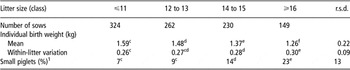
Quiniou et al. (Reference Quiniou, Dagorn and Gaudré2002) found a reduced average individual birth weight from 1.59 to 1.26 kg and an increased within-litter variation of individual birth weight from 0.26 to 0.30 kg when the smallest litters (⩽11 piglets) were compared with larger litters (⩾16 piglets), respectively, and an increased proportion of smaller piglets in larger litters (Table 1). Very little chance of survival until weaning was observed in piglets weighing less than 1 kg at birth, and when they survived their growth performance during the nursing and postweaning period was lower than those of heavier piglets at birth (Quiniou et al., Reference Quiniou, Dagorn and Gaudré2002). These findings suggest that increased litter size induces an increased proportion of light piglets, a concomitant decrease in litter uniformity and average piglet birth weight, having negative effects on the piglets’ viability and performance.
Effect of litter size on piglets’ characteristics at birth

r.s.d. = residual standard deviation.
Source: Quiniou et al. (Reference Quiniou, Dagorn and Gaudré2002).
1Mean proportion of piglets that weighted less than 1 kg at birth.
c,d,e,fP < 0.001.
It is quite clear that the increased prolificacy of the modern sows leads to negative impacts on the fetal growth and development, as large litters are associated with reduced rates of fetal oxygen and nutrient uptakes, and also with reduced utero-placental blood flow per fetus (Reynolds and Redmer, Reference Reynolds and Redmer2001). Thus, these events may limit the uterine capacity, which can decrease fetal growth, increase fetal death and compromise the offspring's performance.
Differences between breeds
The ability of the uterus to meet the nutritional demands to maintain fetuses until farrowing, known as uterine capacity, is characteristic of the genotype and of the animal (Pere and Etienne, Reference Pere and Etienne2000). Thus, differences among breeds are related with differences in the maternal ability to farrow higher number of piglets, with good survival rates, litter uniformity and adequate birth weight. One example, which illustrates these differences in the uterine capacity and maternal ability between breeds, is the Chinese Meishan breed compared with the commercial sow breeds.
The Chinese Meishan breed is known for its prolificacy and higher litter size than the commercial European breeds (Christenson, Reference Christenson1993). There are some evidences suggesting that the Meishan breed have slower fetal growth rates, which could be involved in improved homogeneity and a higher uterine capacity (Ford, Reference Ford1997). Wilson et al. (Reference Wilson, Biensen, Youngs and Ford1998) found a lower growth rate of the Meishan fetus when compared with the Yorkshire fetus. This fact was associated with some form of growth inhibition in the Meishan uterus that slows the rate of fetal growth and also sets an absolute limit on individual fetal size, possibly by restricting placental growth. Ford et al. (Reference Ford, Vonnahme and Wilson2002) suggested that the improved uterine capacity observed in the Meishan sows seemed to have resulted from an increased placental efficiency or an increased uterine size.
According to Ford (Reference Ford1997), another factor that related with the higher uterine capacity of the Meishan sows is the ability of the fetus to increase the placental vascularization to support the increasing fetal growth during the last third of gestation. Biensen et al. (Reference Biensen, Wilson and Ford1998) evaluated the effects of uterine and fetal genotype on the placental size and vascularity, and observed that the Meishan × Yorkshire crossbred fetuses were lighter when gestated in the Meishan rather than in the Yorkshire uterus on days 90 and 110 of gestation. These authors reported, using image analysis, an increase in placental and endometrial vascular density for purebred Meishan bred conceptus compared with purebred Yorkshire bred. These data suggest that expression of angiogenic factors are influenced by breed differences leading to differences in placental and adjacent endometrial vascular density, and thus placental efficiency.
These findings suggest an important line of research to develop effective genetic improvement programs for uterine capacity.
Angiogenesis and placental development during follicular growth
The placenta is the organ through which respiratory gases, nutrients and wastes are exchanged between the maternal and fetal systems. Thus, the fetal growth and development is dependent of the maternal capacity to provide all the metabolic demands required for the fetuses. The efficiency of this process is influenced by the placental blood flow rates, which are dependent on placental vascularization and vasodilatation (Reynolds et al., Reference Reynolds, Killilea and Redmer1992; Ford, Reference Ford1995; Reynolds and Redmer, Reference Reynolds and Redmer2001).
Angiogenesis
The formation of new vascular beds determines the placental vascularization. This process, known as angiogenesis, is a critical process for normal tissue growth and development, and numerous factors have been implicated in this process. However, Reynolds and Redmer (Reference Reynolds and Redmer2001), evaluating the placental angiogenesis, reported that the vascular endothelial growth factor, fibroblast growth factor and the angiopoietin protein families, and also their respective receptors, are the major factors regulating the angiogenesis.
This process begins with the capillary proliferation and culminates in the formation of a new microcirculatory bed, composed of arterioles, capillaries and venules. Angiogenic factors interact with the local vasodilator nitric oxide to coordinate placental angiogenesis and blood flow (Reynolds and Redmer, Reference Reynolds and Redmer2001).
Vasodilatation
Some factors are known to enhance the blood flow rates by increasing the diameter of the placental circulatory channels and the placental vascularity. One of these factors is the endogenous relaxant nitric oxide, which is involved in the vasodilatation of the maternal systemic circulation, regulation of uterine and fetus-placental blood flow, and also the vascular endothelial growth factors that are specific stimulators of vascular permeability (Reynolds and Redmer, Reference Reynolds and Redmer2001).
The establishment of fetal and placental circulation is one of the earliest events during the embryonic and placental development (Wu et al., Reference Wu, Bazer, Cudd, Meininger and Spencer2004). This event is crucial to support the metabolic demands of the fetus, mainly during the later half of gestation when an exponential increase in fetal growth occurs (Reynolds and Redmer, Reference Reynolds and Redmer2001).
Therefore, any events that have negative impact on the placental growth and development or on the maternal ability to transfer the nutrients to the fetus are associated with fetal growth retardation.
Blood flow distribution
One of the factors that influence the fetal growth and development is the utero-placental blood flow. The placental circulation has a critical role in the transplacental exchange rates and in the delivery of nutrients for fetal growth (Reynolds and Redmer, Reference Reynolds and Redmer2001).
Pere and Etienne (Reference Pere and Etienne2000) observed that uterine blood flow increased with litter size; however, the uterine blood flow per fetus decreased when the litter size increased, suggesting that uterine blood flow adapts to litter size, but within limits. Similarly, Reynolds et al. (Reference Reynolds, Ford and Ferrell1985) reported that uterine blood flow was positively correlated with the number of fetuses; however, the blood flow per fetus was negatively correlated with the number of fetuses in the uterine horn.
Because of the increased prolificacy of modern sows, the fetal growth and development has been limited by decreased uterine blood flow per fetus. According to the studies cited previously, there is a negative relationship between litter size and uterine blood flow per fetus. In addition, providing different amounts of nutrients to the fetus during gestation might explain partially the within-litter birth weight variation, as the correct supply of all metabolic demands necessary for fetal growth is influenced by the uterine and umbilical blood flow (Reynolds et al., Reference Reynolds, Ford and Ferrell1985).
Maternal nutrition during gestation
In addition to the higher prolificacy, higher nutritional requirements for supporting the metabolic needs of both the sow and its fetuses are required (Kim et al., Reference Kim, Wu and Baker2005). However, according to McPherson et al. (Reference McPherson, Ji, Wu, Blanton and Kim2004), the nutritional requirements of the animals may not be reached by providing a constant amount of dietary protein during gestation, as the demand for nutrients of both the mother and its fetuses increases throughout gestation. In addition, the nutritional recommendations for pregnant sows are based on the requirements of much less prolific and productive sows of the past than the modern sows (Ball et al., Reference Ball, Samuel and Moehn2008). As such there is a suboptimal nutritional feeding management during gestation. Thus, an incorrect maternal nutrition with respect to increased requirements to support the increased number of fetuses in the uterus may be associated with fetal growth retardation, and, consequently, negative effects on the piglet performance, such as decreased within-litter uniformity and decreased piglet birth weight. Kim et al. (Reference Kim, Hurley, Wu and Ji2009) reported higher weight variations among fetuses mainly after 45 days of gestation, which could be associated with the limitation of sows to provide sufficient nutrient support through blood for maximal growth of all fetuses (Wu et al., Reference Wu, Bazer, Wallace and Spencer2006).
As the fetal growth and development play a crucial role in the within-litter uniformity and piglet birth weight, and thereby in survival and postnatal growth, several studies have been conducted to evaluate different feeding strategies during gestation and consequences on fetal growth and development.
Sow nutrition as an opportunity to improve within-litter uniformity
Nutrition during the preovulatory period
Evidence for effects of preovulatory nutrition on within-litter diversity
Within-cohort variation in oocyte development and maturation during the preovulatory period may determine crucial events that influence the uniformity in embryonic development, such as within-litter variation in early embryonic development and growth, within-litter variation in placental development and growth, and thus consequently the within-litter variation in birth weight.
Many studies have shown a relationship between dietary composition during the preovulatory period and subsequent embryo survival and development (Kirkwood et al., Reference Kirkwood, Baidoo and Aherne1990; Baidoo et al., Reference Baidoo, Aherne, Kirkwood and Foxcroft1992; Zak et al., Reference Zak, Cosgrove, Aherne and Foxcroft1997a and Reference Zak, Xu, Hardin and Foxcroft1997b; Quesnel et al., Reference Quesnel, Pasquier, Mounier and Prunier1998). Although effects of the preovulatory dietary composition on follicle and oocyte development, as well as carryover effects on embryonic survival and development have been established, there is at present no evidence for effects of preovulatory nutrition on variation in development within a preovulatory cohort of ovulating follicles or the oocytes shed at ovulation. However, there is limited evidence for effects of preovulatory nutrition on within-litter embryo diversity.
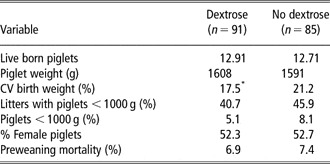
A significantly lower within-litter variation in birth weight was reported by Van den Brand et al. (Reference Van den Brand, Soede and Kemp2006), when first parity Yorkshire × Dutch Landrace sows received a dextrose supplementation diet during the weaning to estrus interval (WEI). The sows received, from weaning until the end of estrus, 150 g dextrose/day in addition to 3.5 kg/day of a sow ration containing 9.4 MJ NE/kg, 156 g/kg CP and 6.8 g/kg digestible lysine. Dextrose was used instead of starch, as an earlier experiment (Van Den Brand et al., Reference Van Den Brand, Soede, Schrama and Kemp1998) has shown that dextrose had a more pronounced effect on plasma glucose and insulin concentrations. Dextrose supplementation did not affect WEI, pregnancy rate, farrowing rate and subsequent litter size or birth weight (Table 2).
Effects of dextrose supplementation during the weaning-to-estrus interval on average piglet birth weight and within-litter variation in piglet weight

CV = coefficient of variation.
Source: Van den Brand et al. (Reference Van den Brand, Soede and Kemp2006).
*Significantly different from the 21.2% CV in the ‘No dextrose’ group (P = 0.03).
Nutritional effects mediated by insulin and IGF-I
The effect of preovulatory nutrition on follicles and oocytes is often associated with the effect of nutrition on circulating metabolic hormone concentrations, such as growth hormone and leptin concentrations, but especially insulin and IGF-I concentrations. Blood concentrations of insulin and IGF-I are considered to be important for mediating the effect of nutrition on the ovaries. In mammals, insulin stimulates in vitro the uptake and utilization of nutrients, granulosa cell proliferation and differentiation, either alone or in synergy with gonadotropins (Prunier and Quesnel, Reference Prunier and Quesnel2000b). Furthermore, numerous in vivo experiments have provided evidence for a stimulating role of both insulin and IGF-I in folliculogenesis. For instance, increasing plasma insulin during the late luteal phase or the early follicular phase, increased ovulation rate irrespective of changes in plasma LH, may be related to the ability of insulin to decrease atresia in small- and medium-sized follicles (Prunier and Quesnel, Reference Prunier and Quesnel2000b). On the basis of another literature review, Prunier and Quesnel (Reference Prunier and Quesnel2000a) concluded that insulin has a positive influence on the nutrient supply, growth and development of follicular cells; however, that direct evidence is still missing to demonstrate that a decrease in insulin secretion due to feed restriction is responsible, even in part, for a decrease in follicle development and ovulation in pigs.
In contrast, increased insulin and IGF-I levels before or at weaning are positively associated with LH pulsatility after weaning. Higher levels of LH stimulate the development of larger follicles, because small follicles only have FSH receptors and not LH receptors; thus, small follicles will be less stimulated and become atretic (Van Den Brand et al., Reference Van Den Brand, Van Enckevort, Van Der Hoeven and Kemp2009). Therefore, the follicle population becomes more uniform, and a more uniform follicle population seems to result in more uniform oocyte quality (Van Den Brand et al., Reference Van Den Brand, Van Enckevort, Van Der Hoeven and Kemp2009). In this context, as cited previously, Van Den Brand et al. (Reference Van den Brand, Soede and Kemp2006) observed higher piglet birth weight uniformity in sows that received a dextrose supplementation diet during the WEI. Similarly, although not significant, Van Den Brand et al. (Reference Van Den Brand, Van Enckevort, Van Der Hoeven and Kemp2009) reported a numerically lower within-litter birth weight variation in sows supplemented dextrose plus lactose during a prolonged period before and during follicular phase (1 week before parturition till the moment of insemination). These findings are possibly related with the fact that dextrose and lactose supplementation possibly increases plasma levels of insulin and IGF-I (Van Den Brand et al., Reference Van Den Brand, Van Enckevort, Van Der Hoeven and Kemp2009).
Nutrition in relation to placental and fetal development and growth
Impact of different dietary energy levels during gestation
The effects of a low dietary energy intake during gestation on reproductive traits were evaluated by Buitrago et al. (Reference Buitrago, Maner, Gallo and Pond1974). In this study, the authors found that individual piglet weight and total litter weight at birth decreased significantly when offspring of sows fed 2.2 Mcal DE/day from breeding to farrowing were compared with offspring of sows fed 8.0 Mcal DE/day. Still in agreement, a direct relationship between maternal nutrition and fetal weight was shown by Noblet et al. (Reference Noblet, Close, Heavens and Brown1985), where a decrease in 28% the feed intake after day 80 of gestation resulted in a reduction in fetal growth in gilts. However, some studies reported that the dams have the ability to mobilize maternal nutrient reserves to support placental and fetal development when these animals are subjected to a restricted energy diet (Anderson, Reference Anderson1975; Pluske et al., Reference Pluske, Williams and Aherne1995; Bee, Reference Bee2004). Thus, several authors also reported no effects of low energy supply in the fetal performance (Liao and Veum, Reference Liao and Veum1994; Jindal et al., Reference Jindal, Cosgrove, Aherne and Foxcroft1996). Bee (Reference Bee2004) found that different energy intake levels (6.6 and 10.7 MJ DE/kg) during early gestation in multiparous sows did not affect the average birth weight, weaning weight, number of piglets born alive or number of piglets at weaning, when considering all progenies.
Lawlor et al. (Reference Lawlor, Lynch, O'Connell, McNamara, Reid and Stickland2007) found no influence in birth weight, weaning weight and within-litter weight variation when five different dietary digestible energy levels were provided during different gestation phases: (1) 30 MJ DE/day throughout gestation; (2) as for one but with 60 MJ DE/day from days 25 to 50 of gestation; (3) as for one but with 60 MJ DE/day from days 50 to 80 of gestation; (4) as for one but with 60 MJ DE/day from days 25 to 80 of gestation; (5) as for one but with 45 MJ DE/day from days 80 to 112 of gestation. Kongsted (Reference Kongsted2005), in a literature review, suggested that pregnancy rate and litter size can be influenced by energy intake. However, the latter authors concluded that the results of the literature were inconsistent and do not provide a clear idea of the relation between energy supply and reproductive performance.
Impact of different dietary protein levels during gestation
Almost everything that occurs in the cell involves one or more proteins. Proteins have different functions and biological activities. Some of these functions include structural roles, nutrition, enzymatic catalyses, molecular transport, organism defense and other functions (Lehninger et al., Reference Lehninger, Nelson and Cox1993). Therefore, dietary protein intakes during gestation play a critical role in the maternal and fetal growth and development.
Wu et al. (Reference Wu, Pond, Flynn, Ott and Bazer1998), evaluating gilts receiving a protein-restricted diet containing 0.5% CP, observed that the maternal dietary protein deficiency decreased concentrations of basic amino acids (arginine, lysine and ornithine) and several neutral amino acids (alanine, glutamine, glycine, branched-chain amino acids, proline, serine, taurine and threonine) in the placenta and endometrium by 16% to 30%, compared with the gilts of the control group that received diets containing 13% CP. However, according to these authors, the protein reduction decreased the activities of nitric oxide synthase, citrulline synthesis from arginine and ornithine decarboxylase activity in placenta and endometrium by 30% to 51%, 34% to 42% and 44% to 47%, respectively, suggesting that these events may decrease the maternal ability to transfer nutrients and oxygen to the fetus, resulting in negative impacts on within-litter birth weight uniformity.
In agreement with these findings, other studies reported negative effects (i.e. intrauterine growth retardation, decreased piglet vitality and birth weight) of restricted-protein diets during gestation on the sow progeny (Atinmo et al., Reference Atinmo, Pond and Barnes1974; Pond et al., Reference Pond, Maurer, Mersmann and Cummins1992; Schoknecht et al., Reference Schoknecht, Newton, Weise and Pond1994; Wu et al., Reference Wu, Bazer, Wallace and Spencer2006). Similarly, Redmer et al. (Reference Redmer, Wallace and Reynolds2004), evaluating the effect of nutrient intake during pregnancy, stated that maternal nutrition can have a profound effect on fetal growth and development by changing placental growth and vascular development. In addition, the authors suggest that placental expression of angiogenic factors and their receptors are disturbed by level of nutrition, and that nutrient restriction of the adult dam during pregnancy suppresses placental cell proliferation and vascularity.
Analyzing the relationship between sow nutrition during gestation and the offspring performance, the low birth weight of the piglets from immature gilts when compared with those from adult sows may illustrate the negative effects of inadequate maternal nutrition on fetal growth, as these immature gilts compete with their own fetus for nutrients (Redmer et al., Reference Redmer, Wallace and Reynolds2004; Wu et al., Reference Wu, Bazer, Cudd, Meininger and Spencer2004).
Impact of different feed intake levels during gestation
There are some evidences about the provision of nutrients below the maternal requirements during gestation; therefore, several studies have been conducted to evaluate the effects of an increased amount of feed during gestation.
In the study of Mahan (Reference Mahan1998), the authors observed that the sows that received a greater quantity of feed, equivalent to 130 g additional feed per day, farrowed more total and live piglets compared with the control group that was given a feed intake similar to the National Research Council (NRC, 1988) recommendations. Similarly, Cromwell et al. (Reference Cromwell, Hall, Clawson, Combs, Knabe, Maxwell, Noland, Orr and Prince1989) concluded that additional feed in late gestation (+1.36 kg of feed/day from day 90 of gestation to farrowing) improves the reproductive performance. The results showed a greater total litter weight at birth (15.06 v. 14.36 kg), an increased weaning weight (5.37 v. 5.20 kg) and increased individual birth weight (1.48 v. 1.44 kg) in sows fed extra amounts of feed when compared with a control group. Likewise, these extra-fed sows also farrowed more piglets per litter (i.e. + 0.35) and more live piglets per litter (i.e. + 0.34) than the control group. In addition, a higher fiber diet during the estrus cycle, preceding mating, increased embryo survival and reduced the fetal intrauterine growth retardation at day 27 of pregnancy (Ferguson et al., Reference Ferguson, Slevin, Edwards, Hunter and Ashworth2006). Nevertheless, several studies have shown no effect of feeding levels during gestation on the sow's reproductive performance. According to Dwyer et al. (Reference Dwyer, Stickland and Fletcher1994) litter size, pig mortality and birth weights were not significantly affected by different quantities of feed during specific periods of gestation (2.5 kg/day throughout 21 to 90 days of gestation; 5.0 kg/day throughout 25 to 50 days; 5.0 kg/day throughout 50 to 80 days; 5.0 kg/day throughout 25 to 80 days). However, the authors concluded that the increased maternal nutrition during early to middle gestation can lead to an increased production of secondary myofibers in the fetus. These findings, suggesting a positive correlation between maternal nutrition during early to mid gestation in sows and fetal muscular fiber growth and distribution, are in agreement with the findings of Gatford et al. (Reference Gatford, Ekert, Blackmore, De Blasio, Boyce, Owens, Campbell and Owens2003) and Bee (Reference Bee2004).
By evaluating different nutritional strategies during gestation, Nissen et al. (Reference Nissen, Danielsen, Jorgensen and Oksbjerg2003) found no beneficial effects on average piglet birth weight, litter size at birth and at weaning, when sows were fed ‘ad libitum’ during different gestation phases (25 to 50 and 25 to 70 days of gestation) compared with a control group (restricted diet), demonstrating no beneficial effect in fetal growth and development. In agreement, no differences were observed on within-litter birth and weaning weight variation, total number born and piglets born alive, when sows received 50% more of the same feed compared with the control group (2.5 to 3.0 kg/day, 2.9 Mcal ME/kg) during 45 to 85 days of gestation (Cerisuelo et al., Reference Cerisuelo, Sala, Gasa, Chapinal, Carrion, Coma and Baucells2008). Rehfeldt and Kuhn (Reference Rehfeldt and Kuhn2006) stated no effect of maternal overnutrition on birth weight of the progeny. Similarly, Miller et al. (Reference Miller, Foxcroft and Aherne2000), Pond et al. (Reference Pond, Yen, Maurer and Christenson1981) and Sterling and Cline (Reference Sterling and Cline1986) did not find effect of increased feed intake in sow reproductive performance.
In contrast, Lawlor et al. (Reference Lawlor, Lynch, O'Connell, McNamara, Reid and Stickland2007), evaluating different diets during specific gestation phases, related an expressive increase in the number of piglets born dead per litter, when sows were overfed from 50 to 80 days of gestation. In addition, Redmer et al. (Reference Redmer, Wallace and Reynolds2004) showed a reduced expression of angiogenic growth factors leading to a lower placental growth and reduced uterine and umbilical blood flow in young ewes receiving a higher amount of nutrients from days 4 to 80 of gestation.
Musser et al. (Reference Musser, Davis, Tokach, Nelssen, Dritz and Goodband2006), evaluating the effects of maternal feed intake during gestation on the fetal muscle development and carcass characteristics, observed that higher amounts of feed fed to sows (3.63 kg/day of gestation diet) from 30 to 50 days of gestation resulted in fewer total pigs born (−1.21 and −0.87). The sows tended to have lower number of pigs born alive (−1.00 and −0.89) when compared with sows fed with the control diet (1.81 kg/day of gestation diet) or the added maize diet (1.81 kg/day of gestation diet plus 1.81 kg/day of additional ground maize). A possible explanation for the lower reproductive performance might be that the maternal nutritional status influences the circulating progesterone, which can modify endometrial development and secretory activity, and affects the composition of allantoic fluids that provide nutrients to the fetus (Ashworth, Reference Ashworth1991). This suggests a detrimental effect of high feed intake on embryo survival, as an inverse relationship between level of nutrition and circulating progesterone concentrations has been demonstrated in pigs (Dyck et al., Reference Dyck, Palmer and Simaraks1980; Prime et al., Reference Prime, Varley and Symonds1988). Interestingly, when hyper-prolific Large White gilts received different amount of nutrients (2.00 v. 4.00 kg/day of gestation diet) during early gestation, 7 days after insemination, the high level of feeding had no effects on embryo survival, size and variability (Quesnel et al., Reference Quesnel, Boulot, Serriere, Venturi and Martinat-Botté2010). However, in this later study, the progesterone concentration was not measured, and thus not allowing the establishment of a relation between circulating progesterone and embryo development.
Influence of amino acids on within-litter uniformity
There is strong evidence that the members of the arginine family of amino acids (AFAAs; arginine, glutamine, glutamate, proline, aspartate, asparagine, ornithine and citrulline, of which the last two are not substrates for protein synthesis) have an important role in placental vascularization and development, especially during the first half of pregnancy (Wu et al., Reference Wu, Bazer, Davis, Jaeger, Johnson, Kim, Knabe, Meininger, Spencer and Yin2007). The AFAAs have an important role in placental angiogenesis and placental, embryonic and fetal development. AFAAs are interconvertible via complex interorgan metabolism in most mammals, including pigs (Wu et al., Reference Wu, Bazer, Davis, Jaeger, Johnson, Kim, Knabe, Meininger, Spencer and Yin2007). Wu et al. (Reference Wu, Bazer, Tuo and Flynn1996b) have shown an unusual abundance of arginine and ornithine in porcine allantoic fluid from 35 to 40 days of pregnancy, that is, the period of rapid placental growth. Glutamine was the most abundant amino acid in the amniotic fluid during the early fetal stage of pregnancy (days 30 to 45) and was also abundant in the allantoic fluid. These authors concluded that the allantoic fluid may serve as a nutrient-rich reservoir for arginine, ornithine and glutamine, at least during this stage of pregnancy. Besides being the building blocks of proteins and polypeptides, some amino acids, called functional amino acids (e.g. arginine, cysteine, glutamine, leucine, proline and tryptophan), are important regulators of key metabolic pathways that are crucial for maintenance, growth, reproduction and immunity (Wu, Reference Wu2009). According to Wu et al. (Reference Wu, Bazer, Burghardt, Johnson, Kim, Li, Satterfield and Spencer2010), nitric oxide, polyamines, arginine and other functional amino acids (e.g. glutamine, leucine and proline) may regulate embryonic and fetal muscle growth and development via cell signaling through the mammalian target of rapamycin. In addition, the same authors concluded that arginine supplementation increases litter size and litter birth weight, and its combination with glutamine, leucine and proline can reduce variation in birth weights of piglets.
Arginine supplementation
Arginine is one of the most versatile amino acids in animal cells, serving as a precursor for the synthesis of proteins, nitric oxide and polyamines.
Nitric oxide is an endogenous relaxant factor; it is produced from arginine via nitric oxide synthase and is involved in the vasodilatation of the maternal systemic circulation, regulation of uterine and feto-placental blood flow (Wu and Morris, Reference Wu and Morris1998; Wu et al., Reference Wu, Bazer, Wallace and Spencer2006). Evidences suggest an interaction between angiogenic factors and nitric oxide to coordinate placental angiogenesis and blood flow, which are crucial events for the placental vascularization and, consequently, fetal growth (Reynolds and Redmer, Reference Reynolds and Redmer2001). Sladek et al. (Reference Sladek, Magness and Conrad1997) reported an increased uterine blood flow when stimulators of endogenous nitric oxide were infused into the uterine circulation in sheep and a reduced plasma volume and newborn weights caused by chronic administration of nitric oxide inhibitors to pregnant rats.
Polyamines are related with protein synthesis regulation and cell function and differentiation. The inhibition of placental polyamine synthesis is related to decreased placental size and lower fetal growth (Wu et al., Reference Wu, Bazer, Cudd, Meininger and Spencer2004). Polyamines are organic compounds that are derived from ornithine by the arginase pathway, resulting in the synthesis of putrescine, spermidine and spermine (Lehninger et al., Reference Lehninger, Nelson and Cox1993; Wang et al., Reference Wang, Delcros, Cannon, Konate, Carias, Biggerstaff, Gardner and Phanstiel O2003). However, the polyamine synthesis in the porcine placenta is dependent on the conversion of arginine into ornithine and proline via the arginase pathway in other maternal tissues, as arginase activity is not detected in the maternal placenta (Wu et al., Reference Wu, Bazer, Wallace and Spencer2006).
The relevance of arginine in fetal growth and development have been recognized, because of the participation of nitric oxide and polyamines in critical events during gestation – angiogenesis, placental vascularization and embryogenesis (Flynn et al., Reference Flynn, Meininger, Haynes and Wu2002; Wu et al., Reference Wu, Bazer, Wallace and Spencer2006).
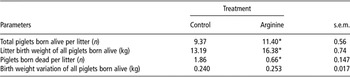
Mateo et al. (Reference Mateo, Wu, Bazer, Park, Shinzato and Kim2007) found an increased number of piglets born alive (22%) and live litter birth weights (24%) without any reduction in the average birth weight of piglets in gilts supplemented with 1% of l-arginine-HCL from days 30 to 114 of gestation compared with a control group that received a control diet (1.7% l-arginine – isonitrogenous diet). In addition, the piglet mortality decreased (65%), the plasma concentration of arginine and its metabolites (ornithine and proline) increased and the birth weight variation of all piglets born alive increased but was not significant (Table 3). According to the authors, the arginine supplementation may have increased the nitric oxide and polyamine synthesis, and thus the increasing placental angiogenesis and growth, enhanced the utero-placental blood flow, the nutrient transfer from mother to fetus and, consequently, fetal survival and development.
Reproductive performance of supplemented and non-supplemented gilts with 1% l-arginine-HCl

s.e.m. = standard error of mean.
Source: Mateo et al. (Reference Mateo, Wu, Bazer, Park, Shinzato and Kim2007).
*Different from the control group, P < 0.05.
A higher number of live piglets were observed in sows supplemented with 25 g l-arginine per day from 14 to 28 days of gestation, without any effect in the average birth weight (Ramaekers et al., Reference Ramaekers, Kemp and van der Lende2006).
Glutamine supplementation
Glutamine is an important amino acid for a variety of metabolic processes in the whole organism, participating in the synthesis of amino sugars and nucleotides that are necessary for cell proliferation and differentiation, and playing crucial roles in fetal and placental nutrition. Among all amino acids transferred from the mother and placenta to the fetus, the concentration of glutamine is the highest, suggesting an active synthesis and release into the fetal circulation by the placenta (Self et al., Reference Self, Spencer, Johnson, Hu, Bazer and Wu2004).
The glutamine delivered to the fetus originates from glutamine from the maternal circulation and from the glutamine synthesis in the placenta. In this process, glutamine is synthesized from glutamate by glutamine synthetase in the placenta (DeMarco et al., Reference DeMarco, McCain, Strauss, Chakrabarti and Neu1997). The placental supply of glutamate is derived from the branched-chain amino acid metabolism (Self et al., Reference Self, Spencer, Johnson, Hu, Bazer and Wu2004) and from the fetal circulation (Battaglia, Reference Battaglia2000).
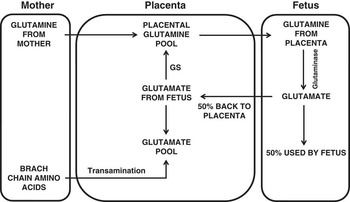
An increased placental glutamine synthesis and glutamine concentration in allantoic fluid in the second third of gestation in sows was observed in the study of Self et al. (Reference Self, Spencer, Johnson, Hu, Bazer and Wu2004), which evaluated the glutamine synthesis in the developing porcine placenta. These findings suggest a higher provision of glutamine because of the most rapid placental and fetal growth in the second third of gestation. In addition, the remained glutamine, which is not metabolized to glutamate in the fetal liver and transported to the placenta, is taken up by the fetal carcass for growth (Figure 1; Neu, Reference Neu2001). In addition, glutamine is a substrate for arginine fetal synthesis, having an important role in regulating the arginine levels in the fetus, because of insufficient uterine uptake of arginine, required to support the fetal growth during the last third of pregnancy (Wu et al., Reference Wu, Ott, Knabe and Bazer1999; Self et al., Reference Self, Spencer, Johnson, Hu, Bazer and Wu2004). Petters et al. (Reference Petters, Johnson, Reed and Archibong1990), evaluating the effects of glutamine on the development of pig embryos, found a greater development of embryos in the presence of glutamine when compared with a control group (absence of glutamine).
Flux of glutamine and glutamate between the mother, placenta and the fetus. Source: Neu (Reference Neu2001).

Some evidences suggest a dependency of the rapidly growing fetus and premature infant to an adequate supply of glutamine and its metabolites for normal physiologic functions and growth (Neu, Reference Neu2001). In addition, some studies demonstrated the possibility that glutamine supplementation might prove beneficial to neonatal piglets’ performance (Dwyer et al., Reference Dwyer, Stickland and Fletcher1994; Wu et al., Reference Wu, Meier and Knabe1996a).
In agreement with our previous discussion of the important roles of arginine and glutamine on fetal nutrition and growth, Wu et al. (Reference Wu, Bazer, Burghardt, Johnson, Kim, Li, Satterfield and Spencer2010) found that supplementing a basal gestation diet with a mixture of 8 g of l-arginine and 12 g of l-glutamine from 30 to 114 days of gestation reduced the variation in birth weights among either all piglets born (−27%) or live-born piglets (−24%) and decreased the proportion of small piglets (−23% for all piglets born and −22% for live-born piglet).
Despite many studies assessing the effect of glutamine supplementation in neonatal piglets, little is known about the effects of glutamine in placental growth and development. As the events related with the placental growth have impact on the fetal development, more research is necessary to evaluate the possible effects of glutamine supplementation during gestation in order to enhance the fetal development and maternal reproductive performance.
Concluding remarks
Within-litter birth weight variation is unfavorably correlated to piglet survival and postnatal growth. This is especially important for highly prolific sows in modern commercial environments. As the litter size increases, the amount of nutrients available per fetus decreases because of an increased fetal competition, which has been related with a suboptimal fetal development and consequently lower birth weight and higher within-litter variation.
A suboptimal maternal nutrition during gestation, unable to provide a correct amount of nutrients for supporting the metabolic needs of the sows and its fetuses, has been regarded as one of the causes of this higher within-litter variability in modern genotypes.
According to our review, there is a positive relationship between birth weight and energy intake of sows throughout gestation. In gilts, the relationship between birth weight and energy intake reaches a plateau, whereas in multiparous sows, birth weights still increase at very high levels of energy intake. Feeding extra feed or energy during late gestation only marginally improves birth weight, and positive effects are not consistent between different studies. It can also be hypothesized that the detrimental effects of protein restriction on fetal growth during early gestation may be due to altered placental and endometrial angiogenesis and growth, which leads to reduction in placental-fetal blood flow and nutrient supply from mother to the fetuses. Furthermore, the current practice to provide a constant amount of dietary protein during gestation is not in accordance with the nutritional requirements of the animals, as the demand for nutrients of both mother and its fetuses increases throughout gestation, which results in a increased fetal competition for nutrients and may be associated with fetal growth retardation, and, consequently, negative effects on the piglet performance.
The number of studies that attempted to influence within-litter variation in birth weight by means of sow nutrition during gestation is limited. In most studies that investigate the effects of sow nutrition on litter weight and piglet viability, within-litter birth weight variation is probably known, but is not mentioned in the results. However, much potential information on this relationship is available in those datasets that contain information on the sow diet during gestation and where individual birth weights are registered, and thus within-litter birth weight variation can be calculated. This knowledge may subsequently provide starting points for the design of nutritional strategies that can influence within-litter birth variation.
Acknowledgments
The authors gratefully acknowledge T. Van der Lende, N. Quiniou, D. Renaudeau and P. Mathur for their critical evaluation of the manuscript.