Nursing homes are recognized for being areas of concern for the development of antimicrobial resistance.Reference Mitchell, Shaffer and Loeb1, Reference Doernberg, Dudas and Trivedi2 Antimicrobials are commonly prescribed to residents that do not meet clinical criteria for urinary tract infection (UTI).Reference Doernberg, Dudas and Trivedi2–Reference Charani, Edwards and Sevdalis5 Contributing factors to the overuse of antimicrobials have been linked to the overutilization of urine testing, specifically when investigating nonspecific symptoms, as well as embedded beliefs (“lore”) and practices (eg, prescribing etiquette), lack of knowledge regarding the difference between asymptomatic bacteriuria (ASB) and UTI, and a liberal prescribing culture.Reference Fleming, Bradley and Cullinan4–Reference Nicolle, Bentley and Garibaldi6 Failure to assess urine test results in the context of patient symptoms is a common theme recognized as an inappropriate use of resources.Reference Rowe and Juthani-Mehta7
Prior studies of the influence of rurality of nursing home care suggest that there are differences in access, acute-care admissions and rehospitalizations, specialist availability, staffing ratios, and quality of care.Reference Temkin-Greener, Zheng and Mukamel8–Reference Blake, Fordyce and Pieper12
Recognizing studies on antimicrobial stewardship in rural nursing homes are limited, the Antimicrobial Stewardship in Rural Continuing Care: Impact of Interprofessional Education and Clinical Decision Tool Implementation on Urinary Tract Infection Treatment (UTI in LTC) intervention was designed based on positive antimicrobial stewardship interventions. It used a multimodal approach that incorporated training, education, system-level changes and evaluation plus feedback, and it was customized to the characteristics of rural practice.Reference Allegranzi, Gayet-Ageron and Damani13–Reference Zabarsky, Sethi and Donskey15
Addressing the perceived lore, it is expected to prevent unnecessary urine testing and empiric prescribing to prevent the challenge of dealing with test results in the absence of clinical symptoms. We hypothesized that the intervention would result in a decrease in the rate of urine culture testing and antimicrobial prescribing for ASB.
Methods
Study setting and design
The UTI in LTC intervention used a cluster randomized controlled study design, with sites matched within ±10% of the number of beds to ensure comparability between control and intervention groups. There are 175 nursing homes in Alberta, Canada. Sites were eligible for inclusion if they (1) were located in centers with a population census <15,000 persons, (2) were operated by Alberta Health Services (AHS), (3) used Meditech (Medical Information Technology, Westwood MA) as their pharmacy dispensation database, and (4) were able to obtain operational approval. In total, 64 eligible nursing homes were identified, with 21 sites selected by blinded randomization with a random-numbers table (odd or even) to be included in the intervention group. This approach was deemed reasonable for the investigators to complete the intervention and exceeded the minimum number needed to detect statistical significance. No nursing homes were excluded from the study due to inability to match with a control site.
In a staggered fashion, the intervention was delivered at each site at a point between April 2015 and January 2016. Baseline data were collected for the 6 months prior to each site’s wash-in month and postintervention data were collected for the 12 months following the wash-in month (Table 1). This study was approved by the Health Research Ethics Board of Alberta (no. HREBA.CHC-14-0031).
Nursing Home and Resident Characteristics

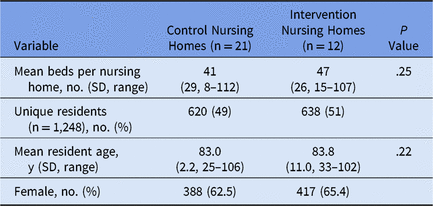
Note. SD, standard deviation.
Intervention
The multimodal intervention was based on the principles of building a culture of safe, effective, and sustainable antimicrobial use, and it targeted key stakeholders in the continuum of care: physicians, nursing staff, and families or caregivers.Reference Fleming, Bradley and Cullinan4 Materials incorporated the following themes: (1) increased awareness of antimicrobial stewardship (with profession specific background documents), (2) best practices for the diagnosis and treatment of UTI and management of ASB (Myths and Facts and Practice Points posters), (3) a pamphlet written in plain language for family and caregivers, and (4) considerations in assessing subtle clinical or behavioural changes in nursing home residents (DELIRIUMS tool).Reference Flaherty and Tumosa16 A clinical decision-making tool (the Urinary Tract Infections in LTC Facilities Checklist) guided staff to identify UTIs based upon clinical symptoms, to collect a urine culture only when indicated, and to review antimicrobial therapy if prescribed. The checklist acted as an interprofessional communication tool.17 This tool is available in the supplementary Appendix online, and the remainder of materials will be made available upon request.
The intervention nursing homes received onsite, face-to-face education sessions that included site leadership and frontline staff, and individual or small group academic detailing sessions with physicians, all conducted by an antimicrobial stewardship pharmacist with training in academic detailing. Participants were asked to incorporate the clinical decision-making tool in their practices. Intervention sites were also presented with the baseline urine culture and antimicrobial prescribing rates at the group sessions, and each site was provided 6-month postintervention rates, along with opportunities for additional education sessions upon request, which could be delivered in person or via webinar.
To encourage conversation and to assist with identifying local barriers, all sessions included a discussion that began with, “What do you need to make these changes happen?” The antimicrobial stewardship pharmacist and participants addressed these barriers together, and plans for implementation with a local context were made. (Examples of the barriers are provided in the Discussion section.) Participants were encouraged to contact the antimicrobial stewardship pharmacist for assistance with any barriers that occurred during implementation. Control sites were not contacted by the investigators.
Outcomes
Recognizing that positive urine culture results (regardless of whether the resident is exhibiting criteria for clinical diagnosis of UTI) drives antimicrobial prescribing and that the main theme of the intervention is to test urine only when there is a strong clinical suspicion of UTI, the primary outcomes of this study were the change in number of urine cultures performed per 1,000 resident days (RD) and the number of antimicrobial prescriptions per 1,000 RD between the control and intervention groups from the baseline to the postintervention periods. The number of urine cultures processed each month at each site was obtained from AHS Provincial Laboratory Services. Prescriptions selected for data collection included oral and parenteral antimicrobials typically used for UTI treatment in the nursing home population: amoxicillin-clavulanic acid, cefixime, ciprofloxacin, fosfomycin, gentamicin, nitrofurantoin, norfloxacin, sulfamethoxazole/trimethoprim, tobramycin, and trimethoprim. Prescription data were retrieved from a Meditech Custom Search report. Duplicate entries, “stat” or single doses (except for fosfomycin), and prescriptions with a charted diagnosis other than UTI were excluded. Secondary outcomes included evaluation of harms from reducing antimicrobial therapy (ie, acute-care and emergency department admissions and mortality per 1,000 RD between control and intervention groups between the baseline and postintervention periods). These data were obtained from the AHS Clinical Analytics and Primary Data Support Service.
To describe the characteristics of the residents who were prescribed antimicrobials, information on residents’ age, urinary catheter use, whether there was a charted diagnosis of UTI, presence of the minimum diagnostic criteria for UTI (eg, fever, dysuria, hematuria, flank or suprapubic pain, new or increased urinary frequency, urgency, or incontinence), and timing of urine culture collection were retrieved from Meditech’s Enterprise Medical Record.
Sample size calculation and randomization
A mean difference of 0.2 in change in the urine culture testing and prescription rates between control and intervention sites, an average cluster bed size of 30 (per site), and an assumption that the intracluster correlation was 0.1, were used to determine that a minimum of 26 clusters (sites) would be required to be able to detect a statistical difference between treatment and control groups with 80% power and 5% significance for the primary outcomes. Power calculations for the secondary outcomes were not performed.
Statistical analysis
A wash-in month was assigned to each site, which indicated when the UTI in LTC intervention was implemented. Data collected for the wash-in month were not used in analyses. The nursing home served as the unit of allocation, intervention, and analysis. Change in the outcome variables between the baseline and postintervention periods of the study were analyzed using the 2-tailed Fisher exact test. To assess the impact of the intervention over time, generalized least-squares linear regression was used to model the outcomes between the control and intervention sites by study month using pair differences in the matched pair of nursing homes. The analysis was conducted using R Studio software (RStudio, Boston, MA).
Results
Study population
In total, 21 sites were allocated into each group. The mean number of beds, mean age, and percentage of females in the control and intervention groups were not significantly different (Table 1).
Urine cultures
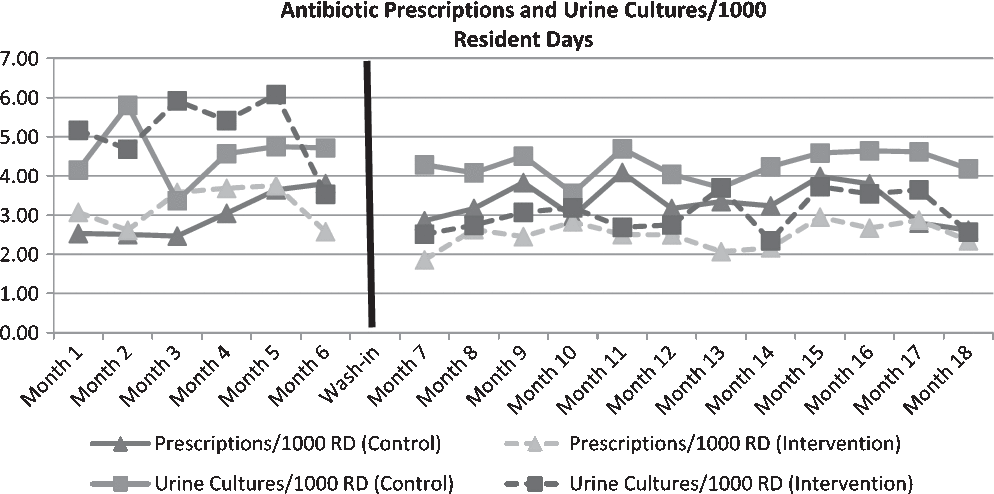
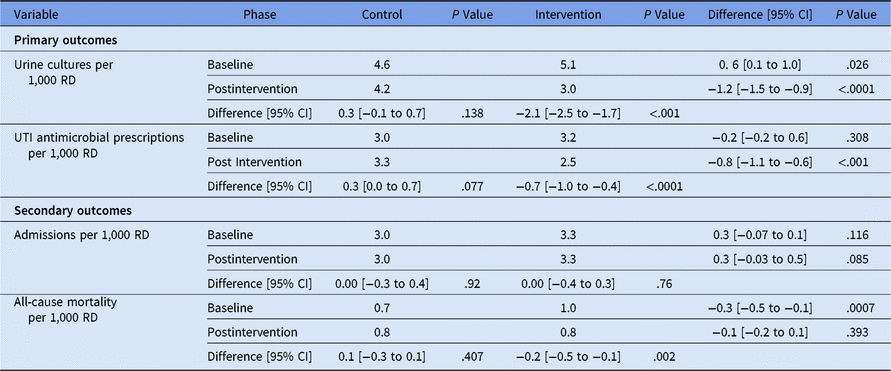
In the baseline period, the urine culture rate in the control group was 5.1 per 1,000 RD lower than the intervention group. After the intervention, there was a statistically significant reduction in urine testing in the intervention group. Urine culture rates in the control group did not differ between the baseline and postintervention periods. In the intervention group, rates decreased the most in the months immediately after the intervention then gradually increased over time (regression coefficient, 0.05; 95% CI, 0.04–0.05) (Fig. 1 and Table 2).
Monthly rates of antimicrobial prescriptions and urine cultures in control and intervention groups

Primary and Secondary Outcomes between Control and Intervention Groups

Note. CI, confidence interval; RD, residence days.
Prescriptions
During the baseline period, prescription rates in the control and intervention groups were similar. After the intervention, there was a statistically significant reduction in the rates of antimicrobial prescribing in the intervention group. Prescribing rates in the control group remained constant through the study period. Similar to urine culture rates, prescribing rates in the intervention group decreased the most in the months immediately after the intervention and gradually increased toward the end of the study period (regression coefficient, 0.02; 95% CI, 0.001–0.03) (Fig. 1 and Table 2).
Secondary outcomes
There were no differences in admissions to acute care or the emergency department between the groups (Table 2). During the baseline period, the mortality rate was 0.3 per 1,000 RD lower in the control group. Following the intervention, the mortality rate decreased by 0.2 per 1,000 RD in the intervention group and was unchanged in the control group. This study was not sufficiently powered to identify changes in mortality, and this outcome is likely due to chance.
Resident characteristics
Additional data were collected on the characteristics of 1,001 of 2,918 prescriptions (750 control, 251 intervention). At the time of prescription, a diagnosis of UTI (5.5%), fever (6.8%) or typical UTI symptoms (16%) was charted infrequently. Urine cultures processed within 72 hours prior to or 24 hours after the prescription occurred in 64.5% of instances. Urinary catheterization was present in 7.1% of reviewed cases.
Discussion
This multimodal intervention statistically significantly decreased urine culture testing by 2.1 tests per 1,000 RD and antimicrobial prescribing for UTI by 0.7 prescriptions per 1,000 RD. In practical terms, for a 40-bed nursing home over a 1-year period, there would be 31 fewer urine cultures performed and 10 fewer antimicrobial prescriptions. Admissions to acute-care facilities or emergency departments or mortality between the groups did not increase, indicating that reducing antimicrobial therapy did not cause harm. Linear regression analysis demonstrated that after an initial decrease, the outcome rates trended toward the baseline over time. This is a common phenomenon observed in antimicrobial stewardship, despite periodic follow-up with sites during the postintervention phase.Reference Loeb, Brazil and Lohfeld14, Reference Landgren, Harvey and Mashford18 This further emphasizes the need to include regular feedback cycles, clinical decision reminders, and coordinated educational efforts to sustain changes in practice.Reference Allegranzi, Gayet-Ageron and Damani13, Reference Crnich, Jump and Trautner19 Urine culture rates decreased relatively more than prescription rates; other studies have observed different degrees of change in urine testing and prescription rates.Reference Loeb, Brazil and Lohfeld14, Reference Trautner, Grigoryan and Petersen20 During the discussion sessions, participants identified that routine urine culture testing was common, as was antimicrobial prescribing for UTIs empirically without urine testing, and that positive urine culture results would result in an antimicrobial order. The prevalence of these practices among the sites and the degree to which the educational themes resonated with participants may explain the relative difference in the primary outcomes.
The educational themes introduced antimicrobial stewardship, including why antimicrobials need to be used in an optimal manner to preserve their value for society and for resident safety. Established guidelines and evidence were used in the UTI in LTC materials to address the perceptions of staff and physicians about the “lore” that nonspecific changes (defined as odorous or cloudy urine, lethargy, weakness, malaise, irritable or aggressive behaviours and falls) in the absence of typical UTI symptoms required urine testing or antimicrobial therapy. Although it was not purely a participatory action research activity, opening discussions with “What do you need to make these changes happen?” generated significant conversation among participants.Reference van Buul, Sikkens and van Agtmael21 Examples of barriers and solutions that participants identified included the needs for (1) improving communication between staff, physicians, and family using the UTI in LTC Facility Checklist and family and caregiver pamphlet, (2) ensuring that behavioral changes are assessed holistically using a systematic process, and (3) maintaining resident hydration by diversifying the responsibility for administering fluids.
The additional data available from 1,001 prescriptions reviewed revealed that clinical information for a UTI diagnosis was present in up to 16% of cases. In contrast, 64.5% of cases had evidence of a urine culture obtained in the time surrounding the antimicrobial prescription. This implies that urine culture testing in the absence of typical UTI symptoms is a driver of antimicrobial prescribing for what could be considered ASB. Because the cases reviewed were not evenly distributed, the impact of the intervention on the charting of UTI diagnostic criteria cannot be ascertained.
This study has several strengths. The cluster design allowed for randomization and analysis of groups of sites. The number of clusters required to detect differences between groups exceeded the minimum amount estimated by the power calculation. A year-long follow-up period addressed seasonal variances and allowed for an assessment of how sustained the intervention impact was. The intervention used available resources and aimed to achieve modest and sustainable changes in practice without relying on additional funding or unrealistic expectations of participants. Broad interprofessional engagement with participatory strategies tailored the intervention to each site and ensured that participants were engaged and that the intervention was relevant to the needs of the site. Since a large number and variety of rural sites across a vast geographic area were included, the outcomes are generally applicable.
The limitations of this study require consideration. Contamination of the control group from other antimicrobial stewardship activities or staff working at more than 1 site is possible because control sites were not sequestered or restricted in pursuing other antimicrobial stewardship opportunities. This possibility would bias results towards the null, but this was unlikely because no change in prescription patterns was observed in the control group over the study period. The operational approval process may have resulted in socialization of the intervention prior to the wash-in month. In addition, some sites required more than a month to complete the intervention, which may have contributed to the primary outcomes being impacted in the latter portion of the baseline period. Nevertheless, the results were still significant and add to the strength of the overall findings (Fig. 1). Utilization of the clinical decision-making tool postintervention was not assessed; an idea of the uptake of the intervention over time would have been valuable feedback for the sites and explained why the primary outcomes gradually increased postintervention. Most of the antimicrobials included may be used for indications other than UTI, and efforts were made to exclude prescriptions that were obviously not for UTI from the data set. Nevertheless, prescription rates may have been influenced by the presence of other indications. Cluster randomization was performed based upon the number of beds only. There was no stratification for other variables, which might affect resident care: for example, the number of attending physicians at each site, staffing ratios, clinical pharmacist coverage, facility age, and whether the nursing home stood alone or was attached to an acute care facility. The primary investigator was responsible for screening antimicrobial prescriptions for inclusion in the database and was aware of the nursing homes’ allocation through delivery of the intervention. Clear, nonsubjective criteria for exclusion mitigated potential bias.
To our knowledge, this is the first study to measure an antimicrobial stewardship intervention focusing on urine testing and appropriate treatment of UTIs in a large number of rural nursing homes. The outcomes are similar to other studies that involved either a limited number of sites or were based in larger, urban nursing homes.Reference Loeb, Brazil and Lohfeld14, Reference Zabarsky, Sethi and Donskey15, Reference Trautner, Grigoryan and Petersen20–Reference McMaughan, Nwaiwu and Zhao24 Rurality was a consideration in the delivery of the intervention because the study sites were located in a large geographic area that required significant travel resources.
The UTI in LTC intervention was able to significantly decrease urine culture testing and UTI prescribing rates without an impact on admission or mortality rates. The concepts were well accepted by staff and physicians, with reassurance that limiting urine testing and antimicrobial prescribing to residents with strong clinical suspicion of UTI would not cause harm. Coordination of resources across disciplines (ie, pharmacy, infection prevention and control, nurse educators and senior leaders) is needed to ensure that the impact of the intervention is sustained over time.
Supplementary material
To view supplementary material for this article, please visit https://doi.org/10.1017/ice.2019.9.
Author ORCIDs
Darren K. Pasay, 0000-0001-8956-6032; Micheal S. Guirguis, 0000-0002-8858-3129; Adrian S. Wagg, 0000-0002-5372-530X; Lauren C. Bresee, 0000-0002-4387-9612
Acknowledgments
The authors thank all of the staff, physicians, and the leadership at each of the intervention sites for their attention and participation, as well as members of the study’s Advisory Panel (Anne-Marie Ewanchuk, Shawna Reynolds, Dianne Calder, Bradley Bennett, Cindy McMinis, Sandra Leung, Alison Devine, and Vineet Saini). We thank Johnathon Tong and Camille Rudolf for developing educational documents, Julia (Bingjie) Jin, Raymond Lam, and Daniel Leung for data collection assistance, and Pat Mayo for statistical mentorship.
Financial support
No financial support was provided relevant to this article.
Conflicts of interest
All authors report no conflicts of interest relevant to this article.