Social anxiety is one of the most commonly reported mental health problems among adolescents (Beesdo, Knappe, & Pine, Reference Beesdo, Knappe and Pine2009; Gren-Landell et al., Reference Gren-Landell, Tillfors, Furmark, Bohlin, Andersson and Svedin2009; Kessler et al., Reference Kessler, Avenevoli, Costello, Georgiades, Green, Gruber and Merikangas2012; Polanczyk, Salum, Sugaya, Caye, & Rohde, Reference Polanczyk, Salum, Sugaya, Caye and Rohde2015). This may not be surprising, as adolescence involves the fundamental task of developing autonomy, with immense biological changes as well as psychological and social developmental tasks, which can be challenging and stressful (Dick, Adkins, & Kuo, Reference Dick, Adkins and Kuo2016; Eccles et al., Reference Eccles, Buchanan, Flanagan, Fuligni, Midgley and Yee1991; Shaffer & Kipp, Reference Shaffer and Kipp2014). Adolescents certainly differ in their reactions to stressful periods, and conscious feelings of anxiety, a requisite for the feasibility of self-reports of anxiety (LeDoux, Reference LeDoux2015), are not the only symptoms of stress in young people. Similarly, while heightened levels of anxiety are transient in most individuals, in others they are more persistent (Copeland, Angold, Shanahan, & Costello, Reference Copeland, Angold, Shanahan and Costello2014; Ginsburg et al., Reference Ginsburg, Becker, Keeton, Sakolsky, Piacentini, Albano and Kendall2014; Kessler et al., Reference Kessler, Avenevoli, Costello, Georgiades, Green, Gruber and Merikangas2012). Differences in the degree to which individuals develop mental health problems in response to stress have been attributed to resilient functioning, a concept first introduced in the 1970s (Garmezy, Reference Garmezy1974; Rutter, Reference Rutter1979). The central idea is that some children and adolescents are more vulnerable to the environmental adversities they are exposed to, whereas others are more resistant to the same environment (Caspi et al., Reference Caspi, McClay, Moffitt, Mill, Martin, Craig and Poulton2002). The conventional approach in studies of anxiety disorders in young people has been consistent with the diathesis–stress model of the interplay between biological and environmental risk variables, an approach predictive of a fan-shaped, ordinal form of interaction (Beesdo et al., Reference Beesdo, Knappe and Pine2009; Salum, Desousa, do Rosario, Pine, & Manfro, Reference Salum, Desousa, do Rosario, Pine and Manfro2013; Widaman et al., Reference Widaman, Helm, Castro-Schilo, Pluess, Stallings and Belsky2012). A new way of understanding this interaction is to conceptualize certain genes as plasticity genes rather than vulnerability genes, a perspective predictive of a crossover, disordinal form of interaction (Widaman et al., Reference Widaman, Helm, Castro-Schilo, Pluess, Stallings and Belsky2012). This approach is derived from the evolutionary–developmental perspective of differential susceptibility, a theory that proposes that individuals vary in their neurobiological sensitivity to both positive and negative environments, leading to a better than average outcome for carriers of plasticity gene variants in favorable environments (Belsky & Hartman, Reference Belsky and Hartman2014; Belsky & Pluess, Reference Belsky and Pluess2009, Reference Belsky and Pluess2013; Ellis, Boyce, Belsky, Bakermans-Kranenburg, & van IJzendoorn, Reference Ellis, Boyce, Belsky, Bakermans-Kranenburg and van IJzendoorn2011).
The neuropeptide oxytocin has a key role in the regulation of human social behavior and the response to stress through its projections in a number of brain regions related to social and threat information processing, including the basal ganglia, the amygdala, and the hippocampus (Kirsch, Reference Kirsch2015; Knobloch & Grinevich, Reference Knobloch and Grinevich2014; Love, Reference Love2014; Wigton et al., Reference Wigton, Radua, Allen, Averbeck, Meyer-Lindenberg, McGuire and Fusar-Poli2015). Oxytocin has been shown to attenuate amygdala activation and the stress hormone response to social challenges and fearful stimuli, a stress-dampening and anxiolytic effect that is augmented in combination with social support (Heinrichs, Baumgartner, Kirschbaum, & Ehlert, Reference Heinrichs, Baumgartner, Kirschbaum and Ehlert2003; Kumsta & Heinrichs, Reference Kumsta and Heinrichs2013; McQuaid et al., Reference McQuaid, McInnis, Paric, Al-Yawer, Matheson and Anisman2016; Meyer-Lindenberg, Domes, Kirsch, & Heinrichs, Reference Meyer-Lindenberg, Domes, Kirsch and Heinrichs2011; Tops, Van Peer, Korf, Wijers, & Tucker, Reference Tops, Van Peer, Korf, Wijers and Tucker2007). Functional magnetic imaging studies have shown that, among individuals diagnosed with social anxiety disorder, intranasally administered oxytocin enhances connectivity between the amygdala and brain regions involved in socioemotional information processing (Dodhia et al., Reference Dodhia, Hosanagar, Fitzgerald, Labuschagne, Wood, Nathan and Phan2014; Gorka et al., Reference Gorka, Fitzgerald, Labuschagne, Hosanagar, Wood, Nathan and Phan2015). In behavioral association studies, intranasally administered oxytocin has been shown to enhance face and emotional recognition and to increase eye region gazing, the ability to infer mental states from facial social cues and interpersonal trust (Kosfeld, Heinrichs, Zak, Fischbacher, & Fehr, Reference Kosfeld, Heinrichs, Zak, Fischbacher and Fehr2005; Lee, Macbeth, Pagani, & Young, Reference Lee, Macbeth, Pagani and Young2009), but these effects seem to be blunted or absent in individuals with adverse childhood experiences (Bakermans-Kranenburg & van IJzendoorn, Reference Bakermans-Kranenburg and van IJzendoorn2013). High levels of blood plasma oxytocin have been associated with trust, positive interaction with a partner, and sensitive parenting (Feldman et al., Reference Feldman, Zagoory-Sharon, Weisman, Schneiderman, Gordon, Maoz and Ebstein2012; Gordon, Martin, Feldman, & Leckman, Reference Gordon, Martin, Feldman and Leckman2011; Meyer-Lindenberg et al., Reference Meyer-Lindenberg, Domes, Kirsch and Heinrichs2011). A negative relationship between cerebrospinal fluid oxytocin concentrations and anxiety ratings has been observed in healthy women, with the lowest concentrations detected among those exposed to childhood emotional abuse (Heim et al., Reference Heim, Young, Newport, Mletzko, Miller and Nemeroff2008). However, in response to a social stress test, higher mean levels of blood plasma oxytocin were observed among childhood cancer survivors compared to sexually abused and control subjects (Pierrehumbert et al., Reference Pierrehumbert, Torrisi, Laufer, Halfon, Ansermet and Beck Popovic2010). In pediatric patients, plasma oxytocin predicts both cerebrospinal fluid oxytocin concentrations and parent ratings of anxiety on the Spence Children's Anxiety Scale (SCAS; Carson et al., Reference Carson, Berquist, Trujillo, Garner, Hannah, Hyde and Parker2015).
Individual genetic variability in the oxytocin system in relation to social behavior and psychopathology has been investigated. Studies have primarily focused on single nucleotide polymorphisms (SNPs) located in the oxytocin receptor gene (OXTR; Ebstein, Knafo, Mankuta, Chew, & Lai, Reference Ebstein, Knafo, Mankuta, Chew and Lai2012; Feldman, Monakhov, Pratt, & Ebstein, Reference Feldman, Monakhov, Pratt and Ebstein2016; Feldman et al., Reference Feldman, Zagoory-Sharon, Weisman, Schneiderman, Gordon, Maoz and Ebstein2012; Heinrichs, von Dawans, & Domes, Reference Heinrichs, von Dawans and Domes2009; Onodera et al., Reference Onodera, Ishitobi, Tanaka, Aizawa, Masuda, Inoue and Akiyoshi2015; Tost et al., Reference Tost, Kolachana, Hakimi, Lemaitre, Verchinski, Mattay and Meyer-Lindenberg2010; Uzefovsky et al., Reference Uzefovsky, Shalev, Israel, Edelman, Raz, Mankuta and Ebstein2015), with results showing support for polymorphic main effects on autism (LoParo & Waldman, Reference LoParo and Waldman2015) and biological functioning outcomes (e.g., oxytocin levels and amygdalar volume; Bakermans-Kranenburg & van IJzendoorn, Reference Bakermans-Kranenburg and van IJzendoorn2014). However, in their meta-analyses of two of the most widely studied OXTR SNPs, rs53576 and rs2254298, Bakermans-Kranenburg and van IJzendoorn (Reference Bakermans-Kranenburg and van IJzendoorn2014) found that these SNPs failed to explain individual differences in personality, psychopathology, social behavior, or autism, while also noting that few studies reported Gene × Environment (G × E) effects, precluding a meta-analysis of G × E interaction (Bakermans-Kranenburg & van IJzendoorn, Reference Bakermans-Kranenburg and van IJzendoorn2014). In later reports, G × E interaction effects consistent with both the diathesis–stress and differential-susceptibility theories have been observed for rs53576 and rs2254298 in association with psychopathology, including social anxiety (Brune, Reference Brune2012; Hammen, Bower, & Cole, Reference Hammen, Bower and Cole2015; Notzon et al., Reference Notzon, Domschke, Holitschke, Ziegler, Arolt, Pauli and Zwanzger2016).
Compared with research on OXTR, a limited number of studies have investigated the gene coding for oxytocin (OXT), with results also implicating a role for OXT-related variants in social behavior and psychiatric disorders (Feldman et al., Reference Feldman, Monakhov, Pratt and Ebstein2016). Using positron emission tomography scans, Love et al. (Reference Love, Enoch, Hodgkinson, Pecina, Mickey, Koeppe and Zubieta2012) investigated associations between SNPs within OXT and stress-induced dopamine release. The OXT SNP rs4813625 was associated with greater dopamine responses in female C allele carriers relative to G homozygotes, with no difference found among male participants. Furthermore, among females, the C allele was related to lower emotional well-being and higher trait and attachment anxiety. Francis et al. (Reference Francis, Kistner-Griffin, Yan, Guter, Cook and Jacob2016) reported significant associations between the rs4813625 C allele and social withdrawal scores and whole-blood serotonin levels in autistic children. A Swedish twin study investigated associations between four OXT SNPs and autistic-like behavior and found significant associations with rs2770378 in girls, with more symptoms of autistic behaviors consistently observed among homozygote major allele carriers than minor allele carriers (Hovey et al., Reference Hovey, Zettergren, Jonsson, Melke, Anckarsater, Lichtenstein and Westberg2014). Three OXT SNPs, rs274010, rs2770378, and rs4813627, were found to be related to childhood-onset mood disorders in a Hungarian family-based study; however, the associations did not remain significant after correction for multiple testing (Strauss et al., Reference Strauss, Freeman, Shaikh, Vetró, Kiss, Kapornai and Kennedy2010). In a study of oxytocin variation effects on mothering, OXT SNPs rs274010 and rs4813627 were associated with differences in mothers’ vocalization to their infants. Furthermore, these SNPs interacted with mothers’ early life quality of care in predicting instrumental care of their infants and postpartum depression (Mileva-Seitz et al., Reference Mileva-Seitz, Steiner, Atkinson, Meaney, Levitan, Kennedy and Fleming2013).
The parent–child relationship and a parental style of autonomy support and flexible guidance have been implicated as important factors in adolescents’ healthy development toward self-reliance and independence (McElhaney, Allen, Stephenson, & Hare, Reference McElhaney, Allen, Stephenson, Hare, Lerner and Steinberg2009; Shaffer & Kipp, Reference Shaffer and Kipp2014), whereas excessive parental control, rejection, and overprotection have been associated with increased risk of developing anxiety disorders (Beesdo et al., Reference Beesdo, Knappe and Pine2009; Salum et al., Reference Salum, Desousa, do Rosario, Pine and Manfro2013). In a systematic review of 22 studies examining the relationship between parental style and adolescent anxiety, Waite, Whittington, and Creswell (Reference Waite, Whittington and Creswell2014) found that 75% of the studies reported significant associations between anxiety and parental control, with effect sizes ranging from small to medium. In the same review, less consistent support was found for an association between adolescent anxiety and perceptions of parental lack of warmth, with 66% of the studies reporting a significant relationship with small to medium effect sizes. Cross-sectional studies investigating adolescent social anxiety found no significant relationship with parental control or warmth (Waite et al., Reference Waite, Whittington and Creswell2014).
As outlined above, a limited body of research provides preliminary support for associations between variants in the OXT gene and the stress response, anxiety, social withdrawal, and parenting behavior. Likewise, reports of the role of parenting style in adolescent social anxiety provide preliminary, but not consistent, evidence for an association between parenting style and anxiety. The majority of studies in these two lines of research have conducted analyses either of the main effects of gene variants and parental behavior or from a risk perspective, without considering contextual factors or differential neurobiological sensitivity to the environment. In the presence of such G × E interaction effects, positive or negative parental behavior effects would be observable only among carriers of plasticity alleles, leading to lower or higher levels of anxiety in those individuals and not in carriers of nonplasticity alleles.
The primary aim of the present study was to investigate the potential interplay between aspects of parenting style and polymorphic variations in the OXT gene in association with social anxiety symptoms in a community sample of adolescents. A secondary aim was to explore the form of G × E interactions from the perspectives of the differential-susceptibility and diathesis–stress frameworks.
Methods
Recruitment of participants
Data for this study were collected from the Survey of Adolescent Life in Västmanland cohort study. The Survey of Adolescent Life in Västmanland study includes two birth cohorts (1997 and 1999) in the county of Västmanland, Sweden, and started in 2012. Västmanland is a medium-sized county located in the southwest of Sweden with approximately 264,000 inhabitants. Västmanland is representative of the larger Swedish society with regard to the distribution of urban and rural areas; educational, income, and employment levels; and ethnic backgrounds. The study group consisted of 1,359 adolescents (59.4% girls) with complete data on measures of anxiety symptoms, parenting style, and genotype, representing 93% of respondents who provided both saliva and questionnaire data (N = 1,456). Of the study group, 697 participants (51.3%) were born in 1997, and 662 (48.7%) in 1999. Participants were recruited by regular mail, and their informed written consent, saliva samples, and behavioral questionnaires were collected by mail in reply envelopes. Approval from the Ethical Review Board of Uppsala was obtained for the study.
Measures
Genotyping
DNA was extracted according to the kit manufacturer's guidelines from saliva samples collected using a DNA Self Collection Kit (Oragene®). Genotyping was performed using a fluorescence-based competitive allele-specific PCR (KASPar) assay (KBioscience®). Two common variants linked to the oxytocin gene, rs4813625 and rs2770378, were genotyped (Sherry et al., Reference Sherry, Ward, Kholodov, Baker, Phan, Smigielski and Sirotkin2001). Allele discrimination was done using SNPviewer2®. The genotype calling was performed blind to psychosocial data. The genotypes were in Hardy–Weinberg equilibrium (Table 1). Genotypes were coded assuming an additive function and based on minor allele count: 0 = homozygous for the major allele, 1 = heterozygous, and 2 = homozygous for the minor allele.
Oxytocin gene single nucleotide polymorphism characteristics

Note: SNP, single nucleotide polymorphism; MAF, minor allele frequency; HWE, Hardy–Weinberg equilibrium; OXT, oxytocin gene; chr20, chromosome 20.
Behavioral questionnaires
Social anxiety symptoms
Self-reported symptoms of anxiety were measured using the SCAS (Spence, Reference Spence1997), a 44-item (38 score-generating items and 6 positive filler items to reduce negative bias) Likert-type (0 = never, 3 = always) questionnaire designed to assess anxiety symptoms in children and adolescents. The SCAS provides a total score (range = 0–114 points) as well as scores on six subscales: panic/agoraphobia, separation anxiety, physical injury fears (specific phobia), social anxiety, obsessive compulsive, and generalized anxiety. The SCAS has been examined across multiple cultures, including in Sweden, and support for its six-factor structure and strong internal consistency have been found in the majority of studies (Olofsdotter, Sonnby, Vadlin, Furmark, & Nilsson, Reference Olofsdotter, Sonnby, Vadlin, Furmark and Nilsson2015; Orgiles, Fernandez-Martinez, Guillen-Riquelme, Espada, & Essau, Reference Orgiles, Fernandez-Martinez, Guillen-Riquelme, Espada and Essau2015). In the current study, the 6-item subscale of social anxiety (range 0–18 points) was used. The internal consistency of the social anxiety subscale, measured as Cronbach α, was 0.79 in the current sample.
Parenting style
Aspects of parenting style were measured using the 24-item Parents as Social Context Questionnaire (PASCQ), adolescent version (Skinner, Johnson, & Snyder, Reference Skinner, Johnson and Snyder2005; Skinner, Wellborn, & Regan, Reference Skinner, Wellborn and Regan1986). The PASCQ was designed to measure parenting style in six dimensions, corresponding to six subscales: autonomy support, warmth, structure, coercion, chaos, and rejection. Adolescents rate how they perceive their parents on a scale ranging from 0 = not at all true to 3 = very true, with scores ranging from 0 to 12 on each subscale. Evaluation of the PASCQ has shown that (a) unipolar dimensions provide a better fit than bipolar dimensions (e.g., warmth–rejection) and (b) supportive and positive aspects of parenting may be captured by combining the three subscales of autonomy support, warmth, and structure, whereas unsupportive and negative aspects of parenting may be assessed by combining the three subscales of coercion, rejection, and chaos (Skinner et al., Reference Skinner, Johnson and Snyder2005). Thus, two composite, 12-item variables of parenting style, PASCQPOS and PASCQNEG, were computed by summing up individual participant scores on the three subscales corresponding to each composite variable. The scores on the PASCQPOS and PASCQNEG ranged from 0 to 36 points. In the current sample, the internal consistency scores of the PASCQPOS and PASCQNEG were 0.83 and 0.85, respectively. The correlation between PASCQPOS and PASCQNEG was –0.59.
Procedure
Statistical analyses
Statistical analyses were conducted using SPSS version 24 running on Windows 7. Descriptive statistics were obtained by computing chi-square (χ2) tests for categorical data and t tests for continuous variables. Multiple linear regression and the PROCESS macro for SPSS version 2.16 were used to test and visualize interaction effects (Hayes, Reference Hayes2013). The PROCESS macro uses an ordinary least squares analytic framework for estimating conditional effects of the predictor on the outcome at different values of the moderator. The PROCESS output includes moderator values defining regions of significance (RoS), that is, where the effect of the predictor on the outcome transitions between statistically significant and not significant, or vice versa. These values define the region or regions of significance. Analyses of main effects of genotype and parenting style were conducted using regression models including only PASCQPOS, PASCQNEG, or genotype and controlling for sex. Interaction models were controlled for sex and included three predictor variables: genotype, parenting style, and the Genotype × Parenting Style interaction term. Predictor, moderator, and outcome variables were all considered continuous. Because the assumption of equal variances was violated, the heteroscedasticity-consistent standard error estimator HC3 was used (Darlington & Hayes, Reference Darlington and Hayes2017; White, Reference White1980).
Analyses of missing data patterns showed that, among participants with genotype data, 5% had at least one missing item response on the PASCQ whereas 1% had missing item responses on the SCAS social anxiety scale. On both measures, less than 0.5% of all values were missing. Logistic regression analyses showed no significant relationships between missingness and genotype, mother's birthplace, sex, self-reported symptoms of social anxiety, depression, attention deficit hyperactivity disorder, and alcohol abuse.
Statistical power was estimated with Quanto (Gauderman & Morrison, Reference Gauderman and Morrison2006). The minor allele frequencies were 0.47 for rs4813625 and 0.37 for rs2770378. The power to detect a marginal coefficient of determination (R 2) interaction effect of 1%, typically seen in observational and genome-wide association studies (Dick et al., Reference Dick, Agrawal, Keller, Adkins, Aliev, Monroe and Sher2015; McClelland & Judd, Reference McClelland and Judd1993), was estimated to be 0.96 for each SNP in the current sample, assuming a significance level of 0.05 and a two-sided test.
Methods recommended by Roisman et al. (Reference Roisman, Newman, Fraley, Haltigan, Groh and Haydon2012) for distinguishing between differential-susceptibility and diathesis–stress models were adopted in the evaluation of G × E interaction effects. These methods include three indices and a test for nonlinearity. The first index is a RoS test to demonstrate an association between social anxiety and genotype at both low and high scores of the PASCQPOS and PASCQNEG. The second index is the proportion of the interaction (PoI) index. This index is a measure of the proportion of the total area between the fitted regression lines in an interaction plot that is on the positive, that is, “for better,” side of the cross-over point. Because existing differential susceptibility criteria for PoI values (i.e., values between 0.40 and 0.60) have been shown to produce false negatives, a revised index, PoI/R, was used where values between 0.20 and 0.80 suggest evidence for differential susceptibility, whereas values closer to 0 suggest evidence for the diathesis–stress model (Del Giudice, Reference Del Giudice2017). The third index, the proportion affected (PA) index, is designed to quantify the proportion of the total sample that falls above the crossover point. PA values equal to or greater than 0.16 have been suggested as evidence for differential susceptibility. As recommended by Roisman et al., the RoS and PoI indices were restricted to a range of interest ±2 SD from the mean of the PASCQPOS and PASCQNEG, although it must be noted that this boundary fell outside the observed range of scores on both parenting style variables. Finally, in order to test whether an apparent significant relationship was an artifact of imposing a linear model on a nonlinear phenomenon, quadratic terms of PASCQPOS and PASCQNEG were included in additional regression models. The results of this model must show that the linear interaction term remains significant after controlling for nonlinear terms. Tests of nonlinearity were conducted with mean-centered parenting variables.
Results
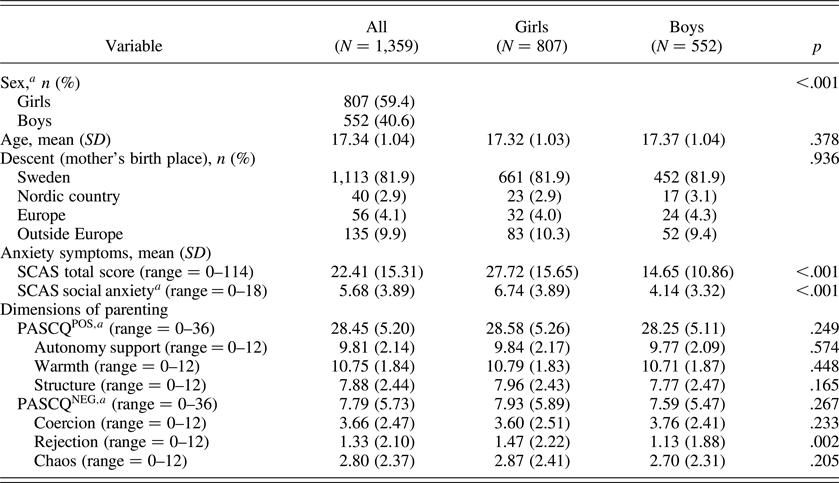
Genotype and demographic characteristics of the study population are presented in Table 1 and Table 2. The mean participant age was 17, and a majority of the sample were female. Most were of Swedish, Nordic, or European descent as measured by mother's birthplace. No significant differences in genotype frequencies were found between participants of Swedish/Nordic/European and non-European descent. No significant associations were found between composite variables of parenting style and OXT variants. However, higher mean scores on the warmth subscale were observed among rs4813625 C allele carriers than among homozygous G allele carriers, F (2, 1,356) = 2.92, p = .05.
Characteristics of the study population
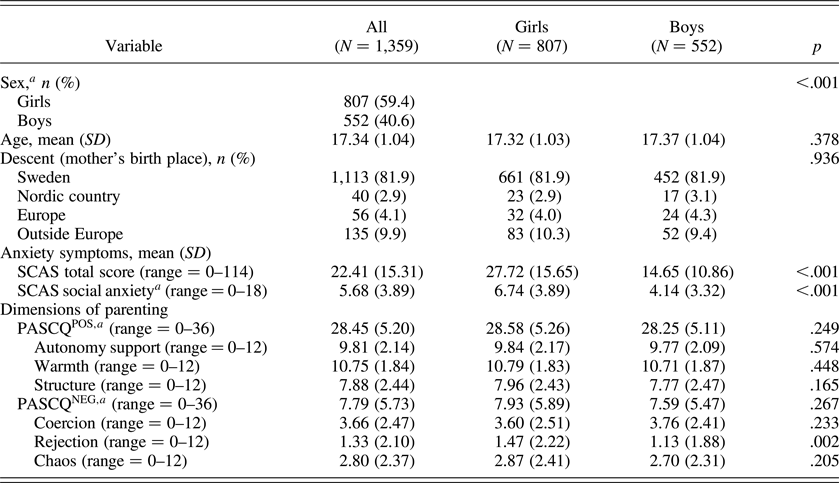
Note: SCAS, Spence Children's Anxiety Scale; PASCQPOS, Parents as Social Context Questionnaire composite variable of autonomy support, warmth, and structure subscales; PASCQNEG, PASCQ composite variable of coercion, rejection, and chaos subscales.
aVariables used in regression models.
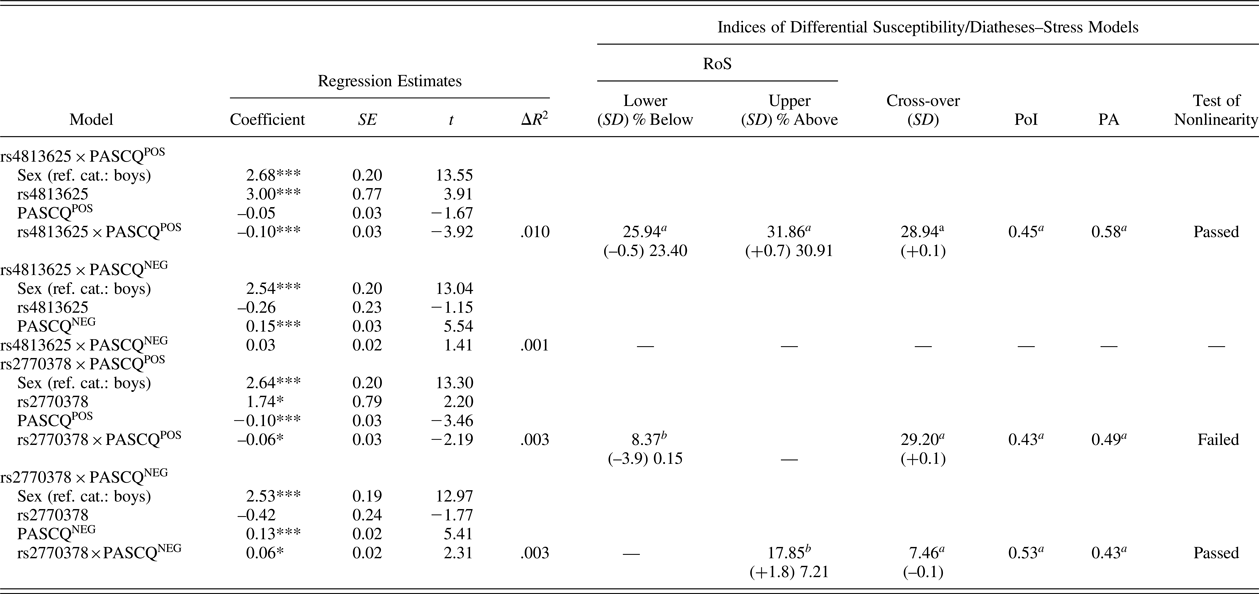
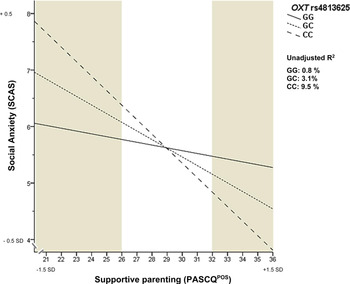
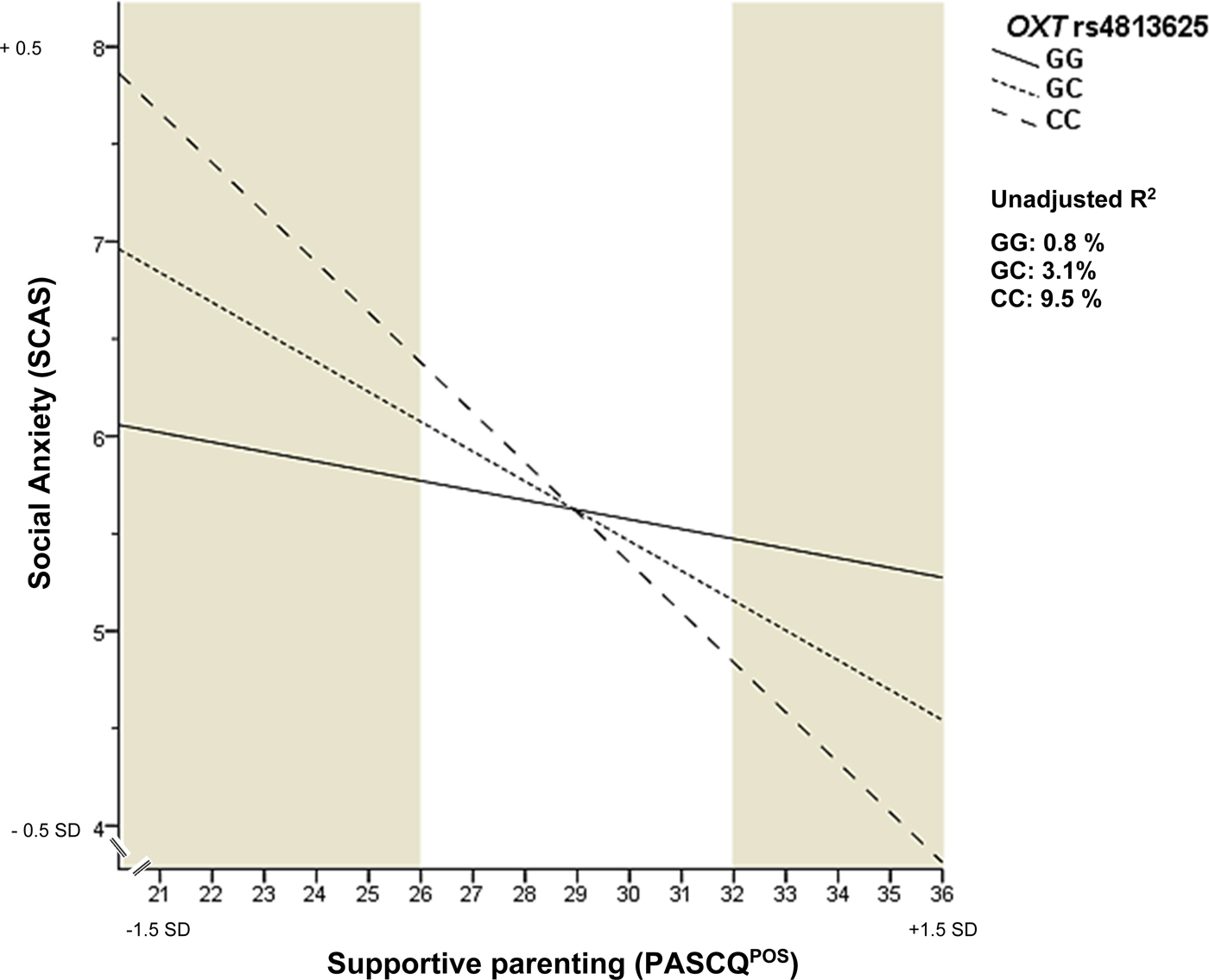
In main effect models adjusted for sex (not shown in tables), social anxiety was negatively associated with PASCQPOS (B = –0.14, SE = 0.02, p < .001, ΔR 2 = 3.5%) and positively associated with PASCQNEG (B = 0.18, SE = 0.02, p < .001, ΔR 2 = 6.8%), whereas the main effects of both OXT variants were nonsignificant. In interaction models adjusted for sex, significant joint effects were observed for both OXT variants with PASCQPOS but only for rs2770378 with PASCQNEG. The interaction of PASCQPOS with rs4813625 was significantly and negatively associated with social anxiety with a significant marginal R 2 change due to the interaction of 1%. Unadjusted R 2 interaction effect sizes for the GG, GC, and CC genotypes in relation to social anxiety were 0.8%, 3.1%, and 9.5%, respectively. The interaction of PASCQPOS with rs2770378 was also significantly and negatively associated with social anxiety, but with a marginal R 2 change due to the interaction of only 0.3% and unadjusted R 2 interaction effect sizes for GG, GA, and AA of 1.6%, 3.2%, and 9.3%, respectively. A similar marginal R 2 change of 0.3% was also observed for the interaction of PASCQNEG with rs2770378, which was positively associated with social anxiety. Unadjusted R 2 effect sizes for GG, GA, and AA genotypes were 4.0%, 8.7%, and 14.2%.
Covariate interactions were evaluated by adding three interaction terms, including sex, in additional models (OXT × Sex, PASCQPOS/NEG × Sex, and OXT × PASCQPOS/NEG × Sex). Results from these analyses showed that significant interactions between OXT variants and PASCQPOS/NEG from original models remained significant, whereas no significant effects of the interaction terms including sex were observed (results not shown in tables). Regression results for the interaction models are presented in Table 3.
Regression estimates and differential-susceptibility/diathesis–stress indices by two oxytocin gene variants and parental style among Swedish adolescents

Note: Coefficient, unstandardized regression coefficient; ΔR 2, R 2 change due to the interaction; RoS, regions of significance on PASCQPOS/NEG; % Below/Above, percentage of the sample below/above RoS values; Cross-over, PASCQPOS/NEG value where the regression lines cross over; PoI, proportion of interaction above the cross-over value; PA, proportion of the sample above the cross-over value; PASCQPOS, Parents as Social Context Questionnaire supportive dimension; PASCQNEG, PASCQ unsupportive dimension.
aSupport for the differential susceptibility model.
bSupport for the diathesis–stress model.
*p < .05. **p < .01. ***p < .001.
Indices of differential-susceptibility or diathesis–stress forms of interaction
Supportive parenting style
Consistent with a differential susceptibility prediction of a crossover form of interaction, the RoS test showed that rs4813625 had an effect on social anxiety at both ends of the distribution of PASCQPOS scores, with lower and upper boundaries of the RoS within ±1 SD from the mean score of PASCQPOS. Carriers of the C allele reported higher levels of social anxiety under low parental support and lower levels of anxiety under high parental support compared with G homozygote carriers. For every 1-point increase in PASCQPOS score, the effect on SCAS social anxiety score was a decrease of 0.15 points for carriers of one C allele and 0.26 points for carriers of two C alleles, whereas the effect for G allele homozygotes, 0.05 points, was nonsignificant. Rs2770378 failed the RoS test of differential susceptibility, as only one value was identified corresponding to 3.9 SD below the mean on the PASCQPOS. The RoS test indicates that rs2770378 is associated with social anxiety only at the lowest end of the PASCQPOS score distribution, with A allele carriers reporting higher levels of social anxiety than GG carriers. For both rs4813625 and rs2770378, evidence for differential susceptibility was observed both on the PoI index, with values close to 0.50, and on the PA index, with values above the proposed threshold of 0.16. Tests of nonlinearity revealed significant associations for the G × E interaction terms including the quadratic term of PASCQPOS. However, when controlling for the nonlinear terms by adding them to the original model, the interaction between rs4813625 and PASCQPOS remained statistically significant (B = –0.06, SE = 0.03, p = .049). The interaction term including rs2770378 did not pass the test of nonlinearity. After controlling for the nonlinear terms in the model, the interaction between rs2770378 and PASCQPOS became nonsignificant. To summarize, evaluation of the form of interaction between OXT variants and supportive parenting style showed that rs4813625 passed all tests of differential susceptibility, whereas rs2770378 failed both the RoS test and the nonlinearity test. Indices of differential-susceptibility or diathesis–stress forms of interaction are presented in Table 3. The conditional effect of OXT rs4813625 on social anxiety scores at different values of adolescent-reported supportive parenting style is presented in Figure 1.
(Color online) Interaction effect of oxytocin gene (OXT) polymorphism rs4813625 and adolescent-reported supportive parenting on social anxiety scores. Model adjusted for sex. Shadowed areas represent regions of significance. SCAS, Spence Children's Anxiety Scale social anxiety subscale; PASCQPOS, Parents As Social Context Questionnaire positive index (composite variable of parental warmth, structure, and autonomy support).
Unsupportive parenting style
Suggestive of a diathesis–stress form of interaction, the RoS test showed that rs2770378 was associated with social anxiety only at higher levels of unsupportive parenting style with a single RoS value identified, corresponding to 1.8 SD above the mean, with A allele carriers reporting higher levels of social anxiety than GG carriers. For every 1-point increase in PASCQNEG score, the effect on SCAS social anxiety score was an increase of 0.14 points for G allele homozygotes, 0.18 points for carriers of one A allele, and 0.22 points for carriers of two A alleles. In contrast to the RoS test, the crossover value, PoI, and PA tests were indicative of a disordinal form of interaction. A test of nonlinearity revealed a significant and negative association for the quadratic term of PASCQNEG, whereas the G × E2 interaction term was nonsignificant. After controlling for nonlinear terms in the model, the interaction between rs2770378 and PASCQNEG remained significant (B = 0.07, SE = 0.03, p = .013). Congruent with the nonsignificant interaction between rs4813625 and PASCQNEG, the RoS test yielded no statistically significant transition values within the observed range of the PASCQNEG. Indices of differential-susceptibility or diathesis–stress forms of interaction are presented in Table 3.
Discussion
The current study provides preliminary evidence for a modifying effect of supportive parenting style on the relationship between OXT SNP rs4813625 and social anxiety symptoms in adolescents, independent of sex. When supportive parenting behavior was perceived as low, carriers of the minor C allele reported higher than average levels of social anxiety compared with homozygote G allele carriers, whose levels of social anxiety were close to average. Likewise, at high perceived levels of supportive parental behavior, C allele carriers reported lower than average levels of social anxiety, again with homozygote G allele carriers remaining almost unaffected by parenting style. At average levels of parental support, rs4813625 was not associated with social anxiety. The nature of the modifying effect was in line with the differential susceptibility theory, which proposes that individuals differ in their neurobiological sensitivity to both favorable and less favorable environments, leading to a better than average outcome for carriers of plasticity gene variants in positive environments. Further support for a differential susceptibility model fit was provided by results from a series of tests suggested by Roisman et al. (Reference Roisman, Newman, Fraley, Haltigan, Groh and Haydon2012). The interaction effects of rs2770378 with supportive and unsupportive parenting style were small but significant; however, only the interaction term including unsupportive parenting style remained significant in nonlinear models. The rs2770378 × PASCQNEG effect was consistent with the diatheses–stress model.
Previous research has shown that oxytocin and social support interact to reduce stress (Heinrichs et al., Reference Heinrichs, Baumgartner, Kirschbaum and Ehlert2003; Meyer-Lindenberg et al., Reference Meyer-Lindenberg, Domes, Kirsch and Heinrichs2011; Tops et al., Reference Tops, Van Peer, Korf, Wijers and Tucker2007), and a supportive parenting style may act as a stress-reducing buffer against exposure to increasing demands for independent social functioning during adolescence, where the OXT variant rs4813625 influences the sensitivity to the social context of parental supportive behavior along a low to high continuum whereas rs2770378 influences sensitivity only to higher levels of unsupportive parenting. One theory about the mechanism by which oxytocin influences social behavior is the social salience hypothesis, which proposes that oxytocin increases attention to social information, such as safety or threat signals in the social context (Bartz, Zaki, Bolger, & Ochsner, Reference Bartz, Zaki, Bolger and Ochsner2011; Olff et al., Reference Olff, Frijling, Kubzansky, Bradley, Ellenbogen, Cardoso and van Zuiden2013; Shamay-Tsoory & Abu-Akel, Reference Shamay-Tsoory and Abu-Akel2016). In line with the conditional joint effects of perceived parenting behavior and OXT variants on social anxiety in the current study, the social salience hypothesis specifies that prosocial behavior can be enhanced in positive, safe contexts, whereas negative or unsafe situations decrease prosocial behavior and increase anxiety (Shamay-Tsoory & Abu-Akel, Reference Shamay-Tsoory and Abu-Akel2016). Dopamine is a neurotransmitter that is vital in motivational processes, as it signals motivational value and the salience of events (Bromberg-Martin, Matsumoto, & Hikosaka, Reference Bromberg-Martin, Matsumoto and Hikosaka2010). By way of projection into the mesolimbic pathway, oxytocin has been suggested to affect dopamine activity, further supporting the social salience hypothesis of oxytocin (Baskerville & Douglas, Reference Baskerville and Douglas2010; Love, Reference Love2014; Shamay-Tsoory & Abu-Akel, Reference Shamay-Tsoory and Abu-Akel2016). Corroborating proposed interactions between dopamine and oxytocin and variability in those interaction effects is the finding of greater stress-induced dopamine release observed in female rs4813625 C allele carriers than in G homozygotes (Love et al., Reference Love, Enoch, Hodgkinson, Pecina, Mickey, Koeppe and Zubieta2012). However, similar to the main effect findings of the current study, Love et al. did not observe any differences between C allele carriers and GG carriers in self-reported state anxiety during the stressor condition. This observation further supports the idea of a contextual dependency of oxytocin effects, as suggested by a review of studies of experimentally manipulated levels of oxytocin, which found no main effect in 43% of studies, situational or personal moderating effects on social cognition or prosocial behavior in 63% of studies, and negative effects on prosocial behavior in 21% of studies (Bartz et al., Reference Bartz, Zaki, Bolger and Ochsner2011).
To our knowledge, this is the first study of joint associations of OXT variants and aspects of parenting style with social anxiety among healthy adolescents. The sample size provided adequate power for the detection of a 1% interaction effect on social anxiety outcome. However, conditional on the rs2770378 minor allele frequency, the power to detect the observed effect of 0.3% for the interaction terms including rs2770378 was only 0.52 in the study sample, which reduces the likelihood that statistically significant findings reflect a true effect (Button et al., Reference Button, Ioannidis, Mokrysz, Nosek, Flint, Robinson and Munafo2013). With regard to parenting style, rs2770378 failed tests of differential susceptibility, with the implication of inconsistency in the form of interaction for rs4813625 compared with rs2770378. The explanation for this may be inadequate power or a difference in functionality between these variants; however, the inclusion of only two SNPs in this study precludes further analyses of their respective loci.
There are several limitations to this study. The cross-sectional design precludes interpretations of causal effects. In analyses of main effects in this study, associations of supportive and unsupportive parenting styles with social anxiety were significant, but any causal inferences about this relationship require different study designs. Parents trying to handle anxious adolescents who deviate from normal development toward autonomy may be perceived as unsupportive, and prior research suggests a reciprocal relationship between parenting style and social anxiety (Waite et al., Reference Waite, Whittington and Creswell2014). By contrast, maternal behaviors of warmth, autonomy support and hostility, and the quality of mother–child interactions have been shown to be fairly stable from infancy to adolescence (Else-Quest, Clark, & Owen, Reference Else-Quest, Clark and Owen2011). It must be stressed that PASCQ scores reported by adolescents cannot be equated with “true” parental behavior, as ratings may be influenced by a range of factors, including genetic effects on perceptions of parents (Moffitt, Reference Moffitt2005), and this has implications for the level of agreement if parenting style scores are obtained from other informants. Apart from that, it has been argued that the assessment of adolescents’ subjective understanding of parenting behaviors, rather than observations, can facilitate further understanding of the mechanisms by which parenting behaviors are related to adolescent outcomes (Powers, Welsh, & Wright, Reference Powers, Welsh and Wright1994). Our results suggest that rs4813625 affects social anxiety levels along a perceived unsafe–safe social context dimension, as reflected by PASCQPOS scores. By contrast, the joint effect of rs2770378 and unsupportive parenting style indicated that the PASCQNEG captures only negative aspects of parenting. These results indicate that separating parenting behavior into negative and positive dimensions, rather than combining them in bipolar dimensions in order to achieve opposite ends of a construct, may be important for further understanding how parenting characteristics influence anxiety. The study design may also raise concerns of biased associations due to the use of a common method and a single respondent to assess social anxiety and parenting. However, because common method variance deflates rather than inflates interaction effects, findings of significant effects in the presence of shared variance should be taken as strong evidence that an interaction effect exists (Siemsen, Roth, & Oliveira, Reference Siemsen, Roth and Oliveira2010).
One common critique of genetic association studies is the multiple comparisons problem, where the risk of Type I errors (i.e., mistakenly rejecting the null hypothesis of no association) increases with each additional test. Different statistical correction methods for this problem exist (Yi, Xu, Lou, & Mallick, Reference Yi, Xu, Lou and Mallick2014). However, reducing the risk of Type I errors reduces power and increases the risk of incorrectly stating that no relationship exists between the investigated factors (i.e., a Type II error; Nakagawa, Reference Nakagawa2004; Rothman, Reference Rothman1990). Instead, a thorough description and explanation of what has been done has been proposed as a better approach (Perneger, Reference Perneger1998). Nevertheless, using the most conservative correction method of standard Bonferroni for eight primary tests (four main effects models and four interaction models) would yield an adjusted significance level of 0.006 and thus retain significance for the interaction between rs4813625 and supportive parenting style. Because recommendations for G × E studies were followed (i.e., inclusion of covariate and quadratic interaction terms in the model), a number of additional models were tested (Dick et al., Reference Dick, Agrawal, Keller, Adkins, Aliev, Monroe and Sher2015; Roisman et al., Reference Roisman, Newman, Fraley, Haltigan, Groh and Haydon2012). The interactions between rs4813625 and PASCQPOS and rs2770378 and PASCQNEG remained significant in these models, suggesting that the findings of the current study are robust. Finally, because the effect of rs4813625 and rs2770378 on oxytocin levels is still unknown, it is impossible to interpret results from this study in terms of higher or lower levels of central or peripheral oxytocin in minor allele carriers compared with homozygote major allele carriers.
In summary, our findings suggest that supportive and unsupportive parenting behaviors and OXT variants interact to influence social anxiety symptoms among adolescents. For rs4813625, this relationship was disordinal in nature, with nearly symmetric differences in anxiety scores between genotypes at both low and high levels of support. The nature of the interaction between rs2770378 and unsupportive parenting style was in line with the diathesis–stress model. Further investigations of the function of rs4813625, rs2770378, and colocalized OXT SNPs in other samples are warranted, as are studies of whether the function is context dependent in relation to social outcomes other than social anxiety.