Teamwork in operating rooms (ORs) has been discussed in the academic literature for decades.Reference Truckey 1 , Reference Wilson 2 More than 100 years ago, it was noted that “surgeons for many years have advocated the so-called ‘team-work’ in their operating rooms, operating for years with the same assistants, trained in the methods of the operator” (emphasis added).Reference Truckey 1 (p803) More recently, this has become an important focus for safety, particularly patient safety.Reference Dekker 3 – Reference Gawande 5 In a recent publication focused on safety among surgical team members, Jagger et alReference Jagger, Berguer, Phillips, Parker and Gomaa 6 note that teamwork is needed to implement safety measures because most of the team members who experienced sharps-related injuries were not the original users of the devices that led to the injury. This suggests that coordination among surgical team members may be an important factor for improving safety with regard to percutaneous blood and body fluid exposures (BBFE).
This epidemiologic study used an index developed by social network theoristsReference Borgatti and Jones 7 to explore quantitatively whether surgical teams that have greater stability among their members experience lower rates of sharps-related percutaneous BBFE during surgical procedures. Although many studies of safety in the OR have focused on communication,Reference Arriaga, Elbardissi and Regenbogen 8 – Reference Awad, Fagan and Bellows 16 this study focused on more structural aspects of relationships among team members. In order for individuals to learn the ways and routines of fellow team members,Reference Wilson 2 they must encounter the same team members repeatedly. This study explored whether teams that have members that have worked together more in the past have lower risk of percutaneous BBFE, focusing on possible safety benefits of increased familiarity among team members.
The measure we examined is derived from administrative records and is based simply on previous coappearances of team members in prior surgical procedures. The focus is on the stability of membership of the entire team. To our knowledge, no previous quantitative attempt to measure the association between surgical team stability and risk of percutaneous BBFE has been performed.
METHODS
Many of the methods employed in this study are described elsewhere.Reference Myers, Lipscomb and Epling 17 Here we focus mainly on unique elements of this component of the study.
A large multicomponent administrative data set assembled at a single academic teaching hospitalReference Dement, Pompeii and Ostbye 18 was the basis for a 10-year retrospective cohort study. A total of 333,073 surgical procedures and 2,113 percutaneous BBFE recorded during 2001–2010 were analyzed. Several properties of procedures were gathered, including estimated patient blood loss, urgency, date, start and stop times (used to measure shift and procedure duration), and number of personnel appearing in the surgical field. These variables were included here as control variables. The association between these procedure properties and risk of percutaneous BBFE were reported previously.Reference Myers, Lipscomb and Epling 17
The Index of Past Collaboration
A variable unique to this percutaneous BBFE study is a measure of the extent to which surgical team members, working any given procedure in the study period, have worked together on surgical procedures in the previous 6 months. This measure, the index of past collaboration developed by Borgatti and Jones,Reference Borgatti and Jones 7 represents the opportunity all members of a surgical procedure have had (during the specified window) to develop familiarity with other members. The measure is continuous, ranging from 0 to 1. The score equals 0 if none of the team members have worked together in the past window; it equals 1 if all members have worked together on all procedures they have performed in the window.
The index was constructed by identifying (1) all the surgical team members who participated in the surgical field at any time during a given procedure and (2) all procedures any of the team members of the given procedure had previously worked during the 6-month window. The numerator was the number of unique procedures worked by any member of the given procedure, during the window. To produce this number, all the previous procedures worked by any members of a team in the past window were tabulated. The number of unique procedures identified was the numerator. If any 2 or more members of a procedure had worked on the same previous procedure, that procedure was counted only once. The sum total of person-procedures worked by all team members, during the window, was the denominator. This was the combined number of appearances in any procedure, in the window, made by all team members present for the given procedure. For example, whether 3 team members had worked on the same procedure, or on 3 different procedures, in the window, they added 3 person-procedures to the denominator. Finally, a correction factor is required to avoid overinflating the index. To make this correction, the maximum number of procedures worked by any member of the team was subtracted from both the numerator and denominator.
The index was originally conceived as a measure of team diversity. In this formulation, the index equals 1 when no team members ever worked together on any project in the past. Borgatti and JonesReference Borgatti and Jones 7 suggest this measure might be used to examine situations where a diverse range of experiences may be positive and when overlapping experiences would be redundant, as when tasked with developing a new product. They explained that subtracting this measure from 1 provides the opposite of diversity—that is, the homogeneity of past experiences. Since the expectation here was that greater familiarity improves safety, this score subtracted from 1 was used to represent the extent to which team members had overlapping collaborations on previous surgical procedures. For a more detailed explanation of the index and a presentation of the formula, see Borgatti and Jones.Reference Borgatti and Jones 7
The duration necessary to attain a level of familiarity with team members that may improve safety in the OR is not clear. We chose to examine 6 months. One classic study suggests that after 2 years, relationships between attending surgeons and scrub nurses may reach a level of trust and proficiency such that nurses perform tasks during operations without being asked ahead of time.Reference Wilson 2 We speculate that 2 years might be unnecessarily long for relationships to reach a level sufficient to improve safety. In addition, the duration necessary to improve safety might vary by job title, or pairs of roles working together in procedures.
Data Analysis
Descriptive statistics of the index score and associations with procedure characteristics were generated. Linear regression was used to measure the associations between procedure characteristics and mean index scores. Poisson regression was used to examine the association between team stability and percutaneous BBFE rates while controlling for potential confounders, including procedure duration, number of personnel in the surgical field, case urgency, estimated blood loss, shift of procedure start, surgical service, month, and year. Procedure duration was the offset parameter.Reference Loomis, Richardson and Elliott 19 Previous analyses of these data revealed some different patterns in risk for exposures involving suture needles and those involving other devices.Reference Myers, Lipscomb and Epling 17 To explore the possibility that the role of familiarity among team members might also vary by device type, additional analyses were conducted stratifying by surgical device category. This distinction is of potential statistical relevance because approximately half of all percutaneous BBFE in the OR involve suture needles.Reference Myers, Epling, Dement and Hunt 20 , Reference Tarantola, Golliot and L’Heriteau 21
Since the team stability index was a continuous measure ranging from 0 to 1, the values were transformed into z scores to improve the interpretability of the rate ratios (RRs). In these models, the RR represents the change in the rate of percutaneous BBFE for a 1-standard-deviation change in the index. Analyses were conducted using Stata statistical software, version 11 (StataCorp). 22 This study was reviewed and approved by the Duke University Medical Center Institutional Review Board.
RESULTS
A total of 333,073 surgical procedures and 2,113 percutaneous BBFE accrued during the study period. The overall rate of exposures was 6.3 per 1,000 procedures. Using a 6-month window, the results reported here include 317,416 procedures and 1,983 percutaneous BBFE. Approximately half (49%) of the exposures involved suture needles. Procedure characteristics were reported previously.Reference Myers, Lipscomb and Epling 17
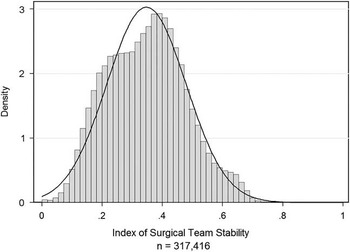
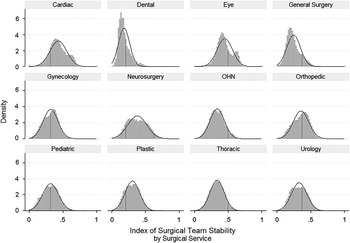
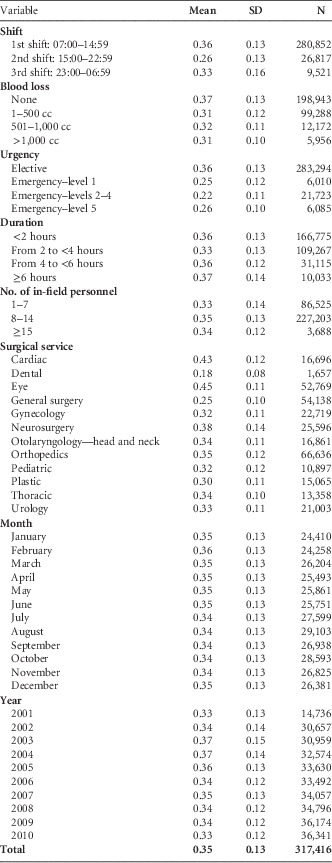
Figure 1 shows the distribution of team stability index scores for all surgical procedures; Figure 2 shows the distributions by surgical service. The stability index mean (SD) was 0.35 (0.13) (N=317,416). Table 1 includes mean scores by procedure properties. Given the large number of observations, all associations were significant (P<.001). However, many of the mean differences were relatively small. The second shift had the lowest mean of the 3 shifts. Procedures with no patient blood loss had the highest mean index score of any blood loss category. Elective procedures had the highest mean index score. There was little substantive difference among categories of procedure duration. Similarly, the number of personnel in the field did not show any considerable variation in team stability. There was little variation by month and no clear trend by year. However, there appeared to be meaningful variation by surgical service. The dental service had the lowest mean score, but this service was represented by only 1,657 observations. The second lowest score was for general surgery, which had a mean of 0.25 (n=54,138). The service with the highest mean score was eye surgery, with an average score of 0.45 (n=52,769).
Overall distribution of index of surgical team stability scores.

Distribution of surgical team scores by surgical service. OHN, otolaryngology—head and neck.

Mean Scores of Team Stability by Procedure Characteristics

NOTE. Some categories do not add to 317,416 owing to missing data.
Associations between rates of percutaneous BBFE and procedure characteristics were previously reported.Reference Myers, Lipscomb and Epling 17 The results indicated that these associations vary somewhat by device type (exposures involving suture needles vs those involving all other devices).
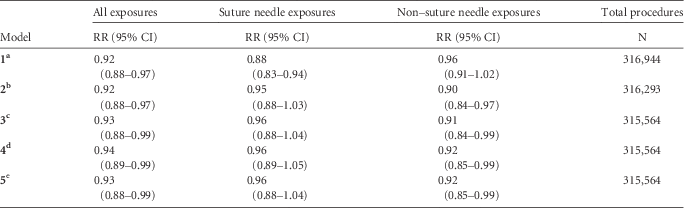
Table 2 includes 3 sets of Poisson regression modeling results that are identical except that the first set models all percutaneous BBFE, the second models those involving suture needles, and the third models exposures involving all other devices. The first model in each group shows the crude association between team stability and the rate of percutaneous BBFE. Additional models adjusted for procedure characteristics, starting with surgical service alone, then further adjustments were made for shift, estimated patient blood loss, duration, urgency, number in the surgical field together, as adding these one at a time showed little effect on the team stability coefficient. Month was then added to account for the effect of the wave of new residents over the late summer. Finally, year was added to adjust for any secular trend.
Poisson Regression Models: Surgical Team Stability and Risk of BBFE

NOTE. Rate ratios (RRs) represent a 1-standard-deviation change in the surgical team stability score. BBFE, blood and body fluid exposure.
a Unadjusted.
b Adjusted for surgical service.
c Adjusted for surgical service, blood loss, urgency, duration, no. of in-field personnel, and shift.
d Adjusted for surgical service, blood loss, urgency, duration, no. of in-field personnel, shift, and month.
e Adjusted for surgical service, blood loss, urgency, duration, no. of in-field personnel, shift, month, and year.
The models that included all percutaneous BBFE showed a significant protective association between risk of exposure and the team stability score (Table 2). The rate of percutaneous BBFE dropped 7% per 1-standard-deviation change in the team stability score (RR, 0.93 [95% CI, 0.88–0.99]); this association was stable across all models regardless of adjustment for various properties of the procedures. For percutaneous BBFE involving suture needles, the crude model showed a significant protective effect of greater team stability. However, adjustment for surgical service alone reduced the RR and produced a nonsignificant association. This association remained nonsignificant in the fully adjusted model (RR, 0.96 [95% CI, 0.88–1.04]).
Results showed a nonsignificant crude association between the team stability index and the incidence of non–suture needle exposures. However, adjustment for surgical service produced a statistically significant protective effect of team stability. Further adjustment for other procedure characteristics did not substantially change the association between team stability and percutaneous BBFE. Fully adjusted results showed a reduction in risk of BBFE of 8% for a 1-standard-deviation change in the index score (RR, 0.92 [95% CI, 0.85–0.99]).
A χ2 analysis of the quartiles of the team stability index by surgical service showed a strong relationship between these variables (P<.001). Since the distribution of the index varied by service, there was a possibility of interaction between the effect of the index and service. Additional device-stratified regression models containing interaction terms of the continuous index by service categorical variables were generated. Likelihood ratio test results showed the interaction terms were nonsignificant for the suture needle model (P=.89) and for the non–suture needle model (P=.09).
DISCUSSION
Overall, results showed moderate evidence for a reduction in risk of percutaneous BBFE for surgical teams that had higher past collaboration index scores. The association between team stability and risk of exposure due to suture needles, while protective, was not statistically significant; however, the association between surgical team stability and risk of exposure involving all other surgical devices, which make up half of the percutaneous BBFE in these data, remained statistically significant while controlling for several properties of the surgical procedures. Reasons for the different effects of team stability on risk between these device categories are not clear. We speculate that injuries involving devices other than suture needles may be more likely to happen during the passing of the instruments, possibly making more opportunities for familiarity among team members to play a role, whereas those involving suture needles may involve a single device handler. It is also possible that both the importance of familiarity among team members and the use of these devices vary by occupation, resulting in different effect estimates of team stability by device type. Another possibility is that there is more variance in the kinds of procedures and in the structure of the surgical teams in which suturing is performed, compared with procedures and teams that employ some of other devices. It may be more difficult to statistically observe effects of team stability on percutaneous BBFE involving suture needles. This may partly account for the fact that the RRs for the suture needle models were protective but not as strong as RRs for other devices.
Because these data were administrative records and were not designed for an epidemiologic study, our ability to control confounding was limited. Procedure complexity, for example, might confound the association between team stability and risk of percutaneous BBFE. More complex procedures might be more dangerousReference Puro, De Carli, Petrosillo and Ippolito 23 ; more complex procedures may have lower team stability scores because they may include more specialists who may be less familiar to the surgical team. Procedure characteristics such as blood loss, urgency, duration, and number of personnel in the surgical field may have served, separately or collectively, as crude markers of complexity. Therefore, it is possible that the weakening of the association for the models including these variables was a result of adjustment for the some measure of complexity of the procedures. It is possible that better measurement of complexity may have weakened the association further, if indeed complexity is such a strong confounder.
The models that tested for interaction between the team stability and surgical service showed the interactions were nonsignificant at the traditional α =.05 level. Given the exploratory application of the team stability variable used in this study, we chose to report the main-effects-only model. Further, we had no clear way to predict a priori how the effect would vary across services. However, it is conceivable that the importance of teamwork varies by service; future research should consider this possibility.
Consistent with our findings, a meta-analysis of group cohesiveness and performance noted effects of cohesiveness on a variety of performance measures were often statistically significant but small in magnitude.Reference Mullen and Copper 24 The same study indicated that contextual factors may modify the effects of cohesiveness.
The measurement of teamwork in the OR is challenging owing to the interprofessional composition of team members.Reference Makary, Sexton and Freischlag 25 , Reference Healey, Undre, Sevdalis, Koutantji and Vincent 26 It is possible that the inclusion of all team members in the construction of the team stability index may hide potentially important effects of relations among subgroups. For example, it is possible that familiarity between a surgeon and a scrub nurse is particularly important for safety. However, the point of this investigation was to explore the effects at the level of the entire team.
We explored the effects of a stability index based on a 3-month window in addition to the 6-month window reported here. The results were quite similar across all models reported in Table 2. Rate ratios for the index of stability showed a protective and significant effect in the fully adjusted model of all percutaneous BBFE (RR, 0.94 [95% CI, 0.89–0.99]). The fully adjusted device-stratified models showed similar effects but confidence intervals were slightly wider (for non–suture needles: RR, 0.93 [95% CI, 0.86–1.01], for suture needles: RR, 0.95 [95% CI, 0.88–1.03]). Additional research should be performed to explore the duration needed to achieve improvements in safety, with consideration of the various job categories of team members and the possible differences of the time required for safety to develop among them.
Some staff may come and go from the OR during a procedure, making it impossible to be sure which other team members were in the room at the precise time the exposure event occurred. The team stability index reflects stability of all those involved at any time. This likely led to some nondifferential misclassification of the index.
The administrative records analyzed for this study do not allow direct measurement of relationship properties. This measure, therefore, does not include any information about the qualities of relationships among surgical personnel, such as how well they communicate or the degree of social cohesion.
Needlesticks and other percutaneous BBFE are recognized to be underreported.Reference Au, Gossage and Bailey 27 – Reference Voide, Darling, Kenfak-Foguena, Erard, Cavassini and Lazor-Blanchet 29 This study is certainly no exception. However, in previous publications our group noted that efforts to improve reporting at this institution were implemented during the study period.Reference Myers, Lipscomb and Epling 17 , Reference Myers, Epling, Dement and Hunt 20 Though others have reported that coworkers witnessing needlestick injuries is a powerful determinant of reporting events,Reference Makary, Al-Attar and Holzmueller 30 it is conceivable that team members who have developed informal interpersonal relationships could be more likely to avoid formal procedures and be less likely to report percutaneous BBFE.
Finally, this study was conducted at a single large academic teaching hospital; the social network measure applied has not previously been used to study injuries in the operating theater. It is difficult, therefore, to generalize from our findings.
Results from this initial exploratory work suggest that greater team stability may reduce percutaneous BBFE during surgical procedures, particularly for exposures involving devices other than suture needles. However, these new findings must be interpreted cautiously. Additional research should examine data specifically intended to measure qualities of relationships among surgical team personnel, in various institutions, to verify these findings and determine whether and which aspects of relationships among team members may be important for safety. Results also demonstrate the potential use of the team stability index to study teamwork and patient safety in the OR.
ACKNOWLEDGMENTS
We thank 2 anonymous reviewers for their comments on an earlier version of this article.
Financial support. National Institute for Occupational Safety and Health (grant 7K01OH009657).
Potential conflicts of interest. All authors report no conflicts of interest relevant to this article.