

Introduction
Ethiopia is a route of sheep migration from Asia to Africa and has diverse traditional sheep breeds spread across diverse ecology, communities and production systems (Solomon, Reference Solomon2008). It is the home for at least nine breeds and 14 traditional sheep populations (Solomon et al., Reference Solomon, Van Arendonk, Komen, Windig and Hanotte2007a) with estimated 25.5 million heads (CSA, 2010/11). Locally available sheep breeds in Ethiopia are the result of many generations of human and natural selection. The sheep can survive under harsh environments such as feed scarcity, disease challenges and are highly adapted to low-input systems (Tibbo et al., Reference Tibbo, Philipsson and Workneh2006). Besides being safe investment for the family and rendering social prestige within the community, they are sold to meet compelled family financial obligations or slaughtered for consumption at home or festivals (Abebe, Reference Abebe1999). The low performance as compared with temperate breeds (Kassahun, Reference Kassahun2000) and the poor understanding of production system, poor nutrition, prevalence of disease, lack of appropriate breed and breeding strategies make them low in production and productivity. However, detailed and up-to-date information on indigenous knowledge of managing the breed, identification of important traits and typical features with full participation of farmers are important for effective and sustainable utilization of typical sheep breeds (Kosgey et al., Reference Kosgey, Baker, Udo and Var Arendonk2006). Unfortunately, such information is not readily available for Ethiopian sheep breeds (Ayalew et al., Reference Ayalew, Getahun, Tibbo, Mamo and Rege2004) in general and for Begait sheep breed in particular at smallholder farmer's level.
Therefore, the objective of this study was to assess the typical features, breeding practices, breeding objectives and morphological as well as biometrical characteristics of Begait sheep breed at smallholder farmers’ level in two districts of western Tigray, Ethiopia
Material and methods
Study sites
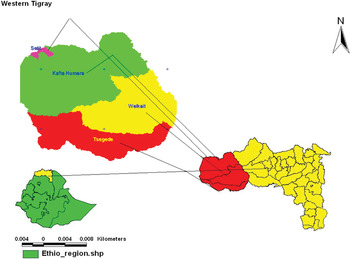
The study was conducted in two districts (Setit Humera and Kafta Humera) of the western zone Tigray, Ethiopia (Figure 1), which are located 1 500 km from Addis Ababa to the north and 252 North West of Gondar and altitude range of 560–1849 m above sea level. The mean maximum temperature varied from 33 to 41.7°C, while the mean minimum temperature varied from 17.5 to 22.2°C. Annual rainfall in the area ranges from 448.8 to 1 102.5 mm in which 80–85 percent is received during the summer/rainy season. Generally, climate is characterized by distinct dry (October–May) and wet seasons (June–September).
Map of the study area, Setit and Kafta Humera.

Data collection methods and procedures
The survey and field observation were conducted from March 2011 up to January 2012. Two sites in Setit Humera and three sites in Kafta Humera were selected based on sheep population, traditional of sheep production system, practices of communal grazing land, market and access of infrastructure of the study sites. A total of 126 households (52 in Setit Humera and 74 in Kafta Humera) were randomly selected for the interview within the selected sites. For typical trait characterization and body linear measurements, a total of 219 female (90 in Setit areas and 129 in Kafta areas) 120 male (30 in Setit areas and 90 in Kafta areas) sheep were considered.
Besides semi-structured questionnaires, participatory rural appraisal together with a focused group discussion and field observation, typical trait characterization and body measurements were employed. For the morphological and biometrical measurements, all sheep (n = 339) above 4 months of age were measured. The live weights of the sheep were measured using the Salter scale (50 kg capacity with 200 g precision). Other body measurements (heart girth, height at wither, body length, pelvic width and chest depth) were taken using flexible metal tape (3 m length) to the nearest 0.5 cm after restraining and holding the animals in an unforced position.
Data analyses
The Statistical Package for Social Sciences (SPSS) computer software (SPSS for window, release 16.0, 2007) was used to analyse the qualitative data. Chi-square test was used to assess statistical significances. Indices were calculated to provide ranking of selection criteria and breeding objectives.
The General Linear Model (GLM) procedures of SAS (2008) were employed to study the body weight and linear body measurements as well as effects of study sites and dentition (PPI) classes.
Model to analyse adult body weight and other linear body measurements were:
 $$Y_{ijk}=\mu+A_i+S_j+T_k+\left({AT} \right)_{ik}\,+\,e_{ijkl}\comma \;$$
where Y ijk is the observed body weight or linear body measurements in the ith age group, jth sex, kth district (study sites) at the lth household; μ is theoverall mean; A i is the effect of ith age group (i = 0, 1, 2, 3 and 4); S j is the effect of jth sex (j = male and female); T k is the effect of district/site; AT ik is the effect of ith age group and the effect of district/site interaction; e ijkl is the random residual error.
Results
Typical morphological features
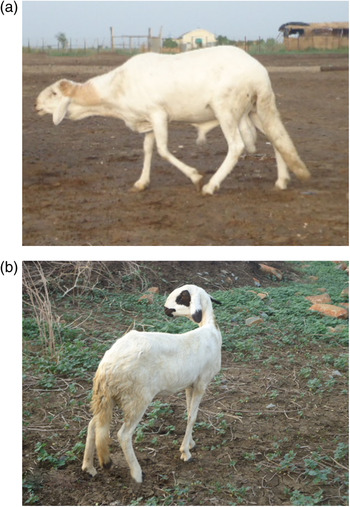
The breed is described as muscular body size, coat color is dominated by white, white and black mouse, grey, slightly red and creamy white (Figure 2a, b). The sheep have typical long and thin tail with straight pointed end (Figure 2a, b). Both males and females are polled; the ear is long, the hair is short and smooth. They are also known for travelling long distance and their ability to disease and heat resistances.
(a) Typical male Begait sheep. (b) Typical female Begait sheep (ewe).

Breeding objectives
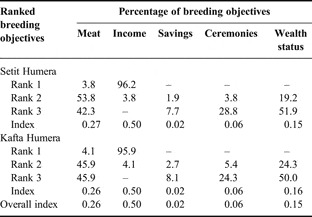
The index value (0.5) revealed that the primary objective of the farmers for breeding and keeping sheep in both districts was for income generation. Meat consumption (0.26), wealth status expression (0.16), celebration of ceremonies (0.06) and source of savings (0.02) had significant index value showing farmers breeding objectives (Table 1).
Ranked and percentage (%) of breeding objectives of smallholder farmers in two districts (Setit Humera and Kafta Humera) of the study area.

Index, sum of [3 for rank 1 + 2 for rank 2 + 1 for rank 3] for particular purpose divided by sum of [3 for rank 1 + 2 for rank 2 + 1 for rank 3] for all purpose.
Breeding practices
In the study districts, mating was predominantly uncontrolled except in Setit Humera where rams were isolated during the day time. This was related to protect rams from theft and not to mate the ram with other flocks. Out of the total farmers interviewed, about 93.2 and 90.4 percent kept their own breeding rams in Kafta and Setit Humera, respectively. The majority (86.5 percent) of breeding rams for Setit Humera and 89.2 percent for Kafta Humera originated from own flock. On average, breeding rams were kept for 2.94 ± 0.83 years with the range of 2–5 years for Setit Humera and 2.97 ± 1.03 years with a range of 1–5 years for Kafta Humera.
Selection criteria
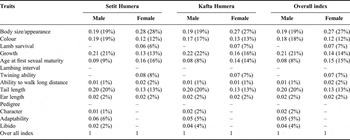
Of the total respondents, 82.7 and 85.1 percent of the farmers in Setit Humera and Kafta Humera, respectively, practice selection for breeding rams. Similarly, 69.2 and 95.9 percent of the respondents in Setit Humera and Kafta Humera practice selection of breeding females, respectively. Ranking of selection criteria for breeding rams and females is presented in Table 2. In Setit Humera, majority of the respondents select breeding rams based on their growth (0.21), tail length (0.20) appearance/conformation and colour with the same value of 0.19 was ranked as their first, second, third and fourth, respectively. Similarly, in Kafta Humera breeding ram was ranked first for fast growth (0.22), second for tail length (0.20), third for appearance (0.19) and fourth for colour (0.17), respectively. In Setit, selection of breeding ewes, traits of body size (0.28), age at first maturity (0.16), lamb growth (0.13), tail length (0.13) and coat color (0.12) were their first, second, third and fourth traits, respectively. On the other hand, in Kafta humera body size (0.27), lamb growth (0.16), age at first service (0.14), coat color type and tail length (0.13) were the first four important traits in their order, respectively.
Ranked index and percentage (%) of selection criteria of trait preference for breeding rams and ewes.

Index, sum of [3 for rank 1 + 2 for rank 2 + 1 for rank 3] for particular purpose divided by sum of [3 for rank 1 + 2 for rank 2 + 1 for rank 3] for all purpose.
Body weight and linear body measurements
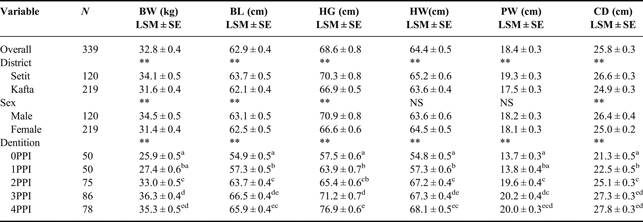
The least squares means of body weight and linear measurements of Begait sheep are presented in Table 3. The overall least squares means of body weight and body length obtained for Begait sheep were 32.8 ± 0.4 kg and 62.9 ± 0.4 cm, respectively.
Least squares means and standard error (LSM ± SE) for main effects of districts, sex and dentition (PPI) on the body weight and linear measurements of Begait sheep.
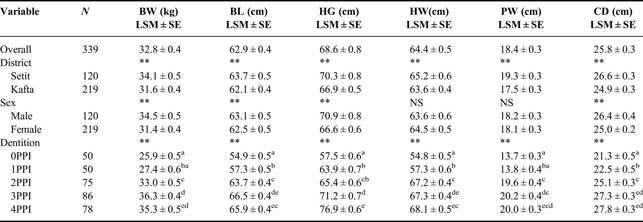
a,b,c,d,eMeans on the same column with different superscripts within the specified dentition group are significantly different (P < 0.01).
**P < 0.01.
BW, body weight; BL, body length; HG, heart girth; WH, wither height; PW, pelvic width; CD, chest depth; 1PPI, 1 pair of permanent incisors; 2 PPI, 2 pairs of permanent incisors; 3PPI, 3 pairs of permanent incisors; 4PPI, 4 pairs of permanent incisors.
Correlation and prediction of weight using body measurements
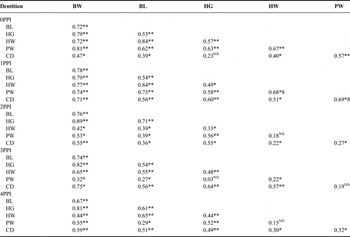
The Pearson's correlation coefficient for body weight and linear body measurements are presented in Table 4. Among the body measurements heart girth had the highest correlation coefficient (r = 0.89, P < 0.01) with body weight in all dentition groups, except, in dentition group of 0PPI; in that case pelvic width had the highest correlation coefficient (r = 0.81, P < 0.01).
Phenotypic correlations between body weight and liner body measurements of Begait sheep.

0PPI, 0 pair of permanent incisors, 1PPI, 1 pair of permanent incisor; 2PPI, 2 pairs of permanent incisors; 3PPI, 3 pair of permanent incisors; 4PPI, 4 pair of permanent incisors; NS, non-significant (P > 0.05); BW, body weight, HG, heart girth, BL, body length, HW, height at withers, PW, pelvic width, CD, chest depth.
**Correlation is significant at P < 0.01.
*Correlation is significant at P < 0.05.
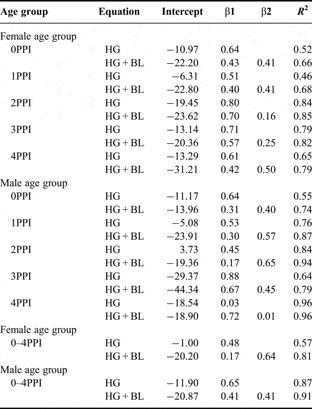
The high correlation coefficients observed between body weight and heart girth for all dentition groups suggest that heart girth alone or in combination with other body measurements could provide a good estimate for live weight of Begait sheep at different dentition groups. Parameter estimates of linear and multiple linear regression equations predicting live weight from body measurements of Begait sheep are presented in Table 5. In this study, heart girth alone had the highest accuracy for estimating body weight (R 2 up to 84 percent) for female's, except, in dentition group 1PPI (R 2 of 46 percent). On the other hand, in male's heart girth alone explains body weight with up to 96 percent accuracy. Comparing dentition groups, the highest coefficient of determination was depicted by age group 2PPI (84 percent of the variation in weight was explained by the equation) for female and at 4PPI age group (96 percent of the variation in weight was explained by the equation) for males, respectively. The differences in the coefficient of determination of equations between different dentition groups indicated that weight can be estimated using different equations for different age groups with different accuracies. Within dentition groups, the coefficient of determination revealed that weight was better predicted when two or more measurements were included in the equation.
Prediction equations at different sex and age groups.

BL, body length; HG, heart girth; 0PPI, 0 pair of permanent incisors, 1PPI, 1 pair of permanent incisors; 2 PPI, 2 pairs of permanent incisors; 3PPI, 3 pairs of permanent incisors; 4 PPI, 4 pairs of permanent incisors.
Discussions
For sustainable genetic improvement programmes understanding of the production system and breeding objectives are important factors (Kosgey et al., Reference Kosgey, Baker, Udo and Var Arendonk2006). This study revealed that the primary breeding objectives of the farmers were to generate income with an index value of 0.50. This value was higher than the value of Afar sheep (0.23; Getachew et al., Reference Getachew, Haile, Tibbo, Sharma, Sölkner and Wurzinger2010). In this study, it was found that mating was predominantly uncontrolled and was similar to Bonga and Horro indigenous sheep breeds of Ethiopia (Zewdu, Reference Zewdu2008). Our study also confirmed that farmers’ breeding rams and ewes selection was mainly based on growth and tail length, which was different from Afar and Menz, (physical appearance; Getachew et al., Reference Getachew, Haile, Tibbo, Sharma, Sölkner and Wurzinger2010). The least squares mean body weight (34.5 ± 0.53 kg) obtained for male Begait sheep was higher than that of Washera ram (28.3 kg) and Bonga ram (27.7 ± 0.17 kg) as reported by Mengistie (Reference Mengistie2008) and Tesfaye (Reference Tesfaye2008), respectively. The mean value of body weight in female Begait sheep was higher than that of female Washera (25.0 kg) and Horro ewe (27.7 ± 0.21 kg) as reported by Mengistie (Reference Mengistie2008) and Tesfaye (Reference Tesfaye2008), respectively, but closer to female Bonga sheep (31.9 ± 0.19; Tesfaye, Reference Tesfaye2008). This shows that the Begait sheep breed has higher body weight gain compared with the known Ethiopian sheep breeds. The correlation between body weight and linear body measurements in Begait sheep were in line with Kassahun (Reference Kassahun2000), Thiruvenkadan (Reference Thiruvenkadan2005), Afolayan, Adeyinka and Lakpini (Reference Afolayan, Adeyinka and Lakpini2006) and Khan et al. (Reference Khan, Muhammd, Ahmed, Nawaz and Zibair2006). The highest coefficient of determination was depicted at age group 2PPI (84 percent) for females and at 4PPI age group (96 percent) for male Begait sheep, respectively. Kassahun (Reference Kassahun2000) found out that heart girth alone explains 83 and 81 percent of weight of Menz and Horro ram lambs, respectively.
Conclusions
Typically the breed is described as long and thin tail with straight pointed end and known for their disease and heat resistance ability and travelling long distance. As a whole, for sustainable and improved sheep breeding programmes, it is important to measure, observe the production environments and involve farmers for exploiting the existing breeding practices, management systems and trait preferences accustomed to the community.
Acknowledgements
We are grateful to the smallholder farmers of Setit and Kafta Humera for their willingness and as a source of necessary data and information, and Bahir Dar University for funding this research.