Marriage remains the socially dominant model in China.Footnote 1 Yet, owing to skewed sex ratios in the adult population, men assumed to seek marriage are significantly greater in number than women in the same situation.Footnote 2 In addition, as Chinese women tend to favour partners who are likely to offer them the prospect of upward social mobility through marriage, the opportunities to meet potential partners are limited for men from a rural background and the least privileged socio-economic categories.Footnote 3 As a consequence, some men find themselves forced to put off their plans for marriage or even give up on them altogether.Footnote 4 Coupled with the practice of female hypergamy, the male surplus within the never-married population, as compared to the number of women in the same situation (in the order of 50 per cent among people aged 20 to 59 nationally), means that China's current marriage market is extremely tight.Footnote 5 Drawing on quantitative data from the “Survey on family, social life, and reproductive health” conducted in 2014–2015, this article sheds light on the situation of single men who are past prime marriage age in three rural districts of Shaanxi that are particularly affected by this phenomenon. Such a male surplus creates increased competition between men seeking to marry, and thus it is important that the social and economic dimensions of bachelorhood should not be neglected. As shown for other regions of rural China, the unequal access to marriage, and the prerogatives associated with it in a very rigid normative context, form part of a set of inequalities.Footnote 6
This article first provides an overview of the differences between married and never-married men with respect to their socio-economic characteristics and overall living conditions, including the impact of the normative environment on the quality of life for single men who are past prime marriage age. Second, it offers insights into the heterogeneity of this group of men in the region with the aim of challenging some commonly accepted but seldom questioned assumptions about circumstances associated with bachelorhood in rural China. More specifically, the aim is to assess possible variations in how men view their position with regard to marriage and, more generally, their intimate relationships with women. For example, do all single men actively seek to marry? Have some of them lost all hope of ever achieving this goal? Do marriage prospects exist beyond prime marriage age? We then continue by examining the association between marriage and sexuality, and in particular whether exclusion from marriage necessarily means an exclusion from a heterosexual partnership and whether all single men form a homogenous group in this respect. Finally, we discuss the relevance of a broader and more intersectional approach for a better understanding of bachelorhood in these poverty-stricken and highly skewed sex ratio settings.
Survey on Men's Living Conditions in High Sex Ratio Settings
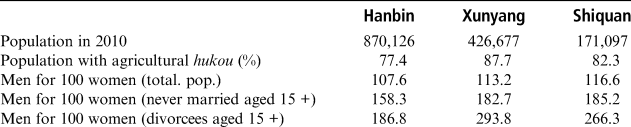
This study draws on quantitative data from the “Survey on family, social life, and reproductive health,” which was specifically designed to investigate various aspects of ever-married and never-married men's living conditions, behaviour and attitudes in rural regions of China with high degrees of poverty and skewed sex ratios.Footnote 7 The analysis aims to gain a better understanding of the socio-economic circumstances associated with men's ability to form intimate relationships when there are fewer women locally than men. The survey was conducted in August 2014 and January 2015 in three rural counties of Ankang city 安康市 in southern Shaanxi. We targeted these three counties because of their high sex ratios, as compared to both rural Shaanxi and rural China as a whole (Table 1). The sex ratios are particularly skewed for the never-married population aged 15 or above, ranging from 158 men for 100 women in Hanbin county 汉滨区 to 183 in Xunyang county 旬阳县 and 185 in Shiquan county 石泉县, against 151 in rural Shaanxi and 149 in rural China as a whole in 2010. These counties were also selected because they are marked by poverty, which has been shown to be among the most prominent discriminatory factors in access to marriage at the individual level in China.Footnote 8 The counties are located within a zone designated as a priority for the reduction of poverty and development by the central government,Footnote 9 with a per capita GDP of less than 13,000 yuan in 2010, which is less than half of that of Shaanxi (about 27,100 yuan, compared to about 30,000 yuan in the whole of China).Footnote 10
Demographic Information about the Survey Site

Source:
Calculations based on 2010 Census data (short form) (PCO 2012).
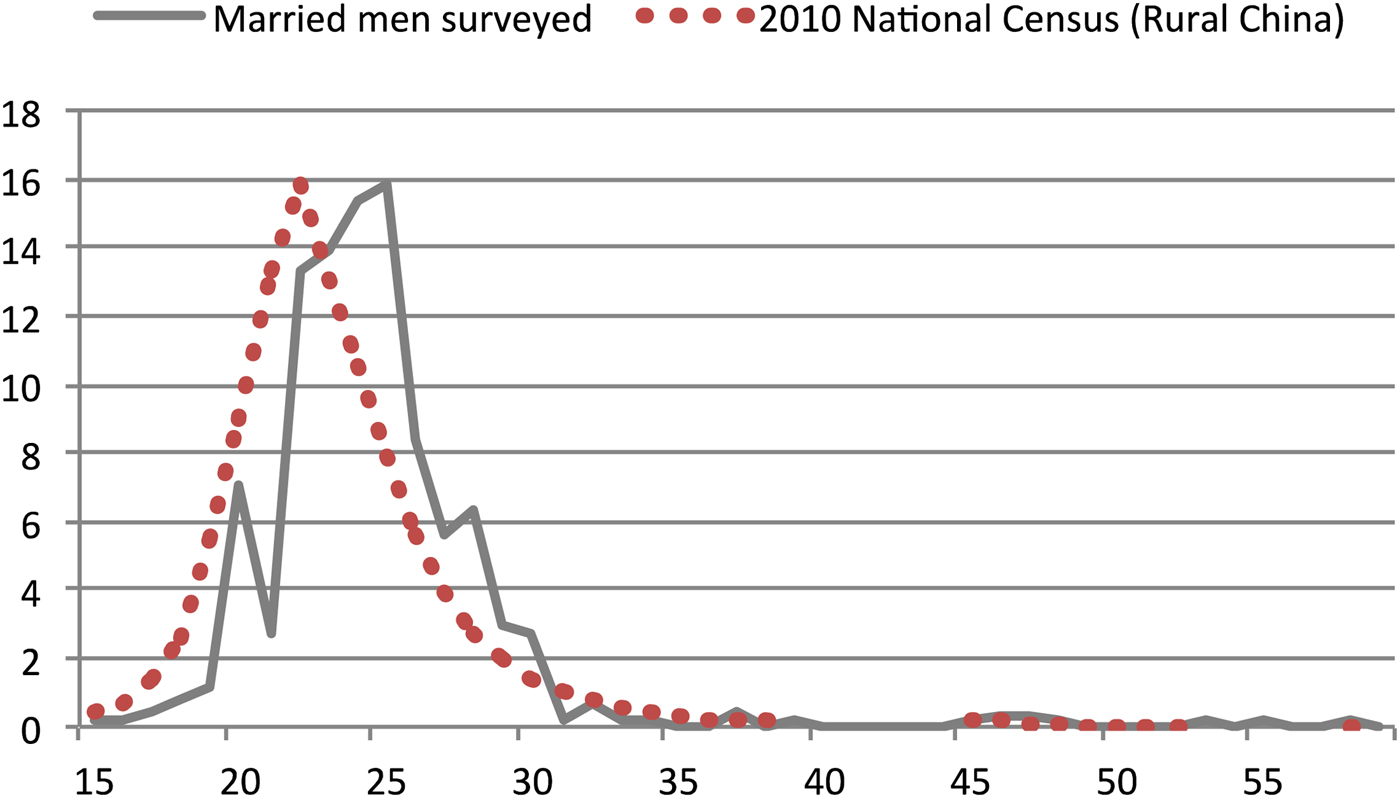
The survey participants were recruited using conventional probability sampling methods from a sampling frame consisting of the family planning administration registers at the county level. Two sub-samples of men were selected using disproportionate stratified random sampling: one of these consisted of ever-married men and the other of never-married men who were past the prime marriage age in China. The survey thus only included men aged 28–59 years old, which is in line with previous research suggesting that in rural China, a man's chance to marry decreases significantly with age, and especially so after age 28.Footnote 11 Beyond this age, men are more likely to have their marriage further delayed or remain unmarried. Indeed, the age of 28 proves to be a threshold in our sample of married male respondents, as 91.3 per cent were married before this age (Figure 1). Two age groups are considered in the analyses: men aged 28 to 42 (born after 1973, when fertility in China began to fall sharply) and men aged 43 to 59 (born when fertility rates stood at 5 to 6 children per woman). Since Chinese men tend to marry women a few years younger than themselves, the numerical decrease in the later cohorts exacerbated the existing sex imbalance on the marriage market. In order to be able to identify their characteristics and allow meaningful comparisons with the married men, the never-married men were purposefully over-sampled. The survey findings shed light on a regional situation and therefore should not be generalized to rural China as a whole; however, they do converge with findings from studies conducted in other regions of the country.Footnote 12
Distribution of the Ages at First Marriage of Married Men in Sample and Rural China at the 2010 Census (age 28–59, %)

Since our survey is cross-sectional and includes a limited amount of biographical information, only men's current characteristics, attitudes and behaviour can be examined in the analyses; there is no possibility to consider if and how these may have changed over time. Although our study is not designed to examine changes in attitudes and behaviour over time or causal links between high sex ratios and men's attitudes and behaviour, the differences observed between the various groups of men give original insights into their respective characteristics. Hence, they open new paths of research for a better understanding of the heterogeneity of single men in rural China.
Survey and Questionnaire Structure
To guarantee confidentiality and privacy of responses and allow respondents to respond freely, the CAPI (Computer-assisted personal interviewing) method was used.Footnote 13 An interviewer was at hand to provide technical assistance to the respondents if necessary. Before starting the process, an interviewer read the informed consent concerning confidentiality and privacy protection to each respondent, and informed him of the possibility to stop the interview at any time. When the respondent was illiterate (i.e. when he could not read or understand what he was reading), the interviewer read out the questions and explained how to input the answers.
The quantitative questionnaire was administered to 1,419 male respondents, 67 of whom stopped before the end or were not successfully interviewed. This corresponds to a response rate of 95.4 per cent. In total, valid questionnaires were obtained from 1,352 respondents, of whom 825 were male villagers who were ever married at the time of the survey (including first married, remarried, divorced and widowed men, as well as those engaged to be married or cohabiting with a partner), and 527 were never married. However, only the men currently married (including those who had remarried as well as those engaged to be married or cohabiting with a partner at the time of the survey – termed as “married” hereafter – but excluding the widowed and divorcees) are considered in the analyses below (N = 655). Sampling weights were calculated to adjust for unequal selection probability and non-coverage and involved calibration of the samples’ age distribution by marital status to match the values of rural Shaanxi in the 2010 census. The adjusted samples (used in the analyses below) are thus consistent with the age distribution of the rural Shaanxi populations of married and never-married men. All statistics shown are using the weighted sample.
It took respondents on average 49 minutes to answer the questionnaire, which comprised seven modules (since the questionnaire was designed with skip logic, not all respondents answered the same number of questions). The first module gathered basic personal information (24–39 questions about migration experience, socio-economic situation, living arrangements and self-evaluation of health); the second module concerned opinions and attitudes about gender roles and gender equality (31 questions); the third module related to marriage mate selection (5–45 questions on attitudes and behaviour with respect to marriage, bachelorhood, spouse selection, marriage costs); the fourth module was devoted to sexual attitudes and behaviour (40–85 questions on masturbation, use of pornographic material, satisfaction and behaviour, casual sex, sexual services, sex with other men and subjective norms; the fifth module concerned knowledge and reproductive health (7–14 questions on use of condoms, STIs, HIV and Aids); the sixth module was devoted to social participation, support networks and leisure activities (11–14 questions); and finally the seventh module asked questions about the impact of some major population issues on personal life (6 questions).
Poorer Living Conditions: A Common Feature of Single, Older Men
Overall, in line with the relevant literature about rural China, our never-married respondents display current socio-economic characteristics that are less favourable than those of their married counterparts and generally have much lower levels of education and income.Footnote 14 A generational gap exists among both the married and never-married men with respect to these characteristics, but it is much greater among the never-married men: those aged 28–42 stayed at school three years longer than those aged 43–59 (against a gap of 1.3 years among the married) and their mean income in the year preceding the survey was 27 per cent higher (against a gap of 19 per cent among married men) (Figure 2).
Education and Income by Marital Status

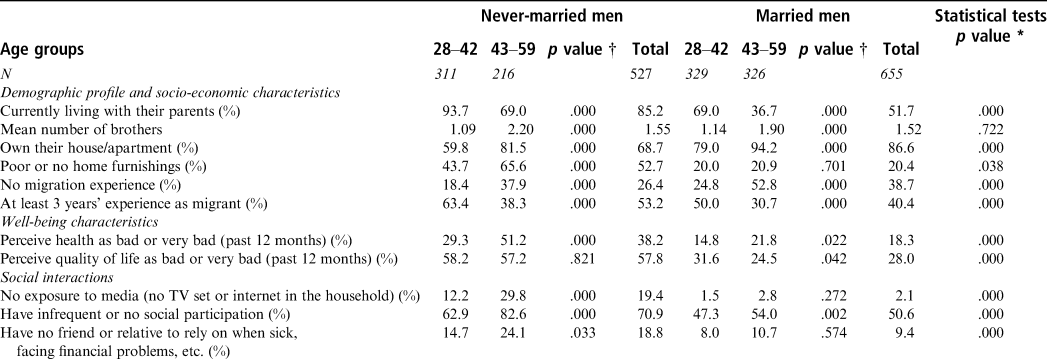
Poorer on average, we find that the never-married respondents who are past the prime marriage age are less likely to own their home than married respondents. As expected, this is mainly true of the youngest of them, as these men have had fewer years to accumulate wealth or inherit from their parents. Never-married men in the region also have poorer housing conditions: they more frequently live in households without a piped water supply or an individual toilet, or without both. Again, this is true in particular for the older ones, who are by far the most disadvantaged (Table 2).
Respondents’ Characteristics by Marital Status and Age Group

Note:
The p values are those of F statistic for the means and of Pearson χ2 for the distributions. Those followed with * test the differences between married and never-married men; those followed by † test the differences between the two age groups within each marital status.
The never-married respondents are also more disadvantaged with respect to health and overall quality of life, which is consistent with studies in other contexts showing that these circumstances are highly dependent on socio-economic characteristics.Footnote 15 Again, a generational gap exists within each marital status group, but in most cases it is greater among the never-married group whose self-perceived health, for instance, deteriorates faster with age: 51.2 per cent of those aged 43–59 declared bad or very bad health in the year preceding the survey, which is more than twice as high as married men in the same age group (21.8 per cent). A gap also exists among the youngest married and never-married men (29.3 and 14.8 per cent, respectively) (Table 2). Consistently, never-married respondents are also more likely than married ones to declare a bad or very bad quality of life in the past 12 months, which is in line with studies in other contexts showing that marriage is associated with better health.Footnote 16 Whether this is owing to the selection of healthy individuals for marriage and/or because bachelorhood affects health in negative ways cannot be established in the current cross-sectional data set.Footnote 17 However, our results tend to confirm some protective effect of marriage that increases with marriage duration, as 35.8 per cent of the men who were married less than ten years reported a bad or very bad quality of life, against 20.9 per cent of those who were married more than 20 years (with p = .005). Single men's worse circumstances in terms of well-being also have to be put in relation to their much lower number of social interactions (Table 2), as shown in other contexts.Footnote 18 Again, a generational gap exists as the older single men (aged 43–59) are the ones most likely to face multidimensional isolation, as defined by the intensity of interpersonal contacts and contacts with the outside world. They are less exposed to media than the other groups of men (29.8 per cent live in a household without either a TV or the internet, against 12.2 per cent of the younger single men; this is almost ten times higher than the figure for married men), meaning that their attitudes are less likely to be influenced by contact with the outside world, as observed in other contexts.Footnote 19 The greater social isolation of the never-married men, but even more of the older ones, is also evidenced by their much less developed support networks and social interactions. The majority of older never-married men have infrequent or no social participation (in that they have not or have only rarely participated in a birth and/or a zhousui 周岁 – a ceremony celebrating the first year of life of a child – and/or a birthday ceremony in the year preceding the survey, and they have not or have only rarely visited friends to chat, have a drink or a meal in the month preceding the survey). Moreover, the older single men are more likely to have no friend or relative to rely on when needed (24.1 per cent of those aged 43–59, against 14.7 per cent of the younger ones; this is against 10.7 per cent of older and 8.0 per cent of younger marrieds). Older single men are also less likely to have left their village in their lifetime: one in three (37.9 per cent) has no migration experience (against 18.4 per cent of the younger ones) (Table 2).
All in all, never-married men past prime marriage age have lower social and economic capital than their married counterparts. This lends support to the notion that Chinese women commonly look to gain upward social mobility through marriage and therefore shun the poorer and least educated section of the male population. Moreover, this group of single men would find it difficult to meet the rising costs of marriage, which include not only the cost of the wedding ceremony but also matchmaker fees, the “bride price” (paid to the woman's family by two in three of the married respondents), and the purchase or renovation of a home. Finally, their greater social isolation acts as an additional factor further diminishing their chances of being introduced as a potential spouse, as social networks in the region are still decisive in this respect: indeed, more than half of the married respondents (58 per cent) were introduced to their current wife through friends, parents or a matchmaker.
Pressure of the Normative Environment
Chinese society has long been governed by the traditional cultural ideal of forming and continuing a family, leading to early and nearly universal marriage.Footnote 20 Although some social norms have weakened in recent years,Footnote 21 marriage still plays a central role in many aspects of family organization and everyday life, and remains a key institution through which the patrilineal system is perpetuated.Footnote 22 It also is the most accepted setting in which procreation and legitimate sexual relations can take place.Footnote 23 Young people are thus urged to enter heterosexual marriage,Footnote 24 which is still socially considered as the route to social adulthood, status and recognition.Footnote 25 Consequently, men and women's single status beyond a certain age, if not a social anomaly, is commonly perceived as an undesirable situation that must be remedied;Footnote 26 not being married often results in social stigma and the exclusion of the unmarried people, both male and female, as well as their family.Footnote 27 This notion is so widely accepted that some recent studies point to the “risk of being forced to remain single”Footnote 28 or have attempted to “devise measures to improve the well-being of men who are unable to marry.”Footnote 29
The pressure of the normative environment is grounded in situations that are regarded as being the most difficult to bear by those who remain single beyond prime marriage age, with eight out of ten single men (81.4 per cent) quoting family pressure and two out of three (68.1 per cent) citing other people gossiping about them. Nearly half of the never-married men (41.5 per cent of those aged 28–42 and 50.2 per cent of those aged 43–59) also reported that they feel ostracized because of their single status (Figure 3). The fact that lack of affection and the absence of sexual relations are reported by more than two-thirds suggests that alternatives to the emotional and intimate relations available within the context of marriage are few and far between. This in turn underlines the strong normativity that surrounds love, sex and family formation, opportunities for which are usually only available within the formal framework of heterosexual marriage. Indeed, although changes are underway in Chinese society, particularly with the development of people cohabiting in a marital-type relationship, only 4 per cent of the never-married men saw cohabitation as an acceptable prelude to marriage.Footnote 30 The consequences of being single, as soon as they are felt negatively by single men themselves, are all associated with a poorer quality of life (Figure 4). This is particularly the case when they feel they are the subject of gossip, which weighs heavily (a difference of around 15 percentage points between those who complain about gossip and those who do not), and when they come under strong family pressure to marry, which is a particular problem for young people. It is, however, the lack of affection that can most affect their quality of life (with a gap of 20 points).
Never-married Men's Views on Most Difficult Situations to Bear Owing to Their Single Status, by Age Group (multiple choice, %)

Never-married Men Reporting a Poor Quality of Life According to Whether They Resent Various Situations that Stem from Their Single Status (%)

Not All Single Men Actively Seek Marriage
The literature on marriage squeezes in various contexts posits that sex ratios in the adult population affect the timing and prevalence of marriage, stating in particular that a reduced availability of potential mates of a given sex would delay marriage or even increase rates of permanent non-marriage for members of the opposite sex.Footnote 31 However, this strand of research has been criticized for its “demographic determinism,”Footnote 32 as it takes for granted that all individuals actively seek to marry someone of the opposite sex.Footnote 33 Bachelorhood receives a great deal of attention in Chinese politics, academia and media as it is considered an abnormal situationFootnote 34 and feared for its supposed threat to the country's social order, which is founded on the family and intergenerational solidarity. The increase in numbers of bachelors stemming from the sex ratio imbalance is thus constructed as a collective concern, and one with major implications for both individuals and society at large.Footnote 35 This normative premise implicitly leads to a victimization of the men who fail to marry because of a lack of suitable female partners.Footnote 36 No account is taken of the possible heterogeneity in this group with respect to their actual positioning in the marriage market and other personal characteristics that do not stem directly from the sex imbalance and which may force them to put off their marriage plans.
Marriage is widely accepted to be the predominant norm in our sample, with most married and single respondents considering that every man (86.8 per cent of the total sample) and every woman (89.5 per cent) should marry. Attachment to the norm of marriage in the region surveyed, however, is diminishing slightly among the younger generation of men (85 per cent of those aged 28–42, against 88.9 per cent of those aged 43–59, with p = .049). This has been observed in other regions in China too, along with a relaxation of other norms governing individuals’ behaviour, society and family organization.Footnote 37 However, some never-married respondents are more nuanced in their responses when it comes to their own expectations. This is shown in the way they position themselves with respect to marriage (as measured by the two variables: “would you like to marry?” and “would you accept being unmarried all your life?”). Marriage is only strongly desired by less than two-thirds of the never-married sample: 61.9 per cent declared that they would like to marry and could not accept remaining unmarried, while the rest (38.1 per cent) reported that they do not wish to marry or would accept remaining unmarried all their life, or both. Yet, the younger never-married men are more likely to strongly desire marriage (74.3 per cent among those aged 28–42, as compared to 44.0 per cent of those aged 43–59, with p = .000). This suggests a form of acceptance among the older never-married men that they will never marry. As they get further past prime marriage age, they realize that their opportunities to marry decrease, and thus they lose hope of ever achieving this goal.
Acceptance of Lifelong Bachelorhood
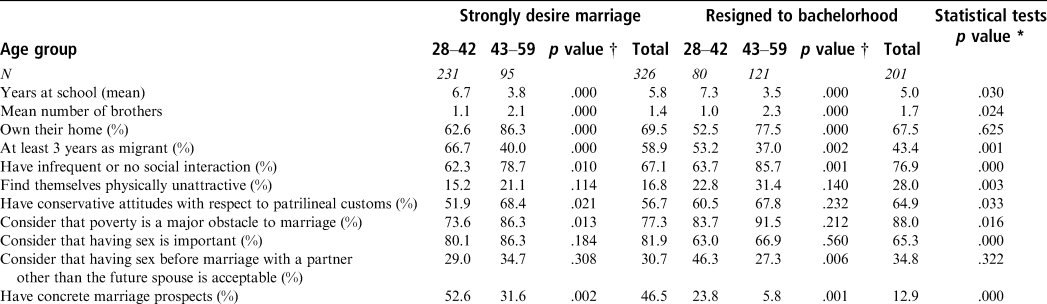
The single men who resign themselves to remaining unmarried are indeed comparatively older (with a median age of 45 years old, as compared to 38 years old for the never-married men who strongly desire marriage) and less likely to find themselves physically attractive (Table 3). However, their acceptance of their single status is not attuned to their attitudes towards patrilineal customsFootnote 38 – as they tend to be more conservative in this respect – nor influenced by how many brothers they have, suggesting that in spite of the drastic decline in the number of siblings among the younger generations, the task of passing on the family line, a central part of filial piety, cannot be shared among siblings and would thus weigh more heavily on each family's son. A common feature among single men who give up hope of ever marrying is that they have lower incomes than those who strongly desire marriage (Figure 5). They are also less likely to own their home, which is a strong determinant of male marriage in rural China.Footnote 39 These men are also less likely to have ever migrated, or else they have experienced shorter periods of migration on average. This indicates that renunciation of the aspiration to marry is associated with a negative evaluation of their personal attributes (including their age, housing, physical appearance and economic situation) and, relatedly, of their perceived chances in a competitive marriage market (Figure 5). Consistently, they are also more likely to report that poverty makes marriage unlikely for them, which suggests that as they see themselves as not very attractive to women, they feel the competition of other men more acutely (Table 3).
Economic Situation of Never-married Respondents According to Whether they Strongly Desire Marriage or Are Resigned to Bachelorhood (%)

Characteristics of Never-married Respondents Depending on Whether They Strongly Desire Marriage or Are Resigned to Bachelorhood

Note:
The p values are those of F statistic for the means and of Pearson χ2 for the distributions. Those followed by * test the differences between married and never married men; those followed by † test the differences between the two age groups within each marital status.
Results also point to another, less explored possibility that this section of the male population would also be more likely to give up on having intimate relationships with women. Although older never-married men have comparable levels of tolerance with respect to having sex with a partner other than a future spouse, they are less likely to report that having sex is important to them. This indicates that there is a strong association between marriage and sexual activity ingrained in individuals’ attitudes, but it might also reflect some resignation in this regard as well. The men who give up hope of marrying are logically those who report no concrete marriage prospects in the short term (within the next three years); however, the reporting of such prospects is considered to be an indicator of an active search for a spouse, although it says nothing about the ability of the men to achieve their goal.
Marriage Prospects beyond Prime Marriage Age
As shown above, marriage in the three counties under study usually takes place before the age of 28 (Figure 1). Once men cross this age threshold, they know that their chances of marrying decrease significantly. As mentioned above, they come under increased pressure from their family and, as they grow older, feel increasingly marginalized (Figure 3). This norm of early marriage informs most of the literature on the marriage squeeze in rural China and underpins the argument that once single men pass prime marriage age they necessarily accept that they will remain unmarried, without any account being taken of variation within this group. Our survey indicates, however, that some single men over prime marriage age still actively search for a spouse, as one in three (33.7 per cent) reported having concrete marriage prospects. These prospects are reserved for a select group of men who are comparatively younger, are more socio-economically advantaged, have longer migration experience (Figure 6), and who have greater social networks. In sum, this suggests that the male surplus at the local level in these poverty-stricken areas may only delay marriage for the most well-off single men who have passed prime marriage age. In contrast, the most disadvantaged single men in these aspects have comparatively fewer marriage prospects and are therefore more likely to accept that they will never marry. Sometimes, this realization comes quite early in life: 32.1 per cent of those aged 28–42 who earned less than 5,000 yuan in the year preceding the survey resigned themselves to lifelong bachelorhood, as against 17.7 per cent of those of the same age who earned 25,000 yuan or over (p = .000).
Never-married Men with Concrete Marriage Prospects, by Income and Migration Experience (%)

Non-marital Romantic and Sexual Relationships
In most societies, marriage is the “pole around which sexual culture is organized.”Footnote 40 And this is the case in China where marriage is still considered to be the legitimate setting for sexuality.Footnote 41 However, although premarital sex is becoming increasingly common in both urban and rural areas,Footnote 42 change has moved at a much slower pace in rural China.Footnote 43 This is particularly so because rural people tend to marry earlier in life and so have less time to seek non-marital partners before marriage.Footnote 44 But little is known about the sexual behaviour of men who are past the prime age for marriage. Although our cross-sectional data do not allow us to determine whether high sex ratios directly influence men's sexual behaviour in the region under study, we can gather insights into the behaviour of men who have no access to marital sexuality and who might be forced to put off their plans for marriage, perhaps indefinitely, in a normative context where there are fewer women than men.
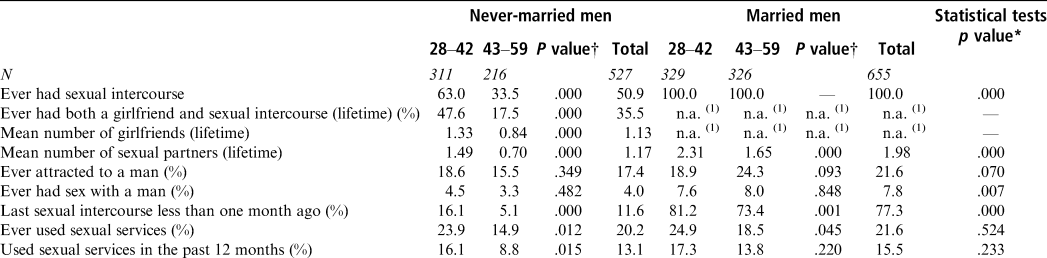
Although the never-married respondents past prime marriage age have on the whole less access to partnered-sex than their married counterparts (only 51.0 per cent have had sexual intercourse at least once in their lifetime), they do have some intimate relations with women that might be a substitute for more formal relations, and/or constitute a more active search for a stable partner from among some of these women (Table 4). According to our survey, never-married respondents have 1.17 sexual partners on average in their lifetime, which is low compared to standard behaviour in Western countries.Footnote 45 This is also 0.81 lower than their married counterparts (1.98) – a gap consistent with results found by other studies.Footnote 46 There is a strong generation effect here: the younger men have more sexual partners in their lifetime regardless of their marital status, with a gap of around 0.7 of a partner between the men aged 28–42 and the men aged 43–59 in both groups. Although the number of sexual partners increases with migration duration, the differences between the married and never-married men persist when migration duration is equal (respectively 1.8 and 0.7 for those with no migration experience, as compared to 2.1 and 1.4 among those who spend at least three years in total as migrants), and a similar trend is observed among the various groups of single men (Figure 7). A fact remains that never-married men are much less active sexually, as only one in ten has had sexual intercourse less than one month ago (11.6 per cent, as compared to 77.3 of the married men) (Table 4). Moreover, the generational gap in most indicators is greater among the never-married than among the married men, indicating that older single men are more likely to be excluded from any sexual activity, as shown by other studies.Footnote 47
Partnership Background of the Never-married Men Past Prime Marriage Age by Migration Experience

Partnership Background and Sexual Behaviour by Marital Status

Note:
The p values are those of F statistic for the means and of Pearson χ2 for the distributions. Those followed by * test the significance between married and never married men; those followed by † test the significance between the two age groups within each marital status. (1) Only the never-married men were asked about number of girlfriends.
Concerning sexual experiences that fall outside of the norms for heterosexual marriage, namely the use of sexual servicesFootnote 48 and sexual relations with other men, some differences also exist between married and never-married men, although these are not always big or significant. Never-married men and married men use sexual services to almost the same extent: 20.2 per cent of never-married and 21.6 per cent of married men have used such services in their lifetime, with 13.1 per cent and 15.5 per cent, respectively, using sexual services in the past 12 months. This goes against the commonly accepted assumption that unmarried men in settings with highly skewed sex ratios would generally adopt such compensatory behaviour.Footnote 49 Instead, this finding suggests that in the region studied, the use of sexual services is part of men's sexual repertoire regardless of their marital status, as has been shown by other studies.Footnote 50 The most influential factor here is in fact migration duration: 23.5 per cent of the men who have accumulated at least three years’ experience as migrants, both married and never-married, have used such services, as compared to 16.4 per cent of those men with no experience of migration (with p = .019) (Figure 7). The use of sexual services is lower only among the poorest never-married men (who earned less than 5,000 yuan in the year preceding the survey) and those who have never migrated: around 13 per cent, as compared to more than 20 per cent among all the other groups of men. Although our data set does not provide for a proper assessment, these findings suggest that there are fewer sexual services on offer in the region studied than in the more urbanized destinations of migrants, and that there is greater social control preventing men from visiting prostitutes in the rural regions surveyed than in the cities. The gap between married and never-married men is, however, wider when it comes to sexual experiences with other men: 3.8 per cent of the never-married men have had such experiences, compared to 7.8 per cent of married men (Table 4). These differences, which persist when education, income levels and migration duration are kept equal, stem from the fact that, overall, the never-married men are much less sexually active than their married counterparts, and this includes same-sex sexual relations. Although not verifiable using our data, this finding might reflect the fact that in the region surveyed, as elsewhere in China, homosexual men frequently enter into heterosexual unions in order to escape social pressure and stigmatization.Footnote 51
As the results presented in Figure 7 suggest, non-marital sexual and romantic relationships are not rare in the region, but there are important disparities among the never-married men. When taken as a whole, one in three men in this group has had both at least one girlfriend and sexual intercourse at least once in his lifetime (35.5 per cent). Interestingly, the never-married men in this group have had a greater number of sexual partners than the married men (2.80 and 1.98 respectively), which shows that, for this fraction of the male population, being single is not a barrier to forming an intimate partnership. More unexpectedly, this is especially true for the older group of single men (aged 43–59), who have had around three sexual partners in their lifetime, which is almost twice as many as the married men in the same age group (2.95 and 1.65, respectively). However, it should be noted that commercial sex workers are likely to represent some of the sexual partners for the never-married men who have had a least one girlfriend and sexual intercourse at least once in their lifetime, as they used sexual services in the last 12 months to a much higher degree than their married counterparts (28.5 and 15.5 per cent respectively, with p = .000).
The group of single men who have experienced both sexual and romantic non-marital relationships are as educated as their married counterparts (with eight years of schooling on average) and have comparable income levels (18,301 yuan in the year preceding the survey), which is in line with findings from other studies that show that the most well-off never-married men have more opportunities to form short-term and long-term relationships with women.Footnote 52 Moreover, they have gained more years of experience as migrants (more than six years, compared to around four years for the other single men and married men). This, again, is in line with studies in other Asian contexts that find that migration increases the opportunities to meet romantic and sexual partners.Footnote 53 Opportunities for this group might also be increased owing to their greater social interactions and bigger support networks. Among those with some experience of migration, who represent the majority of the never-married men past prime marriage age (Table 2), only a small fraction (15.0 per cent of those aged 28–42 and 8.3 per cent of those aged 43–59) currently has a girlfriend. However, they did not usually meet their girlfriend during their periods of migration (only 2.1 per cent of the total sample of never-married men are in such a situation). These results indicate that migration increases the frequency of sexual experiences and enlarges single men's pool of potential mates through greater social participation; however, it is also true that those who migrate tend to be a little more educated and have much higher incomes than those who never migrate (9,053 yuan per year on the average, compared to 17,302 yuan for those with at least three years’ experience as migrants). A quarter of the married respondents reported that they met their wife while they were migrants (30.9 per cent of those aged 28–42 and 14.7 per cent of those aged 43–59).
Concluding Discussion: Understanding the Heterogeneity of Single Men
Our survey findings shed light on a regional situation and should not be generalized to rural China at large. They provide further evidence, however, that men who are still unmarried once they have passed prime marriage age are much less endowed with social and economic capital than their married counterparts in these poverty-stricken and high sex ratio communities where a shortage of women creates competition between men looking for a wife.Footnote 54 This observation fed a significant amount of the literature on the marriage squeeze in China and led to the conclusion that this section of the male population would be systematically excluded from the marriage market because they cannot offer upward social mobility to women.Footnote 55 They would therefore, without distinction, all remain lifelong bachelors and suffer the associated economic hardships, social isolation and limited opportunities to form both short-term and long-term relationships with women. As shown above, our results add nuance to these statements and indicate that, in contrast to what is commonly accepted and in spite of the widespread adherence to the norm of universal marriage, not all men who have passed prime marriage age actively seek marriage, mainly because they have resigned themselves to lifelong bachelorhood. Although the youngest of the group to a large extent still hope to marry and the eldest are more likely to have given up all hope of achieving this goal, age is not the only factor to be considered in this respect. Those with poorer personal attributes with respect to mate selection criteria, including age, housing or property, economic situation, physical appearance and social relations, more often come to the realization that they have little competitive advantage on the marriage market when compared to younger, more well-off, better educated and more physically attractive never-married men who remain active in their search for a spouse.
Another finding breaks with the widespread notion that non-marital romantic and sexual relationships are rare in rural China, and that when they do exist, they involve only younger men. Results indicate that, in the region studied, a non-negligible share of the single men past prime marriage age have had at least one girlfriend and sexual intercourse at least once in their lifetime. Although a huge generational gap exists, some older never-married men have also had such experiences; moreover, those who have had at least one girlfriend and sexual intercourse have had more sexual partners than their married counterparts, regardless of their age. Our results also challenge the assumption that a lack of heterosexual intimate relations within a marriage framework would lead to two types of compensatory behaviour among never-married men, namely the buying of sex and same-sex sexual relations.Footnote 56 The results actually indicate the opposite with regard to same-sex sexual activity, as married men are more likely to have engaged in such activity than single men. This suggests that the male marriage squeeze – and the awareness that there are too few women (66.1 per cent of our single respondents consider that the shortage of women is a major obstacle to their chances of marriage) – does not open up space for homosexual men to sidestep marriage, as has been found by Lisa Eklund.Footnote 57 The results regarding commercial sex indicate that migration is more influential than marital status, as married and single men use sexual services to the same degree, thus defying the notion that a male surplus in the adult population would fuel the sex industry.Footnote 58
While most studies put emphasis on the stratifying effect of marriage (or the absence of marriage), a broader approach is needed to relativize the role of marriage per se in explaining the differences between married and single men with respect to their socio-economic status, living conditions, attitudes, health, sexual behaviour and social environment. Our analyses point to a strong selection effect, as bachelorhood and the absence of intimate relations with a partner affect mainly the most disadvantaged (in terms of their education, income, health, social participation and support networks) single men. Second, our analyses also demonstrate the stratifying effect of marriage, as failure to marry tends to perpetuate poverty and leads to social isolation, sexual inactivity and poor health among men already disadvantaged in these regards (i.e. already poor, socially isolated and in poor health). But our results have also led us to investigate less explored mechanisms, namely the cumulative selection/stratifying effect of other factors. In particular, never-married men's intimate relations with women and the way they position themselves in the marriage and partnership market are important underlying factors, as some give up their aspirations of marrying and forming intimate relationships with women quite early in life.
For a better understanding of the heterogeneity of single men, it is important to take into consideration the extent to which mate selection (including the formation of non-marital sexual relationships) in China is marked by class, social norms, social interactions, health, generation and age, as well as how it requires the mobilization of a certain amount of individual, social and economic resources. This consideration is particularly important in explaining why some men give up their hopes to marry or form non-marital intimate relations with women. Their acceptance of their fate as lifelong bachelors is the outcome of complex interactions between their social and normative environments, attitudes and beliefs constructed throughout life, and a subjective evaluation of their personal attributes and opportunities in a competitive marriage and partnership market. Our results suggest that single men strongly internalize the various characteristics that are centred on being able to offer upward social mobility and better living conditions to a potential wife.Footnote 59 Men are expected to have such attributes in order to attract a spouse in poverty-stricken and high sex ratio settings where women have more choice in mate selection. Those who are least endowed in these various respects when compared to their peers exercise a form of self-exclusion. Such behaviour is more likely to be better understood using a broader and more intersectional approach rather than in mainly numeric terms. This invites a reconsideration of the approach that victimizes single men just because of their inability to find a spouse, mainly because it diverts attention from other important circumstances, such as poverty, low education, poor health, restrictive social norms and rigid family structures, social isolation and the increasing monetization of marriage. These circumstances fuel a pragmatic attitude to mate selection which is deeply ingrained in the collective awareness and leads to self-exclusion.
Acknowledgements
The authors thank the Agence Nationale de la Recherche (ANR, France) and HeSam University (Paris) for funding the DefiChine project (https://defichine.site.ined.fr/en/), without which this article would not have been written.
Biographical notes
Isabelle ATTANÉ is a demographer and sinologist, and a senior researcher at the French Institute for Demographic Studies (INED), Paris.
Lisa EKLUND is an associate professor in sociology at the department of sociology, Lund University.
M. Giovanna MERLI is professor of public policy, sociology and global health at Duke University, North Carolina, and the director of the Duke Population Research Center and a member of the Duke Global Health Institute.
Michel BOZON is a demographer and sociologist, and senior researcher at the French Institute for Demographic Studies (INED), Paris.
Tania ANGELOFF is a sociologist and professor at the Institute of Economic and Social Development Studies (IEDES), Paris 1 University.
YANG Bo is a research assistant at the Institute for Population and Development Studies, School of Public Policy and Administration, Xi'an Jiaotong University.
Shuzhuo LI is a professor and director of the Institute for Population and Development Studies, School of Public Policy and Administration, Xi'an Jiaotong University.
Thierry PAIRAULT, socio-economist and sinologist, is an emeritus research director at the French National Centre for Scientific Research (CNRS) and at the Research Centre on Modern and Contemporary China (CECMC) at the School for Advanced Studies in Social Sciences (EHESS), Paris.
Su WANG is research assistant at the French Institute for Demographic Studies (INED), Paris.
Xueyan YANG is a professor at the Institute for Population and Development Studies, School of Public Policy and Administration, Xi'an Jiaotong University.
Qunlin ZHANG is associate professor of the School of Management at Xi'an Polytechnic University.