What leads some political factions in rising powers to press for a more ambitious foreign policy? This development might seem natural and obvious as a state's material power grows, but it nevertheless carries dangers as well as opportunities. Partly for this reason, such breaks with established policy traditions rarely pass without controversy. The 1890–91 American decision to build the nation's first three modern battleships is one important example. The United States had not previously built such vessels, the preeminent power-projection technology of the time. Following an ambitious Naval Policy Board report calling for a fleet of up to thirty-five battleships, and the publication of Alfred Thayer Mahan's The Influence of Sea Power Upon History, which also appeared in 1890, the potential importance of this step was clear to everyone.Footnote 1 Both contemporary observers and subsequent scholars have identified the decision as a watershed event in the rise of the United States as a world power.Footnote 2 As such, the plan drew criticism as well as praise, with the ranking Democrat on the Senate Naval Affairs Committee condemning it as “the most extravagant and foolish scheme that was ever heard of by any nation or any people since the world began.”Footnote 3
In addition to its historical importance, the battleship debate is a useful window onto the politics of foreign policy ambition more generally. In explaining support for the new policy, it is tempting to draw on arguments about more recent American foreign policy activism. The supporters of a more ambitious world role for the United States since World War II have been associated with the interests that gained most from economic exchange with the rest of the world. Politicians from internationally oriented parts of the country have tended to support greater political and military activism on a range of issues including security questions, funding for multilateral organizations like the International Monetary Fund and the World Bank, and foreign aid.Footnote 4 Parts of the country threatened by exposure to the world economy have produced political leaders skeptical of these policies.
The battleship program may appear to foreshadow later American foreign policy activism, but it had quite different sources of political support. It was backed by Republican policymakers at a time when their party was deeply protectionist. Skeptics tended to come from the Democratic party, which represented the most export-oriented parts of the American political economy. The central role of protectionism in this early manifestation of American global activism explains the inverted political lineup. In contrast to post-1945 activism, the foreign policy associated with the battleship program was intended to advance the overseas interests of the import-competing sector. It threatened export-oriented interests by increasing the chance of political-military conflict with their most important trading partners.
The linkage between protectionism and foreign policy ambition was not confined to the United States. Other major powers pursued similarly connected policies of protectionism and imperialism in the late nineteenth century, and there is evidence that protectionist states may be more aggressive in general.Footnote 5 Other accounts of the battleship program also point to sources of explanation that have broader theoretical relevance, including the effects of industrialization, the interests of military contractors, the search for symbols of national unity in the face of rapid social change, and activism by networks of enthusiasts for new policy ideas. This historical case offers an opportunity to compare these lines of argument in a setting where all are potentially relevant.
The analysis that follows uses Congressional roll-call votes to examine the politics of battleship building. I use data on constituent trade interests, iron and steel and shipping interests, and trends in strikes and immigration to evaluate several possible effects of industrialization on support for the program. I also examine the impact of the individual members’ characteristics, including their party affiliation and their proximity to social networks promoting navalist ideas. The results indicate that constituent trade interests played the dominant role in shaping support for the program, with members from import-competing states tending to support the program while those from export-oriented states generally opposed it. Trends in strikes also had a substantial effect. Both these effects were largely, though not entirely, mediated by party. Other individual-level member characteristics, as well as their states’ parochial stakes in the construction of the fleet, appear to have been far less important.
Explaining the Politics of Battleship Building
The debate over the construction of a battleship fleet touched on fundamental issues about the role of the United States in world politics. The fleet would be both a symbol and an instrument of the nation's rising status as a world power. The United States’ economy was the largest in the world by 1890. Observers at the time lacked modern national income statistics, but the vast and growing American output of key industrial products like steel was clear enough. Acquiring international prestige commensurate with the country's growing material power was appealing to many Americans. As Mark Shulman points out, the advocates of naval expansion mobilized considerable popular enthusiasm for the navy as a patriotic symbol of national power.Footnote 6 Because of their impressive size, technological sophistication, and ostensibly heroic overseas mission, battleships were especially saleable in these terms. Not all Americans wanted their country to become a great power, but many did.
The battleship fleet would be more than just a symbol of national greatness and prestige, though. It would also play an important practical role in a more ambitious foreign policy. In the international environment of the time, power-projection capability was important for insuring access to export markets in less-developed regions. The other major powers frequently used military force to carve out overseas empires in Africa and Asia. By 1890, most of sub-Saharan Africa had been divided into European colonies, as had some parts of the Middle East and North Africa. The French had established colonies in Indochina. The Japanese, Germans, and Russians were seeking to do so elsewhere in East Asia, perhaps by partitioning the weakening Chinese empire. These emerging colonial powers posed a greater threat to American economic interests than did Britain with its long-standing empire because they did not share Britain's commitment to free trade. The Naval Policy Board report anticipated that, as American trade grew, the country's relative political isolation “will gradually be replaced by a condition of affairs which will bring this nation into sharp commercial competition with others in every part of the world.”Footnote 7 A battleship fleet would help persuade the other powers to respect American demands for continuing economic access to less-developed areas. As Representative Jonathan Dolliver (R-IA) summarized it during debate over the naval appropriations bill, “We have grown to the first rank among commercial nations. We must have ships, not to make war on anybody, but to keep other people from disturbing either our prestige or our rights.”Footnote 8
These concerns extended to the Western Hemisphere. As the Naval Policy Board report put it, “even now our commercial relations with our nearest neighbors are clamoring for modification both by sea and land, and in the adjustment of trade with a neighbor, we are certain to reach out and obstruct the interests of foreign nations.”Footnote 9 Without a military force capable of enforcing the Monroe Doctrine's prohibition on further European colonization in the hemisphere, there was no guarantee that other powers would respect it. French efforts to seize Mexico during the Civil War might be repeated elsewhere, especially if local disorders provided a pretext for intervention. As Mahan pointed out, the construction of a canal from the Caribbean Sea to the Pacific Ocean would increase the region's geopolitical importance, making European intervention ever more likely. “The piercing of the isthmus is nothing but a disaster for the United States, in the present state of military and naval preparation.”Footnote 10
These arguments weighed heavily with some policymakers, but others strenuously objected to the program. They suggested instead that the United States should rely on shore batteries, newly developed torpedoes, and smaller, Monitor-style harbor-defense vessels.Footnote 11 In the event of war, smaller and less expensive cruisers could put military pressure on enemies by raiding their commerce.Footnote 12 Others offered more fundamental objections to the thinking behind the battleship program, arguing that the US had no need to fear military conflict at all.Footnote 13 A number of critics offered religiously motivated arguments against European-style power politics, maintaining that the country should rely instead on arbitration and diplomacy.Footnote 14
The arguments for and against the fleet were not merely individual opinions. They resonated more in some parts of the country than in others. Just as industrialization provided the wealth and know-how to construct the fleet, so the divisions arising from industrialization can help explain political conflict over whether the country should actually do it. Most scholars agree that industrialization and the divisions arising from it were critically important drivers of change in American society during the late nineteenth century. There is also evidence linking it to foreign policy ambition in many other historical cases.Footnote 15 There are several ways that industrialization and the changes that went along with it might have shaped the politics of battleship building in the United States. The most important concerns access to overseas markets, but one cannot realistically test this line of argument without considering several related alternatives.
Beyond the Wisconsin School: Trade, Power Projection, and Protectionism
One of the best-developed explanations for the politics of the battleship fleet focuses on its role in protecting access to less-developed markets for American exports. Overseas economic interests were especially important in the historiography of American foreign policy during the 1960s and 1970s. Scholars of the “Wisconsin School,” such as William Appleman Williams, Walter LaFeber, and Thomas McCormick, argued that American policymakers believed that future prosperity and political stability depended on finding overseas markets for the growing output of American farms and factories. The search for these foreign markets drove American political involvement's expansion around the world. Williams's seminal formulation of the argument generalizes from the Open Door Notes of 1899–1900, which petitioned the major powers to guarantee equal commercial access to China. According to Williams, American policymakers from the late nineteenth century through the Cold War sought a worldwide “open door” for American traders and investors, especially in less-developed parts of the world. Policymakers preferred to rely on diplomatic and economic instruments to advance their agenda. However, they needed a substantial military force to deter rival powers from excluding American traders and investors from their empires, and perhaps to create a sphere of influence for the United States. As many members of Congress noted during the debate over its construction, the battleship fleet would be a critical part of this force. It would also come in handy when economic nationalism or civil unrest in less-developed countries threatened to interrupt American access.Footnote 16
More recent research by Peter Trubowitz and Kevin Narizny builds on the Wisconsin School's emphasis on overseas markets but amends it in at least one important respect.Footnote 17 While the Wisconsin School had emphasized a national consensus in favor of expanding overseas trade, both Trubowitz and Narizny stress sharp regional and sectoral divisions over foreign policy.Footnote 18 Less-developed markets might help Northeastern manufacturers, but developed countries provided the only worthwhile overseas markets for Southern cotton producers.Footnote 19 Battleships were not necessary to maintain access to developed markets, so agriculturalists had little reason to support their construction.Footnote 20 If anything, the battleship fleet, as well as the interventionist policy it would support, could actually cause conflict between the United States and its developed trading partners. Trubowitz also stresses that Northeastern steel manufacturers and shipbuilders would enjoy the lion's share of contracts to build the new fleet.Footnote 21 The divergent interests of Northeastern manufacturing and Southern agriculture provide a promising basis for explaining the politics of battleship building.
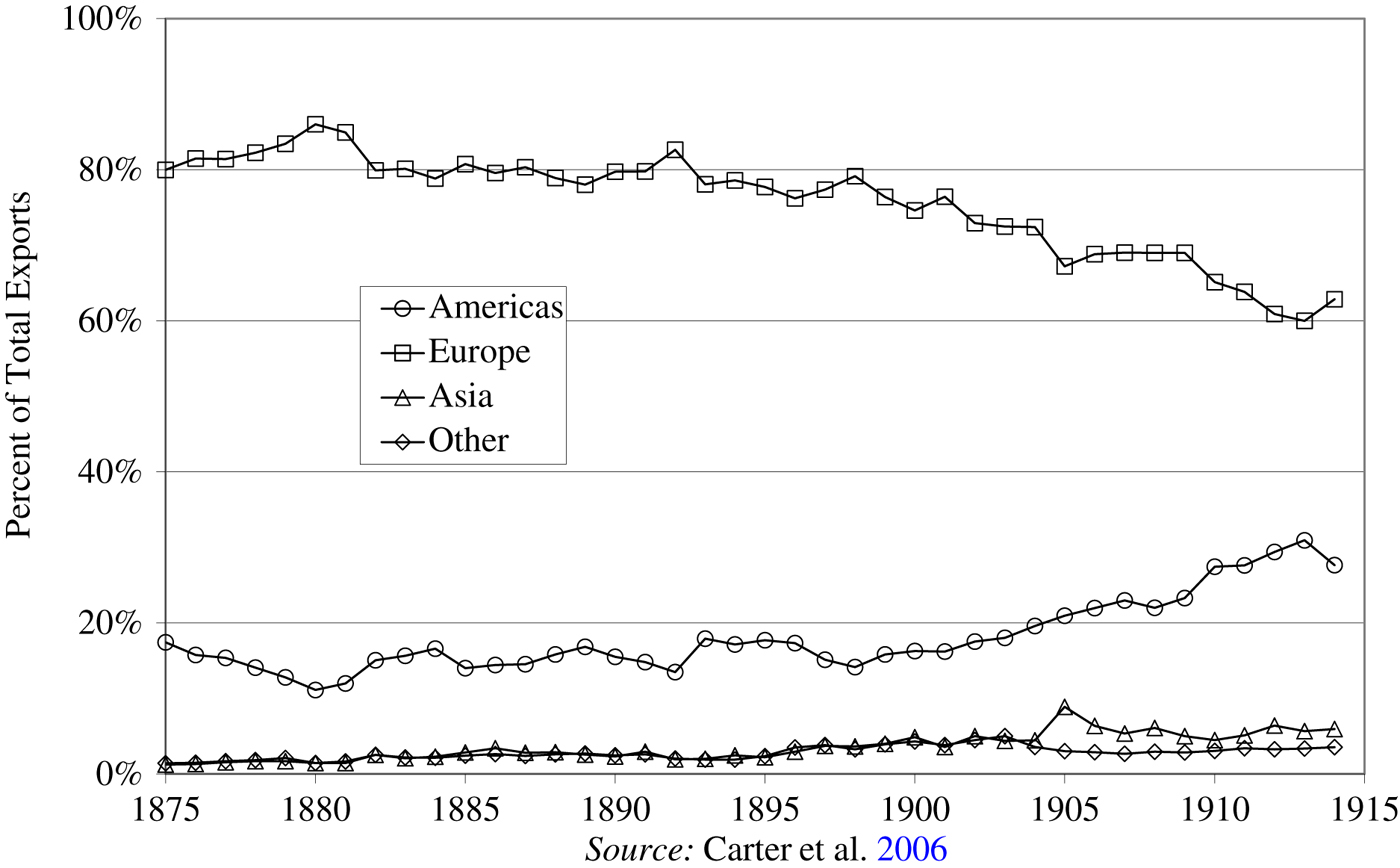
The Wisconsin School presented ample evidence of American policymakers’ interest in overseas markets, but their stress on Asia and Latin America still presents a puzzle: these markets were much less important than those in Europe. As Figure 1 illustrates, Asia and the Americas received only a small share of American exports in 1890, and continued to be relatively unimportant even in 1914, after a quarter century of policies intended to increase their prominence. The statistics in Figure 1 actually overstate the importance of less-developed markets because the largest American trading partners in the Americas and Asia were developed states. Canada accounted for an annual average of 39 percent of American exports to the Americas between 1875 and 1914. Japan's average annual share of American exports to Asia during this period was 27 percent. In both cases, these shares were increasing over time. In fact, developed markets were better even for American manufacturers. Developed countries, including Japan and Canada, received 76 percent of American manufactured exports in 1890. This figure remained essentially unchanged in 1900 and 1914, at 78 percent in both years.Footnote 22
US exports by region of destination, 1875–1914

The bottom line is that for all the attention they received from American thinkers and policymakers, less-developed markets remained relatively poor and unpromising through World War I. If overseas markets were the overriding concern, it would have made more sense to focus on Europe. Access to the enormous American market offered considerable negotiating leverage, had American policymakers been interested in using it. Instead, as Paul Bairoch explains, persistently high American tariffs following the Civil War limited European manufactured exports to the United States. Growing European imports of American agricultural products during the relatively liberal 1860–79 period created substantial trade deficits and pressures for European states to return to protectionism.Footnote 23
The reason for the salience of less-developed markets, and thus of the battleship fleet's importance, lies in the Republican Party's commitment to high protective tariffs. As Richard Bensel explains, maintaining high tariffs on manufactured imports was a core policy that helped hold the Republican coalition together.Footnote 24 It also fundamentally affected the character of their foreign policy. The protectionist 1890 McKinley Tariff made European retaliation more likely than ever. Even in Britain, which remained committed to free trade, the McKinley Tariff brought the idea of a system of imperial preferences into the political mainstream.Footnote 25 As concern about continuing access to European markets grew, protectionist manufacturers and their mainly Republican political representatives turned their attention to less-developed areas that did not export manufactured goods and thus had little reason for concern about the American tariff. Secretary of State James Blaine hoped to establish preferential trading arrangements with Latin American states, and got a provision for reciprocity agreements included in the McKinley Tariff for this purpose.Footnote 26 Plans to exclude other developed states from the US market, and perhaps from Latin America as well, implied a hostile posture toward these states.
As the premier power-projection instrument of the time, battleships were a natural complement to this foreign policy. Although all the elements of it had wide currency among Republican thinkers and policymakers, it is not clear that they amounted to a consciously developed grand strategy.Footnote 27 Even so, the logical and practical connections among them were constraining, even if policymakers did not always grasp all the linkages. It is not surprising that a Republican president introduced the battleship program, and that Republicans remained its principal advocates for the next twenty-five years.Footnote 28
Protectionism also helps explain the program's timing. Prices had been falling since the Panic of 1873, so the concerns about “overproduction” that the Wisconsin School used to explain demand for overseas markets were not new in 1890. This and other economic trends, such as the growth of the manufacturing sector, may indeed have gradually increased pressure for overseas markets, but they do not distinguish 1890 from the years immediately before or after it. Tariff politics do. “The Great Tariff Debate of 1888” dominated that year's presidential and congressional races, crystalizing the Republican commitment to trade protection.Footnote 29 Protectionist Republicans gained control of the White House and both houses of Congress in those elections, passing the McKinley Tariff in 1890, the same year that they proposed the battleship program. While Republicans had long supported high tariffs, John Bassett Moore notes that they explicitly presented the McKinley Tariff as part of a permanent system of protection, not an emergency revenue measure like those imposed during the Civil War.Footnote 30
Like the turn to less-developed markets, the battleship program immediately followed the 1888 elections. Benjamin Harrison expressed support for a battleship program in his March 1889 inaugural address.Footnote 31 This statement emboldened a group of naval officers around Admiral Stephen Luce, the founder and first president of the Naval War College. Luce followed Harrison's endorsement with a July 1889 article in the North American Review setting out the rationale for a battleship navy whose functions would extend well beyond coastal defense.Footnote 32 Benjamin Tracy, Harrison's Secretary of the Navy, accepted Luce's advice, appointing the Naval Policy Board to flesh out the program.Footnote 33 With the commitment to high tariffs and the concomitant interest in less-developed markets in place, 1890 was an especially propitious year for the battleship program.
The connection between protectionism and an aggressive foreign policy has been explored in other historical settings,Footnote 34 but even accounts of American foreign policy that stress the role of international trade during this period mostly overlook the role of trade protection. In keeping with their emphasis on the search for export markets, historians of the Wisconsin School stressed provisions for market-opening trade agreements rather than protectionism when discussing the tariff. For example, LaFeber discusses the reciprocity measures included in the 1890 McKinley Tariff and the 1897 Dingley Tariff at length because these provisions were expressly designed to help secure overseas markets.Footnote 35 For him, these measures show that even an outspoken protectionist like McKinley was willing to make selective tariff reductions in pursuit of overseas markets, underscoring the national consensus behind this goal.Footnote 36 LaFeber's later work continues to stress the reciprocity provisions of the McKinley and Dingley tariff laws.Footnote 37 Others writing in this tradition treat the tariff in much the same way.Footnote 38
Trubowitz and Narizny come much closer to tying protectionism to the battleship program and the stress on less-developed markets, but this linkage is not central to their arguments. Trubowitz explains why the pursuit of less-developed markets was a logical adjunct to protectionism in his section on the bargaining tariff but does not link this to the battleship program. Instead, in addition to the demand for overseas markets, he emphasizes military contracting and political patronage as sources of support for the program.Footnote 39
Narizny takes a different tack, stressing European trade barriers as a reason for pursuing markets elsewhere. He writes that the European market “was almost completely closed off” to American manufactures, and that “offers of reciprocity would be of no avail.”Footnote 40 As the continuing importance of the European market to American manufacturers suggests, this generalization is overstated. Fears of European protectionism clearly played a role in the turn to overseas markets, but these fears were further stoked by Republican policymakers’ knowledge that they were politically unable to rein in their own protectionism. Nor were offers of reciprocity hopeless. In fact, the McKinley administration later successfully negotiated a set of reciprocity agreements under the 1897 Dingley Tariff, including an especially important one with France. It was the US Senate, not the Europeans, that rejected these agreements following vigorous objections from the National Association of Manufacturers.Footnote 41 Narizny does not mention American protectionism in his account of the manufacturing sector's foreign policy interests.
The role of protectionism exposes critically important differences between the American foreign policy activism of the 1890s and the superficially similar activism of the postwar era. After 1945, American policymakers sought a relatively liberal international order centered on the country's developed allies and trading partners. American policy before World War I was far from liberal, and its posture toward other developed countries was distinctly uncooperative. The Wisconsin School's relentless stress on overseas markets, even to the point of arguing that the United States pursued its own version of the British “imperialism of free trade” in the late nineteenth century, obscures these differences.Footnote 42 Different politics follow from the different policies. Previous research has found that export-oriented interests were among the primary supporters of postwar American activism, and that import-competing interests tended to oppose it.Footnote 43 Considering the battleship fleet's underlying purpose, precisely the opposite relationships should hold during the debate over its construction: members of Congress representing relatively export-oriented states should oppose it, and those representing relatively import-competing states should support it.
Alternative Linkages Between Industrialization and Battleship Building
The political economy of trade and trade protection is not the only way to link industrialization to the battleship debate. A realistic assessment of trade interests' role requires considering several other explanations.
A Military-industrial Complex?
One alternative explanation for the politics of battleship building arising from economic structure concerns the interests of American steel and shipping manufacturers. Some historians date the early development of the military-industrial complex to the period between the Civil War and World War I.Footnote 44 The construction of battleships would keep some shipyards busy and consume significant quantities of steel. Trubowitz stresses this aspect of the battleship program in explaining support for it. “Such a program promised high-wage jobs for the Northeast's workers, lucrative federal contracts for its shipyards, steel mills, and gun foundries, and business for many of its ancillary industries.”Footnote 45 These benefits, like the gains from access to less-developed markets, would accrue mainly to Northeastern manufacturers. Scholars have pointed to the importance of steel manufacturers as boosters of naval programs in other national settings at the same time.Footnote 46 Claims about economic interests in battleship building parallel more recent concerns about the role of military contractors in national security policy since World War II.Footnote 47
This line of argument is important because it suggests an alternative linkage between the manufacturing sector and the battleship program. At the same time, there is reason to doubt the political importance of military contracting in 1890. Spending on the Army and Navy combined accounted for only 0.50 percent of gross national product (GNP) in that year. After Congress approved the battleship program, the military's share of GNP rose only to 0.56 percent by 1893. Even after the naval spending increases that followed the Spanish-American War, military spending remained below 1 percent of GNP in most years before World War I.Footnote 48 By comparison, military spending has rarely dropped below 4 percent of gross domestic product (GDP) since World War II and has frequently been much higher. There was certainly some special pleading on behalf of shipyards in members’ home states during the battleship debate,Footnote 49 but these parochial interests might not explain the political lineup. To the extent that they did, we should find that members of Congress representing states with relatively large steel or shipbuilding sectors were more likely to support the battleship program.
Industrialization and the “Psychic Crisis.”
Several historians have explained domestic support of the battleship fleet and American overseas expansionism using a less direct effect of industrialization. Focusing on the later decision to annex the Philippines, Richard Hofstadter argues that a constellation of social problems arising from industrialization produced a “psychic crisis” that drove the United States toward a more aggressive foreign policy in the 1890s.Footnote 50 These problems included free-silver agitation among farmers, growing labor unrest, urban corruption, and new waves of “seemingly unassimilable” immigrants. Hofstadter argued that American elites responded through movements for social reform at home and expansion abroad. Patriotic symbols linked to the growth of American military power became increasingly important as a means of promoting national solidarity. This line of argument closely parallels claims about social imperialism in the European context, especially in the case of Germany.Footnote 51 It also bears a family resemblance to the diversionary theory of war.Footnote 52
Subsequent writers further developed Hofstadter's case. Robert Dallek was among the most systematic. He argued that at the root of American expansionism “were the domestic tensions over the country's shift from an agricultural, rural, largely homogenous society to an industrial, urban one with a heterogeneous population.”Footnote 53 Edward Rhodes's account of the battleship debate strikes a similar note, arguing that social changes made the traditional account of what it meant to be an American obsolete. “It offered no explanation of why an urban proletariat should join in common society with an industrial capitalist class, or of why Protestants of English, German, and Dutch descent should work in common cause with Catholics and Jews from Southern and Eastern Europe.”Footnote 54
Appeals to national pride and competition with other powers offered a way to promote national solidarity among this newly diverse population. Less positively, one might say that jingoism offered a conservative alternative to demands for sweeping domestic change from labor activists, urban social reformers, and rural populists.
Like the other explanations stemming from industrialization, this one suggests that the new foreign policy served manufacturing interests best. It posits a different causal process, however. The argument about protectionism and the drive for overseas markets suggests that trade interests might have prompted support for the battleship fleet even if American society had remained ethnically homogenous and labor had been quiescent. Steel and shipbuilding interests would have benefited from battleship building even if it had served no other purpose. The “psychic crisis” account suggests that the battleship fleet would have been politically important even if it had not helped secure access to markets in less-developed regions of the world or benefited steel and shipbuilding interests. These explanations are not mutually exclusive, but they point to the difficulty of discerning the precise meaning of a broad relationship between economic structure and support for battleship building.
The “psychic crisis” thesis might explain the politics of battleship building because the social changes it emphasizes did not affect the entire country uniformly. Support for the new military posture should be stronger in areas of the country where these trends were most pronounced. If this line of argument is correct, we should expect members of Congress from states that had relatively higher rates of immigration from Eastern and Southern Europe, or increasing rates of strikes, to support the battleship program.
Is Economic Structure Really So Important?
All of the arguments I have outlined so far locate the roots of political divisions over the battleship fleet in economic structure. Directly or indirectly, the process of industrialization shapes the political lineup. This style of explanation is not without its critics, both in general and in this specific historical case. Some recent scholarship downplays the role of external social and economic forces, focusing instead on the role of ideas. As I noted earlier, Rhodes's account of the battleship debate contends that support for the new naval strategy arose in part as a response to major changes in American society. However, Rhodes places a much heavier emphasis on the ideas that supporters of the battleship fleet held. In his account, new concepts about the role of the state in American life, the nature of war, and the requirements for military success greatly strengthened the case for building a battleship navy and adopting the more assertive foreign policy that came with it. Rhodes's essential claim is that the new naval strategy was adopted because the ideas behind it were intrinsically appealing.Footnote 55
What makes Rhodes's account of the battleship debate distinctive is his refusal to concede that structural factors contributed to the spread of these ideas. Unlike Hofstadter or Dallek, Rhodes argues forcefully that the new concepts were not simply a reflection of underlying economic interests.
Just as religions have an internal logic of their own that transcends the immediate instrumental interest of any of their adherents, so too do political beliefs. And, rather than reflecting the power of various interest groups, the influence of beliefs—political or religious—reflects their ability to permit individuals to overcome key cultural and cognitive problems and to impose an acceptable order on social relationships and intellectual processes.Footnote 56
Although neither discusses the 1890s specifically, both Jeffrey Legro and Colin Dueck make a similar case for the role of ideas in explaining changes in American foreign policy more generally.Footnote 57 Other historical accounts of American foreign policy that stress the role of various schools of thought implicitly adopt the same position.Footnote 58 In these accounts, policy arises from intellectual debate, and the positions taken in this debate are largely independent of material forces.
This line of argument deserves to be taken seriously. It reflects an understandable discomfort with explanations of policy choice that stress impersonal social and economic structures. Such accounts often appear to diminish the importance of both scholars’ strategic ideas and policymakers’ agency, treating their efforts as incidental effects of these broader forces. This skepticism of structural considerations taps into a very old debate about human motives that cannot be resolved here. For now, suffice it to say that accounts emphasizing structure are not necessarily deterministic. Structural forces do not put ideas in people's heads but rather create an environment that makes it easier for particular ideas to find broader political support. In this case, the analytical stakes concern whether the individuals who developed these ideas and sought to persuade others to accept them were more important than the environment in which their efforts took place. If this line of argument is correct, then individual characteristics associated with navalism, such as age or prior military service, should predict support for the battleship program even controlling for the characteristics of their home state.
Research Design and Data
Congressional debate offers a useful window onto the sources of support and opposition to the program in American society. Members of Congress took relatively clear positions on the program and had relatively clearly defined constituencies.
The Dependent Variable: Congressional Support for Battleship Building in 1890–91
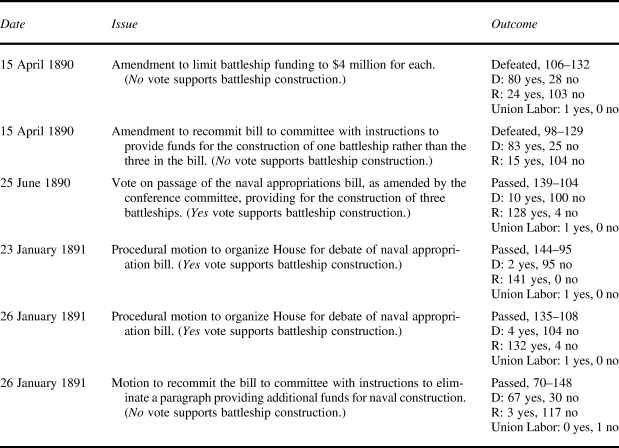
I test the arguments set out in the previous section using all six roll-call votes on battleship construction in the House of Representatives during the 1890–91 debate. Table 1 provides information about each of these votes. Unfortunately, a comparable analysis of the Senate's deliberations is not possible. There were even fewer roll-call votes on the naval appropriations bill taken there, and none that directly concerned battleship construction. The dependent variable in the analysis that follows is the individual member's vote on each issue. For the analysis, I recoded the votes as indicated in Table 1 such that a 1 indicates support for battleship fleet, and 0 indicates opposition. I treat expressions of the member's position other than voting, such as pairing, as votes. Because the issue and precise circumstances surrounding each vote were different, the model includes a dummy variable for each roll call. This permits the baseline probability of supporting each measure to vary.Footnote 59
House roll-call votes on battleship construction, 1890–91

Measuring Trade Interests
Previous quantitative research on the battleship debate has examined regional differences in aggregate support for the program.Footnote 60 While suggestive of patterns arising from industrialization, this approach does not permit us to disentangle the different effects of economic structure, or to compare them to individual-level considerations. Measuring export orientation and import sensitivity by state requires data on both exports and imports, disaggregated by commodity, and data on the production of these commodities by state. Most readily available trade and output data for this historical period are highly aggregated,Footnote 61 but sufficiently detailed and disaggregated data exist.
Given the necessary data, it is possible to compute indices of the export orientation and import sensitivity for each US state. Previous research has employed similar measures in analyses of congressional voting.Footnote 62 The first step is to gather data on exports and imports disaggregated by commodity. The annual volumes of Foreign Commerce and Navigation of the United States contain detailed country-by-commodity trade data. For example, the 1890 volume presents data on 292 imported commodities for seventy-five states and colonies. It also provides data on 276 US export commodities to seventy-seven states and colonies.
The next step is to match the traded commodities to production data on the industries that produced them. The US Census gathered detailed data on employment, capital investment, and output, alongside data on population, through 1900. The 1890 census included state-level data on manufacturing in more than 400 industries. Much of the national data from the census is available in machine-readable form.Footnote 63 Unfortunately, this is not true of the state-level economic data. William Roy gathered sectoral data on manufacturing from the census from 1880 through 1914 for the country as a whole and for three major manufacturing states: New Jersey, Pennsylvania, and Ohio.Footnote 64 The remaining data have been coded from the 1890 census.Footnote 65
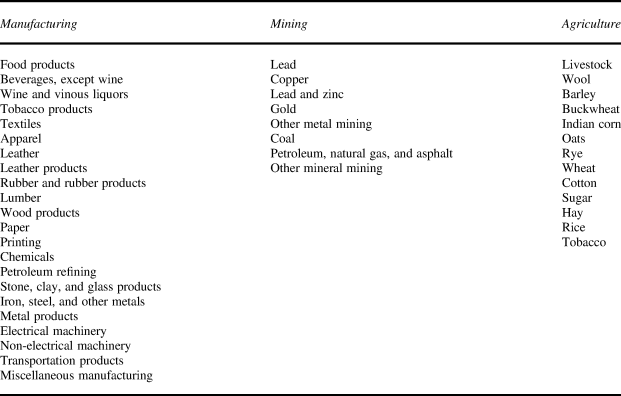
The matching sectoral categories for trade and production must be broad enough to accommodate the different schemes used to measure trade and production, but narrow enough to capture regional differences. Following Roy's example, I began with the manufacturing sectors originally set out by George Evans.Footnote 66 Some of these had to be further aggregated to match the trade data. Table 2 lists the sectors I used. I supplemented the manufacturing data with comparable information on nine mineral and thirteen agricultural commodities for which trade data are also available. I used these data to compute indices of export orientation and import sensitivity for each sector. The export-orientation index is the value of exports divided by total production. The import-sensitivity index is the value of imports divided by the sum of domestic production and imports.
Sectors used in trade and output data

Next, I combined these indices with state-level employment data to estimate overall import sensitivity and export orientation for each state. To do this, I used employment data to construct a set of weights indicating each sector's economic importance within each state. These weights are the sector's share of overall employment in the state. The indices of export orientation and import sensitivity for each state are the weighted sum of the export orientation and import sensitivity for each sector across all industries in that state.
The state import-sensitivity scores contain an extreme outlier. Louisiana's score, 0.29, is more than four times the second highest value, 0.07. The rest of the states are more tightly clustered together, with scores between 0.01 and 0.07. This outlier is a result of Louisiana's enormous production of sugar, one of the most import-sensitive goods. Sugar played a large role in the state's economy, and the state accounted for roughly 97 percent of cane sugar produced in the United States in 1890. While the state's import-sensitivity score reflects an economic reality, it is likely to distort inferences about the effect of import sensitivity for the country as a whole. To mitigate this effect, analyses that include the import-sensitivity variable also include a dummy for Lousiana.
Strikes and Immigration
Testing the hypotheses drawn from the “psychic crisis” argument requires data on strikes and immigration. Fortunately, the United States government kept detailed data on both phenomena. The census kept track of country of birth for the US population. The argument I reviewed earlier focused primarily on immigrants from Eastern and Southern Europe, what the 1890 census termed “Latin Nations” and “Slav Nations.”Footnote 67 In the analysis that follows, the change in the proportion of the total population in each state that was born in these countries between the 1880 and 1890 censuses will indicate the growth in immigration.
During the late nineteenth and early twentieth centuries, periodic reports by the Commissioner of Labor presented state-level data on strikes. The Sixteenth Annual Report provides data from the 1880s and 1890s.Footnote 68 For the analysis in the next section, I use the difference between the number of strikes per 1,000 people living in each state during the 1881–85 and 1886–90 periods to indicate growth in strike activity. The argument in the last section concerns broad trends in labor unrest, something better represented by change over a relatively long period of time. The five-year totals are also less prone to distortion by a single unusual year.
The Role of Ideas and Individual Member Characteristics
The claim that strategic ideas influenced decisions about battleship building independent of economic structure is more difficult to test. Ideas cannot be observed unless actors express them. This makes it difficult to avoid a tautology when explaining those same actors’ policy positions. The ideas political actors hold (the proposed independent variable) have to be distinguished from the positions they take in political debates (the dependent variable). Advocacy for the battleship fleet necessarily employs concepts and arguments that make it appear to be a wise choice. Evaluating whether the ideas members of Congress use in debates predict their policy positions is thus not an informative exercise.
I pursue a different strategy for testing this line of argument. If the ideational argument is correct, then variables indicating individual exposure and receptivity to the ideas supporting the battleship fleet should be more important in predicting their position on the issue than the economic structure of their home state. First, members who served as military officers are more likely to have heard the arguments in favor of a battleship fleet. They might also be more receptive to increased military spending. Second, younger members of Congress should be more likely to support battleship construction. They should have less commitment to older strategic ideas, or at least to well-established patterns in naval spending. Third, individuals who were socially closer to those who developed the new ideas are more likely to have adopted them. Rhodes quotes O'Connell's observation that the key advocates of the new naval strategy were “Anglo-Saxons of upper class origins and anti-commercial leanings,” including a variety of famous names from the early years of what would later be known as the foreign policy establishment.Footnote 69 I use attendance at an Ivy League university as a rough indicator of social proximity to this group.Footnote 70
The Role of Political Party
Even a cursory examination of the information about the votes in Table 1 reveals that political party played an important role in shaping support and opposition to the battleship program. Republicans always supported the program more than Democrats did. Parties reflect both individual-level considerations and broader societal interests. Because they organize groups and individuals with similar views into an effective coalition for political action, they are the most obvious and important social networks through which the strategic ideas supporting a battleship fleet could spread. At the same time, parties’ positions reflect the demands of the social and economic interests that support them. Party reflects a bargaining process that organizes interests and ideas into a coalition. It has an independent role because partisans might deviate from their personal preferences or the interests of their constituents on some issues to hold the coalition together and secure the votes of other members on different questions.
To estimate the effect of party on roll-call voting, we have to consider the role of economic structure in shaping a member's party—or, put differently, its role in determining which party wins elections in particular parts of the country. Parties have well-known positions on many issues. Battleship construction was definitely one example. Constituents interested in the issue had every reason to select their representative based on party. Districts with interests favoring battleship construction should be more likely to elect Republicans, while those with opposing interests should be more likely to elect Democrats. Party thus embodies in part the influence of economic structure.
Model Specification
Testing the effects discussed here is not a simple matter of including all the proposed independent variables together in a single model. Some of them are causally prior to others. The causal order matters because including post-treatment control variables will produce biased estimates of the primary independent variables’ effects.Footnote 71 At the same time, estimating the effects of some variables requires controlling for antecedent-confounding effects. Guarding against both these problems requires different specifications depending on the relationship being estimated.Footnote 72
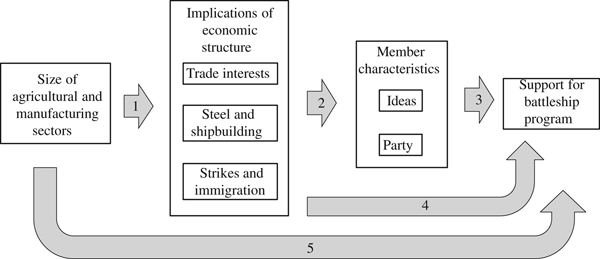
Figure 2 depicts the order of the proposed causal effects on support for the battleship program. I will not estimate the entire causal structure depicted in the figure, but rather the specific parts of it that are important for the arguments I reviewed earlier. The causal order it indicates is straightforward. Fundamental economic structure—the size of the manufacturing and agricultural sectors—is the product of resource endowments that change quite slowly. The next set of variables in the figure consists of the immediate results of this structure. These considerations might influence the balance between agriculture and manufacturing in the long run, but not immediately. The individual characteristics of members of Congress are a further step down the causal chain since economic structure and its implications might have influenced them, but the relationship cannot run in the other direction. Member characteristics may influence support for the battleship program, but their effects also reflect, in part, the impact of the causally prior economic variables. Both economic structure and its implications might also influence support for the battleship program directly, as indicated by arrows 4 and 5. It is worth emphasizing that Figure 2 depicts only the causal order. It is not intended to suggest that members’ characteristics are entirely a function of economic structure, or that strikes and immigration, or other variables situated at the same point in the sequence of causation, are entirely a function of the size of the manufacturing and agricultural sectors. All these variables also have other, exogenous causes.
Causal effects on support for the battleship program

The relationships of primary interest here are those affecting support for battleship building, indicated by arrows 3, 4, and 5. Estimating each set raises somewhat different specification issues. The most fundamental relationship is that between economic structure and support for battleship building, indicated by arrow 5. Nearly all the arguments set out in the last section concern the implications of economic structure. Regional differences in trade interests, the parochial benefits of battleship building, and levels of strikes and immigration, result largely from the economic activity of the people in these regions. The individual characteristics of members of Congress also arise in part from these regional differences. From the standpoint of economic structure, all are post-treatment effects. A model excluding these variables will provide the best estimates of economic structure's effect. Because this model does not distinguish among the explanations set out earlier, it is not the most important specification. However, because it tests the basic plausibility of the linkage between industrialization and battleship building, it is still worth considering.
The relationships implied in arrow 4 test claims about the reasons for the linkage between economic structure and support for the battleship program. The individual member characteristics are post-treatment variables in this instance so I will exclude them when estimating these effects. It also makes sense to include all the relevant implications of economic structure together when estimating each one. A single causal process is unlikely to explain support for battleship building. Tested one at a time, variables representing different effects of economic structure would proxy all of the others. A more difficult issue concerns the inclusion of the size of the agricultural and manufacturing sectors in this model. Doing so offers a more stringent test of the specific implications of economic structure. If there are other, unmodeled linkages between economic structure and voting on battleship building, including basic economic structure should capture them. In the presence of these unmodeled relationships, the estimates from this full model would be more accurate. On the other hand, to the extent that the implications of economic structure capture most or all of the relevant relationships, including basic economic structure will diminish the efficiency of the estimates. This is especially true because all the economic structural variables are correlated with one another to some extent, and the model includes several of them. Moreover, the fact that all these variables are measured for states rather than congressional districts introduces some measurement error that may also increase the standard errors. Multicollinearity might thus lead to an incorrect rejection of the null hypothesis. I report estimates for models with and without basic economic structure in the analysis that follows.
The third set of relationships of theoretical interest here are those between individual members’ characteristics and support for the battleship program, indicated in arrow 3. There are good reasons to include the implications of economic structure when estimating the individual-level effects. The personal background or party affiliation of a member of Congress is quite likely to be at least partly a function of the economic structure of their home state. To the extent that these individual characteristics make a member more likely to support the battleship program, interests with a stake in the program may work to get that person elected. Assessing whether these individual-level considerations have effects beyond those of economic structure requires a model that includes economic structure. A model that excluded these considerations might produce more efficient estimates but will not really answer this question. I report the results of both types of models, even though the one that excludes economic structure has limited value in this context.
Empirical Results
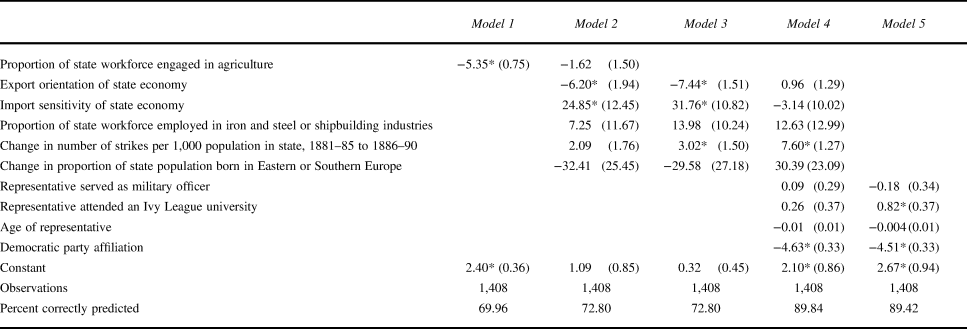
Table 3 presents the results of five models of roll-call voting on the battleship fleet in the House of Representatives. The first includes only economic structure, as indicated by the size of the agricultural sector. The next two test the arguments concerning the implications of economic structure, both with and without the size of the agricultural sector in the model. The last two focus on the characteristics of individual members, testing their effects on support for battleship building with and without the structural variables in the model.
Logit models of House votes on battleship construction, 1890–91

Notes: Asterisk indicates significance at the p < .05 level. Robust standard errors adjusted for clustering on the state are reported in parentheses. All models also include a dummy variable for five of the six roll-call votes, not reported here. Models that include import sensitivity also include a dummy variable for the state of Louisiana to control for the state's outlying import-sensitivity score.
The Impact of Economic Structure
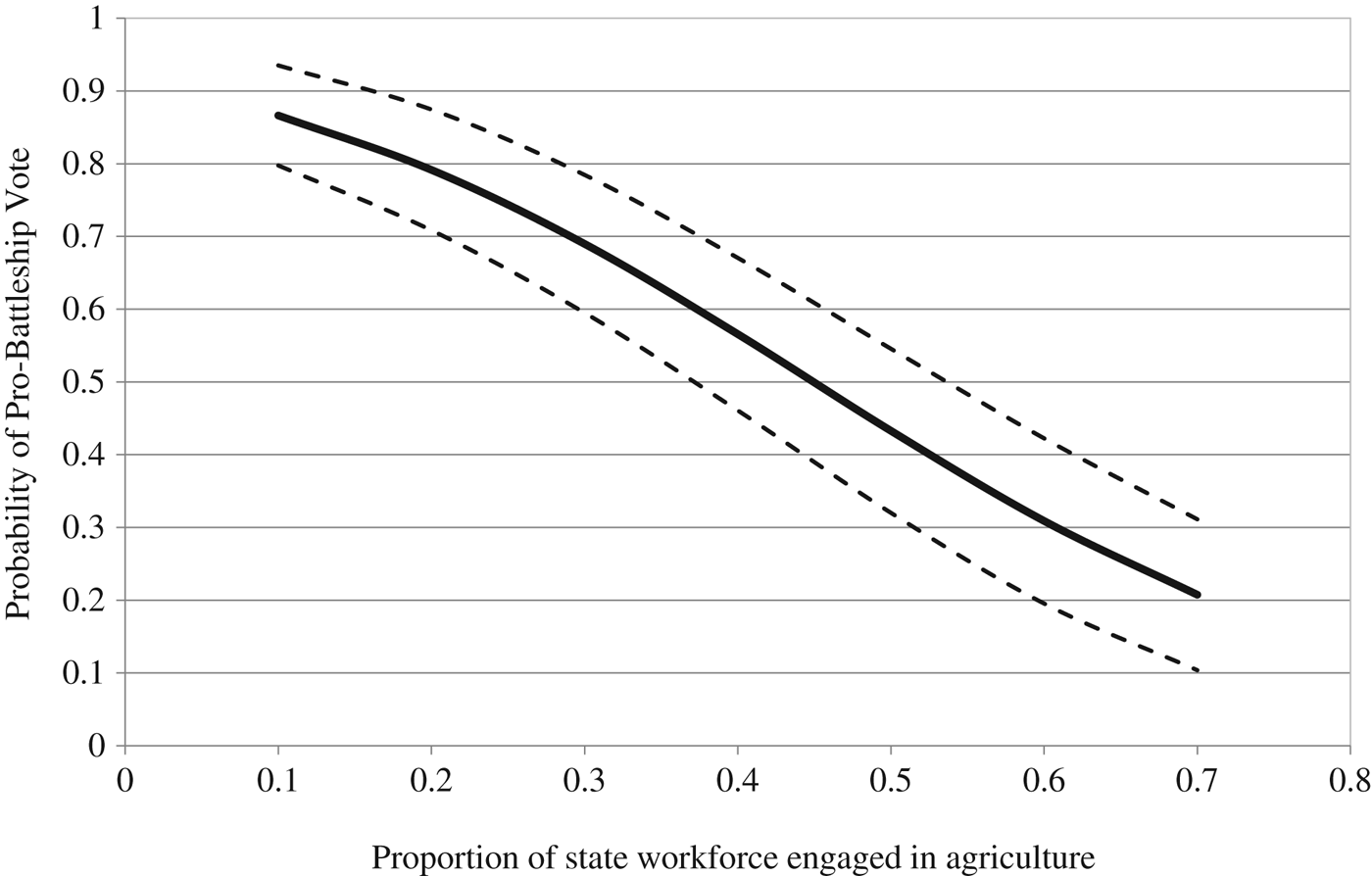
Model 1 estimates the impact of basic economic structure on the 1890–91 roll-call votes concerning the battleship program. It tests the general plausibility of arguments that posit a relationship between economic structure and support for battleship building. The strong negative correlation between the size of the agricultural and manufacturing sectors (ρ = −0.93) dictates the use of only one of these variables in estimation. The size of the agricultural sector produced a better-fitting model than an alternative using the size of the manufacturing sector, so the table displays these results.Footnote 73 This variable captures not the effect of the agricultural sector alone, but rather of the balance between agriculture and manufacturing in the member's home state.Footnote 74
Figure 3 shows the effect of economic structure on support for battleship building across most of the range of agricultural employment. (In fact, this proportion varies from 0.07 in Massachusetts to 0.78 in Mississippi.) This effect is quite large. Members of Congress from the states where manufacturing predominated were almost sure to vote for the battleship program. Those from the states where agriculture prevailed were just as likely to vote against it. It is clear that there is a strong relationship between economic structure and support for battleship building, but which argument best accounts for it?
Economic structure and support for battleship building

Models 2 and 3 seek to answer this question. Overall, the results provide the strongest support for the argument concerning trade interests, but there is evidence that labor unrest also made a difference. The parochial economic stakes in battleship construction are not statistically significant predictors of support for the program.
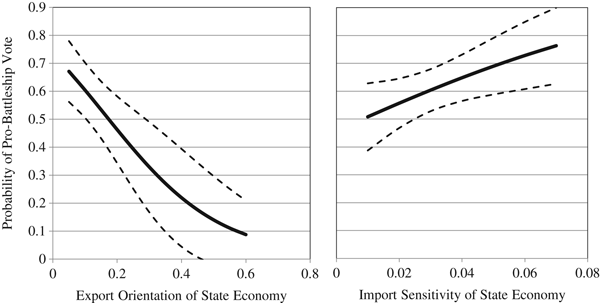
Trade interests have the largest substantive effects among the economic structural variables in models 2 and 3. Export orientation and import sensitivity are statistically significant in both models. Figure 3 displays the effects implied by model 2, the more conservative specification. Holding other variables at their means, the probability of a vote supporting the battleship program fell from around 0.7 at the lowest observed values of export orientation to around 0.1 at the highest observed values. The impact of import sensitivity was slightly smaller. The probability of supporting the program rose from around 0.5 at the lowest observed levels of this variable to around 0.8 at the highest observed values other than the Louisiana outlier. The marginal effects implied by model 3, a more generous specification that omits the correlated indicator of basic economic structure, are slightly larger. The greater effect of export orientation compared to import sensitivity is not surprising. The high tariff levels prevailing in 1890 reduced observed import penetration in protected industries, especially in manufacturing, truncating the range of this variable. The manufacturing sector was actually more sensitive to imports than the measure indicates.
Trade interests and support for battleship building

Variables representing elements of the “psychic crisis” brought on by industrialization produce mixed results. Neither trends in labor unrest nor immigration were associated with increased support for the battleship program in the more conservative specification of model 2. Immigration from Southern and Eastern Europe has the incorrect sign in both model 2 and model 3. Trends in labor activism were both statistically significant and substantively important in model 3, however. Holding other variables at their mean values, members from states with no increase in labor activism had a 0.55 probability of casting a vote in favor of building battleships. Members from states with values near the maximum observed had a 0.75 probability of doing so. This is a substantial result but, because it happens only in the more generous specification, it must be regarded as less certain than the effects of the trade variables.Footnote 75
Models 2 and 3 produce no evidence to support the idea that the beneficiaries of spending on new battleships drove support for the program. The variable indicating employment in the iron and steel or shipbuilding sectors was not statistically significant in either model. This is not the result of aggregating the two sectors. Alternative models that include only one of these sectors also produce no supportive results.Footnote 76 For the reasons noted earlier, this line of argument was always tenuous given the relatively low level of military spending during this historical period. Its inclusion here was intended mainly to test whether modeling this consideration would affect support for the other possible effects of economic structure. It does not appear to do so.Footnote 77
The Effect of Individual-Level Variables
Models 4 and 5 evaluate the impact of the individual-level variables. Model 4 provides the best assessment of the causal impact of these variables because it controls for the prior effects of economic structure. In effect, it provides an answer to the question of whether these background characteristics of the individual members—service as a military officer, age, an Ivy League education, and party affiliation—had effects beyond socioeconomic conditions in their home state. The results support only a party effect. Not surprisingly, in view of the voting breakdown by party presented in Table 1, it is quite large. Holding other variables at their means, a Democrat had only a 0.10 probability of voting to support battleship building, whereas a Republican had a 0.92 probability of doing so.Footnote 78
Model 5 suggests why the other individual-level variables predicted voting patterns so poorly. In this model, which includes only the individual-level variables, an Ivy League education predicts support for battleship building, as arguments about the social origins of those propagating navalist ideology suggest. Among Democrats, those with an Ivy League education had a 0.23 probability of voting for the battleship program, compared to 0.11 among those without this background. Among Republicans, those with an Ivy League education had a 0.96 probability of voting in favor of the program, while those without it had a 0.92 probability of doing so. The omission of socioeconomic variables from model 6 implicitly assumes that constituents did not use individual-level characteristics like a candidate's educational background as criteria for selecting their representative. The fact that the effect of Ivy League education does not hold up when the socioeconomic variables enter the model suggests that this assumption is probably false. Accounts stressing the role of ideas about naval power circulating in elite social networks have a point, but overemphasizing ideational social networks produces a superficial explanation. Members of Congress sharing this elite social background were indeed more likely to favor the battleship program, but they found political success only in areas of the country with economic interests that were predisposed to support their position. Socioeconomic structure was more important because it pushed even members who did not have this background characteristic to support the program as well.
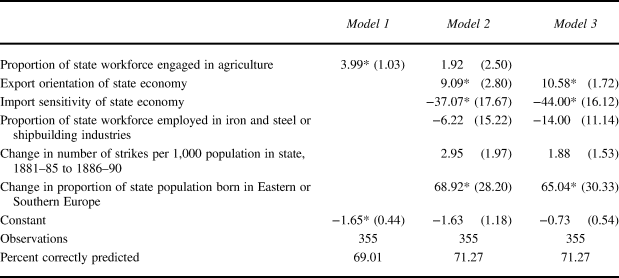
Of course, the same cannot be said for political party, which strongly influenced members’ views even in the presence of the socioeconomic structural variables. Indeed, none of these other independent variables except trends in strikes is statistically significant when party is included in the model. This raises two important analytical issues. The first is whether party was really partly a result of socioeconomic structure, rather than an entirely independent consideration. Table 4 presents evidence that socioeconomic structure indeed influenced party. It shows the results of three models of members’ party affiliation. In effect, these are models of party success in the 1888 congressional elections. The first model shows that basic economic structure—the balance between agriculture and manufacturing—exerted a decisive influence on the party that prevailed in each state. A member from a manufacturing state like Pennsylvania, where agriculture occupied about 16 percent of the workforce, had a 0.26 probability of being a Democrat. A member from a state like Georgia, where 63 percent of the workforce was engaged in agriculture, had a 0.70 probability of being a Democrat. The remaining two models in the table duplicate the sets of structural variables used to predict battleship voting in the second and third models from Table 4. These indicate that most of the other socioeconomic considerations also had substantial effects on party selection. The precise magnitude of these effects is less important than the general point that the two parties represented different socioeconomic constituencies. The large effect of party on roll-call voting does not indicate that economic structure was irrelevant. Party was not entirely a function of economic structure, but was heavily influenced by it.
Logit models of Democratic party affiliation in the House of Representatives, 51st Congress (1888 election)

Notes: Asterisk indicates significance at the p < .05 level. Robust standard errors adjusted for clustering on the state are reported in parentheses. Models that include import sensitivity also include a dummy variable for the state of Louisiana to control for the state's outlying import-sensitivity score.
The second issue raised by the insignificance of most of the socioeconomic variables in model 4 of Table 3 is whether party completely mediates the causal effects of these other variables. If the influence of socioeconomic conditions runs entirely through party loyalty, then members of Congress might not actually have paid much attention to the specific economic interests of their constituents when forming their views on the battleship program, attending instead to their party's program. While this program reflected their party's overall socioeconomic constituency, this causal process is less direct than most accounts of the influence of constituent economic interests suggest. The results of model 4 do not unequivocally point to this conclusion, however. It is possible that the socioeconomic variables still directly influenced individual members, but that they did so differently for Democrats and Republicans. Previous research on the effect of economic interests on congressional voting has found such party differences.Footnote 79 Historical evidence that the import-sensitive manufacturing sector was more important to Republicans and the export-oriented agricultural sector mattered more to Democrats suggests that these differences are possible here as well.
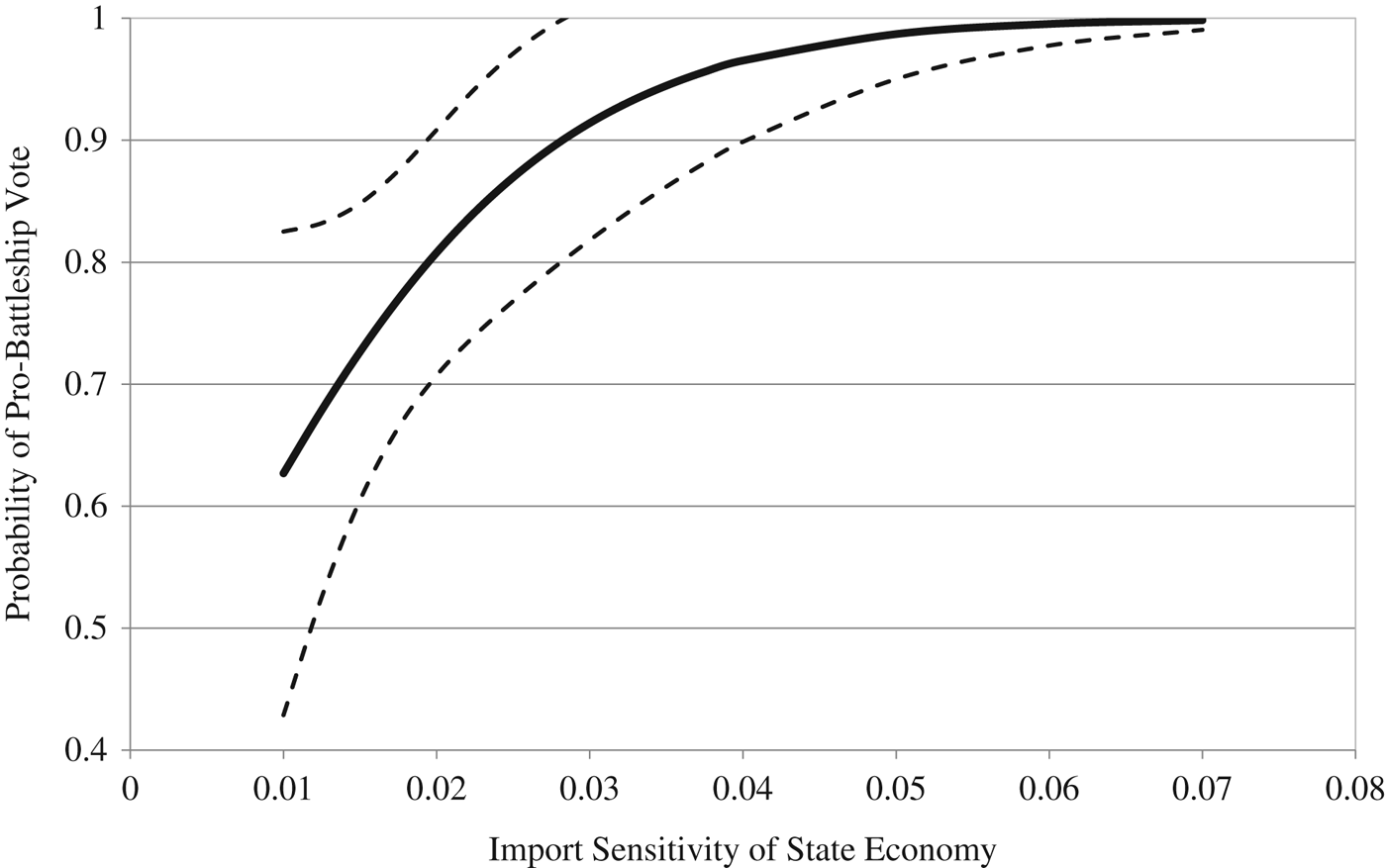
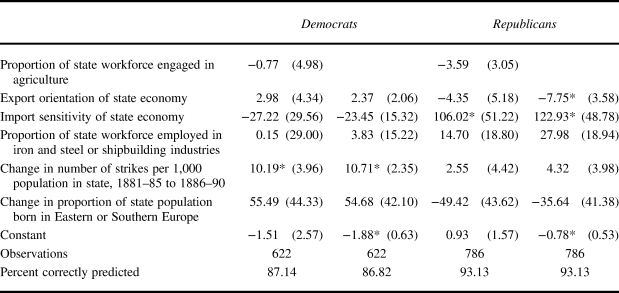
Table 5 presents the results of several models estimating the effects of the socioeconomic variables separately on the two parties. As in Table 3, the results include both a conservative specification that includes the size of the agricultural sector and a more generous specification that omits it. The results suggest that the socioeconomic variables indeed affected members of the two parties differently. First, the within-party influence of the trade variables appears to be confined to Republicans. Neither export orientation nor import sensitivity was statistically significantly related to support for the battleship program among Democrats. By contrast, import sensitivity was a significant predictor of support among Republicans, as was export orientation in the more generous specification. Figure 5 shows the effect of import sensitivity indicated in model 4. Members from the least import-sensitive states were most likely to have reservations about the program and to vote against it. This effect is apparent only at very low values of import sensitivity, but 28 percent of the Republican sample had import sensitivity values below 0.015.
The effect of import sensitivity on Republicans

Logit models of House votes on battleship construction, 1890–91, by party

Notes: Asterisk indicates significance at the p < .05 level. Robust standard errors adjusted for clustering on the state are reported in parentheses. All models also include a dummy variable for five of the six roll-call votes, not reported here. Models that include import sensitivity also include a dummy variable for the state of Louisiana to control for the state's outlying import-sensitivity score.
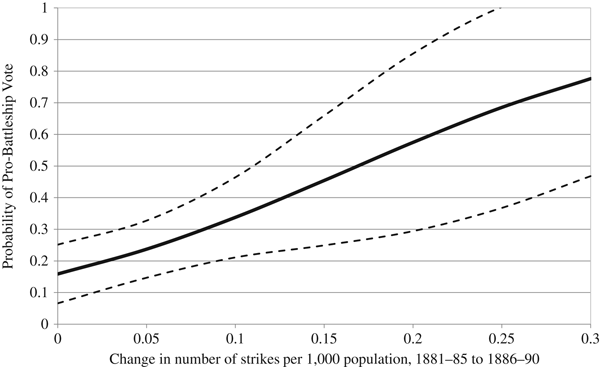
The effect of strikes was confined to the Democrats. This is more surprising than the evidence that the import-competing sector had a larger effect on Republicans because there is not a substantial body of historical research anticipating it. As Figure 6 illustrates, however, the effect was substantial. It may be that it took highly visible events like strikes to pull Democratic members of Congress away from their party's general opposition to the battleship program. Increasing strike rates affected a substantial share of the Democrats. Roughly 44 percent of the sample came from states where the change in the number of strikes per 1,000 population was greater than 0.2, enough to raise the probability of supporting the battleship program above 0.5, other things being equal. Overall, the results in Table 6 indicate that the causal impact of the socioeconomic variables was not entirely mediated by party. These variables also had direct effects on support for the battleship program, but these effects differed for Democrats and Republicans.
The effect of increasing strikes on Democrats

Conclusion
Overall, the evidence most strongly supports the role of trade interests in driving support for the battleship program. Members of Congress from import-sensitive states tended to support the program, while those from export-oriented states tended to oppose it. This is the reverse of the pattern of support and opposition to American foreign policy activism after World War II. The difference stems from the central role of protectionism in shaping American foreign policy during this period. The Republican policymakers who supported the program intended to use the battleships to secure American access to less-developed markets on behalf of heavily protected manufacturers. At the same time, both trade protection and power projection risked conflict with the developed states that were the greatest consumers of American agricultural exports. The objectives of American foreign policy during this period contrast sharply with the effort to build a more liberal international order after World War II, mainly in cooperation with other developed states. The protectionist character of the earlier foreign policy is worth emphasizing because most research on this period underrates its significance.
There is also evidence that rising labor activism also contributed to support for the battleship program, though it is less certain than that concerning trade interests. This pattern was clearer among Democrats than among Republicans, who were already likely to support the program. These members might reasonably have hoped that the patriotic symbolism of the battleship fleet would bolster nationalist sentiments—and perhaps support for relatively conservative political leaders—within the restive working class. This pattern may not be confined to this historical case. Indeed, ideas about this sort of social imperialism were originally developed mainly in the context of European states like Germany.Footnote 80 While the association between protectionist trade interests and an aggressive foreign policy does not hold in the post-1945 period, at least in the United States, strikes and other threats to the social and political order might still produce support for an aggressive foreign policy in more recent settings where such a policy has broad appeal.
The evidence considered here raises questions about accounts of the battleship program stressing free-floating ideas and the social networks associated with them. Even if one were to reject the argument about trade interests, one would still have to confront the very strong relationship between basic economic structure and support for the battleship program. The battleship program was rooted in the strategic thought and advocacy of Luce, Mahan, and others. Social networks like those associated with Ivy League universities spread these ideas. However, whatever their intrinsic merit, the ideas were ultimately persuasive mainly to political leaders who came from areas of the country that stood to benefit materially from them. This analytical problem is likely to recur in other historical settings. When assessing the influence of ideas on policy, it is important to consider the possibility that they spread mainly under favorable material circumstances. Archival sources alone may not reveal whether this is the case.
The conditions under which trade protection might be linked to a more ambitious and aggressive foreign policy are not unique to the United States in the late nineteenth century. For one thing, while the British pursued “the imperialism of free trade,” many other late-nineteenth-century imperial powers protected their domestic industries while using military and political power to secure privileged access to less-developed markets. Protectionist interests appear to have stood behind these policies in at least some other imperial powers, just as they did in the United States.Footnote 81 This protectionist imperialism reflected the international conditions prevailing at the time. Multilateral institutions for securing access to world markets were far less developed then than they have become since World War II. In their absence, power-projection capability was arguably indispensable for securing access to markets and sites for investment in some parts of the world. The barriers to using political-military pressure to obtain privileged access for protected interests were also much lower at the time. Imperialism of this sort was more common, less normatively stigmatized, and carried a smaller risk of concerted international opposition than it would after 1945. The postwar liberal international order has made it more difficult for protected interests in major powers to pursue their overseas interests. A breakdown of this order could once again give them a reason to support greater political-military competition.
Even if the linkage between trade protection and foreign policy ambition does not re-emerge, other issue linkages might modify the sources of support for foreign policy ambition. A settled policy in one area may restrict the options available in others. This observation is commonplace in research on foreign economic policy. For instance, scholars have demonstrated how choices about exchange rate stability, price stability, and monetary policy depend on one another.Footnote 82 Interdependencies like these may make a difference even if political actors do not fully understand them. These linkages between policies could, in turn, affect the political lineup, depending on the salience of each policy to the actors involved. This case shows that such linkages may also exist on security matters. When evaluating the likely sources of support and opposition to a particular foreign policy initiative, it is important to consider the broader set of policies in which the initiative is embedded.
Supplementary Material
Supplementary material for this article is available at <https://doi.org/10.1017/S0020818318000449>.