Introduction
Traumatic brain injury (TBI) affects over 1.4 million Americans annually, and an estimated 5.3 million people are currently living with lifelong disability as a result of TBI (Langlois, Rutland-Brown, & Thomas, Reference Langlois, Rutland-Brown and Thomas2004). TBI commonly occurs in early adulthood, and the long-term consequences can include depression and anxiety (e.g., Whelan-Goodinson, Ponsford, Johnston, & Grant, Reference Whelan-Goodinson, Ponsford, Johnston and Grant2009), low return to productivity (e.g., Wood & Rutterford, Reference Wood and Rutterford2006), lost independence (e.g., Dikmen, Ross, Machamer, & Temkin, Reference Dikmen, Ross, Machamer and Temkin1995), and interpersonal changes (e.g., Finset, Dyrnes, Krogstad, & Berstad, Reference Finset, Dyrnes, Krogstad and Berstad1995). There are many predictors of outcomes following TBI, such as injury severity (e.g., Dikmen, Machamer, Powell, & Temkin, Reference Dikmen, Machamer, Powell and Temkin2003), sociodemographic factors (Green, Colella, Christensen, et al., Reference Green, Colella, Christensen, Johns, Frasca, Bayley and Monette2008), neuropsychological performance (Green, Colella, Hebert, et al., Reference Green, Colella, Hebert, Bayley, Kang, Till and Monette2008), and self-efficacy (Cicerone & Azulay, Reference Cicerone and Azulay2007). Recent research has suggested, however, that outcomes are best predicted by the use of escape avoidant coping (Dawson, Levine, Schwartz, & Stuss, Reference Dawson, Levine, Schwartz and Stuss2004; Dawson, Schwartz, Winocur, & Stuss, Reference Dawson, Schwartz, Winocur and Stuss2007).
Coping has been defined as a person's “constantly changing cognitive and behavioral efforts to manage specific external or internal demands that are appraised as taxing or exceeding the resources of the person” (Lazarus & Folkman, Reference Lazarus and Folkman1984, p. 141). The literature broadly divides coping into “problem focused” and “emotion focused” (see Lazarus & Folkman, Reference Lazarus and Folkman1984). Problem-focused coping involves actively seeking a solution to the problem (Lazarus & Folkman, Reference Lazarus and Folkman1984). Emotion-focused coping involves managing stress through emotion regulation (Lazarus & Folkman, Reference Lazarus and Folkman1984). Particular attention has been paid to “avoidant coping,” a sub-category of emotion-focused coping, because of its consistent negative relation to outcome following TBI (e.g., Anson & Ponsford, Reference Anson and Ponsford2006a; Curran, Ponsford, & Crow, Reference Curran, Ponsford and Crowe2000; Dawson, Levine, Schwartz, & Stuss, 2006). Despite these relationships to negative outcomes, and also despite clinical observation to the contrary, it has been consistently demonstrated that there are no measureable differences in coping between people with TBI and matched control groups (Curran et al., Reference Curran, Ponsford and Crowe2000; Finset & Andersson, Reference Finset and Andersson2000; Krpan, Levine, Stuss, & Dawson, Reference Krpan, Levine, Stuss and Dawson2007).
This latter counterintuitive finding may be an artifact of the methods by which coping has been assessed. In the TBI literature, coping has almost exclusively been measured through self-report (e.g., Anson & Ponsford, Reference Anson and Ponsford2006a; Curran et al., Reference Curran, Ponsford and Crowe2000; Dawson et al., Reference Dawson, Cantanzaro, Firestone, Schwartz and Stuss2006; Krpan et al., Reference Krpan, Levine, Stuss and Dawson2007). On the Ways of Coping Questionnaire (WOC; Folkman & Lazarus, Reference Folkman and Lazarus1988), for example, participants are asked to recall a stressful situation that has occurred in the past 2 weeks, and report to 66 questions using a 4-point Likert scale as to how they coped with the problem. Inherent to any self-report measure are problems associated with demand characteristics, impression management, and self-deceptive denial, but among people with TBI, there may be additional concerns associated with self-report. To attain an accurate account of coping on the WOC, a person must not only answer truthfully to each question, but must also recall the stressful event, and be aware of how they felt and behaved. Given the documented deficits in memory and self-awareness post-TBI (Prigatano, Reference Prigatano2005; Stuss, Reference Stuss1991; Stuss & Gow Reference Stuss and Gow1992; Stuss et al., Reference Stuss, Ely, Hugenholtz, Richard, LaRochelle, Poirier and Bell1985), self-reported coping does not likely reflect actual coping behavior in the real world. Many investigators rely on ratings from significant others about their loved one's behavior; yet to our knowledge, there is no evidence that these ratings are more valid indicators than self-report.
The current study expands upon earlier work by directly observing coping behavior among people with moderate-to-severe TBI. We designed a behavioral paradigm intended to induce simulated real-world stress and allow for the observation of coping behavior. The Baycrest Psychosocial Stress Test (BPST) is based upon the Trier Social Stress Test (Kirschbaum, Pirke, & Hellhammer, Reference Kirschbaum, Pirke and Hellhammer1993), and is to our knowledge, the first behavioral measure of coping post-TBI to be reported.
There were three main objectives to the current study: (1) to evaluate coping behavior during a simulated real-world stress test (BPST); (2) to evaluate self- and significant other (SO) -reported coping (WOC); and (3) to evaluate the relationship between behavioral (BPST) and self- and SO-report (WOC) measures of coping in individuals with moderate-to-severe TBI and matched controls. We predicted that: (1) people with TBI would engage in more avoidant coping on the BPST than would control participants; (2) there would be an interaction between group (TBI and control) and assessment tool (BPST and WOC), such that the groups would vary on behavioral measures of coping, but not on self-report measures; and (3) the relationship between behavior on the BPST and self- and SO-reported coping on the WOC would be weaker in the TBI than control group.
Methods
The research protocol was approved by the Joint Baycrest/University of Toronto Research Ethics Board, and all participants provided written informed consent.
Recruitment and Inclusion/Exclusion Criteria
Eighteen participants with TBI were recruited from the community by means of advertisements in the local newspaper and by acquired brain injury newsletters, flyers, and word of mouth. Inclusion criteria were as follows: English speaking, traumatic brain injury with a Glasgow Coma Scale (GCS) rating of 12 or less, and at least 18 years of age. Patients with a premorbid history of neurological disease, systemic disease, psychiatric disorder, substance abuse, or developmental disorder were excluded. Patients were also excluded if there were co-morbid spinal cord injuries, serious burns, serious facial disfigurement, and/or amputations that might affect coping style. Eighteen significant other (SO) participants were recruited through the TBI participant. The SO group consisted of family members, friends, or support workers who knew the person with TBI well and felt competent enough to complete questionnaires on their behalf. Twenty-four control participants were drawn from friends and family members of TBI participants (where possible) to control for sociodemographic factors specific to the TBI participants (see Dikmen et al., Reference Dikmen, Ross, Machamer and Temkin1995). Additional control participants were drawn from a participant pool at the Rotman Research Institute at Baycrest, Toronto, Canada, with an effort made to have them match the TBI participants in terms of age, education, and sex. Control participants were English speaking and did not have any serious medical, psychiatric, or substance abuse problems, and had no history of sustaining a brain injury or any neurological disease.
General Procedure
The BPST was administered as a part of a larger study that included 2 days of neuropsychological testing, and completion of questionnaires. The BPST was always administered first thing on the morning of the second day of testing.
Baycrest Psychosocial Stress Test
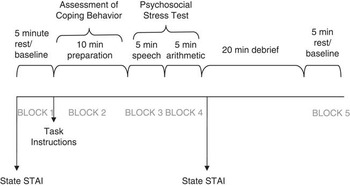
The Baycrest Psychosocial Stress Test (BPST) was adapted from the Trier Psychosocial Stress Test (TPST; Kirschbaum et al., Reference Kirschbaum, Pirke and Hellhammer1993). The BPST consists of an anticipation period where coping can be directly observed (10 min) and a test period (10 min) in which the participant has to deliver a speech and perform mental arithmetic while being video recorded (see Figure 1). This protocol (see Kirschbaum et al., Reference Kirschbaum, Pirke and Hellhammer1993) has been used extensively in non-TBI populations, and reliably induces adrenocortical stress responses.
Schematic representation of the Baycrest Psychosocial Stress Test. STAI = State Trait Anxiety Inventory.

Upon arrival for day 2 of testing, participants were taken to a room where audio-video equipment was installed. Participants rated their subjective anxiety on the State Trait Anxiety Inventory (STAI: Spielberger, Reference Spielberger1983), and baseline physiological measures were collected (see below). Participants were asked to give a 5-min speech about crime in Toronto. They were told that they were going to be left alone but video recorded while in the examination room for 10 min and that during this time they were free to use any of the materials they found in the room (barring they did not disturb wires for heart rate and skin conductance), but that they did not have to do so. They were told that following the 10-min period, a colleague of the examiner (e.g., Dr. Black) would enter the room, and they were then to give their speech to him/her. The participants were told that Dr. Black was an expert in communications, and was there to evaluate the content of their speech, as well as their non-verbal behavior. In fact, Dr. Black was a trained research assistant. In addition, participants were told that the speech would be video-recorded, and that later a panel of judges would analyze the content of the speech, the non-verbal language, and voice frequency. Participants were then provided an opportunity to ask questions and have task demands clarified.
Following the oral instructions, the participants were left alone for 10 min to prepare the speech (or do as they pleased) and behavior was video-recorded. In front of them on the table were materials that could facilitate either problem-focused coping or avoidant coping. The problem-focused materials were a pencil and paper, a package labeled “speech requirements” that contained the required outline of the speech, and a newspaper. The avoidant materials were magazines, crossword puzzles, and Sudoku puzzles. Behavior during the preparation period was coded at a later date by three masked independent raters.
Following the 10-min preparation period, the confederate (e.g., Dr. Black) entered the room and the participants were prompted to introduce themselves and begin their speech. If a participant completed the speech in less than 5 min, the confederate prompted him or her by saying “You still have some time left. Please continue!” If the participant finished again before 5 min, the confederate asked a set of prepared questions relating to crime in Toronto. Following completion of the 5-min speech, the confederate asked the participants to serially subtract the number 13 from 1,022 as quickly and as accurately as possible. On every failure, the participant was asked to restart at 1,022 with the confederate interfering by saying “Stop. 1,022”. After 20 min (preparation+speech+mental arithmetic), the task was terminated and the experimenter returned and immediately administered the STAI to index subjective anxiety. Following a 20-min interview regarding strategy, resting physiological measures were collected to establish a return to baseline.
Analysis of behavior during the BPST
During the preparation period, the behaviors observed included speech writing, reviewing the speech, reading speech requirements, writing and appearing to think, reading the magazine, playing crosswords, text messaging, staring into space, reading the newspaper, looking through materials, and “other” behaviors (e.g., doodling, adjusting clothing, sipping a drink, grooming). To reduce these behaviors into meaningful categories, correlation analyses were performed on the entire sample. Behaviors that were correlated with one another (r > .3) were then summed to create total scores for each participant. These analyses produced two types of coping scores: planful and avoidant. The total planful score was the summed durations of writing, reviewing the speech, and writing and appearing to think. The total avoidant score was the summed durations of reading magazines, playing puzzles, text messaging, staring into space, and “other” avoidant behaviors. Two-way random absolute intraclass correlations coefficients (ICC) were calculated between the three independent raters’ behavior scores. Reliability was excellent; ICC for planful = 0.983; Cronbach's alpha = .983; ICC for avoidant = 0.945, Cronbach's alpha = .947. The behavioral data presented are the average across all three raters.
Correlates of stress
Subjective and objective measures of stress were included to ensure that the BPST did induce a stress response; and to evaluate group differences in perceived stress that may influence coping behavior.
The State Trait Anxiety Inventory (STAI: Spielberger, Reference Spielberger1983) is a 20-item inventory assessing state anxiety. The state STAI was used to assess how participants felt immediately before and immediately after the BPST. This allowed for an estimate of the level of anxiety that was induced by the task.
Electrodermal activity
Skin conductance response was recorded continuously using the BioPac GSR 100 amplifier with a constant voltage method (0.5 V). The participant was asked to gently exfoliate the distal phalanges of the non-dominant index and middle finger with alcohol to ensure proper electrode contact. Two 8-mm Ag/AgCl finger electrodes were filled with electrode gel and affixed to the participant using self-adhesive tape and Velcro (see Dawson, Schell, & Filion, Reference Dawson, Schell and Filion1990; O'Keeffe, Dockree, & Robertson, Reference O'Keeffe, Dockree and Robertson2004). Skin conductance was continuously recorded throughout all five blocks of the BPST (i.e., baseline, preparation, speech, arithmetic, and baseline 2).
Heart-rate
Heart-rate was continuously recorded using the BioPac ECG 100 amplifier throughout the five blocks of the BPST. Participants were asked to gently exfoliate three places on their thorax with alcohol to ensure proper electrode contact (on the right below the clavicle, on the left below the clavicle, and on the left ribcage below the heart). Electrode gel was then applied to the surface of three self-adhesive electrodes and affixed to the participant at the above named locations, and leads were attached. Heart-rate was calculated by averaging the mean beats/min for each of the five blocks of the BPST.
Cortisol
Salivary cortisol samples were taken using a salivette (Salimetrics, State College, PA). Participants removed a cylindrical cotton swab from a test tube and chewed or sucked on it for 30–45 s or until it was fully saturated. They then returned it to the test tube. Following the session samples were frozen in a −40°C freezer until analyzed. Samples were later centrifuged for 10 min, at 3000 rpm at 4°C, before being analyzed in duplicate using a expanded range high sensitivity salivary cortisol enzyme immunoassay kit (Salimetrics) for quantitative measurement of salivary cortisol. Cortisol was measured at Time 1, before task instructions; at Time 2, immediately following the BPST; and Time 3; 20 min after completing the BPST. Measurement of hormones at 20-min intervals allowed for analysis of changing free (biologically active) concentrations of cortisol in response to the tasks (e.g., Fleming, Steiner, & Corter, Reference Fleming, Steiner and Corter1997; Krpan, Coombs, Zinga, Steiner, & Fleming, Reference Krpan, Coombs, Zinga, Steiner and Fleming2005).
Results
Demographic and Injury-Related Characteristics
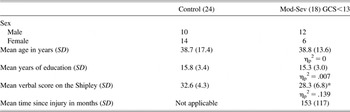
Univariate analyses of variance were performed to compare the control and TBI group on demographic variables. As displayed in Table 1, the only significant difference between groups was that the TBI group had lower estimated premorbid IQ on the verbal component of the Shipley Institute of Living Scale (Zachary, Reference Zachary1982). Accordingly, premorbid intelligence was added as a covariate to analyses of coping behavior and did not alter the pattern of results significantly.
Demographic and injury severity characteristics

Note. Mod-Sev = moderate to severe; GCS = Glasgow Coma Scale.
*Indicates a significant difference between groups (p < .05).
Subjective and Objective Stress
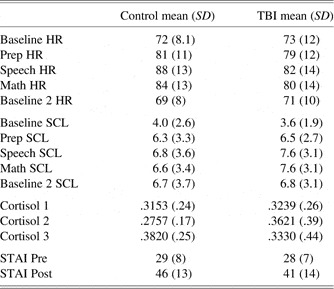
Before analyzing the behavioral data, it was first necessary to confirm that the BPST had induced stress. Importantly, there were no differences between the groups’ baseline state-STAI scores [Control mean (SD) = 28.5 (8); TBI mean (SD) = 27.7 (7)], heart rates, skin conductance response, or cortisol (see Table 2). Participants in both groups reported subjectively higher anxiety following the BPST (Control group; F(1,20) = 37.0; p < .001; ηp2 = .65; TBI group; F(1,17) = 19.2; p < .001; ηp2 = .53). Participants in both groups also displayed a significant increase in heart-rate (Control group; F(1,20) = 54.5; p < .001; ηp2 = .73; TBI group; F(1,17) = 38.1; p < .001; ηp2 = .69) and skin conductance level (Control group; F(1,19) = 47.8; p < .001; ηp2 = .72; TBI group; F(1,15) = 66.6; p < .001; ηp2 = .82) between baseline and performing the speech. Importantly, there were no significant group differences across blocks of the BPST in heart-rate, skin conductance level, or cortisol, suggesting that the task induced similar levels of stress for both groups. The cortisol measurements did not change significantly for either group.
Mean (SD) changes in physiological and subjective arousal across blocks of the BPST

Note. There were no significant differences between the TBI and Control groups. Cortisol was measured in μg/dl. TBI = traumatic brain injury; HR = heart rate measured in beats per minute; SCL = skin conductance level measured in mmho; STAI = State Trait Anxiety Inventory (state score reported).
Behavior on the BPST
The data from one participant with TBI and two controls are not included in these analyses because the video recording for those participants was of too poor quality to code.
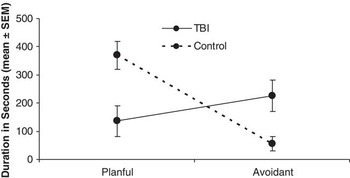
Repeated measures analyses were performed to assess group differences in the total duration engaged in planful and avoidant coping behavior on the BPST (see Figure 2). In contrast to the existing TBI coping literature, this analysis revealed significant interaction where control participants engaged in more planful than avoidant behavior, and the TBI group engaged in more avoidant than planful behavior, F(1,36) = 12.85, p < .001, ηp2 = .26. When premorbid intelligence was added to this analysis as a covariate, the same pattern of results emerged, F(1,35) = 7.78, p < .05, ηp2 = .18.
Mean (±SEM) group differences engaging in planful and avoidant coping behavior. TBI = traumatic brain injury.

In summary, these data indicated that, although there were no differences in subjective (STAI) or objective (physiological) measures of stress at baseline or induced by the BPST, there were marked differences in coping behavior between TBI and control groups. People with TBI engaged in more avoidant behavior than planful behavior, while the control group engaged in the opposite pattern of behavior. This is the first time, to our knowledge, that group differences in coping have been reported following TBI.
Self- and SO-Reported Coping on the WOC
The self- and SO-reported coping data were analyzed in two ways. Univariate analyses were conducted (1) between the control and SO groups (who completed the WOC on behalf of the patient) and (2) between the TBI and SO groups.
There were no significant differences between SO and control reports of planful problem solving coping [SO mean (SD) = 7.0 (3.9); Control mean (SD) = 7.7 (4.3)], or escape avoidant coping on the WOC [SO mean (SD) = 7.2 (5.3); Control mean (SD) = 5.4 (5.3)]. There was a marginal difference, with a small effect size, between TBI and SO-reported escape avoidant coping, where the SO group reported that the patients used more avoidance than did the TBI patients themselves, F(1,32) = 2.1, p = .15, ηp2 = .06. There were no differences between TBI and SO participants on the planful problem solving subscale [SO mean (SD) = 7.2 (5.3); TBI mean (SD) = 7.9 (3.8)].
Group X Assessment Tool Interaction
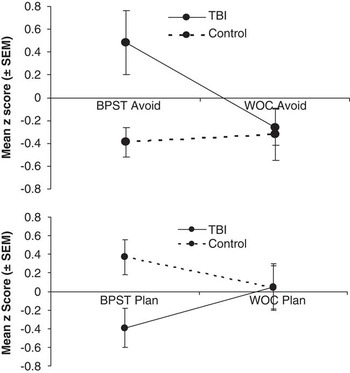
To demonstrate group differences on behavioral measures of coping, but not on self-reported measures of coping, repeated measures analyses were performed. For this set of analyses, BPST and WOC scores of the controls and patients with TBI were converted to z scores, and entered into a repeated measure analysis as a within subject factor, with group as the between subject factor. As depicted in Figure 3 (top panel), there was a significant interaction for avoidant coping, F(1,36) = 6.6, p < .05, ηp2 = .14, such that there were no differences between groups on WOC scores, but markedly greater avoidant coping among the patients than the controls on the BPST. There was also an interaction for planful coping F(1,36) = 6.2, p < .05, ηp2 = .15, where there were no differences between groups on WOC scores, but greater planful coping for the controls than patients on the BPST (see Figure 3, bottom panel). When premorbid intelligence was added as a covariate to each of these analyses, the patterns of results were unchanged, F(1,35) = 4.1, p = .05, ηp2 = .11 for avoidant coping/ and F(1,35), 2.8, p = .10, ηp2 = .07 for avoidant coping. In summary, these analyses indicated that, while there were no differences between groups in self-reported avoidant or planful coping, there were marked differences in actual coping behavior. While these self-report data are consistent with prior literature, we believe that this is the first report of behavioral differences in coping post-TBI.
Mean (±SEM) avoidant (top panel) and planful (bottom panel) coping on the Baycrest Psychosocial Stress Test (BPST) and WOC in patients with traumatic brain injury (TBI) and controls.

Relation Between WOC and BPST
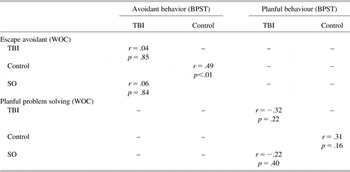
The final set of analyses was conducted to further determine the relation between self- and SO-reported coping and behavior on the BPST. Correlations were performed between; (1) control self-report and control behavior; (2) TBI self-report and TBI behavior; and (3) SO-report and TBI behavior. As depicted in Table 3, within the control group there was a positive correlation between avoidant coping on the BPST and self-reported escape avoidant coping on the WOC, and a marginal positive correlation between planful behavior on the BPST and self-reported planful problem solving coping on the WOC. Within the TBI group, however, there was a non-significant but negative correlation between planful behavior on the BPST and self- and SO-reported planful problem solving coping on the WOC. The correlations between avoidant coping on the BPST and self- and SO-reported escape avoidant coping on the WOC were not reliable. This final set of analyses revealed that self-reported coping is positively related to behavior among control participants, but not among people with TBI. This finding is likely reflective of the documented deficits of memory and awareness that are often observed after brain injury (Prigatano, Reference Prigatano2005; Stuss, Reference Stuss1991; Stuss & Gow, Reference Stuss and Gow1992; Stuss et al., Reference Stuss, Ely, Hugenholtz, Richard, LaRochelle, Poirier and Bell1985). Moreover, these analyses also suggest that SO reports are not reliable indicators of patients’ coping behaviors.
Relationships between self- and SO-reported coping on the WOC and behavior on the BPST

Note. SO = significant other; WOC = ways of coping questionnaire; BPST = Baycrest Psychosocial Stress Test; TBI = traumatic brain injury.
Discussion
This is the first study, to our knowledge, to directly observe coping behavior in patients with TBI during a simulated real-world stress test. There are three main findings of this study. First, the group with TBI behaved in a markedly different way on the BPST than did control participants. Rather than engaging in predominantly planful behavior (as the controls did), they engaged in more avoidant than planful behavior. Second, despite this difference in behavior, there were no significant differences between the TBI and control group in self-reported coping, consistent with prior literature (e.g., Curran et al., Reference Curran, Ponsford and Crowe2000; Dawson et al., Reference Dawson, Cantanzaro, Firestone, Schwartz and Stuss2006; Krpan et al., Reference Krpan, Levine, Stuss and Dawson2007). Third, while there were positive relations between self-reported coping and coping behavior in the control group, these relationships did not exist in the TBI group, even when SO ratings were used as subjective indicators of patients’ behavior. Each of these findings is discussed in turn below, followed by a brief discussion of caveats, applications to rehabilitation, and study limitations.
The first goal of this study was to evaluate coping behavior during a simulated real-world stress test (BPST). To appropriately assess this, it was first necessary to document that the BPST successfully induced stress. There were no group differences in baseline subjective (STAI) or objective (physiological) stress, suggesting that any observed differences in coping behavior could not be accounted for by baseline differences in anxiety or autonomic arousal. Moreover, both the TBI and control groups reported experiencing comparable levels of stress as a result of the BPST, and also had comparable increases in heart-rate and elevated skin conductance levels while presenting the speech, which indicates that that task was equally stressful for the two groups. The critical finding of the current study was that, on a task that was comparably stressful for both people with TBI and matched controls, the TBI group engaged in more avoidant than planful behavior on the BPST, while the control group displayed the opposite pattern of behavior. To our knowledge, this is the first report of documented behavioral differences in coping among people with TBI.
The second and third goals of this study were to evaluate group differences in self-reported coping on the WOC, and relate those self-report data to the behavioral data. Consistent with the literature and with our hypotheses, we found no evidence of group differences in self-reported coping on the WOC. Among those in the control group, however, there were positive relationships between how people reported coping on the WOC, and how they actually behaved on the BPST. In the TBI group, these relationships were not present, even when SO data were evaluated. These data demonstrate that, among people with TBI, real-life behavioral measures of coping are more sensitive than are self-report measures, and suggest that SO reports are no more valid indicators of coping behavior than are patients’ own reports. Moreover, the current results suggest that sensitivity of the BPST lends itself to better understanding the mechanisms of coping, and most importantly, their relations to outcomes.
Significance and Application to Rehabilitation
The BPST provided information about coping behavior that was unavailable through self-report, and that may be of value in the context of rehabilitation. As a group, individuals with TBI engaged in more avoidant than planful behavior. Based upon the self-report literature, the relatively higher use of avoidant coping should predict negative long term outcomes. Accordingly, it follows that rehabilitative programs aimed to reduce avoidance and increase planfulness may be of benefit to people with TBI. Indeed, planful coping has been successfully targeted through cognitive behavioral therapy following TBI (Anson & Ponsford, Reference Anson and Ponsford2006b,Reference Anson and Ponsfordc). Unfortunately, however, in that study increases in self-reported planful coping were not accompanied by changes in anxiety, depression, self-esteem, or psychosocial outcome in that study. Moreover, Anson and Ponsford's results suggest that people with low self-awareness actually became more depressed after interventions designed to encourage planful coping. This highlights the importance of identifying subgroups of people with TBI for rehabilitative purposes.
Consistent with this idea, we have argued for some time that it is necessary to better characterize subgroups of patients if rehabilitative intervention is to be sophisticated, targeted, and ultimately more successful (Cicerone, Levin, Malec, Stuss, & Whyte, Reference Cicerone, Levin, Malec, Stuss and Whyte2006; Mateer & Sira, Reference Mateer and Sira2006; Levine, Turner, & Stuss, Reference Levine, Turner and Stuss2008). As such, we conducted an individual analysis of coping behavior within the two groups and discovered that 11 people (65%) with TBI could be clearly classified as avoidant, and only 6 as planful, whereas the control group consisted of 5 avoiders (23%) and 17 planners. The small sub-group sample sizes did not provide adequate power for investigation of how planners differ from avoiders with respect to neuropsychological function, estimated premorbid intelligence, responsivity to stress (psychological or physiological), or in relation to outcome. We hypothesize, however, that there are marked differences between these groups, and that understanding the moderators of coping behavior will certainly inform the tailoring or enhance the positive and minimize potentially deleterious effects of intervention (see Anson & Ponsford, Reference Anson and Ponsford2006c). The next step in this body of research is to study in vivo, coping behavior in more individuals with TBI, to consider the moderators of their behavior, and to evaluate more closely real-world long term outcomes (e.g., return to productivity, quality of life, etc.) as they relate to coping behavior. It is likely that this line of research will further reveal a distinct subset of people with TBI, guiding individually tailored rehabilitation.
Limitations
The current data demonstrate resounding differences in coping behavior, but we recognize that the study sample size was modest. The participants were recruited through the community (i.e., they were self-selected and highly motivated), and may not reflect the larger population. The BPST itself is an experimental task, and the psychometric properties have not yet been established, although behavioral coding was highly reliable, its sensitivity to different types of coping behavior is evident. Moreover, individual differences with respect to life experience giving speeches, or prior knowledge about the assigned speech topic (i.e., crime in Toronto), may have influenced coping behavior on the BPST. Beyond estimates of premorbid IQ, we were unable to evaluate pre-injury factors (e.g., premorbid coping, personality, social support, culture, etc.) that may have affected coping abilities. These limitations should certainly be considered when interpreting our data and addressed in future research.
Conclusions
This is believed to be the first study to directly observe coping behavior in a group of people with TBI. Our data demonstrate that behavioral measures of coping are more sensitive to differences in coping between individuals with brain injury and controls than are self-report measures. Our data also provide a platform for future research investigating not only the variability in coping behavior following TBI, but also the moderators of those behaviors, their relation to real-world outcomes, and ultimately, their application to rehabilitation.
Acknowledgments
We thank Dr. M. Binns for his statistical advice on this project, and S. Blackwood, A. Chaudhry, S. Gillingham, A. Maione, C. Nguyen, S. Priselac, and S. Waters-Schulte for all their help with the study. Funding: There are no financial or other relationships that could be interpreted as a conflict of interest affecting this manuscript. This work was supported by an NSERC grant to N.D. Anderson. K.M. Krpan was a doctoral student in the Department of Psychology at the University of Toronto during the project, and was funded by CIHR Doctoral Fellowship, Ontario Research Coalition, Toronto Rehabilitation Institute, Max and Ruth Wiseman Award and the Mary Gertrude l'Anson Scholarship.