INTRODUCTION
Schistosomiasis is an important poverty-related health problem in many developing countries and 85% of infected people are currently living on the African continent (Chitsulo et al. Reference Chitsulo, Engels, Montresor and Savioli2000). In Mali, urinary schistosomiasis is a serious public health problem (Traoré, Reference Traoré, Traoré, Kardorff, Diarra, Landouré, Vester, Doehring and Bradley1994). The transmission is highly focal and confined to water development projects areas and along the main rivers (Niger and Senegal) and streams. A first national schistosomiasis control programme was initiated in 1982. The aim of schistosomiasis control is reduction of morbidity and chemotherapy is the main strategy with a single dose of 40 mg/kg praziquantel (PZQ) used as the drug of choice in many other countries endemic for schistosomiasis (WHO, 2002). The drug has been shown to have good efficacy in killing of both mature worms and eggs. However, the use of a single dose 40 mg/kg has limitations and PZQ does not kill immature worms (REF). Low cure rates have been reported in several studies (Sabah et al. Reference Sabah, Fletcher, Webbe and Doenhoff1986; Stelma et al. Reference Stelma, Talla, Sow, Kongs, Niang, Ploman, Deelder and Gryseels1995; De Clercq et al. Reference Danso-Appiah and De Vlas1997; Kahama et al. Reference Kahama, Vennervald, Kombe, Kihara, Ndzovu, Mungai and Ouma1999; Polman, Reference Polman2000; Kabatereine et al. Reference Kabatereine, Kemijumbi, Ouma, Sturrock, Butterworth, Madsen, Ornbjerg, Dunne and Vennnervald2003). A failure of complete cure in Schistosoma mansoni infection with standard treatment with PZQ was reported by Lawn, Lucas and Chiodini (Reference Lawn, Lucas and Chiodini2003) and they suggested repeated doses. Furthermore, in the absence of radical cure, the inflammatory response in the tissue may be sustained by the continued presence of eggs (Kahama et al. Reference Kahama, Kremsner, van Dam and Deelder1998). If the infection was more radically cured this might have an impact on morbidity re-appearance since the inflammation will subside completely before re-infection occurs. The rate of regression of urinary tract morbidity is remarkably similar from one endemic area to another but the rate of re-appearance is dependent on the level of transmission and re-infection.
An important question is whether an improved treatment success can prolong the interval before morbidity re-appears despite heavy re-infection rates. A way of testing this hypothesis is by comparing the standard treatment with a two-dose regimen given 2 weeks apart. The 2 dose treatment may influence cure rate and thus the inflammatory response. Offering this regimen might (1) increase the proportion of adult worms killed and (2) kill juvenile worms that have matured during the period after the first treatment.
In this study we assessed the cure rates of the two different treatment strategies (single dose 40 mg/kg versus 2×40 mg/kg PZQ within a two week interval) and compared their effect on the prevalence and intensity of the infection as well as on micro-haematuria in two areas with varying transmission over time.
MATERIAL AND METHODS
Study area and population
The study was a randomized, double-blind, placebo-controlled intervention trial including school-aged children (age: 7 to 14 years). It consisted of an initial pre-treatment survey and follow-up treatment surveys at 3, 6 and 18 months. The study was undertaken in two areas of the Niger River Basin: Koulikoro district and Selingué dam area in Mali.
The Koulikoro district is located along the river Niger about 60 km from the capital Bamako. The population depends largely on the rivers which constitute the principal water supply for domestic and occupational purposes.
The Selingué dam was completed in 1980 on the Sankarani River, a major tributary of the Niger River. It currently irrigates approximately 2,000 ha and produces 44 MW of electricity. The area can be considered as a man-made change in the environment and also as a new focus of schistosomiasis as compared to Koulikoro. The main activities in this area are fishing, agriculture (predominantly rice cultivation in the irrigation scheme and cultivation of millet as well as vegetables) and livestock. The irrigation and fishing activities arose as a result of the construction of the dam for hydroelectric power production. The area with its economic potential has attracted and still attracts migrant fishermen and peasants from other regions of the country.
Urine examination
Urine samples were collected between 10 am and 2 pm on three consecutive days in all surveys. Examination for micro-haematuria was performed using reagent strips (Haemastix®, Bayer, Mishawaka, USA). For egg counts, 10 ml of urine was passed through Nuclepore filter (Peters et al. Reference Peters, Warren and Mahmoud1976) using Swinnex filter support. The filters were examined microscopically for the presence of eggs. The intensity of S. haematobium infection was expressed as number of eggs per 10 ml of urine and the mean intensity of infection was the mean of the egg counts in the three replicate urine samples.
Randomisation and treatment
For assignment to the type of treatment in each area, children were randomly divided into two groups using SPSS-generated random numbers after entering all collected data from the baseline survey. There were no significant differences between the groups assigned for either type of treatment. One group received a single dose of 40 mg/kg PZQ and a placebo 2 weeks later. The second group received 2 doses of 40 mg/kg of body weight PZQ with a 2 week interval. Treatment was given using tablets of PZQ USP 600 mg manufactured by Remedica Ltd-Cyprus Essential Drug Programme. The placebo was made by the Usine Malienne des Produits Pharmaceutiques (UMPP), a Malian pharmaceutical company. PZQ and placebo tablets were of same form and colour as PZQ. The tablets were swallowed under the supervision of a medical officer involved in the study.
Ethical considerations
The study was cleared by the Ethical Committee of the National Institute for Research in Public Health (INRSP), Mali and the Danish National Committee for Biomedical Research Ethics. All individuals were informed in detail about the study procedure. The participation in all phases of the study was voluntary after full informed consent.
Data analysis
Prevalence, intensity of infection and cure rates were assessed on the basis of a total of 3 urine samples per child taken over consecutives days. The analysis of cure rate has been limited to those individuals present both at baseline and 3 month after treatment. The cure rate was calculated as the proportion of infected individuals who became parasitologically negative (0 egg/10 ml urine based on three urine samples) at 3 months post-treatment. Individual egg counts were calculated as the mean number of eggs per 10 ml of urine in the 3 urine samples. To compare the effect of the treatment on the intensity of the infection at 3, 6 and 18 months geometric mean egg/10 ml for all urine samples examined for S. haematobium eggs were calculated as log10 (x+1) to allow egg count of 0 to be included in the analysis. In all analysis a probability of P<0·05 was considered significant.
RESULTS
A total of 603 individuals (313 for single dose and 290 for 2 doses) who were examined for the presence of S. haematobium infection and micro-haematuria and who were treated and participated at both the pre-treatment and 3 months following treatment examinations were selected for the analysis.
Cure rate
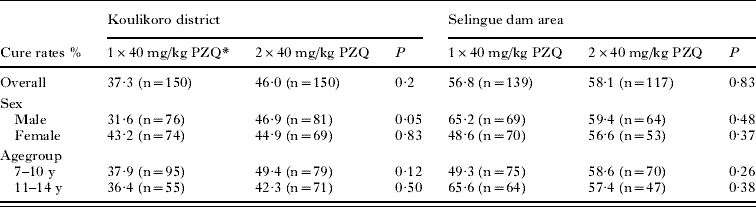
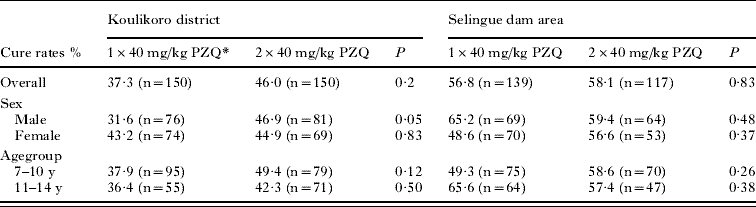
Table 1 shows the overall cure rate according to sex and age group of a single dose of PZQ compared to 2×40 mg/kg PZQ in the two studies areas. No significant differences in overall cure rates were detected between the two treatment regimes. However, the cure rate in males receiving 2 doses (46·9%) was significantly higher than among males treated with a single dose (31·6%) (P<0·05). No significant differences were found in the cure rates according to age group. In Selingue dam area, the overall cure rate was comparable for the 2 treatment regimens (56·8% and 58·1% for single dose and for 2 doses of 40 mg/kg, respectively).
Overall cure rates of two treatments for S. haematobium infection according to sex and age group among school aged children in Koulikoro district (river Niger area) and Selingue dam areas
* PZQ= praziquantel.
Effect of the two treatments on prevalence of infection
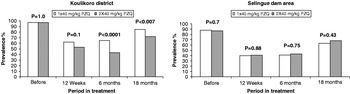
The effect of the two treatments on overall prevalence of infection following treatment is illustrated in Fig. 1. In Koulikoro, the prevalence of infection 3 months after treatment did not differ significantly among the two groups (61·9% in group of single dose and 52·9% in group of two doses, P>0·05). However, at 6 and 18 months following treatment marked differences were observed in the effect of the two treatment regimes (P<0·001 at 6 months, P<0·05 at 18 months). The prevalence of infection in children who received 2 doses 40 mg/kg was significantly lower compared to children having received a single dose of PZQ. In Selingue, no differences were observed between the two groups before and after treatment.
Effect of the two treatments regimens on prevalence of infection at 12 weeks, 6 months and 18 months following treatment in the two study areas.

Effect of the 2 treatments on intensity of infection
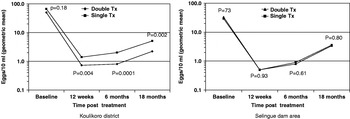
The effect of the 2 treatments on reduction of mean egg counts is summarised in Fig. 2. In Koulikoro district, there was a significant difference between the two groups, whereas in Selingue no significant difference was found between the 2 groups before and after treatment. In Koulikoro district, the mean egg count was particularly low among children having received 2 doses of PZQ and the difference in egg reduction between the 2 treatments was significant at 3 months (P<0·005), 6 months (P<0·0001) and 18 months (P<0·003) after treatment.
Infection intensity expressed by Geometric mean egg/10 ml urine at baseline and 12 weeks, 6 months and 18 months after treatment of S. haematobium infections with a single dose of PZQ (40 mg/kg) vs. 2 times 40 mg/kg in Koulikoro district and Selingue dam areas.

Effect on level of micro-haematuria
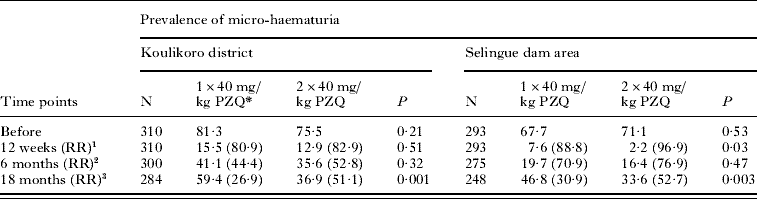
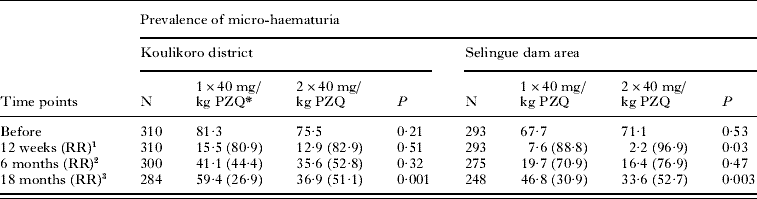
The level of micro-haematuria (Table 2) dropped considerable after treatment with a significant differences between the two treatment regimes at 18 month in Koulikoro (P<0·001) and in Selingue (P<0·003).
Efficacy of the two treatment strategies on overall prevalence of micro-haematuria at 12 weeks, 6 months and 18 months following treatment in the two study areas
* PZQ= praziquantel.
1 R= Reduction rate (%) from baseline to 12 weeks; 2 Reduction rate (%) from baseline to 6 months; 3 Reduction rate (%) from baseline to 18 months.
DISCUSSION
In this study, we examined the effect of the 2 doses 40 mg/kg PZQ administered 2 weeks apart compared to a standard single dose of 40 mg/kg with particular attention to the effect on cure rate, intensity of infection post-treatment and reduction in the level of micro-haematuria.
The low cure rate observed is consistent with other studies on S. haematobium infection and has especially been observed among children with high intensity of infection (Mott et al. Reference Mott, Dixon, Osei-Tutu, England and Davis1985; Kahama et al. Reference Kahama, Vennervald, Kombe, Kihara, Ndzovu, Mungai and Ouma1999; N'Goran et al. Reference N'Goran, Utzinger, N'Guessan, Muller, Zamble, Lohourignon, Traoré, Sosthene, Lengeler and Tanner2001; Saathoff et al. Reference Saathoff, Olsen, Magnussen, Kvalsvig, Becker and Appleton2004). However, the results are in contrast with the cure rates of more than 80% observed in other studies of S. haematobium infection (King et al. Reference King, Lombardi, Lombardi, Greenblatt, Hodder, Kinyanjui, Ouma, Odiambo, Bryan, Muruka, Magak, Weinert, Mackay, Ransohoff, Houser, Koech, Arap Siongok and Mahmoud1990, Muchiri, Ouma and King, Reference Muchiri, Ouma and King1996). An increased cure rate (>80%) was recently reported in a study among schoolchildren in Cameroon, but only after administrating 3 doses of 40 mg/kg PZQ during an interval of 3 weeks (Tchuem Tchuente et al. Reference Tchuem Tchuenté, Shaw, Polla, Cioli and Vercryusse2004). The low cure in our case could partly be attributed to the high intensity of the infection and rapid re-infection as described elsewhere (Kahama et al. Reference Kahama, Vennervald, Kombe, Kihara, Ndzovu, Mungai and Ouma1999; Gryseels et al. Reference Gryseels, Mbaye, De Vlas, Stelma, Guisse, Van Lieshout, Faye, Diop, Ly, Tchuem-Tchuente, Engels and Polman2001; Danso-Appiah and De Vlas, Reference Danso-Appiah and De Vlas2002). Thus, in Koulikoro, more than 50% of the children were found with heavy infection (mean epg/10 ml ⩾50). Utzinger et al. (Reference Utzinger, N'Goran, N'Dri, Lengeler and Tanner2000) observed a clear association between cure rate and infection intensity with the highest cure rate found among children with light infections of S. mansoni. However, other issues should be considered. Firstly, examination of 3 urine samples obtained on consecutives days may have improved the sensitivity of the parasitological examination especially after treatment and thereby resulted in an observed lower cure rate. Secondly, a test of the viability of excreted eggs at 3 months post-treatment, in order to avoid false positive cases caused by dead eggs which might continue to be eliminated through the urine, was not performed in the present study (Giboda et al. Reference Giboda, Loudova, Shonova, Bouckova, Horacek, Numrich, Ruppel, Vitovec, Lukes and Noll1992; Botros et al. Reference Botros, Sayed, Amer, El-Ghannam, Bennett and Day2005).
There was a significant difference between the two treatments regarding the prevalence of infection at 6 and 18 months following treatment in Koulikoro indicating that re-infection might have occurred more rapidly in the group treated with single dose PZQ compared to those being treated with 2 doses PZQ, suggesting that double treatment could delay the susceptibility to re-infection by boosting the immune system. PZQ has been shown to act in synergy with the immune system (Doenhoff et al. Reference Doenhoff, Modha, Lambertucci and McLaren1991). Moreover, it has been observed that resistance to re-infection with S. mansoni in human populations living in different regions of sub-Saharan Africa is correlated with high levels of anti-schistosome IgE (Dunne et al. Reference Dunne, Butterworth, Fulford, Kariuki, Langley, Ouma, Capron, Pierce and Sturrock1992). It has been also reported that the Th2 cytokines responses associated with immunity are boosted by PZQ treatment (Joseph et al. Reference Joseph, Jones, Walter, Fulford, Kimani, Mwatha, Kamau, Kariuki, Kazibwe, Tukahebwa, Kabatereine, Ouma, Vennervald and Dunne2004; Fitzsimmons et al. Reference Fitzsimmons, Joseph, Jones, Reimert, Hoffmann, Kazibwe, Kimani, Mwatha, Ouma, Tukahebwa, Kariuki, Vennervald, Kabatereine and Dunne2004, Mutapi, Mduluza and Roddam, Reference Mutapi, Mduluza and Roddam2005). In view of these observations, it is possible that double treatment may have an additional effect in boosting the immune system and inducing an increased level of schistosome specific IgE as well as Th2 cytokines leading to an improvement of acquired resistance. This hypothesis needs to be investigated further by assessing the effect of double treatment as compared to a single treatment on immune responses as well as correlating these changes with resistance to re-infection with S. haematobium.
In general, the effect of the treatment was followed by a marked reduction of the intensity of infection as has also been demonstrated in several other studies in relation to S. haematobium (Mott et al. Reference Mott, Dixon, Osei-Tutu, England and Davis1985; Magnussen et al. Reference Magnussen, Muchiri, Mungai, Ndzovu, Ouma and Tosha1997; N'Goran et al. Reference N'Goran, Utzinger, N'Guessan, Muller, Zamble, Lohourignon, Traoré, Sosthene, Lengeler and Tanner2001; Tchuem Tchuente et al. Reference Tchuem Tchuenté, Shaw, Polla, Cioli and Vercryusse2004). However, our study has clearly shown a marked difference between the 2 treatment regimens in egg reduction following treatment. The double treatment was significantly more effective than a single dose and the difference was even more pronounced 6 months post treatment. This difference could be explained by the fact that, in high intensity areas (i.e. in Koulikoro district) a single dose is insufficient to kill all worms and residual immature eggs. This supposition is supported by a study on S. mansoni from a high transmission area with high re-infection rate, where a single dose of PZQ failed to reduce the mean egg count significantly after 6 months (N'Goran et al. Reference N'Goran, Utzinger, N'Guessan, Muller, Zamble, Lohourignon, Traoré, Sosthene, Lengeler and Tanner2001). However, in areas of high infection intensity for S. haematobium, high cure and reduction rates of 93·0% and 96·6% respectively were found after administrating two doses of 40 mg/kg PZQ (N'Goran et al. Reference N'Goran, Gnaka, Tanner and Utzinger2003).
At 18 months following treatment we recorded a significant difference between the two treatment regimes on the overall prevalence of micro-haematuria in both study areas. In Mali and probably in other places as well, this could indicate an impact of double treatment in reducing morbidity as a close relationship between urinary tract pathology and micro-haematuria has been demonstrated (Traoré et al. Reference Traoré, Traoré, Kardorff, Diarra, Landouré, Vester, Doehring and Bradley1998).
In conclusion, our results, as well as findings from other studies reveal the complexity in assessing the ‘real cure’ rate in operational research, in particular in high intensity and transmission areas. At the moment there is no standard methodological approach in terms of diagnostic tools and timings for assessment. The significant difference in mean intensity of infection 6 and 18 months after treatment and also on the level of micro-haematuria 18 months following treatment between the two treatment regimes is an important finding, since one of the main strategies in schistosomiasis control is reduction of morbidity. Thus, the effect of double treatment resulting in a marked reduction in intensity as well as haematuria may have a great impact on the general health status of the child because even with low intensity infection the subtle morbidity such as continuous local tissue inflammation, may led to impairment of nutritional status, children growth and anaemia.
ACKNOWLEDGEMENTS
We thank the communities, the school children and the teachers of the study villages for their cooperation and compliance. We also acknowledged the Medical district officers of the two study areas (Dr Cherif N'Diaye and Dr Diabaté) and the schistosomiasis research team of the INRSP for active participation to the study. We are grateful to the direction of Usine Malienne des Produits Pharmaceutiques (UMPP) for providing placebo tablets.
This study was financially supported by DBL-Institute for Health Research and Development, Denmark.