1. Clitic left dislocation and inverse scope: The puzzle
The phenomenon of Clitic Left Dislocation (CLLD), in which a phrase is left dislocated and a clitic precedes the verb, as illustrated for Greek in (1), has received much attention in Romance and Greek linguistics.Footnote 2

The status of CLLD has been widely debated due to its mixed properties (Cinque Reference Cinque1977, Reference Cinque1990; Anagnostopoulou Reference Anagnostopoulou1994, Reference Anagnostopoulou, Anagnostopoulou, van Riemsdijk and Zwarts1997; Iatridou Reference Iatridou, Izvorski and Tredinnick1995; Alexiadou Reference Alexiadou, Alexiadou, Horrocks and Stavrou1999, Reference Alexiadou, Everaert and van Riemsdijk2006, and others). While CLLD patterns with a movement analysis with respect to a variety of dependency phenomena, such as binding reconstruction, idiomatic interpretations, and island sensitivity (Kayne Reference Kayne1975; Cinque Reference Cinque1977; Agouraki Reference Agouraki1992; Cecchetto Reference Cecchetto2000; Kupula Reference Kupula, Kimmelman, Korotkova and Yanovich2014; López Reference López2014; Angelopoulos & Sportiche Reference Angelopoulos and Sportiche2021), there is also evidence against movement. Most famously, the absence of Weak Crossover effects (WCO) and the obligatory wide scope for CLLD-ed QPs have been taken as arguments in favor of a base generation analysis (Cinque Reference Cinque1990; Anagnostopoulou Reference Anagnostopoulou1994; Iatridou Reference Iatridou, Izvorski and Tredinnick1995; Alexiadou & Anagnostopoulou Reference Alexiadou and Anagnostopoulou1998; Alexopoulou & Kolliakou Reference Alexopoulou and Kolliakou2002; De Cat Reference De Cat2007). An additional complication arises from the fact that CLLD does not exhibit the same properties across languages and across different types of CLLD. For example, whereas in Greek CLLD has been invariably associated with wide scope in all environments, in Italian a contrast between CLLD-ed DPs and PPs has been reported (Cecchetto & Chierchia Reference Cecchetto and Chierchia1999; Cecchetto Reference Cecchetto, Cecchetto, Chierchia and Guasti2001). As discussed, among others, in Cecchetto & Chierchia (Reference Cecchetto and Chierchia1999), Cecchetto (Reference Cecchetto, Cecchetto, Chierchia and Guasti2001), and Alexopoulou & Folli (Reference Alexopoulou and Folli2019), in Italian a CLLD-ed argument DP can get inverse scope in contrast with a CLLD-ed PP.
In this paper, we focus on the interpretation of CLLD-ed quantifying expressions in Greek, bringing forth a contrast which, to our knowledge, has not been discussed before. Although, as it has long been noticed, plain indefinites (e.g. kapjos ‘some’ as in (2a)) have a specific wide scope interpretation, numerical expressions as in (2b) can get a non-specific interpretation and appear in the scope of the universal quantifier.Footnote 3

We take the availability of inverse scope with numerical expressions to constitute evidence for movement. However, we show that inverse scope is not the result of complete reconstruction of the numerical expression to a position c-commanded by the universal quantifier. Rather, we argue that because of their internal structure numerical quantifiers and other degree expressions can get split scope by interpreting the degree quantifier (numeral) on its surface position and the existential quantifier on a lower intermediate position. A special property of this construction in which a CLLD-ed numeral takes narrow scope is that it obligatorily has a low-bound interpretation, i.e. an at-least reading. We argue that this property stems from the semantics of contrastive topic which foregrounds an ‘incompleteness’ inference.
Under the split scope hypothesis, it is expected that CLLD-ed plain quantifiers, lacking a degree quantifier, can only be interpreted in their surface position. Thus, the contrast in (2) can be attributed to the different properties of plain indefinites and numerals without stipulating a variable behavior in terms of inverse scope availability for CLLD. Our explanation is consistent with the widely held observation regarding scope facts in Greek, which can be formulated as in (3):

The availability of apparent inverse scope with numerals as in (2b) is due to the properties of the numerals which allow for a split scope interpretation. Only the degree quantifier is CLLD-ed with the existential component remaining in a lower position. Crucially, however, this analysis presupposes that CLLD is the result of movement from a lower position, below the universal subject, thus constituting evidence against a base generation analysis. At the same time, the availability of inverse scope with CLLD-ed numerals presents challenges for alternative explanations of the wide scope constraint as in Arregi (Reference Arregi, Kaiser and Arunachalam2003) and Alexopoulou & Folli (Reference Alexopoulou and Folli2019). This, in turn, raises the question as to why scope reconstruction (as opposed to binding reconstruction) is not available for CLLD-ed QPs. Although, we do not provide a definitive answer for this puzzle, we conjecture that the absence of scope reconstruction in CLLD is due to the stricter locality restrictions that have been observed for quantifier scope reconstruction as opposed to other types of movement (see the discussion in Wurmbrand Reference Wurmbrand2018). As we will see, this hypothesis has certain implications for the syntax of focus movement, which, based on our experimental study, appears to invariably allow inverse scope contrary to CLLD.
The paper develops as follows. Section 2 presents three experiments. First, we discuss the behavior of the plain indefinite in constructions involving focus fronting (Focus experiment) and CLLD (CLLD experiment). The comparison of the two constructions is important because although the word order and the pictures are exactly the same, the results concerning inverse scope availability are very different. Second, we present the experiment with the CLLD-ed numeral (Num experiment), which deviates from the behavior of CLLD-ed plain indefinites, verifying the observation in (2). In Section 3, we develop an account for the apparent availability of inverse scope with CLLD-ed numerals arguing that it is an instance of split scope rather than inverse scope. In Section 4, we discuss the consequences of our analysis for the broader debate concerning the status of CLLD. As we discuss, evidence converges toward a movement analysis. The restrictions on inverse scope are not due to base generation, but due to special locality constraints that have been observed for quantifier scope phenomena. This, in turn, suggests, that the landing site of CLLD-ed phrases, at least in Greek, is higher than the landing site of other A-bar dependencies such as focus movement, for which inverse scope is clearly available. Section 5 concludes and points toward further questions.
2. Testing inverse scope with Focus, CLLD, and CLLD-ed numerals: Design, predictions, and results
In this section, we present experimental evidence for the contrast between CLLD-ed plain indefinites and CLLD-ed numerals illustrated in (2). The experiment with the plain indefinite is part of a larger experimental study in which we tested the availability of inverse scope in Greek for different configurations (Oikonomou, Golcher & Alexiadou Reference Oikonomou, Golcher and Alexiadou2020). Crucially, in this study we found that inverse scope is available both with the default SVO and VSO word orders as well as with the focused SVO and OVS word orders in which the subject and the object was focused respectively. On the contrary, the only configuration in which inverse scope was not available was the CLLD-ed plain indefinite. Below we summarize the results from the study with the default SVO and VSO word order and then we present the contrast between focused and CLLD-ed QPs before moving on to the study of CLLD-ed numerals.
2.1 Background: Availability of inverse scope in Greek
As we discuss in Oikonomou et al. (Reference Oikonomou, Golcher and Alexiadou2020), inverse scope appears to be available with the default SVO and VSO word orders.Footnote 4 Similar to what has been observed for English, doubly quantified sentences with broad focus intonation like (4) are ambiguous between a surface and an inverse scope reading.Footnote 5

Based on a truth-value judgment task with pictures, in three different experiments, we found that the mean proportion of acceptance for the surface scope is around 90% whereas for inverse scope it is around 60%, patterning with what has been shown for English in similar experimental studies (Scontras et al. Reference Scontras, Tsai, Mai and Polinsky2014, 2017). The fact that inverse scope is available with the default word order is important because otherwise the lack of inverse scope with CLLD-ed plain indefinites would be derivative on the general lack of inverse scope. As we show in this study inverse scope is clearly available in Greek (see also Baltazani Reference Baltazani2002).Footnote 6
2.2 Focus, CLLD, and inverse scope
In this section, we present two experiments, one that involves focus fronting and one with CLLD. Focus fronting, being analyzed unanimously as involving movement (Tsimpli Reference Tsimpli1990, Reference Tsimpli and Kiss1995; Anagnostopoulou Reference Anagnostopoulou1994; Alexiadou Reference Alexiadou, Alexiadou, Horrocks and Stavrou1999; Baltazani Reference Baltazani2002; Gryllia Reference Gryllia2009), presents a clear control case for the behavior of CLLD for which there is a debate regarding its derivation. As we see, the only difference between the two experiments is the intonation and the presence of a clitic and yet the acceptability of inverse scope varies greatly in the two cases.
2.2.1 Design and materials
All experiments involved a truth value judgment task (TVJ) with diagrams. We used a 2×2 design, with the position of the quantifiers (indefinite in the subject or object position) and the scope scenario (surface vs. inverse) as the two factors, providing four different conditions in total. Table 1 summarizes the conditions for the Focus and the CLLD experiment.Footnote 7
Conditions in experiments 7 and 8.

In all conditions the existential precedes the universal since it is the existential QP that is left dislocated whether it is the subject (conditions 1 and 2) or the object (conditions 3 and 4). The two experiments differ with respect to the type of the dislocation; the Focus experiment involves focus intonation (NPA on the restrictor of the existential, followed by deaccenting) and focus fronting whereas the CLLD experiment involves contrastive topic intonation (CT on the restrictor and focus on kathe) and CLLD. The pictures and the content of the sentences are identical in the two experiments.
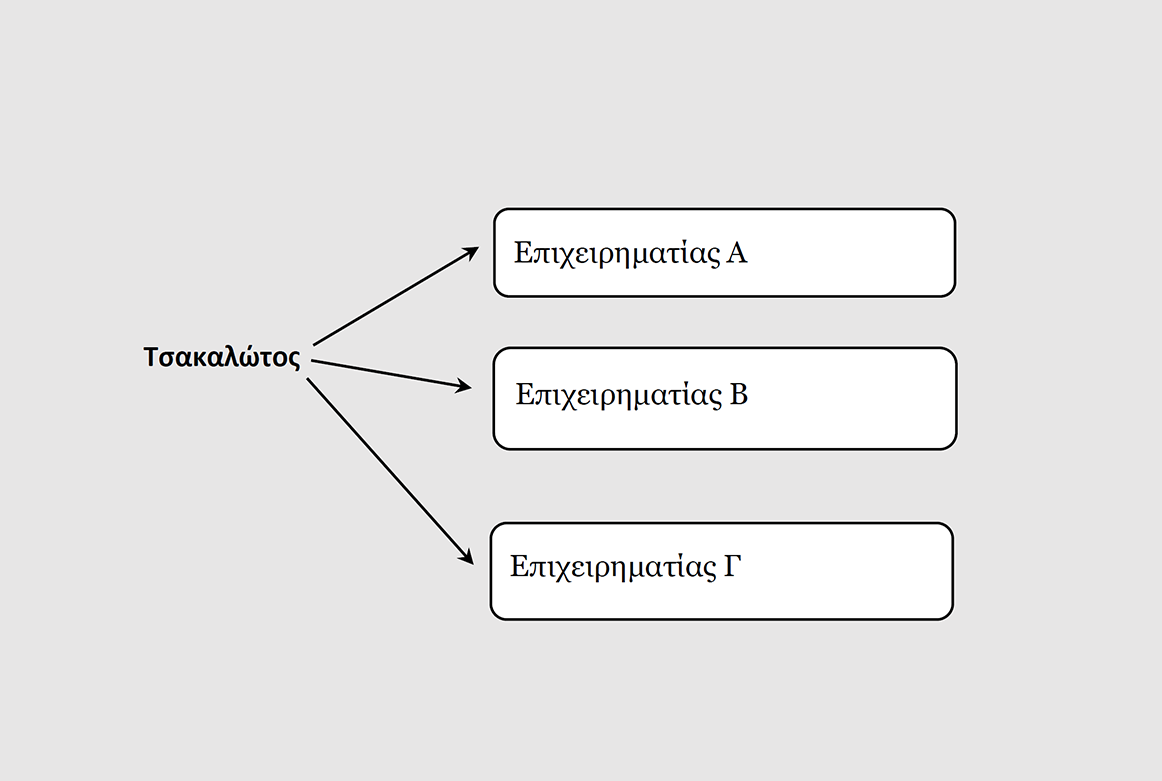
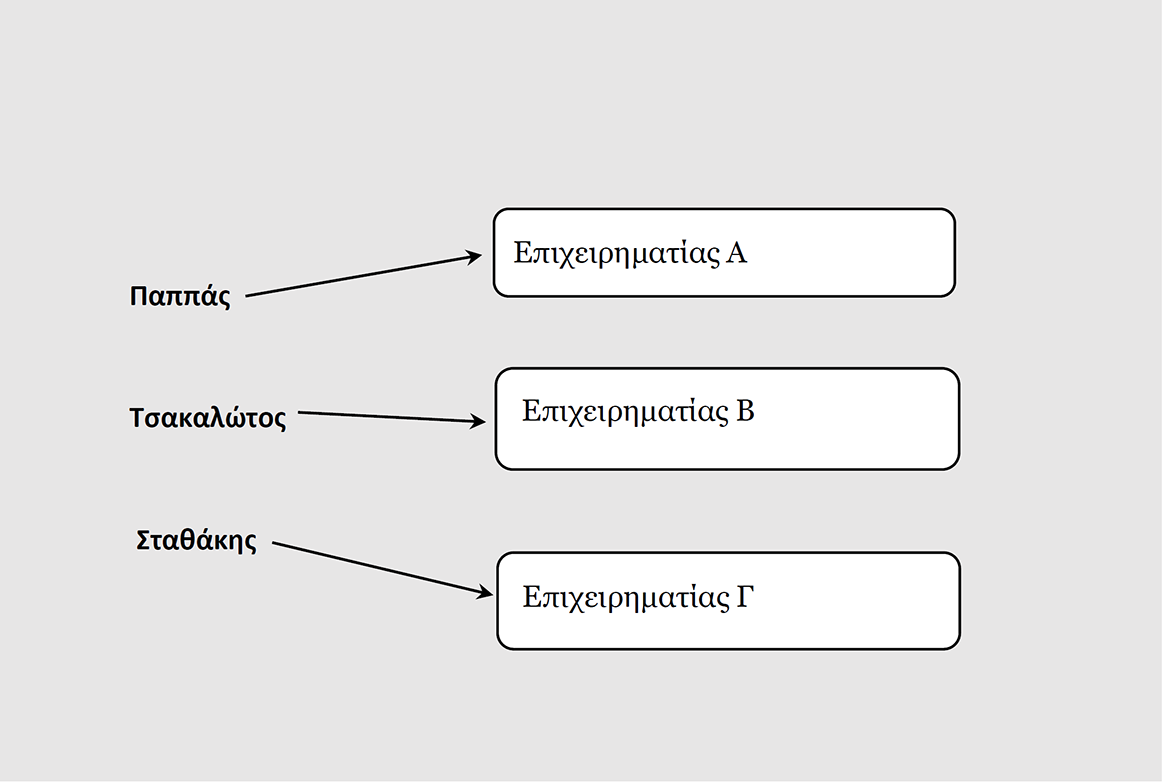
In conditions 1 and 2, the indefinite subject is focused (5a) or CLLD-ed (5b). As one can notice the only factor differentiating between focus and CLLD for the subject is intonation because in Greek there is no clitic for subjects.Footnote 8 Surface scope (Con1) corresponds to a scenario in which a single agent acts on different themes (Figure 1) whereas inverse scope involves different agents acting upon different themes (Figure 2).

Surface (Con1)

Inverse (Con2)

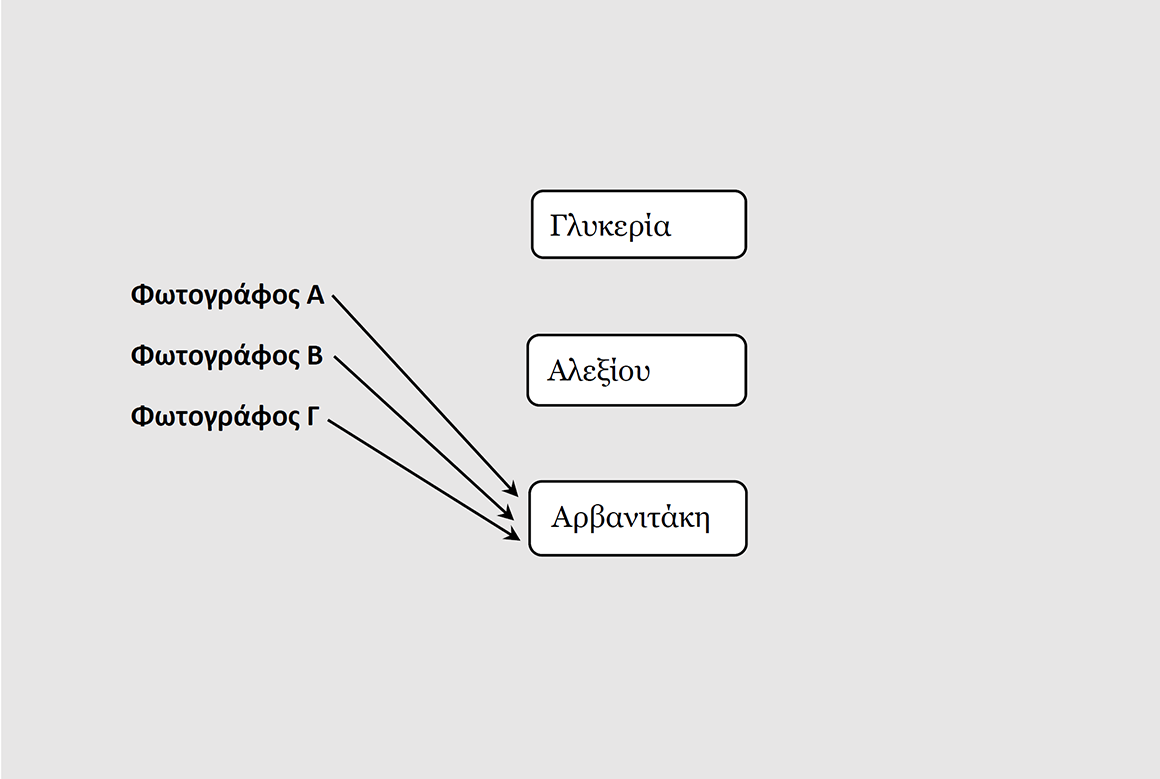
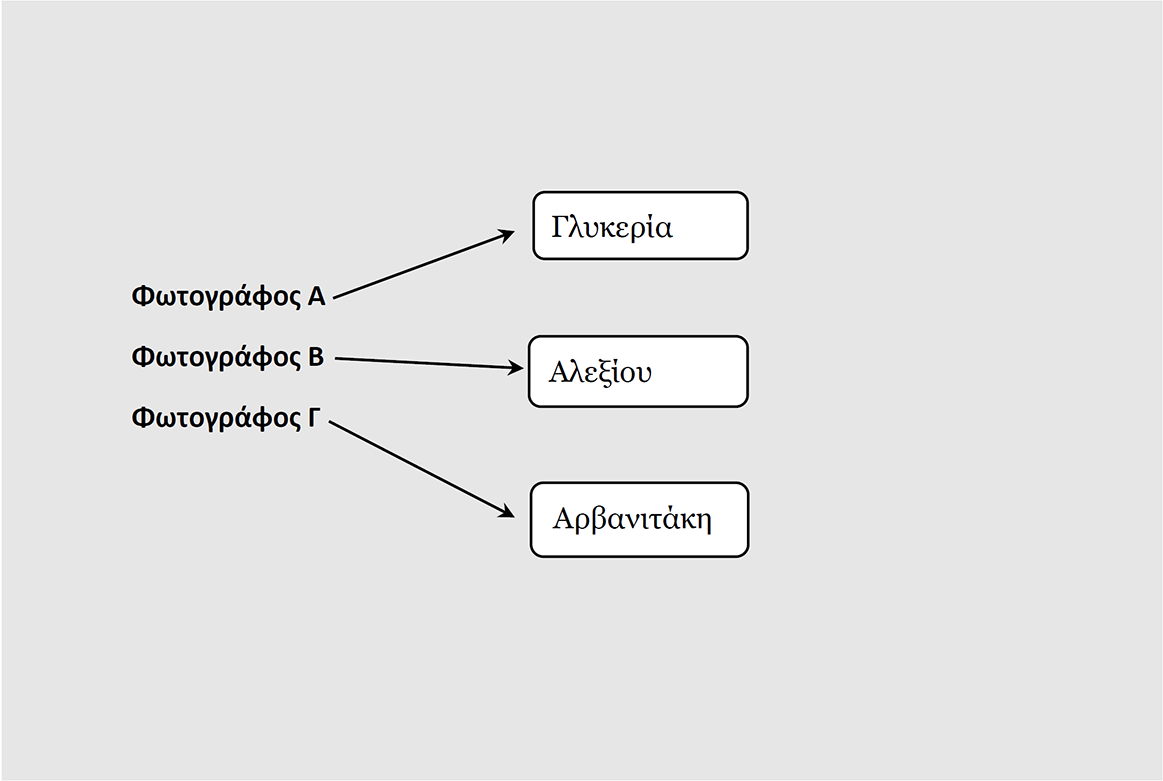
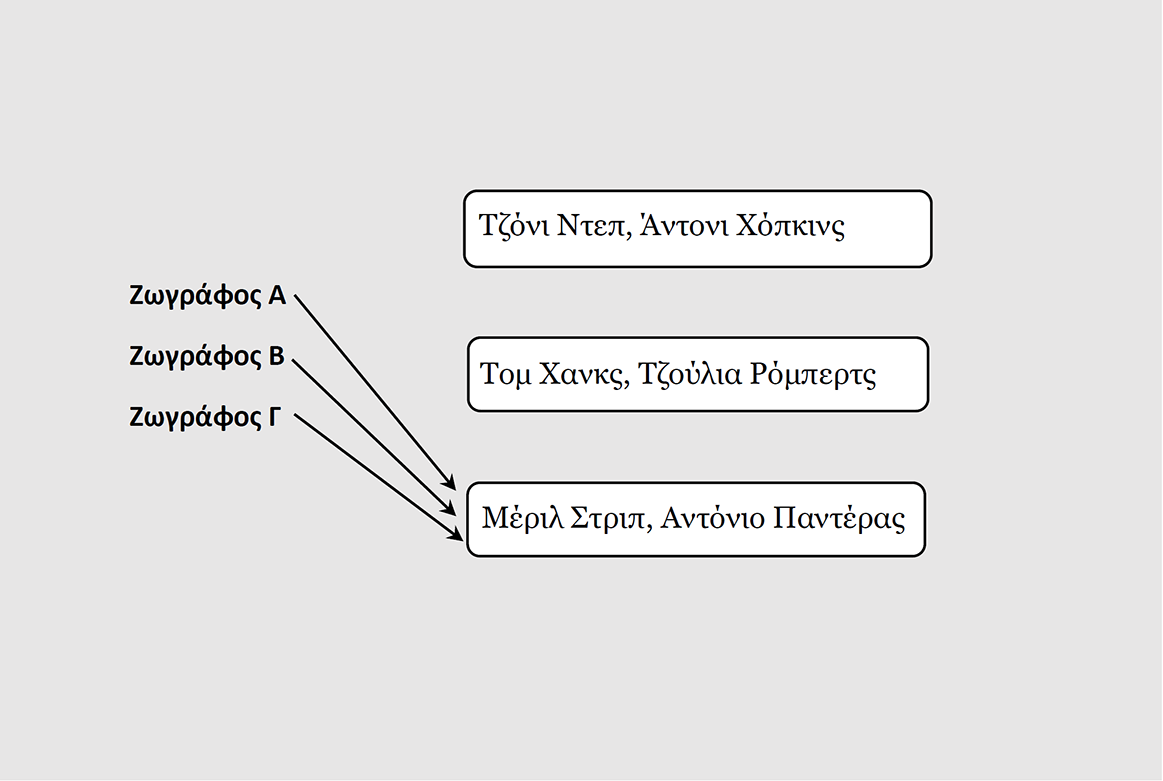
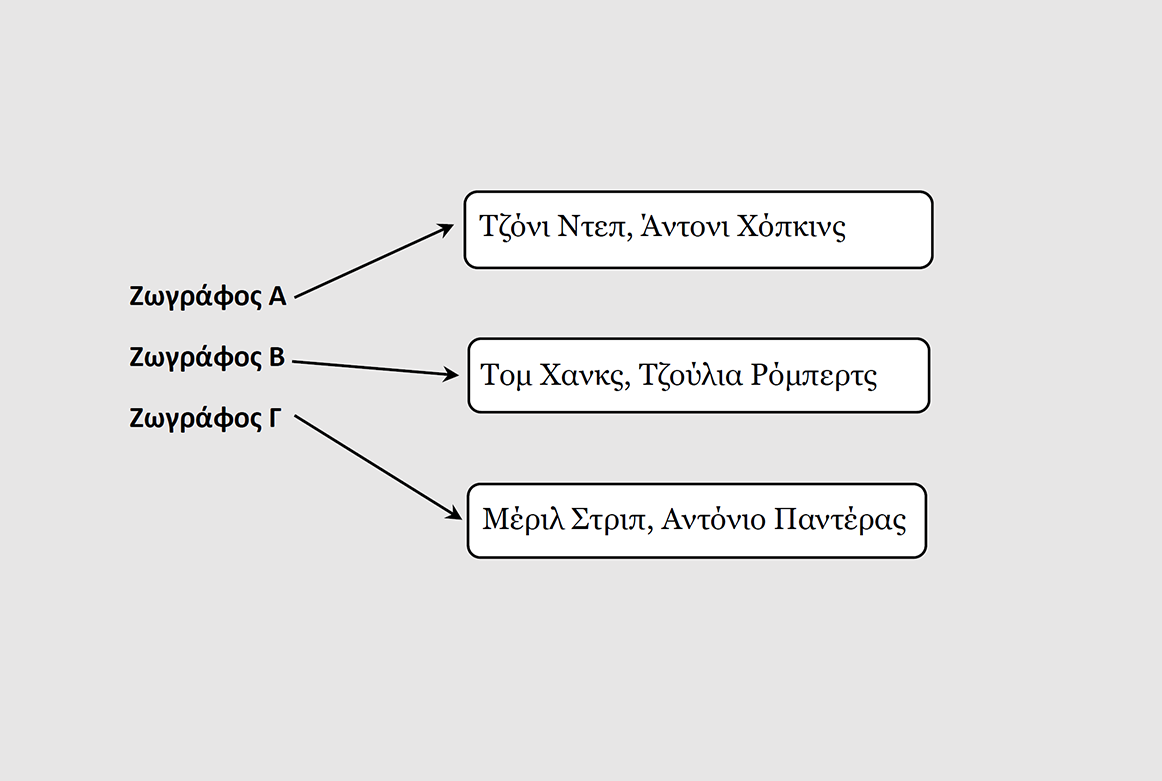
In conditions 3 and 4, the indefinite object is focused (6a) or CLLD-ed (6b). In this case, aside from intonation, the presence of the clitic in (6b) marks the contrast between the two configurations. Surface scope (Con1) corresponds to a scenario in which there is a single theme that different agents act on (Figure 3) whereas inverse scope involves different agents acting on different themes (Figure 4).

Surface (Con3)

Inverse (Con4)

In each experiment, there were 20 sentence–picture pairs (i.e. 5 items per condition, see the Appendix for the full list of items per experiment). A participant would never hear the same sentence across two different conditions. This means that we had a between-design, i.e. for a given target, half of the participants would see the inverse scope scenario and half the surface scope scenario. Crucially, the sentences were recorded to ensure the intended intonation. In the Focus experiment, there was focus on the restrictor of the existential quantifier, realized with low NPA followed by deaccenting. In the CLLD experiment, the QP (e.g. kapjos ipurgos) has a contrastive topic intonation with a NPA on the restrictor followed by a phrase accent (Baltazani & Jun Reference Baltazani, Jun, Ohala, Hasegawa, Ohala, Granville and Bailey1999; Baltazani Reference Baltazani2002) and then narrow focus on the universal quantifier kathe ‘every’. The sentences were annotated using Praat software (Boersma & Weenink Reference Boersma and Weenink2016) based on the Greek ToBI developed by Amalia Arvaniti and Mary Baltazani in a series of works (Arvaniti & Baltazani Reference Arvaniti and Baltazani2000, Reference Arvaniti, Baltazani and Jun2005; Baltazani Reference Baltazani2002).
The experiment was designed using the second version of E-Prime professional software (Schneider, Eschman & Zuccolotto Reference Schneider, Eschman and Zuccolotto2002). Participants would first hear a sentence and directly afterwards one picture appeared on the screen. They had 10 seconds to decide if the sentence they heard could describe the picture they saw. A yes-answer was recorded by pressing a green key on the right and a no-answer a red key on the left. A total of 36 monolingual speakers participated in the Focus experiment and 27 speakers in the CLLD experiment.
2.2.2 Focus and CLLD experiments: Predictions
As we said, since inverse scope appears to be available in broad focus (default) sentences, we expect that it will also be available when one of the QPs is F-marked. Focus fronting has been shown to be derived by movement and therefore scope reconstruction should be possible. On the contrary, given the debated status of CLLD our predictions are not as clear. Based on reported judgments and own intuitions we do not expect inverse scope with CLLD-ed plain indefinites to be available.
2.2.3 Focus experiment: Results
For all experiments, we fitted the Generalized Linear Mixed-Effects Models as implemented in the function glmer in the R package lme4 (Bates et al. Reference Bates, Mächler, Bolker and Walker2015). The only fixed factor was the condition. As random variables we modeled the subject and the audio file the subjects listened to. The full random structure with random slopes and the variance matrix for condition usually did not converge. We cut it down to a reasonable size. Random slopes for items (audio file) were disregarded. Random parameters for items are usually at least one order of magnitude below that for subjects, so intercepts should suffice here. For the subjects we removed the correlation parameters. Including those that produced unrealistically high correlation parameters which usually are spurious. We evaluated the planned contrasts which test our predictions with the emmeans package (Lenth Reference Lenth2020).
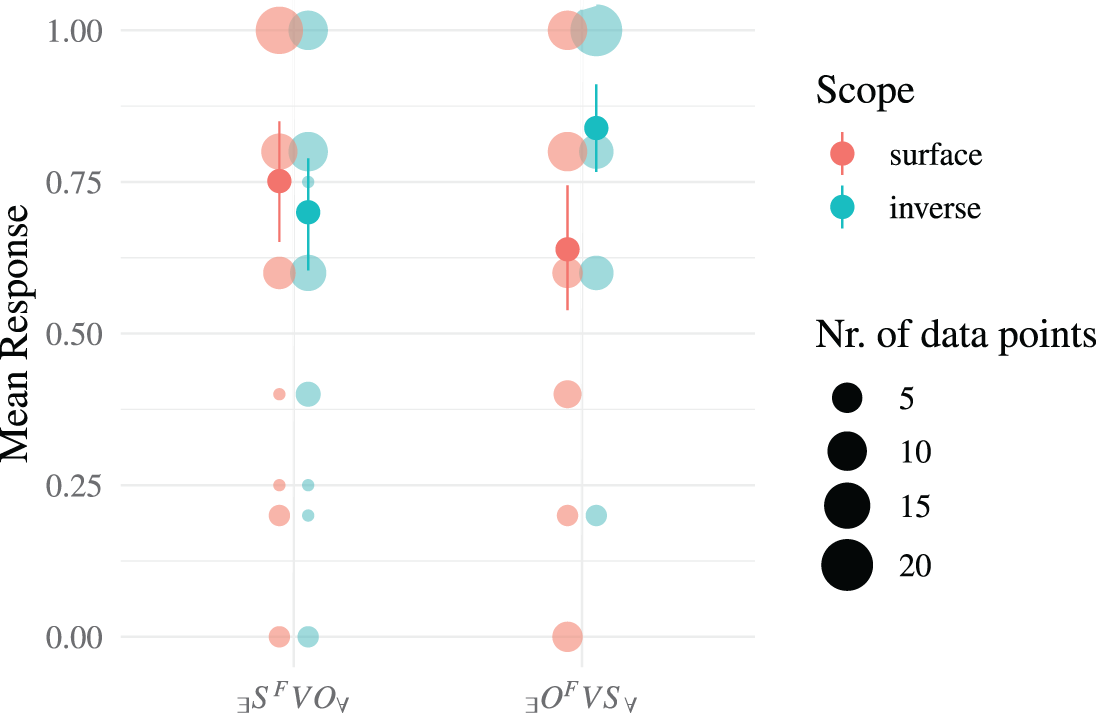
Figure 5 and Table 2 show the results for the Focus experiment. The transparent dots represent per person means of the binary answers given by the subjects. The size of the dots represents the number of subjects with a given mean in a given condition. The error bars are bootstrapped confidence intervals.
(Colour online) Focus Exp. The mean response of the participants is shown on the y axis. Larger semitransparent blobs correspond to a higher number of participants having this particular mean response. The error bars are bootstrapped confidence intervals as computed with the Hmisc R package (Harrell & Dupont Reference Harrell and Dupont2019).

Mean proportion of acceptance in Focus Exp.

The mean proportion of acceptance in Con1 is 75% and in Con2 70%. The difference between conditions 1 and 2 is not significant with a confidence interval from -0.235 to 1.15. The confidence interval for the difference between conditions 3 and 4 (p<.01) has a confidence interval from -3.07 to -0.624.
As we had anticipated, we find that inverse scope is available in both conditions (2 and 4). Moreover, contrary to what we found for inverse scope acceptability with the default SVO and VSO the difference between surface and inverse scope acceptability is not significant. This means that focus marking not only allows but also facilitates inverse scope interpretation. For a discussion on the factors facilitating inverse scope we refer to Oikonomou et al. (Reference Oikonomou, Golcher and Alexiadou2020). For the purposes of this paper, the important component is that inverse scope with the word orders derived by focus fronting is clearly available. This provides us with a clear control case for the same word orders with CLLD-ed indefinites.
2.2.4 CLLD experiment: Results
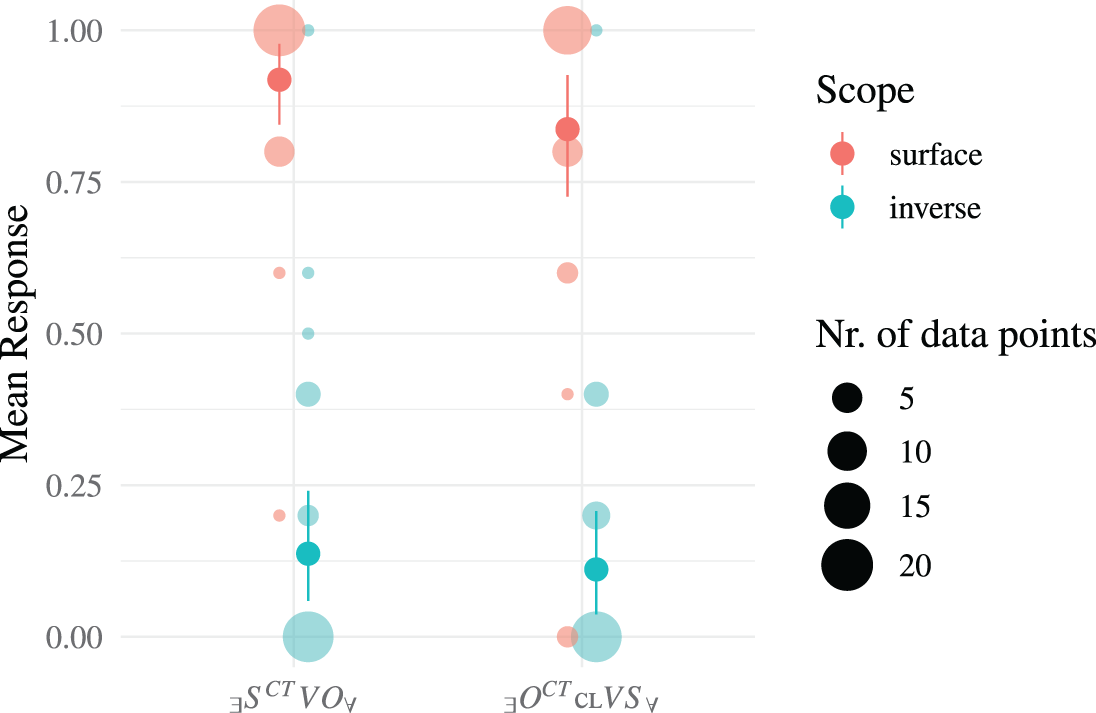
Figure 6 and Table 3 summarize the results for the CLLD experiment. Both contrasts are (obviously) significant. The difference between conditions 1 and 2 (p<0.001) has a confidence interval from 4.33 to 9.28. The difference between conditions 3 and 4 (p<0.01) shows a confidence interval from 4.5 to 14.5.
(Colour online) CLLD Exp. The mean response of the participants is shown on the y axis. Larger semitransparent blobs correspond to a higher number of participants having this particular mean response. The error bars are bootstrapped confidence intervals as computed with the Hmisc R package (Harrell & Dupont Reference Harrell and Dupont2019).

Mean proportion of acceptance in CLLD Exp.

Contrary to what we saw with focus fronting, here we see a sharp contrast between surface and inverse scope acceptability. Both in the case of a CLLD-ed subject (marked exclusively by intonation) and in the case of a CLLD-ed object (marked by intonation and the presence of the clitic) surface scope remains high (with mean acceptance 92% and 84% accordingly) whereas inverse scope interpretation is very low (13% and 11% accordingly). While there is some variability, we observe that the majority of participants do not accept, or accept to a very small extent, inverse scope of CLLD-ed indefinite phrases. As shown in Figure 6, there is only one participant who consistently accepts inverse scope with CLLD more than half of the times. Based on this, we cannot conclude that there are speakers for which the wide scope constraint (WSC) does not hold. However, if, as we will see in Section 5, the WSC is part of a general locality restriction on QR related with processing restrictions (Wurmbrand Reference Wurmbrand2018), it is possible that under certain circumstances WSC is violable, as the 10% acceptability suggests.
2.2.5 Focus and CLLD: Interim summary
The results from the two experiments confirm the empirical generalizations that are so far reported in the literature. Inverse scope is available with focus fronting, as it is predicted by its analysis as involving movement, whereas in CLLD, as it has long been observed, a CLLD-ed indefinite takes a wide scope. This has been taken as an argument for a base-generation analysis of CLLD-ed constituents. In what follows, we present experimental evidence for the observation that CLLD-ed numerals can be interpreted in the scope of a universal quantifier. Our findings confirm the contrast in (2) and provide evidence for a movement analysis of CLLD.
2.3 CLLD-ed numerals
2.3.1 Design and materials
The design is exactly the same as in the previous experiments (i.e. TVJ task, 2×2 design) but crucially in this case we use the numeral dio ‘two’ instead of a plain indefinite. The prosodic pattern is the same as with plain indefinites, i.e. contrastive topic intonation in the CLLD-ed NumP with the NPA in the restrictor of the numeral and focus on the universal quantifier kathe ‘every’. The items are in the same spirit but in many cases they are slightly different, as exemplified below (for the full list of items see the Appendix).
In (7), which exemplifies conditions 1 and 2, the numerical subject is CLLD-ed. Again, the only witness for CLLD is contrastive topic intonation since there is no overt clitic for subjects. Surface scope (Con1) corresponds to a scenario in which a specific pair of agents act on different themes (Figure 7), whereas in the inverse scope for every theme there is a different pair of agents that act on them (Figure 8).

Surface (Con1)

Inverse (Con2)

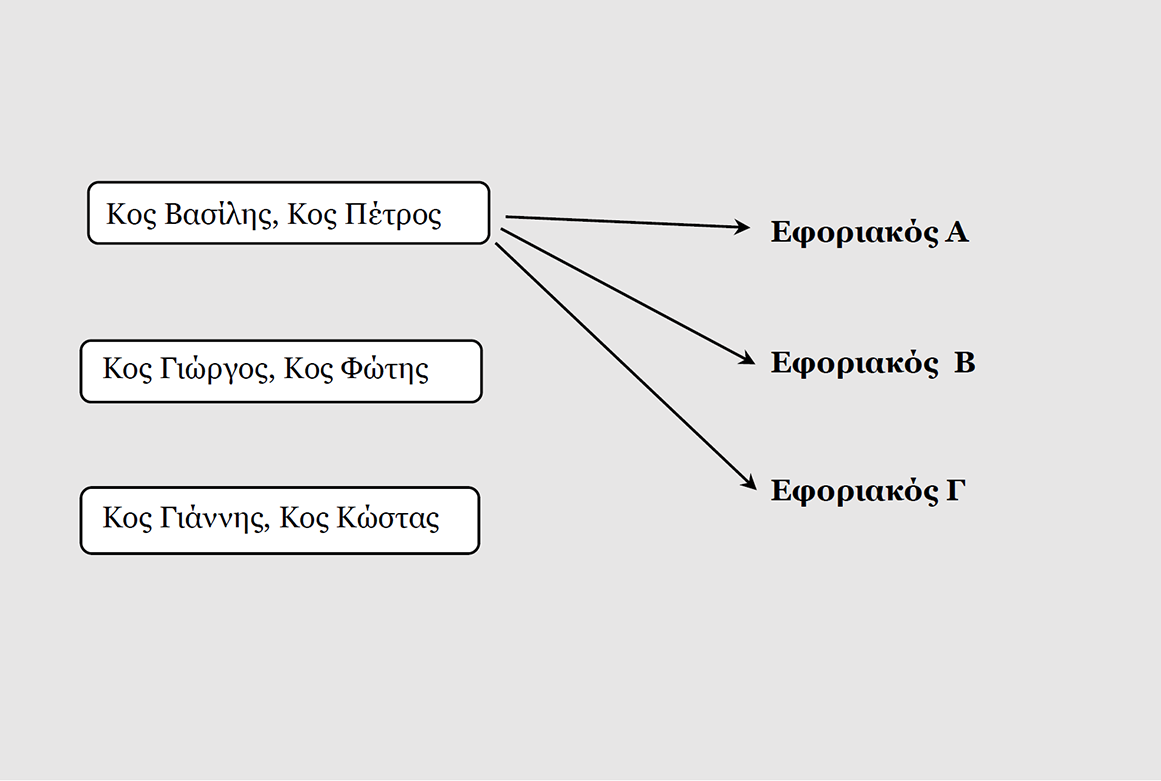
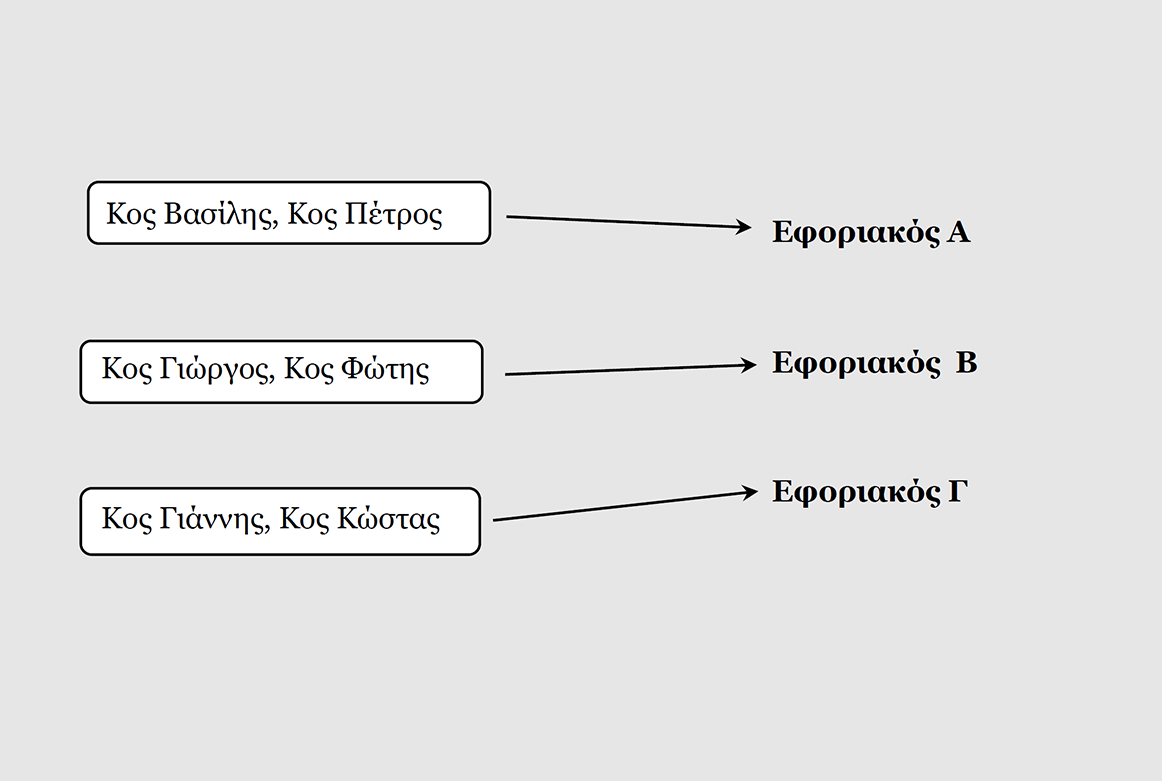
In (8), which exemplifies conditions 3 and 4, the numerical object is CLLD-ed. In this case, the presence of the accusative clitic witnesses CLLD in addition to the contrastive topic intonation. Surface scope (Con3) corresponds to a scenario in which a specific pair of themes is targeted by all agents (Figure 9), whereas in the inverse scope for every agent there is a different pair of themes (Figure 10).

Surface (Con3)

Inverse (Con4)

Twenty-three monolingual participants were recruited in the National and Kapodistrian University of Athens and The Panteion University of Social and Political Sciences located in Athens.
2.3.2 CLLD-ed numerals: Results
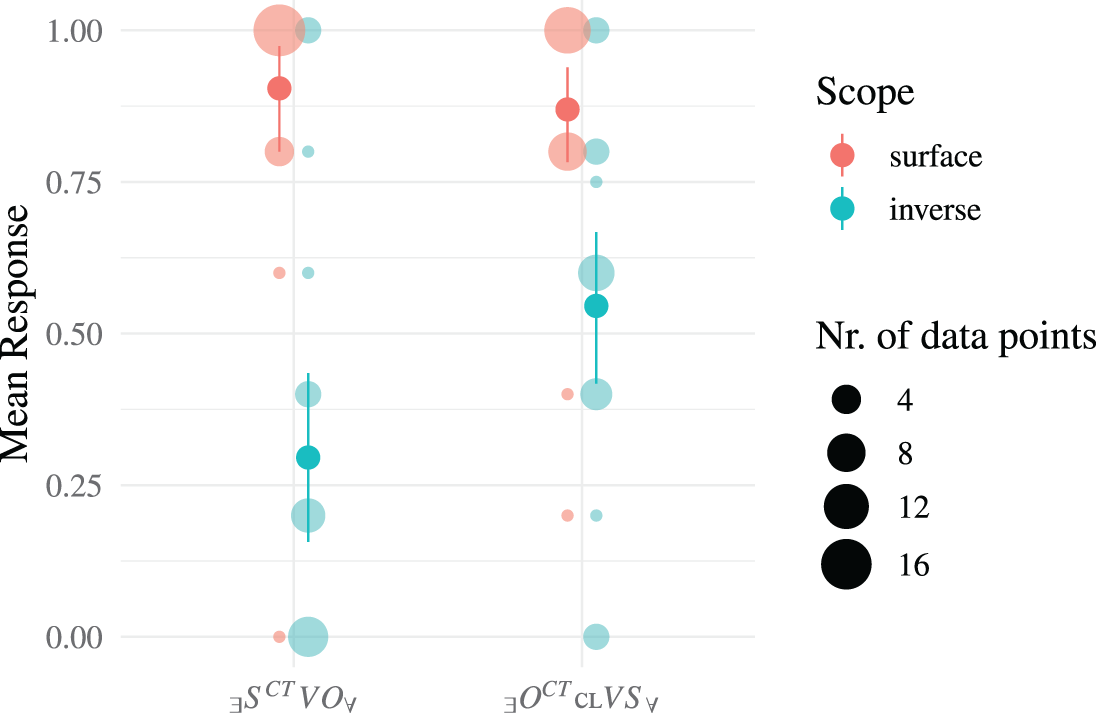
The results confirmed our theory since we found that inverse scope acceptability with CLLD-ed numerals is significantly higher than with CLLD-ed plain indefinites. Figure 11 and Table 4 summarize the results for this experiment (Num Exp). Again, both contrasts are significant. The difference between conditions 1 and 2 (p<0.001) has a confidence interval from 3.12 to 5.52. The difference between conditions 3 and 4 (p<0.001) shows a confidence interval from 1.17 to 3.33.
(Colour online) Num Exp. The mean response of the participants is shown on the y axis. Larger semitransparent blobs correspond to a higher number of participants having this particular mean response. The error bars are bootstrapped confidence intervals as computed with the Hmisc R package Harrell & Dupont (Reference Harrell and Dupont2019).

Mean proportion of acceptance in Num Exp.

In order to see the role of the indefinite type (numeral vs. plain indefinite) in inverse scope acceptability, we compared Num Exp with CLLD Exp. We combined the data for the two experiments and added an interaction for the variable indicating the experiment, or, equivalently, the type of the indefinite. The difference between the experiments is significant with a p-value of 0.0028 for the interaction. We then compared the results of the experiments within conditions. Crucially, we found no significant difference in Con1 and Con3 (surface scope) but we found significant results in inverse scope conditions 2 (p=0.029) and 4 (p<0.0001).
2.4 Interim summary: Plain indefinites versus numerals in CLLD
Our experimental evidence converges with our original observation that the availability of inverse scope in CLLD depends on the type of the indefinite, namely that a CLLD-ed numerical quantifier can be in the scope of a universal. The next section provides an explanation for this contrast based on the different properties of numerals and plain indefinites.
3. Inverse scope with CLLD-ed numerals versus plain indefinites
Before considering the contrast between plain indefinites and numerals, let us consider the possible LFs for an inverse scope interpretation in the case of CLLD. Following the arguments in Fox (Reference Fox1995, Reference Fox1998), Heim & Kratzer (Reference Heim and Kratzer1998), Hackl (Reference Hackl2000), Johnson (Reference Johnson, Martin, Michaels and Uriagereka2000), and Miyagawa (Reference Miyagawa and Boeckx2012) we assume that scope ambiguities are derived by covert movement (May Reference May1977 and subsequent work). Furthermore, all quantifiers should raise obligatorily above the VoiceP, in a position where the event argument has been saturated, in order to resolve a type mismatch (generalized quantifiers are of type << et >,t > whereas the vP is of type <e,st>) (Landman Reference Landman and Lappin1996; Lechner Reference Lechner, Krifka and Schenner2018).Footnote 9 Under this view, a question arises as to the ordering of operations. Assuming standard bottom-up derivations, we assume that lower nodes move first (cyclicity condition as in Chomsky Reference Chomsky, Hale and Keyser1993; Cecchetto Reference Cecchetto2004; Lechner Reference Lechner, Krifka and Schenner2018; Wurmbrand Reference Wurmbrand2018). As we discuss in detail in Oikonomou et al. (Reference Oikonomou, Golcher and Alexiadou2020), adopting the cyclicity condition for covert movement is necessary in order to account for the fact that inverse scope in VSO sentences in Greek is less acceptable compared to surface scope.
For CLLD-ed constructions, the possible LFs depend on the theory one has for CLLD (i.e. base generation vs. movement). The surface scope interpretation is straightforward under either analysis. The CLLD-ed indefinite is interpreted in its base position and the universal quantifier remains in its scope. For the inverse scope interpretation, two possibilities arise: If CLLD involves base generation the only way to derive an inverse scope interpretation would be to raise the universal quantifier covertly above the CLLD-ed indefinite. If, however, as we argue, CLLD involves movement of the CLLD-ed phrase from a lower position to TopP, there is the additional way to derive inverse scope by reconstructing the CLLD-ed indefinite to an intermediate interpretable position in the scope of the universal quantifier.
For the sentence in (9) with a CLLD-ed indefinite object, we provide the surface scope derivation in (12). The pronounced positions are given with bold-faced characters and the positions where the quantifier is interpreted are underlined. First, the indefinite object moves to an interpretable position at the level of Asp1P, which is also the edge of a phase in Greek, so that it remains visible for further operations.Footnote 10 The second step involves covert movement of the universal subject to an interpretable position at Asp2P. The third step of the derivation, involves movement of the indefinite to spec,TopP driven by a contrastive topic (CT) δ-feature.
Under this view, an inverse scope reading, with the indefinite interpreted in the scope of the universal as in (11), can be achieved via reconstruction to the intermediate position at Asp1P, as shown in (11b).


For a CLLD-ed subject, reconstruction is possible only if the subject also moves to an intermediate position before moving to its surface position. Under this hypothesis, it is possible that the universal object raises above this intermediate position and outscopes the reconstructed indefinite. Crucially, as one can see by comparing (15b) with (11), the derivation in (15b) involves one more step, since the universal quantifier raises twice, and, therefore, under the hypothesis that scope-shifting operations induce a processing scope (see e.g. Anderson Reference Anderson2004), we expect that inverse scope with CLLD-ed subjects under this configuration will be less accessible. Alternatively, if we allow the object-QP to raise via a second-step movement above the CLLD-ed subject we can derive inverse scope as in (15c):


Turning back to the contrast between plain indefinites and numerals, under a base-generation approach the only way to derive the difference between the two types of indefinites would be to argue that a universal quantifier can raise above a numerical quantifier but not above a pure existential one. Such a restriction on raising would seem paradoxical. On the contrary, under a movement analysis of CLLD we can derive the contrast in inverse scope availability based on already established differences between the two types of indefinites. In particular, we lay out an account that is based on the possibility for numerals to have a split scope interpretation (Heim Reference Heim, Jackson and Matthews2000; Kennedy Reference Kennedy2015; Blok, Bylinina & Nouwen Reference Blok, Bylinina, Nouwen, Cremers, van Gessel and Roelofsen2017; Bylinina Reference Bylinina2019; Bylinina & Nouwen Reference Bylinina and Nouwen2020).
3.1 Split scope with numerals: CLLD of the degree-quantifier
In order to describe the fact that CLLD-ed plain indefinites take obligatorily wide scope in Greek, we introduced the Wide Scope Constraint (WSC), repeated in (16). Let us assume that the WSC applies across the board irrespective of the indefinite type.

Whereas it is straightforward that plain indefinites obey the WSC, the apparent inverse scope with numerals poses a challenge. We argue that the different behavior of numerals is due to their different structure and semantics from plain existential quantifiers. In particular, adopting a degree-quantifier analysis for numerals (following Kennedy Reference Kennedy2015; Blok et al. Reference Blok, Bylinina, Nouwen, Cremers, van Gessel and Roelofsen2017; Bylinina & Nouwen Reference Bylinina and Nouwen2020) we show that the numeral can have a split scope interpretation under which only the numerical quantifier is CLLD-ed and thus it is interpreted above the universal quantifier while the existentially quantified individual remains lower in the scope of the universal.Footnote 11 Below we outline our basic assumptions for the syntax and semantics of numerals following the degree-quantifier analysis.
It has long been observed that numerals behave differently than plain quantifiers in many respects, leading to different analyses of numerals (see Bylinina & Nouwen Reference Bylinina and Nouwen2020 for a comprehensive review). Here we follow the degree-quantifier view (Hackl Reference Hackl2000; Nouwen Reference Nouwen2010; Kennedy Reference Kennedy2015; Blok et al. Reference Blok, Bylinina, Nouwen, Cremers, van Gessel and Roelofsen2017). Under this view, numerals are degree quantifiers of type <dt,t> combining with a silent many which associates its complement NP with the cardinality n (see Hackl Reference Hackl2000, and later work in numerals adopting this decompositional analysis, e.g. Nouwen Reference Nouwen2010; Kennedy Reference Kennedy2015; Blok et al. Reference Blok, Bylinina, Nouwen, Cremers, van Gessel and Roelofsen2017; Blok Reference Blok2019; Bylinina & Nouwen Reference Bylinina and Nouwen2020). Following the implementation in Blok et al. (Reference Blok, Bylinina, Nouwen, Cremers, van Gessel and Roelofsen2017) (see also Bylinina Reference Bylinina2019; Bylinina & Nouwen Reference Bylinina and Nouwen2020), we take a numeral to be a singular term as in (17a), which is type-shifted to denote a generalized degree quantifier of type <dt,t> as shown in (17b):

The silent many has the meaning in (18) under which it first takes an argument of type d and then it combines P and Q of type <et> (Blok et al. Reference Blok, Bylinina, Nouwen, Cremers, van Gessel and Roelofsen2017; Blok Reference Blok2019, after Hackl Reference Hackl2000).

Given the analysis of the numeral as a degree quantifier, we can show that when it moves to Spec,TopP driven by a CT-feature, it can resolve its type mismatch and, at the same time, ensure a wide scope interpretation of the numeral only, with the existential being interpreted in the scope of the universal. This is shown in the derivation in (19). We represent the numerical/cardinality phrase as #P (as in, e.g. Borer Reference Borer, Kempchinsky and Slabakova2005). As of type <dt,t>, the type-shifted numeral moves leaving a trace d which is the internal argument of the silent many. Thus at the level of Asp1P, we get the interpretation in (20b) that there is an amount of books read by DP2. At the level of Asp2P, the universal quantifier is interpreted having in its scope the existential operator, deriving the interpretation that for every student y some books were read by y, as in (20c). Finally, the raised numeral of type <dt,t> takes as its argument its complement of type <dt> and saturates the degree argument deriving the propositional meaning that the cardinality of books such that every student read this amount of books is 2, as in (20d).


Under this view, what is CLLD-ed is the degree quantifier and not the entire numerical phrase (#P1). As we noticed, the CLLD-ed numeral is a contrastive topic. Critically, the idea that only the degree quantifier is contrastively topicalized is consistent with our intuition that what is contrasted is the cardinality of books that each student read rather than the things that have been read. Thus, only the degree quantifier moves leaving the rest of the DP behind. The fact that the entire DP is pronounced at the CLLD-ed position is due to the obligatory pied-piping. As it has been argued for wh-movement, although the entire wh-phrase is pronounced in the moved position, only the wh-word is moving while the NP remains lower, exhibiting the phenomenon of pied-piping (Cable Reference Cable2010). Similarly, focus movement has been noticed to involve pied-piping, in which only a particular lexical item is F-marked, but the entire DP is pied-piped to the focus position (Horvath Reference Horvath, Karimi, Samiian and Wilkins2007).
The present analysis captures the difference between plain indefinites and numerals since plain indefinites do not involve a degree quantifier and therefore what is CLLD-ed is always the entire QP. The same analysis can apply to CLLD-ed subjects as in (7). However, in this case, given that the universal DP has moved first to Spec,Asp1P and the indefinite follows at Spec, Asp2P, the universal DP needs to covert QR in a second-step movement above the Asp2P in order to take scope above the intermediate position of the indefinite. This might explain why inverse scope acceptability with CLLD-ed numerical subjects is significantly lower than with CLLD-ed numerical objects. However, in the absence of any evidence from online processing experiments this remains only a hypothesis.
What is definitely predicted by this analysis is that all numerals and, as we see below, other degree expressions allow a split scope in CLLD-ed constructions. Crucially, the indefinite numeral ena ‘one’, which in Greek functions both as an indefinite, i.e. a, and as a numeral, one, patterns with the rest of the numerals allowing split scope. This uniformity suggests that the item ena should also be analyzed as a numeral in line with what has been argued in Stavrou & Terzi (Reference Stavrou, Terzi, Chang and Haynie2008), Alexiadou (Reference Alexiadou2014), and Alexopoulou & Folli (Reference Alexopoulou and Folli2019).
There are two remaining issues to be discussed with respect to the configuration in (19). The first one concerns the split scope in view of what is often called the Heim–Kennedy generalization for degree operators (Kennedy Reference Kennedy1999; Heim Reference Heim, Jackson and Matthews2000). The observation is that degree operators can raise to take scope over a modal quantifier but not over a nominal quantifier. The same generalization holds for modified and plain numerals as discussed in Kennedy (Reference Kennedy2015), Blok et al. (Reference Blok, Bylinina, Nouwen, Cremers, van Gessel and Roelofsen2017), and Bylinina & Nouwen (Reference Bylinina and Nouwen2020). The following two examples with the modified numerals illustrate this contrast. Example (21) is ambiguous between a surface reading that Juliet is not allowed to read more than two books in (21a) and an inverse scope reading under which Juliet is required to read two books (but if she wants she can read more) in (21b). On the other hand, the sentence in (22) does not have an inverse scope (22b), suggesting that at most two cannot QR above the universal DP (see e.g. the discussion in Blok et al. Reference Blok, Bylinina, Nouwen, Cremers, van Gessel and Roelofsen2017).


Our data seem to contradict this generalization since the degree quantifier raises above the universal DP-quantifier. However, there are two critical differences between the CLLD-ed numerals as in (2b) and examples like (22); First, the movement in (19) is overt and, second, as we noticed above, movement is triggered due to CT-feature on the degree quantifier. That is, the movement of the numeral above the universal quantifier is overt and is motivated independently due to CT-marking on the numeral. The hypothesis that the Kennedy–Heim generalization applies only for covert and not for overt movement is explicitly argued for in Stateva (Reference Stateva2004). The second difference is related with the idea that Kennedy–Heim generalization can receive a unified account with intervention effects in wh-questions (Beck Reference Beck2006, Reference Beck2012). Under this view, what differentiates the configuration in (19) might be the distinctive CT-feature. We leave this issue for future research as it touches on different phenomena and requires an in-depth investigation into different types of movement.
The second question concerns the choice of the particular analysis of numerals as degree quantifiers, as advocated by Blok et al. (Reference Blok, Bylinina, Nouwen, Cremers, van Gessel and Roelofsen2017) and Bylinina & Nouwen (Reference Bylinina and Nouwen2020). Split scope interpretation of the numeral can also be derived under Kennedy’s (Reference Kennedy2015) analysis. However, Kennedy (Reference Kennedy2015) argues that a numeral, e.g. two, is true of a property of degrees if the maximum number that satisfies the property is 2 as in (23):

Under this view, we would expect an upper-bound interpretation for CLLD-ed numerals. However, as we discuss in detail in the following section, we find the opposite, i.e. a low-bound interpretation. As we show in Section 3.2, the analysis pursued by Blok et al. (Reference Blok, Bylinina, Nouwen, Cremers, van Gessel and Roelofsen2017), Bylinina (Reference Bylinina2019), and Bylinina & Nouwen (Reference Bylinina and Nouwen2020) of plain numerals as degree quantifiers without a maximizing element can better explain the interpretation of these propositions.Footnote 12
3.2 Accounting for the low-boundedness restriction of CLLD-ed numerals
As we mentioned in the introduction, the narrow scope reading with the CLLD-ed numerals is obligatorily accompanied by a low-bound inference. In particular, our original example, under an inverse scope reading, can only get an at-least interpretation. As we explained in the previous section the intuition for a low-bound interpretation is that led us to a non-maximal analysis by Blok et al. (Reference Blok, Bylinina, Nouwen, Cremers, van Gessel and Roelofsen2017), Bylinina (Reference Bylinina2019), and Bylinina & Nouwen (Reference Bylinina and Nouwen2020) as opposed to Kennedy’s (Reference Kennedy2015) approach under which numerals are degree quantifiers with a two-sided (upper-bound) interpretation.

This requirement for a low-bound interpretation when we have a CLLD-ed numeral becomes clear once we use modified numerals (see Arregi Reference Arregi, Kaiser and Arunachalam2003). At-least-numerals can undergo CLLD with an inverse scope interpretation (25a) whereas at-most numerals cannot. The sentence in (25b) with at-most sounds odd, since modified numerals resist a specific interpretation (Arregi Reference Arregi, Kaiser and Arunachalam2003).Footnote 13

In addition we notice that degree quantity expressions allow inverse scope as long as they denote a relatively small amount in (26a) and not a large amount, in (26b–c). In this case as well, if the QP liga vivlia ‘few books’ in (26a) was a hanging topic only a specific, wide scope interpretation would be licensed.Footnote 14

The low-boundedness requirement under inverse scope needs to be explained. Critically, the semantic derivation in (20) allows for a low-bound reading but does not enforce it. In order to account for the low-bound interpretation, we argue, following the discussion in Tomioka (Reference Tomioka, Zimmermann and Féry2010), that low-boundedness is due to the semantics of contrastive topic. The general consensus about contrastive topic is that it requires that there are live alternatives in the context, i.e. alternatives which the interlocutors consider as live possibilities (Büring Reference Büring2003; Hara Reference Hara2003; Tomioka Reference Tomioka, Zimmermann and Féry2010;Wagner Reference Wagner2012; Constant Reference Constant2014).Footnote 15 For example, the answer in (27a) leaves a doubt as to what happened with the others while (27b) in which the Peter is focused derives the inference that the speaker only saw Peter out of his friends.

The CT requirement that we consider open alternatives enforces an at-least-interpretation over an exact- or an at-most-reading.Footnote 16 To illustrate, following Büring’s (Reference Büring2003) mechanism for the computation of CT alternatives, a sentence like (8), repeated in (28), can generate the alternatives in (29) by substituting different values for the F-marked and CT constituents:


An upper-bound interpretation, in combination with the focused universal provides a complete answer (e.g. At most two actors were painted by every painter), yielding CT infelicitous. In this way, we can explain why we always get a low-bound and not an upper-bound interpretation.
3.3 Interim summary
In this section, we addressed the contrast between CLLD-ed plain indefinites, arguing that numerals can get split scope, therefore exhibiting apparent inverse scope. We have also made two basic assumptions; the first one is the WSC for CLLD-ed QPs and the second is that CLLD involves movement and not base generation. In what follows, we discuss these assumptions and their significance for our overall understanding of CLLD.
4. Inverse scope with CLLD: Consequences for CLLD
As we noticed in the introduction, the syntactic derivation of CLLD presents a puzzle because of conflicting evidence. On the one hand, island sensitivity,Footnote 17 binding reconstruction, and idioms provide evidence in favor of movement, since these are taken to be diagnostics for movement. On the other hand, the absence of weak crossover effects (WCO), the intolerance of parasitic gaps (Cinque Reference Cinque1990; Iatridou Reference Iatridou, Izvorski and Tredinnick1995; Anagnostopoulou Reference Anagnostopoulou, Anagnostopoulou, van Riemsdijk and Zwarts1997) and, in addition, the wide scope of CLLD-ed QPs have been taken as arguments in favor of base generation.
The behavior of CLLD-ed numerals provides evidence in favor of the movement analysis as opposed to a base-generation analysis. Under a movement analysis, we need to explain why CLLD does not trigger WCO and does not license parasitic gaps in addition to the wide scope restriction for CLLD-ed QPs. The first two issues, WCO and parasitic gaps, are discussed by Angelopoulos & Sportiche (Reference Angelopoulos and Sportiche2021), showing that the facts can be explained within a certain movement analysis in which the CLLD-ed phrase first undergoes movement to a K-position and then
 $ {\mathrm{A}}^{\prime } $
-movement to its surface position. For the latter, as we discuss in Section 5, the lack of inverse scope does not constitute a good argument neither for a base generation nor for a movement analysis. Therefore, following several works in this tradition (Kayne Reference Kayne1975; Cinque Reference Cinque1977; Agouraki Reference Agouraki1992; Cecchetto Reference Cecchetto2000; Kupula Reference Kupula, Kimmelman, Korotkova and Yanovich2014; López Reference López2014; Angelopoulos & Sportiche Reference Angelopoulos and Sportiche2021), we take CLLD to be a special instance of movement. Our work does not provide any further insights regarding the details of the derivation but we refer the reader to Angelopoulos & Sportiche (Reference Angelopoulos and Sportiche2021) for an analysis consistent with our findings.Footnote
18
In what follows we discuss two different approaches to CLLD which attribute the non-availability of inverse scope with indefinites to independent factors not related with the base-generation approach.
The first one is developed by Alexopoulou & Folli (Reference Alexopoulou and Folli2019) and suggests that the clitic in Greek (but not in Italian) is referential, therefore deriving the crosslinguistic contrast in the availability of inverse scope. Whereas this account has advantages in distinguishing CLLD from contrastive topicalization in Greek, which lacks a clitic and permits an inverse scope interpretation, it posits certain issues, some of which have been pointed out in the literature.
First, there are many environments in which the clitic is not referential such as expletive clitics in idiomatic expressions, generic clitics, and clitics which double anaphors (see Angelopoulos & Sportiche Reference Angelopoulos and Sportiche2021 and the references therein). In addition to this, it seems that some of the environments discussed by Alexopoulou & Folli (Reference Alexopoulou and Folli2019) as disallowing referential clitics are in fact compatible with clitics. One of the environments they present, as incompatible with clitics, is indefinite bare antecedents. As illustrated in (30), the clitic ton ‘him’ cannot be used in this environment to refer back to the bare antecedent idravliko ‘plumber’:

However, as we see in (31a), once we use a different predicate than find it is possible to use a clitic with a bare non-referential antecedent. As pointed out by a reviewer even with the predicate vrisko ‘find’ in (31b), the sentence is fine. Additionally, in (31c) the clitic is obligatory although it does not refer to a particular plumber. Finally, in (31d), it is clear that the clitic does not refer to a particular doctor. Whatever the strategy for the interpretation of the clitic is in (31), it presents a challenge to the clitic-referential account.Footnote 19

Second, the contrast between numerals and plain indefinites is also observable in other contexts which involve modal operators. Alexopoulou & Folli (Reference Alexopoulou and Folli2019) provide the following example as an argument that a CLLD-ed numeral always takes a specific wide scope interpretation. In particular, the fact that the continuation in (32b) which forces a non-specific interpretation of the numeral is infelicitous after (32a) is explained in their account as a consequence of the referential properties of the clitic.

However, we can minimally modify (32) as in (33), and the CLLD-ed indefinite can take narrow scope, i.e. the indefinite is interpreted below the modal operator. Crucially, the same sentence with the plain indefinite kapjos ‘some’ is not felicitous with a narrow scope reading. The crucial difference between (32) and (33) is that in the latter by using the modal need we foreground a low-bound interpretation thus licensing a CLLD-ed numeral with a split scope interpretation.

Finally, the wide scope restriction also holds in cases in which the wide scope requirement is clearly not related to the referentiality of the clitic.
In (35) and (37) the only-DP and the even-DP are CLLD-ed and, consequently, they obligatorily get wide scope over the indefinite whereas their non-CLLD-ed version in (34) and (36) has both readings. In both cases, the properties of the clitic are not relevant for the wide scope of the operators.


These cases suggest that the WSC cannot be due to the referential character of CLLD or the clitics.
A similar explanation, presented from a different angle, is put forth by Arregi (Reference Arregi, Kaiser and Arunachalam2003). He argues that the observed wide scope of indefinites in CLLD, is enforced by the semantics of CLLD which associates with a contrastive topic. This is relevant for our analysis because we also referred to the semantics of contrastive topic to account for the low-boundedness of CLLD-ed numerals. Arregi (Reference Arregi, Kaiser and Arunachalam2003) argues that only referential type <e> expressions can be CLLD-ed. In a similar vein, Constant (Reference Constant2012, Reference Constant2014) argues that in most cases quantifiers that are contrastive topics are interpreted as individuals of type <e>, probably via choice functions. He argues that this is due to the semantic requirement of contrastive topics which establish a contrast between subsets of a larger set that is salient in the discourse. Therefore, when indefinite QPs are contrastive topics, they tend to be interpreted as denoting plural individuals, pointing to a particular subset of individuals, rather than generalized quantifiers. That said, as Constant (Reference Constant2014) points out, when the context facilitates a reading where we contrast proportions, it is possible that we interpret indefinite QPs which are contrastive topics as true quantifiers. This is the case with CLLD-ed numerals in which as we saw we are able to establish a set of alternatives that involve different amounts (or portions as in Constant Reference Constant2014).
Even for the case of plain indefinites, however, the semantic explanation (Arregi Reference Arregi, Kaiser and Arunachalam2003; Constant Reference Constant2014) that contrastive topics resist inverse scope because of the difficulty to establish a proportional contrast with other quantifying elements, can be excluded because, as we discussed above, contrastiveness can be on the restrictor alone (i.e. establishing property alternatives such as singers, actors, composers, etc.). Crucially, contrastive topicalization, which differs from contrastive CLLD in that it does not involve a clitic allows inverse scope as discussed in Alexopoulou & Kolliakou (Reference Alexopoulou and Kolliakou2002). In (38) an inverse scope interpretation is very natural, especially in a context where we discuss whether every photographer has photographed a singer or an actress, a top model, etc.

Both the intonation and the interpretation we get in (38) suggest that the left dislocated phrase is a contrastive topic, contrasting different properties. Yet, an inverse scope interpretation is possible suggesting that the lack of inverse scope with CLLD-ed contrastive topics is not due to the semantics of contrastive topic. This contrast is also one of the main arguments leading Alexopoulou & Folli (Reference Alexopoulou and Folli2019) to argue that the crucial factor is the properties of the clitic. Below we point to a different direction under which the clitic might simply indicate the boundary of a locality domain.
5. Wide scope constraint in CLLD: A locality restriction?
It is a well-known puzzle that scope-shifting operations in contrast with overt instances of movement are clause bound (Fox Reference Fox1995, Reference Fox2000; Johnson Reference Johnson, Martin, Michaels and Uriagereka2000; Cecchetto Reference Cecchetto2004; Wurmbrand Reference Wurmbrand2018). The examples below illustrate the phenomenon as summarized by Wurmbrand (Reference Wurmbrand2018).

Crucially, the same restrictions apply in Greek QR. For example, the corresponding of (39a), in (40), is infelicitous due to the fact that only the wide scope interpretation that every man got married with Ana survives instead of the natural inverse scope reading that for every man x there is some individual y who said that x got married with Ana:

We propose that irrespective of what makes QR to be more restricted than overt movement (see Wurmbrand Reference Wurmbrand2018 for an overview and a summary of the ideas developed in e.g. Fox Reference Fox1995, Reference Fox2000; Cecchetto Reference Cecchetto2004) it is the same reason that is responsible for the WSC in CLLD. In other words, the idea is that CLLD involves the crossing of a domain which creates a barrier for scope-shifting operations (QR or reconstruction).
We can see two possibilities. The first one is that the landing site of the CLLD-ed is in a higher domain than the landing site of focus movement or contrastive topicalization. The second possibility is that this particular type of syntactic derivation creates a phase domain which is then no longer accessible for scope-shifting operations. Given the available evidence, we cannot distinguish between these two options. Yet, it is important to mention that there is some evidence that CLLD targets a higher position than focus fronting or contrastive topicalization. Most evidently, as it has long been observed (Tsimpli Reference Tsimpli1990, Reference Tsimpli and Kiss1995; Iatridou Reference Iatridou, Izvorski and Tredinnick1995), CLLD-ed materials necessarily precede focused phrases or fronted subjects in the default SVO word order as illustrated by the contrast between (41a) and (41b).

Similarly, topicalization is also considered to involve a lower position than CLLD. Notice that a classic example of topicalization as in (42), from Alexopoulou & Kolliakou (Reference Alexopoulou and Kolliakou2002), cannot be construed unless the topicalized phrase is adjacent to the verb. This patterns nicely with the observation that inverse scope seems to be available with topicalized plain indefinite QPs.

These facts lead to the conclusion that whatever the reasons are for the locality restrictions of QR, the same locality restrictions apply to CLLD, i.e. CLLD-ed XPs cross a boundary not crossed by other instances of fronting such as contrastive topicalization, focus fronting, and subject fronting deriving the default SVO word order. A possible way to formulate this dichotomy between CLLD in Greek and other instances of movement is within Miyagawa’s (Reference Miyagawa2017) agreement system, under which there is a variation on whether discourse δ and inflection ϕ features are inherited from C to T, thus creating different possibilities for movement. It is possible that in Greek, certain topic features associated with CLLD remain at C, whereas the focus feature is inherited by T, thus triggering movement to a lower domain than CLLD. This idea patterns with the analysis of CLLD as being in the C-domain (e.g. Iatridou Reference Iatridou, Izvorski and Tredinnick1995; Angelopoulos & Sportiche Reference Angelopoulos and Sportiche2021) and goes against an analysis of CLLD as being in the I-domain (e.g. Anagnostopoulou Reference Anagnostopoulou, Anagnostopoulou, van Riemsdijk and Zwarts1997). This line of analysis could also explain the availability of inverse scope with CLLD-ed DPs in Italian if CLLD in Italian can also target a lower position as argued by Rizzi (Reference Rizzi and Haegeman1997).Footnote 20 An alternative explanation, not necessarily presupposing different heights is that the type of the movement (i.e. adjunction to a certain position as in Iatridou Reference Iatridou, Izvorski and Tredinnick1995; Anagnostopoulou Reference Anagnostopoulou, Anagnostopoulou, van Riemsdijk and Zwarts1997) creates a separate domain. Within the scope of this paper it is not possible to decide among alternatives.
As a last piece of evidence in favor of the locality restriction hypothesis, we would like to come back to the results of our experiment with CLLD-ed plain indefinites. As we noticed in Section 2.2.4, the fact that there is a minor – but still considerable (around 10%) – acceptance rate for inverse scope with CLLD plain indefinites, indicates that the lack of inverse scope is not attributed to ungrammaticality but rather to a processing cost associated with a locality constraint in QR (see Wurmbrand Reference Wurmbrand2018; Pasternak & Graf Reference Pasternak and Graf2021 for a discussion).
Finally, it is worth-mentioning that even if we were assuming a base-generation analysis, in order to explain the lack of inverse scope we would again need to assume that there is a locality restriction because otherwise there is nothing that would prevent a quantifier to raise above a base-generated QP in order to take scope. In other words, the lack of inverse scope cannot constitute an argument in favor of base generation, rather, as we put it here, it only suggests that the surface position of the CLLD-ed phrase, whether the result of movement of base generation, lies in a domain not accessible for scope-shifting operations.Footnote 21
6. Concluding remarks and further questions
In this work, we focused on a contrast between CLLD-ed plain indefinites and degree expressions, showing that the latter tolerate inverse scope interpretation whereas the former do not. Our experimental evidence suggests that the contrast is robust among speakers.
In order to explain this contrast, we resorted to the different properties of the two types of indefinites. In particular, we showed that under a degree-based approach to numerals and other degree expressions such as liga ‘few’ we can account for the data without stipulating different scope constraints for CLLD-ed QPs. Under this view, all CLLD-ed QPs obey the WSC. What gives rise to an inverse scope interpretation in numerals is, in fact, a split scope interpretation, under which only the numerical quantifier raises to the CLLD-ed position leaving the existential component below in the scope of the universal operator. At the same time, we accounted for the obligatory low-bound interpretation of numerals and the licensing of low-bound modified numerals by referring to the semantics of contrastive topics which require that there are live alternatives (Büring Reference Büring2003; Tomioka Reference Tomioka, Zimmermann and Féry2010; Wagner Reference Wagner2012; Constant Reference Constant2014).
These data, in turn, provide a new piece of evidence in favor of a movement approach to CLLD since in order to derive a split scope interpretation it is necessary that the entire QP originates somewhere lower in the structure.
Under this view, we suggested that the WSC can be better explained as a locality constraint which generally restricts scope-shifting operations. This path also points to a difference in the domains created by CLLD and other types of left dislocations. It remains to be seen whether this hypothesis can be confirmed by independent evidence.
As we said in the beginning, our analysis is restricted to Greek. Scope facts are different in other languages. For example, as Cecchetto (Reference Cecchetto, Cecchetto, Chierchia and Guasti2001) and Alexopoulou & Kolliakou (Reference Alexopoulou and Kolliakou2002) discuss, CLLD-ed QPs in Italian can get narrow scope. It is always possible that the crosslinguistic differences could be explained as an illustration of different domains for CLLD. Such a distinction would also be possible to maintain for different types of CLLD within the same language which appear to have different scope restrictions (i.e. argument vs. adjunct CLLD in Italian; Cecchetto & Chierchia Reference Cecchetto and Chierchia1999; Cecchetto Reference Cecchetto, Cecchetto, Chierchia and Guasti2001). However, any claim regarding the landing site or the creation of different domains in CLLD would require an in-depth crosslinguistic comparison that goes well beyond the goals of this paper.
A. Appendix: List of experimental items
In this appendix, we present the experimental items which were all recorded and annotated in Praat (Boersma & Weenink Reference Boersma and Weenink2016). In the Focus Exp, an L* NPA is on the restrictor of the existential quantifier and the rest of the sentence is de-accented. In the CLLD and Num experiment, the contrastive topic is marked with a fall-rise (L*+H) accent on the restrictor of the indefinite/numeral followed by a phrase boundary and then a NPA on the universal quantifier kathe ‘every’. All items have a low boundary tone, like default declaratives. For the prosodic annotation of the sentences we were based on the Greek ToBI developed by Amalia Arvaniti and Mary Baltazani (Arvaniti & Baltazani Reference Arvaniti and Baltazani2000, Reference Arvaniti, Baltazani and Jun2005) and relevant work by Baltazani & Jun (Reference Baltazani, Jun, Ohala, Hasegawa, Ohala, Granville and Bailey1999) and Baltazani (Reference Baltazani2002).
A.1. Focus experiment
Conditions 1 and 2

Conditions 3 and 4

A.2. CLLD experiment (plain indefinite)
Conditions 1 and 2: The items are identical as in conditions 1 and 2 of the Focus Exp modulo intonation. The subject is a contrastive topic and kathe is focused.
Conditions 3 and 4

A.3. CLLD-ed numeral (Num Exp)
Conditions 1 and 2

Conditions 3 and 4