Introduction
The house mouse, Mus musculus L., is one of the most successful mammal invaders on Southern Ocean islands, having established on at least eight of them (Frenot et al. Reference Frenot, Chown, Whinam, Selkirk, Convey, Skotnicki and Bergstrom2005). On several of these islands the impacts of this rodent are now clear. Mice consume large numbers of indigenous invertebrates, including important keystone species such as flightless moth caterpillars on Marion Island (Chown & Smith Reference Chown and Smith1993, Smith et al. Reference Smith, Avenant and Chown2002); earthworms, weevils and aphids on Guillou Island in the Iles Kerguelen (le Roux et al. Reference le Roux, Chapuis, Frenot and Vernon2002); and several invertebrate species on Macquarie Island (Copson Reference Copson1986). The effects of mice also extend beyond direct influences on the populations of their prey species, and these include alterations of nutrient dynamics (Smith & Steenkamp Reference Smith and Steenkamp1990), changes in the distribution of prey given mouse habitat preferences (Jones et al. Reference Jones, Chown and Gaston2003), and indirect effects on indigenous predators as a consequence of competition for the same food resources (Huyser et al. Reference Huyser, Ryan and Cooper2000). More recently, mice have been found to feed on live albatross and petrel chicks, so posing a considerable threat to species that are in many cases already impacted by long-line fishing activities at sea (Wanless et al. Reference Wanless, Angel, Cuthbert, Hilton and Ryan2007). In consequence, the significance of the introduced house mouse in the terrestrial ecosystems of Southern Ocean islands is now widely appreciated (Frenot et al. Reference Frenot, Chown, Whinam, Selkirk, Convey, Skotnicki and Bergstrom2005).
However, one aspect of their activities has, to date, been under-investigated: the direct impact that the species might have on plants, and the secondary landscape level effects that might arise as a consequence. Whilst many studies have documented the presence of seeds and other plant remains in the stomach contents of mice, food items which may have both a high percentage occurrence (> 75%) (e.g. le Roux et al. Reference le Roux, Chapuis, Frenot and Vernon2002) and percentage contribution (at times > 50%) (Smith et al. Reference Smith, Avenant and Chown2002), few investigations have sought to determine the impact that this level of consumption might have on the plants. Only Chown & Smith (Reference Chown and Smith1993) have shown that by consuming seeds of the sedge Uncinia compacta, mice may be restricting its range expansion as a consequence of drying conditions on Marion Island. Nonetheless, high levels of mouse activity and consumption may well have broader effects, especially by transporting alien species (e.g. Taraxacum on Kerguelen - le Roux et al. Reference le Roux, Chapuis, Frenot and Vernon2002), or by changing the landscape through seed harvesting or burrowing (Avenant & Smith Reference Avenant and Smith2003).
The latter seems especially probable on Marion Island, where Avenant & Smith (Reference Avenant and Smith2003) found that more than 50% of mouse burrow entrances occurred in A. selago cushions at sites where the species was not the dominant plant. Their findings suggest that A. selago might be the preferred species for burrow entrances in habitats where it is present. Given the significance of this plant as a keystone species, especially in fellfield areas (Barendse & Chown Reference Barendse and Chown2001, McGeoch et al. Reference McGeoch, le Roux, Hugo, Nyakatya, Chown and Froneman2008), and its effects on landscape structure (Boelhouwers et al. Reference Boelhouwers, Holness and Sumner2000), mouse activity in A. selago could potentially have considerable, landscape level implications for ecosystem functioning on the island. In this study we examine the extent and spatial distribution of disturbance to A. selago cushions by mice using systematic and ad hoc sampling of cushions at an island-wide scale. We do so especially to determine the extent to which the house mouse may be having impacts on the landscape: a scale of impact previously not investigated for this species on the islands to which it has been introduced.
Materials and methods
Study site and species
Marion Island (46°54′00″S, 37°45′00″E), is situated just to the north of the Antarctic Polar Frontal Zone, and together with neighbouring Prince Edward Island, makes up the Prince Edward Island (PEI) group. The island has an area of 290 km2 and rises to 1230 m with a 72 km coastline (Verwoerd Reference Verwoerd, van Zinderen Bakker, Winterbottom and Dyer1971). It has undergone rapid climate change over the last five decades, with mean annual temperature increasing by nearly 1.5°C (le Roux & McGeoch Reference le Roux and McGeoch2008, see also Chown & Froneman Reference Chown and Froneman2008 for further information on the island's ecosystems). Because of its low temperature and geographic isolation it has relatively low species richness (Chown et al. Reference Chown, Gremmen and Gaston1998, Chown & Froneman Reference Chown and Froneman2008). The island's vegetation has been classified into seven vegetation complexes containing twenty-three habitats (Chown & Froneman Reference Chown and Froneman2008).
The house mouse was introduced to Marion Island over 200 years ago (Watkins & Cooper Reference Watkins and Cooper1986), probably from Scandinavia (van Vuuren & Chown Reference van Vuuren and Chown2007). Following the successful eradication of feral cats (Bester et al. Reference Bester, Bloomer, Bartlett, Muller, van Rooyen and Buchner2000), it is now the only naturalized terrestrial alien invasive mammal on Marion Island. Its population is thought to have increased over the last thirty years as a consequence of climatic amelioration. Nonetheless, the temporal demographic picture is complex with both temperature and population density acting in concert to affect population levels (Smith & Steenkamp Reference Smith and Steenkamp1990, Ferreira et al. Reference Ferreira, van Aarde and Wassenaar2006, van Aarde & Jackson Reference van Aarde and Jackson2007). Although the eradication of cats might have affected mouse densities, mice were never an important prey item for cats and cat predation probably did not limit the mouse population (Ferreira et al. Reference Ferreira, van Aarde and Wassenaar2006). At present, lowland mouse densities are in the region of 100–260 mice.ha-1, depending on vegetation type, with peak densities occurring in April/May, and the lowest densities in October–December (Ferreira et al. Reference Ferreira, van Aarde and Wassenaar2006). The species has also increased its altitudinal range on the island. Anderson & Condy (Reference Anderson and Condy1974) estimated that high mouse densities were found only below 300 m a.s.l. Later, Gleeson (Reference Gleeson1981) estimated that at 450 m a.s.l. mice were surviving close to their physiological limits on the island. Mice are now active, but not abundant, close to 800 m a.s.l. (in the Katedraalkrans field hut; personal observation) and sightings of dead mice have been reported from close to 1200 m a.s.l. (Avenant & Smith Reference Avenant and Smith2003).
Azorella selago Hook. f. (Apiaceae) is a cushion-forming plant and is an important constituent of sub-Antarctic plant communities (Huntley Reference Huntley1972). On Marion Island it is one of the five vascular plant species dominating the aerial standing crop (Smith Reference Smith1978), and it is the only vascular plant that occurs in all vegetation complexes on the island (Smith et al. Reference Smith, Steenkamp and Gremmen2001), ranging from sea level to approximately 840 m a.s.l., so also setting the altitudinal limits for vascular plants on the island (Hedding Reference Hedding2006). The leaves and stems of individual Azorella selago plants grow tightly together to form hard, compact surfaces of various shapes and sizes, resulting in two distinct growth forms - discrete cushions, and large, continuous mats (Frenot et al. Reference Frenot, Gloaguen, Picot, Bougére and Benjamin1993). The discrete cushions are spatially isolated individuals that are often surrounded by bare soil and rock, while the mat growth form is characterized by flat, continuous expanses of multiple plants (Mortimer et al. Reference Mortimer, McGeoch, Daniels and van Vuuren2008), often associated with seepages (Huntley Reference Huntley1972, Gremmen Reference Gremmen and Junk1981). Continuous mats of A. selago may extend over areas as large as 1200 m2. The species is a slow growing perennial (le Roux & McGeoch Reference le Roux and McGeoch2004), with cushion age estimated to be between 30 and 80 years for cushions of 40 cm diameter (le Roux & McGeoch Reference le Roux and McGeoch2004).
Sampling
Since most studies have examined the ecology and the impacts of mice on invertebrates at low altitudes (e.g. Gleeson & van Rensburg Reference Gleeson and van Rensburg1982, Chown & Smith Reference Chown and Smith1993, Avenant & Smith Reference Avenant and Smith2003, Ferreira et al. Reference Ferreira, van Aarde and Wassenaar2006) and to avoid bias towards paths, the abundance and distribution of A. selago, and damage to it by mice across its entire, island-wide range was quantified. That is, the extent of the sampling covered the entire island. Owing to the island's considerable size, the resolution of the sampling was chosen as 1 × 1 minute. These one minute latitude/longitude gridline intersection points resulted in a total of 124 points sampled across the island. They were located in the field using a handheld GPS receiver unit, and at each sampling point a 64 m2 grid was placed and the total number of A. selago cushions (cushion density) and number of mouse burrows and/or excavated A. selago cushions (burrow density) were counted in each plot. Thus, the extent of the sampling was 290 km2, the resolution was 1 × 1 minute, and the sample unit size was 64 m2 (see McGeoch & Gaston (Reference McGeoch and Gaston2002) for additional discussion of this terminology). The sampling protocol was adopted after careful consideration of the total island area to be covered relative to the spatial variation in cushion densities that had been recorded previously (where present, c. 0.14 to 1.55 cushions.m-2, McGeoch et al. Reference McGeoch, le Roux, Hugo, Nyakatya, Chown and Froneman2008).
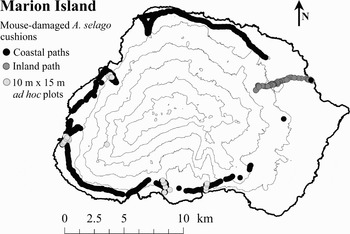
In addition to the systematic sampling, twenty-six, 150 m2 plots (randomly located at low altitudes, below 300 m a.s.l.) at several locations around the island (see Fig. 1) were also surveyed. In these plots A. selago density, the number of mouse burrows (occurring in both A. selago and the surrounding vegetation), the number of A. selago cushions which had been burrowed into, and the number of mouse burrows occurring in each A. selago cushion were recorded.
Ad hoc observations of mouse activity (damage) in Azorella selago cushions along coastal and inland paths on Marion Island, as well as for the twenty-six ad hoc 10 m × 15 m plots.

Data analyses
Global positioning system point localities were converted to shapefiles and the distribution of A. selago cushions, including those that had signs of mouse damage, was mapped (ArcGISTM 9.1 ArcMap), for both the systematic and ad hoc sampling. Universal kriging (ArcGISTM 9.1 Geostatistical Analyst), a method used for producing interpolated maps by determining the level of spatial autocorrelation of the variable being analysed and for the prediction of abundances at unsampled sites (Zimmerman & Zimmerman Reference Zimmerman and Zimmerman1991), was used to interpolate the distribution of A. selago density, recorded in the 124, 64 m2 plots, across Marion Island. The proportion of mouse-damaged A. selago cushions per 64 m2 plot (only plots with cushions that were burrowed into) was also interpolated by means of kriging. For both sampling approaches we also re-expressed the data on the basis of the number of burrows per cushion surface area using median cushion diameter estimates (given a right-skew in the frequency distribution) obtained from three different areas of the island (0.475 m, see le Roux & McGeoch Reference le Roux and McGeoch2004), and the assumption of an approximately spherical cushion shape.
Results
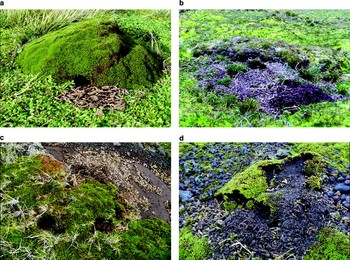
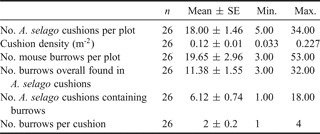
Opportunistic field observations showed that mouse damage to Azorella selago was almost continuous along coastal and inland paths on Marion Island (Fig. 1). In the twenty-six, 150 m2ad hoc plots, the number of burrow entrances in cushions ranged from one to four (Table I), and in some cases entire cushions were excavated by burrowing, causing the disintegration of the plant (Fig. 2). In the ad hoc plots, a mean of 18 A. selago cushions was found per plot (a mean density of 0.12 cushions.m-2) (Table I). Of a total of 19.7 mouse burrows per plot, approximately 11.4 burrows were found in A. selago cushions, the remainder being found in other vegetation (Table I). Based on a median cushion diameter of 0.475 m (le Roux & McGeoch Reference le Roux and McGeoch2004), and the assumption of a roughly spherical cushion (giving a median area of 0.746 m2), the density of mouse burrows per cushion surface area was estimated as 0.85 burrows.m-2 on average, ranging from a minimum estimate of 0.44 burrows.m-2 of cushion area to a maximum estimate of 3.0 burrows.m-2 of cushion area.
The observed mouse damage to Azorella selago cushions along paths and across Marion Island (in systematic and ad hoc plots). Azorella selago with a. a single burrow entrance, b. multiple burrow entrances, c. multiple burrow entrances and partial disintegration, and d. a disintegrated cushion where mouse burrow entrances are barely visible.

Summary statistics for the number of Azorella selago cushions and the numbers of mouse burrows per plot and per cushion in the 26, 150 m2 plots.

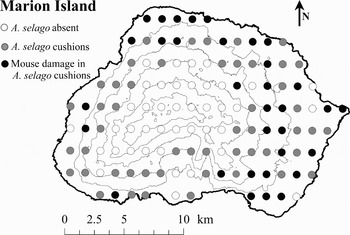
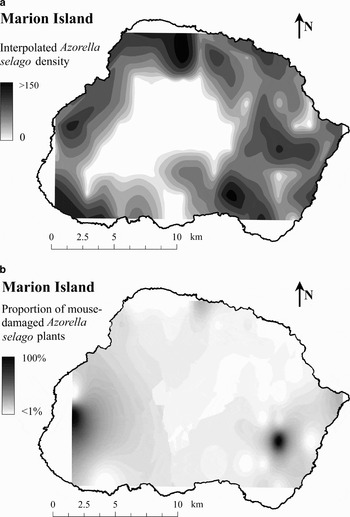
In the systematic sampling (the 124, 64 m2 plots), A. selago was recorded in 83 of the 124 plots, between 37 m and 667 m a.s.l. (Figs 3 & 4a). Cushion density ranged from 0.016 to 3.25 cushions.m-2 (mean ± SE: 0.81 ± 0.08 cushions.m-2), excluding coalesced, mat-like cushions which were found in 14 of the 83 plots. Mouse burrows were found in 32 of the 83 plots (39%) and in cushions up to 548 m a.s.l. (Fig. 3). In these, mostly higher elevation plots, the number of burrows per A. selago cushion was low (mean ± SE: 0.13 ± 0.04), and 28 plots had < 15% of their A. selago cushions affected by mice (Fig. 4b). Areas that had high A. selago densities tended to have a lower proportion of mouse-damaged cushions (compare Fig. 4a & b).
The distribution of Azorella selago recorded on a minute-by-minute basis across Marion Island. The white circles indicate areas where A. selago is absent. The grey circles show areas where A. selago is present, but no mouse damage was found, while the black circles are indicative of A. selago cushions that had signs of mouse damage.

a. Interpolated Azorella selago cushion density in 64 m2 plots on a minute-by-minute basis across Marion Island. White areas indicate sites where A. selago is absent and the black areas represent high A. selago densities (>150 cushions per plot). b. Interpolated proportions of mouse-damaged Azorella selago cushions in 64 m2 plots based on the thirty-two plots where A. selago was damaged or burrowed into by mice, with mouse damage ranging from <1% (white areas) to 100% (black areas).

Discussion
To date, investigations of the impacts of house mice on Southern Ocean ecosystems have been concerned largely with their direct effects on invertebrates and seabirds, and indirect effects on nutrient cycling. By contrast, little attention has been given to their impacts on plant populations (beyond documenting the inclusion of plant material in the diet) and certainly not at a landscape scale. This study makes it clear that neglect of such landscape scale impacts will lead to an underestimate of the significance of introduced mice in Southern Ocean island ecosystems. Structural damage by mice to A. selago is widespread on Marion Island, being found across nearly the full range of the cushion plant and up to 548 m in elevation, close to the elevational limit of cushions (667 m a.s.l.) identified in the systematic sampling. In addition, c. 39% of plots sampled contained mouse damage, and within these plots damage was sometimes extensive, although more typically fewer than 15% of cushions were affected.
In lowland areas, the ad hoc sampling revealed a mean density of c. 0.85 burrows.m-2 of cushion surface area. Moreover, it can be assumed that A. selago cushions constitute c. 5% of overall surface area at these typically lower elevations, given that other plant species dominate the lowland vegetation (Chown & Froneman Reference Chown and Froneman2008). At higher elevations, the percentage surface area covered by cushions ranges from 7 to 33% with a mean of c. 20% (Nyakatya et al. unpublished data; see also Barendse & Chown (Reference Barendse and Chown2001) who found a value of 8.7%). On this basis, an estimate of c. 425 mouse burrows per hectare can be made (0.85 burrows.m-2 × 500 m2 of cushion.ha-1 = 425 burrows.ha-1), which is in keeping with the 340 to 1000 burrow.ha-1 recorded by Avenant & Smith (Reference Avenant and Smith2003) in other lowland vegetation types. At the mostly higher elevation, systematic sampling plots, mean cushion density was high, at 0.81 cushions.m-2, and burrow density was low, typically 0.13 burrows per cushion or 0.16 burrows.m-2 of cushion surface area. Assuming a mean surface area covered by A. selago cushions of c. 20% of the total surface area available (see above), burrow density at these mostly higher elevations amounts to c. 320 ha-1, a value also in keeping with the lower end of those found by Avenant & Smith (Reference Avenant and Smith2003) for coastal areas. These estimates provide grounds for a whole-island first estimate of mouse impact on A. selago. If it is assumed that at low elevations (200–400 m) 0.85 burrows are found per m2 of cushion surface, that 5% of surface area is covered by A. selago cushions, and that the total surface area of these elevations is 6705 ha (Meiklejohn & Smith Reference Meiklejohn and Smith2008), c. 2.8 million burrows are likely. At the higher elevations (400 to 600 m, 5206 ha), by similar calculation, c. 1.7 million burrows are present. In total, 4.5 million mouse burrows are likely to have been present at the time of sampling. These values appear extraordinarily high, but on closer assessment are not unrealistic. By using the digital elevation model surface area data provided by Meiklejohn & Smith (Reference Meiklejohn and Smith2008) and the lowest (0.12 cushions.m-2) and highest (2.81 cushions.m-2) cushion density estimates for all studies of this species (Hugo Reference Hugo2006, Nyakatya Reference Nyakatya2006, this study), the estimated total number of cushions on the island, between 200 and 600 m a.s.l., varies between 11.4 and 267 million cushions (acknowledging that much spatial variation is present (Fig. 4b), and in many areas cushions coalesce to form mats (Gremmen Reference Gremmen and Junk1981, Mortimer et al. Reference Mortimer, McGeoch, Daniels and van Vuuren2008)). These numbers provide an estimate of 0.02 to 0.4 mouse burrows per cushion, which encompasses the recorded value of 0.13 burrows per cushion in the systematic sampling plots.
Given that mice are clearly capable of causing total disintegration of cushions, that A. selago cushions are in the order of 30 to 80 years old on average (le Roux & McGeoch Reference le Roux and McGeoch2004), and that special, and currently unknown, conditions appear to be required for seedling establishment (McGeoch et al. Reference McGeoch, le Roux, Hugo, Nyakatya, Chown and Froneman2008), this level of ‘standing damage’ is substantial and of considerable concern for a species of which the population dynamics and turnover are so poorly known. Certainly it appears that impacts in fellfield systems may be much more significant than previously thought (e.g. Gleeson & van Rensburg Reference Gleeson and van Rensburg1982). However, establishing the real significance of these impacts will require an estimate of annual mouse damage to cushions as well as recruitment to the A. selago population because it is the interaction of these two rates that will provide the most meaningful estimate of impact. Such estimates will require long-term studies of both mouse and A. selago populations in a spatially explicit fashion. The spatial detail will be especially necessary because mouse damage to cushions is not uniformly distributed across the island, as is clear from the landscape scale variation in the proportion of cushions affected by mouse burrowing (Fig. 4b) relative to cushion density (Fig. 4a). High cushion density areas are less affected by mice than low cushion density areas. It seems likely that, given temperature and density regulation of mouse abundances (Ferreira et al. Reference Ferreira, van Aarde and Wassenaar2006), this spatial asynchrony may well be a consequence of a surplus of cushion resources in high cushion density areas. However, only further, detailed demographic studies will reveal its cause. At present, explicit demographic work of this form is not being undertaken on the island, although several long-term plots to assess A. selago population dynamics have been established (McGeoch et al. Reference McGeoch, le Roux, Hugo, Nyakatya, Chown and Froneman2008).
Of course, it is not simply direct impacts on the A. selago population that may be ecologically significant. Azorella selago serves as a nurse plant for many epiphyte species, so increasing the altitudinal range of a variety of them, and also houses high densities of invertebrates, acting as a keystone species especially in fellfield landscapes (Barendse & Chown Reference Barendse and Chown2001, McGeoch et al. Reference McGeoch, le Roux, Hugo, Nyakatya, Chown and Froneman2008). In this way it significantly influences the structure and dynamics of fellfield systems, also contributing substantially to successional patterns found on Marion Island (Yeloff et al. Reference Yeloff, Mauquoy, Barber, Way, van Geel and Turney2007). By damaging cushions, and in some cases by causing their disintegration, mice might, to an unknown and quite likely large extent, be affecting this keystone role of A. selago. Moreover, because warming and drying on the island (le Roux & McGeoch Reference le Roux and McGeoch2008) are predicted to have deleterious effects on cushions and their associated biota (McGeoch et al. Reference McGeoch, le Roux, Hugo and Chown2006), and because further climate change is predicted to lead to greater impacts by mice (Smith & Steenkamp Reference Smith and Steenkamp1990), the landscape level impacts of mice on ecosystem functioning, as a consequence of their predilection for A. selago cushions, might be larger than presently estimated.
In addition to quantifying levels, distribution and rates of impact, understanding the reasons for the selection of cushions by mice is also important. It seems likely that a combination of thermally stable environments and significant food resources may prompt mice to select cushions for burrowing and for nest construction. Cushions act as a thermal buffer (Nyakatya & McGeoch Reference Nyakatya and McGeoch2008) and the difference in temperature between the plant surface and 10 cm below it may be as high as 2°C in summer. In winter, cushions are thermally stable. Overall, cushion interiors experience less extreme and less variable temperatures than the surface of the plants, irrespective of where they occur on the island (Nyakatya & McGeoch Reference Nyakatya and McGeoch2008). Cushions also house high densities of arthropods (Barendse & Chown Reference Barendse and Chown2001), including the species on which mice feed. For instance, weevils of the genus Ectemnorhinus are among the preferred prey of mice (Smith et al. Reference Smith, Avenant and Chown2002), and the biomass of weevil larvae in A. selago cushions is more than double that found in mire communities at similar elevations, and peaks during the winter months when resources may be most critical to survive harsh conditions (Chown & Scholtz Reference Chown and Scholtz1989). Moreover, large weevil adults, preferred by mice (Chown & Smith Reference Chown and Smith1993) are also abundant on A. selago cushions. Therefore, both milder temperatures and greater food availability in cushions may have provided mice with a means of colonizing high altitudes as climates have ameliorated in these areas (see le Roux & McGeoch Reference le Roux and McGeoch2008).
The present results have added to a growing list of the impacts that the house mouse has on Southern Ocean island species and ecosystems (Copson Reference Copson1986, Smith & Steenkamp Reference Smith and Steenkamp1990, Huyser et al. Reference Huyser, Ryan and Cooper2000, Chown et al. Reference Chown, McGeoch and Marshall2002, le Roux et al. Reference le Roux, Chapuis, Frenot and Vernon2002, Jones et al. Reference Jones, Chown and Gaston2003, Wanless et al. Reference Wanless, Angel, Cuthbert, Hilton and Ryan2007). Indeed, it is clear that this species constitutes a significant conservation challenge in the region, as do other rodent species, such as rats, that occur on several Southern Ocean islands (see e.g. Chapuis et al. Reference Chapuis, Boussès and Barnaud1994, Frenot et al. Reference Frenot, Chown, Whinam, Selkirk, Convey, Skotnicki and Bergstrom2005). In a report concerning the possibility of eradicating mice from Marion Island, Chown & Cooper (Reference Chown and Cooper1995) stated that the eradication of mice from Marion Island is both “desirable and feasible”. Rodents, including house mice, have been successfully eradicated from several New Zealand islands (reviewed by Towns & Broome Reference Towns and Broome2003, see also Howald et al. Reference Howald, Donlan, Tershy, Croll, Russell, Saunders and Clout2007), but most of these islands are smaller in area (Towns & Broome Reference Towns and Broome2003) than is the c. 290 km2 Marion Island. Nonetheless, given their significant, and probably growing impacts, the eradication of mice from Marion Island is indeed desirable and should be made a priority during the implementation of the new Environmental Management Plan for the Prince Edward Islands (see Davies et al. Reference Davies, Chown and Joubert2007).
Acknowledgements
Asanda Phiri is thanked for assistance in the field and Peter le Roux for comments, discussion, valuable insight, and data on cushion density. Two referees substantially improved the work by providing comments on a previous version of the manuscript. This work was funded by the United States Agency for International Development (USAID), DST-NRF Centre of Excellence for Invasion Biology, and Stellenbosch University. The South African National Antarctic Programme is acknowledged for logistic support.