Every successful undertaking, serving the general well-being, started out as a utopia and ended as reality.Footnote 1
Ernst Schönholzer, 1930This quotation opened a paper in the leading Swiss technical journal in 1930. In choosing these words the Swiss engineer Ernst Schönholzer explicitly paraphrased Count Coudenhove-Kalergi, whose agitation for a Pan-European Union was gaining currency in diplomatic and intellectual circles at the time. Schönholzer was very sympathetic towards the count's project of uniting a fragmented Europe of competing and war-prone states. In contrast to the count, however, he proposed not a political union but sheer material integration in a pan-European electric power grid. Such a grid would make Europe's energy sources, unevenly distributed among its states, available to all. Replacing competition with co-operation, it would create joint prosperity and peace for the entire continent.
Schönholzer was not alone in this argument: proposals for European infrastructural integration flourished in the early 1930s. Next to electric power grids, such proposals heralded transnational railway, motorway, airline, telephony and broadcasting networks as spearheads for European co-operation and integration. Moreover, this argument was not new. Such proposals for European infrastructural integration recycled and revived promises about a century older. In 1833 the Saint-Simonean and future French minister Michel Chevalier had singled out railways as the ultimate tool to tie peoples and countries into interdependency, co-operation, and peace: ‘Railways have more relation to the religious spirit than we think . . . Never has there existed an instrument of such power to link together scattered peoples’.Footnote 2 Chevalier's writings mark the full articulation of what has been called the ‘ideology of circulation’, according to which infrastructures or ‘networks’ (the term ‘infrastructure’ is of a later dateFootnote 3) inspire mutual co-operation and understanding in the service of joint prosperity and peace. This infrastructure promise appeared in European thought and action ever since.Footnote 4
Of course, such promises should not be taken at face value. Yet neither should they be ignored as naive precursors to functionalism or transactionalism. Their persistent presence, multiple forms and implications merit critical historical enquiry. In the nineteenth and twentieth centuries politicians, engineers, business communities and militaries incessantly pushed infrastructure projects to forge polities, economies and societies, or to prepare for war. On a regional scale, the European Union's promotion of ‘trans-European networks’ as ‘a key instrument for economic, social and territorial cohesion’ is only the latest example of a great number of international organisations pursuing European infrastructural integration for the greater good.Footnote 5 The League of Nations (1919), the United Nations Economic Commission for Europe (1947), the Organisation for European Economic Co-operation (1948), the Council of Europe (1948) and the Council for Mutual Economic Assistance or COMECON (1949) all pushed transnational infrastructure programmes. Moreover, a whole array of specialised international agencies was established to orchestrate transborder interconnection of specific infrastructures. These agencies bear witness to a fascinating history of twentieth-century infrastructural integration – but also non-integration and fragmentation – of peoples and countries in Europe that has been inadequately studied and often lacks adequate conceptualisation.
The purpose of this paper is to spotlight such agencies – Europe's system builders – as a fruitful research site for investigating transnational infrastructure development and, hopefully, some of its intertwinements with the efforts at building transnational polities, economies and societies in twentieth-century Europe. We shall develop the theme both conceptually and empirically. First, we shall discuss how Europe's system builders can be studied. Then we try our approach on three cases involving different eras, technologies and types of organisation. We start in the early 1930s, when International Labour Office director Albert Thomas teamed up with a new road builder organisation – the Bureau International des Autoroutes (International Motorway Office, 1931) – to push the construction of a European motorway network. Though it failed for the time being, this project provides important clues to the challenges of transnational infrastructure building. Next we investigate the Union for the Co-ordination of Production and Transport of Electricity (1951), co-ordinating a transnational power grid that today covers most of Europe. Finally, we shall address railway integration efforts by the European Conference of Ministers of Transport (1953), an organisation that currently claims the role of Pan-European infrastructure builder beyond European Union limits.Footnote 6
Before we proceed, two comments are apposite. First, this research aims to contribute to an emerging literature on transnational infrastructures and the shaping of contemporary Europe. Europe's historians have long recognised the pivotal importance of infrastructures in European history, but tended to treat infrastructural changes as an exogenous transnational force, typically represented by key inventions. Exactly how ‘Europeans were united by the romance and the utility of their railways’ or how integration ‘is not a set of treaties or organisational frameworks but the degree to which politics, economies and societies of nation-states were enme-shed . . . at a more fundamental level’ remained obscure, as did the kind of ‘Europe’ that infrastructural changes produced.Footnote 7 By contrast, specialised infrastructure histories have developed more nuanced understandings of how infrastructural and societal change intertwined, but only within (sub)national frameworks of analysis, including some cross-national comparisons, and almost completely neglecting transnational issues.Footnote 8 Only recently have historians started to bridge this gap. They observe a ‘networking of Europe’ in the nineteenth and twentieth centuries which was not a smooth, technologically or politically inevitable process, but a highly asymmetrical and contested one. We follow up on their explorative work by scrutinizing one of several promising research sites identified – international organisations dedicated to transnational infrastructure building.Footnote 9
Second, to avoid a misunderstanding easily induced by a tradition busy exposing supranationality as a myth, it is important to stress that we consider these international organisations neither as monolithic units nor as representatives of some kind of supranational Europe. Quite to the contrary: we see these organisations as arenas where many actors – corporate, government, federalist – negotiated possible versions of European infrastructural integration. Accordingly, by infrastructural integration we do not mean the subordination of national systems to international ones. Instead, we ask what shape transnational networks took and how the national and international (and possibly the subnational and corporate) were juxtaposed. Finally, this entails that we do not presuppose any definition of Europe. Rather, we inquire which ‘infrastructural Europe’ was perceived, negotiated and constructed in processes of transnational system building. In doing so we explicitly avoid equating ‘Europe’ with ‘western Europe’ and set out to identify exclusions from, and tensions within, infrastructural collaborations.
Features of transnational system building
In investigating international organisations dedicated to the infrastructural integration of Europe, we need to acknowledge and transcend two dominant approaches. First, the emerging literature on European infrastructural integration overwhelmingly departs from national actors, perspectives and sources, even when occasionally studying international organisations.Footnote 10 These studies convincingly show the prominence of national interests and concerns in international organisations and the corresponding shaping of transnational networks. However, this approach has its shortcomings. To keep such an enquiry practical and doable, such studies invariably privilege a few national perspectives, typically the German, French and British, tacitly excluding the vast majority of European countries from the picture and often implicitly reducing ‘Europe’ to ‘western Europe’. In addition, given the a priori selection of national viewpoints and sources as departure points for historical inquiry, their conclusions on the predominance of national interests are hardly surprising. International organisations and their archives, we argue, constitute a research site better suited to bring into view the overall picture of European infrastructural collaborations and those excluded from them. Also, since such organisations typically had little decision-making power but rather functioned as co-ordination and negotiation arenas for federalist, national and corporate interests, an international organisation perspective should allow us to investigate the juxtaposition and relative weight of these various interests in transnational infrastructure development.
This brings us to a second tradition of enquiry. The recent upsurge of transnational history foregrounds international organisations and their role in shaping of the contemporary world. Indeed, it counts infrastructure-related organisations such as the International Rhine Commission (1815), the International Telegraph Union (1865), the International Air Traffic Association (1919) and the International Broadcasting Union (1925) among the earliest and most successful examples of international collaboration. However, this literature typically studies international organisations as the expression and institutionalisation of global consciousness or global governance. Accordingly, it often privileges organisations promoting peace, human rights and cultural exchanges, rather than the mundane efforts at infrastructural collaboration. Political science forerunners to this literature treated infrastructure-related organisations much more prominently, but they too emphasised institutional and community-building aspects, not their implications for actual infrastructural change. These implications are taken for granted: ‘the locomotive, the steam ship, the telegraph, and the telephone were bringing peoples of the world into ever closer contact’.Footnote 11 This approach, we argue, needs additional conceptualisation of the multiple and sometimes ambivalent ways in which international organisations actually engaged with infrastructural change.
To achieve this we take our cue from infrastructure history and in particular the notion of system builders. This concept (among others) was originally coined by the American historian Thomas Hughes in the early 1980s. It was designed to highlight the role of individuals in the shaping of large-scale infrastructure and production systems, and to inquire how they proceeded.Footnote 12 According to the economic historian Louis Galambos, this research line helped to ‘humanise’ infrastructure history at a time when human agency was largely ignored in prevailing system theories and much economic history.Footnote 13 Soon, the concept was also used to inquire how organisations (or ‘collective system builders’) such as government or military agencies dealt with infrastructures.Footnote 14 In this article we shall employ the concept to study actors in the international arena working simultaneously on transnational infrastructures and taking ‘Europe’, however defined, as their sphere of activity. For our purpose, however, the concept needs some adaptation, partly to shift the research focus from explaining infrastructure development towards the multiple intertwinements of infrastructure- and Europe-building, and partly to accommodate some relevant critiques of the concept.
The original concept of ‘system builders’ carries two methodological connotations that we wish to preserve. An important concern for Hughes and others was to overcome the customary focus on artefacts and machines in history and sociology, routinely listing the light bulb, locomotive or motor car as harbingers of social change. They argued that such artefacts were just few among many interrelated elements in geographically extended ‘systems’ for electricity supply or transportation. These systems were the true frontiers of twentieth-century technical change and should constitute the proper unit of historical inquiry. Accordingly, the system builder concept suggests studying key actors not as heroic inventors of artefacts, but as dedicated builders of systems: Thomas Edison was not concerned with inventing the light bulb, but with designing and selling entire electricity supply systems in which steam engines, generators, distribution networks and consumer appliances functioned properly together. Our enquiry likewise focuses on Europe's system builders’ engagement with (transnational) systems, rather than on prominent elements such as nuclear power plants or fast locomotives.
Another original connotation we want to preserve is that explaining system development and its functioning demands understanding these systems’ sociotechnical nature. In the case of electricity supply systems, design properties also interacted with non-technical system elements such as company structures, financial possibilities and obligations, government concessions, and consumer practices. Traditional analytical categories separating a priori ‘technical’, ‘political’ and ‘economic’ aspects of infrastructure tend to obscure such sociotechnical intertwinement. The system builder concept, by contrast, invites historians to follow key actors as they routinely cross disciplinary boundaries and engage in transdisciplinary problem-solving while building sociotechnical systems. It highlights how Edison worked simultaneously on a commercial vision, negotiating with local governments and financiers, setting up companies and marketing, as well as working on generators, distribution networks and light bulbs, continuously adapting and aligning elements into a coherent sociotechnical whole.Footnote 15 We shall argue below that such a transdisciplinary approach was also crucial in transnational system building, affecting success and failure, network shapes, and inclusions and exclusions from infrastructural collaborations.
In addition, we should like to add two dimensions of transnational system building that were less prominent in the original concept, but are highly relevant to our theme. As noted in the introduction, Europe's system builders often discursively related infrastructure building to a wider ideological agenda, recycling the centuries-old promise that infrastructures produce prosperity and peace. Although such promises might cover over agendas and interests, they can be profitably investigated for perceived relationships between infrastructure development and polity, economy or society building, and for perceptions of infrastructural ‘Europe’ – was it an all-inclusive category or did it merely denote ‘a string of coastal states’ on the west side of the peninsula, a practice fiercely condemned by those working for east–west integration?Footnote 16 Besides constituting one arena for defining ‘Europe’, such promises are a form of expectations, the contents, articulation and appeal of which – innovation studies tell us – are key factors shaping technological projects.Footnote 17
Finally, the study of Europe's system builders should not miss the negotiated and contested character of infrastructure building. The original concept of ‘system builders’ has been fiercely criticised for emphasising the successful top-down alignment of system elements, while silencing disharmony, conflict, criticism and failure. Later studies indeed showed that top-down system building was often a fiction; usually, system building was a game of many actors and, consequently, full of negotiation and conflict, producing winners as well as losers.Footnote 18 This insight is particular important in transnational system building. It underlines the fact that Europe's system builders should not be studied as monolithic entities in control of infrastructure building, but as sites where competing interests and versions of European infrastructural integration met and were negotiated – this is why international organisations are such a promising research site in the first place. The existing literature suggests a range of possible conflicts, for example between competing states, between states and international organisations, between visionary individuals and their constituencies, between sectoral interests and between meso-regional (e.g. Nordic and west and east European) alliances.
This conceptualisation invites us to examine actors in the international arena, be they international organisations or visionary individuals, as a window on contested processes of infrastructural integration and associated political and economic changes. It suggests three dimensions of transnational system building where possible infrastructural Europes were negotiated: the ideological framing of transnational infrastructures, sociotechnical system building practices and negotiation processes between involved parties. We shall now explore these dimensions in three cases.
Motorway building: the drive for peace
In a famous speech before the League of Nations’ tenth assembly on 5 September 1929, the French foreign minister Aristide Briand revealed his dream of a political federation of European states. The French socialist Albert Thomas, inspired director of the International Labour Organisation (ILO, 1919) and an influential advocate of modernisation, formulated a comprehensive plan for European public works as a corollary to Briand's initiative. His plan is a textbook example of mobilising large-scale infrastructure building to achieve European integration, tackle the economic troubles of the epoch and produce a durable peace on the continent. In this sense, Thomas was a true ‘artisan of European union’.Footnote 19
Road builders from across Europe were quick to respond to Thomas's vision, sensing an opportunity to promote motorway construction.Footnote 20 Such roads, reserved exclusively for motorised vehicles, were still a very recent technology. In Italy, Piero Puricelli had just constructed the first small network around Milan, serving mainly tourist purposes.Footnote 21 Yet motorways were perceived as inherently international in character, demanding international co-ordination and co-operation; as early as 1925 Puricelli had stated that his true ambition was to create a European road network.Footnote 22
With the support of Thomas and his ILO, road builders organised two European motorway congresses in 1931 and 1932, and founded the Bureau International des Autoroutes (BIAR, 1931; renamed the Office International des Autoroutes, OIAR, in 1932), to organise pan-European motorway construction.Footnote 23 Simultaneously, the subcommittee on road traffic of the League of Nations Communications and Transit Organisation took up the question of European integration through road transport. It is these system builders we shall consider here. At the time they were unsuccessful. In retrospect, interwar transnational motorway projects and their associated dream of European community form a case of failed system building. Only after the Second World War would their lessons be taken up successfully.
Motorway promises
Unsurprisingly, Albert Thomas himself expressed the ideological dimension of motorway system building most explicitly. Like Briand, he was convinced that future peace and prosperity in Europe depended on the willingness of its war-prone states to give up parts of their sovereignty and co-operate. Unlike Briand, Thomas recognised European public works as a major opportunity to push countries into such co-operation and stimulate a European spirit among them. Thomas found Briand too much of a ‘thinker’, lacking a practical approach.Footnote 24 As he stated at the Second Motorway Congress,
Who does not see the fertility of a project like the one we have permitted ourselves to suggest? It would assure a new boost for international communications and provide a new possibility for co-operation among peoples. It would constitute an immediate remedy for the unemployment crisis. It could lead to renewed prosperity.Footnote 25
It was about time to start such a project:
It is already more than a century ago that the genius Saint-Simon developed his idea of a European federation and proposed an immense program of public works; didn't he say that the importance of such works was to ‘transport all nations “beyond themselves”’, so to say, to free them of all prejudice, of all routines, of all traditional political sentimentalities that might prevent them from uniting?Footnote 26
Thomas thus explicitly reproduced the Saint-Simonean promise of infrastructures.
He was equally clear about which ‘Europe’ he envisaged, emphasising the inclusion of both its western and its eastern half. Thomas was an admirer of the work of Francis Delaisi, who in Les Deux Europes (1929) had claimed that future European prosperity depended on durable economic and trade connections between the wealthy industrialised west and the largely agricultural east. Later Delaisi even called for a five-year plan to construct rural roads in eastern Europe, which lagged significantly in terms of infrastructure.Footnote 27 When writing to east European governments, Thomas did not hesitate to call himself openly a ‘propagandist’ of Delaisi.Footnote 28
Finally, we should observe the technocratic thread in this discursive constellation. To realise his vision, Thomas saw a key role for technical experts like those in the International Motorway Office. After all, it was largely a road builder organisation, counting many entrepreneurs among its members, appointing Piero Puricelli as honorary president and chair of its technical committee, and electing Lucien Lainé, director of the French Compagnie des Autoroutes that worked on the Autoroute du Nord, as general president.Footnote 29 In Thomas's words,
You are technicians. You are experts. You are capable, through your calculations and experience, of adjusting projects that are too vague, too general. But, I beg you, examine them, and realise them. Collaborate as much as you can to fulfil the immense task of reconstruction and organisation that is required from our generation.Footnote 30
Designing the system
In terms of sociotechnical system building, the BIAR/OIAR proceeded to work only on a few issues. First of all, members of the organisation discussed pan-European motorway designs. At the first congress Puricelli's technical committee proposed a network typical of the age. It pictured motorways as a purely international phenomenon, neglecting local interests and uses and connecting large cities and tourist destinations in almost straight lines. This first design was clearly skewed towards the north-west, primarily connecting France, Germany, Switzerland, the Low Countries and northern Italy, with extensions to Barcelona, Budapest and Warsaw. The technical committee assigned several projects of prominent members, such as the Autoroute du Nord, a priority status within the overall network. The lion's share of the network did not follow existing routes. Accordingly, BIAR focused on the overall system level rather than specific bottlenecks in the system, although some were mentioned. For instance, a tunnel underneath Mont Blanc would be desirable.Footnote 31
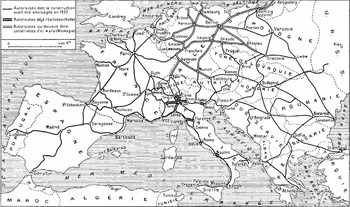
A more elaborate design was discussed at the second congress in Milan eight months later. The final resolution charged the organisation, now renamed OIAR, with taking all measures necessary to ensure the speedy realisation of international motorways in the spirit of the example set by Italy.Footnote 32 As a guideline, the congress adopted a five-year plan for constructing a 14,000- kilometre network, starting in 1933. Thomas was mentioned as its author, but Puricelli was its true creator.Footnote 33 This plan should eventually expand to a network of 37,176 kilometres (see fig. 1).Footnote 34
The motorway network presented at the 1932 BIAR congress. Source: ‘La Question des Autoroutes’, L'Illustration, 91, 4,727 (1933), 18–19, at 19.

A primary consideration behind the plan was to reconcile national networks with the overarching European network. Some again criticised the plan for randomly connecting nodes by imaginary straight lines.Footnote 35 And, again, the resulting motorways were unequally distributed over the continent, serving some countries better than others: France and Germany needed 3,950 kilometres each, Yugoslavia 235 kilometres and Poland 130 kilometres. The British Isles and Scandinavia were not connected at all, while roads in mountainous regions carried so little traffic that upgrading was deemed to be unnecessary.Footnote 36
While focusing primarily on planning the technical network, the road builders did realise that successful construction of this network would demand economic, judicial and social action as well. This insight was even inserted into the OIAR's statutes. As far as the sources tell, however, non-technical issues were hardly addressed, with one exception most relevant to road builders: financing.Footnote 37 Several options were considered. Albert Thomas suggested that the rich countries in the west construct their own shares of the network while eastern European stretches should be financed by capital lying fallow in the international money market.Footnote 38 The OIAR also discussed the Italian solution of levying motorway tolls, but this option was dismissed as an all-European solution, since several governments forbade road tolls.Footnote 39 It finally preferred financing motorways by fuel taxes. This option had implications for the network design, illustrating the interrelatedness of financial and technical elements in sociotechnical system building: countries with low automobile densities would generate less income and receive lower density networks. In this scenario, the theoretical French share of the system was increased to 6,419 kilometres, and the Yugoslavian share was further reduced, to 58 kilometres.Footnote 40
Still, the BIAR/OIAR neglected important aspects of sociotechnical system building, as the roads subcommittee of the League of Nations’ Communications and Transit Organisation pointed out. This commission argued that European road transport was best integrated not by building new motorways, but by clearing regulatory barriers that impeded transnational traffic on existing roads.Footnote 41 One of its first tasks had concerned the introduction of an international driving licence.Footnote 42 By 1931 it had adopted conventions on the unification of road signals and the taxation of foreign motor vehicles. Negotiations on the regulation of international commercial road traffic, by contrast, ended in complete failure, showing the limits of the European states’ willingness to co-operate.Footnote 43
Causes of failure
Despite appealing promises and serious technical, organisational and financial work, these attempts to launch a European motorway network, as mentioned above, failed. Existing accounts blame the international situation, as well as the unexpected death of Thomas only weeks after the second congress, apparently leaving the OIAR paralysed. The third motorway congress, to be held in Frankfurt am Main, never took place.Footnote 44 Analysing this failure from the perspective of transnational system building, we can add that Thomas and the BIAR/OIAR never managed to create the backing and balanced approach necessary for a coherent and sustained system-building effort.
Thomas and the road builders worked reasonably well together, although in private correspondence Thomas expressed ambivalence: ‘I am not a motorway fanatic’.Footnote 45 He feared that the road builders might hijack his plan for European public works to the detriment of other important components, particularly European electric power co-operation.Footnote 46 Thomas also had some trouble defending his co-operation with road interests before his own socialist constituency:
Since I attended the First Motorway Congress, I have been the victim of some mockery. Some have accused me, with the indulgent smile that one usually reserves for maniacs, to want to unite the capitals of Europe and the world by motorways without delay and bringing all other roadworks to a halt. Others have reproached me that I serve . . . the fantasies of the rich classes . . . The truth is that I want to try to serve . . . the ideas that have captured my heart and that seem to me in the general interest.Footnote 47
In addition, Thomas failed to enrol several important collaborators. Most serious was his failure to enrol the League of Nations road committee in the planning. Its secretary, the Dutch civil engineer Johan Romein, dismissed the need for a European motorway network for want of demand. The problem was not lack of transport possibilities, but the lack of goods and people to be transported. In the end a sociotechnical system building effort was divided over several actors maintaining a tense relationship.Footnote 48
Another blow to European motorway plans was delivered by the League of Nations Economic Conference in London in 1933, which scattered the last hopes of international finance for European public works – in particular the British government deemed the construction of public works in eastern Europe to be too costly.Footnote 49 Road builders now turned towards national funding options, and earlier visions of a top-down planned European motorway network gave way to motorway building in a national context. The ‘drive for peace’ came to an end before it had even started.
Electrifying Europe
In the first half of the twentieth century, few technologies excited contemporaries more than electricity supply. This relatively new technology made energy for lighting or power instantly available by the simple flick of a switch. In the 1920s and 1930s a number of authors envisaged an electricity supply system binding Europe's states together.Footnote 50 After the Second World War the actual construction of such a system commenced. In 1951 the Union for the Co-ordination of Production and Transport of Electricity (UCPTE) was established, after preparatory work within the European Recovery Program and the Organisation for European Economic Co-operation (OEEC, 1948).Footnote 51 The UCPTE brought together utility managers and government officials from different countries in order to organise electricity supply on a transnational level ‘as if there were no borders’.Footnote 52 By 1958, cross-border power links allowed the synchronous operation of electricity networks in Belgium, the Federal Republic of Germany, France, Italy, Luxemburg, the Netherlands, Austria and Switzerland at the ‘European electrical heartbeat’ of 50 Hertz.Footnote 53 By 2004 the organisation claimed always to have been one step ahead of political integration (the 1990 unification of Germany was a single exceptionFootnote 54); in its own words (which we shall examine critically below), it now co-ordinated ‘the operation and development of the electricity transmission grid from Portugal to Poland and from Belgium to Romania and Greece’, using ‘interconnected power highways’ to ‘keep the lights on’ for 450 million people in twenty-three countries.Footnote 55
Power and progress
Legitimising this system-building effort, lofty promises similar to those discussed above for European motorway integration regularly popped up in UCPTE rhetoric. A few years after its establishment, the West German member Heinrich Freiberger hoped that the organisation would be ‘allowed to continue to work as silently, as effectively for Europe and therefore for the greater good of humanity and of peace’.Footnote 56 The Italian UCPTE president P. Facconi, on the occasion of its twentieth anniversary, recalled that the technical work of the UCPTE was of ‘historic importance for its remarkable contribution to the ideal of a “United Europe”’.Footnote 57
These ‘Saint-Simonean’ promises had been carried over from the interwar period, when engineers and architects enthusiastically debated options for a joint European power supply. We have already mentioned the 1930 vision of Ernst Schönholzer at the beginning of this article. The German architect Herman Sörgel was likewise inspired by Count Coudenhove-Kalergi, but sceptical of the political road to integration: ‘the concatenation of Europe by power lines is a better peace warranty than pacts on paper; because in destroying these power lines, each nation would destroy itself’.Footnote 58 The League of Nations Communications and Transit Organisation agreed: ‘a European electrical supply network would establish a common interest of countries well suited to consolidate peace’.Footnote 59 Such rhetoric, however, received a morbid twist when Nazi Germany captured the idea and contemplated integrating their Neuropa by means of an underground power grid. Neither system was built, however.Footnote 60
In contrast to the approach to the cases of motorways and railways (discussed below), it is important to note that these ideals of peace, prosperity and European integration were just as often absent from UCPTE discourse. Often they were toned down relative to a second set of promises of internal economic and efficiency gains for the electricity sector itself. These latter promises, aimed directly at utility representatives in the organisation, also dated from the interwar period. For instance, balancing distant thermal and hydropower plants in one interconnected system would enable a more rational use of resources. In addition, interconnection would allow the sharing (and thus reduction) of emergency power-generation capacity. These promises of sectoral gains proved more potent in mobilising collaboration among utility representatives than ‘Saint Simonean’ ideals. Right from the start, they dominated the OEEC Electricity Committee deliberations in which the future UCPTE founders drew up their plans.Footnote 61
This discursive constellation differed even more from the motorway and railway cases. In the OEEC discussions it had already been agreed that economic gains were chiefly to be achieved within the supply areas of existing utilities, that is, within national borders: ‘by far the largest part of the economic advantages of interconnected operation could be gained within the relatively small systems of single companies, so it has been found in Europe that the major advantages are to be gained within national frontiers’.Footnote 62 Accordingly, the term ‘Europe’ was downplayed in the organisation's early years. Contrary to the UCPTE anniversary booklets and today's mission statement, the 1951 and 1954 statutes do not speak of ‘Europe’ at all. They simply define the organisation's aim as ‘promoting the most efficient use of existing or new means for producing and transporting electric energy in the member's countries’ and to ‘ease and promote international electricity exchanges’.Footnote 63
Electrical system building
As for its system-building approach, the UCPTE rapidly developed a systemic view. Again, the OEEC Electricity Committee paved the way, urging a postwar emergency construction programme of some 1,000 megawatts (MW) of production capacity. Thermal power plants had priority, since hydroelectric plants required higher investments and a longer construction time. This 1,000 MW production capacity was to be an international resource, and thus required international co-ordination as well as cross-border transport to be, in short, a ‘European power pool’.Footnote 64 Whereas the 1,000 MW programme failed, the power pool became a success. Either way, the very naming of the UCPTE reflected this systemic alignment of electricity production (the letter P) as well as transport (the letter T). Incidentally, in the wake of the recent liberalisation of the electricity supply industry and the associated separation of electricity production and transmission activities, the UCPTE dropped production (and the letter P) from its remit and became an organisation of transmission system operators.
The UCPTE was not given the authority, however, to enforce such a power pool from the top down. On the contrary, its members gathered as private individuals, not as company representatives, and relied ‘solely on the power of persuasion’ to promote and co-ordinate international co-operation.Footnote 65 With regard to investment, the construction of power lines and daily operation, individual power companies maintained full autonomy. Cross-border network expansions and power exchanges were negotiated between them and decided on a bilateral or multilateral basis. The UCPTE technical work therefore took the shape of studies and recommendations, and often dealt with standards or safety measures.
To compensate for its lack of authority regarding network construction and use, and quite unlike the International Motorway Office, the UCPTE actively focused on non-technical activities to promote cross-border electricity co-operation.Footnote 66 For instance, it teamed up with the OEEC in a political lobby in favour of abolishing national limitations on electricity exports, a much-used national energy security instrument. This resulted in OEEC recommendations to national governments to abolish such limitations in 1953 (incidental exchanges), 1956 (seasonal exchanges) and 1959 (all exchanges), which were implemented by most member countries.
Quite another type of activity was systematic information gathering, sharing and publication. Gathering and sharing information on members’ wishes regarding exporting or importing electricity triggered exchanges.Footnote 67 A database of member plant machinery provided a common knowledge base. Booklets and lexicons defined standardised power station operation terminology in the Union's four languages (French, German, Italian and Dutch) in order to improve telephonic communication between the personnel at different control centres. Finally, the UCPTE advertised the transnational system through the biennial publication of a map, which deliberately foregrounded transnational power lines at the expense of subnational ones, even though the latter had much more practical importance. This effort seemed to pay off. The number of cross-border connections rapidly increased, and electricity exchange between UCPTE-countries increased from 3 billion kilowatt-hours in 1948 to 28 billion in 1969.Footnote 68
Negotiating electrical Europe
The ideological framing proved convincing enough to mobilise partners; the sociotechnical system-building effort resulted in a newly constructed power grid that today covers most of Europe, procedures guiding transborder electricity trade and a steep increase in cross-border electricity trade. The case of transnational electricity system building seems highly successful at first sight. Before submitting to the UCPTE's own rhetoric of success, however, we should examine the negotiated and contested character of this particular system-building process. And contested it was.
First, there was negotiation over inclusion and exclusion in the UCPTE. For most of its history, UCPTE membership included only a limited number of countries. Most visible was the Cold War-infused exclusion of central and east European states and power companies. Eschewing such OEEC-inspired co-operation as the UCPTE, these chose to co-operate instead in COMECON, which established the Central Dispatch Organisation of the Interconnected Power Systems in 1962 to improve electric power co-ordination. Just like the UCPTE, the Central Dispatch Organisation retrospectively described itself as ‘European’ and ‘one of the centres of European integration in the electric power industry’.Footnote 69 The Central Dispatch Organisation system was interconnected with the Soviet United Power System, another system not included in the UCPTE sphere. Central Dispatch Organisation frequencies and frequency control were adjusted to the Soviet system, not the UCPTE system, which prevented structural power co-operation between east and west. In the late 1970s and 1980s, the oil crises and environmental concerns hampered the generation capacity of UCPTE members, leading to increased imports from Central Dispatch Organisation members in need of hard currency. Structural two-way co-operation only came in the post-1989 era, when several Central Dispatch Organisation members disconnected from the Soviet system to start synchronous operation with the UCPTE system in the so-called Trans-European Synchronously Interconnected System (1995). Russia, Ukraine and Belarus remain excluded, and the Baltic republics still vascillate between the desired connection to western Europe and cashing in on their traditional power exports to Russia.Footnote 70
More surprising, perhaps, is the failure to lure Nordic power companies into UCPTE membership. Although all of them were OEEC members, the Nordic countries looked at postwar European integration with ‘mixed feelings’ and embarked on a Nordic political and economic integration process which was reflected in electric power co-operation.Footnote 71 Advised by the Nordic Council, Nordic power companies founded their own international organisation, Nordel, in 1963 to co-ordinate a Nordic power grid.Footnote 72 Nordel developed a certain amount of co-operation with the UCPTE through submarine high-voltage direct current cables, which are expensive but do not require the frequency synchronisation of other systems. Today it is the Nordic power pool – not the UCPTE system – that counts as the best integrated in the world, and Nordic power companies are still not UCPTE members; only the transmission company of continental Denmark has a double status.
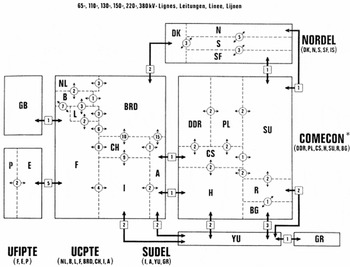
Europe's electrical integration, then, was not a homogenous process but proceeded in distinct meso-regional blocks (fig. 2). Here we should also note the exclusion of the British Isles from UCPTE co-operation. Furthermore, General Franco's reign prevented Spain's participation, and a diplomatic row with the West Germany caused the exclusion of Yugoslavia.Footnote 73 In response French, Spanish and Portuguese utilities also established their own co-operation system in the Union Franco-Iberian pour la Coordination de la Production et du Transport de l'Electricité (UFIPTE, 1963), while Italian, Austrian, Yugoslavian and Greek utilities co-operated in SUDEL (1964). In contrast to Nordel members, they became full UCPTE members in the late 1980s.Footnote 74
National and meso-regional blocks in European power grids in 1975. The numbers between countries and regions represent transborder power lines (regardless of their capacity). Source: UCPTE 1951–1976, 199. (Reproduced with kind permission of the UCTE.)

In addition to this meso-regional fragmentation, the connection of the organisation's members in the UCPTE network remained highly asymmetrical. In accordance with the voluntary status of the organisation, some members proceeded to construct cross-border power lines, while others did not. The European Commission observed that by 2000 some countries (the Netherlands, Belgium and Austria) were well integrated, while others (e.g. Spain, Portugal, Italy, Greece, the United Kindom and Ireland) certainly were not – their physical import capacity was below 5 per cent of their domestic generating capacity.Footnote 75 To a considerable extent, then, the UCPTE network was a constellation of poorly interconnected national networks.
Worse, even well-connected members might not behave at all as part of a single UCPTE system with optimised efficiency. Switzerland was well interconnected and engaged in intense cross-border exchanges. By contrast, the Netherlands, nominally a front-runner in European economic and electrical integration and physically well integrated into the UCPTE grid, only produced marginal cross-border exchanges until the era of liberalisation. Dutch power companies prioritised the autonomous supply of their own supply areas, and used the UCPTE grid for incidental exchanges and back-up capacity only. Sub-national, company-level electricity flows clearly dominated. Figures for the entire continent (excluding only the former Soviet Union) suggest that cross-border flows made up merely 5 per cent of the net domestic production by 1980 and 9.6 per cent in 2004, meaning that over 90 per cent of electricity produced still circulated at (sub)national level.Footnote 76
This does not mean that transnational interdependencies are absent; recent power outages, like the one in November 2006 that cascaded through the network from northern Germany to Morocco, prove otherwise. It does mean, however, that the UCPTE vision of a European electricity supply system ‘as if there are no borders’ proved a fiction. Instead, company, national and meso-regional borders provide the structures that organise European electricity flows.
Europe on rails
The examples of motorways and electric power grids concerned rather new network technologies, which thrilled contemporaries and – as new technologies often do – easily attracted promises of co-operation, peace and progress. Railways, in contrast, had been built since the first half of the nineteenth century. As noted in the introduction, they had carried similar promises almost from the beginning. Remarkably, a century later calls for a true European rail integration still found resonance.Footnote 77 Apparently, the old promises had not been sufficiently redeemed. Railway networks had indeed been built in most European countries, usually with the heavy financial and regulatory involvement of state governments concerned with national unification and military defence. Governments generally became system owners during the first half of the twentieth century.Footnote 78 Virtually all national networks were mutually interconnected, and some argued that, already, in the interwar years ‘as a railway unit, Europe was functioning far better than as a political or economic unit’.Footnote 79 Others, however, found the ‘European network’ highly inefficient and criticised the basic ‘national organisation of railways’ as a formidable barrier to true co-operation. In addition, two world wars had shown railways as key instruments of war rather than peace.Footnote 80
Our last case, the European Conference of Ministers of Transport (ECMT, 1953), was established in order to improve the international orientation of ground transport systems. Its foundation was prepared by the OEEC, of which it became an administrative part. The new transport organisation associated the ministers of transport of member states in an attempt to accumulate sufficient authority to achieve true European collaboration. The co-operation efforts of existing international organisations, such as the International Railway Union (1922), had proved to be no match for state governments guarding their large financial and military stakes in railway networks. In addition, co-ordination of different ground transport modes had hitherto been poor, and the new organisation should deal simultaneously with transeuropean rail, road and inland navigation systems.Footnote 81
After fierce deliberations, the ECMT became a voluntary intergovernmental organisation, not a supranational one as originally intended.Footnote 82 Still, its added value lay in its practical decision-making capacity: unlike many other international organisation it had no right of veto, and those transport ministers accepting a decision were to implement it back home. The aim was ‘instituting a procedure whereby effective steps can be taken to co-ordinate and rationalise European inland transport of international importance’.Footnote 83 The ECMT was also to ‘co-ordinate and promote the activities of international organisations concerned with inland European transport’.Footnote 84 In other words, its decision-making capacity should make it a sort of super-system-builder co-ordinating and amplifying the work of other players in the field. Over the years, the ECMT associated over twenty-five international governmental and non-governmental organisations with consultative status.
At a first glance, this strategy seemed successful. The ECMT was always considerably more inclusive than the UCPTE, expanding from seventeen founding members to forty-four full members in early 2007. Currently, the ECMT co-operation stretches from Norway in the North to Greece and Turkey in the south, and from Portugal and Ireland in the west to the Russian Federation, Armenia and Azerbaijan in the east.Footnote 85
Transport promises
Compared with the previous case, ECMT spokespersons, especially professional politicians, particularly emphasised the now familiar Saint-Simonean promises. In 1955 the retiring ECMT chairman, the French minister of public works General Corniglion-Holinier, expressed to the Conference his ‘faith in the part that transport will play in European co-operation’.Footnote 86 His successor, the German minister of transport H. C. Seebohm, emphasised that ‘transport is an important element to bind nations together and can help smooth out difficulties between them and contribute to peace both in Europe and in the rest of the world’. Furthermore, ‘our organisation has the important task of making European public opinion aware of the transport problems, which are so important to each individual, and of drawing attention to the importance of transport as a decisive factor in our struggle towards a European Community’. In short, the Conference was making ‘real and effective contributions to the realisation of the European ideal’.Footnote 87
Accordingly, like Albert Thomas but quite unlike UCPTE spokespersons, ECMT representatives explicitly claimed to serve ‘Europe’, and they used this concept in an inclusive fashion: ‘transport Europe’ should not be a collaboration of the privileged few, but embrace as many countries as possible. For Corniglion-Molinier,
No effort should be spared to give European transport every chance of being constructed on as wide a basis as possible and corresponding as closely as possible to the natural structure of Europe . . . We cannot for political or ideological reasons and preferences . . . ignore certain countries . . . the Europe of transport could not be confined to a restricted or discontinuous space; it has no meaning unless it covers the majority of European countries on a sound geographical basis.Footnote 88
This inclusive understanding of ‘Europe’ was even more emphasised after the newly established European Union (1993) embarked on an active transport policy. The ECMT now positioned itself as the transport organisation looking beyond European Union borders, seeing ‘pursuit of lasting economic and social integration in Europe as a whole [as] one of the most crucial political issues for the present decade’ (emphasis added), and believing ‘that modern and efficient transport infrastructure is an important element in the integration of peripheral countries and of countries in transition’.Footnote 89 Accordingly, the current ECMT mission statement not only aims at discussing ‘transport policy issues’ and ‘helping to create an integrated transport system’; the organisation also found a new raison d'être in ‘helping to build a bridge between the European Union and the rest of the continent at a political level’.Footnote 90
As we shall see, as in the UCPTE case ECMT members used their new collaboration to achieve benefits for their financially troubled railway companies, which were hard-pressed by car traffic and aviation. Still, unlike the UCPTE case, such national member benefits were not promised in the founding documents; nominally, the organisation was to serve international transport.
Rail-system building
Compared with its pre-war predecessors, the ECMT system-building effort included a broad range of activities. We shall here elaborate on its transdisciplinary approach to railway integration, and note that it used similar approaches to roads and inland waterways.
As for railways, the ECMT diagnosed the dominance of unco-ordinated national railway policies as the key problem. Its transdisciplinary solution was already visible in its founding protocol, which identified five rail transport challenges: (i) the ‘joint use of goods wagons’; (ii) the ‘adoption of rational routes for the transport of goods by rail and the unification of tariff rates’; (iii) ‘standardisation of equipment and electrification’; (iv) ‘international financing of purchases of railway rolling stock’; and (v) ‘measures to increase the number of signatories to the International Conventions on Rail Transport and to expedite the ratification of International Conventions drafted by specialised agencies’.Footnote 91
This agenda reveals that the technical focus was not on building new transnational links – wartime damages had rapidly been repaired and the physical network seemed sufficient – but on resuming the prewar efforts of modernising the existing system: electrifying lines, adopting diesel traction and implementing modern signalling systems. Here, international standards would create economies of scale and improve the financial situation of individual railway companies.Footnote 92
Another set of measures was directed at stimulating cross-border traffic on existing lines. Next to appointing international routes, the exchange of goods wagons between members had to be improved; the ECMT supported the EUROP wagon pool formally established by railway administrations in 1953, according to which participants could use each other's freight wagons more freely and extensively than before.Footnote 93 Also, to reduce frontier formalities it worked to implement and expand the reach of international conventions negotiated within the UN Economic Commission for Europe's Inland Transport Committee. This is a good example of using the ECMT decision-making capacity to amplify the work of other international organisations.
A third set of measures aimed at improving the poor financial situation of member railway administrations. The initiative of the ECMT to set up the European Company for the Financing of Railroad Rolling Stock (EUROFIMA, 1955) is a celebrated example. The company, owned by member railway administrations, still exists today.Footnote 94 It addressed a problem already noted by the International Railway Union in 1951: the fragmented nature of Europe's railway industry – a great number of firms producing a great variety of rolling stock – caused high prices and a slow rate of innovation. This was a major competitive disadvantage to road traffic, and a major cause of the financial straits of railway companies.Footnote 95 In the ECMT solution, the financing and production of railway equipment were centralised; EUROFIMA borrowed the necessary funds and placed orders centrally, always with the interests of national manufactures in mind. The firm also demanded the application of international standards. The purchased equipment was then rented to member railway administrations so that the loans could be repaid. This initiative in the sphere of finance and business allowed the ECMT simultaneously to promote the modernisation of railway equipment and the diffusion of international railway standards, and to provide much needed orders to national railway manufacturers.
Negotiating railway Europe
The ECMT, then, mobilised co-operation between international organisations, jointly addressing bottlenecks in a transdisciplinary way, and managed relatively well to implement such work in member countries. The geographical range of European railway collaboration was impressively expanded. However, as in the case of the UCPTE, consideration of the contested aspects of rail-system building nuances this success story quite a bit.
First, despite its declared aim to involve ‘all of Europe’, the organisation did not include east European partners for most of its history. Indeed, as a practical decision-making body, it was an alternative to the all-European, but less decisive UN Economic Commission for Europe. This organisational choice had consequences for railway (non-)integration. Concerning the international circulation of freight wagons, for instance, railway administrations in central and eastern Europe set up the Common Freight Wagon Pool (OPW, Obschtschij Park Wagonow, 1964) as an alternative to the EUROP pool. The OPW was to increase the economic performance of rolling-stock operation and supervise international railway traffic. Only during the 1980s did members grow dissatisfied with the conservative OPW policy and increasingly exchanged wagons with EUROP countries, which paid fees in hard currency. In 1990 the OPW was dissolved.Footnote 96
Second, relations within the ECMT region were far from smooth. As Henrich-Franke has shown, the founding deliberations were difficult, and notions of a supranational transport organisation (in the form of a merger of national railway administrations, or of a ‘High Authority’ following the model of the new European Coal and Steel Community) were torpedoed by the British and Scandinavian wish for a looser integration concept and by transport ministers’ reluctance to subordinate transport interests to political goals. Relations with the more integrationist European Coal and Steel Community (1951), the coal and steel pool of six countries considered to be the root of the European Communities and the European Union, were strained ever since. The Community was critical of the intergovernmental ECMT, which could hardly be expected to ‘approach the problems from a European standpoint’ and was not in a position ‘to give the problems the sustained attention their urgency requires’.Footnote 97
Other bodies continued to criticise the progress in rail integration, thus questioning the success of the ECMT in this realm. Indeed, by 1985 many member railway administrations were still in competitive and financial crisis, and the ECMT itself expressed utter dissatisfaction with the progress of international services, technical standardisation and communication between national railway administrations. It still blamed the railway legacy of ‘national characteristics from the geographical, technical and legal standpoints, their role ending at the frontiers of each country’. Apparently, thirty-two years of ECMT work had not changed at all the ‘general rule [that] the immediate financial interest of each railway has taken precedence over their common interest’. Not unlike three decades earlier, the Conference concluded that ‘the need now is for deeds rather than words’.Footnote 98
Perceptions of failure remained. In 2003 a Council of Europe report on fifty years of ECMT activity bitingly observed how ‘railways nowadays move goods at an excruciatingly slow speed (between 20 and 30 km/h on the major international corridors, and with poor reliability). No wonder businesses are deserting rail for road transport’.Footnote 99 The European Commission also observed that even today ‘technical fragmentation of rail networks is a major handicap hindering the development of this mode of transport’.Footnote 100 In 2004 it established the European Rail Agency in a renewed attempt to achieve true railway integration.
Conclusion
In this article we have asked whether and how twentieth-century dreams of European infrastructural integration turned into historical realities, and what kind of ‘Europe’ was produced in this process. We spotlighted international actors dedicated to transnational infrastructures – international organisations and visionary individuals – as key witnesses to this issue and a promising research site. Unlike studies departing from national viewpoints and sources, the study of international actors and their archives should bring into vogue the broader picture of European infrastructural integration and fragmentation. We have also noted that a historiography of international organisations already exists but tends to focus on international governance, or on community-building aspects; in order to enquire specifically into how our actors engaged with infrastructures, we proposed to study them as ‘system builders’. This concept suggests searching for the shaping of infrastructural Europe in three dimensions of transnational system building: the articulation of promises of infrastructural integration, a transdisciplinary approach identifying and addressing key problems, and negotiation and conflict between stakeholders.
We refrained from defining ‘Europe’ upfront, in order to inquire openly what kind of ‘infrastructural Europe’ emerged from such system-building processes. Our exploration of three cases suggests that Europe's system builders invariably had to negotiate and align different interests – internationalist, national, sectoral – and equally diverging perceptions of what European infrastructural collaboration could or should be. This negotiation and juxtaposition of interests resulted in a multilayered infrastructural Europe, which displays signs of integration as well as fragmentation.
In all three cases a pan-European rhetoric (integrating as many countries as possible in order to secure joint prosperity and peace for the entire continent) was clearly present. It was invoked to mobilise political support, and perhaps also this rhetoric contributed to wider discourses on European co-operation. Moreover, in both the electricity and railway cases, near continent-wide collaborations eventually emerged. However, this pan-European element was weakly translated into the physical networks and cross-border exchanges. Instead, it seems that Saint-Simonean promises of prosperity and peace for the continent needed additional promises of sectoral and national economy gains to lure stakeholders into bilateral or multilateral system building projects and exchanges.
The electricity supply and railway cases suggest that meso-regional blocks proved a more potent level of infrastructural organisation, certainly in the Cold War era. System-building efforts were organisationally framed in separate western and eastern blocs. In the electricity case, we even observed how Nordic, south-western, and south-eastern European alliances formed distinct blocs in transnational system building; cross-border co-operation took place primarily within such blocs.
Finally, national and sectoral interests weighed heavily, producing national and corporate gravity points in multi-layered networks. Transnational co-operation and interdependencies have clearly emerged, as extensive freight wagon exchanges and transnational power failures demonstrate. Still, railway and electric power networks never came to function ‘as if there were no borders’, to quote a UCPTE promise. In these cases corporate, national and, to some extent, meso-regional borders continue to characterise infrastructural Europe as a multilayered entity. A more systematic enquiry, including road transport, navigation, aviation, broadcasting and telecommunications, is necessary to test and develop this image further.