

1. Introduction.
This paper compares the use of a number of modal particles in German and Dutch, in written and spoken corpora, in the light of the TRANSPARENCY PRINCIPLE (Transparenzprinzip)—the tendency to assume that cognate words behave similarly in the two languages (see Abraham 1981, Foolen 2003). Since our purpose is to compare German and Dutch discourse particles at the level of linguistic data, we cannot address the theoretical and terminological problems surrounding this group of words.Footnote 1 Briefly, we view modal particles (MPs) as a subcategory of discourse particles. Typically, they are a phenomenon of spoken language, especially of spontaneous, informal speech. They occupy the middle field, they can cluster, and they do not carry stress.Footnote 2 Modal particles cannot affect a sentence's truth value, but alter the sentence semantically and pragmatically, expressing the speaker's attitude to the propositional content of the sentence (Helbig & Helbig 1995:9, Karagjosova 2003: 335).
Given these criteria, a typical list of MPs in German consists of between 16 and 19 (as in König & Requardt, 1991:63): aber, auch, bloß, denn, doch, eben, eigentlich, einfach, erst, etwa, halt, ja, nun (mal), mal, nur, ruhig, schon, vielleicht, wohl (those underlined do not occur in the list of Thurmair 1991:20).Footnote 3 In Dutch, the number traditionally given is smaller, between six and nine, but typically includes dan, nu, toch, maar, eens, even.Footnote 4 The transparency principle might lead us to expect considerable similarities between many German and Dutch particles, for instance, in the pairs nun/nu, doch/toch, wohl/wel, eben/even, denn/dan. Logically extending the transparency principle might also lead us to expect non-cognate lexemes with similar semantics to function as particles in similar ways: (ein)mal/ een keer, schon/al, and nur/alleen, for example. Yet, both assumptions are risky, as the extreme case of a cognate, the German lexeme überhaupt, which has been borrowed unchanged into Dutch, shows. We found in a pilot investigation of 80 tokens in both Dutch and German (from the Corpus Gesproken Nederlands, described in section 2.2, and the Deutsches Spracharchiv, held by the Institut für Deutsche Sprache; see note 6 below), that überhaupt is used far less frequently in negative statements in Dutch than in German. Occurrences in a positive statement outnumbered those in a negative statement 3:1 in Dutch, while German showed the reverse trend: three times more tokens were found in a negative than in a positive statement.
In the light of growing interest in modal particles over the last two decades, the extent to which German and Dutch MPs behave similarly is a timely research question. Ready access to spoken corpora now allows us to address this question—here with the emphasis on MP clusters.
2. Clustering of MPs in Dutch and German.
2.1. Clustering, Corpora, and Method.
The “clusterability” of modal particles is one of the features that helps distinguish them from other modal words. We cannot combine ordinary modal words to say, for example, *Er hat möglicherweise wahrscheinlich gekündigt (‘*He has possibly probably given notice’; Bublitz 1978: 37). Furthermore, in some cases, the words only become interpreted as modal particles when in a cluster. Er geht nun weg (‘He is going away now’) and Er geht einmal weg both have a different sense to the concession expressed by Er geht nun einmal weg (‘Well, he's just going away [and that's all there's to it]’; Weydt 1969:80). Helbig (1988:75) allowed for clusters in German of up to four MPs together. For Dutch, Hulshof (1987), who concerned himself only with particle combinations possible in imperative sentences, dan, nu, toch, maar, ‘es [eens], and even, listed 21 possible combinations of four particles, ten of five particles, and even two six-particle clusters.
The German particles we investigated are aber, auch, bloß, denn, doch, eben, eigentlich, halt, ja, schon, überhaupt, and wohl. Footnote 5 For Dutch, we searched for the fifteen two-particle combinations listed by Hulshof (1987:86) (they are dan nu, dan toch, dan maar, dan ‘es, dan even, nu toch, nu maar, nu ‘es, nu even, toch maar, toch ‘es, toch even, maar ‘es, maar even, ‘es even), and tallied all combinations including these clusters. We extended our list to include al, allemaal, een keer(tje), eerst, enfin, eventjes, ja, misschien, net, pas, soms and weer, as they occurred in combination with the clusters listed by Hulshof. We excluded tokens that did not function as modal particles. For instance, we discounted cases where dan had a comparative meaning, as in dan nu ‘than now’, or where eens at the end of a particle cluster had the full sense of ‘once’, as in toch maar eens in de maand, ‘once a month’. There was some inconsistency in transcription of een keer/ne keer, and ‘es/eens in the Dutch corpus. Results for een keer/ne keer have been grouped together, as well as results for ‘es and eens.
Our German data are taken from a corpus of 51 interviews carried out in Berlin in the early 1990s (originally collected by Norbert Dittmar, Free University of Berlin) about the interviewees’ recollections of the fall of the Wall and of the period thereafter. These interviews vary in length, but the majority are between thirty and sixty minutes long.Footnote 6 The Dutch data are drawn from the much larger nine-million word corpus of spoken language, the Corpus Gesproken Nederlands (CGN) compiled under the auspices of the Dutch Language Union and freely available to researchers.Footnote 7 The difference in size and scope of the two corpora is a methodological problem, but in our view, it is unlikely that the striking differences reported below between our German and Dutch data are entirely due to this difference.
2.2. German: Cluster size, Combinations, and Sequencing.
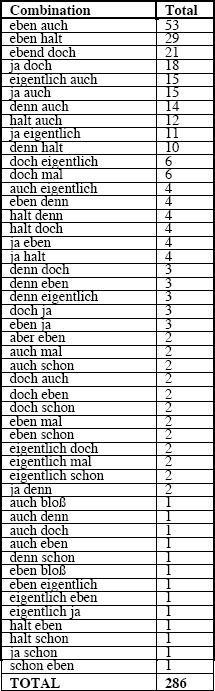
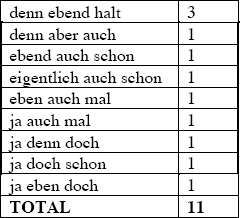
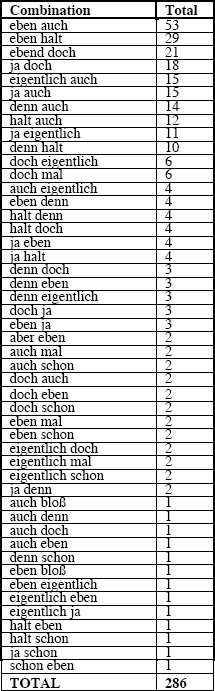
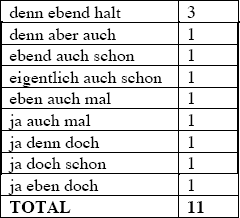
Relatively few combinations emerged from the German data compared to the Dutch. Table 1 presents a list of all two-particle clusters found in our corpus data, listed in order of frequency, while table 2 lists three-particle clusters. First, they show that some two-item combinations are very frequent in the German data, in particular eben auch, eben halt and eben doch. The transparency principle might lead us to expect similar patterns in the Dutch data for even, the cognate of eben, but we shall see below that even is typically cluster-final in Dutch (table 11), and that even toch, which would be the equivalent Dutch pairing of the cognates for eben doch, does not occur at all. Second, it is obvious that—despite Helbig's (1988:75) examples—three-particle clusters are rare in our German data set, accounting for 11/297 clusters, or only 3.7% of the total (or 10/249=4% if we exclude combinations with eigentlich; see note 5). Four-particle clusters do not occur at all.
Various attempts have been made to capture regularities in the ordering of German particles. Doherty (1985:114–115) suggested that German MPs tend to be ordered by their assertive power: a particle of higher assertive power will always come before one of lower assertive power, such that the order ja → doch → wohl cannot be altered.Footnote 8 Ickler (1994:379) argued that the leftmost MPs in clusters (that is, those appearing earlier in the cluster) would have a more general, nonspecific meaning than those on the right.Footnote 9 Helbig (1988:75) grouped German particles into six sets, labeled (a) to (f), and suggested that a particle cluster would select up to one item from each set, in the order (a)–(f):
Two-particle combinations in the German corpus, ordered by frequency.
a) denn, doch (unstressed), eigentlich, etwa, ja
b) aber, eben, halt, vielleicht, wohl
c) doch (stressed), schon (though we ourselves would not include stressed doch in the category of MPs, which are by definition unstressed)
d) auch, mal
e) bloβ, nur
f) noch
Three-particle clusters in the German data.
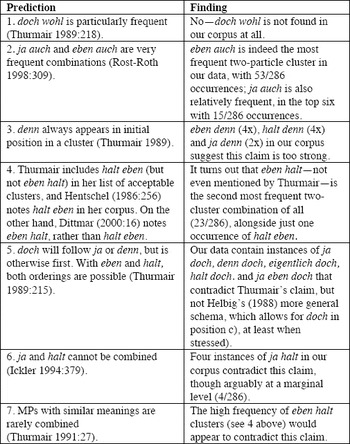
Work by Thurmair (1989, 1991) and others, such as Hentschel (1986), Ickler (1994), Rost-Roth (1998), and Dittmar (2000), has added a number of detailed claims to Helbig's schema that may be tested. Table 3 below summarizes our findings in the light of some of these predictions.
German MP clusters: Predictions and findings.

In the light of the wide range of combinations in the data presented in tables 1 and 2, it is not surprising that table 3 reveals clusters that contravene the orders suggested by Thurmair and others. However, the data adhere, for most part, to the more general rules of Helbig. Exceptions to Helbig's orders are eben eigentlich 1x, auch eigentlich 4x (but see note 4) and schon eben1x (see table 1). It is noteworthy, though, that more than one particle from the same group in Helbig's schema (for instance, ja and doch) may occur in a cluster. For the German data, both Lindner (1991:168) and Thurmair (1989:215) considered doch ja unlikely, and our data confirm this: ja doch (18x) is by far the more frequent ordering, but we do find doch ja (3x) too (see 5 in table 3). The second most frequent combination of all (23x), alongside just one occurrence of halt eben (see 7 in table 3), is eben halt. This seems to contradict Thurmair's hypothesis that particles of similar meaning are rarely combined (Thurmair 1991:27). In fact, particles from the same group (admittedly not identical to Thurmair's “particles of similar meaning”) seem to combine freely, albeit with a notable preference as to their order.
2.3. Dutch: Cluster Size, Combinations, and Sequencing.
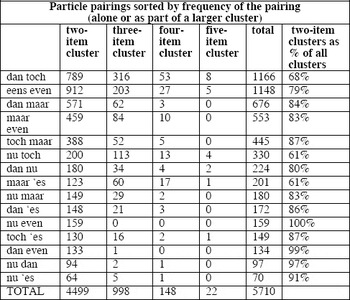
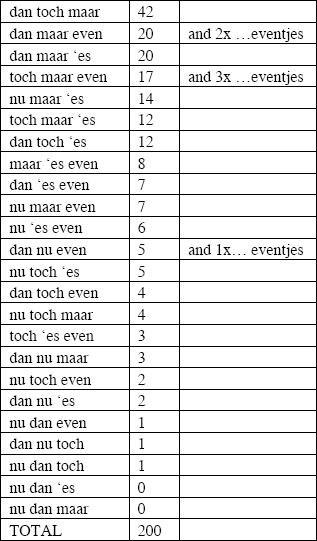
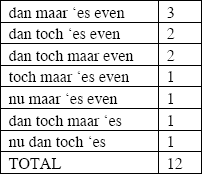
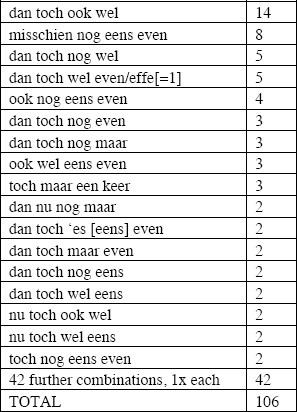
To what extent do Dutch MPs behave similarly to their German counterparts? Table 4 gives an overview of our results from the Dutch corpus for all the two-item clusters considered by Hulshof (1987), including the frequency with which they feature as part of a larger cluster. Tables 5, 6, and 7 list the three-, four- and five-item clusters that we found. It is immediately evident that larger clusters of particles are far more frequent in the Dutch than in the German corpus. The largest clusters in our German data were three-particle clusters, and they were rare (3.7%, or 4%, excluding eigentlich). In contrast, three- to five-item clusters make up more than 20% (1169/5710) of all Dutch clusters. Three-item clusters make up the bulk of this: 999/5710=17.5%. Four-item clusters make up only 2.6%, with five-item clusters making up 0.3% of the total. Even allowing that the smaller German corpus may mean we have missed less common clusters that can occur, the difference between the two data sets is striking.
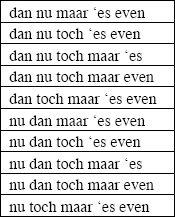
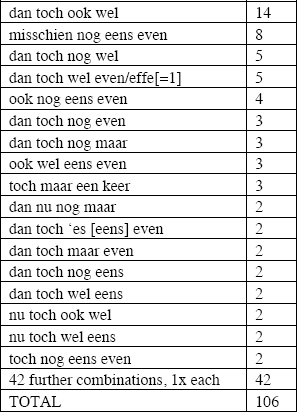
A second significant finding with respect to the Dutch data is the considerable range in frequency amongst the combinations deemed possible by Hulshof. Of the three-item clusters, dan toch maar is most frequent (42x), but thirteen out of the 24 combinations occur less than five times, and two do not occur at all: nu dan ‘es, nu dan maar. Of the 21 possible four-item clusters listed by Hulshof (1987), only seven are attested in the data (table 6). The remaining 15 in Hulshof's list are not attested at all in our data. They are nu toch ‘es even, dan nu ‘es even, nu dan ‘es even, dan nu maar even, nu dan maar even, dan nu toch even, nu dan toch even, nu toch maar ‘es, dan toch maar ‘es, dan nu maar ‘es, nu dan maar ‘es, dan nu toch ‘es, nu dan toch ‘es, dan nu toch maar, nu dan toch maar. However, many other four-item clusters besides those listed by Hulshof do occur. The top 17 four-item clusters in our data are given in table 7, which lists all those that occurred twice or more—another 42 combinations occurred just once each. Finally, none of the ten five-item combinations listed by Hulshof occur in our data (as listed in table 8). Instead, there are 17 other such five-particle clusters in the data (table 9).Footnote 10 Hulshof lists two possible combinations of six particles, but these were not found in our data either: dan nu toch maar ‘es even and nu dan toch maar ‘es even.
Frequency of all two-item clusters from Hulshof's list in the CGN Dutch corpus.Footnote 11

Frequencies in the CGN Dutch corpus of the three-item clusters listed by Hulshof.
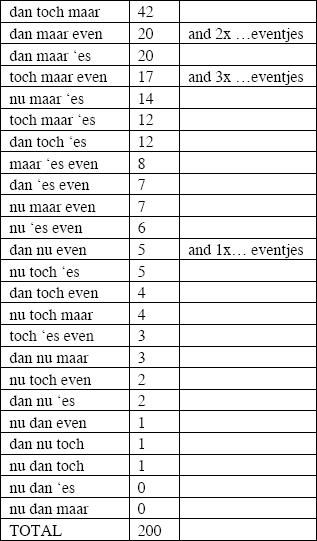
Frequency in the CGN Dutch corpus of the four-particle clusters listed by Hulshof.Footnote 12
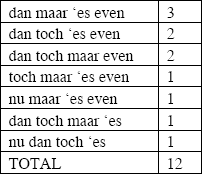
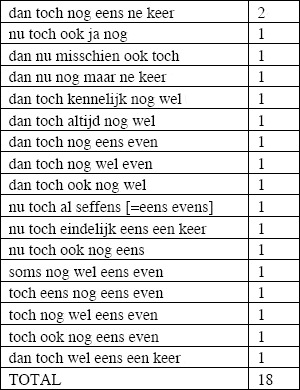
The top 17 four-item clusters in the CGN Dutch corpus.Footnote 13
The ten five-item clusters postulated by Hulshof (1987), none of which are attested in our data.
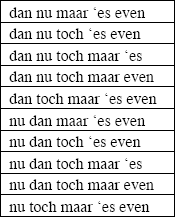
Five-particle clusters found in the CGN Dutch corpus.

There is a considerable discrepancy between the particle combinations that Hulshof (1987) found by introspection and those in our corpus data. First, many—especially of the larger clusters—are not attested at all. Of course, caution is called for here: even many of those attested occur only once, and a corpus of nine million words is still just a sample of the language, not a complete range of all possibilities. It is possible that the CGN corpus does not include a sufficiently high number of directives to allow all the clusters postulated by Hulshof to occur, though the subjective impression from our trawl of the data was that many directives did occur. Second, there is considerable variation in frequency among those clusters that are attested. We found a similar variance in frequency for the German clusters, where the most frequent two-item cluster (eben auch) accounts for 18.5% of all such clusters (53/286). Such striking frequency differences in our data suggest that future studies of particle ordering and particle combinations must account not just for what is permissible, but also for the fact that some permissible combinations are very frequent, while others are marginal.
De Vriendt et al. (1991) propose the following principles for the sequence of Dutch particles. Deictic-anaphoric particles (nu, dan, or toch) tend to come first in a cluster, near the thematic end of the utterance, since they relate to the context, that is, to what is already known. The existentially quantifying particles eens, even, een keer(tje) will tend to come at the end, in the position for the rheme (that is, new information). In between come the downtoning particles maar (with an essentially restrictive illocutionary force) and wel (with an essentially affirmative illocutionary force). Maar and wel cannot occur together. Footnote 14
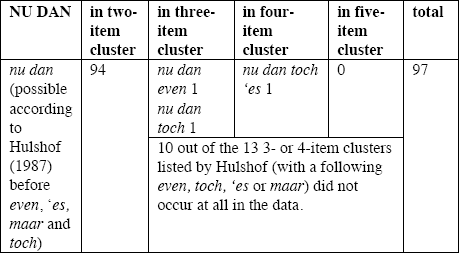
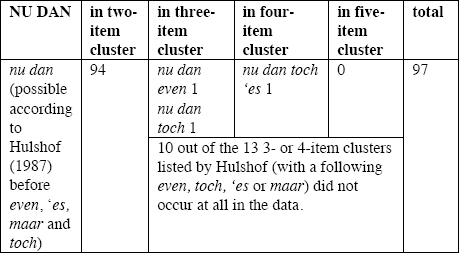
As with German, our Dutch data are interesting with respect to the co-occurrence of particles from the same group. The two particles dan and nu both belong to the group of deictic-anaphoric particles identified by De Vriendt et al. (1991) that typically occur first in a particle cluster. Hulshof (1987) did not allow for nu dan as a stand-alone cluster, only dan nu. According to Hulshof, nu dan could, however, occur as part of a larger cluster, before even, ‘es, maar and toch. The CGN data do not support this claim. Only three out of the 16 nu dan … possibilities that Hulshof listed are actually attested in our data, and only once each, making nu dan as part of larger clusters very marginal (table 10). In contrast, the stand-alone two-item cluster nu dan is far from marginal, even if it is outnumbered about 2:1 by dan nu (the exact ratio is 180:94, as can be seen in table 4).
Frequency of nu dan in the CGN corpus.
Despite some contradictions of Hulshof's (1987) predictions, our data show that some cluster sequences are clearly more robust than others. Given that nu dan, dan nu, dan toch, and nu toch are all frequent in the data, we might logically expect the other two possible combinations from the “deictic-anaphoric” group to be frequent too: toch dan and toch nu. Yet toch dan does not occur at all, and toch nu is fairly marginal, with just 15 occurrences. (Recall the oft-cited standard ordering dan nu toch maar ‘es [eens] even). This suggests that, as far as ordering is concerned, the “deictic-anaphoric” group of De Vriendt et al. is in fact two groups: dan/nu, followed by toch (as De Vriendt et al.'s discussion of them separately does in fact imply).
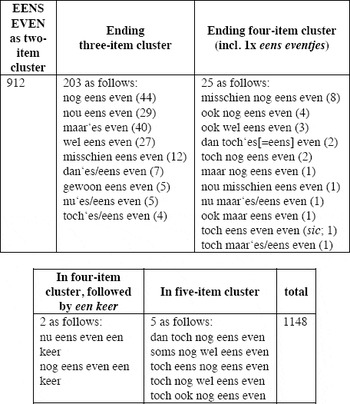
There is also some good news for language judgements arrived at by introspection like Hulshof's particle clusters. The cluster-final combination eens even is very robust. As table 11 shows, eens even occurs just twice in non-final position, when it is followed by een keer.
Distribution of eens even in the CGN Dutch corpus.

3. Discussion: Which Clusters of Modal Particles, and Why?
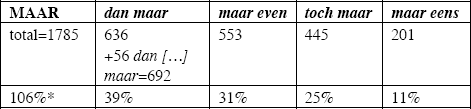
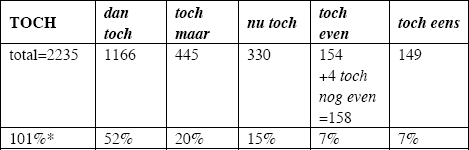
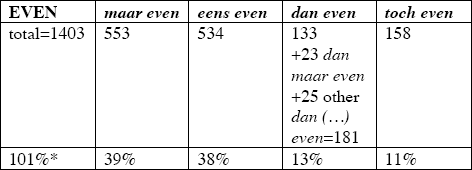
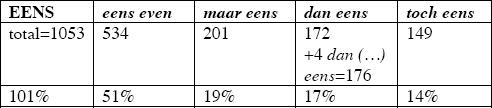
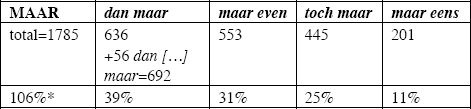
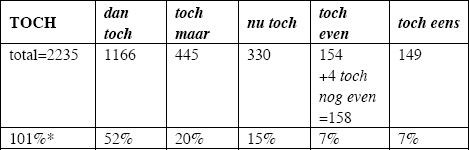
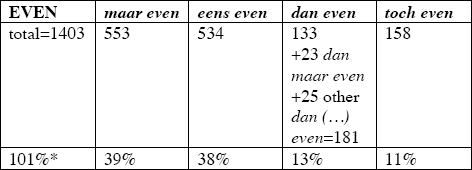
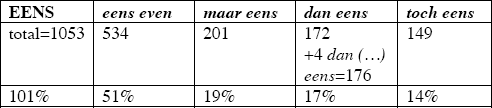
Our corpus investigation has revealed tendencies and preferences, rather than absolute rules for clusters. We can identify other regularities too with respect to cluster-formation, based on the concrete data. Let us consider maar, dan, toch, even, and eens as examples (see tables 12–15). One set of regularities takes the form of linear pairings. The frequent dan toch captures 52% of occurrences of toch in a cluster (table 13); maar even and eens even together capture 77% of occurrences of even in clusters (table 14); and eens even also captures 51% of occurrences of eens in a cluster (table 15).
Moreover, our data also offer a new avenue for future research, for they suggest that some regularities govern non-contiguous pairings. For example, dan […] maar captures 39% of all occurrences of maar, including also examples such as dan toch maar, the most frequent three-item cluster of all (see table 12). A similar, if less striking, pairing is toch […] even (table 13). Most strikingly, over a quarter of the dan+even combinations (48/181) occur with a third particle in between (table 14). Further research may reveal, then, that the huge variety of orders possible in a cluster can be captured by a much smaller number of basic preferences (or constraints, in an optimality theory approach) that allow for non-contiguous as well as contiguous pairings.
Maar and its favored cluster combinations.Footnote 15
Toch and its favored cluster combinations.Footnote 16
Even and its favored cluster combinations.Footnote 17
Eens and its favored cluster combinations.Footnote 18
Finally, the frequency of particle clusters observed in spontaneous speech, especially in Dutch, must raise the question of their function. Is their force compositional, that is, do clusters fulfill two or more functions at once, one for each particle? The observation that particles of similar meaning are rarely combined (Thurmair 1991:27) might constitute evidence that the meaning of clusters is compositional. Even occurrences of apparently synonymous pairs such as eben halt may fulfill two different functions, if we accept Métrich & Faucher's (2009:462–463) observation that—despite the regional distribution of the two—eben and halt are not strictly interchangeable. Alternatively, it may be that large clusters are not compositional in meaning, but are a conversational strategy for ex-pressing speaker attitude that differs from non-clustered particles or from smaller clusters.Footnote 19 Finally, a third plausible explanation for the existence of particle clusters is a diachronic one: as one particle (or particle cluster) becomes weakened in force through frequent use, another particle is added in support. A similar analysis is commonly offered for the development of negation in the Germanic languages (as in ni > ne > ne niht > niht), known as Jespersen's Cycle (see Breitbarth 2009). Modal particles should be very susceptible to this process because they do not carry stress. For example, one might postulate a process such as the reduction of eens to ‘es, to which even is then added; eens even in turn is reduced to a pronunciation approximated by the spelling seffen (transcribed as a single word on the CGN orthographic tier at least once), which is strengthened in its turn, either by the addition of the diminutive (eens eventjes) or by an additional particle, whether following it (een keer) or preceding it within the cluster. Such an explanation would account well for the range of clusters involving these MPs in the Dutch data.
4. Conclusion.
Clearly, the function and meaning of particle clusters merits further investigation. Our corpus study of Dutch and German modal particles has, however, shown the following:
• Dutch is much more cluster-friendly than German: larger clusters occur, and they are far more frequent.
• The transparency principle does not hold as a rule when applied to Dutch and German particles. There are clear differences in how cognate particles behave in the two languages.
• It has been fruitful to extend the focus on particles beyond the range typically found in directives, revealing many combinations in Dutch not predicted by Hulshof (1987).
• Corpus linguistics can contribute significantly to introspection: some of Hulshof's suggested orderings are not attested at all, while others, not listed in his study, are frequent.
• It is useful to consider non-linear pairings of particles when capturing regularities of how particles cluster.