Introduction
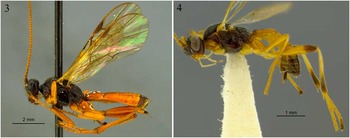
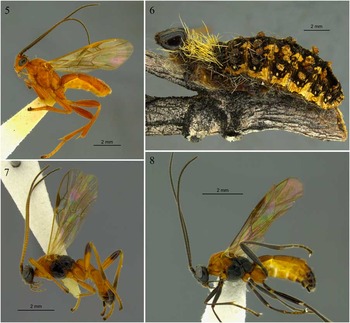
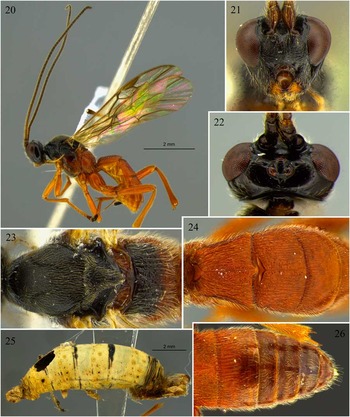
Aleiodes Wesmael (Hymenoptera: Braconidae: Rogadinae) is the most common rogadine genus worldwide, and is particularly prevalent in the New World (Shaw et al. Reference Shaw, Marsh and Fortier1997). Worldwide, ~663 Aleiodes species are described, with 143 of those being found in the Nearctic and 104 species in Neotropical Region (Yu et al. Reference Yu, van Achterberg and Horstmann2012; Shimbori et al. Reference Shimbori, Penteado-Dias and Shaw2015, Reference Shimbori, Shaw, Almeida and Penteado-Dias2017). The species of Aleiodes are koinobiont endoparasitoids of Lepidoptera larvae, especially of taxa in the superfamilies Noctuoidea and Geometroidea. Pupation occurs within the shrunken, hardened remains of the host caterpillar, which often is referred to as a “mummy” (Shaw et al. Reference Shaw, Marsh and Fortier1997) (Figs. 6, 24). The A. apicalis (Brullé) species group is a small, mainly Holarctic, monophyletic lineage of Aleiodes, assigned to the subgenus Chelonorhogas Enderlein (Shaw et al. Reference Shaw, Marsh and Fortier1998; Fortier and Shaw Reference Fortier and Shaw1999; Zaldívar-Riverón et al. Reference Zaldívar-Riverón, Belokobylskij, León-Regagnon, Briceño-G. and Quicke2008). The subgenus is a relatively basal lineage of Aleiodes, and the majority of the recorded hosts are noctuids. Members of the A. apicalis species group, as far as known, also are mostly parasitoids of Noctuidae, and other related Noctuoidea families (Shaw et al. Reference Shaw, Marsh and Fortier1998).
Species in the A. apicalis species group have most of the diagnostic characters of the subgenus Chelonorhogas, including the carinate smooth area mid-basally on second metasomal tergum, a hind wing with marginal cell gradually and distinctly widening toward apex, and a mainly smooth mesopleuron (van Achterberg Reference van Achterberg1991). Of the 11 species included in this group, only one is know from South America (Shimbori and Martinez Reference Shimbori and Martinez2016). Here we present descriptions of four new Neotropical species, discuss the limits of the species group, and an extended key to the New World species of the A. apicalis species group modified from Shaw et al. (Reference Shaw, Marsh and Fortier1998).
Methods
Type specimens of the newly described species are deposited at the Entomological Collection of the Department of Ecology and Evolutionary Biology, Universidade Federal de São Carlos, São Paulo, Brazil (DCBU); the Museo Nacional de Costa Rica, San José, Costa Rica (MNCR); the Departamento de Entomología, Museo de Historia Natural, Universidad Nacional Mayor de San Marcos, Lima, Peru (MUSM); the Universidade Federal do Paraná, Curitiba, Paraná, Brazil (UFPR); and the University of Wyoming Insect Museum, University of Wyoming, Laramie, Wyoming, United States of America (UWIM).
For recognition of the subfamily Rogadinae see van Achterberg (Reference van Achterberg1993) and Sharkey (Reference Sharkey1997). The definition of Aleiodes follows that of van Achterberg (Reference van Achterberg1991) and Shaw (Reference Shaw1993). Species-group definitions follow Shaw et al. (Reference Shaw, Marsh and Fortier1997), Fortier and Shaw (Reference Fortier and Shaw1999), and Townsend and Shaw (Reference Townsend and Shaw2009). Terminology follows Sharkey and Wharton (Reference Sharkey and Wharton1997) and Shaw et al. (Reference Shaw, Marsh and Fortier1997). Microsculpture terminology follows that of Harris (Reference Harris1979). Wing vein terminology follows the system adopted by Sharkey and Wharton (Reference Sharkey and Wharton1997). Reassessment of the species-group concept and diagnosis were made after examination of all species included in the A. apicalis species group. The concept used here follows in great extent the species-group division by Fortier and Shaw (Reference Fortier and Shaw1999), and diagnosis by Shaw et al. (Reference Shaw, Marsh and Fortier1998). A broader concept of the A. apicalis species group, which includes all species previously assigned to the subgenus Chelonorhogas, was proposed by van Achterberg and Shaw (Reference van Achterberg and Shaw2016). Since no evidence other than the possible paraphyletic nature of Chelonorhogas is presented as a justification of this new concept we opt to follow and attempt to improve the original, more restrictive, concept.
Images were captured with a 3MP Leica video camera and a Leica M205C stereomicroscope running Leica Application Suite (LAS) software (Leica Microsystems GmbH, Wetzlar, Hesse, Germany), and focus stacked using the same software. Some minor adjustments in images and plate preparation were performed in Adobe Photoshop version CS6 (Adobe Systems, San Jose, California, United States of America).
Aleiodes (Chelonorhogas) apicalis species group
Included species. Aleiodes abdominalis Cresson, 1869 (Nearctic), A. ambrosiae new species (Neotropical), A. apicalis (Brullé, 1832) (Palaearctic), A. aquilesi new species (Neotropical), A. atriceps Cresson, 1869 (Nearctic), A. brethesi Shenefelt, Reference Shenefelt1975 (Neotropical), A. cariniventris (Enderlein, 1912) (Oriental); A. convexus van Achterberg, Reference van Achterberg1991 (Palearctic, Oriental), A. flavitarsus Marsh and Shaw, 1998 (Nearctic), A. grandis Giraud, 1857 (Palaearctic), A. molestus (Cresson, Reference Cresson1872) (New World), A. nobilis (Curtis, 1834) (Palaearctic), A. parasiticus Norton, 1869 (Nearctic), A. rileyi (Cresson, 1869) (Nearctic), A. sachambrosiae new species (Neotropical), A. schirjajewi Kokujev, 1898 (Palaearctic, Oriental), A. tapirape new species (Neotropical).
Aleiodes nobilis (Curtis, 1834) has been treated as a variation (Shenefelt Reference Shenefelt1975) and synonym (Papp Reference Papp1991) of Aleiodes ductor (Thunberg, 1822) until van Achterberg (Reference van Achterberg1997) elevated the status to the species level. This species is clearly a member of this group but has not been formally assigned until now.
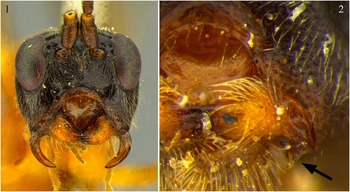
Diagnostic characters. This species group, as part of the subgenus Chelonorhogas (=A. apicalis species group sensu van Achterberg and Shaw Reference van Achterberg and Shaw2016), shares the diagnostic characters of the subgenus (van Achterberg Reference van Achterberg1991). It differs from other species in the subgenus by the combination of the following characters: tarsal claws with a strong, black pecten, without a gap between the apical hook and pectin; pecten with five to six teeth in most species, longer tooth almost as long as apical hook; males of most species with a dense setal mat on T4-7, subdivided medially by a narrow glabrous line (absent in the male of A. aquilesi); clypeus distinctly protruding, with two distinct surfaces; eye relatively small, with transverse diameter less than two times longer than temple in lateral view; face transverse, more than two times wider than height (excluding clypeus); antenna with basal flagellomeres longer than wide; hind wing vein 2-1A present; T1 shorter than apical width.
Redescription. Marginal cell of hind wing gradually widening towards apex, in some cases only distinctly widening in apical half (except in A. rileyi, in which the base of the vein RS is curved upward and the apical 2/3 runs close and nearly parallel to wing margin). Metasomal tergum 2 with distinctly carinate, mid-basal, smooth area; usually triangular, rarely roughly semicircular. Tarsal claws with a strong, black pecten, without a gap between apical hook and pectin; pecten with five to six teeth in most species, however, the most basal 1 or 2 teeth are usually difficult to see without removing the claw; teeth not tightly arranged, always with some space between each pair, longest tooth nearly as long as apical hook. Mesopleuron with at least part of central disc smooth and polished, and devoid of setae. Face transverse, at least two times wider than height excluding clypeus; mid-longitudinal ridge of face in most cases extending over half or more of the face (excluding clypeus), rarely about 0.4. Clypeus distinctly protruding, with two distinct surfaces, not as strongly protruding and narrow as in the A. melanopterus species group, and not carinate (but relatively wide and narrow in A. atriceps). Eyes and ocelli relatively small, diameter of lateral ocellus in most species not longer than distance between eye and lateral ocellus (except A. ambrosiae and A. rileyi); in lateral view, transverse diameter of eyes less than two times longer than temple (except A. ambrosiae=2.3 times). Occipital carina variable, in most species meeting hypostomal carina ventrally, but reduced or absent ventrally in several species. Mid-ventral line of mesopleuron set within shallow, smooth, or finely crenulate sulcus; without distinct pit posteriorly (A. apicalis and A. nobilis have an indication of pit, not distinct as in the A. gasterator and A. unipunctator species groups). Second submarginal cell short, vein 3RSa usually about as long as vein 2RS (never more than 1.5 times longer) and slightly convex. Hind wing vein m-cu absent or present, when present nearly interstitial or distinctly postfurcal to r-m (never distinctly antefurcal). Hind wing vein 2-1A present. Wings hyaline or subhyaline (never infuscate). Metasomal tergum 1 shorter than apical width. Head usually dark brown or black, body in most species black or dark brown contrasting with reddish brown or brownish orange parts (except A. rileyi and A. aquilesi entirely brownish orange and yellow respectively); males of most species with a dense setal mat on T4-7, subdivided medially by a narrow glabrous line (in A. convexus the mat is secondarily absent and T4-7 are usually concealed beneath T3; the only known male of A. aquilesi has T4-7 virtually glabrous).
Comments. Recently, van Achterberg and Shaw (Reference van Achterberg and Shaw2016) discussed the A. apicalis species group as having a different meaning than the one used here. These authors equate the A. apicalis species group to the subgenus Chelonorhogas, and based on the presumed paraphyly of the later they reject using this group name (based on unpublished data). Our decision to maintain the former meaning for the species group (Shaw et al. Reference Shaw, Marsh and Fortier1998; Fortier and Shaw Reference Fortier and Shaw1999), as a lineage within the subgenus Chelonorhogas, is based on previous published works that have relatively strong support for smaller monophyletic groups inside Chelonorhogas (i.e., A. gasterator+A. unipunctator) (Zaldívar-Riverón et al. Reference Zaldívar-Riverón, Belokobylskij, León-Regagnon, Briceño-G. and Quicke2008). The monophyly of the A. apicalis species group, as we define it, is supported by putative synapomorphies for the A. apicalis species group, described in the previous section (i.e., subdivided mat of dense setae at T4-7 on males, and strongly pectinate tarsal claws). While we respect the decision of van Achterberg and Shaw (Reference van Achterberg and Shaw2016) to not use species groups in their revision of European Aleiodes species, we do not see that decision as a compelling reason to discontinue using species groups that have worked well for arranging the New World species for the past two decades. It is worth remembering that species groups are informal taxonomic concepts, and there are no rules that require people either to use them, or that restrict how they can be employed or defined. We assert that species groups are informal concepts that are extremely useful for more easily identifying species and arranging collections, and helpful for taxonomists, ecologists, biocontrol workers, and students to more easily come to understand a large complex genus. We also feel that abandoning an established system of species groups, without providing any replacement system, and without providing any evidence on how the included species could be better arranged, would not be either prudent or helpful to the users of this paper, or related papers.
Aleiodes atriceps Cresson. 1. Male face. 2. Female, detail of mandible base with extra teeth (arrow).

Habitus. 3. Aleiodes abdominalis Cresson, female. 4. Aleiodes flavitarsus Marsh and Shaw, female paratype.

5. Aleiodes rileyi Cresson habitus, female. 6. Aleiodes rileyi mummified remains of host caterpillar Acronicta oblinita (Smith) (Lepidoptera: Noctuidae). 7. Aleiodes parasiticus Norton habitus, female. 8. Aleiodes molestus Cresson habitus, female (from Costa Rica).


Aleiodes ambrosiae Sulca, Shimbori, and Shaw, new species
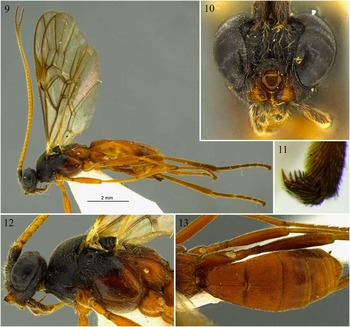
Aleiodes ambrosiae Sulca, Shimbori, and Shaw new species, female paratype. 9. Habitus. 10. Face. 11. Mesotarsal claw. 12. Head and mesosoma, lateral. 13. Metasoma, dorsal.

Material examined. Holotype (MUSM) – ♀ top label: “PERU: CA, Cajamarca, Chota, Casupe, 6°28'34.6"S/79°22'44.9"W, 23–24.iv.2012, light trap, I. Medina y O. Mestanza”. Paratypes — 1 ♀, “PERU: CA, Cajamarca, Chota, Casupe, 6°28'34.6"S/79°22'44.9"W, 23–24.iv.2012, light trap, I. Medina y O. Mestanza” (UWIM); 2 ♀, “PERU: Lambayeque, Chaparri 6°28'0.4"S/79°28'32"W, 558 m, 20.iv.2012, light trap, I. Medina y O. Mestanza” (MUSM).
Diagnosis. Ocell-ocular distance about 0.5 times diameter of lateral ocellus; occipital carina complete but not touching the hypostomal carina; head colour black except gena light brown, oral space and mandible yellowish orange but tips mandible dark brown; malar space 0.81 times basal width of mandible; pronotum granulate costate with laterally running wrinkles laterally; metapleuron smooth and shiny except anterior and posterior area granulate. Metapleuron with T1, T2 rugose striate, longitudinal carina present along this sculpturing; T3 granulate on basal 0.3, smooth or weakly on apical 0.7. Ovipositor sheaths about 0.56 times length of metatarsomere 1, round apex.
Description. Female Body length: 6.9–7.3 mm; antenna length: 8.0 mm; fore wing length: 6.4–6.8 mm.
Colour (Fig. 9). Antenna whitish yellow to light brown. Head black except gena light brown, oral space and mandible yellowish orange but mandible tips dark brown; mesosoma dark brown except propodeum and mesopleuron orange brown, pronotum dark brown with central spot orange brown; metasoma orange yellow; antenna whitish yellow to light brown; wings hyaline with dark brown veins, stigma honey yellow. Legs: prothoracic leg honey yellow, mesothoracic and metathoracic legs orange yellow.
Head. Antenna with 49–51 antennomeres; malar space about 0.81 times basal width of mandible, and ~0.35 times eye height; occipital carina complete but not touching the hypostomal carina; oral space small and circular, diameter about equal to basal width of mandible; clypeus slightly swollen; ocell-ocular distance about 0.5 times diameter of lateral ocellus; maxillary palpus swollen; head surface sculpturing granular-coriaceous but occiput smooth and shiny; dorsal face with few transverse striae.
Mesosoma. Mesonotum coarsely granulate; pronotum granulate costate with running wrinkles laterally; propodeum rugulose and granulate with mid-longitudinal carina complete with wrinkles diverting laterally and posteriorly; notauli present anteriorly, meeting a depressed rugose area posteriorly; mesopleuron granulate coriaceous on anterior corner with few winkles; metapleuron granulate with lateral depressed areas and transverse striae.
Wings. Fore wing: stigma about five times longer than high; vein r 0.57 times vein 2RS and about equal to vein RS+Mb, and 0.54 times vein m-cu; vein 3RSa about 0.42 times vein 3RSb, and about 0.8 times vein 2M; vein 1CUa 1.56 times vein 1cu-a; vein 1CUb about equal to vein 1CUa; vein 1M moderately curved in basal half; vein M+CU moderately sinuate; subbasal cell evenly and rather densely setose. Hind wing: marginal cell gradually widening, vein RS slightly curved downward; vein m-cu not tubular vein interstitial to vein r-m; vein M+CU 1.25×1M; vein r-m 0.55 times vein 1M; vein 2-1A present; basal cell evenly and rather sparsely setose.
Legs. Tarsal claw strongly pectinate with eight stout teeth, apical three teeth of pectin about 0.5 times as long as apical claw, remaining teeth gradually shorter towards base of claw; metatarsomere 1 2.8 times length of inner apical spur of metatibia; few rugosities dorsolaterally on outer side of metacoxa.
Metasoma. T1, T2 rugose striate, longitudinal carina present along this sculpturing; T3 granulate on basal 0.3, smooth or weak on apical 0.7. Ovipositor sheaths about 0.6 times length of metatarsomere 1, ovipositor sheaths with round apex.
Male. Unknown.
Etymology. This species is named in honour of Ambrosia Garro Diaz, mother of L.S.G., in gratitude for her support for entomological studies.
Distribution. Known only from two departments in Peru (Cajamarca and Lambayeque).
Comments. This new species is quite similar to A. sachambrosiae, differing from it in the diameter of ocelli, which about two times longer than ocell-ocular distance in A. ambrosiae, as compared to nearly half the ocell-ocular distance in A. sachambrosiae. Also, the occipital carina is complete and touches the hypostomal carina in A. ambrosiae, but in A. sachambrosiae the occipital carina does not touch the hypostomal carina.
Aleiodes aquilesi Sulca, Shimbori, and Shaw, new species
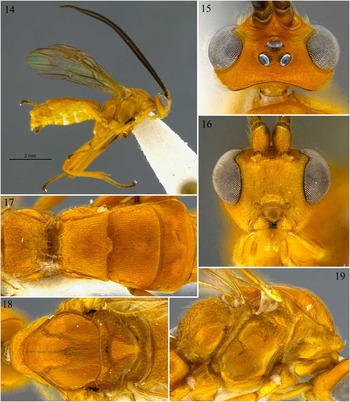
Aleiodes aquilesi Sulca, Shimbori, and Shaw new species, female holotype. 14. Habitus. 15. Face. 16. Head, dorsal. 17. Metasomal T1-3 and propodeum, dorsal. 18. Mesonotum, dorsal. 19. Mesosoma, lateral.

Material examined. Holotype (UWIM) – ♀: “Costa Rica: Guanacaste, GCA. Sector Santa Rosa, tropical dry forest, open field nr. Road to Playa Naranjo. malaise trap. 8–18 June 1995. Dadelahi, Price, Zitani”. Paratypes (UWIM unless otherwise indicated) – 1 ♀, “Costa Rica: Guanacaste, GCA. Sector Santa Rosa, tropical dry forest, open field nr. Road to Playa Naranjo. malaise trap. 8–18 June 1995. Dadelahi, Price, Zitani”; 1 ♀, “Costa Rica: Guanacaste, GCA. Sector Santa Rosa, tropical dry forest, San Emilio. malaise trap. 19 June to 10 July 1995. Dadelahi, Price, Zitani”; 2 ♀, top label “Costa Rica: Guanacaste, Santa Rosa Natl. Park, 300m, ex. Malaise trap. Site # SE 6-C. Dates 3-24.VIII.1985. I.D. Gauld & D. Janzen”, bottom label “[SE] Bosque San Emilio 50yr old deciduous forest. [C] more or less fully shaded as possible”; 4 ♀ (2 ♀ deposited in MNCR), top label “Costa Rica: Guanacaste, Santa Rosa Natl. Park, 300m, ex. Malaise trap. Site # SE 6-C. Dates 5.vii.1986. I.D. Gauld & D. Janzen”, bottom label “[SE] Bosque San Emilio 50yr old deciduous forest. [C] more or less fully shaded as possible”; 2 ♀, top label “Costa Rica: Guanacaste, Santa Rosa Natl. Park, 300m, ex. Malaise trap. Site # 6, 27.ix–18.x.1986. I.D. Gauld & D. Janzen”, bottom label “[SE] Bosque San Emilio 50yr old deciduous forest. [C] more or less fully shaded as possible”; 1 ♀, top label “Costa Rica: Guanacaste, Santa Rosa Natl. Park, 300m, ex. Malaise trap. Site # 6, 24.v–18.vi.1986. I.D. Gauld & D. Janzen”, bottom label “[H] open regenerating woodland <10 years old [C] more or less fully shaded as possible”; 1 ♀, top label “Costa Rica: Guanacaste, Santa Rosa Natl. Park, 300m, ex. Malaise trap. Site # 6, 26.vii–14.viii.1986. I.D. Gauld & D. Janzen”, bottom label “[H] open regenerating woodland <10 years old [C] more or less fully shaded as possible”; 3 ♀, top label “Costa Rica: Guanacaste, Santa Rosa Natl. Park, 300m, ex. Malaise trap. Site # 6, 14.viii–6.ix.1986. I.D. Gauld & D. Janzen”, bottom label “[H] open regenerating woodland <10 years old [C] more or less fully shaded as possible”; 1 ♀ “Costa Rica, Guanacaste Pr. Guan. Conservation Area, Santa Rosa Hdq. 200m Malaise trap, 3-7.VII. 1997 3x day L.J. van der Ent”; 1 ♂, “Costa Rica, Guanacaste Pr. Guan. Conservation Area, Santa Rosa Hdq. 200m light trap, 7-VII 1997, L.J. van der Ent”.
Diagnosis. Body and head entirely yellow, legs mostly yellow with tarsomere 5 on all legs dark brown, flagellum black. Mesopleuron and metapleuron glabrous and mostly smooth and polished. Occipital carina absent ventrally, not touching hypostomal carina. Flagellomeres relatively compact.
Description. Female Body length (female): 5.4–6.7 mm; antenna length: 5.8–7.2 mm; fore wing length: 4.0–5.1 mm.
Colour (Fig. 9). Yellow. Protarsi and mesotarsi light brown except for tarsomere 5 dark brown. Metatarsi mainly dark brown except for base of metatarsomere 1 brown. Flagellum black, scape and pedicel yellow with dark brown lateral stripe. Wings subhyaline, veins brown, stigma pale yellow and darker dorsally, parastigma dorsally and base stigma whitish yellow.
Head. Antenna with 55–62 antennomeres; malar space 1.0–1.1 times basal width of mandible, and 0.37–0.39 times eye height; occipital carina complete dorsally, present ventrally but not touching the hypostomal carina; oral space small and circular, diameter about equal to basal width of mandible; clypeus slightly swollen; ocell-ocular distance about 1.1 times diameter of lateral ocellus; maxillary palpus weakly swollen; head surface sculpturing smooth and shiny, vertex entirely curvedly transversely striate, face transversely striate but smooth medially.
Mesosoma. Mesonotum shiny granular-coriaceous; pronotum mostly smooth and polished with pronotal groove crenulate anteriorly; propodeum areolate-rugulose, longitudinal carina complete, sometimes irregular posteriorly; notauli complete and mostly smooth, with few crenulations anteriorly, meeting a longitudinally costate area posteriorly; mesopleuron mostly smooth and polished, and glabrous, subalar groove weakly rugose; metapleuron mostly smooth and polished, and glabrous, rugose posteriorly.
Wings. Fore wing: stigma 3.9–4.0 times longer than high; vein r 0.6–0.7 times vein 2RS and about 1.2 times vein RS+Mb, and 0.55–0.60 times vein m-cu; vein 3RSa about 0.45 times vein 3RSb, and 0.82–0.87 times vein 2M; vein 1CUa 1.9–2.2 times vein 1cu-a; vein 1CUb 1.1–1.4 times vein 1CUa; vein 1M weakly curved at basal half; vein M+CU only slightly sinuate; subbasal cell with irregular glabrous patches. Hind wing: marginal cell gradually widening, vein RS virtually straight; vein m-cu absent; vein M+CU 1.3–1.4 times 1M; vein r-m about 0.7 times vein 1M; vein 2-1A present; basal cell mostly devoid of setae, with a patch of setae at antero-costal region and few scattered setae.
Legs. Tarsal claw strongly pectinate with four visible, stout teeth, longest tooth (3rd from apex) nearly as long as apical claw; metatarsomere 1 2.0–2.3 times length of inner apical spur of metatibia; metacoxa smooth and polished with transverse striation apically at dorsal face.
Metasoma. T1, T2, and most of T3 rugose-costate, but sculpturing weaker at T3; longitudinal carina complete at T1-2; apical 1/5 of T3 and remainder terga smooth. Ovipositor sheaths about 0.6 times length of metatarsomere 1, ovipositor sheaths with round apex.
Male. Essentially as in female. Metasomal T4-7 evenly and rather sparsely setose, without the dense setal mat characteristic of most males on this species group.
Etymology. This species is named in honour of Aquiles Sulca, father of L.S.G., in gratitude for his support for entomological studies.
Distribution. Known only from Guanacaste (Costa Rica).
Comments. The new species resembles A. rileyi in having head and body unicoloured, without dark brown or black parts, although A. rileyi is entirely brownish orange and A. aquilesi is entirely yellow. Aleiodes aquilesi differs from A. rileyi in having the diameter of lateral ocellus smaller than ocell-ocular distance, as compared with about two times longer in A. rileyi, and a marginal cell gradually widening towards apex, whereas in A. rileyi the base of the vein RS is curved upward and the apical 2/3 runs close and nearly parallel to wing margin.
Aleiodes molestus Cresson
(Fig. 8)
Rogas molestus Cresson, Reference Cresson1872: 188
Rogas rufocoxalis Gahan, Reference Gahan1917: 207 (synonym)
Aleiodes molestus: Shaw et al. Reference Shaw, Marsh and Fortier1998: 70
Material examined. Costa Rica: 1 ♀, San Jose, Cerro de la Muerte, 6 km N San Gerardo, 2800 m, ix.1993, Malaise, P. Hanson; 1♀ San Jose, Zurqui de Moravia, 1600 m, v.1992, P. Hanson; 2 ♀, Cartago, La Cangreja, 1950 m, vi–vii.1992, P. Hanson (UWIM).
Distribution. United States of America, Mexico, and Costa Rica (new country record).
Aleiodes sachambrosiae Sulca, Shimbori, and Shaw, new species
Aleiodes sachambrosiae Sulca, Shimbori, and Shaw, new species. 20. Habitus of holotype, female. 21. Face of holotype, female. 22. Head, dorsal of a female paratype. 23. Mesosoma, dorsal of a female paratype. 24. Metasoma, dorsal of a female paratype. 25. Mummified remains of unknown Noctuidae host. 26. Metasomal T3-7 showing subdivided setal mat at T4-7 of a male paratype.

Material examined. Holotype (DCBU #22226) – ♀: “Poços de Caldas, MG, Brasil, Sitio da Ferradura, S21°47'3.4" W46°37'22.8", Armadilha Malaise, 20.XI.2007, A.E. de Carvalho”. Paratypes, BRAZIL: ♀ (#22225), “Poços de Caldas, MG, Brasil, Sitio da Ferradura, S21°47'3.4" W46°37'22.8", Armadilha Malaise, 20.XI.2007, A.E. de Carvalho” (DCBU); ♀ (#10601), “Poços de Caldas, MG, Brasil, Sitio da Ferradura, S21°47'3.4" W46°37'22.8", Armadilha Malaise, 19.III.2007, A.E. de Carvalho” (DCBU); 3♀ (#10412, #09905, #22224), “Poços de Caldas, MG, Brasil, Sitio da Ferradura, S21°47'3.4" W46°37'22.8", Armadilha Malaise, 20.XI.2007, A.E. de Carvalho” (DCBU); 2 ♂ (#10436, #10373), “Poços de Caldas, MG, Brasil, Sitio da Ferradura, S21°47'3.4" W46°37'22.8", Armadilha Malaise, 19.IV.2007, A.E. de Carvalho” (DCBU); ♂, “Varginha, MG, IX.1961, M. Alvarenga” (UFPR); ♀ (#00759) and ♂ (#00763), “Ribeirão Grande, SP, Parque Estadual de Intervales, Armadilha Malaise, S24°16'28" W48°25'14.8", 22.XI.2010, N.W, Perioto e eq.” (DCBU); ♂ (#10276), “Ribeirão Grande, SP, Parque Estadual de Intervales, Armadilha Malaise, S24°16'28" W48°25'14.8", 22.II.2011, N.W, Perioto e eq.” (DCBU); ♀ (#01956), “Ribeirão Grande, SP, Parque Estadual de Intervales, Armadilha Malaise, S24°16'28" W48°25'14.8", 22.XI.2010, N.W, Perioto e eq.” (DCBU); 2♂ (#22228, #22229), “Sítio Sonho do Vovô, Juquitiba, SP, 22.IV.1988, sweeping vegetation, L.A Joaquim col.” (DCBU); ♂ (#22231), “Fazenda Canchim, São Carlos, SP, Atlantic forest, 17.IX.1987, sweeping vegetation, L.A. Joaquim col.” (DCBU); ♂ (#22222), “Fazenda Canchim, São Carlos, SP, Atlantic forest, 14.V.1990, sweeping vegetation, L.A. Joaquim col” (DCBU); ♀ (#22230), “Fazenda Canchim, São Carlos, SP, Atlantic forest, 31.III.1989, sweeping vegetation, L.A. Joaquim col” (DCBU); ♂, “Fazenda Canchim, São Carlos, SP, Atlantic forest, 11.IX.1989, sweeping vegetation, L.A. Joaquim col” (DCBU); ♀ (#22223), “Fazenda Canchim, São Carlos, SP, Atlantic forest, X.1989, M.C. Gonçalves col.” (DCBU); ♂, “São Carlos, SP, UFSCar, Cerrado, 22.IV-11.V.2004, Moericke, A.M.P. Dias col.” (DCBU); ♂ (#22234), “Fazenda São José, Rio Claro, SP, 23.V.1990, L.A. Joaquin col.” (DCBU); ♂ (#22235), “Fazenda São José, Rio Claro, SP, 20.IV.1993, sweeping vegetation, L.A. Joaquin col,” (DCBU); ♀ (#22227), “Jundiaí, SP, Serra do Japi, Moericke, 29.III.2009, J.F. Sobczak col.” (DCBU); ♂, “Estação Biológica de Boracéia, Salesópolis, SP, 3-8.III.1962, Lenko and Reichardt” (DCBU); ♂, “Barueri, SP, 5.II.1966, K. Lenko col.” (MZUSP); ♂, “Nova Teutonia [= Seara, SC], 27°11'S 52°23'W, 300–500 m, XI.1968, Fritz Plaumann” (UWIM); ♂ (#22236), “Rondonópolis, MT, 15.XII.1950, Dirings col.” (DCBU).
Diagnosis. Ocell-ocular distance about two times diameter of lateral ocellus; occipital carina complete; head colour black with oral space and mandibles honey yellow except mandible tips dark brown, labial palpus light brown; antenna light brown. Malar space 1.6 times basal width of mandible; propodeum rugulose-granulate with mid-longitudinal carina incomplete with wrinkles posteriorly; metapleuron granulate; metasomal terga 1–4 entirely orange-yellow; ovipositor sheaths about 3/8 of metatarsomere 1 length.
Description. Female. Body length (female): 5.5–6.7 mm; antenna length: 4.6–5.0 mm; fore wing length: 4.7–5.8 mm.
Colour (Fig. 19). Antenna light brown to dark brown. Head black with oral space honey yellow, mandibles honey yellow with tips dark brown, labial palpus light brown; antenna light brown. Mesosoma black with metanotum dark brown, propodeum orange-yellow; mesopleuron 1/3 dorsal black and 2/3 ventral orange-yellow with three spots dark brown. Ovipositor sheaths dark brown. Metasoma orange-yellow. Wings hyaline with light brown veins and stigma. Legs orange-yellow to orange except tarsomere 5 and claws dark brown.
Head. Antenna with 46–51 antennomeres; malar space about 1.3 times basal width of mandible, and ~0.7 times eye height; occipital carina complete and well define at vertex, ventrally touching the hypostomal carina; oral space small and circular, diameter about equal to basal width of mandible; clypeus slightly swollen; ocell-ocular distance two times diameter of lateral ocellus; maxillary palpus not swollen; head surface sculpturing finely granular-coriaceous, but occiput smooth and shiny.
Mesosoma. Mesonotum strongly granulate; pronotum rugose costate; propleuron granulate; propodeum rugulose-granulate with mid-longitudinal carina incomplete with wrinkles posteriorly; metapleuron granulate; notauli present anteriorly, meeting a depressed rugose area posteriorly; mesopleuron with central elevated area smooth, area below sternaulus granulate.
Wings. Fore wing: stigma about 4.5 times longer than high; vein r 0.5 times vein 2RS, two times vein RS+Mb, and 0.5 times vein m-cu; vein 3RSa about 0.5 times vein 3RSb and 0.8 times vein 2M; vein 1CUa 1.7 times vein 1cu-a; vein 1CUb 2.3 times vein 1CUa; vein 1M moderately curved at basal half; vein M+CU weakly sinuate; subbasal cell evenly and rather densely setose. Hind wing: marginal cell gradually widening, vein RS slightly curved downward; vein m-cu short and interstitial to vein r-m; vein M+CU about equal to 1M; vein r-m 0.5 times vein 1M; vein 2-1A present; basal cell evenly setose.
Legs. Tarsal claw strongly pectinate with seven stout teeth, apical four teeth of pectin about 0.75 times as long as apical claw, remaining teeth gradually shorter towards base of claw; metatarsomere 1 2.2 times length of inner apical spur of metatibia.
Metasoma. T1 and T2 rugose costate, longitudinal carina present along this sculpturing; T3 costate on basal 0.3, smooth or weakly alutaceous on apical 0.7. Ovipositor sheaths about 0.63 times length of metatarsomere 1, round apex.
Male. Body length 4.7–6.2 mm; antenna with 46–47 antennomeres. Virtually identical to female. Vein m-cu short and postfurcal to vein r-m.
Variation. Mesopleuron with variable colour pattern, but always black and orange-yellow. Sometimes propodeum colour completely black.
Etymology. The prefix “sacha” mean false in Quechua, a Peruvian indigenous language. The name is in reference to A. ambrosiae.
Distribution. Brazil.
Comments. This species is distinguished from all other Neotropical species in having a complete occipital carina, which ventrally clearly joins the hypostomal carina. Comparison with the most similar species, A. ambrosiae, is found under the comments heading for that species.
Aleiodes tapirape Shimbori and Penteado-Dias, new species
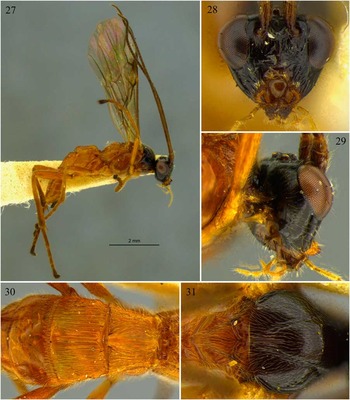
Aleiodes tapirape Shimbori and Penteado-Dias new species, holotype, female. 27. Habitus. 28. Face. 29. Head, posterolateral view showing poorly defined occipital carina. 30. Metasomal T1-3. 31. Mesonotum, dorsal.

Material examined. Holotype (DCBU #22263) – ♀: “Barra do Tapirapés, Mato Grosso, Brasil, 25–27.i.1964, B. Malkin col.”
Diagnosis. Ocell-ocular distance about two times diameter of lateral ocellus; occipital carina weakly indicated and far apart from hypostomal carina; frons and vertex smooth and polished. Head colour black, antenna brown, body mostly orange except mesoscutum, pronotum and part of propleuron black.
Description. Female. Body length (female): 5.1 mm; antenna length: 7.0 mm; fore wing length: 4.6 mm.
Colour. Brownish orange. Antenna brown, darker at apical 2/3 and at scape. Head black with clypeus, oral space, and mandibles honey yellow; mandible tips dark brown; palpus pale yellow. Mesoscutum black, pronotum mostly and propleuron laterally dark brown. Tarsomere 5 and claws on all legs and ovipositor sheaths dark brown. Wings slightly infuscate, veins brown, and stigma brown with basal tip yellow.
Head. Antenna with 50 antennomeres; malar space about 1.7 times basal width of mandible, and 0.6 times eye height; oral space small and circular, diameter about equal to basal width of mandible; clypeus slightly swollen; occipital carina only weakly indicated laterally, ventrally absent, not touching hypostomal carina; ocell–ocular distance two times diameter of lateral ocellus; maxillary palpus not swollen; head surface sculpturing entirely smooth and shiny, face with distinct mid-longitudinal crest.
Mesosoma. Mostly smooth and polished; pronotum costate anteriorly; propleuron granulate; mesocutum weakly punctate with mid-longitudinal crest posteriorly; propodeum mostly rugose, smooth anteriorly, without longitudinal carina, posteriorly with undefined areola present. Notauli complete and smooth; prescutellar sulcus smooth with one distinct median carina. Mesoscutellar trough costate. Metanotum mostly smooth, only sparsely costate.
Wings. Fore wing: stigma 3.5 times longer than high; vein r 0.5 times vein 2RS, 1.1 times as long as vein RS+Mb, and 0.5 times vein m-cu; vein 3RSa about 0.5 times vein 3RSb, and 0.7 times vein 2M; vein 1CUa 1.5 times vein 1cu-a; vein 1CUb 2.6 times vein 1CUa; vein 1M moderately curved at basal half; vein M+CU distinctly sinuate; subbasal cell with scattered setae and irregular glabrous patches. Hind wing: marginal cell gradually widening, vein RS virtually straight; vein m-cu short and distinctly postfurcal to vein r-m; vein M+CU 1.4 times 1M; vein r-m about as long as vein 1M; vein 2-1A present; basal cell with few scattered setae, somewhat denser at costal region.
Legs. Tarsal claw strongly pectinate with six stout teeth, longest tooth of pectin about 0.5 times as long as apical claw, teeth after second gradually shorter towards base of claw; metatarsomere 1 2.2 times length of inner apical spur of metatibia.
Metasoma. T1 and T2 costate, longitudinal carina present along this sculpturing; in lateral view, longitudinal carina on T1 strongly elevated and distinctly bent down at apical 1–4 of the segment; T3 completely smooth and polished, with transverse furrow between T2 and T3 entirely costate. Ovipositor sheaths about 0.5 times length of metatarsomere 1, apex rounded.
Male. Unknown
Etymology. This species is named in honour of the Tapirapé people, one of the many indigenous ethnicities of Brazil, who inhabited the region where the type specimen was collected. For more information on this group see Wagley (Reference Wagley1940) and further publications of this author.
Distribution. Mato Grosso, Brazil.
Comments. Aleiodes tapirape resembles A. brethesi in having a mostly smooth head and mesoscutum, and differs from it in having a black and densely setose mesoscutum, as compared with the orange mostly glabrous mesoscutum in A. brethesi. The colour pattern of A. tapirape is similar to A. sachambrosiae. These two species can be distinguished by the weakly defined occipital carina of A. tapirape, which is distinctly separated from the hypostomal carina, whereas in A. sachambrosiae. the occipital carina is complete and well defined.
Acknowledgements
The authors are thankful Gerardo Lamas, whose support was essential for the completion of this work. L.S.G acknowledges support from Fondo Nacional de Desarrollo Científico y Tecnológico (FONDECYT, Peru) through grant 139-2015 by “Programa de Movilización Internacional IV”. E.M.S. was supported by the National Science Foundation grant DEB 14-42110, from the Dimensions of Biodiversity programme. Additional financial support for this research was provided by: Fundação de Amparo à Pesquisa do Estado de São Paulo (FAPESP), Coordenação de Aperfeiçoamento de Pessoal de Nível Superior (CAPES), and Instituto Nacional de Ciência e Tecnologia dos Hymenoptera Parasitoides da Região Sudeste Brasileira (INCT-HYMPAR SUDESTE). The authors thank Cornelis van Achterberg for providing important information on the assignment of Aleiodes nobilis in this species group.